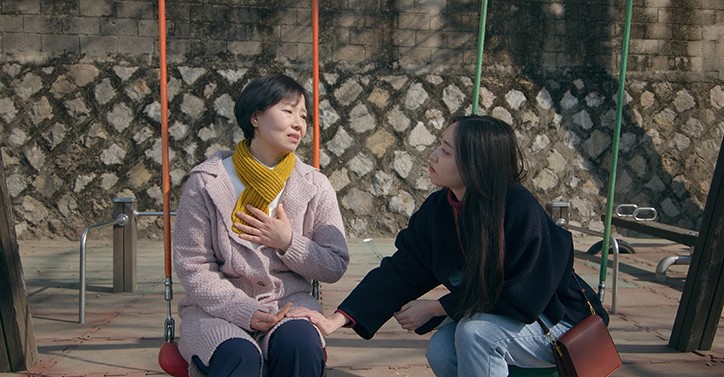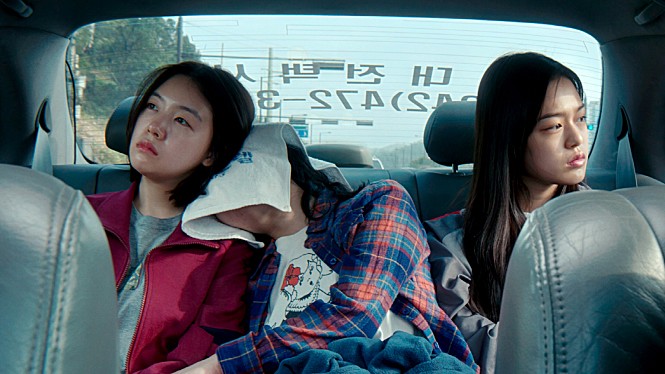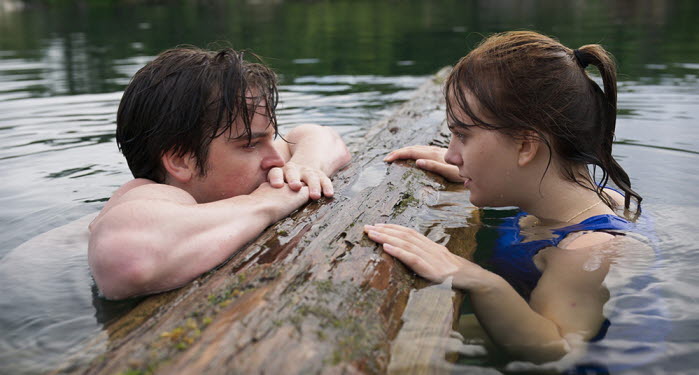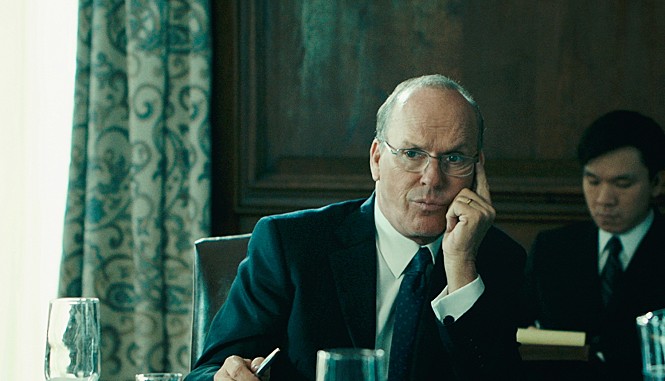
Blue Gate Crossing (2002) ☆☆☆(3/4): A little complicated adolescent triangle

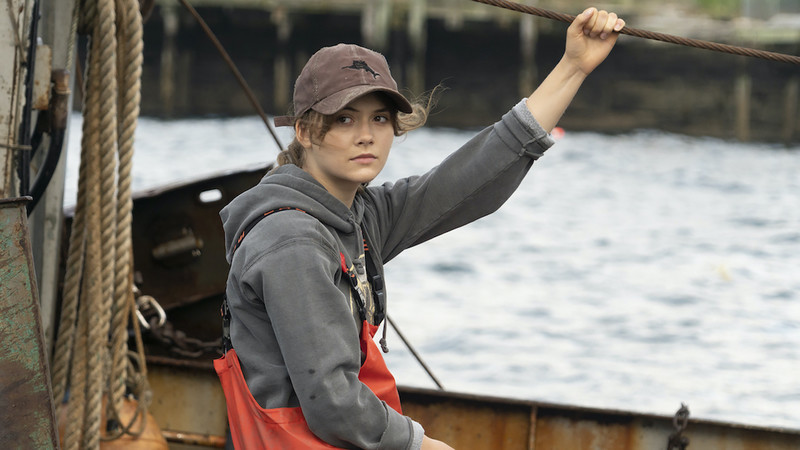
Taiwanese film “Blue Gate Crossing”, which happened to be released in South Korean theaters yesterday, is a modest adolescent drama revolving around one little complicated triangle. Although it is a bit too short with some underdeveloped aspects, the movie is still fairly engaging thanks to its good mood and solid performances, and it is certainly interesting to watch considering that it launched the career of one of the most prominent actresses in Taiwan during last two decades.

At first, the movie focuses on the friendship between Lin Yuezhen (Yolin Liang) and Meng Kerou (Gwei Lun-mei), two high school girls who have been quite close to each other. In the opening scene where they happen to have a little private time together, Yuezhen is trying to imagine her future life with a boy she has had a crush on, and Kerou listens to every word from her friend with quiet seriousness, though she does not try to imagine anything about whom she wants to be with in the future.

That boy in question is Zhang Shihao (Chen Bolin), a handsome athlete student in the school where Yuezhen and Kerou have studied. As they look at this hunky boy from time to time, Yuezhen cannot help but thrilled by the possibility of romance with him, and we are not so surprised to learn later that her mind has actually been quite fixated on winning Shihao’s affection for a while. At one point, she shows Kerou a box full of collected stuffs once belonging to Shihao, and she and Kerou come to bond more together as cheerfully sharing that little secret of hers between them.

In the end, Yuezhen asks Kerou to function as a messenger of love between her and Shihao. During one night, they sneak into the school swimming pool where Shihao often practices without permission, and they watch him practicing alone in the pool for a while. Kerou subsequently draws his attention on Yuezhen’s behalf, but then Yuezhen is disappeared in the last minute, and that leads to her rather awkward encounter with Shihao, who actually becomes smitten with Kerou as coming to spend more time with her than expected.

Kerou is not particularly interested in getting involved more with Shihao, but she keeps helping her friend nonetheless, though that results in more complications to her annoyance. Yuezhen later writes a love letter to Shihao, but she uses her friend’s name instead, and, after one embarrassing incident associated with that love letter of hers, everyone in the school regards Shihao and Kerou as a couple.

Because of his growing affection toward Kerou, Shihao does not mind this trouble at all, and he tries to get closer to her, but then it turns out that Kerou has a little secret behind her back. As a matter of fact, she has felt quite attracted to Yuezhen. While not so sure about her sexuality, she is afraid that her hidden feeling toward Yuezhen may destroy their friendship, and, ironically, she finds herself being more with Shihao as he kindly listens to her growing inner conflict.

As leisurely rolling along with its three main characters, director/writer Yee Chin-yen’s screenplay plainly but sensitively depicts the development of their complicated triangle. Just for checking whether she can like other men besides Shihao, Kerou unwisely attempts to seduce her physical education teacher when they happen to come across each other during one evening, and then she has no choice but to stick to Shihao just for saving her face at the school. More attracted to Kerou’s plucky personality, Shihao is willing to try to win her heart, but, of course, he only finds himself getting more frustrated with her ongoing sexual confusion. In case of Yuezhen, she is still waiting for getting Shihao’s attention while being jealous of whatever is going on between him and her best friend, and there is a little poignant moment where she does a sort of private prayer for her wish fulfillment.

Although it does not go that deep into Kerou’s sexual conflict or its consequent effect on her friendship with Yuezhen, the movie does not push its three main characters into contrived melodrama at least, and they simply come to us as innocent kids who still need to learn and grow up more. The ending feels a bit unresolved as mostly focusing on what eventually happens between Kerou and Shihao, but it still works with a bright and hopeful sense of optimism the movie rightfully earns along the story, and we come to hope that things will get better for not only Kerou and Shihao but also Yuezhen.

The movie is supported well by its three good main cast members. While Gwei Lun-mei, who has steadily advanced further since making her debut here in this film, shines with her unadorned star quality, Chen Bolin complements her well during several key scenes of theirs, and Yolin Liang is also effective as another crucial part of the story, though her character is rather underdeveloped in comparison.

While remembered mainly for Gwei’s debut performance, “Blue Gate Crossing” is worthwhile to watch because of several other good reasons including its youthful spirit coupled with palpable summer atmosphere. It is more or less than a time capsule from its era (Gwei’s subsequent queer drama film “Girlfriend Boyfriend” (2012) is relatively more forthright compared to that, by the way), but its plain intimate drama still has some charm and vigor, and I admire that to some degree.

Posted in Movies | Tagged , , , , | Leave a comment

Misha and the Wolves (2021) ☆☆☆(3/4): A Holocaust story too good to be true

Netflix documentary film “Misha and the Wolves”, which was released in last week, presents a real-life story which is surely stranger than fiction for good reasons. Mainly revolving around an unbelievably dramatic tale from one old woman, the documentary initially draws our attention as examining how much that narrative of hers appealed to everyone around her, and then it catches us off guard as pulling the rug from under us in more than one way, so I sincerely recommend you not to read further if you are already interested in watching the documentary without exposed to any spoiler.

During its early part, the documentary introduces us to several different interviewees who knew a woman named Misha Defonseca in the 1990s. On the surface, she was just an ordinary old Belgian lady living with her husband in a small rural town of Massachusetts, but she later told her close neighbors that she was actually a Holocaust survivor who lost her Jewish parents during the World War II, and her neighbors were quite touched and impressed by her harrowing narrative of survival and resilience. When she subsequently told her story at a meeting held at a local Jewish synagogue, her audiences were utterly captivated by her story, and one of the interviewees in the documentary still vividly remembers that impressive moment.

Defonseca’s story was quite dramatic to say the least. According her, her parents were suddenly arrested and then deported to somewhere along with many other Jewish people shortly after Nazi Germany invaded Belgium in 1940, but young Defonseca was fortunately protected by a Catholic family just like many other local Jewish children during that dark period. Mainly because of the lack of care and affection from that Catholic family, young Defonseca later decided to leave and then search for her parents for herself, and she surely experienced and witnessed many horrors of the war as trying to survive and reunite with her parents, but, when the war was over, her parents turned out to be dead already.

As listening to Defonseca’s story, my mind went back to one of the most acerbic lines from Joseph L. Mankiewicz’s great classic film “All About Eve” (1950): “What a story! Everything but the bloodhounds snappin’ at her rear end.” Well, Defonseca’s story does not have any bloodhound, but, surprise, it has a pack of wild wolves which somehow let her join them shortly after their accidental encounter in the middle of a winter forest. Although they regarded her as a lesser being in the pack, these wild wolves were more reliable than humans to her, and their company gave her more will and strength for surviving whatever would come upon her.

As Defonseca’s unbelievably remarkable story was spread more around the town, her neighbors suggested that her story should be known to more people out there, and one of them, who happened to be a local small-time publisher, was quite willing to publish Defonseca’s memoir. Once it was written, Defonseca’s memoir came to draw lots of attention even before its publication date in US, and everything seemed to be going pretty well for Defonseca and her publisher as her memoir was also introduced to the European market.

However, there came a big legal trouble between Defonseca and her publisher, and her publisher came to have a growing doubt on Defonseca’s story. Especially after finding one glaring discrepancy between her memoir and its French version, Defonseca’s publisher became quite determined to get to the bottom of this increasingly questionable matter, and the documentary accordingly introduces to a couple of persons hired for investigating this matter at that time. One of them was incidentally a Jewish Belgian genealogist who was also a Holocaust survivor, and that person was certainly quite interested in verifying whether Defonseca’s story was really true.

Meanwhile, Defonseca’s story continued to draw more attention outside. Her memoir became a bestseller in many European countries including France, and we see a series of archival footage clips showing her being interviewed on French TV programs. In addition, the memoir was subsequently adapted into a feature film in 2007, and that certainly boosted its popularity among many European readers – until a certain undeniable fact was fully exposed in public not long after that movie was released in France.

Around that point, the documentary takes a couple of unexpected turns later. While I was amazed to some degree during my viewing, I am not that sure about whether that really brings any extra depth to the narrative, though director/writer Sam Hobkinson and his crew members did a slick job of engaging and then surprising us more and more along the narrative. In fact, the overall result feels rather superficial at times as not delving that deep into how easily people can be deceived due to understandable human reasons, and you may be disappointed if you expect any insight and understanding on Defonseca, who later turns out to be a much more distant figure in the documentary than she seems to us at first.

Anyway, “Misha and the Wolves” is a fairly entertaining documentary on the whole, and I recommend it despite having some reservation. Because I read one review on it in advance, I was not surprised as much as intended, but I had a fair share of amusement and disbelief from its inherently compelling real-life story, so I will not grumble for now.

Posted in Movies | Tagged , , , , | Leave a comment

Midsummer Madness (2020) ☆☆☆(3/4): One summer day of a struggling poet

South Korean independent film “Midsummer Madness” follows one struggling artistic process to observe and reflect on. While its young heroine wanders around here and there for getting any possible inspiration for her, the movie calmly doles out one amusing moment after another along its free-flowing narrative, and these nice moments are further enhanced by several good poems appearing in the film.

The movie is mainly about one hot summer day of a young woman named Hyeong-sil (Kim Ye-eun), who has been quite unhappy about how things have not gone that well in her current life. While not fully recovering from her recent break-up with her boyfriend, she has focused on writing five poems to be submitted to some big poetry contest which may help her career, and she has so far completed four poems, but she still cannot finish the last one. While quite pressured by the approaching deadline, she manages to write the draft at least, but, unfortunately, she does not have any good idea yet on how to polish and compress that further for bringing more artistic qualities, and she only finds herself becoming more bored and frustrated as time keeps going by without any progress for her at all.

In the end, Hyeon-sil resorts to doing something any frustrated writer usually does for solving their artistic slump. She decides to take a walk outside for a while, and, what do you know, she comes to spend a lot more time than expected as encountering a number of people in her life. At first, she comes across a young woman who was close to her male senior, and their conversation later becomes a bit awkward when that young woman reveals that she does not live with him anymore.

After that awkward encounter, Hyeon-sil’s mind cannot help but drifted toward her past relationship with her ex-boyfriend. While the void caused by his absence has been filled by her recently acquired pet dog, her small residence is still strewn with a number of stuffs belonging to him, and Hyeon-sil often finds herself missing him a bit, even though he emphasized to her that they are totally finished with each other now.

And then Hyeon-sil comes across a fellow young poet who was once her best female friend before a little private relationship matter came between them. On the surface, they are totally fine to be around each other now as casually talking with each other, but then their conversation becomes strained as we get to know a bit about what broke up their friendship at that time.

Some time later, Hyeon-sil calls a male of friend of hers who is incidentally an independent filmmaker, and we get one of the most amusing moments in the film as they drink and talk a lot together. Both of them soon get mired in self-pity and pettiness as they drink more and more, and you may chuckle a bit when they ramble about how lousy many independent films are. When Hyeon-sil later comes across the aforementioned male senior, she is willing to listen to him despite being quite drunk, but his empty talk does not help or inspire Hyeon-sil much, and we get another good laugh from that.

In the meantime, the screenplay by Kim Jong-jae, who made several short films before making a feature film debut here, gradually generates its slow but engaging narrative flow under the mundane ambience of hot summer day, and we come to sense more of Hyeon-sil’s artistic process. Along the story, her four completed poems are read one by one, and it is not much of a spoiler to tell you that the movie eventually ends with the completion of her fifth poem, but its effortless delivery of a small but significant sense of artistic achievement is surely something worthwhile to experience for yourself.

These five poems in the film, which were written by Hwang In-chan, feel plain at first, but their poetic quality will probably linger on your mind for a long time as you appreciate whatever is implied between words besides some playfulness to be savored. To be frank with you, I am a sort of dyslexic to poetry, but these poems in the movie somehow resonate with the images of the film in my mind, and I am willing to watch the movie again for appreciating how they are effectively incorporated into the screen.

The movie is also supported well by the charming lead performance by Kim Ye-eun, who previously appeared in a number of notable South Korean films including “Microhabitat” (2017) and “A Resistance” (2019). While deftly capturing the comic aspects of her character’s emotional/artistic confusion, she also imbues her character with considerable life and personality, and we come to cheer for her character more than expected. In case of the other main cast members in the film, Han Hae-in, Shin Gi-hwan, Kwak Min-gyoo, and Oh Gyu-chul are also solid in their respective supporting roles, and the special mention goes to a scene-stealing dog which plays Hyeon-sil’s pet dog.

On the whole, “Midsummer Madness” is a slow but engaging comedy drama about poetry and life, and I enjoyed its laid-back mood and sly sense of humor. This is basically another simple but talky South Korean independent film influenced a lot by the works of Hong Sang-soo, but it has enough substance and personality to distinguish itself, so I recommend you to give this little but solid work a chance someday.

Posted in Movies | Tagged , , | Leave a comment

Assassins (2020) ☆☆☆(3/4): A close look into one infamous assassination case

Documentary film “Assassins” gives us a close look into one infamous assassination case which surprised many of us a few years ago. On February 13th, 2017, a certain prominent North Korean exile was assassinated right in the middle of Kuala Lumpur International Airport, Malaysia, and it was all the more shocking that the North Korean government got away with that in the end while also getting considerable political benefits for its current head of state.

That assassinated figure in question is Kim Jong-nam, who was the eldest son of North Korean dictator Kim Jong-il. Around the 1990s, Kim Jong-nam had been expected to succeed his father just like his father succeeded his grandfather Kim Il-sung in 1994, but, due to one humiliating public incident that occurred in 2001, he become less likely to succeed his father, and he eventually left his country while his half-brother Kim Jong-un consequently gained more favor from their father.

When Kim Jong-il subsequently died in 2011, Kim Jong-un was only a 28-year-old college graduate at that time, but it did not take much time for him to take his country under full control. First, he did a swift and extensive purge upon his government as well as the North Korean military for solidifying his political status, and he did not even hesitate to execute one of his uncles, who was incidentally one of the most powerful figures in the regime of his father.

As Kim Jong-un’s older brother, Kim Jong-nam was certainly another potential political threat to Kim Jong-un, but Kim Jong-nam happened to be under the protection of the Chinese government. While fully supporting Kim Jong-un and his new regime, the Chinese government also wanted to keep Kim Jong-nam as a sort of political safety measure just in case, and Kim Jong-un and his North Korean government certainly did not dare to eliminate Kim Jong-nam as long as he remained in China.

However, as an international journalist interviewed in the documentary tells us, the situation became more perilous for Kim Jong-nam as he was frequently quite vocal about his opposition to his younger brother’s regime. He later pleaded to Kim Jong-un that he would be silent in exchange of safety and freedom for him and his family, but his assassination was eventually executed when he happened to be outside China at that time.

As many of you remember, the aftermath of Kim Jong-nam’s assassination was pretty messy to say the least. Once the Malaysian Police embarked on the investigation right after his death, a group of North Koreans were identified as suspects, but most of them already left Malaysia, and the rest of these North Koreans, who were held in Malaysia for a while, were later allowed to return to North Korea after the following diplomatic tug-of-war between the North Korean government and the Malaysian government.

Mainly for saving its face, the Malaysian government came to focus more on punishing Siti Aisyah and Doan Thi Huong, two different South Asian women assumed to be manipulated and then exploited by those North Korean suspects. While Aisyah was from some rural area of Indonesia, Huong was from Hanoi, Vietnam, and, according to their respective testimonies, they even did not know about each other when they respectively did what they were hired to do as a part of “prank show”.

The documentary later details how each of these two unfortunate young ladies unwittingly got themselves involved in the assassination plan. As a poor woman who really needed money for herself and her family in Indonesia, Aisyah did not hesitate when one of the North Korean suspects approached to her with a seemingly lucrative offer. In case of Huong, she happened to get a similar offer while trying to find any breakthrough for her future acting career in Hanoi, and both she and Aisyah did not suspect anything while they subsequently ‘performed’ a number of pranks in several public spaces including Kuala Lumpur International Airport. After all, they got paid as much as promised, and what they did looked pretty harmless on the surface.

However, what Aisyah and Huong were instructed to do on that fateful day of February 2017 was not harmless at all. They simply caught Kim Jong-nam off guard as suddenly approaching to him from the behind and then touching his face via their hands, but their hands were respectively covered with the two different components of VX nerve agent. Once these two components were mixed on Kim Jong-nam’s face, the resulting VX nerve agent, which can be very lethal even in a very small amount. swiftly worked upon his body, and he eventually died only a few hours later.

As following the subsequent trial of Aisyah and Huong during its second half, the documentary sharply points out how unjust their legal situation was in many aspects – and how impertinently the North Korean government evaded any responsibility while further solidifying its political status. With no one to threaten his position, Kim Jong-un has continued his reign during next several years, and the Chinese government and other powerful governments around the world quickly sanctioned him as another major international political player.

On the whole, “Assassins” feels rather incomplete as its main subject is still a story to be continued, but director/co-producer Ryan White did a competent job of presenting the main subject with enough intrigue and information. As a South Korean audience who is fairly familiar with how dangerous and aggressive the North Korean government has been during last 61 years, I must tell you that what is shown in the documentary did not surprise me much, but it is still an engaging documentary nonetheless, and I recommend it especially if you are interested in knowing more about its main subject.

Posted in Movies | Tagged , , , , , | Leave a comment

Free Guy (2021) ☆☆1/2(2.5/4): Enjoyable but derivative

“Free Guy” is an enjoyable but derivative product reminiscent of too many other similar films out there. Its story premise will surely take you back to a number of movies associated with video games, but it does not try to go further than the numerous influences from these senior films ranging from “Tron” (1982) to “Ready Player One” (2018), and I was not surprised or impressed much despite some entertaining moments in the film.

At the beginning, the movie sets up its artificial main background through the cheery viewpoint of its nice ordinary hero. For Guy (Ryan Reynolds), everyday feels pretty much same as he wakes up and then goes to his mundane workplace, but he has no problem with that at all, and the same thing can be said about everyone else in the city including his best friend Buddy (Lil Rel Howery). No matter how frequently their city is smashed by certain figures everyday, they are not so shocked at all while following their respective routines as usual, and the movie generates some laughs from this absurd comic setting.

As shown from the trailer of the movie, Guy and his fellow citizens are actually the non-player characters (NPC) in a very popular online video game, and we soon see what has been going on in the real world outside the game. Thanks to its growing popularity around the world, Antwan (Taika Waititi), who is the owner of the company behind the game, has earned lots of profit, but the game was actually based on what he stole from two young aspiring computer program developers Millie (Jodie Comer) and Walter (Joe Keery) several years ago. While Walter chose to work under Antwan, Millie has tried to sue Antwan for his intellectual theft, and, as “Molotov Girl”, she has been searching around here and there inside the game for finding a certain evidence to prove that Antwan did steal what she and Walter created via their artificial intelligence (AI) algorithms.

When Guy happens to notice Molotov Girl on one day, she looks like a dream girl he has yearned for, and that leads to a big change in his daily life. After a series of decisions including the one involved with another attacker at his workplace, he finds himself beholding a hidden reality in a way which will remind you of those memorable moments in John Carpenter’s “They Live” (1988), and, as adjusting himself more to this new reality, he is alternatively awed and delighted by what he is capable of. Once he understands what he needs to do for approaching to the much higher gamer level of Molotov Girl, he goes all the way without any inhibition, and his exponential rise in the game soon comes to draw the attention of millions of online users around the world.

After Guy saves her game avatar from her latest peril, Millie finds herself attracted to his sweet and earnest sides while having no idea on his true identity, and we accordingly get an amusing romantic scene where they come to have a little sweet time together. Even when she belatedly comes to learn that Guy is actually the outcome of the digital evolution of what she and Walter created, Millie still cares a lot about Guy, and she becomes determined to save him and his world when her evil opponent attempts to cover up his intellectual theft by any means necessary.

During its last act, the movie throws lots of actions into the screen as expected, and that is the point where it becomes less entertaining than before. You may be tickled by a heap of cultural references including the one associated with the brief appearance by a certain recognizable actor, but the climax part of the film still feels overlong and predictable on the whole, and its handling of Guy and Millie’s emotional matter is rote and contrived while not giving us much surprise in the end.

At least, the movie is not boring thanks to the good comic chemistry between its two lead performers. Even before “Deadpool” (2016) and its 2018 sequel, Ryan Reynolds showed his considerable comic side in Marjane Satrapi’s morbid comedy film “The Voices” (2014), and he deftly handles several uproarious moments in the film while also giving a bit of gravitas to his likable character. As his counterpart, Jodie Comer, who has been mainly known for her Emmy-winning turn in British TV drama series “Killing Eve”, ably complements Reynolds whenever they share the screen together, and her performance surely brings some necessary spirit to the movie like Reynolds’.

In case of the supporting cast members in the film, they are mostly stuck in thankless functional roles. While Joe Keery and Utkarsh Ambudkar are wasted due to their flat supporting characters, Taika Waititi chews his every moment a little too much as the main villain of the story, and Lil Rel Howery, a gifted comedy actor of whom I have grown fond as watching his several small but notable supporting turns in “Get Out” (2017) and “Judas and the Black Messiah” (2021), steals the show as usual even though he is only required to play your average best friend character.

Directed by Shawn Levy, who is mainly known for “Night at the Museum” (2006) and its two following sequels, “Free Guy” is competent enough to engage us during its 115-minute running time, but it does not distinguish itself enough due to the glaring lack of its own style and personality. Although it turns out to be a bit better than I expected when I watched its trailer in last year (It is one of many Hollywood blockbuster movies whose theatrical release was postponed for more than one year due to the ongoing COVID-19 pandemic, by the way), it does not linger much on my mind, and my mind is already readying itself for anything more impressive or entertaining.

Posted in Movies | Tagged , , , , | 1 Comment

Vivo (2021) ☆☆1/2(2.5/4): Not as colorful or lively as its music background

Netflix animation film “Vivo”, which was released on last Friday, is not as colorful or memorable as required by its music background, and that is a shame considering a number of notable talented folks assembled here for its production. While it is often buoyed by its fairly commendable songs, the film does not have enough style and personality for being more than a merely passable musical story, and my mind kept going back to several better alternatives while not caring that much about its weak characters and predictable storyline.

The opening part of the film, which is set in Havana, Cuba, is engaging thanks to an odd but interesting pairing of two different talented artists. While Lin-Manuel Miranda, who has been a big household name to many of us thanks to his Broadway mega hit “Hamilton”, is jolly in his spirited voice performance as a kinkajou named Vivo, Juan de Marcos González, a Cuban musician who has been a key member of the Buena Vista Social club, effortlessly brings warmth and wisdom to Vivo’s old, hearty musician owner Andrés, and their distinctive voice actings complement well each other when they perform the first musical number scene in the film together.

Since he happened to be found and then raised by Andrés several years ago, Vivo has been Andrés’s dependable musical partner, and he has been pretty content with his life with Andrés, but there comes an unexpected news for Andrés. Many years ago, Andrés was quite close to a young talented female singer named Marta (voiced by Gloria Estefan, who is another inspiring casting choice in the film), and she was also in love with him even though they did not express their mutual feeling that much. When Marta subsequently left for US for a bigger career success promised to her, Andrés did not stop her at all because he did not want to stand on her way to success, and that seemed to be the end of their love story as many years passed, but, what do you know, Marta still does not forget Andrés at all as shown from the invitation letter for her upcoming farewell concert to be held in Miami, Florida.

Understandably excited and delighted by Marta’s invitation, Andrés promptly embarks on preparing a special song to be performed by Marta, and Vivo reluctantly supports Andrés’ decision to travel to Miami, but, alas, Andrés suddenly dies not long after that. Vivo subsequently mourns for Andrés’ untimely death along with many folks who enjoyed Andrés’ music in their neighborhood, and that is how Vivo comes across Andrés’ American grand-niece Gabi (voiced by Ynairaly Simo), who has just come to Havana along with her mother Rosa (voiced by Zoe Saldana) for attending Andrés’ memorial.

When he learns that Gabi and Rosa are from Key West, Florida and will soon go back there, Vivo decides to stow away to Florida via their return trip. Once he arrives in Key West, it looks like all he will have to do is going to Miami for meeting Marta by any means necessary, but, of course, things get a bit complicated when he is discovered by Gabi, who becomes quite enthusiastic about helping Vivo once she sees what he is trying to do. Although her mother, who is as forceful and stubborn as just like her daughter, expects her to join those local girl scout troopers selling cookies out there, Gabi wants to pay more attention to music as remembering her absent father, and helping Vivo certainly looks like a big exciting adventure to this plucky ebullient girl.

At first, it seems that their adventure will not be that long because all they need is a bus ride to Miami, but, of course, the situation soon becomes quite complicated when Gabi and Vivo come across a trio of sassy girl scout troopers, who become very zealous about taking Vivo away from Gabi as following their strong eco-friendly belief. While trying to evade these girl scout troopers, Gabi and Vivo inadvertently get themselves stranded in the middle of the wetland area of the Everglades, and it does not take much time for them to realize how dangerous it is to wander around in such a vast remote wildlife region like that.

This interlude part feels rather redundant in my humble opinion, but it is not entirely without amusement. You may be amused a bit by the scene involved with a pair of roseate spoonbills voiced by Brian Tyree Henry and Nicole Byer, and the mood becomes a bit tense when Vivo later encounters a giant anaconda voiced by Michael Rooker, who has a little small fun with his character’s vicious nature despite being under-utilized even compared to his brief recent appearance at the beginning of “The Suicide Squad” (2021).

It is not much of a spoiler to tell you that Vivo and Gabi eventually come to find a way to arrive in Miami right before Marta’s farewell concert is started, and we surely get a moment of poignancy as Marta is doing what her old lover wanted for years, but the screenplay by director Kirk DeMicco and his co-writer Quiara Alegría Hudes, who previously collaborated with Miranda in “In the Heights” (2021), suffers from its rote storytelling and thin characterization. In case of a number of songs written by Miranda, they are as good as you can expect, but I doubt whether you will hum them as much as the key songs from “Hamilton” and “In the Heights” – or his Oscar-nominated song for Disney animation film “Moana” (2016).

On the whole, “Vivo” is a bright and cheerful musical animation film decorated with nice musical moments, but it does not leave us much impression in the end, and, though I watched it early in this morning, my mind is already beginning to forget it without much regret. In fact, I would rather recommend Oscar-nominated animation film “Chico & Rita” (2010), which handles not only Cuban music and cultural background but also its own bittersweet tale of star-crossed lovers well with more energy, style, and poignancy. Believe me, you will have a much more productive and entertaining time with that overlooked animation film.

Posted in Movies | Tagged , , , | Leave a comment

The Green Knight (2021) ☆☆☆1/2(3.5/4): An unorthodox medieval fantasy tale

David Lowery’s new film “The Green Knight” is an unorthodox medieval fantasy tale you have to experience for yourself. Based on the 14th-century poem “Sir Gawain and the Green Knight”, the movie alternatively baffles and amazes you as calmly and thoughtfully delivering one uncanny magical moment to another along its seemingly simple narrative, and the overall result is quite stunning to say the least. To be frank with you, even at this point, I am actually scratching my head on what exactly its key moments are about, but, as reflecting more and more on these sublime moments, I find myself quite willing to experience the whole movie again for more understanding and appreciation.

After the prologue scene which boldly promises something different from usual medieval fantasy tales, the movie promptly introduces us to Sir Gawain (Dev Patel), and we see how this carefree lad happens to get himself involved into a very serious circumstance. Shortly after he comes to the Christmas banquet held inside the court of the king who is also Gawain’s uncle, the banquet is suddenly disrupted by the appearance of a mysterious magical figure called, yes, the Green Knight (Ralph Ineson), and the Green Knight has a challenge to be accepted by any of the king’s knights. If he is struck down by the knight who accepts the challenge during the following duel, that knight will get his green ax in addition to gaining considerable wealth and fame, but, of course, there is a catch (Isn’t it ever?). On the very next Christmas, the Green Knight will wait for that knight at a spot called Green Chapel, and he will give back the exact same blow to that knight.

When all of the king’s noble knights do not come forward, Gawain bravely comes forward instead, but, what do you know, the challenge turns out to be much easier than expected. The Green Knight virtually lets himself decapitated by Gawain, so everyone is relieved for a while, but, not so surprisingly, the Green Knight is promptly revived and then disappears away from the scene, while also reminding Gawain of the inevitable consequence of choosing to accepting his challenge.

As amusingly pointed out to us after that, one year quickly passes, and Gawain is certainly quite depressed about his approaching doom. The next Christmas is approaching day by day, and there is nothing he can do except accepting what is demanded by the Green Knight, so he eventually comes to begin his journey after getting himself prepared by not only his uncle but also his mother. Although his mother incidentally does not get along that well with her brother like her paganism and his Christianity, both she and her brother respectively do as much as they can for Gawain, and we accordingly get an oddly interesting moment of the juxtaposition between two contrasting religions.

It is not much of a spoiler to tell you that our hero will come across a series of difficulties and plights during his journey, but the Lowery’s screenplay often catches us off guard while leisurely taking its time. As Gawain struggles more and more along his difficult journey, the mood around him becomes increasingly dreamy and hallucinogenic, and we are served with several haunting scenes including the one involved with a young woman and her barren residence. While I am not so sure about what this scene actually means, it is still quite mesmerizing thanks to its ethereal spookiness, and it also become a bit poignant when Gawain does a little brave act of mercy for her.

The movie continued to baffle me more during my viewing, but it still held my attention nevertheless thanks to Lowery’s effortless handling of atmosphere and narrative, and the technical aspects of the movie are simply superlative. While the production design by Jade Healy and the costume design by Malgosia Turzanska are commendable for bringing considerable gritty realism as well as sublime touches of imagination to the movie, cinematographer Andrew Roz Palermo delivers numerous awesome visual moments to behold for mood and details, and these visually impressive moments are further enhanced by the effective medieval score by Daniel Hart, who previously collaborated with Lowery in “Pete’s Dragon” (2016), “A Ghost Story” (2017), and “The Old Man & the Gun” (2019).

As the human center of the movie, Dev Patel, who has steadily advanced since his breakthrough turn in Danny Boyle’s Oscar-winning film “Slumdog Millionaire” (2008), is compelling in his character’s gradual development along the story. While never staying away from his character’s human weaknesses, Patel brings substantial emotional intensity to a number of crucial scenes which depend a lot on his talent and presence, and we come to care more about his character’s supposedly inevitable end – and whether he really has any chance to survive his second encounter with the Green Knight.

Around Patel, Lowery places a number of various notable performers, each of whom has each own moment to shine. While Alicia Vikander has the most fun via her two different roles, Sean Harris, Kate Dickie, Joel Edgerton, Ralph Ineson, Erin Kellyman, Barry Keoghan, and Sarita Choudhury are also well-cast in their respective roles, and Keoghan, who drew my attention for the first time via his small but memorable supporting role in “’71” (2014), reminds me again that he is one of the most interesting new actors to watch at present.

On the whole, “The Green Knight” is definitely not something you can watch on Sunday afternoon just for casual fun, but it will be a very rewarding experience for you if you are ready for something different from recent fantasy blockbuster films while also understanding well what it boldly attempts to do. In short, this is one of the best films of this year besides being another admirable work from Lowery, and I urge you to check it out as soon as possible.

Posted in Movies | Tagged , | 1 Comment

Jallikattu (2019) ☆☆☆1/2(3.5/4): A mass rampage surrounding one water buffalo

“Jallikattu”, which was selected as India’s submission to Best International Film Oscar in last year, is one hell of experience you have to see for yourself. At first, it simply looks like a merely chaotic absurd comedy revolving around one big silly hunt, but then it is gradually turned into something much more intense and ambitious, and I must tell you that I was quite mesmerized by a number of awesome moments during its last act.

The opening sequence promptly sets the tone of the film along with a series of edgy percussive sounds and disturbing vocal sounds on the soundtrack. Jumping from one close-up shot from another, the movie introduces us to a various bunch of people living in a rural village located in some remote mountain area of Kerala, India, and the repetitive shots of the daily work of a local butcher and his assistant Anthony (Antony Varghese) let us gather how important his routine daily supply of water buffalo meat is to many of village folks.

When the butcher and his assistant are about to slaughter his latest water buffalo during one early morning, a little trouble happens. Although we do not see how that exactly occurs as the camera thankfully observes them from the distance, that water buffalo to be slaughtered runs away anyway, and then it inadvertently causes a big fire in the middle of the village. Once they manage to extinguish the fire in the end, many people in the town soon embark on finding and then killing the water buffalo because they do not want it to cause any more trouble.

However, the situation turns out to be a bit more challenging than expected. While it does not take much time for the village people to find the water buffalo in the forest surrounding the village, the water buffalo keeps evading them, and it continues to cause more troubles in the village. Like “Jaws” (1975) does not show that shark much during its first act, the movie also often restrains itself from showing its water buffalo on the screen, and that is why this water buffalo’s occasional sudden appearance is dramatically effective as shown from one tense action sequence unfolded on the main street of the village.

Anyway, it becomes quite clear to the villagers that they need some more extra help, but the local police officers are not particularly willing to use their firearms just because they are not allowed to do that without any official permission. When a local poacher named Kuttachan (Sabumon Abdusamad) enters the picture later, the villagers are certainly delighted and excited, and this dude, who looks as confident as Robert Shaw’s character in “Jaws”, announces to them that he will track down and then kill the water buffalo within a short time.

However, it is subsequently revealed to us that there is an old grudge between Kuttachan and Antony, and the movie goes back to when Antony worked along with Kuttachan under the local butcher. Because he and Kuttachan were vying with each other for getting the affection of a certain young woman, Antony decided to play dirty a bit, and Kuttachan, who was consequently kicked out of the village at that time, still does not forgive what Antony did to him at that time.

As these two characters frequently conflict with each other, the villagers zealously keep hunting for the water buffalo as before, and the movie steadily accumulates more tension and anxiety on the screen as pushing them further into more frenzy and madness. When a group of people from some other village come later in the story, the mood becomes all the more volatile in the village as these people often clash with some of the villagers, and, again, the local police do not do anything about decreasing the tension among people – until something really serious inevitably happens to their vehicle.

Although it is initially a bit confusing for us as the screenplay by S. Hareesh and R. Jayakumar, which is based on Hareesh’s short story “Maoist”, busily bounces around so many different characters besides Antony and Kuttachan, director Lijo Jose Pellissery and his crew members keep holding our attention via their impressive technical achievements. The cinematography by Girish Gangadharan is astounding in its fluid and masterful camerawork during several impressive extended shots in the film, and the editing by Deepu Joseph dexterously sets the staccato narrative rhythm of the film along with the deliberately blatant score by Prashant Pillai. In case of the water buffalo in the film, I have no idea on how much of it is real or CGI, it functions fairly well as one of the crucial elements in the story, and you may actually come to feel sorry for this unfortunate animal, which does not seem to have any malice at all while simply trying to follow its survival instinct.

So far, I have restrained myself from describing the consequences of the mass human madness so vividly and absurdly depicted in the film. I can only tell you that the movie virtually goes all the way for sheer chaos and horror along with its numerous human characters during the last act, and the result is utterly intense and overwhelming to say the least. I will not go into details here, but, in my humble opinion, what is so strikingly and singularly presented on the screen around the end of the film may be appreciated a lot by Werner Herzog, who once said our civilization is starving for new images.

In conclusion, “Jallikattu” is unforgettable for its stupendous intensity coupled with a dark sense of humor, and it also shows us a bit of another distinctive cultural side of India as one of the recent notable offerings from Malayalam cinema, which is the Indian film industry based in the southern state of Kerala. Yes, as reflected by several scenes in this impressive Mollywood film, there are a considerable number of Christian communities over there, and that will certainly remind you again of what a complex country India really is.

Posted in Movies | Tagged , | Leave a comment

The Dry (2020) ☆☆☆(3/4): A dry but compelling outback mystery thriller

Australian film “The Dry” is a dry but compelling outback mystery thriller to be admired for several good reasons. Besides its solid plot which ably handles its two main mysteries, the movie is fully shrouded in the palpable sense of locations and people, and we find ourselves more immersed into its vast and remote rural background while also wondering more about what will be eventually revealed along the story.

After the calm but chilling opening scene, the movie begins to unfold the story via the viewpoint of a federal agent named Aaron Falk (Eric Bana). Many years ago, Aaron and his father left their rural hometown for some serious incident, but now he is requested to return to his hometown because of the funeral of his close friend, and he does not feel that comfortable about that in addition to being disturbed by the circumstance surrounding his friend’s death. It seems that, for some unknown reason, his friend killed his wife and their young son before committing suicide later, and the town is still reeling from the shock from this horrible incident when Aaron arrives before the funeral.

Although many years have passed since that old incident associated with him, there are some people who do not welcome Aaron’s presence much, and Aaron certainly prefers to leave as soon as possible once the funeral is over, but then he is held by the desperate request from his dead friend’s parents. He is not so sure about whether he can actually do anything for them, but he has no choice but to accept their request mainly because the dead friend’s father knows something about that old incident.

As Aaron reluctantly embarks on unofficially helping the investigation supervised by the local police sergeant, we get a series of flashback scenes showing the relationships among Aaron, his dead friend, and two girls who were close to them. Around that time when that old incident occurred, these four kids frequently hung around with each other outside, but then one of these two girls was found dead at a spot where they usually spent time together. For a reason to be revealed later in the story, Aaron was instantly regarded as the prime suspect, so he lied along with his friend for avoiding getting arrested, though their lie did not help him that much even though he was not arrested in the end.

While he looks around here and there for his informal investigation, Aaron comes to see that his dark past remains much alive in the town. That dead girl’s father and her cousin recognize Aaron with instant malice and hostility, and they do not have anything good to say about Aaron’s dead friend either. In case of Gretchen (Genevieve O’Reilly), who was the other girl in the group, she seems to be glad to see Aaron again, but it also looks like she has something she would rather not tell him for now.

Meanwhile, Aaron begins to sense a number of questionable things about the circumstance surrounding his friend’s death. There is a little but suspicious matter involved with shotgun shells supposedly used by his friend for killing himself as well as his two family members, and then Aaron subsequently discovers something which can be a crucial clue pointing at a certain person in the town. Is it possible that his friend and his two family members were actually murdered by someone else? If so, what was the actual motive behind that?

Deftly going back and forth between its two main mysteries, the screenplay by director/co-producer Robert Connolly and his co-writer Harry Cripps, which is based on the novel of the same name by Jane Harper, gradually throws more intrigue and tension into the story, and the movie holds our attention further with its vivid and distinctive local atmosphere, which is conveyed mainly via the calm but ominous shots of wide landscapes dried by many days of drought. As already shown from many other notable films including “Walkabout” (1971) and “Picnic at Hanging Rock” (1975), there is always something quite uncanny about the outback region of Australia, and cinematographer Stefan Duscio did a commendable job of capturing that striking quality well on the screen.

What is finally revealed during the last act of the film may not surprise you that much especially if you are an avid reader of mystery novels like me, but the movie keeps engaging us as before, and it is also supported well by the solid performances from its main cast members. Although he has been less prominent during last several years, Eric Bana, who also serves as one of the producers of the movie, is still a good actor as before, and his effective low-key lead performance carries us well from the beginning to the end of the story. In case of the other cast members, Genevieve O’Reilly brings some warmth to her several key scenes with Bana, and Keir O’Donnell is also fine as a local police officer who may not be so good in his job but does care about doing as much as he can about his latest case.

I must confess that I did not expect that much when I watched “The Dry” at last night. I felt rather tired right after watching “The Suicide Squad” (2021), but then I was surprised as finding myself intrigued and invigorated a lot by its mood, storytelling, and performance, and I eventually felt more satisfied with it than “The Suicide Squad”. To be frank with you, I think you will have a more productive time if you watch this modest but competent genre piece instead of “The Suicide Squad”, and I assure you that you will not be disappointed at all.

Posted in Movies | Tagged , , , | Leave a comment

The Suicide Squad (2021) ☆☆1/2 (2.5/4): More or less than adding “The”

I observed “The Suicide Squad” with occasional mild amusement while not feeling much care or enthusiasm. As the sequel to one of the most disappointing entries in DC Extended Universe (DCEU), it is definitely an improvement in comparison in many aspects, and I could discern that the cast and crew members of the movie clearly had some fun during its production, but the movie did not click that well with me nonetheless, mainly because I found myself often displeased about its blatantly mean and vicious sides instead of embracing and enjoying them like many critics and audiences.

During the opening sequence, the movie does a sort of cleaning job in a spectacularly gory and violent way. Under the command of Colonel Rick Flag (Joel Kinnaman), a bunch of nasty criminals including Harley Quinn (Margot Robbie) are pushed into an extremely perilous mission set up by their ruthless supervisor Amanda Waller (Viola Davis), and we get to know these figures a bit as they are sent to some small South American island country, but then, what do you know, most of them turn out to be not only expendable but also quite inconsequential in Waller’s cold-blooded scheme.

Anyway, we are soon introduced to the real team to accomplish the mission, which is led by Robert DuBois/Bloodsport (Idris Elba), a notorious mercenary who reluctantly accepts a deal with Waller due to his adolescent daughter’s recent legal trouble. He is accompanied with Christopher Smith/Peacemaker (John Cena), Abner Krill/Polka-Dot Man (David Dastmalchian), Cleo Cazo/Ratcatcher 2 (Daniel Melchoir), and Nanaue/King Shark (Sylvester Stallone), and it goes without saying that he and these four other criminals do not get along that well with each other right from when they are gathered together for the first time.

Their mission looks pretty simple on the surface. That South American island country, which was recently turned upside down by a big military coup d’état, happens to have a top-secret facility, and this facility has something which should not tumble into the wrong hands at any chance. Therefore, they must infiltrate into that facility and then destroy everything associated with its clandestine project before the new leader of the country, who incidentally does not like the American government that much, takes the full control of whatever is hidden inside the facility.

While DuBois and his problematic team members safely infiltrate into the island without much trouble, the situation becomes a bit more complicated than expected, and they keep having troubles in working with each other. While Dubois and Smith come to conflict a lot with each other on who should lead the team, Krill and Cazo are still struggling with their respective parental issues, and, as a humongous shark monster, Nanaue often cannot help but driven by his carnivorous nature.

Director/writer James Gunn, who previously directed “Guardians of the Galaxy” (2014) and its 2017 sequel, is no stranger to handling a bunch of oddball comic book characters, and the first half of the movie generates some good laughs from the disharmonious interactions among DuBois and his team members. There is a cheerfully violent scene where DuBois and Smith zealously compete with each other on eliminating a bunch of soldiers around them, and, depending on your taste, you will wince or laugh as beholding their casual killings. I was also amused a bit by DuBois’ aversion to a certain aspect of Cazo’s ability, and you may appreciate how the movie later delivers a big payoff moment to this.

During its second half, the movie throws lots of actions into the screen as expected, but, alas, that is the point where its level of fun begins to be decreased. Except the escape sequence driven by one of its main characters, many of key action scenes in the film feel rather unimpressive and pedestrian without enough wit or style to engage and thrill us, and the obligatory climatic sequence does not work as well as intended due to the incoherent mix of comedy, action, and a bit of certain genre element which incidentally takes me back to Gunn’s deliberately gross B-horror film “Slither” (2006). In addition, the movie is sometimes too mean and vicious to be compensated by its irreverent comedy, and it eventually left me with bad tastes even though I understood its intention of being as edgy and naughty as its main characters.

At least, the main cast members of the film fill their broad characters with considerable personality. Margot Robbie, Joel Kinnaman, and Viola Davis dutifully fill their respective spots as required, and, as before, Robbie plays her cheerfully deranged character with gusto, though I must point out that her character was much more fun and interesting to watch in “Birds of Prey (and the Fantabulous Emancipation of One Harley Quinn)” (2020). In case of the other main cast members, Idris Elba is intense as usual while also demonstrating his comic talent, and he is supported well by John Cena, David Dastmalchian, Peter Capaldi, Daniel Melchoir, and Sylvester Stallone, who surely has more lines to say than Vin Diesel in “Guardians of the Galaxy”.

Overall, “The Suicide Squad” succeeds in cleaning up the mess left by its predecessor, but it is less entertaining than “Birds of Prey (and the Fantabulous Emancipation of One Harley Quinn)” or “Zack Snyder’s Justice League” (2021). I gave these two films three stars while giving two stars to “Suicide Squad” (2016), so I give “The Suicide Squad” 2.5 stars, but I think you will enjoy it more than me if you are not as tired of uncharacteristic superhero films as I have been these days.

Posted in Movies | Tagged , | Leave a comment