Little Boxes (2016) ☆☆1/2(2.5/4): As they are trying to settle in a suburb

“Little Boxes” is a mild comedy about one family trying to settle in their new neighborhood. Although the result is less edgy and satiric than it could be while not showing anything particularly new about its familiar main subjects, we get several small moments of humor as its three main characters clumsily try to adjust themselves to their new environment, and its three main cast members carry the film well together on the whole even when the movie spins its wheels from time to time.

In the beginning, we are introduced to Gina McNulty-Burns (Melanie Lynskey) and her African American husband Mack Burns (Nelsan Ellis), who are soon going to leave their Brooklyn neighborhood in New York City along with their son Clark (Armani Jackson) because Gina recently accepted a position in some college located in Washington State. Gina hopes that this will be the new beginning for her artistic/academic career, and Mack expects to have a more peaceful environment for his writing, but Clark is not so happy about this change as he will be far away from his school friends.

Anyway, when they finally arrive in a small suburban area near the college where Gina is going to work, everything looks promising on the surface. She bought a big house which will give them more space than before, and they are soon welcomed by one of their new neighbors, who cheerfully encourages Clark to hang around with other kids in the neighborhood.

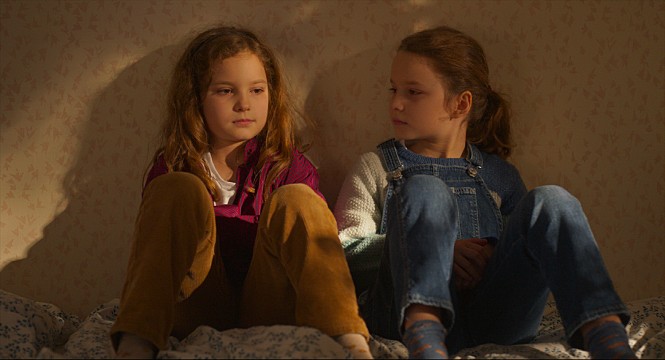
However, there is a problem which turns out to be more annoying than expected. Many of stuffs belonging to them are somehow stuck somewhere in the delivery route, so the house remains to be mostly empty as before, and Gina and her family cannot help but feel uncertain about whether they can settle in their new neighborhood, which surely feels quieter but less eventful than their old Brooklyn neighborhood. At least, Gina has some new colleagues on whom she can lean in her workplace, but Mack often feels bored and frustrated as his writing process is not improved much on the whole, and the same thing can be said about Clark, who comes to spend more time with two young girls in the neighborhood because, well, there is nothing to do for him before the new semester begins in his new school.

The most humorous moments in the film come from the dryly wry observation of how these main characters slowly let themselves mired in the ennui of their suburban neighborhood. Although she will surely have to prepare a lot for the upcoming semester in the college, Gina does not say no when her new colleagues suggest that she should have more fun along with them outside. As a result, she later finds herself pretty drunk during one night, and she comes to wonder whether her life and career reach to a dead end,

In case of Mack, he finds himself aimlessly walking here and there around his new neighborhood after getting more frustrated with his writing process. When he happens to draw the attention of others as a new local writer in the town, he is not so happy because he does not have anything to show off besides his first and only book published some years ago, and, as one of a few colored residents in the neighborhood, he also has to tolerate an insensitive remark from one Caucasian neighbor at one point.

Meanwhile, Clark becomes more interested in getting closer to one of the two girls with whom he has been hanging around for days, though he is well aware that these two girls are curious about him mainly for his racial background. There is a little absurd moment when he and they talk a bit about those contemporary rappers, and we come to wince more as observing how they are often unintentionally insensitive to Clark.

As its three main characters struggle more and more with their respective situations, the screenplay by Annie Howell gradually increases the level of anxiety and discontent among them, though it does not always succeed in my humble opinion. For instance, a part involved with a certain hygiene problem in the house is a bit too blatantly symbolic, and the last act feels heavy-handed as eventually fizzling out without much dramatic impact.

The movie is still worthwhile to watch to some degree mainly due to the diligent efforts from its three main cast members. Melanie Lynskey, who has been one of the dependable actresses since her unforgettable breakout turn in Peter Jackson’s “Heavenly Creatures” (1994), subtly expresses her character’s increasingly anxious state of mind, Nelsan Ellis, who unfortunately died not long after the movie was released, complements his co-start well with his seemingly calm and reserved attitude. As another crucial part of the story, Armani Jackson holds his own place well between Lynskey and Ellis, and Oona Laurence is also solid as a carefree young girl interested in Clark for a wrong reason.

“Little Boxes”, whose title is evidently derived from that famous satiric song of the same name, is dissatisfying compared to other acclaimed suburban films such as, yes, “American Beauty” (1999), but it is not a total dud at least thanks to the competent direction of director Rob Meyer and his good main cast members. I was not bored during my viewing, but I still think it could do more beyond being merely amused by suburban ennui.

Posted in Movies | Tagged , , | Leave a comment

Malignant (2021) ☆☆1/2(2.5/4): A nutty outrageous horror thriller film by James Wan

James Wan’s new film “Malignant” is so relentlessly nutty and outrageous that I am still scratching my head on how to evaluate whether it works. While I did get a fair share of laughs and thrills from this rather deranged but well-made piece of work, I also observed its loony plot development from the distance without much care, and I am still debating over whether it is “so-bad-so-good” intentionally or unintentionally.

After the gloriously overblown opening scene unfolded inside a big, imposing mental hospital on a steep seaside cliff, the movie moves forward to 28 years later, and we meet a young married woman named Madison “Maddie” Lake-Mitchell (Annabelle Wallis), who lives with her husband in an old shabby house looking like your average haunted spot. Although Maddie is the one who has earned their living despite being pregnant for months, her husband, who seems to be unemployed at present, does not appreciate this at all, and we are not so surprised when he cruelly abuses Maddie later.

Not long after that, something terrible happens in their house. Her husband is suddenly killed by some mysterious figure, but the two detectives subsequently assigned to the case are baffled as there is no clue to identify the killer, and Maddie cannot help them that much because she happened to lose her consciousness shortly after the killer murdered her husband and then swooped down on her.

However, it does not take much time for Maddie to realize what is really going on around her. Her mind is somehow linked with the mind of the killer as the killer continues the killing spree, and that makes her to look back into her old forgotten past. Before she was adopted by her foster parents 28 years ago, she was in that mental hospital for some unknown reason, and the killer, who looks like a cross between that murderous ghost in Japanese film “Ring” (1998) and those insane killers in giallo flicks, seems to be very angry about several certain figures associated with the killer as well as Maddie.

I will not dare to go into details on who the killer is, but I can tell you instead that I was often amused by how the film goes all the way along with this mysterious figure. Besides looking spooky and menacing as demanded, the killer also has some supernatural ability of making electronic equipments go amok (I particularly like a nasty moment involved with a pacemaker), and this dude also seems to be quite invincible in physical aspects. At one point, one of the two aforementioned cop characters shoots many times toward the killer while chasing after the killer, but the killer does not look injured at all while demonstrating pretty incredible physical flexibility.

As the movie becomes more and more preposterous along the plot, Wan and his crew members including cinematographer Michael Burgess boldly push the movie into sheer excess. Besides that mental hospital, many locations in the film look deliberately artificial and stylish, and I was especially impressed by the vast and stark interior of a police station where our two cop characters work. The movie frequently unnerves us via various visual ways including tilted shots, and the resulting anxious mood is further amplified by the jumpy score by Joseph Bishara.

In case of character development, the movie is incoherent at best and nonsense at worst. Most of main characters in the film are more or less than plot elements to be manipulated in one way or another, and that is the main reason why we are not so scared of whatever will happen to and around our unfortunate heroine, who is quite hysterical around the point when she is cornered more and more by her homicidal opponent. In case of the other main characters besides them, they are not particularly developed well, and we do not care that much about whether they will be killed or not along the story.

However, I will not deny that I got sort of guilty pleasure as the movie struck me harder and harder with more blood and outrageousness. I enjoyed watching Maddie’s plucky younger sister Sydney (Maddie Hasson) doing some detective work a la Nancy Drew, and the movie gives us some good chills as she eventually discovers a dark secret literally hidden behind her older sister, which somehow makes sense with the bizarre aspects of the killer. In case of a certain sequence during the last act, the movie throws lots of crazy and bloody moments of action onto the screen, and you will not be disappointed all if you are willing to go along with its over-the-top approach.

The main cast members in the film play their respective characters as straight as required, though their good efforts are hampered by weak characterization at times. While Annabelle Wallis dutifully holds the center, George Young and Michole Briana White are mostly stuck in their functional roles, and Maddie Hasson brings some life and personality to her seemingly thankless role.

On the whole, “Malignant” tries to be something wilder and crazier than Wan’s previous works including “Insidious” (2010) and “The Conjuring” (2013), and I appreciate that to some degree, but it is still not better than them in my inconsequential opinion. Considering that I gave both “Insidious” and “The Conjuring” 2.5 stars out of four, I give “Malignant” 2.5 stars, but it was not a waste of time for me at least, and I think you will probably be more generous than me if you enjoyed Wan’s works more than I did.

Posted in Movies | Tagged , , , | 1 Comment

The Best Years of a Life (2019) ☆☆☆(3/4): Still Living (and Loving)

Claude Lelouch’s latest film “The Best Years of a Life” is a sentimental epilogue which frequently takes us back to the nostalgic memories of its two main characters, who passionately fell in love in Lelouch’s Oscar-winning film “A Man and A Woman” (1966). Although it is more or less than a footnote to that lovely classic film, the movie is often enhanced by the undeniable chemistry between its two lead performers, who still shine together although they were near 90 around the time when the movie was made.

The story starts at a cozy facility for old people where Jean-Louis Duroc (Jean-Louis Trintignant) is currently living. While he looks mostly okay on the surface, Jean-Louis has been struggling with the late onset of dementia, and he often finds himself lost in the memories of his old times whenever he is left on a couch installed in the lawn in front of the facility. As you can surely remember if you have ever watched “A Man and A Woman”, Jean-Louis was a dashing and promising car racer at that time, and Trintignant is quietly poignant whenever his current fragile appearance is contrasted with how handsome and confident he looked at that time.

In that movie, Jean-Louis happened to come across a young widow named Anne Gauthier (Anouk Aimée), whose daughter happened to be the same boarding school which his son. As they subsequently came to spend more time with each other, a certain mutual feeling was developed between them, and, despite Anne’s grief associated with her dead husband, they eventually became more passionate about each other with Francis Lai’s catchy score frequently played in the background, and it looked like they would be never apart from each other as they openly embraced each other at the end of that film.

However, as Anne frankly admits to us at the beginning of the film, she and Jean-Louis subsequently became separated from each other because their almost perfect romance was eventually tarnished mainly due to Jean-Louis’ indiscretion, and they have never met each other again for more than 50 years. Lelouch actually made a sequel titled “”A Man and a Woman: 20 Years Later” (1986), but he thankfully erases that uneven misfire from the timeline of his two main characters, and, if you dislike that film as much I did, you will gladly go along with that change without much problem.

At present, Anne is running a small shop alone in a small town of Normandy mainly for living closer to her daughter Françoise (Souad Amidou, who incidentally played young Françoise in the 1966 film), who works as a horse veterinarian there. When Jean-Louis’s son Antoine (Antoine Sire, who also appeared in the 1966 film as young Antoine) comes to the shop for asking her to meet his father, she is understandably reluctant, but she eventually decides to visit that facility for old times’ sake.

When Anne finally meets Jean-Louis again, it does not take much for her to realize how foggy his mind has been these days. While recognizing her at all, he cannot help but ramble about his precious memories of his romantic relationship with her, and she listens to him with care and compassion while not saying much about her. Although many years have passed since they appeared together in 1966 and 1986, Trintignant and Aimée effortlessly interact with each other on the screen, and these two living legends of French Cinema poignantly remind us again that they have lost none of their talent and presence yet despite their old age.

However, Lelouch cannot help but become sentimental about those glory days of him and his two lead performers, and the movie frequently goes back to those highlight moments of the 1966 film. Yes, we see again how Jean-Louis and Anne came to fall in love as talking with each other in his car. Yes, we revisit that undeniably romantic moment on a beach. Yes, we watch again that bittersweet intimate lovemaking scene between them unfolded within one room of a nearby hotel.

In addition, Lelouch also tries no less than two dream sequences where Anne allows herself to join Jean-Louis’s nutty escapade. These sequences are playful with some amusing moments to be savored, but the movie seems to be going anywhere beyond that, and I am not so sure about whether a certain key scene featuring Monica Bellucci is real or not.

Anyway, Trintignant and Aimée still carry the film well together, and I would not complain at all if Lelouch simply lets these two very engaging performers talk and talk with each other throughout the 90-minute running time of his film. Since I belatedly came to notice him via Krzysztof Kieślowski’s last film “Three Colors: Red” (1994), Trintignant has been always interesting to watch, and the same thing can be said about Aimée, who was constantly terrific in many notable films including Federico Fellini’s “La Dolce Vita” (1960) and “8 1/2” (1963). They always click quite well together from the beginning to the end, and it is a shame that the movie does not go further with them to give us something as sublime as, say, Ingmar Bergman’s “Saraband” (2003), a sequel to his great film “Scenes from a Marriage” (1973).

In conclusion, “The Best Years of a Life” is no more than a sappy tribute to “A Man and A Woman”, but it is still worthwhile to watch mainly for its two great performers who surely deserve to be commended for trying their best with the material given to them. If you like the 1966 film, you should check it out someday, and I assure you that you will humming again its theme song.

Posted in Movies | Tagged , | Leave a comment

Worth (2020) ☆☆☆(3/4): What Is Life Worth?

“Worth”, which was released in South Korean theaters several months ago while released on Netflix in US a few weeks ago, attempts to examine what is really fair and just in evaluating the individual worth of many different human lives lost in one of the most devastating incidents in US during last 20 years. While its initially calm and objective stance eventually is tilted toward emotions and sentiments as expected, the movie did a fairly admirable job of handing its human matters with care and attention, and I appreciate a number of quietly touching moments glimpsed from the long and frustrating legal struggles depicted in the film.

The story of the movie is mainly told via the viewpoint of Kenneth Feinberg (Michael Keaton), a senior partner of one prominent law firm in Washington D.C. In the early morning of September 11th, 2001, he is going to the city along with many others via a commuter train as usual, but then many cellular phones suddenly ring here and there around him when they are about to arrive in the city, and he and others around him soon come to learn of those terrible terrorist attacks which just happened in New York City and Washington D.C.

Around two weeks later, the country and its citizens are still reeling from the enormous shock of the 9/11 incident, but the US government and its high-ranking officials are already focusing on handling the messy aftermath as soon as possible, and one of their immediate issues is how to compensate fairly to each of thousands of citizens who lost their respective loved ones during the incident. While it goes without saying that all lives equally matter in theory, they cannot possibly have the same amount of money allotted to all of those various victims ranging from a poor janitor to a rich company executive, so somebody must set the rules and boundaries to dictate how much they should pay in each case.

Because of seeing not only an interesting legal challenge associated with his expertise but also a valuable opportunity to help his country and government, Feinberg volunteers to be the one who will do that tricky job, and he and his senior partner Camille Biros (Amy Ryan) promptly embark on this legal project along with several interns at their law firm. Feinberg is confident that they will be able to persuade at least 80% of applicants to side with his plan before the deadline incidentally set around the end of 2003, but he and his team soon come to see how daunting their job is in many aspects. Many of applicants are regarding his plan with suspicion and distrust, and some of them have already hired lawyers, who are ready to go for the lawsuits for getting any possible damages from the US government or those airline companies.

Fortunately, there is a guy who may persuade most of these numerous applicants to be more sensible and reasonable with what Feinberg is going to propose, though he does not particularly approve of Feinberg’s plan right from the beginning. He is Charles Wolf (Stanley Tucci), and he genuinely cares about what should done for him and many other applicants out there, so it does not take much time for him to draw more attention from his fellow applicants than Feinberg.

While understanding more of the position of Wolf and many other applicants, Feinberg tries to be neutral and objective as much as he can, and he and his team are reminded again and again of how that is nearly impossible for them because, well, they are also human beings just like the people they are handling at present. Wisely avoiding any cheap tear or sentimentality, the movie simply listens to a series of harrowing human stories from some of the applicants at one point, and that is more enough for us to feel a bit of the immensely tragic aspects of the 9/11 incident.

The screenplay by Max Borenstein, which is based on Feinberg’s nonfiction book “What Is Life Worth?”, becomes a little tense when Feinberg and his team try much harder for accomplishing their seemingly impossible goal within a short time, but the movie still maintains its dry low-key tone under the competent direction of director Sara Colangelo, who previously made “The Kindergarten Teacher” (2018). Although Borenstein’s screenplay overplays a bit in case of a grieving widow whose dead husband later turns out to have a very complicated private life, the film still does not lose its balance even during that part, and it does not overstep at all when it arrives at the expected finale, which is pretty somber and anti-climactic but leaves lots of things for us to reflect on.

The cast members of the film dutifully fill their respective spots as required. Michael Keaton, who also served as one of the producers of the film, is dependable as usual, and it is engaging to observe how he gradually dials down his distinctive presence along the story as his character becomes more personally involved in the human aspects of his project. As Keaton’s counterpart in the story, Stanley Tucci brings considerable humanity and decency to his character, and he is particularly good when his character happens to have a honest and meaningful discussion with Feinberg later in the story. In case of the other substantial cast members including Shunori Ramanathan, Tate Donovan, and Amy Ryan, they are rather under-utilized in their functional supporting roles, but Ryan did a bit more than constantly looking concerned beside Keaton at least.

On the whole, “Worth” does not delve that deep into its main subjects, but it is sincere and thoughtful enough to hold my attention nonetheless. Although it does not answer to its moral questions that well, these moral questions are surely something worthwhile to muse on, so I recommend it despite some reservation on whether it works as well as intended.

Posted in Movies | Tagged , , , | Leave a comment

Respect (2021) ☆☆1/2(2.5/4): A conventional biopic starring Jennifer Hudson

“Respect” is a thoroughly conventional musician biopic whose glaring flaws are occasionally compensated by the strong performance from its lead actress. Whenever the movie lets us down during its rather long running time (145 minutes), she always lifts it up via her undeniable presence and talent, and she certainly handles her real-life character with care, passion, and, yes, lots of respect, even though her commendable acting is often hampered by those many weak aspects of the movie.

That real-life character in question is none other than Aretha Franklin, a legendary African American singer whose reputation and legacy have still been growing even after her death in 2018. I must confess that I did not know a lot about her before hearing about her death and then watching Sidney Pollack’s exceptional music documentary film “Amazing Grace” (2018), but I still vividly remember when I was blown away by her scene-stealing musical scene in John Landis’ “The Blues Brothers” (1980) many years ago, and many of her songs appearing in “Respect” surely remind me again of how much I have been familiar with them without knowing her life and career that much.

Unfortunately, the movie does not tell me more about Franklin’s life and career as duly doling out one genre cliché after another. While it does not disappoint me in case of its several good musical moments, the movie often suffers from scattershot narrative and thin characterization as covering too much of the 20 years of Franklin’s life, and we are only left with the vague impression of her artistic greatness without getting to know her that much.

Anyway, there are some parts which do work as well as intended, and one of them is the early part showing the childhood years of Franklin in Detroit, Michigan during the 1950s. Even when she was only 10 years old, young Franklin, who is played with considerable pluck and confidence by young performer Skye Dakota Turner, showed considerable potential as a singer, and both of her parents are certainly willing to encourage her more. As an influential local pastor connected with many different famous African American figures ranging from Martin Luther King Jr. to Dinah Washington, her father C.L. Franklin (Forest Whitaker) was already ready to prepare her for professional musician career, and her mother Barbara (Audra McDonald) welcomed that because she had worked as a professional singer for years, though she did not see her daughter that often after her divorce.

After showing two incidents which broke young Franklin’s heart a lot, the movie soon moves onto the 1960s. Now becoming a young lady singer, Franklin, who is played by Jennifer Hudson from this point, is eager to go for professional success, and her father is certainly determined to support her as much as he can, but she soon finds herself not so happy with her father’s management of her career. Although he helps her get a contract with Columbia Records in New York City, her career still goes nowhere despite releasing several albums, and she naturally comes to feel more need to go her own way and then find her own voice to distinguish herself.

And then there comes a seemingly good opportunity for that via Ted White (Marlon Wayans, who looks as serious as when he appeared in Darren Aronofsky’s great film “Requiem for a Dream” (2000)), a handsome dude Franklin came across in Detroit several years ago. Although White is not exactly trustworthy, Franklin decides to take a chance with White despite the warning from her father, and things soon get much better for her career once he helps her getting a new contract with Atlantic Records. Once she releases her first hit song, everything goes quite well for her within a few years, and she is soon regarded as a new rising talent to watch in her field.

Of course, like many of musician biopics out there, the movie later throws lots of small and big troubles into the story, and that is where the screenplay by Tracey Scott Wilson, which is based on the story by Wilson and her co-writer Callie Khouri, begins to stumble. Too frequently going up and down along with its heroine, the story feels rather uneven and contrived without bringing enough depth to its heroine, and a bunch of supporting characters around her are more or less than flat plot elements to accompany her. At least, Forest Whitaker and Audra McDonald manage to overcome their thankless roles to some degree, and Whittaker is particularly good in conveying to us his character’s complex emotional relationship with Franklin.
Anyway, Hudson, who finally gets a chance to fully utilize her natural talent and charisma after many years since her show-stopping Oscar-winning turn in “Dreamgirls” (2006), is utterly committed to say the least, and she did an admirable job of channeling Franklin’s personality and talent. In case of the expected redemptive finale associated with the making of “Amazing Grace” in 1972, Hudson is quite captivating in her intense presentation of spiritual elevation, and I did not sense much awkwardness or disparity when I subsequently saw the epilogue video clip showing real Franklin performing in front of hundreds of audiences including President Barack Obama.

Directed by Liesl Tommy, “Respect” is not a total failure at least mainly thanks to Hudson’s sincere and diligent efforts, but it does not have enough life and personality compared to those acclaimed musician biopic films such as Taylor Hackford’s “Ray” (2004) or James Mangold’s “Walk the Line” (2005). Somewhere in the film, there is a more effective story which would serve Hudson better, and I wish I could watch it instead.

Posted in Movies | Tagged , , , , | Leave a comment

In the Same Breath (2021) ☆☆☆1/2(3.5/4): Another important documentary of the COVID-19 pandemic era

HBO documentary film “In the Same Breath” is another important record of the ongoing COVID-19 pandemic era. Mostly sticking to personal stories to show and tell, the documentary calmly and harrowingly observes how things went wrong in China and then US during last year, and you may come to fear for what will possibly happen next if we do not learn anything from the devastating outcomes of the pandemic at present.

At the beginning, director/co-producer/co-editor Nanfu Wang, who previously drew my attention for her acclaimed documentary “One Child Nation” (2019), shows us how everything looked fine and normal in Wuhan, China on the first day of 2020. As many people in the city were celebrating the New Year’s Day outside, the state-controlled media reported on the arrest of 8 people for spreading unsubstantiated rumors about a new strain of coronavirus on the same day, but that news looked insignificant to the citizens of Wuhan as well as Wang, who happened to visit her hometown, which is incidentally not so far from Wuhan, along with her American husband and their two-year-old daughter around that time. During next two weeks, the Chinese government and its media outlets kept assuring to the public that there was nothing to fear as everything was under control, and Wang and her husband were not particularly concerned when they left for US while letting their daughter stay with her grandmother a bit longer.

However, as we all know, things got pretty worse around the end of January 2021. As Wuhan was subsequently quarantined from the world outside by the Chinese government, many other cities in China were also alerted to take actions against the growing number of COVID-19 infection cases, and, of course, many other countries began to take notice of this medical emergency at last. Quite worried about her daughter, Wang managed to have her daughter brought back to US, but then she was quite concerned about her mother and other family members in her hometown.

While trying to discern what was exactly going on in Wuhan, Wang came across numerous online writings and video clips posted from the city, and that was the beginning of her documentary project. She contacted several cameramen willing to record as much as they were permitted, and what they recorded on their cameras is not so far from “76 Days” (2020), an Emmy-winning documentary which presents raw glimpses into the lockdown period of Wuhan. While we often see empty streets, we also watch many hospital workers trying their best despite their daunting circumstance, and we later meet several local people willing to talk a bit about their personal loss and grief caused by COVID-19.

Many of the Chinese interviewees in the documentary prefer to remain anonymous or speak nothing at all against their country and government, and the documentary sharply points out how the Chinese government tried to protect itself by any means necessary. At first, it simply tried to cover up the epidemic as expecting the epidemic to be over within a short time. Once the situations turned out to be much more serious, it quickly changed the position while also spreading “positive” propaganda about its mighty efforts against the epidemic, and Wang cannot help but show her sardonic amusement on that.

Around the time when Wuhan was freed from lockdown, it was reported that around 3,300 people died of COVID-19 during the lockdown period, but, not so surprisingly, that is another lie from the Chinese government, which was already ready to move onto the future while further solidifying its power from Chinese people. According to one anonymous interviewee working in one of several public cemeteries in Wuhan, more than 20,000 people actually died during the lockdown period, and those countless tombstones shown at one point speak volumes to us about how much the city and its people were devastated during that time.
Despite watching how things got worse and worse in China during the first two months of 2020, Wang was not concerned that much when the first case of COVID-19 was reported in US, but then she and many others in US saw how the situation got quickly worse during next several months thanks to the mishandling of the situation by the US government, which was unfortunately led by that orange-faced bastard at that point. Thanks to heaps of misinformation spread by that irresponsible prick and his deplorable cronies and followers, the American society was soon turned upside down, and Wang helplessly observed how the situation could also go quite wrong in the opposite way in contrast to China.

In addition, Wang interviewed several American medical workers who were quite serious about the epidemic from the beginning, and their personal experiences are not so different from their Chinese counterparts. They all saw and experienced lots of deaths despite their best efforts, and the resulting emotional tolls on them feel palpable to us when they cannot say more in front of the camera. Watching their emotional moments, I could not help but muse on the enormous efforts of those local medical workers in South Korea at present, and I certainly support any good policy to help and relieve these people more.

On the whole, “In the Same Breath” is worthwhile to watch for its achingly human moments as well as its sobering observation on how the COVID-19 pandemic was disastrously mishandled by both the Chinese and US governments, and, probably because I was vaccinated just before watching the documentary, I came to reflect more on what Wang points out around the end of the documentary. Yes, things will never be the same even after we do not have to wear mask anymore, but will people really learn from this ongoing pandemic? I am not so sure, and that surely makes me as concerned as Wang.

Posted in Movies | Tagged , , , | 1 Comment

Dreaming Cat (2020) ☆☆☆(3/4): Save those stray cats

To be frank with you, I cannot possibly be objective about South Korean documentary film “Dreaming Cats”, which is about many different cats living in abandoned neighborhoods to be demolished sooner or later. As a guy who does not have any pet cat yet but has heaps of cat photographs saved in his smartphone, I could not help but look at those cats in the documentary with curiosity and endearment, and I was certainly quite touched by the decent human efforts for saving and helping them.

Looking around several different abandoned neighborhoods in South Korea, the documentary closely and calmly observes the daily activities of cats living in these neighborhoods. Not knowing at all that their neighborhoods will be soon demolished, these cats keep leading their daily life as usual, and some of them are actually quite friendly to humans as expecting any chance of eating. In case of one chubby cat, this cat surely knows how to appeal to humans, and I must confess that I could not help but smile a bit as watching this cat rolling its body a bit on the ground.

Because it is highly likely that the cats in these abandoned neighborhoods may not survive once their neighborhoods start to be demolished, they really need to be sheltered and relocated as soon as possible, and the documentary gives us a close look on the sincere efforts of a number of cat lovers. In addition to feeding cats from time to time, they also try to catch cats as many as possible via various means including cage traps, and we later see how captured cats are handled at animal shelters and hospitals. As spending lots of time outside without much help, many of captured cats are riddled with injuries and diseases, and that certainly reminds us again of why we need to pay more attention to stray cats as well as other stray animals out there.

One of the notable stray cats in the documentary is a tuxedo cat with lame hind legs, and the documentary focuses a bit on its medical treatment and following recovery. Although its lame hind legs turn out to be a congenital defect, this disabled cat soon begins to get better as time goes by, and we subsequently see it having a fairly comfortable time with several other rescued cats in some nice shelter for them.

We also see several other shelters, and one of those shelter owners gladly talks about her passion and affection toward those rescued cats under her care. Once they are recovered, many of them will be returned to safer places to inhabit outside, but some of them are allowed to live in the shelter for understandable reasons, and the shelter owner does not mind taking care of all of these remaining cats everyday at all.

Meanwhile, the efforts for catching and saving strayed cats are continued as usual. In case of one abandoned neighborhood, there is not much time left, so those animal rescue people try really hard for catching cats, but there are still many cats left – and many of them are much smarter than expected. For instance, these smart cats find how to eat the baits without getting caught in the cage traps for them, and the animal rescue people cannot help but impressed despite their increasing frustration.

In the end, many of abandoned neighborhoods shown in the documentary are demolished step by step, and it is rather devastating to see these neighborhoods turned into barren flat areas for new buildings to be built someday. We see a few stray cats still living around these demolished areas, but many stray cats probably did not survive during those demolition processes, and you will be reminded of how inconsiderable we often are to many other species on the Earth as mostly occupied with our inconvenience. As mentioned at the end of the documentary, there are around 3,000 areas to be demolished in South Korea, but animal rescue operations are done in only around 1% of them.

This is indeed a gloomy fact to say the least, so it is a bit comforting to see that there are many people who really care about helping and saving stray cats. In case of one young couple, they became interested in stray cats shorty after beginning to raise their little pet cat, and we see them cheerfully going around here and there in their neighborhood for giving some food to those stray cats in their neighborhood. Although it was not so easy for them at the beginning, they subsequently got the approvals from many of their neighborhood, and they even installed a number of little cozy spots for stray cats to rest and eat.

Overall, “Dreaming Cats”, which is directed by Ji Won and Kang Min-hyun, did an admirable job of presenting its feline subjects with considerable care and affection, and it deserves to be compared to other recent notable feline documentaries such as “Kedi” (2017), a very adorable piece of work about various stray cats living in Istanbul, Turkey. Although it is understandably not as joyful as “Kedi”, “Dreaming Cats” will still make you feel amused and tickled by its many different stray cats who have each own adorable quality to be savored, and I certainly recommend it to you especially if you watch cute cat video clips on YouTube as frequently as I have these days. Yes, I sometimes think cats can be pretty haughty and ungrateful, but my cranky heart is always melted by their genuine cuteness, and the documentary reminds me again that I should keep being nice to those stray cats in my old college campus.

Posted in Movies | Tagged , , | Leave a comment

Good Person (2020) ☆☆☆(3/4): A teacher oscillating between faith and doubt

South Korean film “Good Person” is a calm but tense drama mainly revolving around the gloomy plight of one man oscillating between faith and doubt after one devastating incident. Struggling with the resulting grief and anger, he simply tries to do the right things, but he only ends up committing a series of wrong things instead, and he is reminded again and again of those serious human flaws still inside him.

Everything begins from one seemingly insignificant incident at a high school where Kyeong-seok (Kim Tae-hoon) works as one of its staff members. Somebody stole the wallet of one of his class students, and the security camera installed around the classroom clearly shows that the culprit is one of other students in the class, though its video footage is not clear enough for Kyeong-seok to identify who that student really is. While promising that there will be no disclosure or punishment, Kyeong-seok tries as much as he can with his class students, but, alas, nobody still comes to him, and he understandably gets more frustrated.

And then there comes a little tip from one of Kyeong-seok class students. According to this student, Se-ik (Lee Hyo-je), one of his classmates, is the one who stole that wallet, so Kyeong-seok subsequently comes to have a private meeting with Se-ik. Not so surprisingly, Se-ik, a sullen introverted boy who does not seem to be not so social to say the least, is not particularly willing to tell anything to Kyeong-seok, so Kyeong-seok soon finds himself running out of his patience. Nevertheless, he keeps maintaining his calm attitude as usual, and he eventually has Se-ik remain in the school for several more hours, which may give Se-ik enough time for writing or telling anything.

Meanwhile, there is something else Kyeong-seok has to handle immediately. Because his ex-wife happens to be absent for a few days due to her work, Kyeong-seok must take care of their little daughter in the meantime, but it is apparent that his daughter is not so pleased about spending time with her father for some unknown reason. No matter how much Kyeong-seok tries to cajole his daughter, she remains quite unhappy while not saying much to her father, and Kyeong-seok finally becomes very irritated around the time when he arrives at his school along with his daughter. After he blurts out some harsh words to his daughter, her mood becomes much worse than before, and he eventually leaves her in his car before going inside the school for handling his matter with Ik-se.

In case of Ik-se, he still does not write or tell anything at all, and Kyeong-seok has no choice but to let Ik-se go, but then something really serious happens. Shortly after Ik-se goes out, Kyeong-seok goes back to his car, and he is surprised to find that his daughter left the car during his absence. After looking for her for a while, he subsequently reports her missing to the police, and, unfortunately, it soon turns out that his daughter had a car accident at a spot not so far from the school.

At least, Kyeong-seok’s daughter is not dead, but both Kyeong-seok and his ex-wife are devastated to see their daughter being unconscious at a hospital, and Kyeong-seok’s ex-wife is certainly angry at him – especially when she happens to discover what occurred between him and their daughter not long before the time of the accident. As a result, old resentments between them are resurfaced while they are respectively coping with grief and anger, and she even puts a restraining order on him later.

While facing more agony and guilt as a consequence, Kyeong-seok becomes gradually obsessed with finding what really happened at that time. According to the driver of the vehicle which hit Kyeong-seok’s daughter, she was pushed onto the road by some unidentified high school student, and the police are already quite interested in investigating on Ik-se because a security camera installed around the spot shows his accidental encounter with Kyeong-seok’s daughter right before the time of the accident. As he comes to delve more into the case, Kyeong-seok cannot help but think of a certain horrible possibility, but then things become more complicated when Ik-se stops coming to the school for no apparent reason, and Kyeong-seok becomes more confused and exasperated while going nowhere at all.

As steadily keeping things rolling along its narrative, the movie focuses more on its hero’s emerging person demons. Kim Tae-hoon did a solid job of conveying to us his character’s increasingly troubled state of mind, and he is also supported well by several good performers surrounding him. As Kyeong-seok’s devastated wife, Kim Hyun-jung did more than her thankless job requires, and Kim Jong-goo is also fine in his small but crucial supporting part. In case of Lee Hyo-je, a young actor who previously appeared in “The Throne” (2015) and “Vanishing Time: A Boy Who Returned” (2016), he ably sways his role back and forth between sympathy and suspicion, and I sincerely hope that we will see more of his considerable talent in the future.

In conclusion, “Good Person”, which is incidentally the first feature film from director Jung Wook, is often stark and melancholic in its harrowing tale of grief and anger, but it is fairly engaging on the whole thanks to its competent direction and good performances, and it does earn a little tentative glimpse of hope in the end. It is certainly not something you can watch for cheering you up, but, folks, no good movie is depressing, and this movie is good enough to make you reflect on its story and characters for a while.

Posted in Movies | Tagged , , , | Leave a comment

Beyond You (2020) ☆☆☆(3/4): Beyond Him

To be frank with you, I was rather bored during the first 30 minutes of South Korean independent film “Beyond You” because I did not know much about what and how it was going to be about. On the surface, it initially looked like another low-budget film influenced by those plain talky works of Hong Sang-soo, but then it somehow engaged me more as turning into something quite different. As reflecting more on a number of key moments in the film, I come to admire its storytelling and technical aspects more, and I am willing to appreciate its several strong points again someday.

At the beginning, we get the odd opening scene unfolded at a small public park in Seoul. After the camera observes a bunch of tiny ants on the ground for a while, the movie baffles us with a brief but bizarre moment involved with its struggling filmmaker hero Kyeong-ho (Kim Kwon-hoo), and then we see him subsequently meeting a young woman named Ji-yeon(Yoon Hye-ri), who sends him a message accompanied with a piece of writing written by her mother In-sook (Oh Min-ae). Many years ago, In-sook was quite close to Kyeong-ho, but she has recently been suffering the early onset of dementia, and Ji-yeon is curious about whatever happened between Kyeong-ho and her mother during that time.

However, Kyeong-ho does not seem to remember Ji-yeon’s mother well at present, and he is understandably flabbergasted when Ji-yeon asks whether he is actually her biological father. While their little conversation is going nowhere, the camera steadily hangs around them in addition to paying some attention to the background, and I was a bit amused by a seemingly coincidental moment involved with a certain vehicle and its driver in the background.

As we wonder about Ji-yeon’s question, she eventually leaves the scene, and, probably because of curiosity, Kyeong-ho decides to follow her without being noticed by her. Shortly arriving at some shabby neighborhood which looks labyrinthian due to those narrow alleys, she eventually arrives at a small public place where someone is waiting for her, and that person in question is none other than her mother. They talk with each other for a while, and then Ji-yeon leaves, and then Kyeong-ho tries to approach to In-sook, who, to his another bafflement, does not remember him at all.

Meanwhile, we also get to know a bit about how things have been going nowhere for Kyeong-ho’s life and his filmmaking career. He attempts to write a new script which is incidentally based on his personal feelings, but the president of a movie production company, who has also been an old acquaintance of his, is not much interested as pointing out the lack of entertainment value in Kyeong-ho’s script, and that certainly makes the mood pretty bitter and awkward between them. Quite more frustrated than before, Kyeong-ho later meets a female writer which may help him a bit, but their conversation is eventually interrupted when he happens to spot Ji-yeon, and that leads to another baffling moment to him as he promptly goes after her.

Around that narrative point, the screenplay by director Park Hong-min and his co-writer Cha Hye-jin does not seem to be going anywhere, but then it takes an unexpected left turn in terms of mood and storytelling. When Kyeong-ho is trying to revise his rejected screenplay at his small and shabby residence during one evening, somebody suddenly knocks on the door of his residence, and Kyeong-ho is alarmed to find Ji-yeon outside his residence. For some unknown reason, she wants to see and talk with him right now, and she is quite adamant even though he refuses her urgent request again and again.

I will not go into details on what happens next, but I can tell you instead that the movie soon enters the dreamy territory of those fascinatingly mind-bending films ranging from “Mulholland Drive” (2001) to “I’m Thinking of Ending Things” (2020). As we come to wonder about what is exactly going on around Kyeong-ho, we also come to question the reliability of his increasingly shaky viewpoint, and the movie does not hesitate to catch us off guard as jumping from one strange moment to another. Despite its low production budget, the movie is steadily imbued with subtle dreamy qualities in addition to having some realistic ground for that, and Park and his crew members provide us a number of technically commendable moments including one certain key scene where the effortless 360-degree panning of the camera generates considerable drama effect between the two main characters in the film.

Although the three main characters of the film are more or less than archetypes, its three main cast members dutifully fill their respective parts without overshadowing each other at all. While Kim Kwon-hoo earnestly holds the center as required, Yoon Hye-ri gives an engaging performance which always suggests something more behind her rather elusive character, and Oh Min-ae is particularly heartbreaking when her character is scared and devastated by the fading status of her mind.

On the whole, “Beyond You” requires some patience from you during its opening part, but it is worthwhile to watch for its gradually compelling handling of mood and narrative, and the overall result is much better than “Me and Me” (2020), which also tried similar stuffs but ultimately failed to engage or intrigue me enough. I am still trying to understand and interpret its whole picture, but I did enjoy the free-flowing narrative of the film and the dream logic behind it, and that is more than enough for recommendation in my humble opinion.

Posted in Movies | Tagged , , , , | 1 Comment

Snowball (2020) ☆☆☆(3/4): They try their best – and they also do their worst

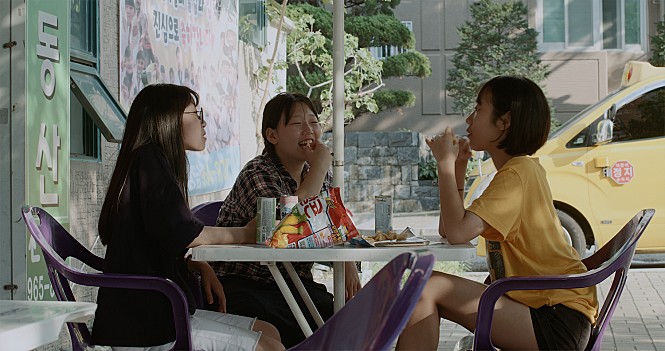
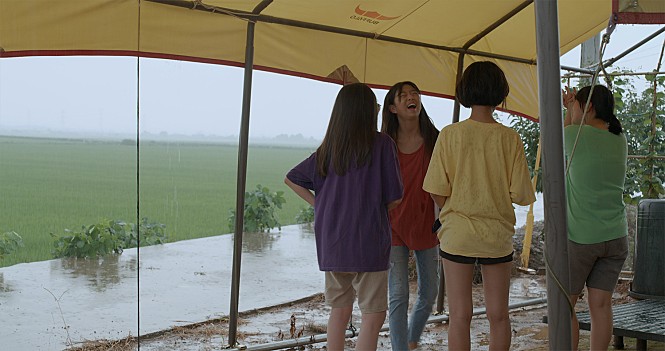
I often wanted to shake my head as watching South Korean film “Snowball”, which mainly revolves around three different adolescent girls who try their best but end up doing their worst. Although it phlegmatically observes their worsening circumstance from the distance, the movie also lets us understand their emotional struggle and confusion to some degree, and we keep watching them even when it becomes quite apparent that something worse will continue to happen among them along the story.

The story is mainly told via the viewpoint of Kang-i (Bang Minah), a 18-year-old high school girl who has been not so happy due to many uncertainties in her daily life. As the only daughter of a rather poor family, she often feels lonely and isolated among many of her schoolmates who are more affluent compared to her, and the only consolation comes from her two close friends Ah-ram (Shim Dal-gi) and So-yeong (Han Sung-min). While Ah-ram is the most miserable one in the bunch due to her abusive father, So-yeong is a confident model student supported by her rich family as well as those teachers of their school, and Kang-i tells us a bit about how much her rich friend can get away with many things at the school.

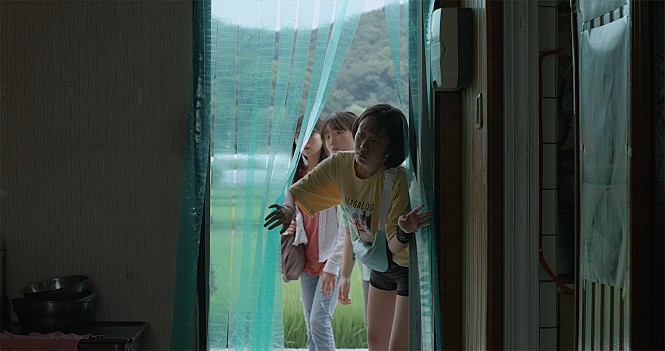
Anyway, both Kang-i and her two friends have been quite suffocated by their school and their respective families, and Ah-ram and Kang-i do not hesitate at all when So-yeong suggests that they should run away and then go to Seoul together. Having aspired to become an actress someday, So-yeong is willing to take a chance with some audition for new talents to be held in Seoul, and both Ah-ram and Kang-i are eager to enjoy much more freedom than before while their friend is preparing for that audition.

However, not so surprisingly, things do not go well for all of them as they soon come to face harsh reality, though the movie thankfully restrains itself from showing too much of their dark and seedy circumstance. When they happen to be on an alley without nowhere else to go, they come across a guy who not only gives them some money but also allows them to sleep at his small residence, and we are naturally concerned about what may happen next, but then this awkward situation is turned upside down to our little dark amusement.

Kang-i and her two friends later manage to get some other place where they can stay for a while, but they are still stuck in their increasingly despairing circumstance. Not long after So-yeong fails in that audition, Ah-ram lets herself get involved with someone who leads her to a certain job not suitable to any adolescent girl, but she does not seem to mind this at all in addition to bringing a little stray cat to their temporary staying place.

While Ah-ram is often absent day by day, Kang-i and So-yeong remain stuck in their temporary staying place without nothing much to do. As getting more frustrated with their ongoing ennui, So-yeong becomes rather harsh to Kang-i, and Kang-i does not know how to deal with her friend’s increasingly edgy attitude toward her, but then the emotional tension between them is developed into something quite unexpected on one day.

In the end, after getting so tired of how they have been going nowhere, Kang-i and her two friends eventually decide to return to their families. While So-yeong resumes her school life as if nothing had happened at all, Ah-ram gets exactly what she expects from her abusive father, Kang-i’s position is somewhere between her two friends’ respective positions. Although her parents are sincerely relieved to see her returning to their home, the mood is pretty strained between her and her parents, and they are all clumsy when they try to talk a bit with each other over a dinner table.

It seems that our three girls will eventually graduate as long as they do not make any fuss during next several months, but, alas, they get into more troubles as they frequently conflict with each other. Probably because of her shame from what happened between her and Kang-i at that time, So-yeong begins to bully Kang-i along with several classmates of theirs, and that throws Kang-i into more anger and confusion. In case of Ah-ram, she does not help either of her two friends much as swayed back and forth between her two friends, and she is already considering running away again.

It is not so pleasant to see how the circumstance among these three main characters gets worse and worse due to their unwise choices and foolish deeds, but director/writer Lee Woo-jeong, who adapted Lim Sol-ah’s acclaimed novel “Best Life” for the film, keeps engaging us via her competent and thoughtful handling of story and characters. Even when its three main characters become quite unsympathetic, the movie does not lose any of understanding and empathy toward them as maintaining its calm and sober attitude as usual, and its three main cast members are believable in the complex relationship dynamics among their characters.

On the whole, “Snowball” is not something you can casually watch on Sunday afternoon, but it is still worthwhile to watch because of its good storytelling and solid performances, and Lee, who previously made several short films besides working as an actress at times, made a commendable feature film debut here. I do not think I can soon revisit the film, but it is one of the more interesting South Korean films of this year, so I recommend you with some caution.

Posted in Movies | Tagged , , , , | 2 Comments