Attica (2021) ☆☆☆1/2(3.5/4): Five Days in Attica, 1971

Documentary film “Attica” looks into the uprising at the Attica Correctional Facility, New York in 1971, and it tells and shows much more than what I vaguely knew about this incident. To be frank with you, I only came to know a bit about this incident via that certain big scene in Sidney Lumet’s “Dog Day Afternoon” (1975), and the documentary surely enlightened me a lot on why it is still notorious as a sobering reminder of how problematic the American prison system has been during last 50 years.

When the uprising suddenly happened on September 9th, 1971, it felt like something inevitable to many prisoners and guards in the facility because the mood inside the prison had been pretty tense for a while due to the growing discontent and resentment among hundreds of prisoners in the facility, who had been quite angry about their lousy condition of life in the facility. For example, they were not supplied with enough necessities such as toilet paper, and their daily meals were quite bad in terms of quality and quantity to say the least. In addition, many of prisoners were constantly abused and harassed by the guards, and the documentary sharply points out the considerable racial gap between the guards and the prisoners, who were mostly African or Hispanic Americans in contrast to those all-white guards in the facility.

After they swiftly took over the prison within several hours, they strongly demanded a number of necessary reforms to Russell G. Oswald, who was the New York Commissioner of Corrections at that time. Although lots of policemen were ready to strike down the prisoners at any point, the prisoners already held a bunch of hostages in the facility, and Oswald was willing to do some negotiation with the prisoners, but things did not go quite well for him due to his rather sloppy handling of the situation. He boldly entered the facility for his negotiation with the prisoners, but, mainly thanks to those TV reporters outside the facility, it did not take much time for the prisoners to realize that he was not that reliable, and so they subsequently demanded to negotiate with a committee consisting of a number of more reliable public figures including a prominent civil rights lawyer named William Kunstler (Yes, he was that lawyer played by Mark Rylance in “The Trial of the Chicago 7” (2021)).

As several surviving committee members attest to us during their interviews, they and their fellow committee members came to empathize a lot with how angry and desperate the prisoners were, and the committee members and several representatives of the prisoners subsequently worked together more on what the prisoners really wanted. As a result, they demanded 30 things to be reformed besides the guarantee of amnesty on the uprising, and it seemed that things would work out fairy well for both the prisoners and the New York State government.

However, the situation unfortunately became far less advantageous for the prisoners when one of the injured guards eventually died not long after he was taken out of the facility. While many family members of those hostages in the facility became more concerned about the safety of their loved ones, the New York State government was more pressured to end the uprising as quickly as possible, and the prisoners became more nervous about whether their defiant stand would lead to nothing in the end.

This increasingly complicated circumstance could be solved a bit at least if the New York State government stepped back a little, but Governor Nelson Rockefeller preferred not to do that at all simply because he did not want to damage his public image as a Republican politician who had always emphasized law and order just like President Richard M. Nixon. As a matter of fact, President Nixon virtually allowed Governor Rockefeller to do whatever was necessary for crushing the prisoners, and, once the negotiation process reached to the inevitable dead end, Governor Rockefeller sent not only the police but the National Guard into the facility.

Alternating between a number of people who were prisoners in the facility and a National Guard soldier who was there at a that time, the documentary conveys to us how the uprising was brutally and atrociously suppressed on September 13th. Most of prisoners, who were not armed at all, were quite panic and helpless when the police and the National Guard began to shoot at them without any hesitation, and no less than 29 prisoners and 10 hostages were killed during this pandemonium. Once this massacre was over, the surviving prisoners were relieved a bit, but then there came another horrible ordeal for them, and the documentary shows us a series of disturbing photographs shot in the facility during that terrible time.

The documentary also listens to the family members of several prison guards who were in the facility during the uprising, and it is clear that they were also quite traumatized by what happened in the end. Although they subsequently received considerable compensation from the New York State government after filing a lawsuit against it, they are still sad and angry about the death of their loved ones, and we come to discern more of how unjust the brutal suppression of the uprising in Attica really was.

In conclusion, “Attica” is a terrific documentary which thoroughly examines its historical subject without losing any human dimension, and directors Stanley Nelson and Traci Curry did a commendable job on the whole. Considering how the system has not changed much during next five decades, the documentary is certainly relevant and enlightening, and you will reflect more on its social issues after watching it.


Posted in Movies | Tagged , , , , , | 1 Comment

Nowhere Special (2020) ☆☆1/2(2.5/4): Before he dies

“Nowhere Special” is a mildly poignant drama film about a decent guy who simply wants his young son to have a good life after he is gone. Although it thankfully avoids sappy sentimentality as earnestly rolling its story from one episodic point to another, the movie is a bit too muted and reserved to engage me enough, and that is a shame considering some good efforts shown from this rather passable work.

At first, the movie, which is set in Belfast, Northern Island, shows us how much John (James Norton) cares about his young son Michael (Daniel Lamont). Since his foreign wife left them some years ago, John has tried to raise Michael alone by himself, and it looks like he has been doing a good job on that. We see him taking his son to his son’s kindergarten before beginning another workday of his, and their bond is palpable to us even when they do not speak with each other.

However, there is one big problem. John has actually been terminally ill (The movie never specifies that, by the way), and he does not have any close family member to take care of his son after he dies. Besides, as a menial laborer, he has been barely making ends meet day by day for him and his son, and he is certainly quite worried about his son’s welfare in the future.

At least, John gets some help from a couple of social service workers, who willingly introduce him to a number of people who seem ready to take care of his son. At one point, he visits an affluent middle-class people who look like ideal foster parents for his son in many aspects, but he cannot help but hesitate because he does not feel that right about these people and, above all, there are still several other candidates to meet besides them.

The other candidates are also fairly good, but, not so surprisingly, each of them has each own flaw to notice. When John and Michael later visit one jolly middle-aged couple, they are surely happy to meet John and Michael, but they do not look that dependable even if John could overlook their age. In case of some other candidate couple, they already have several other kids under their foster care, so they look more dependable in comparison, but, as observing their constantly busy domestic environment, John only comes to feel more uncertain about whether his son will be able to grow up well there.

Naturally, John wants to see more candidates, but he is running out of time day by day, and his increasingly weakening body often reminds him of that grim harsh truth. He still works as usual, but it becomes more apparent that there will soon be the time when he cannot possibly hide his terminal illness from his son, and he becomes more conflicted about that. Maybe he should tell everything to his son before it is too late, but he does not want to hurt his son’s feelings, and he is even not so eager to leave anything to his son. After all, he is just a common working-class dude who does not have anything to distinguish himself, so he sees no point in his son getting to know more about him later.

Nevertheless, John cannot help but feel happy whenever he spends time with his son, and the movie gives us several mundane but genuinely intimate scenes as they go through their daily routines together. While Michael can often be rather willful, John always handles his son with tender tactfulness, and there is a brief but touching moment when they casually enjoy their little free time together outside.

In addition, John also gets some consolation from an old friendly widow who has employed him for a long time. This generous lady, who could take care of his son if it were not for her old age, is ready to listen to his growing concern over his son’s welfare as well as his impending death, and her words comfort him a bit even though he does not agree much to her personal belief on afterlife.

Of course, there eventually comes a point where John must make important decisions for his son, but the screenplay by director/writer/co-producer Uberto Pasolini, who was Oscar-nominated for producing “The Full Monty” (1997), does not hurry at all even at that point, and the movie sticks to its calm and phlegmatic attitude as before. You will probably not be that surprised by which candidate John will choose for his son in the end, but you may be touched by a little quiet but heartfelt scene where John carefully conveys to his son what is going to happen to him sooner or later.

Although his character is a bit too flat and colorless, James Norton, a British actor who previously drew my attention for his solid lead performance in Agnieszka Holland’s “Mr. Jones” (2019), compensates for that via his diligent acting, and he and young performer Daniel Lamont are effortless in their unadorned interactions on the screen. Right from their very first scene, they are convincing as a father and a son, and I wish the movie delved more into their characters’ relationship instead of simply regarding them from the distance.

Overall, “Nowhere Special” has some admirable qualities, but I am still hesitating to recommend it because I observed its story and characters only with a mild degree of care and attention. It is surely sincere and sensitive to the core, but it could have more substance and personality in my trivial opinion, and I will just let you decide whether you will watch it or not.

Posted in Movies | Tagged , , | Leave a comment

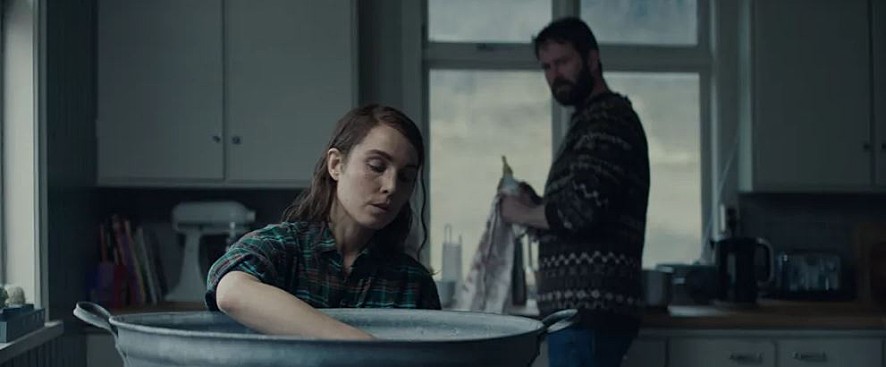
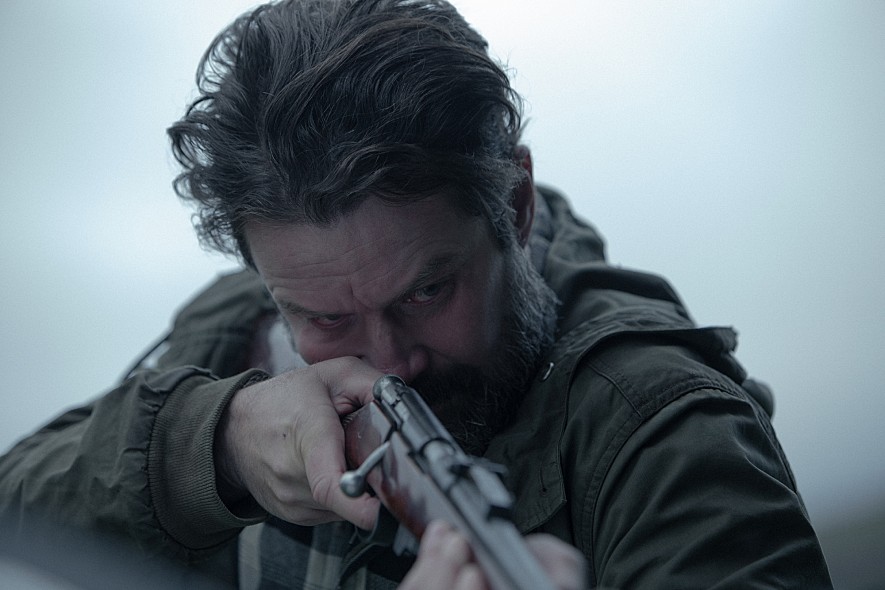
Lamb (2021) ☆☆☆(3/4): A coldly unnerving drama from Iceland

Icelandic film “Lamb”, which was recently included in the shortlist for Best International Film Oscar, is a coldly unnerving drama which intrigues us with its very weird story premise at first. Although its final few minutes is a letdown compared to what has been so carefully built up in terms of mood and details, the movie is still fairly impressive on the whole thanks to its mood, storytelling, and performance, and I observed it with some curiosity and fascination despite becoming a bit impatient from time to time.

After the opening scene which succinctly sets the ambiguously ominous tone on the screen, the movie shows us the daily life of Maria (Noomi Rapace) and her husband Ingvar (Hilmir Snær Guðnason). They have run a farm located in some remote rural place, and nothing seems to be particularly bad in the farm, but we gradually come to sense something missing in their rather isolated life. While they are seemingly happy to be with each other, they do not have any child between them, and the camera often observes how empty and barren their supposedly cozy domestic environment is.

And then something quite unexpected happens. When one of the female sheep under their care is about to go through its delivery stage, Maria and Ingvar are certainly ready to help its delivery, but then they are surprised and flabbergasted to see a very strange creature coming out of that female sheep. The camera simply looks at their confused faces for a while instead of showing this creature in details, but that is more than enough for us to discern how extraordinary their situation is.

For a reason to be revealed later in the story, Maria decides to take care of the creature for herself, and Ingvar goes along with that without any hesitation as her good husband. As the creature grows day by day, Maria becomes more emotionally attached to it, and Ingvar does not mind that at all because, well, the mood in their house becomes less barren than before.

Now I should be more discreet here for not spoiling your entertainment, but I can tell you instead more on how director/co-writer Valdimar Jóhannsson and his crew members including cinematographer Eli Arenson and editor Agnieszka Glinska subtly accumulate more mood and tension on the screen. While Arenson’s camera frequently looks around the cold and stark landscapes surrounding the main characters in the story, the movie is imbued with some uncanny atmosphere, and that is further enhanced by the ambient score by Þórarinn Guðnason. As a result, we become more involved in the story while also wondering more about what may happen next to the main characters.

During the second act, the situation becomes a bit complicated as another character enters the picture. When this figure subsequently sees what Maria and Ingvar are doing in their house, there understandably comes a personal conflict between them and this figure, but then this figure cannot help but feel some compassion to how much Maria and Ingvar care about the creature, who is virtually their dear child around that point.

So far, I have been rather vague about the creature in the film. If you have seen its trailer, I am sure you already have a pretty good idea about how the creature looks, but the movie will tantalize you as showing the creature bit by bit before fully revealing it at last. I do not dare to tell you about how it exactly looks, but it somehow reminds me of that hybrid creature in “The Fly” (1958). Although I could clearly see how the creature is presented on the screen via CGI and some practical special effects, it looks convincing on the screen nevertheless, and that is one of the main reasons why the story works despite its preposterous aspects.

Anyway, the circumstance eventually becomes less tense and more cordial among the four main figures in the story, but then the movie slowly dials up the level of creepiness bit by bit. As implied by the opening scene, the birth of the creature is not merely accidental at all, and we come to sense more of something lurking around the farm.

What is finally revealed around the end of the film will not surprise you much in addition to feeling rather anti-climactic, but its main cast members still hold our attention as before. As she previously did in “The Girl with the Dragon Tattoo” (2009), Noomi Rapace, who also serves as the executive producer of the film along with Béla Tarr, does not step back at all from her character’s several intense emotional moments, and she and Hilmir Snær Guðnason click well with each other even during a number of silent moments between them. As another substantial part of the story, Björn Hlynur Haraldsson brings some cheerfulness to the movie, and he has its own small moment when his character brightens up the mood a bit for others at one point.

In conclusion, “Lamb” is not entirely without flaws, but it is still an intriguing piece of work nonetheless, so I recommend it with some reservation. After Leos Carax’s “Annette” (2021) and Julia Ducournau’s “Titane” (2021), here comes another offbeat film of this year which deserves to be remembered along with these two other films for a good reason, and I assure you that you will not be disappointed if you are looking for something odd and different.

Posted in Movies | Tagged , , | Leave a comment

The Forever Prisoner (2021) ☆☆☆1/2(3.5/4): It was torture indeed

HBO documentary “The Forever Prisoner” is often sobering and chilling in its calm but blistering presentation on what the US government allowed to happen in the name of War on Terror. While it did not surprise or shock you much if you are familiar with its main subjects, the documentary is still captivating as providing a close look into how that infamous ‘interrogation’ technique was developed and then applied to one particular detainee, and you may find yourself often horrified by what he went through, regardless of what do you think about him.

Director/writer/co-producer Alex Gibney, who has been known for various acclaimed documentary films ranging from “Enron: The Smartest Guys in the Room” (2005) to “Totally Under Control” (2020), interviewed a number of different figures involved with handling that detainee after he was captured in 2002, and they are all quite willing to talk a lot about how much CIA and FBI were pressured at the beginning of War on Terror. As the American society was still quite traumatized with grief and anger after the 9/11 incident, President George W. Bush and his administration were quite determined to do anything for preventing the next possible terrorist attack in addition to capturing those Al-Qaeda leaders including Osama bin Laden. Naturally, CIA and FBI were ready to gather any valuable clue or information by any means necessary, and that was how more drastic ways of interrogation came to be discussed in the top echelon of CIA and the White House. Under the approval from the White House, CIA soon developed “Enhanced Interrogation Techniques” (EIT), and those lawyers working for CIA and the White House made sure that EIT is not technically torture on paper at least for legal protection.

Dr. James Mitchell, a former CIA psychiatrist who was one of the key figures in the development of EIT, does not hesitate at all as casually talking about how he developed the methods and protocols of EIT, which are sort of a reverse version of certain US military training programs for making soldiers prepared for any harsh enemy interrogation. Although these programs turned out to be too risky and deleterious for soldiers, nobody in CIA asked other experts about that, and Dr. Mitchell gladly worked on the development of EIT because, well, he thought it was necessary evil for stopping another 9/11 in the future.

And his new ‘interrogation’ techniques were soon applied to a Saudi Arabian guy named Abu Zubaydah. Although he was not technically associated that much with bin Laden or several other top-ranking figures of Al-Qaeda, Zubaydah was an independent operator who had done a number of different things for Al-Qaeda, and that certainly made him a potentially important source of information for CIA and FBI.

Former FBI agent Ali Soufan, whose story with Al-Qaeda before 9/11 was dramatized in HBO miniseries “The Looming Tower”, tells us about how things went pretty well when he and a fellow FBI agent of his interrogated Zubaydah at some covert place located somewhere in Thailand. Once they tactfully made Zubaydah think that they knew everything from the start, it was not difficult for them to make Zubaydah talk more, and this actually helped FBI stopping some other terror plans in US in addition to identifying a top-ranking Al-Qaeda figure who was incidentally the mastermind of 9/11 right under bin Laden.

However, quite jealous of what was just accomplished by FBI, CIA wanted to squeeze more information from Zubaydah, and so did the White House. After their lawyers prepared the legal ground to sanction EIT and then FBI was pushed out of the scene, CIA embarked on applying EIT methods to Zubaydah, and a series of document excerpts and Zubaydah’s own drawings convey to us a bit of how ruthlessly and relentlessly Zubaydah was pushed into several EIT methods including, yes, waterboarding.

Not so surprisingly, what CIA extracted from Zubaydah in the end was pretty worthless to say the least, but it labelled this negative result as a success just because, well, they ‘succeeded’ in proving that Zubaydah had nothing else to hide besides what he already told to FBI. As a consequence, EIT methods were widely utilized in not only CIA but also the US military, and this alarming trend eventually culminated to those shocking photographs from the Abu Ghraib prison.

Daniel J. Jones, whose US Senate investigation on CIA was dramatized in Scott Z. Burns’ 2019 film “The Report”, tells us about how those high-ranking CIA and White House officials managed to get away with what they committed in the name of War on Terror. Although President Barack Obama subsequently recognized in public that CIA indeed tortured detainees, nobody went to jail for that, and Gibney sardonically points out how many of them, including Dr. Mitchell, came to have extra benefits later while Zubaydah was kept detained by the US government as before. After subsequently moved from one covert place to another around the world, Zubaydah has been stuck in Guantanamo for more than 15 years, and it looks like he will be there forever unless the US government changes its opinion on him.

On the whole, “The Forever Prisoner” is another incisive documentary on War on Terror, and I recommend you to watch it with Gibney’s Oscar-winning documentary “Taxi to the Dark Side” (2007), which is about one wrongfully accused Afghan taxi driver who was killed by American soldiers while being held in extrajudicial detention and interrogated at a black site at Bagram air base. In my humble opinion, these two excellent documentaries will make a good double feature show on War on Terror, and they will surely remind you more of how disastrously the US government failed in that during last 20 years.

Posted in Movies | Tagged , , , , , | Leave a comment

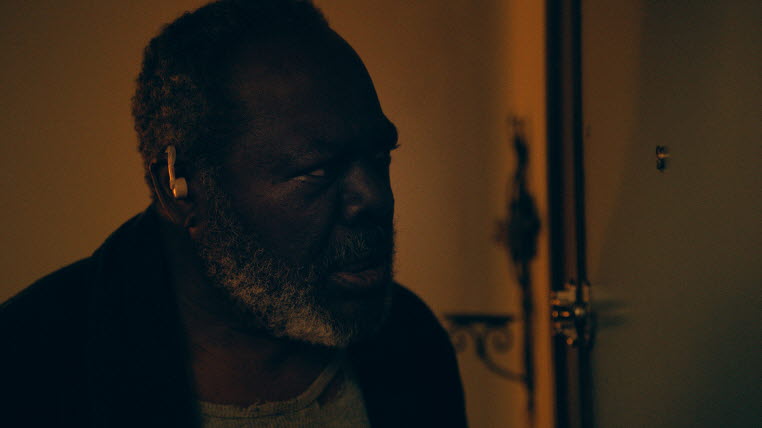
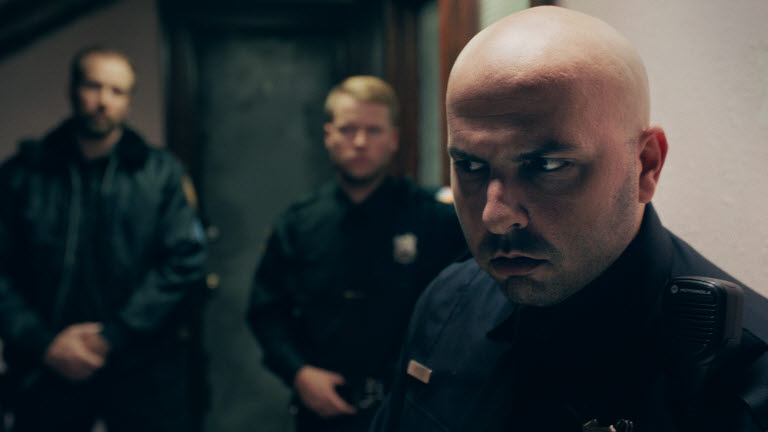
The Killing of Kenneth Chamberlain (2020) ☆☆☆(3/4): That tragic incident

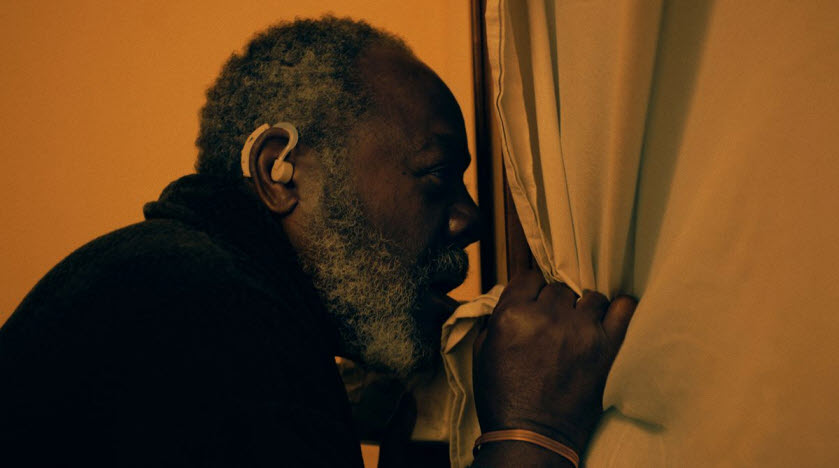
“The Killing of Kenneth Chamberlain” shook me up a lot when I watched it at last night. Based on one tragic real-life incident which occurred in one poor neighborhood of White Plains, New York during the early morning of November 29th, 2011, the movie is alternatively infuriating and harrowing in its vivid and realistic presentation of mental illness and police brutality, and it is also firmly anchored by its strong lead performance which is incidentally one of the best performances of this year.

The movie opens with its ill-fated hero sleeping in his small apartment. He is a 70-year-old African American ex-marine named Kenneth Chamberlain (Frankie Faison), and we gradually come to gather that he lives alone in his residence despite his several serious health problems including his weak heart condition. He wears a beeper just in case for his medical emergency, but he happens to activate it by coincidence while he is sleeping, and there soon comes a phone call from his medical service company.

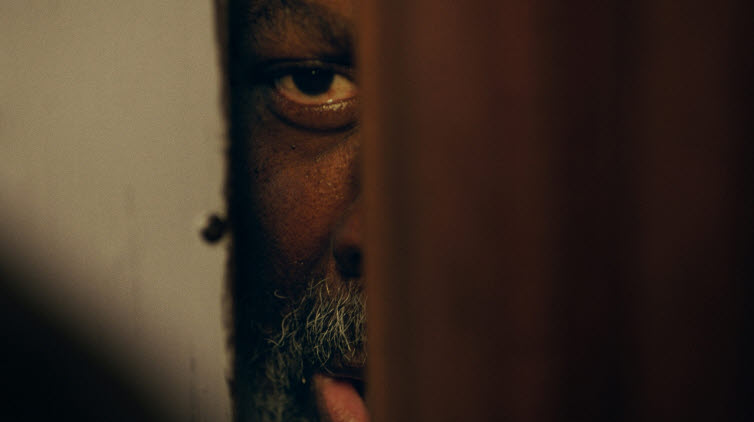
Because Chamberlain does not answer the phone call while still sleeping, his medical service company follows its protocol as usual. Several minutes later, a trio of local police officers come into the apartment building, and then they knock on the door of Chamberlain’s apartment just for checking whether everything is okay in his apartment. Awakened by the sound of knocking, Chamberlain tries to process this sudden unexpected situation, but we can clearly sense that he is not in his best condition at all. Besides his weak physical status, he has also struggled with considerable mental illness, and that is the main reason why he becomes so rattled that he refuses to open the door for the police officers outside his apartment.

After this narrative point, we see how tension slowly escalates between Chamberlain and the police officers. Suspecting that Chamberlain is hiding something in his apartment, the police officers become more hostile and aggressive than before as knocking his apartment door again and again, and that certainly makes Chamberlain a lot more disturbed than before. Although he tries to be as sensible as he can, it seems that there is nothing he possibly can do except adamantly refusing to open his apartment door, and he also becomes quite paranoid in his increasingly isolated status.

In the meantime, his medical service company does try a bit for him, but it still cannot make the police officers go away, and the same thing can be said about his close family members. One of them actually comes later, but then the police officers does not allow any contact between Chamberlain and this family member of his because, well, they really believe they are doing the right thing. Even though Chamberlain is just a weak and helpless old man, they suspect him without hesitation just because of his background, and this will certainly remind you of numerous other recent tragic incidents involved with police brutality in the American society.

Later in the story, it becomes apparent to the police officers that they are probably making a serious mistake, but, to our frustration and exasperation, they all simply let the situation escalate further with more tension and danger. When one of them comes to have more doubt about Chamberlain, this police officer tries to be reasonable with Chamberlain as well as his colleagues, but he also becomes as helpless as Chamberlain around the time when more police officers come to the apartment building, and the circumstance eventually goes beyond control for him as well as others including Chamberlain, whose mental condition gets worse and worse as the police officers outside his apartment corner him more and more.

What inevitably happens between Chamberlain and the police officers in the film is pretty grueling to say the least, but director/writer/co-producer David Midel, who previously made a feature film debut with “NightLights” (2014), and his crew members including cinematographer Camrin Petramale and editor Enrico Natale, who also plays one of the police officers in the film, did a skillful job of holding our attention to the end. Chamberlain’s final moment in the film is devastating to say the least, and we subsequently come to learn a bit of how much the movie is close to what actually happened to him in real life.

As the center of the film, Frankie Faison, a veteran character actor who has been known for his appearances in numerous movies and TV series (I still remember him well for his brief minor supporting turn in “The Silence of the Lambs” (1991) and “Hannibal” (2001), by the way), is utterly convincing in his character’s gradual mental implosion along the story. Although the movie does not show much of his character’s private life, Faison fills his character with considerable details and nuances, and he is particularly heartbreaking when his character copes with not only the police officers but also his deteriorating state of mind at one point later in the film.

On the whole, “The Killing of Kenneth Chamberlain” looks rather modest on the surface, but it often feels quite intense and sobering thanks to its commendable technical aspects and Faison’s commendable performance, and I recommend it with some caution. Yes, it is surely a tough stuff, but it is still worthwhile to watch in my trivial opinion, and, after watching it, you may come to reflect more on those urgent social issues indirectly raised by the film.

Posted in Movies | Tagged , , , | Leave a comment

Being the Ricardos (2021) ☆☆☆(3/4): Their one challenging week

Aaron Sorkin’s latest film “Being the Ricardos”, which was released on Amazon Prime in last week, works best whenever the characters pull and push each other in their verbal interactions. While it cannot possibly recreate the larger-than-life charm and presence of two legendary American TV stars in the story, the movie is mostly entertaining thanks to Sorkin’s sharp writing and the skillful line delivery of his main cast members, and that is more than enough to compensate for its several weak aspects.

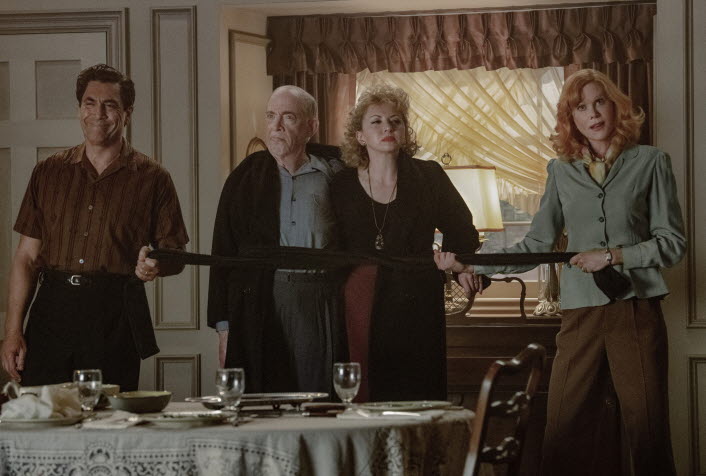
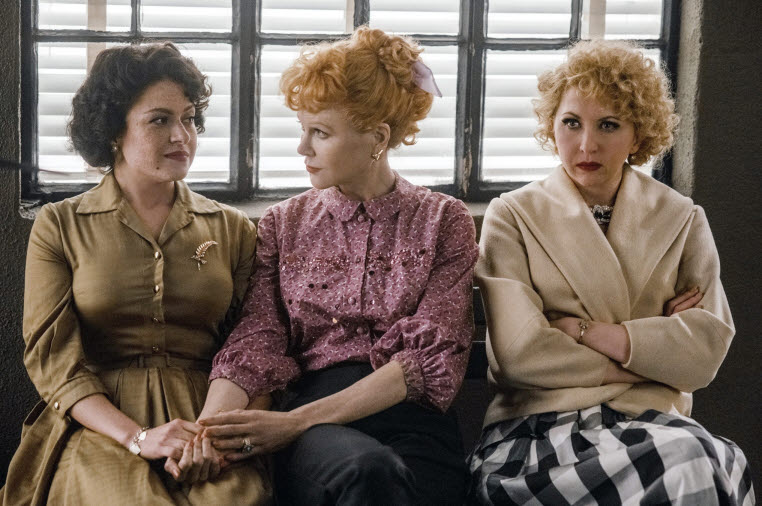
The movie focuses on one rather challenging week of Lucille Ball (Nicole Kidman) and her husband Desi Arnaz (Javier Bardem) in 1952. At that time, Ball and her husband were quite popular for their monumental TV sitcom series “I Love Lucy”, but there came a little trouble when Ball was suddenly suspected of being a communist not long after investigated by the House of Un-American Committee (HUAC). Ball actually did not have much problem compared to many other unfortunate people whose lives were ruined by HUAC, but her whole career could have been considerably damaged, and Sorkin’s screenplay gives us a loosely fictional presentation of how Ball coped with several other matters in her personal/professional life besides that at that time.

At first, the movie shows us Ball and her cast and crew members preparing for another new episode to be shot and then broadcast a few days later. Because it is no secret among them that she was recently investigated by HUAC, everyone around her cannot help but become nervous, but Ball does not give a damn about that because there is nothing of which she is ashamed, and she and her husband lead the script reading as usual.

On the surface, Ball and her husband look like excellent professional partners besides being a model married couple, but there is actually a growing problem in their private life. A local gossip newspaper recently published an article suggesting Arnaz’s infidelity, and, as a wife who knows her charming husband too well, Ball comes to suspect her husband more than before, though he keeps denying while emphasizing that he was not with some girl on a certain day.

Anyway, Arnaz is still a valuable professional partner for his wife in more than one aspect. Besides being a flawless match for Ball’s comic skill and timing, he also diligently takes care of a number of business matters for them and their beloved TV sitcom series, and this particular set of skills of his are certainly useful when he tries to calm down those TV company executives and sponsors behind “I Love Lucy”, who are understandably concerned about whether “I Love Lucy” will be far less popular due to those growing rumors about Ball being a communist.

And then it turns out that there is also the other problem. Ball has actually been in the early period of pregnancy, and Arnaz is willing to incorporate this significant change in their private life into their TV sitcom show, but the TV company executives and sponsors wince and then balk for a good reason. After all, it is the 1950s, and not only sex but also pregnancy was a taboo on American TV at that time. Nevertheless, Arnaz is quite willing to push the boundary a bit, and so is Ball.

Meanwhile, Ball has several other things to deal with. As constantly paying lots of attention to those numerous comic moments to be handled by her and her cast members, she often comes to clash with her director and writers, and there is also some considerable tension between her and Vivian Vance (Nina Arianda), who has played another comic couple in “I Love Lucy” along with William Frawley (J.K. Simmons). Later in the story, she and Vance come to have a real honest conversation about anxiety and rivalry, and that is one of more interesting moments in the film.

All these backstage drama stuffs are alternated with a series of flashback scenes showing how Ball and Arnaz’s earlier years in the 1940s. While she was just a stock actress working in RKO Pictures, Arnaz, who was already a popular entertainer at that time, was instantly attracted to Ball not long after their first encounter, and they soon came to live happily together as a married couple, though they soon found how it was difficult for them to balance themselves between love and career.

I must point out that this part is rather redundant, but it is at least buoyed by the natural charisma of its two good lead performers. Nicole Kidman’s plucky acting ably rises above the level of mere mimicry, and she is also complemented well by Javier Bardem’s suave performance, which shows us that he can be funny and likable in contrast to his various cases of drama acting ranging from “The Sea Inside” (2004) to “No Country for Old Men” (2007). In case of several other notable actors, Nina Arianda steals the show along with J.K. Simmons, and Tony Hale, Alia Shawkat, and Jake Lacy are also solid in their respective supporting roles.

On the whole, “Being the Ricardos” is relatively lightweight to compared to Sorkin’s previous works such as “The Trial of the Chicago 7” (2020), and it is often hampered by some unnecessary parts including those fake interview scenes in the film, but it is still engaging enough on the whole. Yes, this is another your average Oscar season movie of this year, but I had a fairly good time with it, so I will not grumble for now.

Posted in Movies | Tagged , , , , | 1 Comment

The First Wave (2021) ☆☆☆(3/4): Their first several months with COVID-19

Matthew Heineman’s new documentary film “The First Wave”, which was recently included in the shortlist for Best Documentary Oscar, looks at a number of New York City hospital workers and patients who struggled a lot during the first several months of the COVID-19 pandemic. While it simply presents their urgent and desperate struggles on the screen, the documentary has several powerful human moments to observe and appreciate, and you may come to reflect more on how much our human society has been affected by the ongoing COVID-19 pandemic during last few years.

The documentary mainly revolves around Long Island Jewish Medical Center of New York City. At first, it shows us how busy everyone was in hospital when the city was being hit by the COVID-pandemic in March 2020, and we see how strenuously and diligently many nurses and doctors in hospital worked together for saving their COVID-19 patients. As they were frequently overwhelmed by the rising number of new COVID-19 patients, some of their patients died due to various medical complications associated with COVID-19, and that certainly daunted and depressed them a lot.

Nevertheless, the nurses and doctors of Long Island Jewish Medical Center kept going just like thousands of other medical workers in the city. In case of Dr. Nathalie Douge, she continues to try to keep her spirit high as before even though she cannot help but become emotional about those COVID-19 patients who urgently need the medical help and assistance from her and her colleagues right now. As pointed out at one point in the documentary, many of COVID-19 patients in the city are usually Hispanic or African Americans, and, as the child of an African Haitian couple, Dr. Douge often sees lots of her neighbors and family members from many of COVID-19 patients admitted into Long Island Jewish Medical Center.

We also meet several nurses in the hospital, and the documentary comes to focus more on a female nurse named Kellie Wunsch, who is the most spirited one in the bunch. Although she is certainly well aware of the possibility of getting infected at her workplace at any time, she is always ready to try her best for her many COVID-19 patients, and we see how she and her fellow nurses often swing back and forth between relieving victory and saddening defeat as fighting more with COVID-19 everyday. In case of one certain patient, he looks fairly well for a while, but then he somehow succumbs to death not long after that, and that is surely devastating to Wunsch and her colleagues.

Meanwhile, the documentary also shows us how things got worse and worse during next several months. As the lockdown was started in New York City, the city and its citizens struggled more and more with the COVID-19 pandemic, and the workers of Long Island Jewish Medical Center became much busier than before while the death by COVID-19 became more frequent than before. During one devastating scene, the documentary shows a comatose patient dying quietly after it turns out that there is really nothing they can do for him, and what follows next is quiet but equally harrowing to say the least.

At least, there are also some patients who get slowly recovered despite their constantly fragile medical status. In case of a police officer named Ahmed Ellis, he looks rather hopeless as his medical condition often fluctuates, and that surely makes his nurses as well as his wife quite concerned, but then, to everyone’s relief, he gradually gets better day by day. Around the time when he can breathe without the assistance from a respiratory machine, he can barely move or speak, but the worst time seems to be over for him, and then we see him going through his physical therapy sessions step by step.

The documentary also pays some attention to Brussels Joban, a hospital nurse who also struggled a lot with COVID-19 on her hospital bed after she got infected along with her family. Due to her serious medical condition, she had to give birth to her baby much earlier than expected, and then she naturally had to be separated from her baby for a while. Eventually, she embarks on her way to recovery, but nothing is certain even at that point, and her family members are certainly anxious about when she can finally leave the hospital and then return to their home.

The documentary loses its focus a bit when it shows Dr. Douge’s active participation in the public demonstration sparked by the death of George Floyd, but it eventually returns to its main narrative later, and then we get several uplifting moments to remember. Yes, the COVID-19 pandemic is still raging around the world at present, but it is difficult for any of us not to be touched by some small human victories shown in the documentary, and they resonate more with what is presented on the screen at the very end of the documentary.

Overall, “The First Wave” is another good documentary from Heineman, who previously gave us “Cartel Land” (2015) and “City of Ghosts” (2017). In short, this is another notable COVID-19 documentary of this year after “In the Same Breath” (2021) and “Convergence: Courage in a Crisis” (2021), and you will surely appreciate those hard-working medical workers more after watching it. Folks, let’s hope together that they will not toil any more after the next year at least.
Posted in Movies | Tagged , , , , , , , | Leave a comment

Don’t Look Up (2021) ☆☆1/2(2.5/4): An uneven disaster comedy

Adam McKay’s new film “Don’t Look Up”, which was released on Netflix on Christmas Eve after being released at theaters early in this month, attempts to laugh about how absurd and incorrigible we can be in front of one big global disaster, but it comes to resort to a series of cheap and superficial laughs coupled with irritating smugness. Considering the ongoing COVID-19 global pandemic and how many governments including the US government were sloppy and incompetent in their first response to that, the movie could be a timely social/political black comedy for our increasingly disturbing current era, but I am sad to report here that it merely ridicules on our reality instead of reaching to something as unthinkable as Stanley Kubrick’s great comedy film “Dr. Strangelove or: How I Learned to Stop Worrying and Love the Bomb” (1964).

At the beginning, we are introduced to Professor Randall Mindy (Leonardo DiCaprio) and his graduate student Kate Dibiasky (Jennifer Lawrence), who happens to discover a new comet when she is doing her routine work at an observatory associated with Michigan State University. She and others including Dr. Mindy are certainly excited about this unexpected discovery at first, but there soon comes a very grim moment as they embark on calculating the trajectory and route of this comet. It unfortunately turns out that this comet will definitely clash with the Earth after several months, and, considering the immense size of the comet, the eventual clash will surely lead to the end of not only the entire human civilization but also all other life forms on the planet.

Quite alarmed by this terrible discovery, Dr. Mindy and Dibiasky promptly contact with the Planetary Defense Coordination Office as well as NASA, but, to their frustration and exasperation, they do not get much response from either of these two important government organizations. While Dr. Teddy Oglethrope (Rob Morgan) is certainly willing to spread this very important news as much as he can, there are not many things he can do besides that, and the current head of NASA is an utterly incompetent one who has simply occupied the position just because of being a close associate of the current US President.

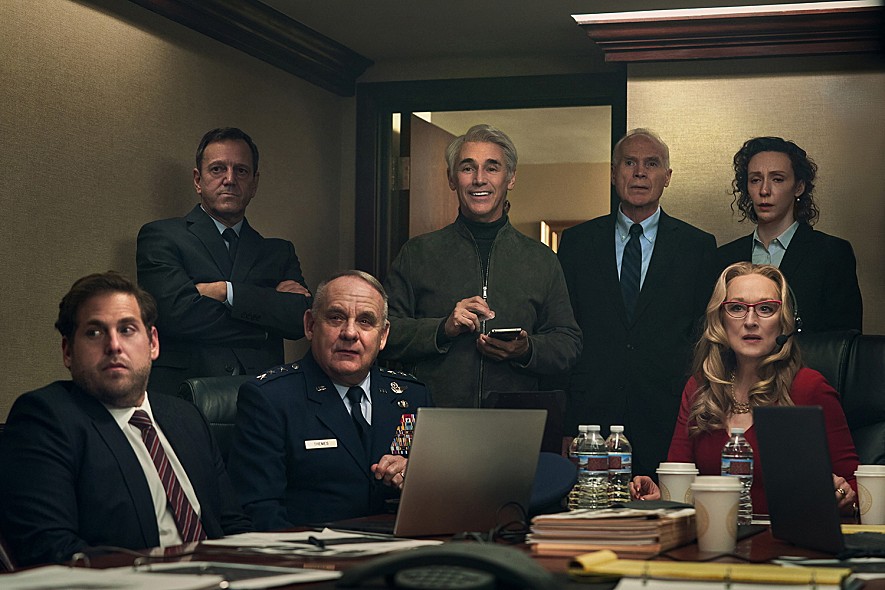
Anyway, Dr. Mindy, Dr. Oglethrope, and Dibiasky finally manage to deliver the news to President Janie Orlean (Meryl Streep), but President Orlean, which is clearly a mix between Sarah Palin and Donald J. Trump, is not so alarmed mainly because she has been occupied with handling her current big scandal as quickly as possible before the mid-term election. She simply wants to put aside the news for a while, and Dr. Mindy and Dibiasky become much more frustrated than before as instructed not to disclose anything about the comet in the meantime.

And that is just the beginning of more absurdities they are going to face along with Dr. Oglethrope. As suggested by Dr. Olgethrope, Dr. Mindy and Dibiasky go to some respectable newspaper which is apparently a fictional version of the New York Times, and they are advised to appear in some popular TV evening news show, but they only come to embarrass themselves when they appear on that TV evening news show. No matter how much they try, nobody seems to discern and realize how grim and serious their news really is, and, not so surprisingly, their embarrassing public moment is spread widely in the world of social media applications for more ridicule and entertainment.

When it looks like everyone including President Orlean finally becomes serious about stopping the comet from clashing with the Earth by any means necessary, things soon go wrong again thanks to the last-minute intervention of a famous (and popular) tech billionaire named Peter Isherwell (Mark Rylance), who is apparently based on Tim Cook and Elon Musk. While quite flabbergasted by this, Dr. Mindy tries his best as before, but he only becomes more helpless than before just like Dibiasky and Dr. Oglethrope, and he also finds himself going astray in his private life as beginning an inappropriate relationship with one of the two hosts of that TV evening news show.

McKay’s screenplay, which is based on the story written by him and his co-writer David Sirota, attempts to juggle many different story elements together for generating one big picture of absurdity and incompetence, but these numerous elements do not gel with each other much as seriously lacking focus and substance to hold our attention. In addition, many of characters in the film are more or less than broad caricatures without much human insight or depth, and McKay’s screenplay merely regards most of them with lazy contempt and shallow ridicule instead of presenting them as the recognizable cases of human errors and foibles for truly amusing and horrifying us.

The movie gathers heaps of notable performers, but they simply occupy each own spot without generating much synergy between themselves. While Leonardo DiCaprio and Jennifer Lawrence are stuck in their thankless straight roles, Rob Morgan, Tyler Perry, Cate Blanchett, Ariana Grande, Melanie Lynskey, Timothée Chalamet, Ron Perlman, and Jonah Hill acquit themselves mostly well, but Meryl Streep and Mark Rylance are unfortunately forced to endure what may be the worst moment in their respective distinguished acting careers.

In conclusion, “Don’t Look Up” does not succeed as well as intended, and the result is another letdown from McKay, who unexpectedly rose higher with “The Big Short” (2015) but then disappointingly fell lower with “Vice” (2018). While it is not entirely humorless, the movie still feels like a big waste of considerable talents gathered on the screen, and now I come to feel more urge to revisit “Dr. Strangelove”. While that great comedy film really shocked me with its absurdly inevitable conclusion when I watched it for the first time in 1996, “Don’t Look Up” did not surprise or shock me at all with its quite predictable arrival point, so I recommend you to skip it and then watch “Dr. Strangelove” instead.

Posted in Movies | Tagged , , | 2 Comments

8-Bit Christmas (2021) ☆☆1/2(2.5/4): A mixed Christmas tale

“8-Bit Christmas” is neither sweet nor naughty enough to generate some good laughs from me. While it wants to be one of those nostalgic childhood Christmas tales, it is rather too broad and cartoonish in terms of story and characters, and it is often a bit too self-conscious in distracting ways. Although it also wants to be naughty during a number of silly and absurd scenes, these moments feel rather cheap and artificial in my humble opinion, and you will be just mildly amused from time to time during your viewing.

The story mainly revolves around a young boy named Jake Doyle (Winslow Fegley), and his wacky Christmas tale of 1988 is shown to us bit by bit as adult Jake, played by Neil Patrick Harris, is enthusiastically describing it to his young daughter. During that time, those 8-bit Nintendo video games were pretty cool and exciting to many kids around Jake’s age, and we see many neighborhood kids including him gathering around the house of some rich little prick, who has been so far the only one who has a Nintendo video game player in their neighborhood. Although he does not get much chance to play those Nintendo video games, Jake is more awed and impressed as watching that rich kid having a fun in front of him and several other kids, and he comes to yearn more for having a Nintendo game player of his own.

However, the situation is not particularly good for Jake at present. Although they are preparing a lot for the upcoming Christmas season, neither of his parents cares that much about what their son wants to have on Christmas. While his father, who is usually occupied with some private carpentry projects of his, wants Jake to play outside more instead of playing video games, his mother does not approve much of video games as a schoolteacher, and both of them seem to be more focused on getting what Jake’s younger sister wants, which is incidentally another nostalgic item in the film.

Meanwhile, we are introduced to a bunch of other characters at Jake’s elementary school, who are more or less than silly caricatures instead of being realistic enough to hold our attention. In case of a school bully in the story, you may be amused to see this character being played by an actor much older than other young performers around him, but I must say that this character becomes more tiresome whenever he enters, and that is the main reason why that eventual payoff moment between this character and Jake later in the story does not work as well as intended.

Anyway, every student in the school is quite excited when they come to learn that there is an opportunity for getting a Nintendo video game player, and that is naturally followed by a series of comic moments as Jake and many other kids in the neighborhood try their best to win in their increasingly intense competition. Once he receives some helpful tip from his younger sister, Jake goes all the way for attaining his goal, but, of course, that turns out to be a lot more challenging than expected, and, this is not much of a spoiler, he is quite disappointed by what he gets in the end.

Nevertheless, Jake does not give up at all. He and several schoolmates subsequently concoct a plan involved with their upcoming field trip to Chicago, and the mood naturally becomes cheerfully suspenseful as he has to deal with several obstacles while helped a bit by his accomplices. At one point, one of them deliberately makes himself pretty sick in advance for buying some time for Jake, and I will let you decide whether this is merely gross or quite hilarious.

Watching how the movie arrives at its expectedly sentimental finale, I could not help but think of Bob Clark’s wonderful classic Christmas family film “A Christmas Story” (1983), which is a lot better movie in many aspects. Yes, the main characters of “A Christmas Story” are also broad archetypes to say the least, but they are depicted with recognizable human qualities, and we accordingly become more amused and touched along the story. In case of “8-Bit Christmas”, we only observe shallow comic caricatures merely doing silly things on the screen, and I must tell you that none of their supposedly humorous moment reaches to the sweet and sublime hilarity of “A Christmas Story.”

Anyway, Winslow Fegley, the younger brother of Oakes Fegley, and a number of other young cast members of the film do their best with their respective roles, and it is a shame that the movie does not utilize more of their natural presence while only having them stuck with their glaringly flat characters. In case of several notable adult performers in the film, Steve Zahn and June Diane Raphael are also regrettably under-utilized as their good efforts are often hindered by their underdeveloped supporting parts, and Neil Patrick Harris acquits himself fairly well despite his thankless role as the narrator of the story.

On the whole, “8-Bit Christmas” is not entirely without fun and entertainment, but I doubt whether it will be remembered as long as “A Christmas Story” or “Bad Santa” (2003), which can be a better alternative for you if you want a truly naughty fun for the Christmas season instead of having a sweet fun from the former. Sure, the movie reminded me of how serious I was once about getting what I wanted on Christmas, but, unlike “A Christmas Story”, it only came to scratch the surface of that childhood memory of mine, and that is all.

Posted in Movies | Tagged , , | Leave a comment

The Matrix Resurrection (2021) ☆☆1/2(2.5/4): The Matrix Rehashed

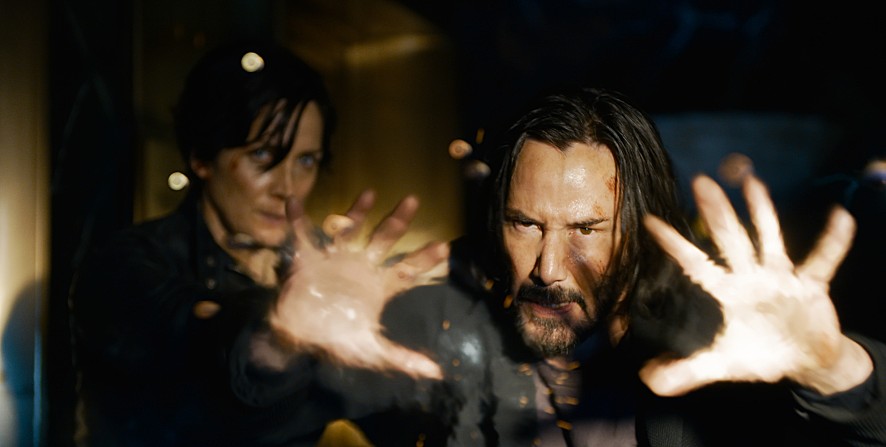
“The Matrix Resurrection” is more or less than a rehashed product mixed with some self-conscious stuffs to amuse any fan of the previous trilogy for a while. Although it is engaging and ambitious to some degree thanks to several intriguing story ideas, the movie is still stuck deep in the very familiar territory of the previous trilogy without transcending or surpassing it at all, and I often felt impatient and dissatisfied as not caring that much about whatever is revealed along its rather incoherent narrative.

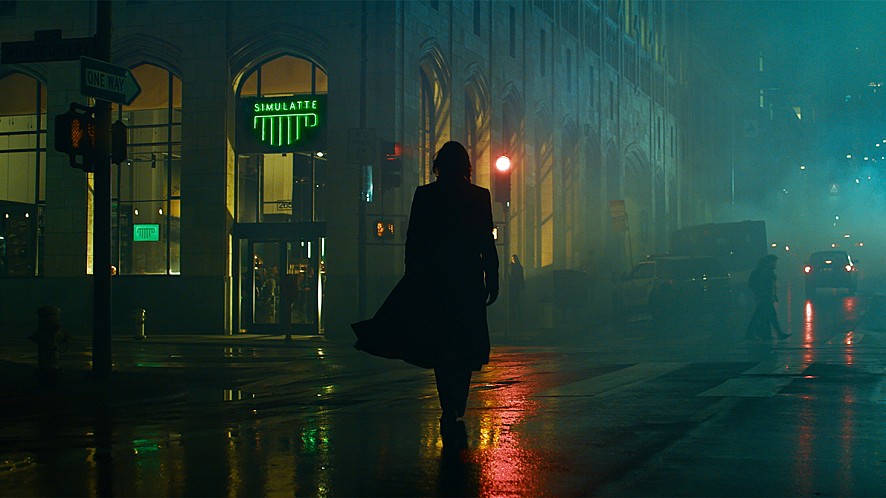
At first, the movie seems to be trying something really different. Keanu Reeves, who previously played the messianic hero of the previous trilogy, is back, but his character in the film is still Thomas A. Anderson, who has worked in some big video game company as one of its key developers since developing his very popular video game named, yes, “The Matrix” many years ago. As a matter of fact, his game was already turned into a trio of blockbuster films by a certain famous movie company, and the company has already been planning on making another sequel based on Anderson’s iconic video game.

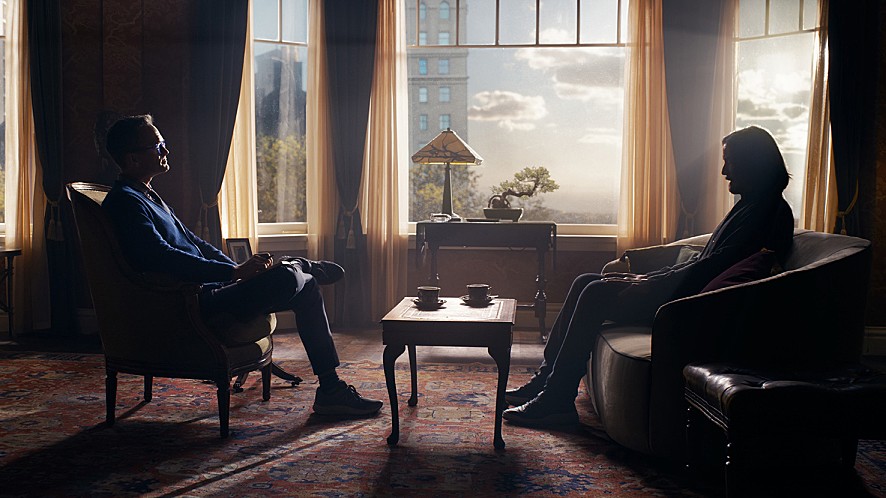
However, things have been not that good for Anderson these days. He has been pressured a lot by his boss to focus on the current development project as well as the new version of “The Matrix” which will be the basis of that upcoming film, and he also has been struggling with a seemingly serious mental issue. As often consulting with his psychiatrist and then getting medicated with pills of a certain color, Anderson tries to keep things under control, but, of course, things become all the more confusing for him as several mysterious figures subsequently appear in front of him.

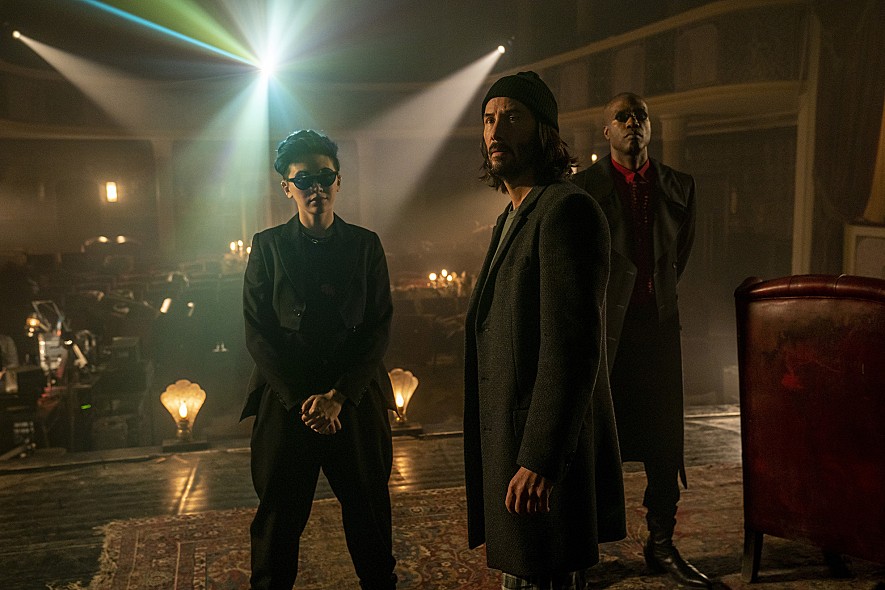
I will not go into details here, but what follows next will not surprise you much if you are familiar with the previous trilogy like me. While our hero is getting more confused with lots of things happening around him, we get a number of very familiar action scenes including the one clearly reminiscent of the electrifying opening action sequence of “The Matrix” (1999), which is frequently quoted along with its two following sequels throughout the film. Although the action scenes in the film are a bit too choppy and busy compared to the ones in the previous trilogy, they are executed fairy well on the screen at least, and Reeves, who is having another peak of his career mainly thanks to the recent considerable success of “John Wick” (2014) and its two sequels, looks convincing just like several main cast members in the film including Yahya Abdul-Mateen II, Jessica Henwick, and Jonathan Groff, who often has a ball with playing his villainous supporting character.

In the meantime, the screenplay by director/co-producer/co-writer Lana Wachowski and her co-writers David Mitchell and Aleksander Hemon attempts to expand and then advance with what was initiated, developed, and then resolved in the previous trilogy, and that brings us back to a bunch of familiar story elements in the previous trilogy. Personally, I enjoyed watching how Jada Pinkett Smith reprises her role while looking quite older, and Smith has a little fun with her supporting role as playing as straight as possible.

I surely felt a bit nostalgic as observing these and other recognizable things in the film, but I also could discern how it often stumbles as trying to juggle lots of different things besides action. In case of its usual philosophical mumbo-jumbo, I assure you that there is plenty of that in the movie, but they are still rather superficial as before, and the same thing can be said about one supposedly humorous discussion scene on how the Matrix trilogy can be interpreted. As your average seasoned amateur movie critic, I was not so impressed because there is nothing particularly new for me in that scene, and I dare to bet that one inconsequential gag scene at the end of the end credits will linger on my mind longer than that.

As going back and forth between nostalgia and disappointment, my mind came to muse on how much things have changed since “The Matrix” came out in 1999. Although I was not very enthusiastic about it in contrast to many of you, it was surely an industrial game changer, and it remains iconic even at present although its many supposedly cool aspects are not that fresh these days. During last 22 years, actions and special effects in the film are much more technically advanced, and nothing in “The Matrix Resurrected” feels ground-breaking to us, except frequently reminding us of how eye-popping “The Matrix” was to us at that time.

In my humble opinion, the Wachowskis simply brought some extra style and mood to quite old and familiar science fiction ideas when they made “The Matrix”, and that was the main reason why they spectacularly failed in “The Matrix Revolution” (2003) after trying to soar higher in “The Matrix Reloaded” (2003). In case of “The Matrix Resurrection”, the movie sincerely tries to go further than that via its new story ideas, but, again, it eventually resorts to its old playbook for more nostalgia as eventually running out of new story elements, and the overall result is as disappointing as Jason Leitman’s “The Ghostbusters: Afterlife” (2021), which also sticks to its old playbook too much just for pleasing its target audiences.

In conclusion, “The Matrix Resurrection” is a nostalgic disappointment, and I and a friend of mine were not particularly excited when we came out of the screening room with other audiences at last night. I felt quite tired at that time, but I decided to show my friend Alex Proyas’s underrated SF gem “Dark City” (1998) right after that, and I think that compensated enough for our disappointing time at the movie theater. To be frank with you, I would rather recommend “Dark City” instead of watching “The Matrix Resurrection”, and I assure you that you will have a much more interesting time.

Posted in Movies | Tagged , , | Leave a comment