Elvis (2022) ☆☆1/2(2.5/4): Extremely excessive and incredibly superficial

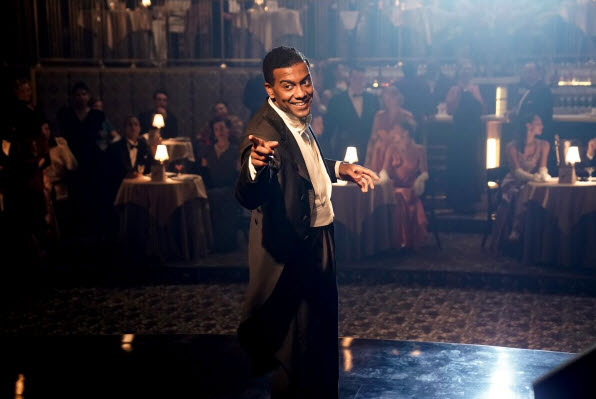
Baz Luhrmann’s latest film “Elvis” is extremely excessive and incredibly superficial. Like many of his previous works such as “Romeo + Juliet” (1996), “Moulin Rouge!” (2001), and “The Great Gatsby” (2013), the movie is full of Luhrmann’s own dizzy stylish touches throughout its 159-minute running time, and there are a number of truly electrifying musical moments to be appreciated, but the movie somehow ends up being curiously distant to its legendary real-life musician hero – even while throwing all the glitter and hoopla to be showered upon him on the screen.

In my humble opinion, the major miscalculation of the film comes from its attempt to tell the story from the viewpoint of a main character played by a glaringly miscast actor. We all know that Tom Hanks can play various real-life figures ranging from Walt Disney to Mister Rogers via his steadily engaging star persona, but I must say that he feels consistently strained as Colonel Tom Parker, who was mainly known as Elvis Presley’s manager. Besides that heavy makeup which is too distracting at times, his Southern accent in the film is as hammy as the one in the Coen brothers’ “The Ladykillers” (2004), and, above all, his natural star persona, which is as wholesome and decent as James Stewart’s, frequently clashes with his increasingly sleazy and opportunistic character.

In contrast, Luhrmann gets a right actor for playing Elvis. Besides ably embodying that familiar swagger and mannerism of Elvis, Austen Butler, a promising newcomer whom we will see again in Denis Villeneuve’s upcoming film “Dune: Part 2” (2023), galvanizes the screen whenever that is required, and he confidently holds the center whenever the movie dials up the level of fun and excitement to the level of 11 for Elvis’ music and dance. Although those loud and excessive musical scenes in the film often approach to the realm of those outrageously exaggerated concert scenes of Jim Abrahams, David Zucker, and Jerry Zucker’s “Top Secret!” (1984), Butler injects enough sincerity and passion to them, and his dedicated performance is certainly the best thing in the film.

Like Butler, the movie did try the best for entertaining us, but I am not so sure about whether it succeeds as much as intended. Right from the opening part, it alternatively dazzles us via showy camerawork and choppy editing, and it seems to be really ready to delve into Elvis’ life and career, but it only comes to scratch the surface as busily and hurriedly bouncing from one narrative point to another. Sure, we get all those important moments in his life and career, but the movie ultimately feels like the overlong and scattershot compilation album of his greatest hits, and the story unfortunately fails to give enough insight or depth to Elvis. For example, the movie frankly acknowledges the influence of a certain African American music genre on Elvis, but its depiction of this interesting aspect of his artistry is rather heavy-handed, and that is particularly evident when Elvis’ first performance is frantically intercut with what he experienced at an African American church revival during his childhood years.

During its relatively quieter moments, the movie tries to show more of the relationships between Elvis and several other main characters in the story besides Colonel Parker, but these main characters in the film do not have much personality beyond their sincere concern toward Elvis. While his father, played by Richard Roxburgh, is nothing but a pathetic and incompetent loser, his mother, played by Helen Thomson, is usually defined by her disapproving attitude coupled with alcoholism, and Elvis’ relationship with his future wife Priscilla (Olivia DeJonge) is perfunctory at best and tedious at worst (He was 24 and she was only 14 when they met for the first time during his military service period in Germany, by the way).

Ultimately, the movie tries to imbue more human complexity into the relationship between Elvis and Colonel Parker, but it does not seem to make up its mind about their problematic personal/business relationship. While their relationship swings back and forth between love and hate, we surely get lots of big dramatic moments including the one when Elvis makes a defiant stance against Colonel Parker via his latest song later in the story, but these moments somehow feel shallow without real emotional impact, and the same thing can be said about a part where Elvis is quite troubled and depressed by a couple of tragic historical incidents in the late 1960s.

As a result, the movie comes to trudge more during its last act, which depicts Elvis’ later years in Las Vegas. The movie still has a fair share of loud and shiny entertainment as Elvis tries to keep going on the stage despite many troubles including his serious drug addiction, but the overall result feels like a series of redundant encores before the fizzling ending where the curtain finally goes down upon our hero’s life and career.

Disappointed more with the film, I tried to appreciate more those several enjoyable things in the movie in addition to Butler’s commendable efforts. The production qualities of the film are top-notch to say the least, and I will not be surprised if Catherine Martin, who is incidentally Luhrmann’s wife, receive one or two Oscar nominations for her contribution to its costume and production design in the next year. In case of the soundtrack of the movie, it is surely full of various songs besides those famous songs performed by Elvis, and the score by Elliott Wheeler holds its own place well among those numerous songs in the film.

In conclusion, “Elvis” is another disappointment from Luhrmann after “The Great Gatsby”, but it has all the distinctive touches you can expect from him, and it will not bore you if you are willing to go along with its excessive style and mood. He and his cast and crew members surely try, but I could only observe their mighty efforts from the distance, and that is all.

Posted in Movies | Tagged , , , | 1 Comment

Men (2022) ☆☆☆(3/4): Stalked by…. men

Alex Garland’s latest film “Men” is deliberately disorienting and baffling with the warped reality surrounding its heroine. While we can sense from the beginning that something is not so right, the movie keeps catching us off guard via a number of odd and disturbing moments, and you may find yourself scratching your head a bit on what is really happening to her.

The setting of the story is very simple to say the least. The heroine is a young woman named Harper Marlowe (Jessie Buckley), and, after an alarming flashback opening scene, we see her driving her car to some rural village where she is supposed to stay alone for a while. The holiday house for her, which is your average cozy British country house, is already prepared well, and she is greeted by a rather eccentric middle-aged dude who is incidentally the owner of this lovely house.

After looking around here and there inside the house along with the owner, she is eventually left alone in the house, and she really hopes that she will have some peace of mind after one tragically shocking incident involved with her husband. As shown from a series of flashback scenes, she already decided to stay away from him as soon as possible for understandable reasons, but she feels guilty about what subsequently happened, and the resulting trauma seems to be hovering over her mind no matter how much she tries to calm herself more.

Thanks to the tranquil bucolic environment surrounding her, she gets a bit relaxed at least. It often looks like there is no one around her in the surrounding area, so she can take a walk alone by herself without any interference, and we later get an interesting aural moment when she comes across a big tunnel in a nearby forest. As she makes sounds, the tunnel functions as a sort of echo chamber, and that reminds us more of her current solitary status.

However, it soon turns out that she is not alone at all. She spots a mysterious figure at the opposite side of the tunnel, and she quickly leaves the spot when this figure starts to approach to her. Not long after that, she spots a naked man staring at her from the distance, and she wonders whether this dude is the same guy she encountered at the tunnel.

Is this merely the reflection of her rather stressed mind? The movie does not provide any clear answer for that as toying with the possible unreliability of her viewpoint. When she shows the photograph of that naked man to her female friend during their video call conversation, it is clear that he was really there, and he becomes all the more real when he suddenly appears outside the house, but he remains as mysterious and frightening as before.

Meanwhile, we also come to notice a certain strange thing, which becomes more apparent as several male supporting characters appear along the story. I will not go into details here for not spoiling anything, but I can tell you instead that I admire how the movie pushes its relevant ideas on toxic masculinity as far as possible, and that somehow makes sense with its heroine’s ongoing psychological struggles.

In the end, the movie reaches to the climax sequence which is a naughty cross among “Repulsion” (1965), “Straw Dogs” (1971), and “The Shining” (1980), and that is where we become more uncertain about whatever is experienced by our heroine. While there are several certain incidents which did happen as far as we can see, there is not much sensible explanation on how the hell these incidents could happen, and even the other viewpoint besides our heroine’s in the story does not help much.

Nevertheless, the movie holds our attention till its gruesome finale via its increasingly disturbing atmosphere. Because this part comes to feel rather repetitive, I doubt whether it works as well as intended by Garland, but I still appreciate how daringly he attempts to emulate the body horror of David Cronenberg’s films.

Above all, almost everything in the film is held together well by the strong presence of Jessie Buckley, who recently received a well-deserved Oscar nomination for her supporting turn in “The Lost Daughter” (2021). Her character is more or less than a symbolic character to be disturbed and tormented, but Buckley ably fills the role with enough emotional details, and that is the main reason why the last shot of the movie works despite being a little too ambiguous in my trivial opinion. In case of the other main cast members of the film, Paapa Essiedu and Gayle Rankin did their best with their functional supporting roles, and Rory Kinnear surely has a fun with his challenging but interesting task.

In conclusion, “Men” is not as successful as Garland’s two previous works “Ex Machina” (2014) and “Annihilation” (2018), but it has a fair share of striking moments to remember at least. I am not so sure about whether they actually gel together well enough to generate something coherent, but the movie engaged me at least during its 100-minute running time, and I guess that is enough for recommendation with some caution. Yes, this may not be for everyone, but it is an interesting horror film with some mood and intelligence, and you may try it if you are looking for something different.

Posted in Movies | Tagged , | Leave a comment

Girl in the Picture (2022) ☆☆☆(3/4): Who is she?

Netflix documentary film “Girl in the Picture”, which was released in last week, looks into one infamous criminal case which will unnerve you a lot as the documentary doles out those disturbing details of the case step by step. Although the overall narrative feels rather manipulate at times, the documentary keeps engaging us as steadily revolving around the true identity of a young woman at the center of the case, and it is poignant to see how she came to get a sort of closure in the end.

The documentary begins with the murder of a 20-year-old female stripper named Tonya Hughes in Oklahoma at one night of April 1990. When she was found at a remote roadside before her eventual death at a local hospital, it was assumed that she was just an unfortunate victim of hit-and-run, but it did not take much time for the local police to suspect her much older husband Clarence. When he attempted to remain as the sole legal guardian of their only son Michael even though it was revealed later that Michael was not his biological son at all, the local police came to pay more attention to him, and they accordingly came to suspect him more than before as noticing many suspicious aspects surrounding Tonya’s death. For example, her co-workers at a local strip club often witnessed signs of domestic abuse from her, and it was quite apparent to them that Michael was a hostage held by Clarence just in case.

And then the situation took a dark turn a few years after Michael was taken to foster parents appointed by the social service. After observing how Michael was often scared of Clarence, his foster parents became more cautious about dealing with Clarence, but then Clarence suddenly kidnapped Michael on one day. When the FBI quickly entered the picture, it subsequently turned out that Clarence Hughes was actually one of several aliases used by a criminal named Franklin Delano Floyd, who had a long history of serious crimes including rape. Furthermore, Tonya Hughes was not actually his dead wife’s real name, and both the FBI and the local police naturally came to wonder more about who the hell she really is.

While the search for Michael and Floyd was continued, the case was widely known all around the country, and that was when the case became all the more bizarre. It was discovered that Tonya and Floyd once lived in Georgia, and, believe or not, they presented themselves as a father and his adolescent daughter to their neighbors while using different names. Tonya was Sharon Marshall, and, as several high school friends of Sharon gladly reminisces about her in front of the camera, we come to gather how spirited and cheerful she was at that time on the surface.

However, Sharon’s friends also came to sense that intangible darkness behind her as she was about to graduate. She was smart enough to accepted by a local technology university, and she was really excited about getting the opportunity for her longtime aspiration, but, to the bafflement of everyone around her, she suddenly quit for no apparent reason. One of her best friends suspected that there was something bad between Sharon and her ‘father’ after Sharon showed her a rather inappropriate gift from him, but then Sharon and her ‘father’ subsequently left the town without any trace.

Through their continued investigation, the FBI discovered what happened next. Sharon was forced by Floyd to work at a local strip club in Florida, but then one of her co-workers came to learn a little too much about them as getting close to them. As a consequence, Tonya and Floyd eventually left their new residence, and that was how they later came to move to Oklahoma.

Anyway, thanks to the extensive efforts from the FBI and the local police, Floyd was eventually arrested and then brought to the following trial on several charges, but there were still a few considerable loose ends. While it was apparent that he killed Michael while running away from the police and the FBI, he did not confess anything about where he buried the body, and he also kept his mouth shut about Tonya’s true identity, though it goes without saying that he kidnapped her when she was very young.

These two unresolved matters haunted the minds of the investigators a lot for next several years, but then there came several significant breakthroughs not long after a nonfiction book on Tonya’s case was published and then received considerable public attention. It was revealed that Tonya actually had two kids and then had them adopted before having Michael, and one of these two kids approached to the author of that nonfiction book because she was really curious about who her biological mother was. In addition, Floyd eventually spoke more about his crimes, and that brought some light onto the case. I must point out that the documentary stumbles more than once when it delves into Tonya’s true identity during its last act, but it is really touching to see the following little personal ceremony held in front of her tombstone, which finally bears her real name at last.

On the whole, “Girl in the Picture”, which is directed by Skye Borgman, is as chilling and fascinating as you can expect from your average true crime documentary, Although it is inherently sensational just like another recent true crime Netflix documentary “American Murder: The Family Next Door” (2020), the documentary handles its sensitive materials with enough care and consideration at least, and you may come to reflect more on how her life was tragically cut short.

Posted in Movies | Tagged , , , , , , | Leave a comment

The Sea Beast (2022) ☆☆☆(3/4): How to Befriend Your Sea Beast

Netflix animation film “The Sea Beast” sometimes takes its time as paying some attention to its rich details and backgrounds, and I like that. While it is rather familiar in terms of story and characters, the film entertains us via a number of solid visual moments besides several obligatory action sequences, and it is a bit shame that we can enjoy the film only via streaming service instead of watching it at big theater.

The story is set in a fantasy world where humans and those big sea monsters have clashed with each other for many centuries, and the opening scene succinctly establishes the story promise via its plucky little orphan heroine. Having read a lot of books about monster hunters, Maisie Brumble (voiced by Zaris-Angel Hator) have been quite eager to join the crew of one legendary monster-hunting ship someday, and we soon see her sneaking away from her orphanage and then leaving for a big port city which has been the center of the monster-hunting business.

That famous monster-hunting ship and its crew led by Captain Crow (voiced by Jared Harris) has just arrived there in time, but the captain is not so pleased although he and his crew hunted enough during their latest voyage. Many years ago, he lost one of his eyes due to one particular sea monster which has evaded him and many other monster hunters for quite a long time, and, just like that obsessive captain hero of Herman Melville’s great American novel “Moby Dick”, he has been quite determined to catch that beast someday. He actually had one golden opportunity during the latest voyage, but, alas, he had to give it up for doing the right thing as advised by his right-hand guy Jacob Holland (voiced by Karl Urban), who has been his surrogate son since he was rescued when he was just a young small boy.

Meanwhile, the king and the queen, who has lived at the center of the port city, come to consider using soldiers instead of hiring Captain Crow and many other monster hunters out there, so Captain Crow and his crew must prove their worth again. Boldly promising to the king and the queen that he and his crew will capture that elusive sea monster as soon as possible, the captain and his crew soon depart from the port city, and then, what do you know, they belatedly find that Maisie sneaked into their ship in advance.

When Captain Crow gladly allows Maisie to join the crew just because he sees from her what he once saw from young Holland, Holland, who incidentally came across Maisie before, is not so pleased, but then the situation becomes quite serious as they and everyone else on the ship later come across their main target again. As Captain Crow is ready to sacrifice everything for attaining his ultimate goal this time, the ship and its crew are thrown into a very serious peril, and that is when both Maisie and Holland come to make a decision against Captain Crow, who is naturally furious about what they boldly did for the ship and its crew.

And then Maisie and Holland are taken away from the spot by the beast. After spending some time inside the beast, they arrive at one remote island inhabited by the beast and many other sea beasts, and the mood becomes a bit leisurely as Maisie and Holland come to stay in the island during next several days. At one point, Maisie comes to befriend a little adorable creature, and she and Holland also come to learn that sea monsters can actually be much less aggressive than they look on the surface.

I wish the film could spend more time on presenting the ecological details of the island, but it still provides enough awe and wonder. While that little creature adopted by Maisie quickly wins our heart via its hyper-cuteness, we are also introduced to a few other beast characters in the island, and the film subsequently serves us a fun and exciting action sequence between the two clashing beast characters.

In addition, the screenplay by director/co-producer Chris Williams, who previously co-directed “Bolt” (2008) and “Big Hero 6” (2014), and Nell Benjamin also diligently builds up the drama among its main characters. While Holland and Maisie’s rocky relationship development functions as the center of the story, the film also brings extra personality to the beast, which comes to look as likable as that dragon character in “How to Train Your Drago” (2010). In case of Captain Crow’s ongoing quest for vengeance on the other side of the story, it is depicted with some human complexity, and his trusted crew members come to have serious doubt and reservation when he tries something rather questionable later in the story.

Everything in the story eventually culminates to the climactic part unfolded with lots of action, but the film thankfully does not lose its focus on story and character. In addition, it makes some good points on how to accept and recognize the past while moving forward to the future, and that will be surely appreciated by both young and adult audiences.

In conclusion, “The Sea Beast” did not surprise me much, but it did a bit better job than I expected from its trailer, and I also enjoyed the good voice performances from its main cast members including Karl Urban, Zaris-Angel Hator, Jared Harris, Dan Stevens, Kathy Burke, Jim Carter, and Marianne Jean-Baptiste. It could do more, but the result has at least more style and personality than, say, “Minions” (2016), and I am fine with that.

Posted in Movies | Tagged , , , , , | 1 Comment

Cure (1997) ☆☆☆1/2(3.5/4): An old creepy psychological thriller by Kiyoshi Kurosawa

Kiyoshi Kurosawa’s 1997 film “Cure”, whose 4K restoration version is released in South Korean theaters in this week, is an unnervingly creepy and insidious masterwork to be appreciated for many good reasons. While you may be disappointed if you expect your average clean-cut thriller flick, it will deftly immerse you into its subtle but palpably ominous atmosphere once you go along with its rather twisty journey into darkness, and you will find yourself chilled a lot more expected around the very final shot of the movie.

At the beginning, the movie puts us right into a bizarre case of serial killings which has baffled a detective named Takabe (Kōji Yakusho) and his colleagues a lot. In each incident, a seemingly normal citizen suddenly committed a brutal act of killing in an uncannily identical pattern, but, while willingly confessing what she or he did, all of those murderers do not know or remember at all what actually motivated them.

While Takabe and a psychologist named Sakuma (Tsuyoshi Ujiki) keep searching for anything common among those murderers besides their identical killing pattern, the movie also shows us what is happening on the opposite side. We are introduced to a mysterious lad named Mamiya (Masato Hagiwara), and the movie calmly observes how this elusive young dude works upon his latest target. On the surface, Mamiya seems to be suffering some odd case of amnesia, and his latest target, a young married schoolteacher, willingly lets him stay at his residence, but Mamiya soon comes to shows his true color while talking a bit with his latest target. He simply asks a seemingly plain personal question, but, along with his increasingly insidious passive-aggressive attitude, that seems to strike something inside his latest target somehow, and that is subsequently followed by another atrocious incident to be added to Takabe’s case.

As alternating between Takabe’s ongoing investigation and Mamiya’s rather random wandering, the movie shocks and chills us via a series of striking moments which are all the more disturbing due to the uttermost detachment beneath them. At one point, cinematographer Tokushô Kikumura’s camera remains static while merely looking at what is about to be happen in front of a small police station sooner or later, and we come to brace for ourselves even though everything feels utterly mundane and detached on the screen. The following interrogation scene is also chillingly phlegmatic as the performers in the scene flatly deliver their lines, and then the mood becomes unexpectedly intense when Takabe attempts something risky on the interrogated person.

And then there comes a sort of breakthrough thanks to the latest incident of killing, but Takabe subsequently finds himself becoming much more agitated than before. There is something about Mamiya which frustrates and disturbs Takabe a lot, and that makes Takabe more obsessed with whatever Mamiya is planning behind his decidedly blank appearance. Regardless of whether he is really an amnesiac or not, Mamiya looks like enjoying toying with Takabe, and it looks quite possible to Takabe that Mamiya somehow found some diabolical method to manipulate others’ minds.

Never clarifying much what Mamiya exactly does to his targets, the movie instead focuses more on Takabe’s psychological implosion behind his stoic façade. Several early scenes in the film already showed us the growing estrangement between him and his wife who apparently has some serious mental problem, and the anxiety beneath their rather barren domestic life is often represented by the recurring sound of an empty washing machine. While she really needs more help than her routine visit to her psychiatrist, it is apparent that he also needs some rest and therapy, and we are not so surprised when he suddenly suffers a sort of mental breakdown later in the story.

As soberingly observing the accumulating crisis of its hero, the movie eventually comes to us as a social horror fable. It subtly implies that Mamiya’s certain frequent question functions as some kind of trigger for all that personal anger and discontent suppressed in the name of social conformity and normalcy, and it goes without saying that Takabe eventually comes to confront his own darkness like any other flawed heroes of noir thriller films.

While the finale is rather ambiguous with some unresolved story elements, the movie still holds our attention nonetheless, and then it strikes us quite hard via what is so casually presented in the last scene. I must confess that I am still scratching my head on how to process and interpret this scene, but I admire how effortlessly Kurosawa delivers the underlying dramatic impact. As looking at what is presented during the following end credits, I came to reflect more on what and how the movie is about, and the movie came to feel creepier to me than before.

In conclusion, “Cure” can be a sort of acquired tasted to you, but you may find yourself mesmerized by its distinctive creepiness and unconventional storytelling. Although some of Kurosawa’s later works such as “Tokyo Sonata” (2008) and “Wife of a Spy” (2020) are more accessible in comparison, the movie, which considerably influenced Oscar-winning South Korean filmmaker Bong Joon-ho (It is actually one of his all-time favorite films, by the way), still exudes its dark and insidious power even after 25 years, and I am glad that I finally watched it at a movie theater.

Posted in Movies | Tagged , , , | Leave a comment

Thor: Love and Thunder (2022) ☆☆1/2(2.5/4): Man, Woman, and Metal

“Thor: Love and Thunder”, the latest offering from the Marvel Cinematic Universe (MCU), does not surprise or impress me enough. While there are a number of inspired comic moments, the movie still feels like a passable mixed bag on the whole as trying a bit too many things together within 2 hours, and even the game efforts from its colorful main cast members cannot compensate for its weak aspects. 

After the prologue scene involved with the origin of its main villain, the movie shows and tells us about how things have been rather dissatisfying for Thor Odinson (Chris Hemsworth) since he joined the Guardians of the Galaxy after what happened in “Avengers: Endgame” (2019). While he is ready to function as the ace in the hole whenever the Guardians of the Galaxy need extra help, Thor feels rather bored and discontent, so, when there comes an imminent galactic threat toward all the gods in the universe, he instantly decides to take care of this matter along with his goofy rocky colleague Korg (voiced by director/co-writer Taika Waititi, who did a nice job of functioning as the main comic relief of the story). 

When Thor and Korg later arrive in a certain region in the Earth where Thor’s fellow Asgardians have resided since what happened in “Thor: Ragnarok” (2017), the main villain of the story, who is grimly and intensely played by Christian Bale, has already unleashed his terrifying power upon the Asgardians, and we accordingly get one of the main action sequences in the film as Thor fights against a bunch of big and hideous creatures along with many other Asgardians including Valkyrie (Tessa Thompson). Although this sequence is technically competent, my interest was quickly decreased as bored with those bland CGI creatures, and that was why I was delighted by Thor’s unexpected encounter with his ex-girlfriend Jane Foster (Natalie Portman), who looks quite different now as holding what once belonged to him.

We are not that surprised because the movie already showed us what happened to Jane after she broke up with Thor not long before “Thor: Ragnarok”. While she kept working during next several years without much regret, she suddenly found herself becoming a terminally ill patient, and then, after one coincidental moment, she decided to take a chance with that shattered hammer of Thor. As a result, she was transformed into “the Mighty Thor”, and she certainly impresses Thor and other Asgardians a lot as deftly wielding that hammer in the middle of their urgent battle.

When it belatedly turns out that the villain’s attack is a mere diversion for the next step of his diabolical plan, Thor, Jane, Gorg, and Valkyrie leave for a certain hidden place somewhere in the universe for getting some extra help from a powerful god ruling over the place, and the movie has some naughty fun as Thor and Jane try to sort out a rather complicated circumstance among them and their respective weapons. Although he is happy to see Jane again, he does not know how to process her considerable change, and his eyes also keep being drawn to his old hammer, while his current weapon seems to be not so pleased about that.

Anyway, the movie provides more fun and amusement when our four main characters eventually arrive at their destination. They soon come into a big meeting attended by many various gods, and then there comes Zeus (Russell Crowe), who is, of course, that certain powerful god who could help them via his awesome weapon. As already shown from the trailer, Crowe has a ball with playing his character as broadly as possible, and we surely get some good laughs from his deliberately hammy performance.

Compared to these and other entertaining comic moments in the first half of the film, the second half is relatively less entertaining as the mood eventually becomes as serious as required. The movie does not disappoint us during its eventual climactic part, and there are several good moments of poignancy including the one involved with Jane’s critical medical condition, but these moments somehow do not gel together well enough to generate enough narrative momentum for the story and characters. Above all, what is being at stake for our main characters does not feel that serious to us because we have seen how things have been often changed or reversed throughout numerous MCU flicks during last 14 years. 

At least, the main cast members of the film are entertaining to watch on the whole. Besides steadily carrying the film as required, Chris Hemsworth occasionally shows fine comic skills as he previous did in “Thor: Ragnarok”, and Natalie Portman is much more exciting compared to how she was regrettably wasted in “Thor” (2011) and the following 2013 sequel. Although she holds her place well around Hemsworth and Portman, but I wish the movie allowed Tessa Thompson to have more fun with her character, and the same thing can be said about Christian Bale, who still manages to balance his villain character well between a twisted sense of humor and an ample amount of pathos.

Despite its fair share of entertainment, I still think “Thor: Love and Thunder” could done better, so I put it below “Thor: Ragnarok”, which is still the most entertaining one in the bunch. Because I gave three stars to “Thor: Ragnarok” while giving two stars to the first two Thor movies, I give 2.5 stars to “Thor: Love and Thunder”, but I will not stop you from watching it if you have been less tired of that increasingly irksome homogeneity of many MCU flicks out there.

Posted in Movies | Tagged , , , | Leave a comment

RRR (2022) ☆☆☆(3/4): An energetic nationalistic buddy action flick from India

As your average seasoned moviegoer, I am not that easily impressed by whatever is shown on the screen, but Indian film “RRR” actually impressed me more than once with how wildly it tries many things during its 3-hour running time. Although I must confess that I often rolled my eyes at its unashamedly nationalistic stance coupled with overblown melodrama, I also appreciated the considerable technical efforts put into a number of big entertaining moments, and I gladly went along with its spirited mood despite some reservation.

Set in India during the 1920s, the movie revolves around two different heroes who are actually based on two real-life Indian revolutionaries, but, as far as I know, it is as historically accurate as “Inglourious Basterds” (2009) or “Abraham Lincoln: Vampire Hunter” (2012). After all, you cannot possibly expect any historical accuracy from a movie which features lots of crazy and exaggerated actions including the one involved with a bunch of wild beasts bursting into the manor of the British Governor of India to terrorize his guests and soldiers.

Anyway, the movie begins with no less than three prologue parts for introducing its two heroes and a rather complicated situation surrounding them. After showing how one young little girl of a certain rural tribe is taken away from her family just because of her singing ability, the movie introduces us to an Indian British military officer named Alluri Sitarama Raju (Ram Charan), and we see how much he is determined to distinguish himself enough to impress those British superiors of his. Just for catching one guy as ordered, he willingly charges into angry local protestors surrounding his military post, and, after injuring so many unfortunate protestors in the process, he eventually catches and then takes the guy into the post.

Nevertheless, promotion still seems to be out of reach for Raju, and then there comes another good opportunity for him. After notified that someone from that rural tribe came into Delhi for looking for that kidnapped girl, the governor demands that that figure should be arrested as soon as possible, and Raju immediately comes forward once it is promised that whoever captures that figure will be promoted.

Meanwhile, the movie also shows what is going on the opposite side. While quietly staying at the home of a Muslim family living in Delhi, Komaram Bheem (N.T. Rama Rao Jr.), who is incidentally that figure in question, is already working on the plan for rescuing that kidnapped girl, and he also does some daily reconnaissance on the manor of the governor, which is certainly guarded heavily every day.

And then, of course, Bheem comes across Raju by sheer coincidence. When a little young boy is suddenly thrown into a serious danger under one big bridge, both Raju and Bheem hurriedly come to the rescue, and, though they are total strangers to each other, they somehow click together well enough to save the boy together without any physical injury despite their daredevil action under the bridge. What follows next is a long musical montage sequence, and that is probably enough for you to sense how quickly their accidental friendship is solidified during next several days.

Of course, both Raju and Bheem still hide their respective missions from each other, while having no idea on what they are respectively doing behind their back. The mood occasionally becomes tense as Raju keeps pursuing his target with Bheem heading toward the final stage of his plan, but the movie does not lose its sense of fun and humor at all, and we get a decidedly anachronistic moment of song and dance when they happen to be invited to a dance party via a young British lady Bheem comes to befriend. I will not go into details here for not spoiling any of your fun and entertainment, but I can tell you instead that I mused on how wrong I was to think I have seen it all.

During its last hour, the movie eventually becomes more serious as expected with several narrative turns, and we are surely served with a series of blatant melodramatic scenes to touch and galvanize its local audiences. The part involved with Raju’s hometown sweetheart feels rather obligatory, and what happens between her and Bheem later in the story is pretty contrived to say the least, but you will probably forgive that and several other shortcomings of director/writer S.S. Rajamouli’s screenplay, which is based on the story by V. Vijayendra Prasad, when the movie goes wilder during its climax action sequence. While Ram Charan and N. T. Rama Rao Jr. are effective with their intense physical presence, Ray Stevenson is also solid as the main villain of the story, and he and Alison Doody, who plays his equally cruel wife, surely demonstrate to us that there is no meanness like British meanness.

Overall, “RRR”, which is the acronym of “Rise, Roar, Revolt”, is basically your typical nationalistic propaganda flick, and you may be bothered by how often Muslim characters are marginalized in the film as it wields its Hindu cultural background right on our face, but it handles its story and characters with enough skill. Although it does not reach to the sheer outrageous fun of Rajamouli’s two previous films “Baahubali: The Beginning” (2015) and “Baahubali 2: The Conclusion” (2017), the movie is still fairly entertaining, so I will not grumble for now. After all, how can I be grouchy after that joyous musical ending where everyone is apparently enjoying themselves a lot?

Posted in Movies | Tagged , | 2 Comments

Baahubali 2: The Conclusion (2017) ☆☆☆1/2(3.5/4): A mostly satisfying second half

Indian film “Baahubali 2: The Conclusion”, which is the following second half to “Baahubali: The Beginning” (2015), does more than delivering whatever was promised by its predecessor. Besides being gleefully overblown and exaggerated as required during its many highlight moments, the movie also brings some engaging human elements to its ambitious epic drama, and the result is not only more serious but also quite more entertaining on the whole.

First, let me summarize a bit about what was presented in “Baahubali: The Beginning”. While it initially follows how its young hero played by Prabhas gets himself into a political turmoil surrounding one big and powerful kingdom and then comes to realize his hidden birthright to the throne, the movie later comes to pay more attention to the life story of his father who was a highly respected prince and warrior (He is also played by Prabhas, by the way), and that is where the movie becomes more entertaining. While I will never, never, never forget that early scene where a baby is lifted above water by a single arm, I was also impressed much by a number of outrageously fun moments of supercharged action later in the film, and that was more than enough for me to overlook its numerous glaring artificial aspects including its rather tacky CGI.

Anyway, “Baahubali: The Conclusion” continues the story right after the very end of its predecessor. After demonstrating not only his valor but also considerable compassion during one spectacular battle, the prince is chosen as the future ruler of the kingdom by his aunt who has overseen the kingdom on behalf of him and her son, and her son, who has fiercely competed against him for many years, is naturally not so pleased about that. While courteously accepting his mother’s decision on the surface, he begins to scheme behind his back along with his father, who has also been quite discontent due to not having much power in contrast to his wife.

Meanwhile, the prince and his loyal slave solider Katappa (Sathyaraj) begin an unofficial journey around several other kingdoms. When they subsequently drop by one particular small kingdom, they happen to see a bunch of bandits being suppressed by a group of local soldiers, and the prince comes to spot a young noble lady who turns out to be more active and courageous than expected. She is a princess of that kingdom, and, having already quite smitten with her, the prince decides to get closer to her while maintaining his humble disguise as before.

During this part, we are initially amused by a series of comic moments coupled with an obligatory musical sequence, but, of course, things later get more serious when the princess, feistily played by Anushka Shetty, refuses the marriage arranged by the prince’s aunt. While he eventually comes to reveal himself after one impressive action sequence involved with lots of water as well as a pack of buffaloes, the prince has no choice but to bring the princess to his kingdom as ordered by his aunt, and he eventually comes to show more of not only his deep love toward his princess but also his strong sense of honor and integrity in front of the princess and many others.

While we already know where the story is heading, the screenplay by director S.S. Rajamouli, which is developed from the story by V. Vijayendra Prasad, keeps holding our attention as its plot gets thickened with some insidious court intrigue. After being reminded again of how popular the prince really is in the kingdom, his villainous cousin, played by Rana Daggubati with overpowering intensity as before, wants to get rid of the prince once for all, and the mood becomes more ominous as he deliberately pushes his mother and Katappa into an impossible circumstance later in the story. What follows next is utterly melodramatic to say the least with many big moments of exaggerated emotions and gestures, but the committed supporting performances from Ramya Krishnan and Sathyaraj keep this part grounded enough to make us care about what inevitably happens in the story.

In comparison, the next part focusing on how the son of the prince tries to avenge for his parents and then regain what is rightfully his is relatively less interesting. Although he is not exactly that experienced compared to his father, he somehow can not only galvanize those rebel soldiers but also concoct some smart strategies for his important battle within a very short time, and that certainly requires considerable suspension in disbelief from us.

Nevertheless, the movie still maintains its irrepressible sense of fun and excitement even during this part, and we are served with heaps of actions cheerfully peppered with CGI on the screen. In case of a certain gigantic statue shown in the previous film, it does not disappoint us at all as dutifully following that familiar dramatic principle called Chekhov’s gun, and the following duel of fate between the two main characters of the story amuses and thrills us a lot before the expected fiery payoff moment.

In conclusion, “Baahubali 2: The Conclusion” is broad and overblown in many aspects just like its predecessor, but it is often quite entertaining thanks to the game efforts from Rajamouli and his cast and crew members. To be frank with you, I often could not keep my face straight while watching “Baahubali: The Beginning” and “Baahubali 2: The Conclusion” due to their numerous silly and preposterous moments, but these moments are presented with considerable style and skill in addition to being spirited and spectacular enough, and it is a shame that I watched them at my home instead of beholding them on big screen.

Posted in Movies | Tagged | Leave a comment

Baahubali: The Beginning (2015) ☆☆☆(3/4): A fairly competent first half

Indian film “Baahubali: The Beginning” is amusingly grandiose and exaggerated to say the least. While its story and characters are quite serious, the movie willingly goes for anything to entertain or amuse us, and its many broad moments ranging from obligatory musical sequences to pulpy action scenes are somehow acceptable even though we often chuckle at their glaring artificial qualities.

Right from its very first scene, you will instantly know that you cannot be that serious about its story and characters. A lady is desperately running away from several soldiers chasing after her, and it is apparent that she is quite determined to protect a little male baby in her arms by any means necessary. When she and the baby are later swept along a big river, it is apparent that she and the baby will be drowned sooner or later, so, what do you know, she simply lifts the baby above the water only with one of her arms, and she somehow maintains that posture even after she eventually gets drowned. What a fascinating case of rigor mortis it is!

Anyway, the baby is eventually discovered in some shabby downriver village, and the wife of the village chief immediately decides to raise the baby as her son, though it subsequently turns out that raising her adopted son is much more demanding than expected. Even when he is just a little boy, he is somehow very curious about whatever is beyond a huge waterfall in the upriver area, and, despite his foster mother’s sincere efforts, his curiosity has only kept growing during next several years.

When he grows up to become a handsome young man played by Prabhas, our hero still keeps trying to climb up along those rocky walls of that waterfall despite many failures, and his foster parents is reminded again that nothing can possibly stop him, especially when he demonstrates how powerful and determined he really is. Not long after his latest failed attempt, he discovers a wooden mask, and that leads to the first musical sequence in the film as he is driven further by his romantic curiosity ignited by that wooden mask. To be frank with you, I have no idea on how the hell he can so easily conjure up his dream lady from that simple mask, but you may put aside that question at least for a while as amused by how he executes a series of risky actions before finally reaching to the top of the waterfall. All these actions are surely drenched in rather obvious CGI, but they are presented on the screen with considerable spirit and humor at least, so we can gladly go along with that.

Not long after he reaches to the top of the waterfall, our hero soon gets involved in an ongoing political conflict between a certain big and powerful kingdom and a bunch of rebels fighting against its mean and cruel ruler. When he comes across a young female rebel fighter played by Tamannaah, he instantly falls in love with her, and we are soon served with several humorous scenes where he conveys to her his love and existence in a certain indirect way, which I will let you see for yourself.

By the way, I must point out that the most interesting thing in the story is happening among that vicious ruler of the kingdom and several figures around them. When he is not occupied with brandishing his physical prowess and political power over others, this mean dude, played by Rana Daggubati with scenery-chewing intensity, enjoys tormenting a certain slave soldier bound by his loyalty oath to the kingdom or a certain noble woman who has been his most notorious prisoner for more than 20 years. Despite being imprisoned for so many years, this lady, played magnificently by Anushka Shetty, is still boiling with pain, resentment, and determination, and her big moment of righteous anger toward to our chief villain takes me back to that famous line furiously uttered by Katharine Hepburn’s banished queen character in “The Lion in Winter” (1968): “I could peel you like a pear, and God himself would call it justice!”

Around the point where our hero comes to realize that he is actually the son of a powerful and respectable prince who was loved and admired by many people of the kingdom before his death, the screenplay by director S.S. Rajamouli, which is developed from the story by V. Vijayendra Prasa, goes back to many years ago for showing us the life story of our hero’s father, who is incidentally also played by Prabhas. Although he became an orphan due to his widow mother’s death right after his birth, the prince grew up under the benevolent care of his aunt who had overseen the kingdom on the behalf of him and her son, and he soon finds himself competing with her son over the throne as both of them grow up to become the two best warriors in the kingdom.

When their kingdom later comes to confront a great big danger represented by millions of savages who somehow remind me of those orc soldiers in Peter Jackson’s the Lord of the Rings trilogy, his aunt decides to use this situation as the ultimate test for both the prince and her son, and we accordingly get lots of thrillingly overblown action scenes as expected. Many of them look and feel quite preposterous in my humble opinion, but Rajamouli and his crew members gleefully push the movie to the full-throttle stage while his two leading actors keep playing straight amid all those deliberately supercharged actions.

On the whole, “Baahubali: The Beginning” is basically a teaser which simply sets the ground for whatever will come next in the following film “The Baahubali: The Conclusion” (2017), but it is still a fairly competent first half which will probably make you have some expectation in the end, and I admired its uninhibited sense of fun and excitement even though I rolled my eyes during some of its broadest moments during my viewing. Although it is shamelessly pulpy indeed, it is made with enough skill and enthusiasm nonetheless, and it is certainly worthwhile to check it out before watching the next film.

Posted in Movies | Tagged , | Leave a comment

C’mon C’mon (2021) ☆☆☆1/2(3.5/4): Stuck with his nephew

Mike Mills’ new film “C’mon C’mon” is a simple but intimate family drama which will grow on you more after you watch it. As observing the bumpy relationship development between its two engaging main characters, this seemingly melancholic but undeniably sweet movie gives us a series of small touching moments to be appreciated, and it is also supported well by the unaffected good acting from its principal cast members.

At first, the movie looks into how a New York City radio journalist named Johnny (Joaquin Phoenix) and his two colleagues work together. As often moving around different cities, they interview a bunch of kids for asking about their life and their thoughts on the future, and each of these kids in the film gives each own interesting response to these questions as being recorded by Johnny and his colleagues. They are all bright enough to be perceptive about their present and future, and their unadulterated responses, which are incidentally unscripted, give considerable realism and spontaneity to the film.

While he is in Detroit, Michigan for another series of interviews to handle, Johnny calls his sister Viv (Gaby Hoffmann), who is living in LA. As shown from several brief flashback scenes, they have been estranged from each other since their personal conflict involved with their senile mother who suffered dementia during her last few years, and their phone conversation is rather awkward to say the least, but Viv happens to need Johnny’s help right now. Her husband recently moved alone to Oakland, California, but he is still struggling with his serious mental illness, so she has to go to Oakland while her 9-year-old son Jesse (Woody Norman) is being taken care of by someone else in the meantime.

Johnny is understandably reluctant at first, but he eventually agrees to babysit his nephew during his sister’s temporary absence, so he subsequently comes to LA to meet his sister and nephew. Although they still feel considerable estrangement between them, he and Viv try to be nice to each other in front of Jesse, and Jesse has no problem with being with his uncle during next several days.

However, of course, Johnny soon comes to realize that Jesse is rather difficult to handle at times. Besides being a bit willful from time to time, this little boy also often does his own odd role-playing, and Viv does not mind this at all as a caring mother who has always tried her best, though, as she admits to Johnny at one point, she still cannot help but feel frustrated with her son’s eccentric sides sometimes.

Anyway, Johnny and his nephew gradually come to get along fairly well with each other during next several days. While he later comes to lose his patience with Jesse, Johnny apologizes to him in addition to talking about that with Viv on the phone, and Jesse comes to lean more on his uncle as spending some fun time with him. When he is allowed to use his uncle’s recording device, Jesse is certainly excited, and we get a little interesting moment as he tries to use that recording device in public under his uncle’s guidance.

Meanwhile, the movie also pays some attention to what its main characters are respectively struggling with. While Johnny is still haunted by his conflict with Viv over their mother’s welfare, Viv also feels bitter about what happened between them during that time, and now she has to deal with another person who needs her help and support a lot just like her mother did. In case of Jesse, he remains mostly cheerful on the surface, but, not so surprisingly, he has been well aware of what is going on around him, and we come to gather that his rather unruly behaviors is just his own way of coping with those personal issues of his.

Instead of pushing its main characters into clichéd big emotional moments, Mills’ screenplay gently and thoughtfully rolls them from one small precious moment to another. While often quoting the excerpts from several notable books including “The Wizard of Oz” by L. Frank Baum, the screenplay slowly builds up its main characters as well as their complicated human relationships, and a number of gorgeous black and white shots by cinematographer Robbie Ryan adds extra poetic quality to the overall picture.

Mills also draws excellent performances from his three main cast members. Joaquin Phoenix, who looks quite subdued here, demonstrates that he can be gentle and sensitive in contrast to his darkly intense Oscar-winning turn in “Joker” (2019), and his quiet nuanced acting is complemented well by young British performer Woody Norman, who does a lot more than holding his own place besides Phoenix. Besides effortlessly interacting with Phoenix throughout the film, Norman did a splendid job of balancing his role well between vivacity and poignancy, and he is particularly good when his character comes to have a cathartic moment of emotional release at one point later in the story. Around the fringe of the story, Gabby Hoffman brings some warmth and personality to her seemingly thankless supporting role, and I especially like how she looks constantly engaging even though she is usually demanded to be merely on the other end of the phone line.

In conclusion, “C’mon C’mon” is another superlative work from Mills, who already impressed me with his two previous films “Beginners” (2010) and “20th Century Women” (2016). While these two previous films of his mostly look at past and parents, “C’mon C’mon” mostly looks at future and kids, and now I see how they come to make a sort of big picture together. To be frank with you, I am willing to revisit all of them together someday, and I am sure that I will admire them and Mills’ talent more than before.

Posted in Movies | Tagged , , | Leave a comment