The Man Who Paints Water Drops (2021) ☆☆☆(3/4): Understanding his artist father

Documentary film “The Man Who Paints Water Drop” attempts to look into the life and artistry of one acclaimed Korean painter who painted water drops for almost 40 years. As steadily maintaining its calm and restrained attitude, the documentary gradually delves into its human subject with considerable care and respect, and it will constantly fascinate and enlighten you even if you do not know that much about him and his works.

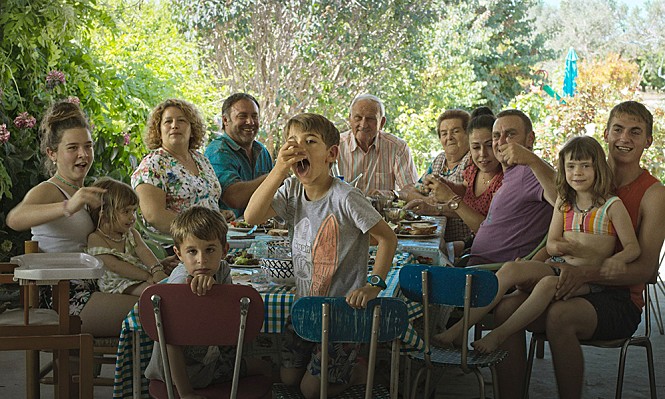
At first, the documentary observes the daily life of Kim Tschang-yeul (1929-2021), who incidentally passed away not long after the documentary was completed. Despite his old and fragile physical appearance on the surface, Kim looks quite focused while working in his big studio full of various paintings of water drops, and his artistic activity is not interrupted much by even the occasional intrusion of his young grandchildren, who happen to visit his residence in Seoul along with Kim’s two sons from France.

Kim is mostly gentle and endearing to his grandchildren, but Kim’s younger son Kim Oan, who made the documentary along with his co-director Brigitte Bouillot, remembers how his father was often rather distant to him and his older brother. While he looked as benign as Santa Clause, he felt more like Sphinx as being frequently reserved and distant, and that is why his two sons still remember well when he became very angry and harsh to them due to a big misbehavior of theirs many years ago.

For getting to know and understand his father more, Kim’s younger son asks some questions to his father while also interviewing his several family members including Kim’s younger brother, and the documentary shows and tells us a bit about Kim’s painful past. Around the time when Kim was a promising lad who showed considerable artistic talent, Korea was divided into North and South Korea, and he and most of his family members, who were in North Korea at that time, had to flee down to South Korea. Not long after Kim’s father went back to North Korea for a family matter, the Korean War broke out, and that was another personal trauma for Kim as he happened to witness many horrors of the war shortly after enlisted in the South Korean Army.

After the war was over, Kim focused again on his artistic career, and the documentary showed us some of his early works which are clearly the reflections of survivor’s guilt in his mind. When he later moved to New York City for some change, he came to try more of abstract painting style, and several works of his from that period convey to us how much he felt alienated as an isolated outsider surrounded by strangers quite different from him in many aspects.

In 1969, Kim moved to Paris without much expectation, but that accidentally led to a big breakthrough for his artistic career. On one day, he happened to get a moment of inspiration from water drops on one of his previous paintings, and that was the beginning of his lifelong artistic obsession with painting water drops. As he drew more and more paintings of water drops in various abstract styles, he became quite more notable around the world, and he also became known well in South Korea.

As simply listening to Kim during his interviews, the documentary slowly lets us gather that those water drops in his paintings are his own artistic way to deal with his traumas, which is mostly based on some Buddhist philosophy. Like one certain legendary Buddhist monk he often talked about, he is driven to more focus and dedication for understanding and accepting his life and the world, and that is why those water drop paintings of his look all the more poignant than before, though they still do not seem to be signifying anything particular to us.

In the meantime, Kim comes to us as a distant but undeniably gentle person capable of showing warmth and affection to others around him. Whenever he is not working or reading, he spends some playful time with his grandchildren, and we later get a little sweet moment between him and the infant kid of his younger son, who is glad to see that his father shows some genuine love and care to his little kid. In case of his French wife, whom he married shortly after coming to France, we can sense the deep bond between them even though they say much about their relationship, and it is clear to us that she has always stood by her dear husband throughout their long married life.

Nevertheless, the past still does not go away for Kim, and there is a bittersweet scene where Kim’s younger son shows his parents a satellite photograph of Kim’s old hometown in North Korea. Kim says he does not want to see the photograph more, but he cannot look away from it, and we can only guess whatever is churning behind his ever-phlegmatic façade. He can be quite emotional as attested by his younger brother, but he keeps feelings and thoughts to himself as usual, and that is all.

Overall, “The Man Who Paints Water Drops” works not only as a meditative essay on Kim’s life and artistry but also a respectful personal tribute from his younger son, who also provided the score for his documentary besides serving as its co-writer/co-producer/co-editor/co-cinematographer. As a matter of fact, I am actually ready for checking out more of Kim’s works, and I am sure you will do the same thing once you watch this solid documentary.

Posted in Movies | Tagged , , , , | Leave a comment

#AfterMeToo (2021) ☆☆☆(3/4): They won’t be silent again

South Korean documentary film “#AfterMeToo” examines how things have become a little different for many women out there in the South Korean society since the #MeToo Movement in 2017. Sure, there are still lots of things to be changed for them even at present, but several female figures in this documentary remind us that women in South Korea will not be silenced anymore no matter what will occur next, and that is surely touching to see at least.

The documentary actually consists of four individual short documentary films respectively directed by four different female South Korean filmmakers, and the first one, which is directed by Park So-hyeon, focuses on a small but significant gender movement at one certain female high school in Seoul. There was some male teacher who has been notorious among students for his very inappropriate attitude and behavior to them for years, and several anonymous graduates of 2019 willingly tell us about how they and many other students came to show their support for a schoolmate of theirs who bravely came froward for exposing that sexual predator. Emboldened by the ongoing #MeToo movement, they proudly expressed their solidarity on the windows of their school building, and that led to a conflict between them and the faculty staff of their school, who seemed to care more about securing the public image of their school.

Nevertheless, the students were not deterred at all to the end. On one day, an unknown graduate of their school did a little demonstration at the school for showing more support for their movement, and that was just a tip of the enormous support they received from the outside. In the end, that sexual predator was prosecuted and then sentenced to several years of imprisonment, and the students were proud of their righteous activities against the injustice which should have been eradicated many years ago.

The second documentary, which is directed by Lee Som-yi, pays attention to a middle-aged woman who writes “I become healthy in my body and mind.” more than once everyday. On the surface, this woman is just a plain working-class person, but there is an old sexual trauma she has not let out from the deep corner of her mind for years, and now she is going to go down to her rural hometown for finally revealing that outside.

Of course, despite lots of preparation for her public speech, she is understandably afraid and hesitant even when she is about to begin her speech in her hometown, but she eventually comes to speak out during next several minutes. Although nobody seems to listen to her words amplified by a number of speakers which are placed here and there around her hometown, her speech comes to function as a sort of exorcism for her personal demons, and that repeatedly written phrase of hers comes to feel a bit different than before as she keeps going with her life as usual.

Directed by Kangyu Ga-ram, the third documentary introduces us to several local female artists who began each own #MeToo movement in their artistic fields as a number of prominent South Korean male artists including Kim Ki-duk were exposed for many years of sexual violence and exploitation hidden behind their artistic careers. They and many other female artists in South Korea joined together for bringing more gender equality and sensitivity to their artistic fields, and they actually made some progress thanks to their passionate efforts.

However, they are still frustrated about how their artistic fields are not changed much even at present, and they also show some personal concern on their individual careers. While they have been willingly devoting themselves a lot to their urgent causes, they also recognize their growing exhaustion, and they often wonder whether they really should focus more on their careers for a while at least. After all, they all are artists first before being activists, aren’t they?

In case of the fourth documentary, which is directed by Kim So-ram, it simply listens to four anonymous interviewees who honestly tell us about how they were sexually abused or exploited in their pursuit of desire and love. In case of one interviewee, she was very frank about what she desired from the beginning, and she did not hesitate much in case of having a quick sex with man. Not so surprisingly, that was not always pleasant to say the least due to the insensitivity of many of her male sex partners, and she still feels hurts as remembering some of her very unpleasant sexual experiences.

Interestingly, the documentary later broadens its main subject a bit more via its last interviewee, a young gay man who also has his own unpleasant sexual experience just like the other ones in the documentary. When he was approached by some guy via an online dating application, he did not worry much just because this guy said he simply wanted to give some massage, but, what do you know, their subsequent private encounter turned out to be very disagreeable to say the least. To be frank with you, as a guy who had a considerable number of various sexual experiences during last six years, I understand him to some degrees, and I must confess that I still feel disgusted whenever I think of some central Asian dude who often handled my body like a sex doll during several sexual encounters between me and him.

On the whole, “#AfterMeToo” is an earnest presentation of how far South Korean women come via the #MeToo movement, and it is certainly worthwhile to watch considering how the South Korean society remains quite insensitive to gender issues in addition to allowing male backlashes against women. As shown from the epilogue part, women in South Korea still need to fight and struggle a lot for gender equality, but they will not step back at all, and they surely deserve more support and solidarity in my trivial opinion.

Posted in Movies | Tagged , , , | Leave a comment

Hellraiser (2022) ☆☆1/2(2.5/4): Creepy but redundant

“Hellraiser”, a reboot of the horror film franchise which began with the 1987 film of the same name, does not impress me that much to my little disappointment. Sure, it does try to bring new life and spirit to its familiar sadomasochistic tale of pain and pleasure, but it still feels rather redundant despite some effective creepy moments, though it is much more competent than many of sequels following the 1987 film.

Although I do not like it a lot, the 1987 film, which is based on its director/writer Clive Barker’s novella “Hellbound Heart”, has remained iconic in its field mainly thanks to a number of gruesome moments and the striking presence of hideous supernatural entities called “Cenobites”. Whenever somebody solves a mysterious ancient puzzle box, they immediately come to bring extreme pain and pleasure upon that person in question before eventually taking that person to their realm of darkness, and its leader, who is nicknamed “Pinhead” due to lots of pins stuck on the head, has been known as well as other familiar horror movie characters such as Freddy Kruger or Michael Myers.

The main reason why I am not a big fan of the 1987 film is its glaring deficiency in terms of story and characters, and, unfortunately, the 2022 reboot version also has the same problem. Many of its main characters are mostly sketchy at best, so we do not care that much about whatever will happen to them in the end, and, besides being rather overlong, the movie often trudges especially during its last act, where it is supposed to deliver some big bloody moments for its target audiences.

After the opening sequence involved with a certain substantial supporting character played by Goran Višnjić, the movie moves forward to several years later, and then we are introduced to a young woman named Riley McKendry (Odessa A’zion), whose life has been rather messy due to her serious addiction problem. Although she has been sober for a while, she still does not pull herself well together on the whole, and that certainly makes her conflict a lot with her concerned older brother Matt (Brandon Flynn), who has let her stay at his apartment because she has nowhere else to go at present.

Matt is especially worried about the possible bad influence of Riley’s current boyfriend Trevor (Drew Starkey), and, of course, he turns out to be right about that. Trevor later suggests to Riley that they should sneak into some abandoned warehouse for stealing whatever is being stored in one big container, and Riley does not hesitate to join her boyfriend at all, though she is baffled to see that container in question does not have anything inside it except one big safe.

It is not much of a spoiler to tell you that Riley eventually finds what is inside that safe and take it away without much thought. When she subsequently clashes with her older brother again, she quickly leaves his apartment along with her stuffs, and, what do you know, she comes to play with that object in question a bit not long after falling into the pit of addition again.

Of course, Riley soon comes to experience very spooky things, but the screenplay by Ben Colin and Luke Piotrowski, which is based on the story written by them and co-producer David S. Goyer, changes the rules of the 1987 film a bit. As usual, several Cenobites, led by “The Priest” (Jamie Clayton), appear, but they demand Riley that she should give them several victims in exchange of leaving her alone, and she must find a way to save herself as well as several others around her.

As Cenobites get their victims one by one along the story, Riley becomes all the more cornered just like many other horror movie heroines, but the movie sadly fails to develop her as an engaging character to root for, and it also falters a lot in case of handling several supporting characters around her. They are more or less than mere targets to be tortured and then killed by Cenobites, and I was especially dissatisfied with a certain key scene involved with the supporting character by Hiam Abbass, whom I still fondly remember for her wonderful supporting turn in Tom McCarthy’s “The Visitor” (2007). She is reliable as usual, but, alas, she does not have much to do here except looking weary and scared as required, and it is too bad that the movie does not utilize her considerable presence well.
In case of the Cenobites in the film, they surely look as creepy and grotesque as demanded, but, probably due to wearing lots of digital special effects on them, they are not very impressive compared their seniors in the 1987 film. At least, Jamie Clayton has some fun with her juicy role, and her good work here in this film often steals the show from Odessa A’zion and several other main cast members who are unluckily stuck with playing plain cardboard characters.

On the whole, “Hellraiser” is not as bad as I feared at first, but it does not reach to the distinctive qualities of the 1987 film or the intense terror of Barker’s novella, which remains better than both of two film versions in my humble opinion. Director David Brucker, who previously directed “The Night House” (2020) and his crew members, did a competent job of generating enough creepy vibe to hold my attention during 2 hours, but I only ended up wanting to read Barker’s novella again, and I think you will have a more satisfying time if you read that novella instead. Sure, the fans of the franchise may respond to it more positively than me, but, seriously, is there anything they never beheld before?

Posted in Movies | Tagged | Leave a comment

Orphan: First Kill (2022) ☆☆1/2 (2.5/4): A little killer coming into US

“Orphan: First Kill”, a belated prequel to “Orphan” (2009), attempts to present the backstory of that little creepy but compelling villain of the 2009 film. Although it unfortunately stumbles more than once during its second half after steadily building up enough tension and creepiness during its first half, the movie works to some degree thanks to two good lead actresses, and it is a shame that it does not explore that much of the morbid relationship between their characters before heading to its expected finale.

The early part of the film revolves around how its titular character came into US several years before what happened in the 2009 film. Due to a certain rare medical condition of hers, Leena Klammer (Isabelle Fuhrman) looks like a young girl on the surface, but she is actually 31, and she is also a very dangerous psychopath who has been locked up in a mental hospital in Estonia before eventually making a bloody escape. Once she becomes free again, she immediately searches for a possible way to go to US, and we soon see her disguising herself as a certain American girl who was gone missing for several years.

Once Leena is “found” in Russia as Esther Albright, Esther’s mother Tricia (Julia Stiles) quickly comes to Russia to reunite with her lost daughter, and Leena certainly tries a lot to convince Tricia, who happens to be a very rich woman who can afford to fly right into Russia via a private jet plane. Although their first encounter is pretty awkward to say the least, Tricia soon comes to embrace Leena as her daughter, and they instantly go back to Tricia’s home in Connecticut while welcomed by Tricia’s artist husband and their teenager son.

At first, everything goes fairly well for both Leena and her new family. Although she still does not like being treated like a child as usual, Leena maintains her disguise in exchange of all the luxuries she can get as “Esther”, and Tricia’s husband is absolutely delighted when she demonstrates considerable artistic talent. As they come to spend more time together, Leena cannot help but attracted to him as an adult woman, and that accordingly makes her stay in his house longer than she planned at first.

In the meantime, things become a little more tense around Leena as several people notice something odd about her. In case of a psychiatrist who was once close to real Esther, she came to have some reasonable doubt as observing how “Esther” seems quite matured despite her young age. In case of a local cop who handled the case of real Esther’s missing at that time, he also has some reservation on the girl’s unlikely return, and it does not take much time for Leena to discern that she should be very discreet whenever she interacts with him or her psychiatrist.

Now this looks like more or less than a variation of what we already saw from the 2009 film, but then the movie suddenly takes a left turn in the middle point of the story. I will not go into details here for not spoiling anything to you, but I can tell you instead that our little lethal protagonist subsequently finds herself stuck in a situation which is quite twisted to say the least. As a matter of fact, you may become interested in how the hell she can possibly get away from that, even though you will also often be horrified by her sheer nastiness.

However, to my disappointment, the movie does not develop this changed circumstance of hers that much before eventually hurrying itself toward its foregone conclusion. While we are surely served with a series of creepy moments, they are mechanically doled out one by one without much thrill or excitement, and the finale feels contrived instead of generating any lasting dramatic impact.

Anyway, Isabelle Fuhrman, who was incidentally 12 when the 2009 film came out, shows admirable commitment here in this film. Besides looking as short and young as she was in the 2009 film thanks to the skillful utilization of make-up, body double, and forced perspective shots, she delves into her character’s morbid nature with lots of gusto, and you can see why she willingly plays her character despite being no less than 25 at present. Yes, Leena is not so likable to say the least, but she is rather fun to watch thanks to considerable personality and sophistication, and that certainly distinguishes her from a lot of run-of-the-mill psychopathic killers in movies.

In case of several performers around Fuhrman, most of them are stuck in their respective thankless roles, but Julia Stiles, who is no stranger to dealing with a bad seed considering her appearance in “The Omen” (2006), manages to bring more to her character than required. She functions mostly well next to Fuhrman, and I particularly enjoyed a little nasty moment of her, which somehow took me back to a certain memorably gruesome moment in “What Ever Happened to Baby Jane?” (1962).

In conclusion, “Orphan: First Kill” feels unnecessary for not being as creepy and entertaining as the 2009 film, but it is not a total waste of time due to the good efforts from Fuhrman and Stiles. Because I gave the 2009 film three stars, I give “Orphan: First Kill” 2.5 stars, but you may want to check it out someday if you really liked the 2009 film and are quite interested in its little vicious heroine’s past.

Posted in Movies | Tagged , , | Leave a comment

Sidney (2022) ☆☆☆(3/4): A respectful tribute to Sidney Poitier

Documentary film “Sidney”, which was released on Apple TV+ in last month, looks into the life and career of late Sidney Poitier, who was one of a few major black Hollywood stars during his prime in the 1950-60s. Although it simply enumerates a number of key points in Poitier’s life and career one by one, the documentary still works as a respectful tribute on the whole, and it surely reminds us again of what an exceptional figure Poitier really was in many aspects.

During its early part, the documentary gives a succinct summary of Poitier’s early years. He was the youngest son of a poor black family in the Bahamas, and he tells us how fortunate he was right from the beginning. When he was prematurely born, it seemed that there was not much possibility of survival for him, so his father actually prepared for his death, but his mother did not give him up at all, and Poitier remained grateful to his parents’ eventual decision for the rest of his life.

In the middle of his following adolescent period in the 1940s, Poitier was sent to Miami in US for living with one of his older brothers, and that was when he came to have the first experiences of racism. In the Bahamas, his racial identity did not matter much as he was surrounded by many other black people living there, but it did matter a lot in US for the prevalent racial discrimination in the American society. His several painful experiences with those racist white folks eventually drove him to New York City, where he could be a lot more comfortable with his racial identity.

During his first days in New York City, Poitier just focused on earning his meager living day by day via a number of menial jobs which did not pay much, but then there came an unexpected life-changing moment for him. After noticing an advertisement in a local black newspaper, he decided to try on the audition held for a local black theater group, and, though the result was not that satisfying to say the least, he came to find that he really wanted to be an actor.

Once his goal was set, Poitier prepared himself a lot. He tried to read more in addition to learning how to speak well in English, and he subsequently made his debut on the stage while also befriending several other black artist figures such as Quincy Jones and Harry Belafonte. As a matter of fact, he was Belafonte’s understudy at one point, and that accidentally gave him a chance to enter Hollywood when he had to appear on the stage instead of Belanfonte during one performance. After making his film debut via Joseph L. Mankiewicz’s “No Way Out” (1950), he appeared in several notable films including Stanley Kramer’s “The Defiant Ones” (1958), which incidentally garnered him the first Oscar nomination, and his growing status in Hollywood was solidified further by the following critical/commercial success of Ralph Nelson’s “Lilies of the Field” (1963), which made him the first black Best Actor Oscar winner. 

Next several years was another high point in Poitier’s movie career. In 1967, he appeared in “To Sir, with Love” (1967), “Guess Who’s Coming to Dinner” (1967), and “In the Heat of the Night” (1967), and he became quite popular among not only black people but also white people in US. With his considerable talent and exemplary star presence, he surely changed the image of black people in American movies, and that is the main reason why he has been respected a lot by many black actors and actresses for years. 

In the meantime, Poitier was also well aware of the ongoing civil rights movements led by many black American figures including Martin Luther King Jr., and we hear about how active he was along with Belanfonte and a number of prominent black American figures during that turbulent period. On one day, he and Belanfonte came into Mississippi for a certain important mission, and they were surely reminded again of how things could be quite risky for them and other black people because of those deplorable racists in the South.

During the 1970s, Poitier saw the end of his clean-cut stardom due to many reasons including the rise of Blaxploitation films such as “Shaft” (1971), but then he found another opportunity via a little black western film “Buck and the Preacher”. When its original director was let go after the first week of the shooting, Belafonte, who happened to Poitier’s co-star, suggested that Poitier try to handle the shooting at least for a while, and, what do you know, it turned out that he was actually competent enough to satisfy those producers. After this successful directorial debut of his, Poitier directed several comedy films including “Stir Crazy” (1980), and I must point out that the documentary somehow overlooks that his directorial career unfortunately did not end that well with “Ghost Dad” (1989), which remains one of a few embarrassing things in his whole career even at present for many reasons besides its recently disgraced lead actor.

In my inconsequential opinion, “Sidney” could delve more into its main subject (Its presentation of Poitier’s private life feels rather shallow and perfunctory, for instance), but director Reginald Hudlin did a fairly good job of juggling archival and new interview clips on the whole, and you may also enjoy an impressive array of famous interviewees ranging from Halle Berry and Denzel Washington to Babra Streisand and Robert Redford. Above all, it is certainly poignant to watch Poitier himself frankly talking about his life and career not long before he died early in this year, and that compensates for the weak aspects of the documentary to some degree. He was indeed a great Hollywood actor besides being a decent man of principle and integrity, and he will surely be missed more than before.

Posted in Movies | Tagged , , , , , , | Leave a comment

Entergalactic (2022) ☆☆☆(3/4): A charming television special with lots of style

I must confess that it is a bit hard to categorize “Entergalactic”, which was released on Netflix a few days ago. According to Wikipedia, it was originally planned as a TV adult animation series which serves as a companion piece to the eighth solo album of the same name by Scott “Kid Cudi” Mescudi, but it is eventually presented now as a TV special which may be followed by more episodes in the future. To be frank with you, I do not know whether I can regard it as a single animation feature film or not, but I can tell you right now that it is one of the better animation works I saw during this year because of many good reasons besides those fairly nice songs by Mescudi.

At the beginning, we are introduced to a young African American man named Jabari (voiced by Scott Mescudi). He is a promising artist who has just been hired by some big comic book company in New York City thanks to his bold and striking graffiti works on streets, but he is not so sure about how to develop his own original comic book series from the recurring figure in many of his graffiti works, and he instead finds himself aimlessly spending time along with his two close friends Ky (voiced by Tyrone Griffi Jr.) and Jimmy (voiced by Timothée Chalamet).

When he moves into his new apartment in Manhattan, Jabari happens to come across a young African American female photographer named Meadow (voiced by Jessica Williams), who incidentally lives right next to his new apartment. Their Meet Cute moment is pretty brief in addition to being rather awkward, but Jabari comes to meet Meadow again when he cannot sleep due to the loud noises from a night party held in Meadow’s apartment, and, what do you know, she looks quite different to him this time. As he looks at her, the whole universe seems to swirl around her right in front of his eyes, and he comes to desire and yearn for her a lot as shown from a humorously embarrassing private moment of his in the very next morning.

Anyway, Meadow comes to him in that morning for apologizing for disrupting his sleep at last night, and, what do you know, it turns out that she is also quite interested in getting close to him. As they talk more with each other at a favorite hamburger shop of hers, both of them find themselves more attracted to each other, and we soon see them seriously consulting with their respective close friends on their immediate matter of heart. They understandably hesitate a lot about whether they should take the next step, but then they instantly go for each other when they meet again, and that is the beginning of their lovely romantic relationship.

As our two young main characters fall in love with each other more and more along the story, the film often delights us with a series of stylish moments to be savored for considerable style and spirit. Clearly influenced by that bold and colorful animation style of Oscar-winning animation film “Spider-Man: Into the Spider-verse” (2018), the film constantly fills the screen with vivid colors and details, and it also tries a bit of several different animation styles at one point to our amusement. In addition, it has some naughty fun in its broad depiction of the art industry in New York City, and I was certainly amused by one particular scene full of sexual stuffs which will tickle you for good reasons.

In case of the soundtrack of the film, several songs from Mescudi’s aforementioned album are mostly effective as organically accompanying a number of key moments in the film. In one certain scene where our two young main characters ride a bicycle together, their romantic mood is enhanced further by sensitive music as well as lively animation, and the following lovemaking scenes feel frank and tender without showing too much of, uh, their carnal details.

Of course, like many other romance flicks out there, the film becomes a bit too predictable when its two young main characters’ romance happens to be interrupted by a problem associated with Jabari’s ex-girlfriend, but it thankfully does not dwell too much on that. Yes, once our two main characters come to realize that they really love and care about each other, we surely get what was expected right from the beginning, but the eventual finale is handled well with enough wit and humor at least, and it surely helps that Mescudi and his co-star click well with each other throughout the film. I am not that familiar with his musical career, but I can tell you at least that Mescudi is fairly good in his likable voice performance, and he is complemented well by Jessica Williams, who is warm and spirited in her charming voice acting.

In case of several other main cast members of the film, they bring some extra life and personality around Mescudi and Williams. While Timothée Chalamet and Tyrone Griffin Jr. are constantly amusing as Jabari’s two dopey friends, Vanessa Hudgens has her own little fun as Meadow’s best female friend, and a number of notable performers including Christopher Abbott, Keith David, Macaulay Culkin, and Luis Guzmán are also solid in their small but colorful supporting parts.

Overall, “Entergalactic”, directed by Fletcher Moules, did a good job of imbuing its rather familiar romance tale with enough charm and personality. Although it looks rather modest on the surface, it is definitely worthwhile to watch if you are looking for something more distinctive than those passable Hollywood blockbuster animations films, and, like me, you may end up hoping for more after enjoying its many impressive moments.

Posted in Movies | Tagged , , , | Leave a comment

Fanatic (2021) ☆☆☆(3/4): Of being a fan

I could not help but become quite amused from time to time while watching South Korean documentary film “Fanatic”. Yes, as shown from the documentary, director Oh Se-yeon was really a big fan of a certain local male idol singer, and the documentary is often darkly and painfully humorous as she attempts to examine and reflect on her shock, anger, and disillusionment caused by that local male idol singer’s serious criminal deeds.

At first, Oh, who was incidentally born in 1999, shows us what a huge fan of that local male idol singer she had been for several years. For example, she collected various pricey items associated with that local male idol singer, and she even met him more than once as shown from one old archival TV show clip. She unabashedly expressed her adoration to him in front of the camera, and she surely felt pretty good as enjoying what was regarded as the most fantastic moment in her life at that time.

However, in 2019, there came a notorious incident which shocked many fans of that local male idol singer. It turned out that he actually committed several serious sex crimes, and Oh and many other fans were all the more confused and disillusioned as his case was eventually brought to the court. While it was undeniable that he was guilty as charged, that certainly clashed with his supposedly wholesome public image, and some of his fans even came to insist that he was not guilty at all.

While trying to cope with her anger and confusion coupled with lots of disillusionment, Oh approaches to several other former fans of his including her assistant director, who incidentally has one of the most humorous moments in the documentary. She and Oh gather a bunch of collectible items associated with him, and it is rather amusing to observe them discussing on how to handle all these completely valueless items. They cannot help but feel bitter as remembering how much they paid for these items as your average big fans, and their talk eventually culminates to a little funeral for these items, which is a gesture of farewell to their little adoration toward him.

In case of several other former fans interviewed in the documentary, they provide each own perspective and insight, and the documentary deftly balances itself between seriousness and some self-deprecating humor. They all were once proud to be ‘seongdeok’ (successful fan), but all of them are now bitter and disillusioned in each own way, and they surely have something to tell as casually talking with Oh. Although they all initially did not believe what he did, they eventually came to accept that inarguable truth about him as growing up a bit more, and that certainly makes them look a lot more reasonable and matured than those toxic online fans of a certain recently disgraced Hollywood star.

Nevertheless, they also cannot help but wonder about how the hell they did not see or sense what was hidden behind his nice public image, and they feel ashamed of their rather blind adoration and passion toward him. As a matter of fact, one of them points out that they and many other fans of his did lots of considerable harm in public as they tried to disbelieve what he allegedly did at first, and she still feels guilty about that.

As listening to Oh and several other former fans in the documentary, my mind was often taken back to several similar experiences of mine. As your average self-serious moviegoer, I usually put some distance between myself and those wonderful filmmakers and performers out there, but I admire many of them with considerable affection nonetheless, and that was why I was quite shocked when some of them turned out to be not good persons at all. In case of a certain Oscar-winning American actor, I had actually rooted for him a lot as observing how he steadily advanced with more impressive results, but I and others belatedly came to learn of the allegations on his sexual misconduct right before the 2017 Academy Awards, and that completely eradicated my accumulating admiration toward him. As a matter of fact, I frowned a lot when he eventually won an Oscar as predicted, even though he gave one of the best performances of 2016.

Oh also comes to reflect more on herself as listening to her fellow former fans, and that leads to some embarrassing discoveries. At one point, she comes across a personal diary of hers which shows that she did not believe the first allegation against that local male singer in 2016, and she is certainly embarrassed to discover that she wrote some very nasty things about a female newspaper reporter who wrote about that first allegation. She later approaches to that female newspaper reporter for personal apology, and their following discussion culminates to one of the most hilarious moments in the documentary. I will not go into details here for not spoiling any of your entertainment, and I assure you that you will have a big laugh as observing how Oh comes to experience the overlap between her former fan activity and a certain kind of deplorable political activity.

In conclusion, “Fanatic” is probably the funniest South Korean documentary film of this year, and I appreciate how Oh handles her personal subject with considerable care and thoughtfulness. In addition to succeeding in exorcizing all the confusion and disillusionment of hers on the screen, she also demonstrates here that she is a good filmmaker to watch, and it will be interesting to see what she will do next in the future, though she has moved onto another kind of fan activity now. After all, we all need something to be personally passionate about, don’t we?

Posted in Movies | Tagged , , , | Leave a comment

The 2nd Repatriation (2022) ☆☆☆1/2(3.5/4): Still waiting for repatriation

South Korean documentary film “The 2nd Repatriation”, which is the sequel to director Kim Dong-won’s acclaimed 2003 documentary “Repatriation” (It won the Freedom of Expression Award at the 2004 Sundance Film Festival, by the way), covers last two decades of a bunch of converted North Koreans still stuck in South Korea even after many years of incarceration. As they desperately hoped for returning to their country, the situation unfortunately got worsen between North and South Korea despite a brief respite in the early 2000s, and it is really sad to observe that they may be never sent back to North Korea even after their impending death.

The documentary begins its story at the point not long after the ending of its predecessor. Since the cease-fire of the Korean War in 1953, there had been many North Koreans who were captured and then imprisoned due to their military/espionage operations in South Korea, but they were not allowed to go back to their country even after they were eventually released due to their old age. In 2000, when the political mood between South and North Korea became quite mild mainly thanks to President Kim Dae-jung’s “sunshine policy”, 63 North Koreans who had been politically “unconverted” were repatriated to North Korea in the end, but their fellow “converted” North Koreans were excluded from that, and the circumstance did not change much for them even after they made a “declaration that the conversion by torture was invalid” in the following year.

The main focus of the documentary is one of such North Koreans, who incidentally gave one of the most poignant moments in the previous film. His name is Kim Yeong-sik, and he was just a crew member of one North Korean boat to contact with some North Korean agent in South Korea. Due to that agent’s betrayal, he and all of his crew members were captured, and that was the beginning of many years of plight and torment for him. Tortured and harassed for next several years, he eventually surrendered and let himself “converted” on record in exchange for his earlier release, and it is clear that he still feels hurt and ashamed about that.

Anyway, Kim and his fellow converted North Koreans defiantly launched a movement for their repatriation in the early 2000s, and the documentary closely observes how they continue to live and struggle day by day while never giving up their hope despite their very old age. In case of Kim, he often attempts to make some statement about his political status to South Korean citizens out there, and he is not daunted at all even though he is usually ignored by many of them and also insulted by some rude right-wing guys at times.

When President Kim Dae-jung was succeeded by President Roh Moo-hyun in 2003, the situation remained frustratingly same as before for Kim and his fellow converted North Koreans. After a certain famous tourist spot in North Korea was opened to South Korean civilians, Kim and his fellow converted North Koreans were certainly ready to go there for seeing their country again just for a few days, but the South Korean government did not allow some of them to go there for a rather insignificant bureaucratic reason, and that certainly dampened their mood to say the least.

Meanwhile, they kept trying to continue their little political movement for repatriation. When “Repatriation” was eventually completed and then released in South Korean theaters with considerable praises, Kim was certainly willing to go to a number of special screenings, but he later said to the director that he was not particularly satisfied with the documentary itself for a number of understandable reasons.

As listening to Kim, the director felt again the considerable gap between his viewpoint and Kim and other converted North Koreans’. As the son of a couple who fled from North Korea before the war, the director later came to reflect more on his deeply anti-communist family background, and he even came to learn later that there was even a sibling behind whom his mother left in North Korea at that time.

That made the director more motivated about getting a permission to enter North Korea for his documentary, but, sadly, the relationship between the South and North Korean government was soon reversed to that old hostile mood due to several unfortunate factors. Besides President George W. Bush in US (Remember “the axis of evil”?), two conservative South Korean presidents after President Roh, both of whom are incidentally big disgraces to South Korean democracy, were not so friendly to the North Korean government to say the least, and the possibility of the second repatriation was accordingly disappeared to Kim and his fellow converted North Koreans’ despair and frustration.

Nevertheless, they kept trying to live another day. As years hopelessly went by, many of them died one by one mainly because of their deteriorating health condition, but they do not still give up their hope entirely, and there is a touching moment as Kim celebrating his 88th birthday along with his friends and supporters in early 2021. He is still alive at present, and I can only hope that things will soon get better for him, though the political situation between South and North Korean recently becomes much more troubling thanks to the current president of South Korea, who is incidentally your typical right-wing nut just like Donald J. Trump or Jair Bolsonaro.

On the whole, “The 2nd Repatriation” is more or less than the continuation of its predecessor, but it is still a powerful documentary on the whole, and I also appreciate how the director often pays some attention to many other different people to observe besides his main human subjects. While it focuses on several female converted North Koreans at times, the documentary also listens to the angry members of the association of the family members of those South Korean taken to North Korea, and, regardless of their political differences, all these and other people in the documentary come to us the victim of the ongoing historical tragedy in the Korean peninsula. To be frank with you, I cannot help but doubt whether there will actually be the eventual closure for all of them before the end of the current decade, but I sincerely wish for the best anyway.

Posted in Movies | Tagged , , , | Leave a comment

Repatriation (2003) ☆☆☆1/2(3.5/4): Waiting for repatriation

South Korean documentary film “Repatriation” simply follows the lives of a bunch of unconverted North Korean people who could not go back to their country even after being imprisoned in South Korea for many years. As observing their long struggle for repatriation during several years, the documentary gradually lets us have some empathy and understanding on these old but defiant people, and it is surely the powerful presentation of rather unknown human tales behind the ongoing political situation between South and North Korea.

It must be pointed out that these North Korean people were once an active part of a long military/espionage war which still does not completely end even at this point. Although the Korean War eventually reached to the cease-fire in 1953, South and North Korea constantly clashed with each other behind their back, and both sides attempted numerous covert military/espionage operations on each other during next 20 years, though none of these operations was successful at all except making them all the more hostile to each other.

According to existing records, more than 7,000 North Korean agents were sent to South Korea, and many of those captured North Korean agents were subsequently incarcerated in prisons for many years. During their incarceration periods, all of them were brutally pushed toward political conversion in one way or another, and most of them were eventually coerced to go through political conversion on record, while rest of them defiantly stuck to their political belief to the end.

After managing to survive for more than two or three decades, some of those defiant North Korean political prisoners were eventually released mainly due to their old age, but they were still not allowed to be sent back to North Korea, which did not recognize their existence officially. While being stuck in South Korea, they had no choice but to continue to live in a society alien to them in many aspects, and, not so surprisingly, their living condition was not so good at all because they were not technically South Korean citizens.

The documentary mainly revolves around two of these unconverted North Koreans: Jo Chang-soon and Kim Suk-hyung. In 1991, Director/writer/co-producer Kim Dong-wan happened to come across these two very old North Koreans when they came to reside in Kim’s shabby neighborhood in Seoul thanks to some little help from a local civilian support group, and that was the beginning of his accidental friendship with these two old North Koreans. Like many of South Koreans accustomed to anti-communist propaganda stuffs, Kim surely felt some distance between him and these two old North Koreans, but he came to like and care about them more than expected as recording some slices of their ongoing lives, and that was the starting point of his personal project which came to took more than 10 years before its eventual completion in 2003.

Through his two unlikely North Korean friends, Kim was allowed to approach to many other similar North Korean folks in South Korea. In case of Kim Yeong-sik, this old North Korean guy was just a crew member of one North Korean boat which was supposed to contact with some North Korean agent hiding in South Korea, but he happened to be captured along with his crew members due to that agent’s betrayal, and he subsequently became ‘converted’ after being tortured and harassed for next several years. Still feeling ashamed of what he was forced to do, he cannot help but become emotional when he is visited by one of his living colleagues, and that is one of the most poignant moments in the documentary.

Regardless of being converted or unconverted, many of these North Korean folks really hoped to go back to their country, and there fortunately came a big chance for them when the political conflict between South and North Korea became less tense than before in 1998. Right after getting elected as the new President of South Korea, Kim Dae-jung embarked on his “sunshine policy” on North Korea for bringing peace to the Korean peninsula, and everyone in South Korean became quite hopeful about the possibility of unification in the near future as watching that historical moment between their president and Kim Jung-il, who was the leader of North Korea at that time.

In the end, the South Korean government allowed the repatriation of a small group of unconverted North Koreans in 2000, but things did not go as well as they hoped. Their repatriation was objected by not only those right-wing organizations but also the association of the family members of those numerous South Korean people taken to North Korea, and the documentary sharply recognizes how complicated the circumstance surrounding the eventual repatriation process. While it is certainly nice to see those North Koreans finally getting their wish, they were eventually used as a propaganda tool for the North Korean government, and I personally wonder whether they were really happier to be there, considering how grim the life in North Korea can be.

Anyway, “Repatriation”, which deservedly received the Freedom of Expression Award at the 2004 Sundance Film Festival, is still a valuable documentary for many reasons, and it is also a bitter reminder of how things looked a bit more optimistic during that period. Unfortunately, the situation between South and North Korea has worsened during next two decades, and the hope for repatriation was accordingly disappeared while many of old North Korean folks in the documentary passed away one by one in the meantime. While you may disagree with them a lot on many political subjects, you will come to have more compassion on them after watching this exceptional documentary – and you may also reflect more on their undeniable tragedy in the last chapter of the Cold War.

Posted in Movies | Tagged , , , | Leave a comment

Athena (2022) ☆☆☆(3/4): Three brothers in the middle of an intense urban conflict

French film “Athena”, which was released on Netflix in last week, is quite gritty and intense in the presentation of one increasingly chaotic conflict in a slum neighborhood. While it takes some time for you to grasp what is exactly going on around its several main characters, the movie steadily and tightly holds your attention in its grip to the end, and its impressive overall technical achievement is more than enough to compensate for its rather weak storytelling.

During the striking opening sequence which plainly begins at a local police station and then electrifies us with considerable technical prowess, the movie quickly establishes the ongoing situation surrounding Abdel (Dali Benssalah) and his two brothers Karim (Sami Slimane) and Moktar (Ouassini Embarek). A few days ago, their youngest brother was brutally murdered, and it seemed that he was killed by several unidentified local police officers. Not so surprisingly, many people in their neighborhood including Karim became quite angry about this ghastly injustice, and that eventually led to the ongoing clash between the local police and a bunch of young protesters led by Karim.

Abdel, who happens to be a decorated soldier of the French Army, tries to calm down others as much as possible. While helping many of his neighbors leave their apartment buildings for their safety, he also tries to persuade Karim and Karim’s protesters to be reasonable about their situation, but Karim is not so willing to listen to his older brother from the beginning. As a matter of fact, he and a bunch of protesters steal a big safe from the aforementioned police station during their ambush, and they are eager to open it even though they do not know what is actually in the safe.

Meanwhile, Moktar, who is incidentally a local drug lord, is more occupied with protecting his drug business from the conflict as much as he can. When the neighborhood is surrounded more by the police, he naturally feels more nervous than before, and that accordingly generates more conflict between him and his two brothers, who share the common contempt toward Moktar despite their very different viewpoints.

While shuffling among its three main characters, the movie also focuses a bit on several substantial supporting figures. We get to know a bit about a young married police officer who is understandably worried about his latest mission, and then we are also introduced to another police officer who seems to care a lot about getting things under control just like Abdel, and then there we later meet a certain disturbingly quiet man who turns out to be more experienced than Karim and his fellow protesters.

As the movie urgently hops from one narrative point to another, we get confused a bit from time to time, but the movie deftly immerses us into the chaotic circumstance surrounding its main characters and many other figures in the background. While I wish it could provide more background information for more understanding, the movie adamantly pays more attention to generating more verisimilitude along the story instead, and we often feel like being in the middle of the chaos along with its characters as a result.

Director/co-producer/co-writer Romain Gavras, who is incidentally the son of Costa-Gavras, and his crew members including cinematographer Matias Boucard and editor Benjamin Weill deserve to be praised for their technical efforts. As Boucard’s camera usually moves along with characters in fluid camerawork, Weill’s editing is succinctly precise without never interrupting the relentless narrative flow of the film, and that is further amplified by the effective score by GENER8ION. Besides its superlative opening sequence, there are also a number of excellent sequences which will dazzle any serious moviegoer, and, when I was watching the film early in this morning. I actually kept wondering how they shot these terrific sequences.

However, I also recognized some notable weak aspects in the screenplay written by Gavras and his co-writers Ladj Ly and Elias Belkeddar. Like Ly’s Oscar-nominated film “Les Misérables” (2019), the movie is surely angry and passionate about several social/political issues including racism and police brutality, but it sometimes stumbles as trying to balance itself between family melodrama and political drama. In addition, I think its inevitable ending could be more impactful without its very final scene, which is rather redundant in my inconsequential opinion.

Anyway, the movie remains to be a compelling piece of work thanks to Gavras’ commendable direction, and he also draws solid performances from his main cast members. While Dali Benssalah dutifully occupies the center, Sami Slimane often galvanizes the screen with his character’s righteous anger, and Anthony Bajon, Ouassini Embarek, and Alexis Manenti are also suitably cast in their respective roles.

In conclusion, “Athena” may not go further than what was shown in “La Haine” (1995) and “Les Misérables”, but it will give you a vivid cinematic experience you will not easily forget, and that may make you reflect more on its main subjects after it is over. Considering the current political circumstance of France as well as many other countries in Europe, the movie surely needs to be watched by more audiences out there, and that is just one of many good reasons for recommendation.

Posted in Movies | Tagged , , | 1 Comment