

I found myself caring a lot more than expected as watching Taiwanese filmmaker Tsai Ming-liang’s 1994 film “Vive L’Amour”, whose recent 4K restoration version was released in South Korean theaters in last week. Leisurely revolving around three different main characters, the movie gradually and sensitively illustrates the achingly deep loneliness in their dry and uncaring urban background, and we are both saddened and touched by that.
The movie opens with a little unexpected opportunity thrown in front of Hsiao-kang (Lee Kang-sheng), a young ossuary salesman who happens to come across a key left hung on the door of some big expensive apartment while going through another workday of his. Once he finds that the apartment has been left empty for some time, he decides to stay inside the apartment because, as slowly implied to us along the story, he has no particular place to stay at present.
And then the story takes a couple of unexpected turns. For some unspecified reason, Hsiao-kang attempts to commit suicide not long after moving into the apartment, but then something quite unexpected interrupts him. A young woman and man suddenly come into the apartment without noticing anything at all, and then they have sex in one of its several bedrooms, which is fortunately not where Hsiao-kang is staying.

We already know who they are – to some degree. The young woman is a real-estate agent named May Lin (Yang Kuei-mei), and the apartment is actually one of those many properties she has been trying to sell for a while. Her sex partner is a young street vendor named Ah-jung (Chen Chao-jung), and he is a total stranger to her as shown from their first scene in the film.
Not long after both of them get what they want, Ah-jung steals the apartment key from May Lin because, just like Hsiao-kang, he needs any place to say right now, and this eventually leads to a wryly comical situation between him and Hsiao-kang, who continues to stay in the apartment after his suicide attempt was aborted by the unexpected entrance of Ah-jung and May Lin. The first encounter between them is understandably a bit confrontational, but it does not take much time for Hsiao-kang and Ah-jrung to understand and then accept their absurd circumstance. After all, both of them are technically intruders, aren’t they?
Instead of hurrying its three main characters into conventional triangle plot, the screenplay by Tsai and his co-writers Tsai Yi-chun Yang Pi-ying takes its time as letting us get to know the three main characters bit by bit. Although they do not reveal that much to us on the surface, their small individual moments give us indirect glimpses into their humanity and personality, and the movie does a masterful job of subtly conveying to us their personal thoughts and feelings without spelling them out at all. As patiently observing more of Hsiao-kang’s daily work, we get more understanding on his deep loneliness which is probably the main motive behind his suicide attempt, and we are not so surprised at all when there subsequently come a series of little private moments revealing a bit of what has made him so lonely and introverted.
And that is the main reason why it is poignant to see how he and his life get brightened up a little by the presence of his “roommate”. While not still noticed by anyone else including May Lin, they keep staying in the apartment as before, and there is a brief but sensitive scene where they cook and then have a dinner together in the apartment. In addition, Hsiao-kang and Ah-jung gladly show each other’s professional life, and we get a little amusing moment as they observe several potential clients visiting Hsiao-kang’s workplace.
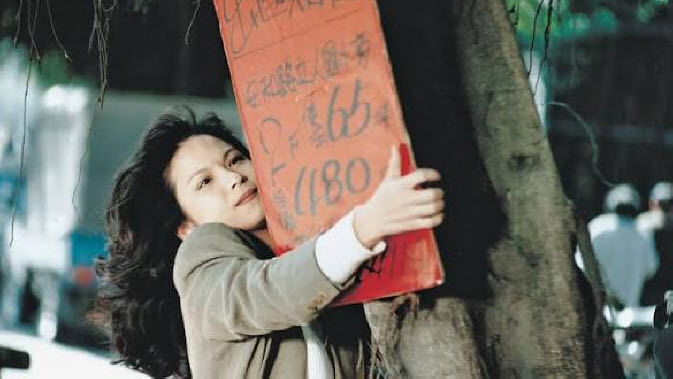
Meanwhile, the movie also shows a lot of sympathy and compassion to May Lin without getting melodramatic about her own loneliness at all. As she busily struggles to sell any of those expensive properties assigned to her day by day, she often cannot help but feel lonelier and emptier, but there is no one on whom she can sincerely lean on. At one point later in the story, she tries to sooth and then relax herself inside her small residence, but that is still not enough for her, and we later get a bitter moment of irony when she happens to come upon a street spot where Ah-jung and many other street vendors are doing their illegal business night by night.
Three main performers of the movie are believable in their respective parts. Yang Kuei-mei, whom you may remember for several other notable Taiwanese films such as Ang Lee’s Oscar-nominated film “Eat Drink Man Woman” (1994), firmly holds the ground as required, and she is simply terrific when the movie depends a lot on her presence and talent around the end of the story. Her two co-stars Lee Kang-sheng and Chen Chao-jung also have each own moment along the story, and Lee, who has been one of Tsai’s main collaborators since Tsai’s 1991 TV movie “Boys”, handles well several key moments where his wordless but expressive face speaks volumes about his character’s inner feelings.
On the whole, “Vive L’Amour”, which was Tsai’s second feature film and deservedly garnered the Golden Lion award when it was shown at the 1994 Venice International Film Festival, is worthwhile to watch for its dry but engaging mood, storytelling, and performance. Yes, this is one of those “slow movies” which definitely requires some patience from the beginning, but, believe me, it will come to you as a rewarding cinematic experience once you sense and then go along with what and how it is about.


