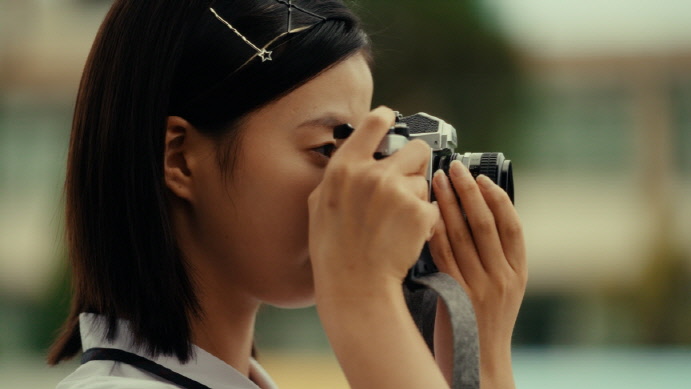
South Korean independent film “Summer’s Camera” is a little queer adolescent drama to be admired for its somber but sensitive moments. Calmly following the uncertain emotional journey of its queer adolescent heroine, the movie subtly illustrates her personal loss and grief beneath the surface, and it is also interesting to observe the story thoughtfully handling what is going to be her very first romance.
At the beginning, Yeo-reum (Kim Si-a) frankly tells us about her life with her father, who worked as a photographer before his sudden death. He gladly shared his professional passion with his daughter whenever they spent time together, and he even gave her some of his old film cameras for encouraging her interest in photography more.
Some time after her father’s death, Yeo-reum, whose name incidentally means “summer” in Korean, remains stuck with the last film camera given to her by him. While still wondering what she really wants to shoot on the last few films of an old film roll inside the camera, Yeo-reum accidentally encounters Yeon-woo (Yu Ga-eun), one of the soccer players in her female high school. Right from when their eyes are met, something clicks inside Yeo-reum, and she eventually uses those last few films for shooting Yeon-woo practicing on the school field.
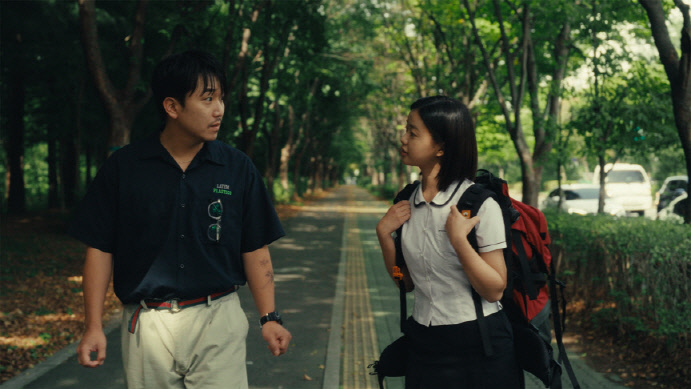
When she subsequently gets the film roll developed, Yeo-reum discovers something quite unexpected. The film roll also contains a bunch of old photographs shot by her father during his high school years, and she notices that he shot a lot of some other boy around his age. Fortunately, there is the name of this boy in one of these old photographs, and then she locates him at a spot not so far from her neighborhood.
His name is Ma-roo (Kwak Min-gyu), and, as he frankly reveals later, Yeo-reum’s father was his boyfriend before breaking up with him and then marrying Yeo-reum’s mother. He and Yeo-reum soon spend more time together, and he gradually becomes someone to whom she can talk about anything including her growing romantic feelings toward Yeon-woo.
However, it does not take much time for Yeo-reum to take her first forward step toward Yeon-woo, who, to Yeo-reum’s surprise, turns out to have been quite attracted to Yeo-reum since their first encounter. When Yeo-reum later reveals more of this romantic situation of hers to her best friend Min-jeong (Lee Eun-sol), Min-jeong does not mind this at all, and it seems that all Yeo-reum will have to do is confiding everything to her mother, who is mostly absent as busily working for supporting herself and her daughter.
It is not much of a spoiler to tell you that there will be an inevitable moment of heartbreak for Yeo-reum, but the movie does not hurry itself at all while wisely avoiding unnecessary melodrama. With some more support from Min-jeong, Yeo-reum and Yeon-woo show more affection to each other without hiding their romantic relationship much from others around them, and that surely reminds us of how South Korean queer cinema has become a lot more open and honest than before. Around 20 years ago, many of South Korean queer films were far from mainstream, but South Korean queer cinema were boosted a lot by a number of critically acclaimed works ranging from “The Handmaiden” (2016) to “3670” (2025) during the last two decades, and it is certainly refreshing to see an adolescent queer character who is totally fine with being herself while more concerned about those universal matters of romance familiar to all of us.
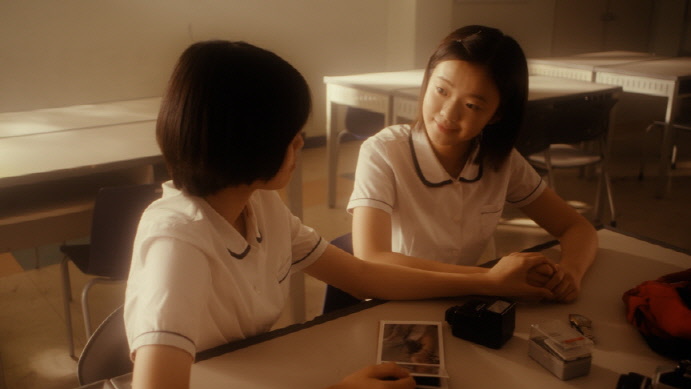
As leisurely rolling its story and characters, the screenplay by director/writer Divine Sung, who incidentally made a feature film debut here in this film, gets us more engaged in Yeo-reum’s slow but steady emotional journey. Several intimate personal moments between Yeo-reum and Yeon-woo are shown with soft and sunny warmness, and that is why it is devastating to see Yeo-reum belatedly realizing an overlooked problem in their supposedly strong relationship. As Ma-roo tells Yeo-reum more about her father, her mind sometimes drifts around imagined moments, and these imagined moments eventually lead to a poignant moment of acceptance for her later in the story.
Sung also draws engaging performances from her main cast members. Kim Si-a, who previously played a substantial supporting character in “Kill Boksoon” (2023), earnestly holds the emotional center of the story, and she is also supported well by several other cast members including Kwak Min-gyu, Yu Ga-eun, and Lee Eun-sol. Kwak’s understated acting complements well Kim’s forthright attitude during several key scenes of theirs, and Yu and Lee hold each own place around Kim besides bringing enough life and personality to their respective supporting roles.
Overall, “Summer’s Camera” is worthwhile to watch for several good reasons including its delicate mood, thoughtful storytelling, and good performances. This is surely another notable feature debut film from South Korean cinema during this year, and it will be interesting to see what may come next from Sung after this commendable starting point. I think she is a fairly promising filmmaker, and I sincerely hope that she will advance further with more artistic achievement to impress us.