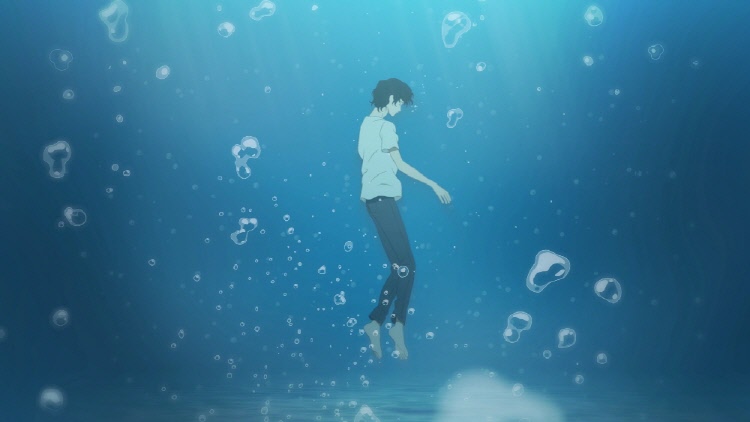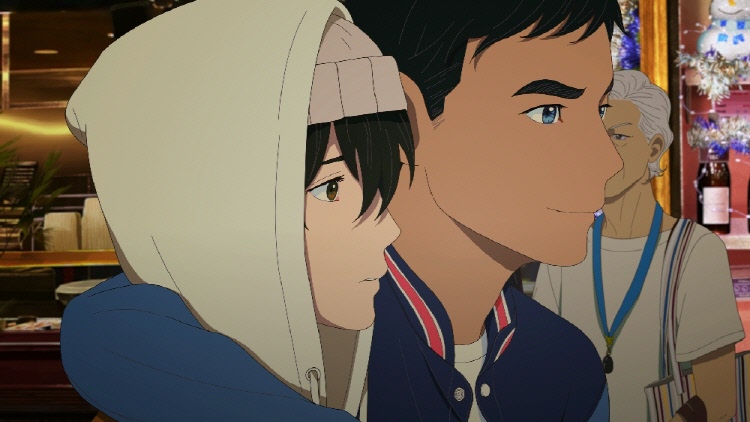
South Korean independent animation feature film “Gill”, which finally came to local movie theaters after being premiered at the Bucheon International Animation Festival two years ago, impressed me a lot for its distinctive mood and style. Based on the 2011 novel of the same name by Gu Byeong-mo, the film presents an odd but compelling fantasy drama, and the result holds our attention to the end even though the story falters a bit during its last act.
The center of the story is a boy who is later named “Gon” (voiced by Jung Hae-in), and the opening part establishes how he somehow acquired an extraordinary ability. When his widower father attempted to drown himself and Gon in a big lake not long after killing someone, Gon managed to survive after becoming able to breathe in water via the sudden generation of a pair of gills on his neck, and then he was later rescued by an old man who has earned his meager living via collecting junks from those abandoned ships and boats on the lake.
The old man lives with his young grandson Kang-ha (voiced by Kang Ha-neul), who has stayed with his grandfather since he was abandoned by his mother several years ago. Although he does not welcome Gon that much at the beginning, Kang-ha soon becomes like a big older brother to Gon as he and his grandfather come to take care of Gon, and he is actually the one who came to think of that new name for him.
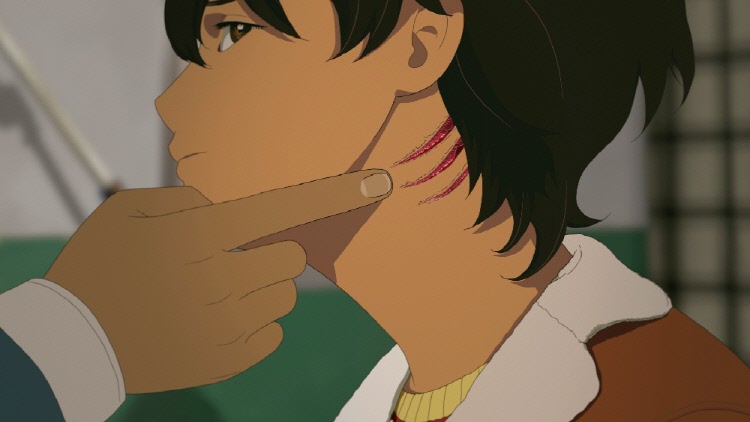
As both Kang-ha and his grandfather try to protect Gon from the outside world as much as possible, we observe a rather complicated relationship developed between Kang-ha and Gon during next several years. While quite fascinated with how different Gon is from others due to not only gills but also the shiny scales on his back, Kang-ha is alternatively protective and abusive to Gon, and he also commits some real cruel things to Gon just for putting more distance between them – until there later comes a point where Gon must leave Kang-ha and the old man.
Their story is presented in a series of flashbacks intercut with a subplot associated with a young woman named Hae-ryoo (voiced by Lee Chung-ah), who happened to be rescued by Gon in the middle of one desperate night of hers. Quite baffled by her unbelievable encounter with Gon, she subsequently tries to locate whoever may know Gon, and that is how she eventually meets older Kang-ha, who, after becoming wiser and more thoughtful than before, is ready to tell everything without hiding or exaggerating anything at all about his very complex past with Gon.
As going back and forth between two individual storylines, the film sometimes loses its narrative focus, and we often observe the story and characters from the distance instead of getting more engaged, but the film compensates for its weak aspects via its distinctive mood and style. Although Gu’s novel is set in contemporary South Korea, the modern background of the film is an amusingly eclectic mix of Korean and European elements, and its cell animation texture often evokes several notable animation films of Studio Ghibli. These deliberate choices in terms of mood and style certainly feel a bit weird even to South Korean audiences like me, but it somehow works well with the fantasy elements in the story besides intriguing us more along the story.
And we are served with a series of fantastic visual moments whenever the story goes further with Gon’s special abilities. As becoming more aware of how different he is from others including Kang-ha and his grandfather, Gon feels more loneliness as your typical outsider, and he naturally comes to feel more freedom whenever he dives into the lake, though he remains stuck with Kang-ha no matter how harsh Kang-ha is to him.

While frequently admiring the commendable visual qualities of the film, I also found its story and characters a bit too flat and superficial. While several substantial supporting characters in the story besides Kang-ha’s grandfather are more or less than mere plot elements, the story also does not delve that deep into that love and hate relationship between Kang-ha and Gon before eventually throwing a couple of melodramatic plot turns during the last act.
Furthermore, the dialogues and narrations in the film are a little stiff and strained at times, and this often undermines the fairly good efforts from its several notable voice cast members from Jung Hae-in, Kang Ha-neul, Lee Chung-ah, Yoo Jae-myung, and Kim Sun-young. Jung, who recently appeared as a substantial supporting character in “I, the Executioner” (2024), and Kang did a solid job of embodying the contrasting personalities of their characters, and Lee brings some extra warmth and sensitivity to the story as her supposedly functional character comes to show more of her own thoughts and feelings along the story.
In conclusion, “Gill”, directed by Ahn Jae-huun, is another interesting work to be added to the growing list of South Korean animation films during last several years. Although their levels of achievement are not so even in my humble opinion, they all show considerable potential in each own way nonetheless, and “Gill” surely demonstrates more of how far South Korean animation may go in the future. In short, this is one of the better recent results from South Korean animation, and I assure you that you will not easily forget it after it is over.