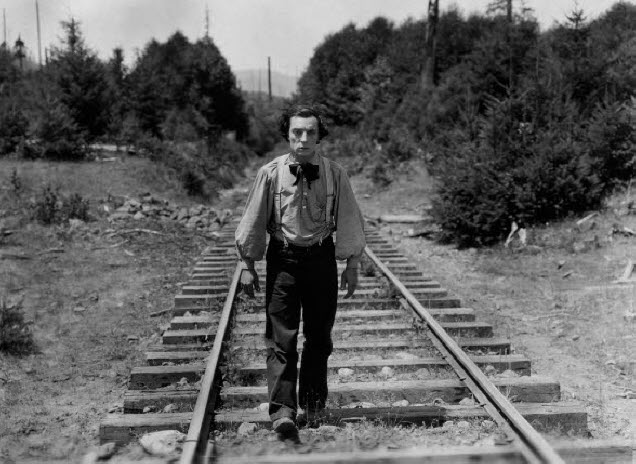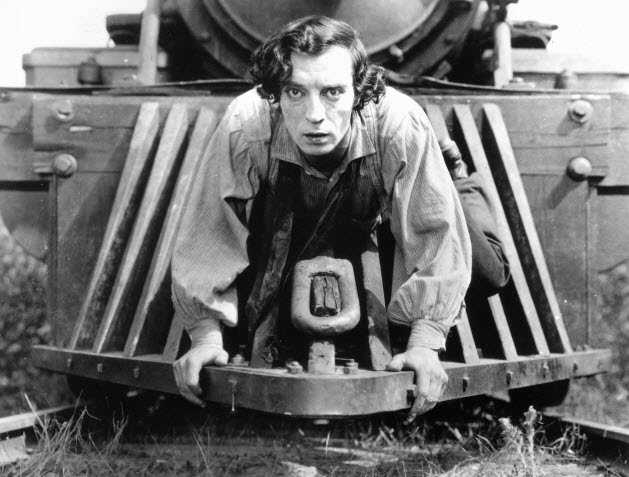
1926 silent black and white film “The General” is simply a great comedy. Although it is 100 years old at this point, the movie is still capable of amusing and entertaining us a lot with many inspired comic moments to remember, and it is certainly one of the finest moments in the career of its legendary star Buster Keaton, who has been regarded as one of the best comedians/filmmakers of the silent film era during the early 20th century along with Charlie Chaplin.
Although it is indubitably one of the last great works from the silent film era, “The General” was actually as a commercial dud when it came out. The movie was not so welcomed by both the audiences and the critics, and its disappointing box office returns compared to its big production budget ($750,000) led to the long career downturn for Keaton. As being consequently forced to make a restrictive deal with Metro-Goldwyn-Mayer, he irrevocably lost his artistic independence, and then he saw his status gradually diminished during next several decades, before his significant achievements in “The General” and his several other comic masterworks were belatedly recognized and admired around the 1950s.
When I happened to get a chance to watch “The General” at a local movie theater thanks to a little special event for Keaton’s several notable works, I observed again how effortlessly Keaton, who also served as its co-director/co-writer/co-producer, handles those numerous amusing moments in the film. No matter how silly and absurd things become for his everyman hero on the screen, the movie sticks to its straightforward tone to the end, and so does his performance – with that famously phlegmatic, or stone-faced, attitude and a bit of earnest sense of bafflement. Usually occupied with what is the most important to him without noticing any absurdity of the situation surrounding him at all, his character comes to function as an oddly calm ground to support everything in the film, and Keaton accomplishes his mission with graceful agility even during its most frantic moments.
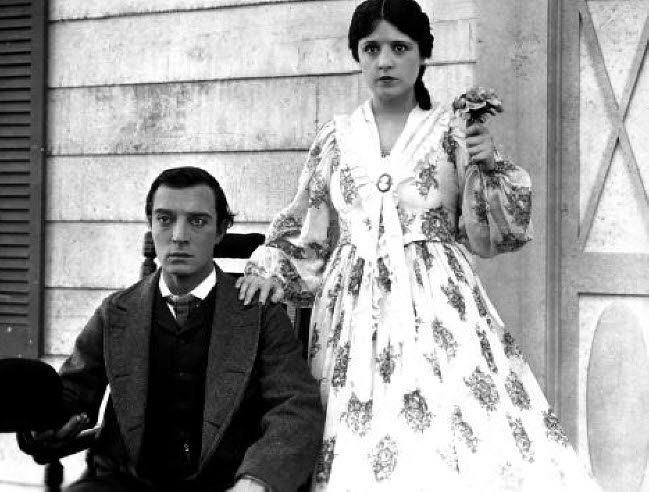
At the beginning, the movie, which is set in an American Southern region in the early 1860s, quickly establishes the two most important things for Keaton’s character, who is a plain train engineer working for Western & Atlantic Railroad. One is his locomotive named “the General”, and the other one is a young Southern lady played by Marion Mack. Early in the film, we see how Keaton’s character tries to win this young woman’s heart, and we are amused by how oblivious his character is to the accumulating comic momentum on the screen. At first, he is simply followed by two little boys imitating his gait, and then he is also followed by that young lady, but he does not notice this at all before he eventually arrives at her family house. We are more amused as this scene becomes more absurd later, but Keaton and the movie maintain their deadpan attitude as before, and this certainly tickles us a lot.
When the Civil War begins, Keaton’s character tries to enlist in the Confederate Army mainly for impressing that young lady more, but, to his disappointment, he gets rejected as being told that he is more useful as a train engineer than a soldier. He is understandably disappointed, but there comes an unlikely chance for proving himself one year later. When a bunch of Union Army soldiers take away his locomotive for their latest military operation, that young lady happens to be on a boxcar connected with that locomotive, and he naturally becomes quite determined to save her by any means necessary.
What follows next is a series of inventive comic moments shining with sharp creativity and precise timing. We are gradually amused as Keaton’s character trying one vehicle after another before eventually driving a locomotive for chasing after those Union Army soldiers, and then there comes a hilarious chase sequence along the railroad. While this is basically one-dimensional chase, Keaton and his co-director Clyde Bruckman, who wrote the screenplay with Al Boasberg and Charles Smith (Their screenplay was based on William Pittenger’s 1863 memoir “The Great Locomotive Chase”, by the way), steadily doles out unexpected comic obstacles for Keaton’s character, and one of the biggest laughs in the film comes from a big cannon clumsily handled by him at one point. As this cannon is slowly pointed toward him and the locomotive, there seems to be no escape for them as the cannon is moving straight along the same railroad just like them, but then there comes a sudden comic turn which still amuses me a lot for considerable ingenuity.
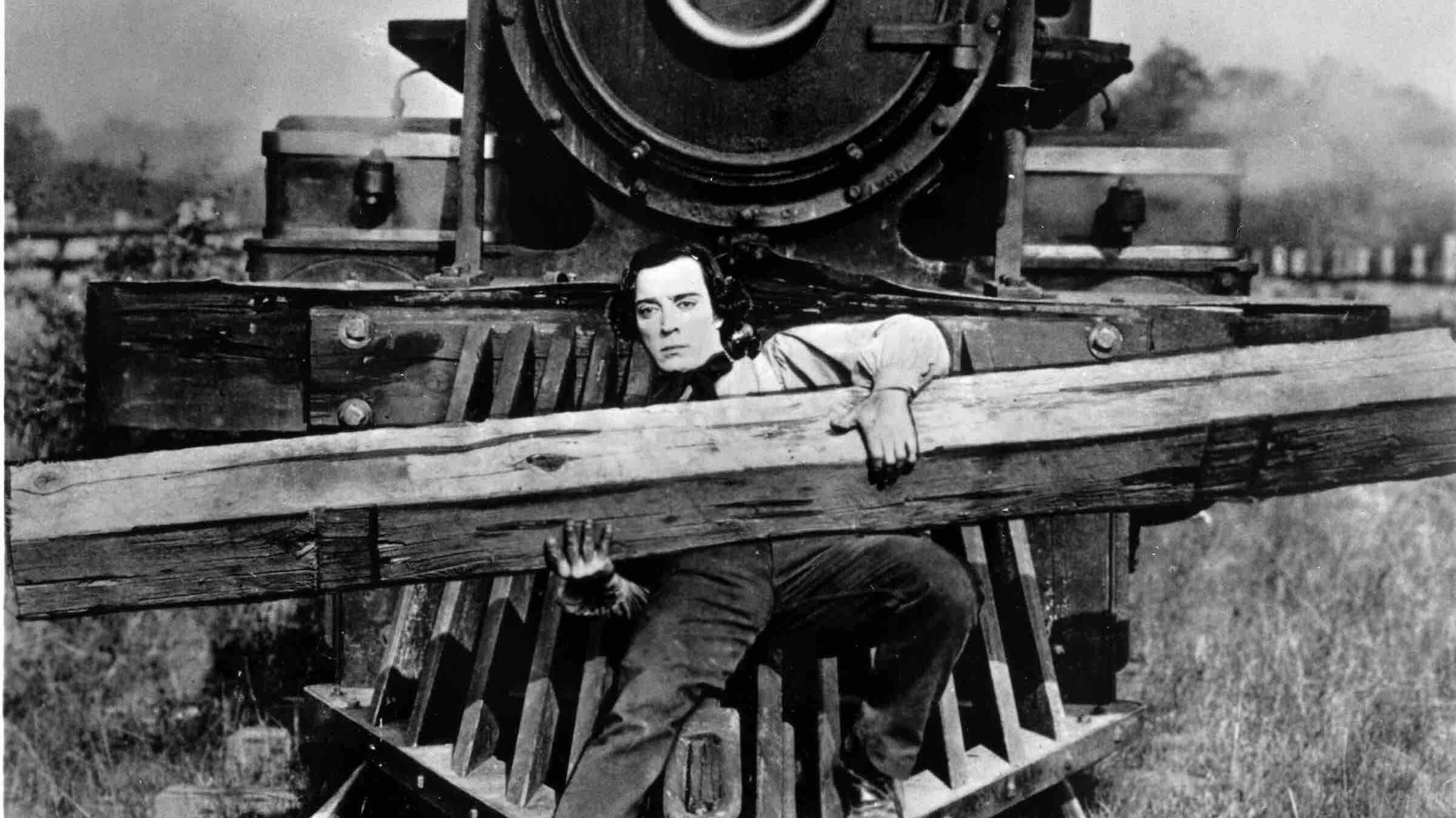
It is known well that Keaton threw himself into all of these and other action scenes in the film like he always did in his other notable works. In case of one certain scene early in the story, he had to sit on one of the coupling rods of a moving locomotive without any safety measure, and he could have got himself seriously injured at any point as shooting this scene. When he performed a very dangerous stunt as placing himself right on the front end of a locomotive moving at a considerably high speed, he had to take a lot of chance despite the sheer peril of this stunt, and you will admire his professional dedication more as appraising this moment.
Amid all these dangers and silliness, Keaton remains calm and earnest, and we come to laugh and then care more about his character’s bumpy quest for winning the heart of that young lady. During one particular key scene in the middle of the film, his character happens to hide under a big table surrounded by his opponents, and the movie has some little visual fun as he gets a chance to look at her via a little accidental hole in the sheet covering the table, which comes to function as an “iris shot” to our little amusement. As sensing more of his sincere love toward her, we come to root for him all the more than before, and the ending feels both sweet and hilarious as we gladly put aside our modern perspective on the Civil War for a while at least.
Overall, “The General” remains fresh and interesting mainly thanks to Keaton’s ingenious unflappable presence and talent. If you have not seen any of his movies, this great film will be a suitable beginning for you, and then you will probably want to check out his other excellent works such as “Our Hospitality” (1923) and “Sherlock Jr.” (1924). They may look quite old to you at first, but their timeless comic qualities will linger on you for a while, and you will appreciate more of his significant contribution to cinema.