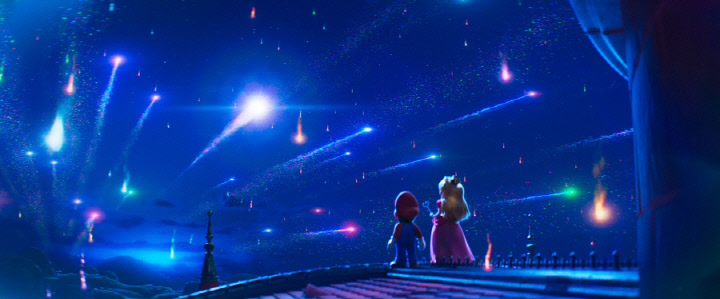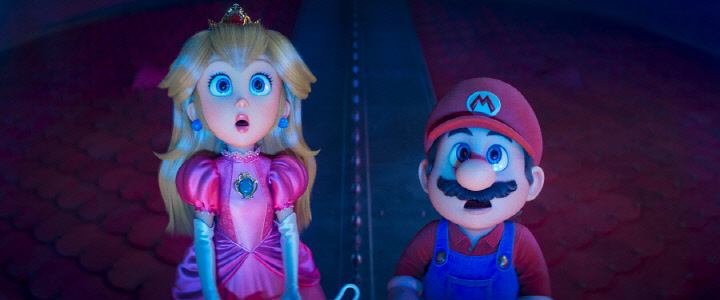
I felt depressed as phlegmatically observing how my mind was frequently turned off as watching animation film “The Super Mario Galaxy Movie”, the sequel to “The Mario Bros. Movie” (2023). I did try to focus on its barebone plot and cardboard characters, but there was nothing I could really hold onto during my viewing, and I was merely amused a bit by a meaningless stream of silly gags and superficial jokes along this expensive but ultimately mediocre product.
As watching the beginning of the film, I struggled to remember anything from “The Super Mario Bros. Movie”, but I could only remember a very few things. As far as I can recall, 1) the story was more or less than your average hero origin story for Mario (voiced by Chris Pratt) and his younger brother Luigi (voiced by Charlie Day), and 2) they eventually saved the day for Princess Peach (voiced by Anya Taylor-Joy) and her kingdom, and 3) their villainous opponent, Bowser (voiced by Jack Black), was defeated and then got imprisoned in his literally downsized status.
The main villain of “The Super Mario Galaxy Movie” is Bowser Jr. (voiced by Benny Safdie), the son of Bowser who has somehow established his own powerful army somewhere in the galaxy and has been quite determined to accomplish his two main goals. First, he wants to liberate his father who is currently a captive in the palace of Princess Peach, and then he is going to dominate the universe along with his father with his planet weapon which is virtually a cartoonish version of the Death Star in the Star Wars movies.
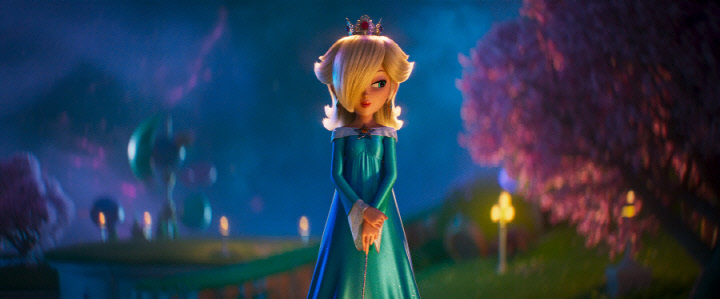
As a part of his diabolical plan, Bowser Jr. kidnaps Princess Rosalina (voiced by Brie Larson), who is the gentle but powerful protector of little orphan stars. He is going to use her power for that weapon of hers, and, needless to say, the Mario brothers and Princess Peach soon get involved into this situation along with Bowser, who seems to be sort of rehabilitated as trying to suppress his evil side in front of the Mario brothers.
As its main characters bounce from one narrative point to another, a lot of recognizable stuffs pop up here and there throughout the film. If you have ever played or encountered that famous Nintendo video game on which the film is based, you will certainly notice many different figures and backgrounds from that video game, and you may be also delighted a bit by how these elements are colorfully presented in digital animation.
However, this fun does not last that long as there is not much development in terms of story and characters. The plot is virtually non-existent as merely moving its main characters along its utterly predictable narrative, and there is not much depth in case of characterization. While Mario and Luigi are simply defined by their broad appearance and attire, the hidden connection between Princess Peach and Princess Rosalina is perfunctory without much interest, the same thing can be said about Bowser’s little inner conflict, which is quickly discarded once he sees how much his son has tried to impress him (Is this a spoiler?).
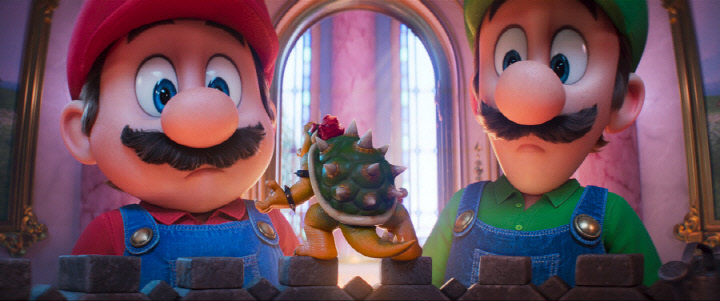
Furthermore, the main voice cast members of the film remain bland and uninspired on the whole. Chris Pratt’s voice performance is improved a bit compared to his utterly flat job in the previous film, but there is nothing much he can do except sounding cheery or heroic. Charlie Day has much more things to do compared to the previous film, but he is only demanded to throw a lot of silly lines just for making us a little amused. Anna Taylor-Joy and Brie Larson bring some pluck to their respective roles, but they are often limited by their limited thin characters, and the same thing can be said about Jack Black and Benny Safdie, who are just required to chew every line of theirs as much as possible. In case of the supporting voice performers including Glen Powell, Issa Rae, Keegan-Michael Key, Luis Guzmán, and Donald Glover, most of them are unfortunately under-utilized despite their game efforts, and that is another disappointment in the film.
In technical aspects, the film shows some competence but remains seriously devoid of style and personality. Sure, directors Aaron Horvath and Michael Jelenic, who also directed the previous film, and their crew members did almost everything they could do for vividly presenting all those stuffs from that Nintendo video game on the screen, but there is not much sense of surprise or inspiration from the start. Sure, the story does try to expand its universe with several different worlds to be unfolded in front of Mario and Luigi, but there is not any particularly fresh style or substance to draw our attention, and we just come to follow a series of happenings and introductions without much care or interest. At least, the score by Brian Tyler, whose score for the previous film was one of a very few saving graces, tries its best for bringing some enthusiasm to the screen, and you may appreciate his efforts more considering he kept working on the score even when he was hospitalized for a while due to a mild stroke.
In conclusion, “The Super Mario Galaxy” simply comes and goes without much impression just like its predecessor, and it is already fading away in my mind although no more than a half day passed since I watched it at last night. Because it earned more than 800 million dollars around the world at this point, there will surely be another sequel within a few years, and now I become all the more depressed as mulling on this daunting prospect.