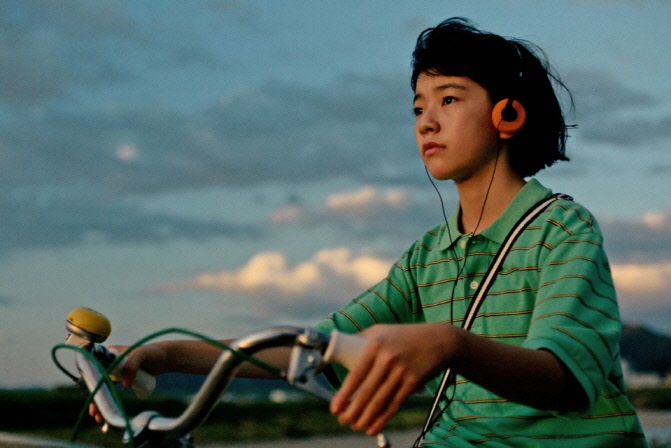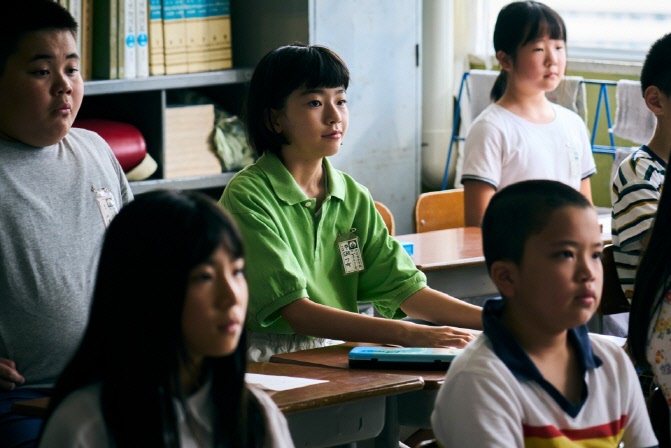
Chie Hayakawa’s latest film “Renoir” takes some time for letting us grasp what and how it is about. At the beginning, you may often be baffled about where the story and its quirky young heroine are going, but you will gradually grasp the emotional confusion behind her rather detached façade as the story leisurely moves from one episodic moment to another.
The movie, which is set in Tokyo around the late 1980s, mainly revolves around the viewpoint of an 11-year-old girl named Fuki Okita (Yui Suzuki), and the rather disturbing opening scene shows a bit of her odd but imaginative sensitivity. She recently wrote a story to be presented as a class homework of hers, and the story is about the sudden death of a young girl around age and its aftermath. While her teacher appreciates her good writing, he is a little concerned because she has frequently written such disturbing stories like that, and her mother is not so amused to say the least.
However, there is a good reason behind those dark stories of Fuki. Her father, who is your average company man, is dying due to his terminal illness, and there eventually comes a point where he really needs to spend his short remaining time at a hospital. Now Fuki’s mother has to take care of a lot more stuffs than before, and it seems that her resulting stress affects her job to some degree.
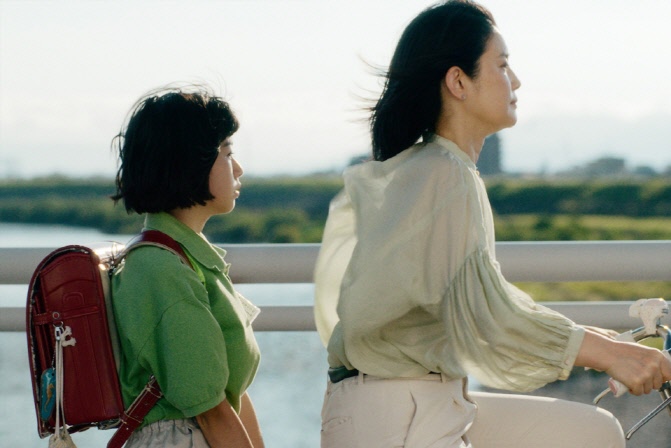
In contrast, Fuki looks rather detached compared to her mother. As her summer vacation begins, she has more free time for herself, and we observe her befriending a new girl in her private English academy. Although their first interaction is rather awkward, it does not take much time for them to get close to each other, though Fuki cannot help but notice how strained her new friend’s parents look. Although they are fairly affluent on the whole, there is some emotional distance between her new friend’s parents, and we are not so surprised when Fuki comes upon a little secret behind them later in the story.
In the meantime, things are getting worse Fuki’s father day by day. While he enjoys being with his daughter, he becomes more aware of his impending death, and he certainly wants to find any possible chance for survival. When his wife happens to come upon someone willing to provide them some special medicine which may cure him, he does not hesitate at all, but Fuki soon comes to notice something going on between her mother and that figure in question. Getting more frustrated with her ongoing struggle to maintain the status quo of her family, Fuki’s mother comes to lean more on that figure, but, of course, this eventually turns out to be a very unwise choice.
And we come to sense more of Fuki’s emotional confusion along the story. While both of her parents are struggling with each own issues, she becomes more isolated in her own little world, and the movie sometimes blurs the line between reality and her imagination. For example, her accidental encounter with a young female neighbor is overlapped a bit with her experience as well as that story written by her, and there are also several other scenes where we will have reasonable doubt on her viewpoint.
However, there are also a number of sobering moments which make us more concerned about her. When Fuki’s father goes to a racetrack outside the city along with her just for having what may be the last fun time for them, she is reminded again of how sick and helpless her father really is. After she comes across an advertisement for blind phone chatting, she decides to leave a little message for connecting with anyone out there, and that leads to a very unnerving scene between her and some questionable dude. As this guy approaches closer to her, we surely become all the more uncomfortable, and the movie subtly dials up the tension beneath the surface, while our young heroine seems rather oblivious to what may happen sooner or later.
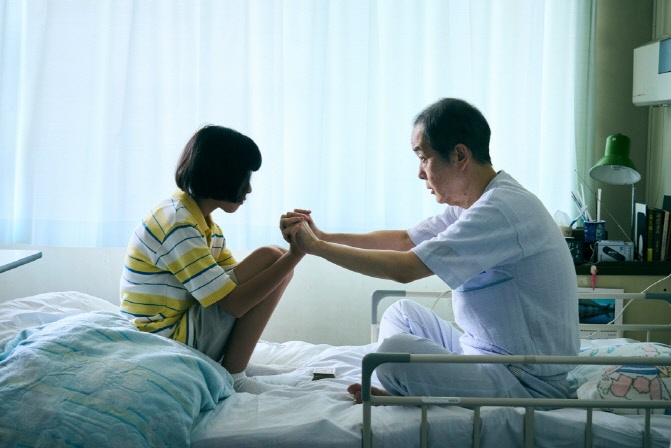
During its last act, the movie blurs the line between reality and imagination a bit more, and we are not so sure about what actually occurs around the eventual death of Yuki’s father. Nevertheless, we also sense some growth and acceptance from her changed appearance, especially after she happens to have a moment of unexpected emotional support around the end of the story. While she remains oddly imaginative as before, things will probably get better for her as she continues to grow up more, and the last scene between her and her mother is quietly touching even though they do not say much to each other.
Young performer Fuki Okita’s unadorned performance diligently carries the film, and she is also supported well by several other solid supporting performers Lily Franky and Hikari Ishida have each own moments around Okita as Yuki’s parents, and Yuumi Kawai, Ayumu Nakajima, and Ryota Bando are also effective in their small but crucial supporting parts.
In conclusion, “Renoir”, whose title is incidentally associated with a replica of one of the notable works of Pierre-Auguste Renoir which appears later in the film, can be rather frustrating due to its occasionally opaque storytelling and slow narrative pacing, but it is worthwhile to watch for its competent handling of mood, story, and characters. It will require some patience for you just like Hayakawa’s previous film “Plan 75” (2022), but it is a bit more engaging with more care and sensitivity, so I recommend you to give it a chance someday.