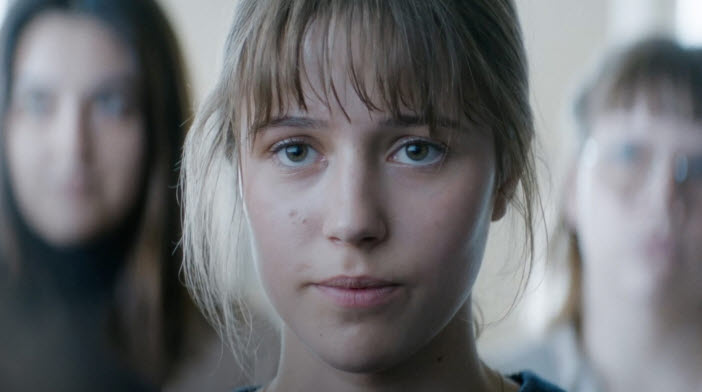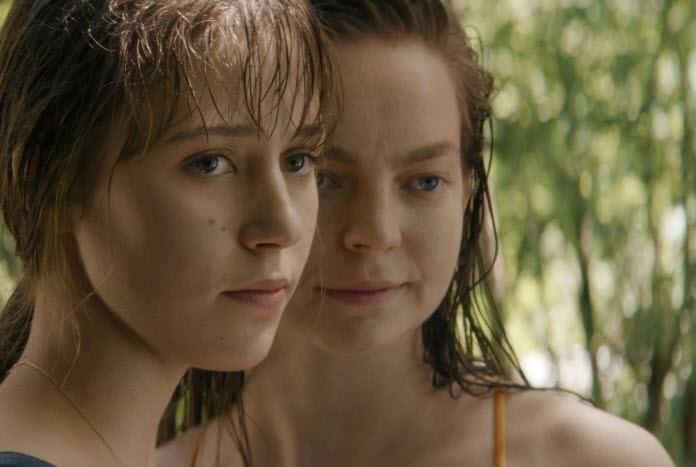
“Little Trouble Girls”, which was the official submission of Slovenia to Best International Film Oscar in last year, follows the gradual sexual awakening of one introverted adolescent Catholic girl. It is apparent from the beginning that she does not know that much about her burgeoning sexuality, but her mind and body cannot help but feel more of whatever they begin to desire, and we come to observe her rather bumpy emotional journey with more interest.
She is a 16-year-old Catholic school girl named Lucija (Jara Sofija Ostan), and the movie directly conveys to us her ongoing sexual awakening right from its opening part. When she joins the all-girls choir of the school, she cannot help but look at a girl named Ana Maria (Mina Švajger), who looks a lot more open and confident compared to Lucija’s rather shy attitude. When they later befriend each other a bit, Ana Maria suggests that Lucija should put some cosmetics on her face, and Lucija has no problem with following Ana Maria’s suggestion
However, this is not approved by Lucija’s mother at all, who is your average strict conservative Catholic mother. Although she is not a bad mother at least, it is clear that Lucija’s mother has exerted considerable repressive influence on Lucija, and Lucija’s father, who seems to be a total loser, is pretty useless and absent as shown from his brief appearance early in the film.
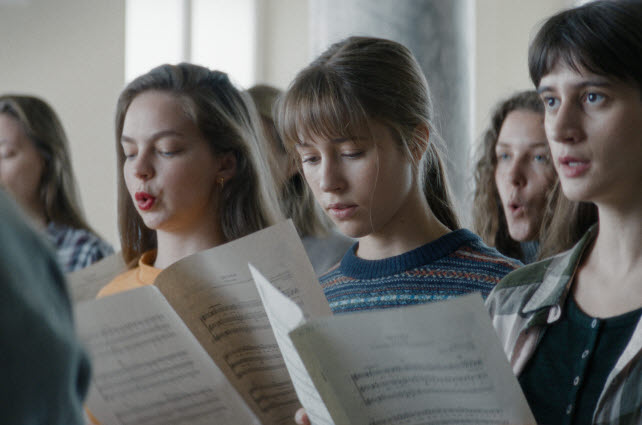
Anyway, Lucija and the other members of her choir subsequently have a retreat at a countryside convent along with their male conductor, who still expects them to hone their singing skill more in this quietly isolated place. However, there are several male workers doing some repair on the convent building, and one of them particularly draws the attention of Lucija and several other girls including Ana Maria just because, well, he looks handsome and virile enough to stimulate their sexual interest.
What follows next is how fluid and amorphous our heroine’s sexuality is. As spending more time with Ana Maria, Lucija finds herself more attracted to her, and her agitated state of mind is occasionally reflected by a series of forthright images. At the same time, she also becomes more interested in that worker in question, and she even commits a little prank on him along with Ana Maria.
Needless to say, her ongoing emotional turmoil comes to influence her singing, and the conductor soon begins to notice that. At one point later in the story, Lucija confesses a bit about her emotional struggle to the conductor, but he does not provide her much support or help, and this makes her all the more agitated than before.
As its heroine goes through one moment of sexual confusion after another along the story, the screenplay by director Urška Djukić and her co-writer Maria Bohr sticks to its non-judgmental attitude while illustrating its heroine’s gradual emotional maturation with considerable sensitivity and thoughtfulness. While we later get apparently symbolic moments including the ones respectively involved with sour and sweet grapes, they are mixed well with more subtle moments such as a brief conversation scene between the mother superior and Ana Maria and Lucija. As the mother superior casually talks about her supposedly deep love and devotion toward her god, Lucija comes to learn a bit about another possible way for her sexuality, and that is dramatically presented around the end of the story, though we are not so sure about whether this is real or imagined by Lucija’s feverish mind.
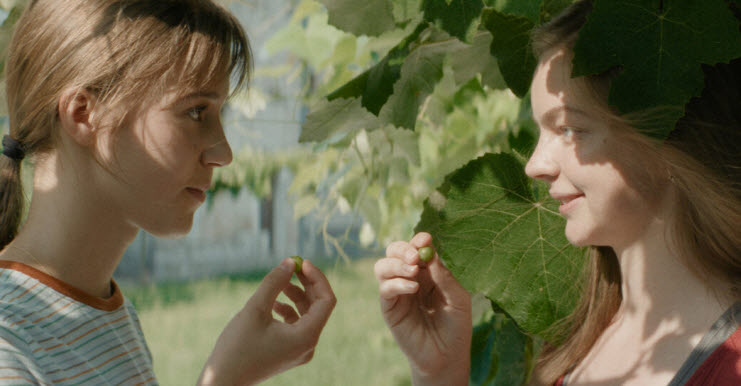
Everything in the film depends a lot on the expressive natural performance of newcomer Jara Sofija Ostan, who never had movie acting experience before but did an impressive job of carrying the film to the end. There are a number of crucial scenes where cinematographer Lev Predan Kowarski’s camera solely focuses on Ostan’s performances, and Ostan never makes any misstep while ably embodying her character’s dynamic inner struggle along the story. Eventually, we observe how much Lucija is changed after the end of her difficult emotional journey, and Osten is utterly convincing even though she does not seem to signify much on the surface.
Around Ostan, several main cast members of the film hold each own place well without overshadowing her at all. Mina Švajger is as charismatic as required by her role, and we can clearly understand Lucija’s attraction toward Ana Maria right from their first scene in the movie. As Lucija’s strict conservative mother, Nataša Burger has a small but revealing moment when her character comes to have a little mother and daughter time with Lucija, and we come to get a little insight on how much she has influenced Lucija in one way or another. Saša Tabaković is also effective as the choir conductor, and he deftly supports Ostan during one particularly tense key scene later in the movie.
On the whole, “Little Trouble Girls”, whose original Slovene title “Kaj ti je deklica” means “What’s wrong, girl?”, is a hauntingly sensitive coming-of-age drama to be appreciated for a number of interesting elements, and Djukić makes a solid feature debut here after making several short films. It is a shame that it went straight to a local streaming service in South Korea instead of getting released in movie theaters, but it is still worthwhile to watch nonetheless, and I recommend you to give it a chance someday.