South Korean independent animation film “Pilgrims” presents a little science fiction tale which could do more in my trivial opinion. While it is fairly competent in technical aspects, the movie feels rather flat and colorless in terms of story and character, and I observed it from the distance instead of caring more about the story and characters.
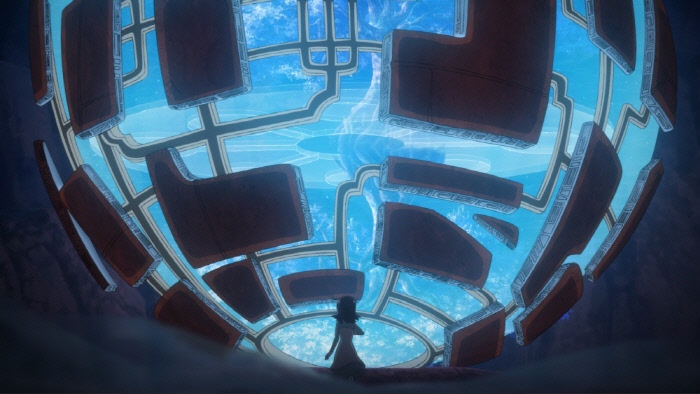
The film, which is based on South Korean science fiction writer Kim Cho-yeop’s short story “Why Do Pilgrims Never Return?”, begins with the introduction of a little utopia world outside the Earth. Every member of this world is incidentally female, and they all have lived together happily and harmoniously while mostly being away from most of those intense human emotions as reflected by one school lesson scene early in the story.
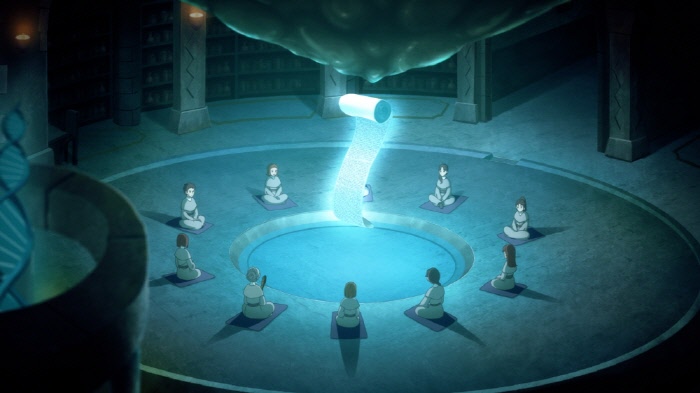
The elder members of this community diligently follow their quasi-religious belief originated from the legendary founder of their community, and one of their main tasks is handling a certain big annual ritual. All of the young members in this world must embark on a one-year pilgrimage to the Earth at the age of 18, and there is a space shuttle which takes the latest pilgrims to the Earth after taking back the returning ones from the Earth.
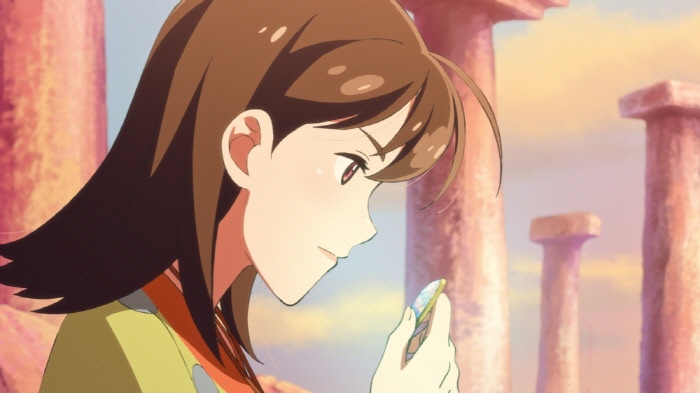
However, not all of the pilgrims sent to the Earth return, and a girl named Daisy (voiced by Park Ji-hu) begins to wonder what happened to those pilgrims who did not return from the Earth. One of those non-returning pilgrims happens to be a close friend of hers, so Daisy decides to go inside the space shuttle instead of greeting those returning pilgrims along with her other close friend Sophie (voiced by Kim Hyang-gi).
Some time later, we see Sophie going through another nice day along with many other girls around her age. She somehow does not remember much of Daisy, so she is quite baffled when Daisy suddenly attempts to correspond with her via a little object given to her in advance. After arriving at a big futuristic city on the Earth, Daisy had to go through some tough moments, and she certainly misses Sophie more than ever, though Sophie still cannot remember a lot of their friendship.
It is not much of a spoiler to tell you that both Sophie and Daisy come to realize that their utopian world is actually closely linked with the dystopian society of that big futuristic city. Many people in the city have been unjustly discriminated just because of being genetically “natural”, and some of them including that old friend of Daisy have been ruthlessly hunted by the system for showing defiant resistance against it.
Yes, this is a very typical science fiction story setup, and Kim’s short story probably brings some style and detail to its familiar story premise, but the film is often shallow and deficient in both style and substance. While we get some glimpses into that big futuristic city, it simply remains as a merely oppressive background without enough interesting stuffs to intrigue us, and it also fails to establish engaging characters to hold our attention. While we are supposed to care more about the emotional bond between Sophie and Daisy along the story, they are no more than broad archetypes without enough personality or spirit, and the story also does not flesh out that old friend of Daisy enough, who are more or less than a tool for some plot exposition.
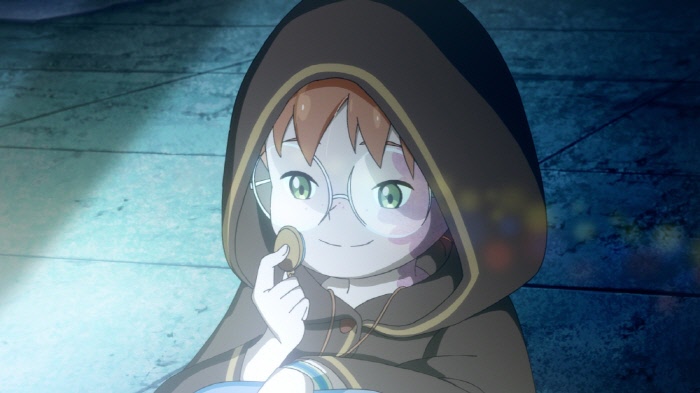
In addition, the voice cast members of the film are usually flat and strained to my disappointment. While Kim Hyang-gi and Park Ji-hu are undeniably talented actresses (Kim recently gave a terrific lead performance in “Hallan” (2025), and I still fondly remember Park’s unforgettable breakthrough turn in “House of Hummingbird” (2019)), their voice performances occasionally show some distracting awkwardness, and they also do not generate much chemistry between their respective parts.
I must point out that director Heo Pyoung-kang had a fair share of animation filmmaking experience before making her directorial feature film debut here. During last two decades, she participated in the production of a number of notable Japanese animation TV series and films ranging from “Night is Short, Walk on Girl” (2017) to “Detective Conan: Zero the Enforcer” (2018), and that is quite evident from the cell animation style of “Pilgrims”, which is not so far from that of many Japanese animation TV series and films out there. As far as I can see, she is a well-experienced animation filmmaker with considerable potential, though the film still feels like a mere test run before whatever may come next from her.
In conclusion, “Pilgrims” does not satisfy me enough during its rather short running time (60 minutes), but I admire it to some degree as another recent South Korean animation to notice. Although South Korean animation industry has been a lot less distinguished compared to the monumental status of the Japanese animation industry for many years, I and South Korean audiences watched a series of small but notable local works such as “Mother Land” (2023), “Exorcism Chronicle: The Beginning” (2024), and “The Square” (2025) during last several years, and they and “Pilgrim” will probably lead to more success and achievement in South Korean animation in the future.