

Mark Herman’s 2008 film “The Boy in the Striped Pyjamas”, which happens to be released in South Korean theaters in this week, works as a fable rather than a realistic Holocaust drama. While its story premise is no more historically accurate than, say, Roberto Benigni’s “Life Is Beautiful” (1997), the story and characters are engaging enough to hold our attention up to its devastating finale, and the main subjects of the movie still feel relevant even at this point.
The story is unfolded mainly via the viewpoint of Bruno (Asa Butterfield), a young boy living in Berlin, Germany in the middle of the World War II. For him, everything looks fine and well as he freely hangs around with his school friends, but, of course, we cannot help but notice a number of disturbing things besides many soldiers and Nazi flags shown here and there in the city.
And his affluent family turns out to be closely associated with the Nazi German government. Bruno’s father Ralf (David Thewlis) is a high-ranking SS officer, and his family is now about to leave Berlin because Bruno’s father happens to be assigned to some important position outside Berlin. Needless to say, both Bruno and his older sister Gretel (Amber Beattie) are not so pleased about this change, but their mother Elsa (Vera Farmiga) assures them that they will have a good time over there.

Needless to say, we gradually sense a number of disconcerting signs as Bruno and his family arrive at their new place to live. Their new house looks fairly big and nice while being located in the middle of some rural region, but then Bruno notices something odd. There seems to be a “farm” not so far from their new house, and he is baffled as wondering why the people in this “farm” are wearing “striped pyjamas”. As he later meets one of those “farm” people later, he becomes all the more curious, but both of his parents still do not tell much about the “farm”.
Unlike him, we all know too well from the beginning that the “farm” is one of many concentration camps under the Nazi Germany government and Bruno’s father is its new commandant, but the movie firmly sticks to his innocent viewpoint. As he becomes more bored in the house, he eventually decides to explore the backyard of the house and the area beyond it even though his parents do not allow that all, and he finally beholds the concentration camp for himself, though he cannot enter there due to the electric wire fence surrounding it.
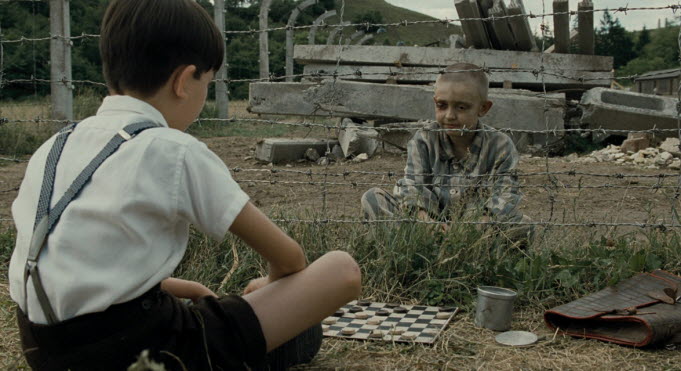
Still not perceiving the grim human atrocity right in front of him at all. Bruno soon encounters a young Jewish boy around his age. His name is Shmuel (Jack Scanlon), and he also wears “striped pyjamas” just like all others in the concentration camp. Just because he has no other boy to hang around with him, Bruno attempts to befriend Shmuel, and that is the beginning of their unlikely friendship.
Needless to say, as getting to know Shmuel bit by bit, Bruno becomes gradually conflicted along the story. While his older sister willingly absorbs and follows whatever is told to them about Jewish people, he begins to have questions and doubts in contrast, but that sadly does not prevent him from committing an act of cowardice later in the story. Nevertheless, he becomes more conscious of what his parents are hiding from him especially after his parents clash over that issue, and this consequently leads him to making a choice which will affect not only him but also his family a lot.
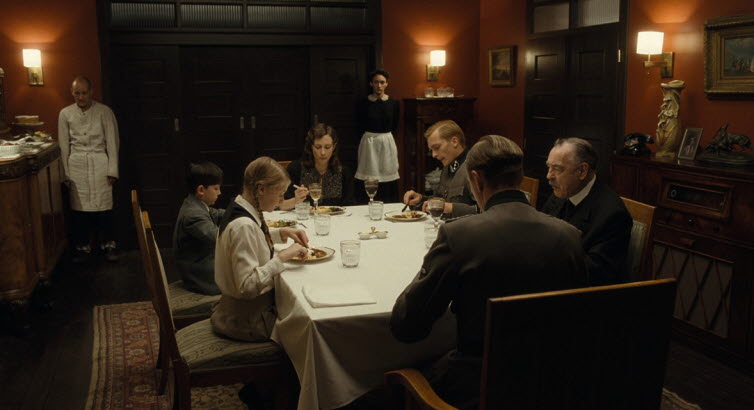
The movie, which is based on the novel of the same name by John Boyne, does not flinch from the horror of the Holocaust during its final act. Although the finale is blatantly melodramatic with more gravitas from the score by James Horner, we care about what inevitably happens at the end of the story, and we also come to reflect more on Bruno’s choice. Yes, he is quite naïve even at that point, but he does what he believes is the right thing to do, and that certainly makes a poignant contrast to most of the adult characters around him, who simply follow or conform to their evil government without much question or resistance at all.
The two young performers at the center of the movie are effective in their earnest performances. Asa Butterfield, who would become more prominent as the young hero of Martin Scorsese’s “Hugo” (2011) and then went further as recently shown from the acclaimed Netflix series “Sex Education”, is convincing as his character slowly opens his eyes to the evil around his limited environment, and he and Jack Scanlon are effortless in their tentative interactions on the screen. In case of several other main cast members in the film, David Thewlis and Verga Farmiga ably handle their respective archetype characters without never toning down their characters’ association with the evil of the Holocaust, and Amber Beattie, Rupert Friend, David Hayman, Sheila Hancock, and Richard Johnson are also well-cast in their small supporting parts.
On the whole, “The Boy in the Striped Pyjamas” does not reach the level of Steven Spielberg’s “Schindler’s List” (1993) or Jonathan Glazer’s “The Zone of Interest” (2023), but it is still worthwhile to watch thanks to the sensitive direction of Herman, who previously directed “Brassed Off” (1996). It is not great, but, considering what is happening in our world right now, this modest Holocaust fable will leave you something to muse on after it is over.


 Seongyong's Private Place