2020 has been pretty hard and difficult for many of us. At the beginning of this year, COVID-19 merely looked like a problem for several countries including mine, but then it has been spread all around the world during last several months, and our global world has been devastated a lot by its ongoing ramification which will be continued for next several years at least.
As we all know, many business fields have been seriously affected by the COVID-10 pandemic, and movie business has been no exception. Numerous new movies have been delayed in their production or theatrical release for several months while many theaters are closed down for public safety, and even major Hollywood movie studios came to surrender as choosing to release some of their latest products via streaming services instead. In case of South Korean theaters, many of them are still in business while releasing new movies every week as usual, but they are naturally restricted by the increasing level of social distancing, and the number of audiences has been considerably decreased despite a few notable local hit movies.
Anyway, there are still a considerable number of small and big films released in 2020, and I have managed to watch and review more than 290 movies during this year. As usual, I submit here the list of a bunch of good movies you should not miss, and I hope this list will help you have a more entertaining time later.
By the way, as an audience living in South Korea, I still cannot watch several notable films of this year including “Minari”, “The Father”, “Nomadland”, “One Night in Miami”, “Small Axe”, “News of the World”, “Another Round”, and “Promising Young Woman”. They all will soon be reviewed, and I will certainly mention them at the end of the next year if they are as good as others say.
Bill Ross IV and Turner Ross’ latest work “Bloody Nose, Empty Pockets” will impress you twice at least if you are going to watch it without much knowledge on how it was produced. Considering how much I was surprised even after I had some vague knowledge on its production, I think you should watch this remarkable piece of work right now instead of reading the following paragraphs which will reveal more about the film.
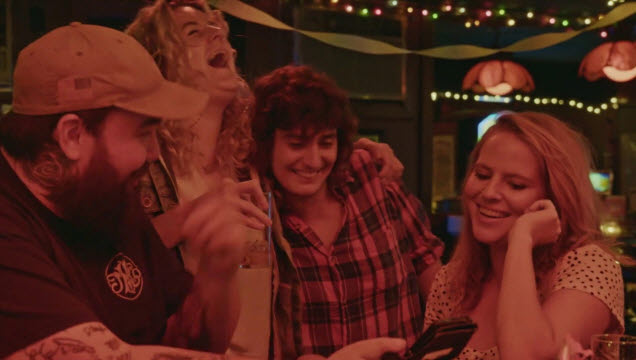
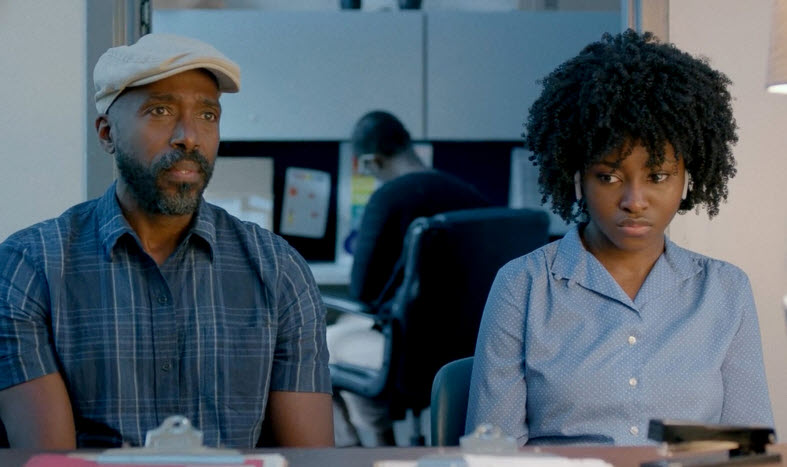
The setup of the film is pretty simple. Its main background is a little shabby bar located somewhere in Las Vegas, Nevada, and we gradually come to gather that the bar is about to have its last day, as meeting its daytime bartender and an alcoholic barfly named Michael, who is apparently suffering the consequence of whatever he drank at last night.
Once the bar is officially open, its usual patrons enter the bar, and we get to know each of them as the camera patiently observes their faces as well as their words. While an old African American guy named Bruce is usually quiet as sitting a bit far from others, Michael and other drinkers lively and closely interact with each other as beginning their another drinking time, and their daytime bartender is happy to provide whatever his customers are about to drink, though it is only around AM 11:00.
While often showing to us the outdoor shots tinted in bright colors, the film sways along with these drinkers in the bar, and time quickly passes with more glasses to be emptied. As a guy who sometimes dropped by a posh bar for drinking several glasses of cocktail, I certainly understand well how the sense of time can be considerably blurred by getting drunk more and more, and I was frequently amused by the ebullient mood among the drinkers in the bar, which is often boosted by a number of different pop songs played in the background.
In the meantime, the drinkers in the bar sometimes come to have sharp moments of wit and insight. Although he can be as cheerful as his fellow drinkers, Bruce seems to be still struggling with those traumatic war experiences during his military tour, and everyone listens to him as he quietly talks about what has been eating him for years. In case of Michael, it is implied that he had some big failures in his life, but he is not so bitter about that at present, and he sarcastically muses on his current status at one point: “I pride myself on only having become an alcoholic after I became a failure.”
As the afternoon is followed by the evening and then the evening is followed by the night, the mood inside the bar remains as lively as before. While the daytime bartender is eventually replaced by the nighttime bartender, several more frequent customers enter the bar, and some of the early customers come to leave because, well, they reach to their limit.
Nevertheless, Michael and several other early drinkers including Bruce and a burly Australian guy named John remain for more drinking, and they surely bring more fun and excitement into the bar despite their growing sadness. They have felt like a big happy family through drinking for many days and nights, but now there finally comes a point where they cannot have another fun drunken night again, and the bitterness comes to grow more and more as the eventual time for the last order is approaching.
During the shooting of their film, the Ross brothers, who also served as co-producers/cinematographers (Bill Ross IV also edited the film as usual, by the way), constantly looked for any good moment to be captured from the drinkers in the bar, and the result is quite vivid and spontaneous to say the least. There are actually several glaring shots in the film where you can see their camera, but they deliberately let these shots stay in the film for giving more rough realism to the film, and you will be amazed to learn that everything presented in the film actually comes from the improvised acting of the mostly non-professional cast assembled by the Ross brothers. As a matter of fact, the bar in the film is actually is located in New Orleans, Louisiana, and it is still in business even at this point.
Now you may question whether the film should be categorized as a work of fiction or should be regarded as a ‘documentary’ as intended by the Ross brothers. I initially felt conflicted a bit after coming to learn more about how they deliberately blurred the line between fiction and documentary during the production of their film, but I must admit that what they created along with their cast members, most of whom are actually experienced barflies selected via a series of auditions, approximates to what Werner Herzog called “exalted truth”, and I admire how the Ross brothers pull off those precious human moments of poetic beauty from their fascinating experiment. Yes, their cast members were really under alcoholic influence as spending two 18-hour days along with them for the shooting, but the cast members earnestly provided sublime materials to be processed by the Ross brothers at least, and these people come to us as unforgettably colorful figures to be remembered.
On the whole, “Bloody Nose, Empty Pockets” is quite fascinating for its curious mix of fiction and documentary, and you will appreciate its numerous good moments especially if you admire Barbet Schroeder’s “Barfly” (1987), which is incidentally one of the best bar drama films in my humble opinion. To be frank with you, I have already taken it for whatever it intends to be, and I am certainly willing to revisit it for more appreciation.
I still fondly remember when I took a train from Chicago to Urbana-Champaign, Illinois in the morning of April 20th, 2010. I was going there for attending the 2010 Ebertfest along with many others including late critic Roger Ebert, and I certainly had lots of expectation and anxiety as the train was approaching to my destination minute by minute, but I soon found myself soothed a bit as watching a series of rural landscapes consisting of fields, roads, towns, vehicles, and people.
While these passing landscapes which I saw from the window next to my seat all looked plain and ordinary, I observed them with curiosity and interest, and Bill Ross IV and Turner Ross’ first feature documentary film “45365” somehow evokes that experience of mine at that time. Although its main background is a small town of Ohio, what is vividly shown in the documentary often took me back to what I watched and experienced during my visit to Urbana-Champaign, and I also came to admire how it carefully and thoughtfully builds up its big, exceptional tapestry of places and people.
The town in question is Sidney, Ohio, whose postal code is, yes, 45365. Consisting of the five chapters respectively corresponding to each digit of this postal code, the documentary freely looks here and there around the places and people of Sidney, and this can feel a little too random for us at times, but the Ross brothers, who handled the cinematography in addition to co-producing their documentary (Bill Ross IV also edited the documentary, by the way), slowly generates a subtle narrative flow with recurring elements and a linear passage of time. For example, we often observe a town officer during his duty hour handling a number of different cases in the town, and his several scenes gradually form one of the main narrative strands to support the documentary, while we get to know his daily work bit by bit.
Another recurring element is the constant radio broadcast in the town. At a small radio studio inside some local station, we often see a local radio show host frequently playing a number of old pop songs, which sometimes accompany occasional outdoor shots in the documentary. Because another high school American football season is coming, everyone is interested in how much their high school American football team will achieve in this year, and we later see two guys discussing about that at the radio station.
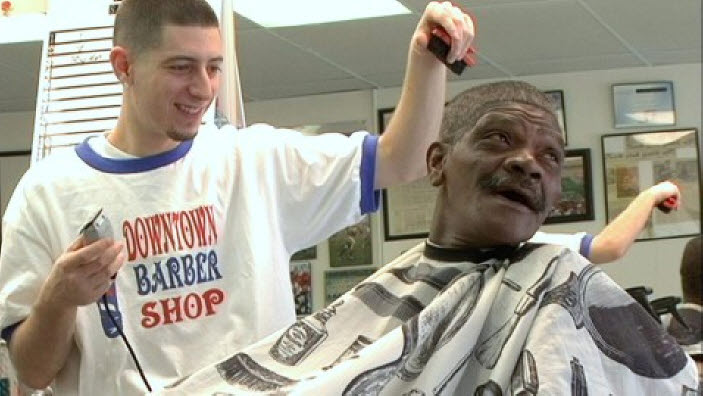
My favourite recurring element in the documentary is a local barbershop, which has three young barbers working there. As they busily work day by day, many different people come and go for haircut, and that reminds me of a similar scene in recent Pixar animation film “Soul” (2020). Once you sit at the corner of a barbershop for a while, you can listen to people talking about one thing after another, and that can be a pretty interesting experience to you.
Without providing any narration and comment for us at all, the documentary simply observes and occasionally listens to its human subjects, but the Ross brothers’ unobtrusive approach helps us get immersed in its small world, and I was often amazed by how their camera could capture very personal moments from some of their human subjects. For example, there are a couple of scenes where a mother and her son angrily argue with each other in their car for some trivial matters, and the Ross brothers’ camera just watches these two people from the backseat, but neither the mother nor her son seems to be aware of the presence of the camera behind them, though they must have been well aware of that they were constantly followed by the Ross brothers’ camera. I later came to learn that the Ross brothers shot their documentary in Sidney for 7 months in 2007, and I guess that was enough for them to make their human subjects less conscious of the presence of the camera closely shooting them.
Like any other town, Sidney and its people are quite excited when their town festival week begins, and the mood in the town becomes as joyous as possible. Although a certain outdoor music concert is ruined by the unexpected downpour from the sky, the performer brought to the concert tries as much as he can, and we are amused as watching a broom being used for pushing up the canvas roof for removing the rainwater on it. During the carnival season, kids are eager to try several different rides, and the documentary induces some curiosity from us as watching a certain weird spot for a while.
The documentary also does not hesitate at all to show the less pleasant sides of the town. Via that aforementioned police officer, we come to meet a number of problematic people, and I particularly remember an ex-con who emphasizes that he has been clean without any more trouble but then gets arrested by the police officer during his next scene. In case of the scene unfolded inside a local courtroom, we see a prisoner going through a certain legal procedure, and we get to know a bit about what he was arrested for.
Later in the documentary, the narrative flow eventually culminates to some important game for the high school American football team of Sidney. As expected, its coach delivers a routine motivation speech for his players in their locker room, and then we soon see these players confidently entering the field in front of their enthusiastic audiences.
Although it won Truer than Fiction award at the 2010 Independent Spirit Awards and then was shown at the 2011 Eberfest, “45365” has been unfortunately overlooked during last 10 years. Fortunately, the Ross brothers have made several acclaimed documentaries including “Bloody Nose, Empty Pockets” (2020) since their debut, and “45365” still remains as one of their notable achievements. At present, the documentary is available on Vimeo (https://vimeo.com/214240589), and I really recommend you to give it a chance someday.
Sofia Coppola’s new film “On the Rocks”, which was released on AppleTV+ two months ago, is a lightweight comedy film often buoyed by another entertaining performance from Bill Murray, who has never been boring throughout his long, illustrious acting career. As shown from a number of notable comedy films ranging from “The Ghostbusters” (1984) and “Groundhog Day” (1993) to “Lost in Translation” (2003) and “St. Vincent” (2014), he has been consistently funny or interesting while steadily cultivating his own deadpan persona, and that is effectively utilized here in this film to our delight.
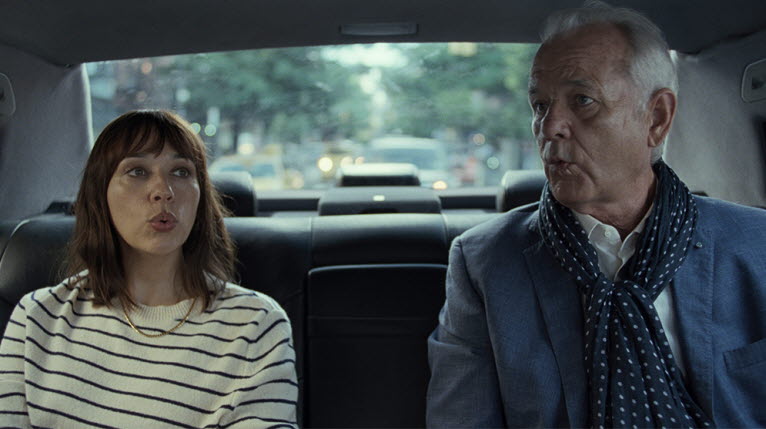
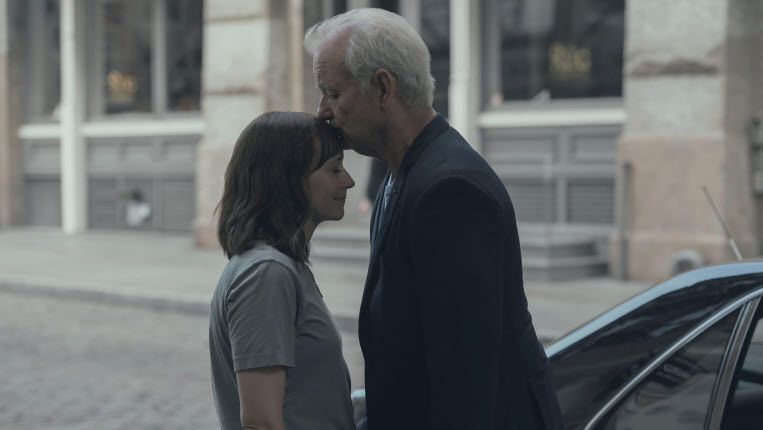
In the movie, Murray plays Felix Keane, a wealthy semi-retired art dealer who happens to come into the life of one of his children again. Although he left his wife and children for some other woman many years ago and has still not given up the carefree lifestyle of a womanizer, he and his writer daughter Laura (Rashida Jones) have been fairly nice and cordial to each other, and she is not that annoyed when her father suddenly comes to New York City just for seeing her and her two kids.
During its first act, the movie mainly focuses on how life seems to be going nowhere for Laura. As her two kids come to need less care and attention from her than before, she finally comes to get more free time for focusing her latest novel, but, alas, her writing process often feels like being stuck in dead end, and she also becomes more unsure about her relationship with her husband Dean (Marlon Wayans). As shown from the opening scene, they were passionately in love when they married under Felix’s sardonic blessing several years ago, but the sparks between them seem to be gone now, and, after noticing a suspicious sign from him at one night, Laura begins to wonder whether her husband has been cheating on her.
When Laura confides her growing suspicion on Dean to her father, Felix only comes to boost her suspicion as talking about how many men are prone to adultery just like him, and he even suggests that they should delve together into this matter for clarifying everything. Laura naturally hesitates at first, but her doubt keeps accumulating as she is reminded of how young and sexy her husband’s new assistant is. Besides, her husband often returns to their home at late night because, according to him, there are many things to be done for his very promising start-up company, so it looks highly possible to Laura that her husband and his assistant are actually having an affair behind their back.
And Felix continues to fuel her suspicion as giving more suspicious signs from her husband. While Dean does not seem to pay much attention to her upcoming birthday, Felix notifies to Laura that Dean seems to be planning to buy something considerably expensive, and Laura comes to suspect Dean more when he later gives her a birthday present which turns out to be far less special in comparison.
As Laura and Felix subsequently become more active in their little private investigation, the movie leisurely rolls from one comic moment to another along with them. In case of a scene where Felix and Laura try to follow after a cab which Dean and his assistant have just got on, we are amused a bit by how Felix sticks to his luxurious lifestyle during their clumsy stakeout, and then we get another small laugh from when they later happen to be stopped by two policemen, who come to help them a bit after Felix talks with one of these two policemen for a while.
In the meantime, Coppola’s screenplay slowly let us understand how its two main characters are driven by each own motive. For Laura, delving into the possibility of her husband’s adultery brings some change and excitement into her rather repetitive daily life, and Coppola, who is no stranger to characters stuck in ennui and insulation as shown from “The Virgin Suicides” (1999) and “Lost in Translation”, did a good job of conveying to us the sense of indirection and suffocation surrounding Laura with some humorous running gags. In case of Felix, he simply wants to spend more time with his daughter despite being your average self-absorbed dude, and there is a little emotional moment when he comes to show a bit more of himself to his daughter later in the story.
The movie comes to lose some of its comic momentum during its last act, but it still has its gentle heart in the right place while carried well by its two main performers. Steadily looking detached as before, Murray deftly balances his character between humor and pathos, and his rich comic performance is complemented well by the no-nonsense acting from Rashida Jones, who is also a good comic performer as shown from TV comedy series “Parks and Recreation”. She and Murray are constantly engaging as they effortlessly interact with each other throughout the film, and they are also supported well by the other main cast members including Jenny Slate and Marlon Wayans, who, in my trivial opinion, gives his most serious performance here since his memorable supporting turn in “Requiem for a Dream” (2000).
On the whole, “On the Rocks” looks less impressive compared to Coppola’s better works including “Lost in Translation”, but it is still enjoyable thanks to Coppola’s competent direction and the good comic chemistry between Murray and Jones. The movie is surely one of funnier films of this year, and it will certainly remind you that Murray is still a treasure to watch as before.
“Farewell Amor”, which is currently available on MUBI, is a small but intimate emigrant drama about three good people struggling with the widening personal gaps among them. As the movie calmly and sensitively observes them one by one, we get to understand and empathize with each of them, and their somber but poignant drama eventually comes to us another interesting slice of American immigrant life.
The movie begins with the long-awaited reunion between a middle-aged Angolan emigrant named Walter (Ntare Guma Mbaho Mwine) and his two family members who have just arrived in New York City. More than 10 years ago, Walter left their homeland for a better life in New York City, but it took quite a time for him to settle in the city and then have a suitable staying place for his wife Esther (Zainab Jah) and his daughter Sylvia (Jayme Lawson), and he is hoping that he and they will finally be a real family again once they get accustomed to their new environment.
However, after their emotional reunion at the JFK airport, we come to sense more of the considerable awkwardness among them. Walter happily takes his wife and daughter to his small residence which incidentally has only one bedroom, and Esther and Sylvia seem to be glad for having their own place to live, but everything feels so alien to them. Having been absent in their life for many years, Walter still feels like a stranger to them, and Esther sincerely tries to rekindle her relationship with her husband later, but Walter does not seem to be that eager to do that along with her.
And we soon come to learn of a reason behind that. Before his wife and daughter came into his life in New York City, Walter lived with some woman who was dear to him, and he is still wondering over whether he did the right thing when he let that woman leave him for having Esther and Sylvia again in his life. During one evening, he tries to forget that woman as spending time at a local bar full of dancing people, but he is only painfully reminded again that he did love that woman.
Nevertheless, he tries to do what he thinks should be done for his wife and daughter. He and Esther continue to try to resume their married life, and Esther, who never considered cheating on him during all those years, is willing to be a good wife for him as before. While constantly conscious of the gap between him and Sylvia, Walter tries to be a good father for Sylvia, and he shows her his willingness to support her growing interest in dancing.
However, the gaps among these three family members become wider as before, and this difficult and complicated situation is also depicted through not only Esther’s viewpoint but also Sylvia’s. Although this shy girl instantly draws the attention from other students during the first day at her new high school mainly because of her foreign accent, it does not take much time for her to get more used to her new school life, and she also gets an opportunity to participate in a dance competition thanks to a generous (and handsome) male student who seems to be interested in befriending her.
In contrast, Esther does not accept well how things have been changed for her and her family now. As a woman who has depended on her religion a lot during her husband’s absence, she usually emphasizes to Walter and Sylvia on faith and morality, and Walter and Sylvia do not like that much although they go along with that without protest. When Esther tells Walter that she is going to send a considerable amount of cash to some religious group in Angola for helping her a lot in spiritual ways, Walter, who has often been short of cash throughout his immigrant life in the city, cannot help but become upset about this, and that puts more distance between him and Esther.
Becoming more distant to her husband as well as her daughter, Esther comes to feel more isolated than before, but then she befriends one of her neighbors in their apartment building. Thanks to the saucy supporting performance by Joie Lee (She is Spike Lee’s sister, by the way), the mood becomes a bit more cheerful as her character gladly gives Esther some good advices on where and how she should do a grocery shopping in their neighborhood, and we are reminded again of those diverse aspects of life in New York City.
During its last act, the screenplay by director/writer Ekwa Msangi takes a couple of dramatic narrative turns, but the movie keeps holding its calm attitude as before as generating several earnest moments to touch you, and Msangi also did a good job of drawing convincing performances from her three main cast performers. While Ntare Guma Mbaho Mwine, who is actually a veteran American actor of Ugandan heritage and has performed in a bunch of many different movies and TV series for many years, humbly holds the ground with his unadorned acting, Zainab Jah, who is a professional actor with a considerable acting career, subtly delivers her character’s conflicted state of mind without any overacting, and Jayme Lawson holds her own place well between her two more experienced co-performers.
“Farewell Amor” is the first feature film directed by Msangi, who previously directed several short films and TV drama episodes before. Although her achievement here in this film looks modest on the surface, I admire how she handles the story and characters with care and attention, and I am still musing on what she tentatively pulls off along with her main cast members during the very last scene of the film. In short, this is another small but impressive debut work of this year, and it will be interesting to see how much Msangi will advance after this successful debut.
“Soul”, the latest work from Pixar Animation Studios, is funny and sublime in its seemingly simple tale of life and music. Although it does not reach to the level of those great Pixar animation films such as “Up” (2009), “Inside Out” (2015), and “Coco” (2017), it shows us that the people of Pixar Animation Studios still have their own magic touches despite several recent subpar films such as “The Good Dinosaur” (2015) and “Onward” (2020), and I am already willing to appreciate more of its rich humor and details coupled with a number of inspired moments you have to watch for yourself.
At the beginning, we meet Joe Gardner (voiced by Jamie Foxx), a jazz pianist who has worked for years as a part-time music teacher in some local school located in New York City. Since he got interested in jazz thanks to his diseased father, Joe has aspired to have a career breakthrough someday, but he still has not got any opportunity for that, and he is not that happy even when he is informed that he is now promoted to a full-time position. As a matter of fact, he simply took the job just for supporting himself without his mother’s help, and he has not been that enthusiastic about teaching his students these days, though he clearly discerns that one of his current students deserves some more attention and encouragement from him.
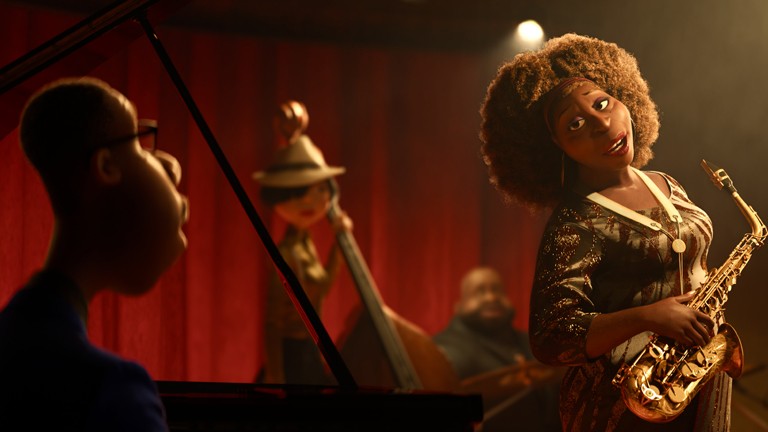
And then, what do you know, there comes a golden opportunity for him. One of Joe’s former students, who is now a professional jazz musician working under a famous jazz saxophone player named Dorothea Williams (voiced by Angela Bassett), suggests that he should try on the audition for Williams’ new pianist, and Joe does his best in front of Williams, who, quite impressed by Joe’s performance, decides to hire him for her upcoming concert at a jazz club.
However, this sudden change of luck for him is followed by an unfortunate incident of bad luck. Quite elated by the possibility of a breakthrough he has always wanted, Joe lets himself mired in euphoria for a while as mindlessly walking along a street, and then he happens to be fallen into an open manhole he fails to notice in advance. After the following blackout, he finds himself on the stairway to the “Great Beyond” along with many other souls, and then he is tumbled into the area of the “Great Before” after trying to escape from the stairway.
In contrast to the “Great Beyond”, which the final destination of all souls leaving life, the “Grant Before” is the starting point for new souls about to start their life, and we get to know the rules of this area through several guides who look like coming right out of Pablo Picasso’s caricature drawings. Each new soul will acquire several necessary personality traits before starting life on the Earth, but they all need something called ‘spark’ above all, and each of them will be advised and helped by ‘experienced’ souls for that.
Under the disguise of some ‘experienced’ soul, Joe happens to be tasked with a soul numbered 22 (voiced by Tina Fey), who has been notorious for being not so interested in living a life for many millenniums. Although they do not get along that well with each other just like many of famous duos in Pixar animation films such as Mr. Fredricksen and Russell in “Up”, Joe comes to make a deal with 22, and that is the start of their bumpy journey among several different zones.
Now I should be a little more careful about describing the movie for not spoiling your entertainment, but I can tell you at least that the screenplay by director Pete Doctor and his co-writers Mike Jones and Kemp Powers keeps throwing and then developing one story idea after another during the middle act. While it generates some tension on Joe’s journey with 22 via the following pursuit of a certain supporting character from the Great Beyond, the movie leisurely bounces from one inspired moment to another, and I particularly enjoyed a part involved with a spiritual sign twirler named Moonhead (voiced by Graham Norton).
Because a considerable part of the story is unfolded on the streets and alleys of New York City, Doctor and his animators pay lots of attention to how to present them realistically via digital animation, and the overall result is quite commendable to say the least. While most of human figures shown during this part are still basically broad caricatures, their many different appearances will remind you again of how diverse the city is in terms of race and culture, and I certainly appreciate a small Korean signboard briefly shown in the background during Joe’s certain embarrassing moment.
Above all, the film tries to bring lots of authenticity to Joe’s cultural background as much as it can, and the efforts are clearly shown from several key scenes including the one unfolded in a local African American barbershop where Joe is one of its frequent customers. In case of the music in the film, the terrific jazz music provided by Jon Batiste is complemented well by the gentle electronic score by Trent Reznor and Atticus Ross, and Reznor and Ross deserve to be praised along with Batiste for showing another side of their talent as they previously did in David Fincher’s recent Netflix film “Mank” (2020).
Although Joe and 22 are quite minimalistic in their appearance as two mismatched souls, Doctor and his Pixar animators successfully convey to us these two characters’ dynamic relationship development, and Jamie Foxx and Tina Fey ably imbue a considerable amount of life and personality to their respective characters, In case of the other voice cast members in the film, several notable performers including Phylicia Rashad, Angela Bassett, Daveed Diggs, Graham Norton, Richard Ayoade, Alice Braga, Wes Studi, and June Squibb are solid on the whole, and Norton is especially funny in his crucial supporting role.
In conclusion, “Soul”, which was released on Disney+ a few days ago in US (It will probably be released in theaters around next January in case of South Korea, by the way), is another superb achievement from Pixar, and I am still amazed by how effortlessly it delivers rather familiar messages on life with lots of humor and poignancy. Although it did not elevate me like “Up” or “Inside Out” did, it is still superlative nonetheless, and you definitely should not miss it.
Netflix film “We Can Be Heroes”, which was released on this Christmas, often tickled and entertained me more than I expected. While this is basically a kiddie version of “The Avengers” (2012), it did a better job of juggling various superhero characters, and I enjoyed its colorfully zany moments while also appreciating its wholesome messages for its young audiences.
The main center of the story is a young girl named Missy Moreno (YaYa Gosselin), and the early part of the movie briskly establishes how her daily life is suddenly turned upside down on one day. Although she is just plain and ordinary, her father Marcus (Pedro Pascal) was once one of famous superheroes operating around the world, and he actually quit his superhero career after his wife’s death for taking care of their daughter more. Alas, when he and Missy are starting their another usual morning, it turns out that the Earth is about to be invaded by a bunch of mysterious aliens from the outer space, and, not so surprisingly, Marcus is soon brought back in action even though that will break his personal promise with Missy.
In the meantime, the agency supervising Marcus and other superheroes decides to have the children of its superheroes under maximum protection just in case, so Missy is soon stuck with a number of other kids in a big safe room without any information on when they can be released. All of them except Missy have each own superpower to demonstrate, and Missy naturally cannot help but feel like an oddball in the group as her new friends show off their superpower one by one.
Anyway, their situation becomes quite more serious than expected when their superhero parents are quickly defeated and then captured by those aliens, who announce that they are going to take over the Earth only after 3 hours. While shocked to see what has just happened to her father and other superheroes, Missy comes to realize that she and other kids in the room must get out of the room as soon as possible, and she finds herself becoming an unlikely leader for them as predicted by one picture drawn by Ojo (Hala Finley), a mute girl who can draw the pictures of whatever will soon happen.
Once it turns out that their current staying place is not safe at all, Missy and her new friends work together for their joint escape, and director/co-producer/writer Robert Rodriguez, who also handled the music and cinematography of his movie, serves us a fun action sequence where Missy busily handles her new friends’ respective superpowers for thwarting many agents’ attempts to stop them. In case of a girl named A Capella (Lotus Blossom), she can levitate not only objects and people via the extremely low range of her voice (She also can go for extremely high pitches, of course), and there is a rather hilarious moment when Missy quickly thinks of how to use A Capella’s superpower against a bunch of agents surrounding them and other kids.
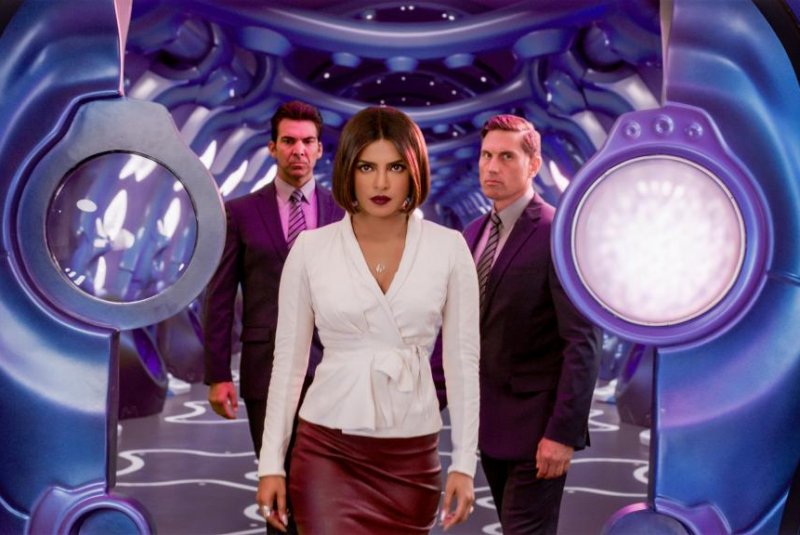
After successfully escaping from the agency and its director Miss Granada (Priyanka Chopra Jonas), Missy and her new friends luckily arrive at the residence of her grandmother Anita (Adriana Barraza), who once taught and trained her son and other superheroes many years ago. Although the remaining time is pretty short to say the least and Miss Granada and her agents are already chasing after them, Missy and her new friends go through your average training scene for less than 10 minutes, and she also comes to find more confidence as planning how to defeat those aliens and then save her father and other superheroes.
It is not much a spoiler to tell you that Missy and her new friends eventually succeed in getting into the mothership of those aliens, but Rodriguez’s screenplay goes further for more goofiness while throwing some nice surprises into the story. For example, the interior of the alien mothership is so colorful and outrageous that you will not be surprised by what is revealed later around the end of the movie, and I rolled my eyes a bit as watching a silly moment from one certain alien which seems to be taking care of some biological matter in the middle of a bush.
Above all, the movie is constantly buoyed by its likable young characters, each of whom is imbued with distinctive personality besides often demonstrating each own superpower as demanded. While the bickering between twin siblings Rewind (Isaiah Russell-Bailey) and Fast Forward (Akira Akbar) is a constant source of laugh, I especially like a kid named Slo-mo (Dylan Henry Lau), and I could not help but amused by how his rather problematic superpower is unexpectedly utilized in the middle of the expected climax sequence.
While YaYa Gosselin and the other young cast members including Andy Walken, Andrew Diaz, Vivien Blair, and Nathan Blair carry the story well together as required, several adult cast members in the film have a little fun around them without overshadowing them at all. Looking a lot more restrained compared to his hammy acting in “Wonder Woman 1984” (2020), Pedro Pascal brings some gravitas to the movie, and Boyd Holbrook, Christopher McDonald, Christian Slater, Priyanka Chopra Jonas, and Adriana Barraza willingly hurl themselves into their broad caricature roles, and Barraza certainly enjoys her every second as your typical no-nonsense mentor figure.
Overall, “We Can Be Heroes” accomplishes its mission as much as intended along with its young superheroes, and you will enjoy it like I did if you were entertained by “Spy Kids” (2001), which is also directed by Rodriguez, or “Dora and the Lost City of Gold” (2019). After all, it made me chuckle even when blatantly showing off a big red digital readout reaching to the zero hour, and I guess that is sort of an accomplishment.