The Blind Man Who Did Not Want to See Titanic (2021) ☆☆☆1/2(3.5/4): But he wants to see it with her right now….

Great Swedish filmmaker Ingmar Bergman once said that human face is the most fascinating subject possible for the camera. That is what came to my mind while I was watching Finnish film “The Blind Man Who Did Not Want to See Titanic”, which won the audience award when it was shown at the Venice International Film Festival in last year. So adamantly focusing on its disabled hero’s face from the beginning to the end, the movie will make you constantly aware of his plain but unforgettable face, and you will find yourself more attentive to whatever can be glimpsed from his face – and whatever he cannot possibly see due to his deteriorating medical condition.

At the beginning, the movie lets us get accustomed to what Jaakko (Petri Pikolainen) has to deal with everyday of his isolated daily life. Due to his worsening multiple sclerosis, he already cannot move the lower part of his body anymore while having also lost most of his eyesight, and he always has to depend a lot on his caregiver who comes to his small apartment everyday. At least, he still can get up from his bed and then move his body to his wheelchair for beginning another day, and he also often has an online talk with a woman who has her own serious illness, though he cannot see her at all while only listening to her voice.

While Jaakko talks more with this woman, we get to know a bit more about him. He is your average movie fan just like me and some of you, and we later see him proudly showing her his modest collection of DVDs, though he cannot watch any of them after losing his eyesight. He turns out to be a big fan of the works of John Carpenter, and I am sure that I can have an interesting discussion with this dude mainly because I like some of Carpenter’s works while also not liking others that much (He will be furious if I say I felt rather cold to “They Live” (1988) or “The Fog” (1980), for example).

In addition, he dislikes James Cameron’s “Titanic” (1997) a lot, but it seems that he is willing to tolerate this gloriously ambitious (and humongous) Hollywood product just because, well, his woman wants to watch it along with him someday. Considering that she lives a bit far from the city where he resides, their wish looks rather improbable, but then something unexpected occurs later. Her medical condition suddenly becomes quite worse than before, and that reminds Jaakko more of how both she and he are running out of time as coping with any possibility of death day by day. In the end, he comes to decide that he must go to her residence right now for watching several movies including, yes, “Titanic” along with her, even though he has been stuck in his small residence for years without going outside at all.

At first, his impromptu plan seems to be going well for him. On the surface, all Jaakko will have to is arranging a taxi ride between his place and a local train station where he will get some help for getting on a train going to the city where she lives, and he feels excited and delighted as being taken to the local train station as planned by him.

However, of course, Jaakko soon finds himself reminded again of how vulnerable and helpless he can be as a person with disability. Yes, there are good people ready to help him as expected, but there are also bad people not hesitating to take advantage of him at all, and the mood becomes a bit more tense when our hero is subsequently cornered by two strangers at one point.

Effortlessly going back and forth between comedy and drama, the screenplay by director/writer/co-producer Teemu Niki generates some nice comic moments which will earn chuckles from any seasoned moviegoer like me. Even when things get considerably grim for him, Jaakko cannot help but become a bit sardonic about his serious circumstance as mentioning Joel and Ethan Coen’s “Fargo” (1996), and my biggest chuckle during my viewing came from when he instantly points out that Peter Stomare, who was in that shockingly memorable climax scene in “Fargo”, is not a Danish but Swedish actor.

While all these and other things happen around its hero along the story, the movie austerely sticks to his very limited viewpoint for having us understand and empathize with him more, and Nikki and his cinematographer Sari Aaltonen deliberately make almost everything around Jaakko look constantly blurry and elusive on the screen. It may take some time for you to get accustomed to this interesting visual choice reminiscent of other notable films including László Nemes’ Oscar-winning movie “Son of Saul” (2015), but Nikki and Aaltonen skillfully handle many key scenes in the film without confusing or distracting us at all, and that is the main reason why the very last shot of the film is so dramatically effective.

Above all, the movie is steadily and diligently carried by Petri Poikolainen, who has been actually struggling with multiple sclerosis for years just like his character. While all other cast members of the film stay in the blurry background, Poikolaniene’s face and body come to function as the emotional center of the film, and Nikki often lets his lead actor delve further into Jaakko’s frustration and helplessness with indelibly poignant emotional effects.

Overall, “The Blind Man Who Did Not Want to See Titanic” is rather modest on the surface, but its considerable poignancy coupled with a lightweight sense of humor will leave some distinctive impression on you, and I appreciate several thoughtful touches which may be also appreciated by its potential audiences with eyesight disability. In short, this is another highlight of this year, and I sincerely urge you to check it out as soon as possible.

Posted in Movies | Tagged , , , , , | 1 Comment

The August Virgin (2019) ☆☆1/2 (2.5/4): Her August in Madrid

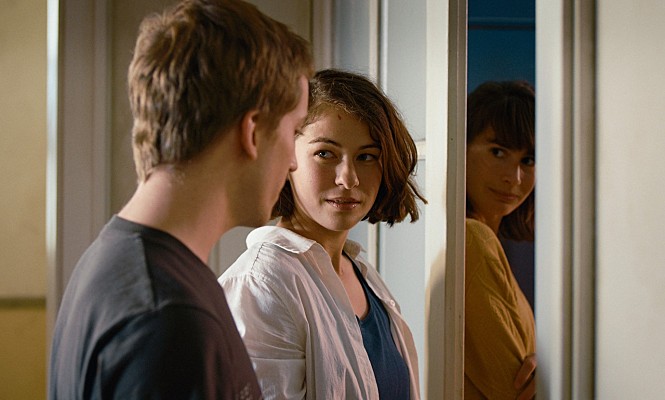
Spanish film “The August Virgin”, which happens to be released in South Korean theaters in this week, simply strolls along with its heroine during her summer stay in Madrid, Spain. While it works to some degree as a likable character study thanks to its good lead actress, the movie often frustrated me during my viewing mainly due to the adamant aimlessness of its rather elusive narrative, and I did not feel much like getting to know its heroine even though I understood and empathized with her disoriented status.

Itsaso Arana, who incidentally wrote the screenplay with director Jonás Trueba, plays a young actress named Eva, and the opening scene shows her looking around one apartment in Madrid where she is going to stay alone during August. Although there are a number of inconveniences in the apartment as admitted to her by its owner, she has no particular problem with the apartment on the whole, and she later has a brief conversation with the owner, who talks a bit about old classic Hollywood films just because he has been quite interested in them.

Anyway, Eva moves to the apartment on the first day of August, and the movie leisurely observes how she goes through next several days. For some personal reason to be revealed later in the story, she simply wants to spend her own private time during her staying period in Madrid, and we see her going around here and there alone in Madrid.

When she drops by a big museum full of many different artifacts, she looks at one of them for a while, and then she unexpected comes across an old male journalist friend of hers, who happens to be there for doing his latest freelance job. After they come out of the museum together, they go to a spot where they can have more conversation between them, and their conversation soon comes to revolve around how he has been doing during last several years – how he has become less idealistic as focusing more on trying to earn his living day by day.

Eva later observes similar things from one of her female friends, who is now living in Madrid as raising her little son. As they casually talk with each other, they are reminded more of how distant they have been to each other for years, but her friend’s life always has to revolve around her young son’s welfare now, and Eva surely understands that without any judgment.

Meanwhile, Eva also has encounters with several strangers who do not mind spending some time with her. At a certain local bar, she happens to meet a British guy who has lived in Spain for several years as working as an English teacher, and she is willing to talk more about herself as he gladly shows more of himself to her. As they talk more with each other, they seem to be more fascinated with each other, but they do not go further than that, and Eva later kindly invites him to a little afternoon picnic for her and her friend.

One of the most amusing moments in the film comes from Eva’s accidental encounter with two women who happen to be sitting right behind her at a movie theater. After hearing these two ladies’ conversation on how to synchronize ovulation cycle to the lunar period, Eva becomes quite interested in that, and she even invites one of them to her staying place. I do not know whether what they do together really works, but it will probably generate some chuckles from you.

What may be the most substantial part in the film comes from some dude Eva happens to spot during one evening. Because he looks rather depressed as he simply remains at a certain spot, Eva comes to care a bit about this guy, and she tries to approach and then talk with him. Although he is not exactly social, the guy responds to her anyway when they encounter each other again, and that is the beginning of their relationship, which eventually culminates to the point where she comes to reveal what she has been concerned about.

I must tell you that this moment of revelation feels rather anti-climactic, and the movie continues to stick to its leisurely aimlessness as before. Its heroine remains vague and ambiguous without letting us know more about her, and then the movie merely walks away from the screen along with her, while we are supposed to fill the gaps and blanks in the story in addition to reflecting a bit on our own life as expected.

While I wish the movie could bring more substance to its story and characters, I still admire Arana’s solid lead performance. While she ably handles a number of key scenes in the film with engaging emotional details, Arana is also supported well by a number of supporting performers who have each own moment to shine without overshadowing her at all, and she and Vito Sanz click well with each other as their characters subtly pull and push each other during several scenes later in the story.

In conclusion, “The August Virgin” is a fairly enjoyable character drama, but it is not interesting enough to engage my mind, which unfortunately happened to be quite distracted for some personal reason. If the movie worked well enough for me, my mind would put aside my private issues for 2 hours at least, but that did not happen at all during my viewing. Therefore, I cannot recommend it for now because of what I felt as watching it, but I also think I should give it another chance someday, and I will be certainly glad if it looks and feels better than before.

Posted in Movies | Tagged , , | Leave a comment

My Prediction on the 94th Academy Awards

We are approaching the end of the first quarter of 2022, and things have been pretty much same as the COVID-19 pandemic is still dominating over us as usual. Although the situation has been less severe in South Korea compared to many other countries including US, I and many others in South Korea are quite careful about any possibility of infection nonetheless due to another big wave of infection, and I still often work a lot at my workplace, whose employees have tirelessly produced virus test kit materials during last two years.

Meanwhile, I watched lots of movies as usual, and I have certainly paid some attention to the current Oscar race. The Oscar race of this year turned out to have some surprises as a number of major local awards showed one interesting sign after another during last several months, and we were all surprised as “CODA” eventually rose as an underdog to defeat “The Power of the Dog”, which has been the top dog of the race for a while. In my humble opinion, “CODA” will make a small but clean sweep in all of its three categories including Best Picture Oscar, and I will be pretty fine with the eventful victory of this little likable family drama film even though I think we had a bunch of better films in last year (Did you watch “Drive My Car” or “The Worst Person in the World”, by the way?).

Anyway, I am pretty sure about which movie will win in case of many categories, but I am still not so sure about several others including Best Screenplay and Best Song Oscar, and I guess we will have some upsets on March 27th. To be frank with you, I have never been wholly correct in my prediction, so I bet you have a pretty good chance of outguessing me.

Continue reading →
Posted in Movies | Tagged | 1 Comment

Days (2020) ☆☆☆(3/4): Those quiet wordless moments

Tsai Ming-liang’s latest feature film “Days”, which won the jury Teddy Award when it was shown at the Berlin International Festival early in 2020, is slowly and patiently observes two different gay persons at its center. While it feels so simple and mundane on the surface without any particular narrative direction, the movie gradually engages us as immersing us into its calm and meditative mood, and you may find yourselves reflecting more on some of those quiet wordless moments in the film after it is over.

At the beginning, we are introduced to a middle-aged guy named Kang (Lee Kang-sheng, who has appeared in all of Tsai’s feature films), and he is silently looking outside the window in the living room of his modest middle-class house. We do not know what he is looking at, and his phlegmatic face signifies nothing at all, but, as the camera simply stares at him during next several minutes, we come to wonder more about whatever he is feeling or thinking behind his expressionless façade.

From Kang’s subsequent scene which is unfolded in some oriental medicine clinic, we come to gather that he has some physical problem in his neck. As a guy who has also frequented oriental medicine clinics for a similar neck problem, I observed Kang’s acupuncture therapy session with some mild amusement, and I got a small laugh as watching him paying some attention to his neck muscles later.

These and other moments of Kang are alternated with the scenes depicting the daily life of a young man named Non (Anong Houngheuangsy). Like Kang, he is living alone, and the movie shows us how he goes through the same day in his rather shabby residence. At one point, the camera just looks at him working in his kitchen during several minutes without any interruption, and, though nothing significant happens on the surface except those vegetables diligently handled by Non, this extended shot steadily holds our attention via its effortless verisimilitude coupled with a subtle but genuine rhythm of daily life.

As time keeps going for both Kang and Non, the movie tentatively flows from one plain moment to another while distancing itself from both of them as before. The movie does not show anything about who they are or how their respective lives have been, but there is always a palpable sense of life from their surrounding environments, and the movie feels like a documentary especially when the camera patiently follows after Kang as he walks along a busy urban street filled with many different people.

The movie was actually edited from what was shot here and there by Tsai and his crew members during several years, but its individual scenes are seamlessly connected together to generate a sort of narrative flow, and then it eventually arrives at the narrative point where its two main characters meet each other in a nice and comfortable hotel room. As arranged between them in advance, Non gives Kang a full-body massage, and the movie calmly looks at how Non works on Kang step by step. While it is not much of a spoiler to tell you that Non does a bit more than usual massage, this key scene is presented with enough sensitivity and tactfulness, and we come to focus more on whatever is exchanged between them beneath the surface.

However, the movie still sticks to its austere storytelling approach even at that point. After their massage session is over, Kang and Non talks a bit with each other, but their brief verbal interaction is barely audible, and, as already told to us from the very beginning, the movie does not provide any subtitle. Kang shows some gratitude to Non via a little small gift, and then he comes to have a little dinner with Non at a nearby restaurant, but the movie observes them from the distance, while we wonder more about what exactly Kang feels about Non during this moment.

What follows next during the rest of the film is another quiet wordless observation of how days continue to pass by as usual for both of them. We see Kang going through another day at his residence. We watch Non working at his kitchen again. We see Kang doing some night walk. And we watch Non becoming a bit melancholic as looking at that little gift from Kang.

Under Tsai’s thoughtful direction, we often sense subtle emotional undercurrents beneath the screen, and his two lead performers did an effective job for that. As a seasoned professional actor, Lee Kang-sheng makes an interesting contrast with the unadorned non-professional acting from Anong Houngheuangsy, who is incidentally a Laotian immigrant to Thailand. Their tentative physical/emotional interactions during the second half of the film function well as the modest but tangible emotional anchor of the movie, and that is the main reason why the last shot of the film leaves some bittersweet emotional impression on us.

Overall, “Days” is surely one of those ‘slow movies’ which require you a considerable amount of patience (According to the IMDB trivia, it has only 46 shots, by the way), but it is worthwhile to watch for its admirable mood, storytelling, and performance. As a matter of fact, I am already willing to revisit it someday for appreciating its seemingly plain but undeniably strong aspects more, and that says a lot about how it works well for me.

Posted in Movies | Tagged | Leave a comment

Zeros and Ones (2021) ☆☆(2/4): A murky and rambling work by Abel Ferrara

I admire how Abel Ferrara have steadily continued his interesting filmmaking career during last 20 years. While he may have passed his prime period after a string of fascinating works he made in US during the 1990s, this distinctive American filmmaker has quietly kept working during next two decades, and his recent films “Pasolini” (2014) and “Tommaso” (2019) showed us that he is still a master filmmaker who deserves more attention.

Mainly because I was amused and entertained by “Tommaso” more than expected, I had some expectation on Ferrara’s very next film “Siberia” (2020), but it turned out to be rather hollow to my disappointment, and now here comes another disappointment via “Zeros and Ones”, which was released in US several months ago. While I could sense to some degree that the movie is the reflection of whatever Ferrara is feeling and thinking during the ongoing COVID-19 pandemic, I frequently felt lost, confused, and frustrated due to its murky visual and barebone narrative, and I was eventually left with empty hands as already dreading over what I could possibly write in this review.

What is presented at the beginning and end of the movie is much more interesting than the movie itself. Ethan Hawke, who plays the solider hero of the movie, talks directly to the audiences, and I actually enjoyed his sincere and enthusiastic introduction for the film. As one of the most interesting (and intelligent) actors working in Hollywood, Hawke has seldom hesitated to accept challenging roles, and we can understand how eager he has been to collaborate with Ferrara as admiring Ferrara’s fruitful recent collaborations with Willem Dafoe, who incidentally gave one of his more interesting performances in “Tommaso”.

I must confess that I had some expectation thanks to Hawke’s introduction clip, but, sadly, my expectation was soon dissipated during next 20 minutes as trying to understand what exactly is going on around Hawke’s character. As far as I can remember from the movie, his soldier character comes to Rome during one night for some secret mission, but the movie is adamantly vague about the details of this secret mission, and I have to admit that I came to understand its plot a bit only after getting some information from Rotten Tomatoes.

Anyway, Hawke’s character goes around here and there in the city, and we see more of how the city has been struggling with the ongoing pandemic, though the movie never specifies whether it is due to COVID-19 or some other highly contagious virus. Almost everyone in the film wears mask as ordered, and some of the characters appearing in the film sometimes say that their test results are negative.

Anyway, Hawke’s character is supposed to prevent a serious terror attack may occur sooner or later in Rome, and it looks like his imprisoned brother, who is also played by Hawke, holds a crucial piece of information for that, but, as your typical rebellious radical, his brother is quite uncooperative to say the least. At point, we see a video clip of his brother being interrogated by several soldiers, and we have to endure a sprawling speech which is incidentally ended with a certain classic song from Woody Guthrie.

After that, Hawke’s character keeps navigating the dark night streets and alleys of Rome, and the movie gives us a series of baffling moments which simply come and go. For example, I have no idea on the purpose of a seedy scene involved with drug and sex, and the same thing can be said about the subsequent sex scene between Hawke’s character and one of the female supporting characters in the film. Furthermore, the movie resorts to lots of rambling from time to time, and this does not add up to anything substantial while merely feeling like random excerpts from Ferrara’s personal notebook.

To make matters worse, the visual quality of the movie is so persistently murky that I often struggled to focus on whatever was shown on the screen. I guess Ferrara and his cinematographer Sean Price Williams attempt to make some point on how murky and confusing our world has been at present due to the COVID-19 pandemic, but their result is simply distracting and suffocating to say the least, and I was relieved only after the movie was finally brightened up a bit around its ending.

After consoled a little by that little bright part, I felt a bit better when Hawke appeared again at the end of the film, and I chuckled a little as he honestly admitted that even he does not know what exactly the movie is about. It looks like he had a fairly good time as working with Ferrara, but his performance here in this film is not exactly one of the highlights in his long and illustrious acting career, and now I am wondering whether he just simply followed whatever Ferrara ordered to him on the set.

In conclusion, “Zeros and Ones” is a misfire which feels more baffling and frustrating as I reflect more on its numerous elusive moments, and I would rather recommend you to watch “Tommaso” (2019) instead. Although I merely admire that film when I watched in October 2020, I still remember well its several interesting moments, and I am willing to revisit it sooner or later. In case of “Zeroes and Ones”, I have no interest at all in re-evaluating this vapid mess for now, and I am already ready to move onto whatever Ferrara will give us next.

Posted in Movies | Tagged , , , | Leave a comment

Marry Me (2022) ☆☆☆(3/4): Her accidental husband

Right from when I watched its trailer a few months ago, I knew what I would get from “Marry Me”, which was released in South Korean theaters in last week. Like another recent romantic comedy film “I Want You Back” (2022) attempts to follow the footsteps of “Addicted to Love” (1997), “Marry Me” tries to emulate what was successful in “Notting Hill” (1999), and it is predictable to the core in terms of plot and characters, but, to my little surprise, it somehow engaged and then entertained me when I watched it at last night.

The story mainly revolves around two contrasting main characters who cannot possibly be more different from each other. While Katarina “Kat” Valdez (Jennifer Lopez) is an extremely popular pop star, Charlie Gilbert (Owen Wilson) is a plain anonymous schoolteacher who is also a divorced man living with his daughter, and the only reason why he goes to Kat’s latest concert is that his daughter happens to be her big fan.

Anyway, the concert has received lots of attention from the public and the media because it is the culmination point for what Kat and her boyfriend singer Bastian (Maluma) have been doing for last several months. Having showed off their passionate romantic relationship as a part of the promotion of their ongoing concert tour, they are going to marry as watched by millions of fans around the world, and Kat really have lots of expectation on that because she sincerely believes Bastian is the one who will always love her for the rest of her life.

However, when her concert is about to reach to its expected climax part, there comes an unexpected moment of disaster. It belatedly turns out that Bastian has been cheating on her for a while, and, to make matters worse, this unpleasant fact has already been reported on an online gossip news. While quite devastated to the degree of nervous breakdown, Kat bravely comes onto the stage as everyone is anxiously watching her, and then she spots Charlie, who happens to be holding a sign saying “Marry Me” as asked by his daughter right at that moment. Without any hesitation, she promptly asks Charlie to marry her, and Charlie accepts her request on the spot because he clearly sees that she needs to be rescued from her humiliating public embarrassment right now.

Once her worst moment is over, it seems that all Charlie and Kat will have to do is quickly having a divorce without much fuss, but Kat decides to be around her accidental husband for a while mainly for recovering from that fiasco as soon as possible. Charlie reluctantly agrees because that looks like a right thing to do for her, but, of course, he soon finds himself overwhelmed as getting lots of public attention along with her. Fortunately, his colleague/best friend Parker Debbs (Sarah Silverman) comes to the rescue as his unofficial manager, and he and Kat can have some private time together for getting to know each other a bit as suggested by Kat.

It is not much of a spoiler to tell you that Kat and Charlie come to like each other more than expected, but the screenplay by John Rogers, Tami Sagher, and Harper Dill, which is actually based on the graphic novel of the same named by Bobby Crosby, generates enough warmth and humor to hold our attention. While Charlie appreciates how Kat makes his and his daughter’s daily life much more exciting than before, Kat comes to learn the pleasure of simple life via Charlie, and she also helps Charlie’s daughter a bit on how to manage her stage fright involved with her upcoming math competition.

Of course, the mood becomes a little more serious during its third act as our two main characters come to have doubts on whether they can actually continue their relationship, but the movie thankfully does not push them into cheap plot contrivance for that. Although we can already see how the story eventually ends, the movie handles its plot formula with some care and thoughtfulness, and it surely earns its predictable but effective finale.

In addition, the movie is supported well by its two likable lead performers. Although her character is more or less than the extension of her public image, Jennifer Lopez is as sexy, beautiful, and charismatic as required during several performance scenes in the film, and her indelible presence makes a good contrast with the down-to-earth qualities of her co-star. As humbly standing by his co-star, Owen Wilson ably embodies his character’s warm decency, and he and Lopez’s good chemistry on the screen is the main reason why the movie can often hop over its genre clichés and conventions.

In case of several supporting performers in the film, they bring a substantial amount of personality to the movie while diligently revolving around Lopez and Wilson. While Sarah Silverman and John Bradley are well-cast in their respective supporting roles, Maluma brings some authenticity to his character as another popular pop star in the film, young performer Chloe Coleman holds her own small space well as Charlie’s smart and plucky daughter.

Overall, “Marry Me”, which is directed by Kat Coiro, is surely another your average romantic comedy flick, but it did its job a little better than I thought, and, probably because I happened to go through no less than four dissatisfying films in row before watching it, I decide to be a little more generous to it as giving 3 stars instead of 2.5 stars. To be frank with you, I doubt whether it will be as enduring as “Notting Hill”, but I felt entertained enough, so I will not grumble for now.

Posted in Movies | Tagged , , , , , | Leave a comment

Deep Water (2022) ☆☆☆(3/4): A tantalizing comeback work from Adrian Lyne

“Deep Water”, which was released on Amazon Prime in last week, works best when it tantalizingly toys with the suspicion and mistrust surrounding a couple at the center of the story. It is a bit disappointing that the movie comes to lose tension around the point where it eventually shows almost every card held behind its back, but the overall result is mostly entertaining as a solid psychological thriller packed with morbidly erotic undertones.

The movie, which is based on the novel of the same name of Patricia Highsmith, is about Vic Van Allen (Ben Affleck) and his wife Melinda (Ana de Armas), a couple with a daughter residing in some small town of Louisiana. Because he earned a lot thanks to his technology business involved with military drones, Vic and his wife and daughter have lived an affluent life together in their house, but we come to sense considerable estrangement between him and Melinda when they are at an evening party held at the house belonging to one of his friends. As drinking a lot, Melinda flirts with a young man who has befriended her and her husband for a while, and she does not mind at all how that looks to others including her husband.

In the end, Melinda comes to have a pretty intimate private time with that lad, and Vic happens to see everything from the distance, but he does not seem to mind at all. It looks like that lad is just the latest dude in his wife’s problematic private life, and it is apparent to us that Vic and Melinda have accepted her infidelity just for maintaining a happy domestic environment for their daughter, though she is not exactly someone to win the mother of the year award.

However, it turns out that Vic has not merely tolerated his wife’s promiscuousness at all. When he happens to have a private conversation with that lad later, he looks totally cool with whatever Melinda is doing with that lad behind her back, but then he says that he killed someone who was also quite close to her just like that lad.

Is he really serious? Or, is he just making a little sick joke on that person, who has been incidentally missing for a while with no apparent reason? While he seems quite serious on the surface, Melinda and others around him including his two best friends are not particularly concerned about that because he has actually said that from time to time for, probably, laughs for others and himself. As a matter of fact, Melinda is quite annoyed when she comes to learn of what her husband said to that lad, so she demands that they should have a dinner with that lad for an occasion for Vic to apologize, but Vic is not so willing to do that, and his subsequent action makes the mood all the more comfortable between him and that lad.

Anyway, things seem to get back to normal for Vic and Melinda later, but then there come a couple of new troubles. Melinda soon gets associated with another man, and everyone including Vic clearly sees what is going on between her and that dude. In addition, there is a writer who recently moves into Vic’s neighborhood, and he is quite interested in delving into that unpleasant rumor about Vic.

The screenplay by Zach Helm and Sam Levinson gradually dials up the level of tension and creepiness beneath the screen as occasionally adding some nice humorous touches to be appreciated. If you know about Highsmith’s longtime fascination with a certain animal in real life, you will certainly be amused whenever the movie shows Vic’s little hobby in the basement of his house, and you will also be tickled by a colorful supporting performance by Lil Rel Howery, who provides an extra dose of humor as he previously did in his breakthrough supporting turn in Jordan Peele’s “Get Out” (2017).

As I said above, the movie becomes less interesting as stumbling more than once during its last act, but director Adrian Lyne, who was somehow dormant for almost 20 years since his last film “Unfaithful” (2002), keeps things rolling as before under his skillful direction. The finale is rather contrived and jumbled in my inconsequential opinion, but the movie still does not lose its sense of humor and irony despite that, and it even throws a little naughty wink at us during the end credits.

In case of Ben Affleck and Ana de Armas, who incidentally dated for a while after the shooting of the film, they click well with each other as exuding uneasy chemistry between them on the screen. Affleck, who is no stranger to playing a stoically ambiguous thriller movie character as previous shown in David Fincher’s “Gone Girl” (2014), ably implies the insidious possibilities of his character without exaggerating them at all, and de Armas, who has been more notable since her delightful performance in Rian Johnson’s “Knives Out” (2019), embodies well her character’s alluring sensuality, and they are supported well by several good supporting performers including Tracy Letts, who has a juicy fun whenever his writer character regards Affleck’s character with suspicion.

Overall, “Deep Water” is indeed flawed in several aspects, but it shows at least that Lyne, who gave us “9 1/2 Weeks” (1986) and “Fatal Attraction” (1987), has not lose any of his skills yet. Although his territory is not as popular as before, he still can intrigue, tantalize, and entertain us, and I sincerely hope that this 81-year-old filmmaker will be able to make more movies in the future.

Posted in Movies | Tagged , , | Leave a comment

Black Crab (2022) ☆☆1/2(2.5/4): A risk mission on the ice

Swedish Netflix film “Black Crab”, which was released a few days ago, does not bring anything particularly new to its gritty genre territory, and that was rather disappointing to me when I watched it in one early morning. Although it is not boring at all as a fairly passable action thriller flick, the movie merely slides from one expected plot point to another without much surprise for us, and it is also hampered further by its overlong final act which feels pedestrian at best and tedious at worst.

During its opening part, the movie promptly throws us into a grim near-future world which has been torn apart by some big war for years. When its heroine Caroline Edh (Noomi Rapace) arrives at a spot near a military base belonging to her army, the movie gives us a brief glimpse on how dire things have been for not only soldiers but also refugees living around the military base, and then we get the first action scene when our heroine suddenly finds herself ambushed by a bunch of thugs.

Anyway, Edh manages to arrive in the military base in the end, and she and several other selected soldiers soon have a private meeting with Colonel Raad (David Dencik). While their army is hopelessly losing the war at present, there is still a small but significant chance for the ultimate victory for them, and Colonel Raad wants Edh and several other soldiers to accomplish one very risky mission for that. They are going to carry a certain important secret item to a remote island whose surrounding sea area happens to be frozen hard enough for skating across it, and, considering numerous risks including enemy soldiers, this is more or less than a suicide mission for them.

Edh is initially reluctant, but then Colonel Raad has an offer she cannot possibly refuse. As shown from the prologue scene, she unfortunately happened to be separated from her young daughter in the middle of the war, and Colonel Raad promises to Edh that she will reunite with her daughter once she accomplishes the mission. Although she has some doubt on that promise, Edh eventually decides to follow the order, and she and several other soldiers subsequently take the first step of their perilous journey across the frozen sea.

It goes without saying that Edh and other soldiers, led by Forsberg (Aliette Opheim), will have to depend a lot on each other for accomplishing the mission and then surviving in the end. While carefully sliding across the frozen sea, they must be constantly watchful of enemy attack, and, above all, they must be wary of any danger hidden in the frozen ice floor, which can be broken under their feet at any chance.

Not so surprisingly, the situation soon gets worse due to one unfortunate incident, and that leads to a conflict between Edh and Nylund (Jakob Oftebro), whom Edh incidentally met before arriving at their military base. Because of what happened between them at that point, Edh does not trust Nylund much, but she has no choice but to accept his leadership just like other soldiers because, well, they all are expected to follow their military protocol no matter what happens.

As the main characters continue to slide from one spot to another, director Adam Berg, who also adapted Jerker Virdsong’s novel with Pelle Rådström, and his crew members including cinematographer Jonas Alarik fill the screen with more coldness and grimness. At one point, the mood becomes a little warm when Edh and other soldiers come across an unexpected moment of hospitality, but that is soon interrupted by harsh reality, and they are reminded again of how treacherous their journey can be.

That secret item to be delivered to the island functions as a MacGuffin at first, but it is eventually revealed around the midpoint of the film, and that is where the movie becomes less interesting than before. It is not much of a spoiler to tell you that our heroine eventually accomplishes the mission, but the movie attempts to go further than that during its 20 minutes, and what we get is pretty mediocre despite lots of shootings on the screen.

At least, the movie is supported well by another strong performance from Noomi Rapace, who has diligently impressed us since her unforgettable breakout turn in “The Girl with the Dragon Tattoo” (2009). While Edh is another tough heroine with some vulnerability in her movie acting career, Rapace still plays her character with admirable conviction, and her effective acting holds our attention to the end. In case of several main cast members surrounding Rapace, they are mostly stuck in their thankless supporting roles, but Aliette Opheim, Jakob Oftebro, and Dar Salim bring enough gritty quality to their military characters, and David Dencik leaves a considerable impression despite his very brief appearance early in the movie.

Overall, “Black Crab” is occasionally engaging to watch thanks to Rapace as well as Berg’s competent direction, but it does not distinguish itself enough compared to many other similar military action films out there. When I watched its trailer several weeks ago, I had a pretty good idea about what and how it would be about, and, to my dissatisfaction, it does not exceed my mild expectation without having much to remember. Sure, you can watch it just for killing your free time, but there are better options out there, you know.

Posted in Movies | Tagged , , , , | Leave a comment

Windfall (2022) ☆☆1/2(2.5/4): Three people stuck in one place

Netflix film “Windfall”, which was released on last Friday, is a little modest thriller which could be a solid entertainment if it simply trusted its three principle cast members. As well-qualified performers, they do their best with its rather thin screenplay, and things always get interesting whenever the movie focuses on whatever is going on among their characters, but, alas, it later loses its narrative pacing too often as our level of interest is decreased bit by bit.

At first, the movie feels like your typical home invasion flick as a nameless dude by Jason Segal, who also wrote the story along with director Charlie McDowell and their screenplay writers Justin Lader and Andrew Kevin Walker, spends some time in a luxurious vacation house located in some remote area. Although it initially seems that he broke into the house just for stealing money and some valuable stuffs inside it, he decides to stay a bit longer as looking here and there in and around the house, and that is when the owner of the house, played by Jesse Plemons, and his wife, played by Lily Collins, arrive at the spot.

Despite his possession of a gun, Segal’s character tries to hide himself from the owner and his wife, but, of course, his presence is soon exposed to them, and that is subsequently followed by a problematic hostage situation among these three figures. It turns out that the owner is a very wealthy man who is incidentally the CEO of some big digital technology company, so he may give the money demanded by Segal’s character, but there is one catch. While the owner does have lots of money, it will take some time for him to get the money delivered in cash, and that naturally means that he and his wife will be held by Segal’s character for one day at least.

As long as the owner and his wife keep themselves still and quiet as demanded by Segal’s character, everything may turn out to be all right for all of them, but, not so surprisingly, the mood gradually becomes tense among them as the owner seems to try on some other options besides giving the money to Segal’s character without complaint. Sure, he is rather casual about losing a bit of his supposedly enormous fortune, but it is apparent that he does not trust Segal’s character much, and he is willing to use his wife as a sort of pawn for any opportunity of gaining an upper hand in his tricky situation with Segal’s character.

In case of his wife, she certainly wants to get away from their increasingly inconvenient circumstance, but it slowly turns out that she has some other thoughts behind her detached façade. While she and her husband look like a fairly good couple on the surface, we gather little by little that they have not been that honest with each other – especially when she happens to have a little private conversation with Segal’s character.

In contrast, the movie is a little too ambiguous about the real intentions of Segal’s character. Although it is apparent that his current financial situation is not so good to say the least, we are not so sure about what exactly he feels and thinks about his two hostages. He certainly dislikes the owner a lot, but he seems to envy all the luxuries belonging to the owner and his wife, and he is also sympathetic to the wife as getting to know her a bit.

Rather than focusing more on the tense and uneasy interactions among its three main characters, the movie unfortunately takes a left turn during its last act, and that is where it begins to stumble more than once while dissipating what has been accumulated on the screen fairly well till that narrative point. When it finally arrives at the finale, it is blandly predictable instead of being surprisingly inevitable, and that is the main reason why the movie feels rather hollow in the end.

Nevertheless, the movie works to degree as the showcase of the talents of its three main cast members, who also incidentally participated in the production of the film. Although he is the weakest one in the group, Jason Segal shows his more serious side which he previously demonstrated in “The End of the Tour” (2015), and he manages to bring some real sense of desperation and frustration to his under-written character. Lily Collins, who has steadily advanced since I noticed her for the first time in “Mirror Mirror” (2012), ably suggests her character’s complicated emotional status along the story, and Jesse Plemons, who has been one of the most dependable actors working in Hollywood since his notable supporting turn in Paul Thomas Anderson’s “The Master” (2012), has lots of sly fun with his character as giving another fine performance to be added to his impressive acting career.

I could discern how much McDowell, who previously made a solid feature film debut with “The One I Love” (2014), and his crew members tried behind the camera, but “Windfall” does not have enough ground for his main performers to go further than demonstrating their acting ability. As reflected by a number of heavy-handed aspects such as David Marks and Saunder Jurriaans’ occasionally intrusive score, the movie also does not seem to be confident about its main performers, and that makes me wonder more about whether it could actually be more improved via simply observing its main performers doing their job in front of the camera in addition to giving them more stuffs to handle. In short, the movie is not a total dud at all, but I still cannot help but feel that there is a better film somewhere inside it, and that lingering dissatisfaction prevents me from recommending it.

Posted in Movies | Tagged , , , , | Leave a comment

I Want You Back (2022) ☆☆1/2(2.5/4): Your average rom-com product without much surprise

As your average romantic comedy, “I Want You Back”, which is currently available on Amazon Prime, has some comic substance and chemistry, but it does not have much surprise for us. Yes, it is already expected right from the very beginning that its two different lead characters will eventually come to realize that they actually love each other, and the movie generates some good laughs from how oblivious they are to that undeniable fact till the last act, but that is not enough for compensating for its several glaring flaws including its rather deficient comic momentum.

During the first act, the movie quickly establishes its two lead characters’ respective miserable private situations. When Emma (Jenny Slate) is having a lunch with her gym trainer boyfriend Noah (Scott Eastwood), Noah suddenly announces that he is going to leave Emma because she does not feel like the one with whom he can live for the rest of his life, and Emma is understandably depressed to hear that. When Peter (Charlie Day) is attending the birthday party of the son of one of his close friends, his schoolteacher girlfriend Anne (Gina Rodriguez) unexpectedly reveals that she is going to leave him because she sees no future between them, and Peter is naturally devastated by that.

Incidentally, Peter and Emma work in the same building, and they come across each other by coincidence while they are struggling with their painful feelings in private. As they share more of how much they feel hurt by their respective hurtful breakups, they come to lean on each other more, and then they find themselves checking together what Anne and Noah are respectively doing at present via social media application.

After discovering that Anne and Noah are already moving onto another romantic partner in their respective private lives, Peter and Emma come to concoct a rather selfish plan to benefit both of them. While Peter is going to disrupt the relationship between Noah and his new girlfriend, Emma is going to do the same thing to Anne and her new boyfriend, and they hope that their plan will be succeeded enough for them to get back their respective ex-partners.

On the surface, their respective missions seem to be pretty easy. All Peter has to do is becoming a new physical training client for Noah, and he soon becomes quite close to Noah as he exercises more under Noah’s guidance. In case of Emma, she simply approaches to both Anne and her new boyfriend when they are preparing together for a musical performance in Anne’s elementary school, and it does not take much time for Emma to draw the attention of Anne’s new boyfriend as pretending that she is quite interested in stage acting.

I must point out that the story is basically a variation of “Addicted to Love” (1997), another romantic comedy film about a duo working together for getting their respective ex-partners back by any means necessary. Peter and Emma thankfully do not reach to the utter nastiness of that romantic comedy film, but, unfortunately, many comic moments generated from their inherently nasty plans do not have much edginess. For instance, a scene involved with several young girls with whom Peter and Noah happen to be associated at one point is unfolded in a very predictable fashion without enough surprise to draw chuckles from us, and the same thing can be said about an absurd scene where Emma suggests something sexually bold for Anne and her boyfriend.

The screenplay by Isaac Aptaker and Elizabeth Berger, who also served as the co-producers of the film, later culminates to an eventual narrative point where, this is not a spoiler at all, Emma and Peter cannot hide their plan anymore from others involved with them in one way or another, but there is not enough comic momentum to make that crucial scene really funny, and that is another letdown for us. Furthermore, the movie only comes to fizzle as subsequently trudging toward its expected ending, and, again, it does not exceed our expectation much.

At least, the movie has two talented comic performers at its center, though their good efforts often remind us that they deserve materials better than this. While Charlie Day brings some natural comic intensity to his occasionally neurotic character, Jenny Slate, who has steadily advanced since her breakthrough turn in “Obvious Child” (2014), is delightful to watch as usual, and she and Day mostly click together well with each other throughout the film. In case of several other main cast members in the film, Gina Rodriguez, Clark Backo, Manny Jacinto, and Scott Eastwood are under-utilized due to their flat supporting roles, but Eastwood shows a bit of comic potential during his several scenes with Day, and the special mention goes to young performer Luke David Blumm. This young performer plays one of the kids participating in that school musical performance, and, in my trivial opinion, he holds his own small place well whenever he appears along with Slate on the screen.

In conclusion, “I Want You Back”, which is directed by Jason Orley is not exactly a waste of time, but there are many romantic comedy flicks which are funnier and wittier in comparison. Although I cannot possibly recommend “Addicted to Love” because it is also not a good one at all, I willingly recommend Paul Thomas Anderson’s “Licorice Pizza” (2021) instead, and I assure you that you will have a more productive time with that charmingly youthful romantic comedy film.

Posted in Movies | Tagged , | Leave a comment