The Girl and the Spider (2021) ☆☆☆(3/4): When her roommate is moving out

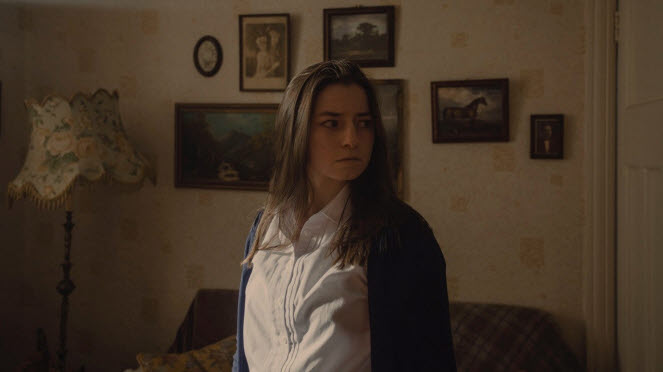
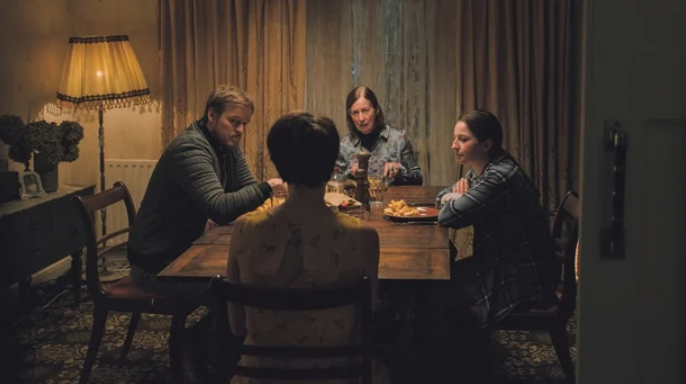
Swiss film “The Girl and the Spider” is deliberately opaque and ambiguous in the observation on one very mundane process for two days. When I watched it for the first time at last night, I often found myself baffled as trying to understand what is really going on between its several main characters, and I became quite impatient from time to time during my viewing. When I watched it again on the next day because I had wrong expectations due to its rather sinister title, I still found myself baffled as before, but I also came to appreciate its dry but skillful handling of mood and details, so I became a bit more relaxed than before as gathering whatever I observed and felt during my viewing.

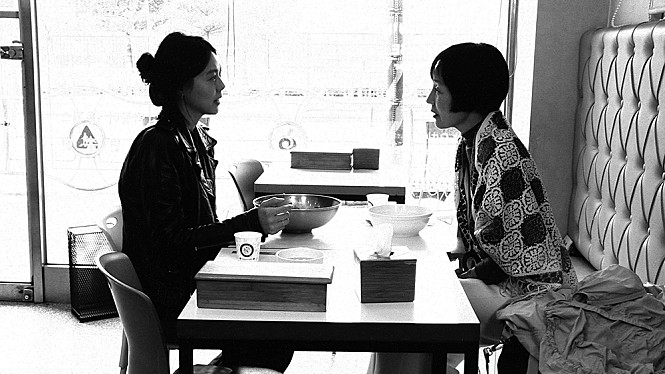
The movie mainly revolves around two young women: Mara (Henriette Confurius) and Lisa (Liliane Amuat). As observing them and Lisa’s mother Astrid (Ursina Lardi) for a while, we come to gather that Mara and Lisa have been living together for some time, but now Lisa is moving out to some other apartment alone, and it is clear that neither Mara nor Astrid is pleased about this change, though the movie never specifies the reason at all.

As these three characters come into Lisa’s new apartment, we meet a number of other persons besides several workers employed by Lisa’s mother. The apartment still needs to be fixed and cleaned a bit more, but it is mostly clean and empty enough for Lisa to move in, and she seems to be happy to get this new place while being away from Mara and her mother.

However, it looks like there is something unresolved between her and Mara, who usually regards Lisa and others with enigmatic silence. At one point early in the film, she suddenly tells Lisa about a small personal experience she happened to have when they were spending some free time outside, and her vivid description of that moment intrigues us even though we have no idea on her motive behind it. Are she and Lisa actually more than merely close friends? If so, are they going through a sort of breakup now?

In case of Astrid, she seems to discern whatever is going on between her daughter and Mara, but she remains silent in her rather frigid appearance. Although it looks like she does not have any particularly hard feeling on Mara, we sense some distance between her and Mara. She seems to care about her daughter enough to help her moving to the new place, but their interactions signify nothing but some estrangement between them, and we come to wonder more about what really happened among these three main characters.

Meanwhile, the movie freely moves around these and several other characters as the moving process is continued. A neighbor living upstairs comes to the apartment along with her little daughter just for curiosity, and there is a little unexpected moment where we sense a bit of emotional attraction between this woman and Mara. Because there are still many other stuffs to be moved out from where they have lived together, Mara and Lisa go back there along with Lisa’s mother, and we observe how that place is also busy due to the ongoing moving process.

Mara and Lisa later hold a party there in the evening, and that is when the movie becomes a little stranger than before. As everyone invited to the party has lot of fun and drink, some of them come to feel some sexual attraction between them, and that subsequently leads to an odd moment featuring not only naked bodies but also a motorcycle helmet. In addition, we get a rather disturbing moment as the following night becomes dark and stormy, and you may wonder about whether there is any meaning on that.

All these and other things in the film are presented on the screen with a realistic sense of daily rhythm, but it occasionally slips a bit into the realms of imagination and fantasy. When Mara talks about a woman who is supposed to be the owner of a certain piano, we are not so sure about the veracity of her tale, but it is still interesting to listen to her, and this part is later developed into a little lovely moment around the end of the film.

Under directors/writers Ramon and Silvan Zürcher’s competent direction, the main cast members are convincing even when their characters feel quite elusive to us. Although we do not know much about their background, their understated acting conveys to us the subtle emotional undercurrents around them, and the Zürchers also did a good job of drawing natural performances from several child performers, who often steal the show around the adult cast members whenever they enter the screen.

On the whole, “The Girl and the Spider”, which won the Best Director award when it was premiered at the Encounters program at the Berlin International Film Festival early in last year, may require a considerable amount of patience from you, but you will probably admire it once you come to accept how it is about instead of struggling to figure out what it is exactly about. Although I am not that enthusiastic about it compared to many other reviewers and critics, its adamant ambiguity still lingers on my mind, and I think it will be interesting to see what its directors, who previously made a feature film debut with “The Strange Little Cat” (2013), will do next in the future.

Posted in Movies | Tagged , | Leave a comment

As They Made Us (2022) ☆☆1/2(2.5/4): As her father is fading away

“As They Made Us” is a mild comedy drama which mainly revolves around its heroine’s emotional struggle with her complex family issues. While it does not bring up anything particularly new from its familiar genre territories, the movie handles its story and characters with enough care and sensitivity at least, and it is also supported well by its engaging cast members, who did try their best in overcoming their clichéd roles.

At first, we get to know how things have been rather frustrating for Abigail (Dianna Agron), a divorced mother who has tried to raise her two young sons alone. While she is taking a sabbatical period after having her professional career on hold, her daily life is constantly busy as taking care of lots of stuffs for her two kids, and she often has to depend on her ex-husband even though they are not a couple anymore. In addition, she also gets frequent calls from her mother Barbara (Candice Bergen) due to the deteriorating health of her father Eugene (Dustin Hoffman), and she cannot help but get annoyed whenever her mother makes a fuss over one matter after another.

However, it is quite apparent that her father does not have much time to live at present. Although her past memories of her father are not that good as reflected by brief flashback scenes, Abigail still loves her father nonetheless, she tries to do whatever is the best for her father as a good daughter, but that is not so easy as she finds herself often clashing with her mother over that matter. While she surely cares a lot about her husband, Barbara is sometimes more concerned about her feelings than her husband’s welfare, and that certainly exasperates her daughter a lot.
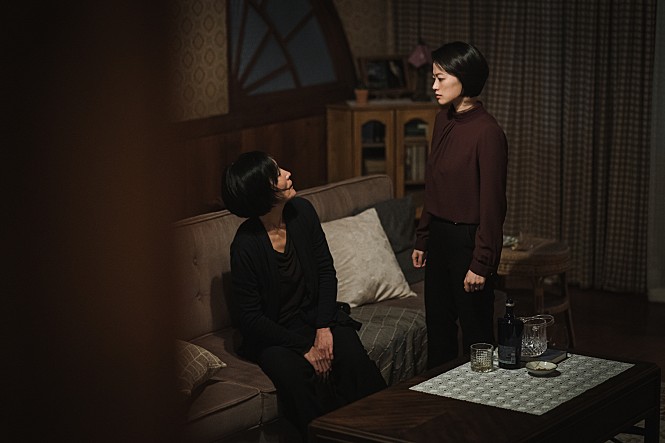
Anyway, Eugene is eventually taken to a hospice where he can peacefully spend the last several months of his life, but Abigail does not feel that relieved as there is still a certain family issue to be resolved. Many years ago, her older brother Nathan (Simon Helberg) left the family after having a big fight with Eugene and Barbara, and he has not contacted with them at all since that, but Abigail thinks he needs to know that his father will die sooner or later.

She eventually manages to talk with Nathan on the phone, and she later goes to a college where he has been teaching gardening as a lecturer with a doctoral degree, but Nathan is still reluctant about meeting his parents again. During their brief conversation scene, the camera only looks at Nathan and Abigail from the distance, but his conflicted feelings about his parents are palpable to us, and we come to gather that he feels still hurt about what he had to endure due to his parents.

That makes Abigail more muse on her equally complicated relationship with her parents. Although she got along fairly well with her parents compared to her older brother, she was also hurt a lot by her parents’ rather toxic relationship just like her older brother, and she also has felt some resentment for not appreciated much by her parents no matter how much she try to help and take care of them.

Meanwhile, there comes a little possibility of romance to her via a handsome landscaper working outside her house. While she prefers to be a mere employer to him, Abigail gradually becomes attracted to this dude, and it turns out that he is also quite interested in getting closer to her. As getting to know each other more, they become more attached to each other, and she even invites him and his parents to her father’s birthday party, though it turns out to be far less pleasant than she wishes.

Leisurely rolling from one episodic moment to another, the screenplay by director/writer/co-producer Mayim Bialik, who has been mainly known for her Emmy-nominated turn in TV comedy series “The Big Bang Theory”, brings some depth and humanity to its main characters. As urged by Abigail, Nathan eventually comes to reunite with his father, but he adamantly sticks to his condition for that nonetheless, and that leaves bittersweet feelings to both Abigail and Barbara. In case of Barbara and Eugene, they are indeed flawed in many aspects, but they still do love each other despite all those hard and difficult times between them, and there is a little poignant moment when Eugene confides his enduring love toward his wife while not aware that much of her presence.

When the story eventually arrives at the inevitable finale filled with sorrow and grief, the movie still sticks to its low-key mood as usual, and its main cast members convey to us well the emotional undercurrents around their characters. While Dianna Aagron, who is mainly known for her supporting turn in TV comedy series “Glee”, dutifully holds the center, Simon Helberg, Candice Bergen, and Dustin Hoffman imbue their respective supporting characters with a considerable amount of life and personality, and Bergen and Hoffman are effortless as a husband and a wife who sort of complement each other in one way or another.

Overall, “As They Made Us” is a fairly competent feature film debut by Bialik, and I appreciate several good performances in the film, but I must point out that there are many other movies which handle those complex family issues with more edginess and thoughtfulness. For now, Tamara Jenkins’ “The Savages” (2007) comes to my mind, and I sincerely recommend you to watch that overlooked gem instead, but I will not stop you from watching “As They Made Us” if you just want something mild.

Posted in Movies | Tagged , , | Leave a comment

All the Old Knives (2022) ☆☆1/2(2.5/4): One treacherous dinner between them

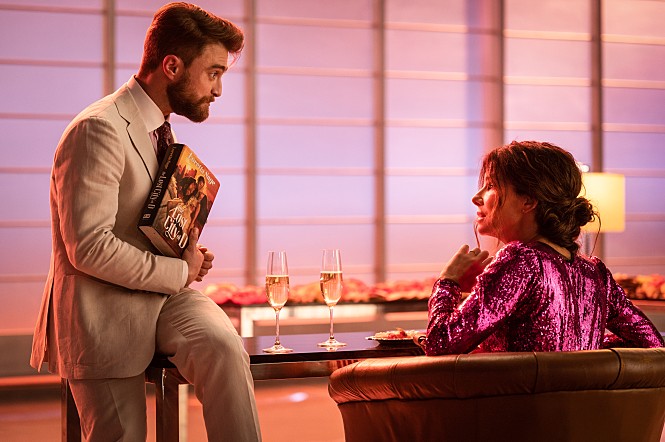
“All the Old Knives”, which was released on Amazon Prime in last week, works best whenever it revolves around the increasingly uneasy interactions between its two main characters. Both of them need to be discreet as much as possible because they cannot trust each other that much despite their close relationship in the past, and we cannot help but wonder more about their true motives and emotions below the surface as the story is unfolded step by step.

They are Henry Pelham (Chris Pine) and Celia Harrison (Thandiwe Newton), and a series of flashback scenes in the film show us what happened when they were working for CIA in Vienna 8 years ago. At that time, they were romantically involved with each other, and they were about to be more serious about their relationship, but then something terrible occurred. An airplane was hijacked by a bunch of terrorists, and, despite the diligent efforts from many CIA officials in Vienna including Pelham and Harrison, those terrorists eventually came to kill all the people in the airplane including themselves.

Quite devastated by this horrific outcome, Harrison promptly left CIA and then has led a fairly normal family life in California during next 8 years, but then she is approached by Pelham, who still works in CIA in contrast. Some time ago, the figure behind that hijacking incident was eventually captured, and it was revealed from this figure that there was actually someone who leaked some crucial information to those terrorists. Pelham is subsequently ordered to investigate a number of people who worked along with him during that time, and it seems that Harrison is one of the prime suspects because of her rather unexplained departure from CIA right after the hijacking incident.

When Pelham and Harrison later meet for a dinner at one posh restaurant looking over a beach, they cordially interact with each other at first, but Pelham soon comes to reveal his real intention, and Harrison is not so surprised about that. As they talk more about what they and others did at that time, they become more guarded to each other, and we cannot help but notice someone in the background, who may be the figure with whom Pelham talked on the phone before coming to the restaurant.

As its two main characters are shrouded in more caution and suspicion, the screenplay by Olen Steinhauer, which is based on his novel of the same name, frequently bounces amid different time points. We see how Pelham and Harrison came to fall in love with each other while serving for their country, and we also observe how things were urgent and desperate for them and many other CIA officials in Vienna at that time. They all did try their best, but then they unfortunately lost their only chance to save those hostages in the airplane because of that information leak, and one of them even committed suicide not long after that.

The movie also gives us a number of brief flashback scenes involved with those hijackers terrorizing their hostages, and that is where the movie stumbles more than once. In addition to often feeling gratuitous and redundant, this overtly sensational part does not fit that well with the overall low-key tone of the film, and I think the movie could be more well-rounded if it instead paid more attention to how the main characters of the film were affected by the incident in one way or another.

Although you can easily guess the answer to its main mystery even before the movie arrives at its last act, its two lead performers still engage us via their own presence and talent. As shown from several acclaimed films including “Hell and High Water” (2016), Chris Pine, whom I still dearly remember for his laid-back supporting turn in “Bottle Shock” (2008), has steadily demonstrated that he can do a lot more than playing Captain Kirk in the recent Star Trek series, and he effortlessly embodies the gray human qualities of his character. On the opposite, Thandiwe Newton, who has been always dependable since her breakout performance in “Flirting” (1991), is solid as her co-star’s equal acting match, and I would not complain at all if the movie just observed whatever is going on between their characters instead of resorting to all those unnecessary flashback scenes.

In case of several other cast members in the film, they are mostly under-utilized on the whole, though they did their best for filling their respective spots. While Laurence Fishburne is merely required to look stern and serious in his brief appearance, Jonathan Pryce manages to leave some impression as another possible prime suspect besides Newton’s character, and the special mention goes to Orli Shuka, who is quite chilling during a certain crucial scene around at the end of the story.

In conclusion, “All the Old Knives”, which is directed by Janus Metz Pedersen, does not bore us while maintaining its poker face along with its main characters for a while, but it eventually fizzles once it unfolds every card held behind its back, and that is disappointing compared to what is so competently developed before that point by Pine and Newton. Watching these two wonderful performers slyly pushing and pulling each other on the screen was a pleasure for me, but their good efforts are not served that well by the film on the whole, and I would rather recommend Louie Malle’s little masterwork “My Dinner with Andre” (1981) instead. It is just simply about two people talking over a dinner from the beginning to the end, but that is a much more interesting and fulfilling experience, and I urge you to check it out if you have not watched it yet.

Posted in Movies | Tagged , , , | Leave a comment

Metal Lords (2022) ☆☆1/2(2.5/4): It doesn’t rock that much

Netflix film “Metal Lords”, which was released a few days ago, often feels to me like watching too much of myself. No, I am not a heavy metal music fan at all, but one of my acquaintances recently advised me that my writing has been rather too repetitive from time to time, and that made me discern more of a number of glaring flaws in the film besides how heavy-handed my writing often is. Besides being quite predictable in terms of story and characters, the movie sometimes tries a little too hard to make a point on its main characters’ enthusiasm toward heavy metal music, and that was rather annoying instead of generating some laughs from me.

At the beginning, we are introduced to Kevin Schlieb (Jaden Martell) and Hunter Sylvester (Adrian Greensmith), and we get to know a bit about these two adolescent kids’ friendship. Although they are quite different from each other in many aspects, these two lonely teenagers have spent lots of time together in the basement of Hunter’s house for playing some heavy metal music, and they even already formed their own band, though they are its only members at present.

While Hunter prefers to be alone as your typical sullen teenager who has been deeply obsessed with heavy metal music, Kevin wants to hang around more with others in contrast, so he goes to a big evening party while reluctantly accompanied by Hunter. Although their experience of the party is not exactly pleasant, they come to learn that there will be soon a band competition at the school, and Hunter becomes quite determined to win at the competition after clashing a bit with another school band which happens to be playing at the party.

Kevin is understandably not so sure about how to prepare for the competition, but, as a kid with considerable musical talent, he gradually gets better once he starts to practice drums in the school, and then he comes across someone who may give some extra help to him and his friend. That person is a girl named Emily Spector (Isis Hainsworth), and, as listening to how skillfully she plays her cello, Kevin becomes convinced that she really should join his band.

Not so surprisingly, Hunter is not so pleased about having another member in their band, and he becomes more displeased as his best friend is getting closer to Emily. In his petty viewpoint tinged with misogyny, Emily is nothing but a trouble in his heavy metal paradise, and that naturally leads to the growing strain in his relationship with Kevin, who becomes more tired of how his friendship with Hunter has been going nowhere except more troubles for both of them.

Around that narrative point, the screenplay by D.B. Weiss, who is mainly known for HBO TV drama series “Game of Thrones”, attempts to push the conflicts among its three main characters to the level of absurdity, and that is where the movie becomes grating instead of amusing. While the scenes involved with Kevin and Emily’s budding romance are sweet and intimate, the scenes associated with Hunter’s increasingly troubled behaviors are merely distracting, and it is often alarming and embarrassing to see how he often goes over the top just for being true to the spirit of heavy metal. Observing how much he behaves like a big jerk with serious mental issues throughout the film, you may wonder about how the hell Kevin has tolerated Hunter for years.

At least, the better parts of the film compensate for its weak aspects to some degree. I enjoyed the tentative romantic relationship between Kevin and Emily, and there is a nice scene where Kevin plays drums while Emily dexterously complements that with her sensitive cello performance. At one point later in the story, Kevin finds himself tempted by some other girl, but then he receives a sort of advices from four certain figures which will be familiar to you if you know a bit about heavy meatal music, and that is the most humorous moment in the film in my trivial opinion.

In the end, the story expectedly culminates to the climactic point where our three main characters must band together for performing something awesome in front of many schoolmates of theirs, and the movie finally rocks enough while being predictable as before. Although there is still not much surprise except one nasty comic moment at the end of this climactic scene, the heavy metal song performed during this scene is fairly good and loud, and you may find yourself nodding with approval.

The three main cast members fill their broad archetype roles as much as they can, though not all of them are successful. Jaeden Martell and Isis Hainsworth click well with each other during several key scenes between their characters, and Hainsworth is especially effective when her character makes a very striking appearance around the climatic part of the film. In case of Adrian Greensmith, he is unfortunately demanded to overact without much substance to fill his character, and I wish he were instructed to dial down his acting a bit more.

Directed by Peter Sollett, “Metal Lords” is not wholly without enjoyable parts, but it is not entertaining enough to recommend, and my mind has been already rummaging out several other similar movies which did a better job in comparison. The first movie to come to my mind was a little Finnish comedy film called “Heavy Trip” (2018), and, as far as I remember, that comedy movie has much more wit and humor in addition to going all the way for more laughs. In fact, I feel some need to see it again, and I really think you should watch it instead.

Posted in Movies | Tagged , , , , , , | Leave a comment

Return to Space (2022) ☆☆1/2(2.5/4): It’s awesome to return to space, but…

Netflix documentary film “Return to Space”, which was released yesterday, is engaging whenever it focuses on those numerous technicians and engineers working together for the common goal set by their wealthy but controversial employer. Yes, it is certainly awesome to return to space, and I am glad to see that these folks actually make some substantial progress for the future, but I cannot help but feel ambivalent about that whenever the documentary looks at their infamous employer.

That figure in question is none other than Elon Musk, who incidentally became the biggest shareholder of Twitter several days ago. Considering how this billionaire figure has received a fair share of both admiration and contempt, the documentary has already been regarded as a mere promotion piece for him and his company SpaceX, but the overall result thankfully stays away from him as much as possible, and it compensates for his hovering presence over the documentary to some degree via those wonderful moments captured from space.

During the early part, the documentary gives us some background information on Musk and his company’s ambitious private space project, which was started in the early 2000s. Around that time, NASA had been shutting down its space shuttle programs due to their enormous cost, so it started to consider the privatization of space programs, and that was where Musk and his company entered. Although he only had lots of money, Musk became quite interested in venturing into aerospace industry after meeting a German aerospace engineer named Hans Koenigsmann, and that eventually led to the foundation of SpaceX. Not so surprisingly, their first several attempts were not successful at all, but Musk’s engineers and technicians kept trying nonetheless as learning more from these big failures, and they finally succeeded in launching their rocket into space without any serious glitch.

The documentary pays some attention to why their eventual success was a revolutionary forward step in the aerospace industry. Unlike those rockets used for space shuttle launches, the rocket developed by the engineers of SpaceX can actually be recycled again and again, and, above all, it also can land back in the launching spot after it succeeds in sending the module into space. Thanks to this new technological advance, the cost for space rocket launch became quite cheaper than before, and that was how Musk came to be regarded as another technology innovator after Bill Gates and Steve Jobs.

After that point, NASA came to lean more into collaborating with private corporations, and, of course, some notable figures including Neil Armstrong became quite concerned about that. Maybe aerospace technology will be much more advanced within a short period via this change, but Armstrong warned about the possible dark sides of privatization, and, as shown from one interview clip, Musk was quite hurt by the opposition from a man whom he supposedly regarded as one of his heroes.

The documentary does not overlook at all how Musk has often behaved like your average privileged Caucasian male jerk during recent several years, but it understandably regards this as mere eccentricities which come with his, uh, visions. I heard that he has Asperger’s syndrome, and that may explain a lot, but, folks, he still looks like an arrogant free-range rude in my inconsequential opinion. To be frank with you, as a guy who also has Asperger’s syndrome, I did often hurt others’ feelings due to my incorrigibly brutal honesty throughout 39 years of my life, but I also have been a bit more socially adjusted after learning valuable lessons from my many big mistakes, and that is why I have more contempt toward him these days.

Although Musk’s presence constantly distracted me during my viewing, I must confess that I also found myself observing the gradual progress of his pet space projects with some curiosity and admiration toward his numerous technicians and engineers. As far as I can see, these people really wanted to make some technology advance for our world, and their enthusiasm touched me a bit, but then I wondered whether their achievement will be just for Musk and some few other rich folks in the end.

The documentary also focuses a lot on two NASA astronauts, who are also quite engaging to observe as they prepare a lot for the launch and then handle the launch process with calm professionalism. While they are casual on the surface, they are also well aware of how things can go wrong at any moment, and that is particularly evident from when their space module is about to go through the docking process with the International Space Station. The process must be as precise as possible, and they and others are all relieved a lot once the process is completed.

Overall, “Return to Space”, which is directed by Jimmy Chin and Elizabeth Chai Vasarhelyi, may not give you anything new if you are familiar with its main subjects, but it is not a total waste of time mainly thanks to its close and vivid presentation of those space projects of SpaceX. I have some reservation on where this technological/commercial advance will eventually take us during next several decades, but space remains awe-inspiring as usual for all of us, and I can only hope that the human race will truly deserve to go further into space. Sure, it will be wonderful to be an interplanetary species, but shouldn’t we fix our suffering planet first?

Posted in Movies | Tagged , , , , | Leave a comment

Better Nate Than Ever (2022) ☆☆☆(3/4): Going to Broadway for his big dream

“Better Nate Than Ever”, which was released on Disney+ in last week, is a plain but likable musical film packed with enough heart and spunk. As a story about one very enthusiastic theater kid dreaming of becoming the next star of Broadway, the movie is pretty predictable to the core, but it constantly delights and amuses us as bouncing from one expected moment to another, and we find ourselves rooting for its little young hero more than expected.

At the beginning, we see how life has been rather frustrating for Nate Foster (Rueby Wood) in his suburban neighborhood of Pittsburgh, Pennsylvania. Although he has aspired to have a successful theater career in the Broadway area of New York City someday, his parents and his older brother Anthony (Joshua Bassett) do not understand his aspiration that much, and he is also often ridiculed at his school just for being, well, quite theatrical.

Anyway, Nate has diligently participated in the school drama club along with his best female friend Libby Reneé (Aira Brooks), and he is ardently hoping that he will be cast as the leading performer of the upcoming musical performance (It is a new rock musical based on Abraham Lincoln’s biography – Blame that certain acclaimed hip-hop musical by Lin-Manuel Miranda if you want). Alas, he only comes to learn that neither he nor Libby gets included in the main cast, and it is quite certain that they will just play minor roles as before.

While Nate naturally becomes daunted a lot by this bad news, Libby suggests that they should go together to New York City for participating in the upcoming audition for the Broadway musical production based on “Lilo & Stitch” (2002), one of a few contemporary Disney animation feature films which I have not somehow watched yet (I will rectify this error someday, I promise you). Nate is reluctant at first, but he soon finds himself quite motivated by the possibility of getting a big breakthrough in Broadway, and he and Libby subsequently embark on planning how to go to New York City without being noticed by their respective parents.

Fortunately, they do not have to lie that much for making their little scheme work. It seems that all they will have to do is taking a midnight bus to New York City and then returning to their neighborhood right after the audition, and, by coincidence, Nate’s parents will take a little vacation together outside Pittsburgh during that short period. They are going to leave their two sons alone in their house for a while, but they are not so concerned because Nate is supposed to be taken care of by Anthony, though taking care of Nate is the last thing to be considered for Anthony for good reasons.

It is not much of a spoiler to tell you that Nate and Libby eventually succeed in arriving in Broadway. Mainly thanks to their accidental encounter with Nate’s struggling actress aunt played by Lisa Kudrow, Nate manages to pass the first stage of the audition, but he and Libby belatedly come to learn that the audition will take more than just one day. While naturally feeling conflicted, he eventually decides to follow what his heart has always wanted, and that certainly makes the circumstance much more complicated than expected.

Around that narrative point, you will get a pretty good idea on how the story will arrive at its expected ending, but the screenplay by director/writer Tim Federle, which is based on his book of the same name, still holds our attention as deftly juggling its genre clichés and conventions. Yes, we surely get several your average musical scenes as our young plucky hero dreams more or more along the story, but these musical moments are peppered well with wit and energy, and I assure you that you cannot help but smile as watching Nate giving an impromptu musical performance in the middle of New York City. Sure, the main characters are more or less than your typical broad archetypes, but they are depicted with loving care and attention at least, and that is particularly evident from Nate’s parents, who still find themselves concerned about their sons even when they are supposed to enjoy their own private time together.

The breezy charm of the movie owes a lot to young newcomer Rueby Wood, who ably carries the film with his own presence and personality. While you may find his character a bit overeager at first, you will be soon disarmed by Wood’s unadorned spirit coupled with considerable singing talent (I can easily imagine him playing Billy Elliot someday), and then you will appreciate more of how his character’s energy and determination will inspire and encourage many theater kids out there. Sure, not all of them will be next Broadway stars, but, after all, there is not anything wrong about following your passion and dream, isn’t it?

The supporting cast members fill their respective spots around Wood as required. While Lisa Kudrow is the most colorful one in the bunch (Raise your hand if you cannot help but feel a bit nostalgic like me due to her certain classic American TV sitcom series), Aria Brooks and Joshua Bassett have each own moment to shine, and Norbert Leo Butz, who is incidentally a two-time Tony winner, and Michelle Federer provide some gravitas to the story as Nate’s parents.

On the whole, “Better Nate Than Ever” is as thin and fluffy as cotton candy, but it is a well-made product equipped with enough charm and competence at least. I am a rather down-to-earth dude who does not have much illusion about life and reality, but I do not mind enjoying such sweet lightweight stuffs like this film as long as they are entertaining, and I am willing to recommend it to my friends – especially if they have kids to be entertained.

Posted in Movies | Tagged , , , , | Leave a comment

The Electrical Life of Louis Wain (2021) ☆☆1/2(2.5/4): Behind all those funny cat pictures of his

“The Electrical Life of Louis Wain” is supposed to appeal to many cat lovers like me out there, but it is not exactly a cheerful experience in my humble opinion. As a biographic period drama about an eccentric dude who became quite famous via his funny cat illustrations, the movie is often flat and pedestrian instead of being witty or whimsical, and it also comes to lose considerable energy and momentum during its second half, which is unfortunately hampered by the absence of what makes its first half engaging enough to hold our attention.

Benedict Cumberbatch, who has been specializing in playing antisocial characters since his breakthrough turn in British TV drama series “Sherlock”, plays Louis Wain, and the opening part of the film shows us how this well-known British illustrator once struggled day by day as a freelancer living in London during the 1870s. While he is a very good illustrator who can draw many drawings within a short time, Wain is not so good at how to sell his talent, and that certainly frustrates his mother and five sisters, who have to depend on him a lot since his father’s recent death.

Anyway, things get a little better for him (and his family) when a governess named Emily Richardson (Claire Foy) begins to stay in his house. Although he does not welcome this change much, he eventually accepts that, and, mainly for affording her, he comes to accept the full employment suggested by Sir William Ingram (Toby Jones), a rich and benevolent newspaper publisher who comes to appreciate Wain’s talent a lot despite Wain’s socially awkward attitude.

What follows next is an amusingly awkward courtship between Wain and Emily. Like any Victorian couple, they do try to be discreet as much as possible, but it does not take much time for his sisters to see what is going on between their older brother and Emily, and the same thing can be said about many others in their neighborhood – especially after when they happen to be spotted at a certain place where they should not be together at any chance.

In the end, Wain’s oldest sister Caroline (Andrea Riseborough) decides to let Emily go, but that only comes to motivate him more. To Caroline’s displeasure, he promptly proposes to Emily, and they move to a cozy little house together shortly after their marriage. As finally finding someone who will love him while also accepting his eccentric personality, Wain feels much happier than before, and Emily gradually becomes the firm ground for his daily life and work. At one point, they happen to adopt a little stray cat on one rainy day, and, thanks to her encouragement, he comes to draw many cat illustrations which lead to considerable public fame for him.

Sadly, their happiness does not last long due to Emily’s terminal illness, and Wain is certainly devastated by her eventual death. As Emily asked not long before her death, he keeps drawing cat illustrations as usual, but he is not wise enough to hold the copyrights of those illustrations, and that makes Caroline and his other sisters all the more frustrated. Thanks to his generous employer, he and his sisters manage to get a place to stay together at least, but things only get worse year by year, and Wain also begins to show more erratic behaviors just like his youngest sister, who is eventually taken to an institute for mental illness.

While the first half of the film is enlivened by the nice chemistry between Cumberbatch and Claire Foy, its second part simply plods from one miserable moment to another in Wain’s later years, and that is where the movie becomes less engaging than before. Director Will Sharpe, who wrote the screenplay with Simon Stephenson, and cinematographer Erik Wilson attempt to convey to us Wain’s increasingly unstable state of mind via a number of visual techniques, but the overall result is rather distracting, and we only come to observe Wain’s worsening mental problem from the distance without much care or attention.

In case of Wain’s cat illustrations, well, I assure you that you will get plenty of them as expected, but we do not get much of artistic joy or excitement as the movie merely wallows in Wain’s growing miseries. Yes, my eyes were immediately drawn to several cute cats in the film including that adorable kitty adopted by Wain and Emily, and I enjoyed Wain’s cat illustrations appearing in the film, but these more cheerful elements do not mix that well with the darker parts of the film. In other words, the movie does have agony, but it does not have enough ecstasy to complement that.

At least, Cumberbatch and several main cast members try as much as they can. He and Foy have some fun as their characters tentatively approach to each other, and that is the main reason why Foy’s eventual absence feels like a big hole. Although she is stuck with a thankless role, Andrea Riseborough makes her long-suffering sister character more understandable than expected, and Toby Jones, who has been one of the most dependable British character actors during last two decades, simply steals the show whenever he appears on the screen.

In conclusion, “The Electrical Life of Louis Wain” is not entirely boring a number of whimsical touches besides its eccentric hero and his lovely artworks, but it is also not engaging enough mainly due to its weak storytelling. If you want to see a really good and cheerful cat movie, there is a little special Turkish documentary film “Kedi” (2016), and, believe me, you will not be disappointed at all.

Posted in Movies | Tagged , , , , | 2 Comments

Apollo 10 1⁄2: A Space Age Childhood (2022) ☆☆☆(3/4): That fun time in the 1960s

Richard Linklater’s new animation feature film “Apollo 10 1/2: A Space Age Childhood”, which was released on Netflix on last Friday, is as sweet, funny, witty, and whimsical as you can expect from his work. Starting with one silly and outrageous story promise, the movie simply rambles from one episodic moment to another, but those individual moments in the film are constantly packed with enough wit and humor tinged with some warm nostalgia, and you may find yourself gladly going along with that.

First, let’s talk a bit about its preposterous story promise. Mainly set in Houston, Texas of the late 1960s, the movie opens with how its young hero happens to be chosen for a certain secret government mission. While he is going through another school day along with his schoolmates, Stanley (voiced by Milo Coy) is approached by a couple of NASA agents, and they subsequently tell him about why he is needed for their latest lunar exploration mission. Due to some engineering error, the lunar module happened to be produced in a half size, so they need a child astronaut right now instead of those adult ones including, yes, Neil Armstrong, and Stanley somehow looks like an ideal one for that.

Once he accepts the request, Stanley soon goes through your average training montage, but then the film comes to focus on something else. Yes, it is apparent to us that what older Stanley, voiced by Jack Black, tells us is no more than a funny fictional tale of grand exaggeration, and the movie looks back at how much this tale is influenced by Stanley’s childhood background. After all, he has grown up in a big suburban family living not so far from that NASA center in Houston, and his father actually works in NASA, though what he does there is not as awesome as his youngest son wishes.

Anyway, living near that NASA center during the late 1960s was pretty fun and exciting for young kids like Stanley. As the American space programs went higher and higher toward the moon, everyone in US became more excited about space and future, and that is quite evident from a brief scene where Stanley and others watch Stanley Kubrick’s great SF film “2001: A Space Odyssey” (1968) at a local movie theater. Although I watched it for the first time alone at my family home at one night of 1996 autumn, I still remembere well how much I was baffled and intrigued during my viewing, and I must confess that I was quite amused by the following scene where Stanley enthusiastically talks about its sublime qualities in front of his several disinterested friends.

Stanley can be regarded as your typical young Linklater hero not so far from the boy hero of Linklater’s masterpiece “Boyhood” (2014), and the film has some fun from Stanley’s dryly humorous observation of his family and many other figures in his neighborhood. While his father is usually busy with his work outside, his mother is mostly occupied with numerous domestic stuffs besides raising their six children including Stanley, and one of the most amusing moments in the film comes from how she diligently handles the daily meals for her and her family every week.

As 1969 begins, the mood becomes more exciting in Stanley’s neighborhood thanks to the upcoming Apollo 11 mission, and the film freely goes back and forth between the reality and whatever is imagined inside Stanley’s imaginative mind. In his imagination, he continues to go through the training before the launch day comes, and, as watching those three astronauts of Apollo 11 preparing for the launch on TV, his mind keeps focusing on how he prepares just like that without being noticed by the media and many people out there including his family.

In the meantime, the film sometimes pays some attention to the considerable social/cultural changes through which the American society was going around that time. Although everything usually looks just fine and normal around Stanley and his family, they often encounter various social issues ranging from the Vietnam War to the civil rights movement whenever they watch TV news, and Stanley naturally becomes more aware of how things are not that rosy for many other people in the country.

In the end, the story culminates to that historic moment on the Moon which happened in August 1969, but Linklater’s screenplay sticks to its casual attitude while continuing to have funs as usual. Cheerfully wielding its distinctive animation style which will instantly take you to Linklater’s two other notable animation films “Waking Life” (2001) and “A Scanner Darkly” (2006), the movie somehow pulls off a solid ending from its free-flowing narrative style, and Coy, Black, and several other substantial voice cast members including Glen Powell and Zachary Levi are mostly effective as wisely keeping their voice performances straight even during the most absurd moments in the film.

In conclusion, “Apollo 10 1/2: A Space Age Childhood” does not reach to the profoundly offbeat aspects of “Waking Life”, but it is still another enjoyable work from Linklater, who has seldom disappointed us since his debut feature film “It’s Impossible to Learn to Plow by Reading Books” (1988). Sure, the film may be no more than a merely whimsical rambling which simply goes on and on throughout its 98-minute running time, but it is done fairly well with enough wit, style, and intelligence, and the result is fun and entertaining at least. It is not great, but I am glad that I spent some time in watching and listening to it, and I assure you that you will not regret at all if you are an admirer of Linklater’s many works just like me.

Posted in Movies | Tagged , , , , , , | Leave a comment

Moonshot (2022) ☆☆(2/4): As they’re heading to Mars

My demand is not that high when I watch any film which happens to draw my interest, but “Moonshot”, which was released on HBO Max in last week, let me down in more than one way. As a romantic comedy, the movie is pretty predictable to the core without surprising or amusing me that much, and that made me more aware of its rather bland storytelling and thin characterization. As a movie decorated with science fiction elements, it woefully lacks imagination and creativity to say the least, and I only came to wonder more about how cheap it is for its filmmakers to produce the film.

The movie begins its story with its hero’s longtime aspiration toward Mars. It is 2049, and space travel has become a bit more common than before thanks to considerable technological advancement while Mars is going through the first stages of colonization. Although he is not so distinguished in many aspects, Walt (Cole Sprouse) still wants to go to Mars someday as he has always wished, and we get some little laugh from how he is still miserably stuck in his mundane daily life on the Earth.

Anyway, there comes an unexpected moment of motivation for Walt during one evening party he happens to crash into. He comes across a pretty girl, and, as they talk with each other more after leaving the party, he soon finds himself quite attracted to her, and it seems she also likes him enough to let him be around her more. Sadly, she will get on a spaceship to Mars on the very next day, so it looks like that is the end of their little nice moment, but Walt becomes quite determined to find any possible way to follow after her.

While he is not particularly rich enough to buy a spaceship ticket (It costs around one million dollars, by the way), Walt is ready to grab any possible opportunity, and the chance comes to him a few days later via Sophie (Lana Condor), another girl whom he happened to encounter at that evening party. Although their first encounter was not exactly pleasant, Sophie comes to let out her thoughts and feelings about her boyfriend who is currently in Mars along with his family, and Walt encourages her to go to Mars right now because he is going to take advantage of her following decision.

Once she gets on the next spaceship to Mars, Sophie belatedly comes to learn of Walt’s opportunistic plan. He managed to sneak in the spaceship right before it left the Earth, and he is going to hide in Sophie’s cabin during next several weeks before the spaceship eventually arrives in Mars. While she is naturally exasperated, Sophie has no choice but to help Walt, and that is the beginning of their uneasy space trip to Mars.

Around that narrative point, you will already have a pretty good idea on where the story and characters are heading, and, unfortunately, the screenplay by Max Taxe is often deficient in terms of humor, tension, and personality. While what is being at stake for our two young lead characters is almost non-existent, the movie frequently stumbles as occasionally throwing casual moments of cheap humor, and many of supporting figures surrounding Walt and Sophie are more or less than broad caricatures simply existing for mild laughs.

It is not much of a spoiler to tell you that Walt and Sophie come to care more about each other than they can admit on the surface, but their supposedly playful moments do not work well despite the good efforts from the two lead performers in the film. While Cole Sprouse, who is mainly known for the recent American TV drama series “Riverdale”, is fairly engaging on the whole, I cannot help but point out that his character is no more than a pesky dude who causes considerable troubles for others who happen to be associated with him, and you may not be so surprised by how Walt’s dream girl responds to him when they finally meet each other again later in the story (Is this a spoiler?). In case of Lana Condor, this wonderful actress was simply charming in Netflix film “To All the Boys I’ve Loved Before” (2018) and its two following sequels, but she is sadly stuck with her rather bland character here, and the only consolation for us is that she somehow acquits herself well despite that.

Above all, the movie is quite dissatisfying in terms of its futuristic background details. I understand that space has become a bit mundane stuff on the screen since “Gravity” (2013) and “Interstellar” (2014), but director Chris Winterbauer and his crew members merely give us a number of mediocre scenes drenched in plain and unimpressive CGIs, and a subplot involved with a big technology corporation CEO played by Zach Braff, who is clearly based on Elon Musk, is redundant at best and distracting at worst.

Although it is passable as a lightweight romantic comedy, “Moonshot” seriously lacks elements to make it a bit more distinctive at least, and I often found myself observing its story and characters without much care. Maybe I was a bit too generous as giving three stars to Jennifer Lopez and Owen Wilson’s recent comedy film “Marry Me” (2022), but that commercial product has more charm and wit in comparison, and I sincerely recommend you to watch it or Richard Linklater’s recent Netflix film “Apollo 10 1/2: A Space Age Childhood” (2022) instead, which did a better job of doing some comedy in the space. Believe me, you will have a much more productive time with either of them.

Posted in Movies | Tagged , , , , , | Leave a comment

After Love (2020) ☆☆☆1/2(3.5/4): Two women left behind

“After Love” is a simple but sensitive film about two different women who happen to be involved with each other via the man they both loved deeply. While calmly observing how one approaches the other without telling anything at all, the movie dryly but sensitively conveys to us the accumulating emotional undercurrents around them, and we come to care about both of them more as gradually understanding and empathizing with their complex personal feelings.

The movie opens with an unexpected happening which turns upside down the daily life of a middled-aged British Muslim woman named Mary Hussain (Joanna Scanlan). For many years, she has been married to a Pakistani guy who has worked as one the crew members of a ship routinely going back and forth between UK and France, and, as clearly shown from her traditional attire, she even converted to Islam for her husband around the time of their marriage. It looks like she and her husband have had a fairly good married life despite having no child between them, and we see her making some tea in the kitchen not long after they return to their home at one night, but then, alas, she belatedly discovers that her husband suddenly died while waiting for the tea in the living room.

While subsequently trying to deal with this sudden loss and the following grief of hers, Mary checks out her husband’s personal belongings for their old time’s sake, and then she finds something suspicious from her husband’s wallet. It is the identification card belonging to some French woman living in Calais, and Mary naturally becomes curious about this French woman whom her husband had never mentioned to her at all.

Shortly after she arrives in Calais, Mary goes to the residence of this French woman, and it does not take much time for her to gather what her husband was hiding from her behind his back. He actually had a longtime affair with this French woman for years, and, to Mary’s surprise, they even have a teenage son between them.

However, probably because of fear and embarrassment, Mary chooses not to tell anything to Genevieve (Nathalie Richard) when they happen to encounter each other at the front of Genevieve’s residence, and Genevieve simply assumes that Mary is a temporary helper sent to her residence. She is soon going to move to some new place as planned by her and her lover, so she has been pretty busy with preparing for that, while wondering why he still does not call her yet after leaving for UK several days ago.

While baffled about why her husband cheated on her for years, Mary finds herself getting involved more with Genevieve and her son Solomon (Talid Ariss). She helps Genevieve packing various stuffs in her residence, and she feels all the more conflicted as observing how important her husband was to Genevieve and Solomon. Although she was well aware from the beginning that her lover was a married man, Genevieve still loves him while being content with being his mistress, and, just like any other boy at his age, Solomon wants to be closer to his father even though his father was frequently absent throughout his childhood.

As Genevieve and Solomon keep waiting for any news from Mary’s husband, Mary is reminded more that she must do something about this increasingly difficult situation between her and them, but she still hesitates nonetheless while coping more with her complicated feelings toward her husband. She may feel betrayed as finding her husband’s stuffs here and there in Genevieve’s residence, but she is also saddened by not knowing or understanding her husband more before his untimely death, and she cannot help but delve more into Genevieve and Solomon’s life as days go by.

Around that narrative point, we can already discern where the story is heading, but the screenplay by director/writer Aleem Khan, which is partially inspired by his personal background (His mother is also a British Muslim convert just like his heroine, for example), patiently builds up its emotional momentum via small intimate moments of character development. While both Mary and Genevieve come to us as well-rounded and complex human figures along the story, the story also pays some attention to Solomon, and it is engaging to observe how these three main characters in the story interact with each other in one way or another.

Khan also draws the very good performances from his three main cast members. Joanna Scanlan, who deservedly received the BAFTA Best Actress award for this movie a few weeks ago, steadily anchors the film with her many quiet but emotionally palpable moments in the movie, and her excellent acting shines whenever she lets us sense more of her character’s life story. On the opposite, Nathalie Richard, a veteran French actress who has appeared in a number of various French films ranging from Olivier Assayas’ “Irma Vep” (1996) to Michael Haneke’s “Caché” (2005), effectively complements her co-star on the whole, and Talid Ariss holds his own small place well between Scanlan and Richard as another substantial part of the story.

In conclusion, “After Love” is a modest but powerful female drama which deserves more attention for its thoughtful direction and wonderful performances, and Khan, who previously made several short films, made a solid feature debut here. In short, this is one of more impressive films I saw during this year, and I think you really should check it out as soon as possible.

Posted in Movies | Tagged , , , | 1 Comment