Rebound (2023) ☆☆☆(3/4): Rebounding from the bottom

South Korean film “Rebound” follows its conventional genre playbook fairly well while making some unexpected moves at times. As your average underdog sports drama incidentally inspired by a dramatic real-life story, it will not surprise you that much if you are a seasoned moviegoer who has already watched numerous similar basketball movies ranging from “Hoosiers” (1986) to “Coach Carter” (2004), but it gradually engages us at least as ably handing its genre clichés and conventions on the whole.

At the beginning, the movie, which is set in the early 2010s (How that period feels quite distant to us now because of the recent COVID-19 pandemic, even though it is just around 10 years ago!) quickly establishes the rather dismal status of the basketball team of Jungang High School in Busan. There was a time when this basketball team was quite prominent, but it is now on the verge of becoming defunct at any point, and, to make matters worse, nobody is particularly willing to join the team at present.

In the end, the school manages to hire a new coach for the team, but the prospect is still not very bright to say the least. As an alumnus of the school who once had a promising basketball career in the past, Coach Kang Yang-hyeon (Ahn Jae-hong) is determined to try his best, but he soon finds himself daunted a lot by the poor conditions of his team. Besides its shabby training environment, the team has only four players, and two of them quickly leave right from his very first day with the team.

Nevertheless, Coach Kang does not easily give up mainly because there is not any other option for his life and career, and he soon embarks on recruiting several more players for his team. In case of Ki-beom (Lee Shin-young), this lad is understandably reluctant at first, but he eventually decides to join the team once Coach Kang manages to recruit a certain star player into his team, though he is not so pleased to see that one of the new team members is someone he has resented for some personal reason.

Anyway, Coach Kang keeps trying to get things under control, but then he comes to make a number of errors and mistakes instead. For example, he tries too hard to show his will and determination, and he stubbornly sticks to his game strategy even when one of his players points out its main weakness. When that game strategy of his is irrevocably ruined by one unexpected change during their first game, he comes to go a bit too far in the middle of the game, and that consequently leads to a big moment of shame and disgrace for him.

Around that narrative point, you can clearly see where the story and characters are going. Yes, Coach Kang comes to have lots of regret and reflection, so he desperately reaches for the second chance even though it looks like there is not much chance for him. Yes, he manages to persuade not only his team but also the school, and there is a little funny scene where he persistently pleads to the principal of the school until the principal eventually relents at him. Yes, we surely get your typical training sequence as Coach Kang and his players stick together again, and it is not much of a spoiler to tell you that Ki-beom and his rival come to resolve their personal issue as they train along with the other team members.

During it second half, the movie naturally gives us a series of competent basketball game sequences as Coach Kang and his team participate in the National Championship. Even though you do not know much about basketball (Full disclosure: I am one of such persons), you can follow what is happening here and there in the field while the movie occasionally provides some explanation for us, and you will enjoy how the movie builds up its narrative momentum as deftly moving from one expected moment to another. Sure, we eventually get a big dramatic speech from Coach Kang in the middle of the finale, but then the movie arrives at the ending in a succinctly effective way, and the following epilogue part has considerable emotional resonance as a result.

As the main center of the movie, Ahn Jae-hong, who has steadily advanced since his likable breakthrough turn in “The King of Jokgu” (2013), did a commendable job of balancing his character well between comedy and drama, and his solid lead performance is supported by several younger performers who hold each own place well around Ahn besides looking convincing in the basketball game sequences in the film. While Lee Shin-young and Jeong Jin-woon are the most prominent ones in the bunch, Jung Gun-joo, Ahn Ji-ho, Kim Taek, and Kim Min are also fine as the other team members, and Kim Min is particularly good when his supporting character must be much more confident about himself despite his lack of field experience.

Directed by Jang Hang-jun (He previously directed several feature films including “Forgotten” (2017) besides also working as a screenplay writer/editor, by the way), “Rebound” does not bring anything particularly new to its genre territory, but it plays clichés and conventions well within its genre territory at least. I must point out that it is less impressive than Japanese animation film “The First Slam Dunk” (2022) or recent American basketball drama “Air” (2022), but it is still entertaining enough to overcome its rather predictable story and characters, and I will not grumble for now.

Posted in Movies | Tagged , , , , , | Leave a comment

John Wick: Chapter 4 (2022) ☆☆☆1/2(3.5/4): John Wick Vs. the World (Continued)

“John Wick: Chapter 4” aims for being bigger, faster, and louder with more style, vision, and excitement than its predecessors, and I appreciate and enjoy that a lot. Sure, the movie is mostly all about style and entertainment without much depth in terms of story and characters, but there are a series of tense, stupefying, and exhilarating action sequences to remember, and you will definitely admire how its franchise has steadily and creatively advanced during last several years since the rather modest first film came out in early 2015.

First, let me summarize what happened during the first three movies. In “John Wick” (2014), our titular hero played by Keanu Reeves was a retired professional hitman and assassin, but, not long after losing his dear wife, he came to be back in action for his personal revenge for a dog left by his dead wife. As a result, he was drawn back into the secret underworld society filled with various criminal figures in “John Wick: Chapter 2” (2017), and then he came to break a certain cardinal rule of his old criminal world. As a consequence, he came to fight against a lot of guys sent by a very, very, very powerful organization named the High Table in “John Wick: Chapter 3 – Parabellum” (2019), and then, at the last minute, he was betrayed by Winston Scott (Ian McShane), who was supposed to be one of his few main allies.

Anyway, as shown at the end of the third film, Wick managed to survive, and he prepares to continue his brutal lonely fight against the High Table under the protection of the Bowery King (Laurence Fishburne), a local underground crime boss who is also quite angry about the High Table just like Wick. Once he gets sort of fully charged, Wick quickly goes all the way to a certain figure ruling over the High Table, and the movie gives us a little nice nod to that famous jump cut moment in David Lean’s “Lawrence of Arabia (1962).

Donnie Yen as Caine in John Wick: Chapter 4. Photo Credit: Murray Close

However, those folks of the High Table still do not quit at all mainly because of those old but firm rules and principles to which everyone including them and Wick stick without any question. In their viewpoint, Wick must be eliminated as soon as possible for maintaining their own law and order, so there comes Marquis Vincent de Gramont (Bill Skarsgård), a prominent member of the High Table who takes the full control for killing Wick by any means necessary. Besides raising the amount of the bounty on Wick, the Marquis also hires a blind but lethal assassin named Caine (Donnie Yen), and Caine cannot say no to the Marquis for good reasons, even though he was one of Wick’s old friends in the past.

As Caine and those numerous goons sent by the High Table go after Wick along the story, we surely get plenty of actions unfolded on the screen as expected, and director/co-producer Chad Stahelski and his crew members including cinematographer Dan Lausten, who was recently Oscar-nominated for Guillermo del Toro’s “The Shape of Water” (2017) and “Nightmare Alley” (2021), pull all the stops for maximum cinematic effect. For example, one main action sequence set in Tokyo is as stylish and energetic as that famous action sequence in Quentin Tarantino’s “Kill Bill – Volume 1” (2003), and that is just the appetizer for what will follow next along the story. I like the surreal qualities of the busy action sequence unfolded inside a big nightclub in Berlin, and I assure you that the expected climactic part set in Paris will not disappoint you at all with a wonderful homage to Walter Hill’s “Warriors” (1979).

I must also point out that you may cringe and wince a lot during some of the most violent moments in the film. However, these brutal moments are deftly executed with a considerable amount of style and technique at least, and there is also some dry sense of absurd humor around the movie. After all, the members of the High Table are committing one of the most idiotic wastes of human resource in the action movie history just because they want to eliminate only one man, aren’t they?

Keanu Reeves as John Wick in John Wick 4. Photo Credit: Murray Close

Amid all the sound and the fury in the film, Reeves diligently carries the film as he did before in the previous three films. He may have limits as an actor, but his understated acting style constantly anchors the film from the beginning to the end, and his overall efforts in the John Wick series surely demonstrate how he has become more interesting during last two decades since the Wachowskis’ “Matrix” (1999).

Around Reeves, the movie has a number of colorful cast members to complement Reeves’ stoic presence. While Donnie Yen and Bill Skarsgård certainly have a lot of juicy moments as Wick’s two main opponents, Laurence Fishburne, Hiroyuki Sanada, Rina Sawayama, Shamier Anderson, Scott Adkins, Clancy Brown, and Ian McShane have each own fun with their respective supporting parts, and the special mention goes to Lance Reddick, a dependable character actor who sadly died a few weeks ago but gets his own small moment to shine early in this film at least.

On the whole, “John Wick – Chapter 4” is the best entry in its franchise thanks to its skillful handling of mood and action. Despite its long running time, which is no less than 169 minutes, the movie seldom lags while never boring us at all, and I wanted to applaud its striking style and grand ambition even though I was often overwhelmed and exhausted by its relentless intensity throughout my viewing. In short, this is one of the most exciting action films of this year, and you should really check it out especially if you enjoyed the first three films.

Laurence Fishburne as Bowery King, Keanu Reeves as John Wick, and Ian McShane as Winston in John Wick 4. Photo Credit: Murray Close
Posted in Movies | Tagged , | 1 Comment

Air (2023) ☆☆☆1/2(3.5/4): Betting all on Michael Jordan

Ben Affleck’s new film “Air” jumps high from one spot to another for our amusement and entertainment, and I am happy to report to you here that it succeeds magnificently. Inspired by a real-life story about how one notable sportswear company came to have its biggest breakthrough moment via a certain promising rookie basketball player, the movie has lots of fun with how its main characters work together for their common goal step by step, and the result is one of more entertaining movies of this year.

Mainly set in 1984, the movie quickly establishes the rather dismal status of Nike during that time. Having been struggling behind two other major sportswear companies, Adidas and Converse, for years, the company surely needs something big enough to boost its status, and that is why Sonny Vaccaro (Matt Damon), a basketball talent scout hired by Nike, is looking for any promising rookie player to sign up for the company. From the beginning, the basketball division of the company is not so big besides not having much budget, but Vaccaro believes that he will eventually find the right one for the company, and then he begins to notice the possible right one on one day.

That rookie player in question is named, surprise, Michael Jordan, and Vaccaro instinctively senses the considerable potential of greatness as watching how Jordan led his college team to an unexpected win at the last moment. All he will have to do next is persuading Rob Strasser (Jason Bateman), the head of the marketing division in Nike, and their CEO Phil Knight (Ben Affleck), but both Strasser and Knight are understandably reluctant for good reasons. While they cannot give Vaccaro a lot for luring Jordan, they are also against recruiting only Jordan instead of three rookie players as planned.

Besides, Jordan has already been approached by both Converse and Adidas, both of which have each own nice offer for him. Knowing well how much Nike is disadvantaged compared to its two main competitors, Vaccaro must find a way to approach and then convince Jordan, and he gets an idea from Howard White (Chris Tucker), a close colleague of his who was also once a promising basketball rookie player before getting seriously injured. White told him that the best way for approaching to African American athletes is talking with their mothers, so Vaccaro decides to break the rules a bit. Instead of talking to Jordan’s aggressive agent David Falk (Chris Messina), he goes straight to Jordan’s family home in North Carolina, and then he comes to have a little private talk with Jordan’s mother Deloris (Viola Davis), who turns out to be a lot shrewder than Vaccaro expected. Like him, she also believes a lot in her son’s potential for greatness, but she may consider accepting the offer from Nike only if Nike looks like a more ideal business partner for her son than Converse or Adidas.

It is not much of a spoiler to tell you that Vaccaro eventually gets the full support from not only Strasser and Knight but also a nerdy shoe designer named Peter Moore (Matthew Maher, a veteran character actor who should need to be known more considering how he steals every moment of his scenes), but the movie keeps us engaged and excited as these professional figures try to do their best for persuading Jordan and his parents to sign up for them. Because their budget is still limited even though they bet all on Jordan, so they are really going to need a new basketball shoe model to impress Jordan and his parents, and that eventually leads to the creation of that famous basketball shoe which has always been associated with Jordan.

While the screenplay by Alex Convery often delights us with a number of sharply written scenes shining with wit and humor, Affleck and his crew members including cinematographer Robert Richardson and editor William Goldenberg did a fantastic job of filling the screen with enough narrative momentum as well as an ample amount of vivid period atmosphere. Right from the opening scene consisting of various archival footage clips from the 1980s, the movie is brimming with boisterous mood, and that is further accentuated by the soundtrack packed with numerous stuffs from the 1980s (I was particularly amused by when Pino Donaggio’s score for Brian De Palma’s “Body Double” (1984) is briefly used later in the film).

Above all, the movie is supported by its fabulous ensemble led by Matt Damon, who gives one of his best performances here in this film. Ably balancing his performance well between comedy and drama, Damon’s seemingly earnest performance becomes more compelling along the story, and Affleck, who has been Damon’s best friend since they grew up together in Boston, Massachusetts, gives Damon a big moment to shine when Vaccaro gives an impromptu personal speech in the middle of a certain key scene, which is powerfully intercut with the archival footage clips of real Jordan.

By the way, Jordan is not shown much on the screen as the movie is more about the figures pushing and pulling each other over Jordan, and Affleck assembles a bunch of colorful performers around Damon. While Affleck himself gives a wonderful deadpan performance as the CEO of Nike, Jason Bateman and Chris Messina provide some of the funniest moments in the film in each own way, and Messina is quite uproarious in his hilariously angry phone conversation scene with Damon. Viola Davis, a great American actress who recently joined the prestigious list of EGOT (Emmy, Grammy, Oscar, and Tony) winners, brings a considerable amount of gravitas to the story, and Chris Tucker and Marlon Wayans are as funny as expected in their small but substantial roles.

In conclusion, “Air” is quite enjoyable thanks to Affleck’s skillful direction and his terrific cast members, and Affleck demonstrates here that he is still a competent filmmaker who gave us “Gone Baby Gone” (2007), “The Town” (2010), and “Argo” (2012), which incidentally garnered him the Best Picture Oscar. To be frank with you, I am not interested much in basketball or shoes while also vaguely knowing about Jordan’s legendary professional basketball career, but the movie impressed and entertained me a lot, and that is certainly an achievement in my inconsequential opinion.

Posted in Movies | Tagged , , | 1 Comment

I Still Miss You, Roger

Dear Roger

Hello, Roger. I cannot believe it has been no less than 10 years since you passed on April 4th, 2013, and I am rather amazed by that. I thought I might stop writing about films around the end of the 2010s, and I actually took a few weeks of break in 2016, but, what do you know, I keep going as usual even at this point. To be frank with you, I usually write around 250~300 movie reviews on my personal blog per one year, and, considering that I do not get paid at all for this, I will surely go to hell someday.

Meanwhile, you may be depressed by how things seem to be falling apart in our world these days. As you feared around the time of your death, the global climate has gotten worse and worse during last 10 years, and I was particularly disturbed by the alarmingly early flowering season of this year in South Korea. The flowers were usually supposed to be blossomed in early April at least, but they came several weeks earlier, and I am afraid we will suffer another hotter summer in the middle of this year.

Furthermore, I and many others are quite concerned about another rise of fascism around the world. In the time of President Barack Obama, we were fairly optimistic, but, thanks to many negative factors including those toxic social network service applications including Facebook, there came the unbelievable political ascent of Donald J. Trump, whom you incidentally despised a lot for many reasons. Thanks to this orange-faced prick, the American society came to show more of its uglier sides, and this deplorable bastard also enabled many similar rotten politicians around the world including Russian President Vladimir Putin, who recently started a big war against Ukraine not long after contributing a lot to Trump’s entrance in the White House in 2017.

In case of moviegoing, well, Roger, there are some good news and some bad news, and let’s start with those bad news. When Steven Soderbergh’s “Contagion” (2011) came out, we thought that its chillingly realistic depiction of a global pandemic was merely possible, but, what do you know, our world were struck really hard by the COVID-19 pandemic in 2020, and it took no less than 3 years for us to arrive at the point of recovery. During that period, I and many others in South Korea always wore mask in addition to getting vaccinated more than once, but this pandemic was pretty unpredictable and chaotic, and I must tell you that I got infected once in last April. It was not a very pleasant experience at all, but, at least, I and many others in South Korea were more fortunate compared to millions of people around the world, because we did not have to suffer any extensive period of lockdown thanks to the collaborative efforts from the government and citizens.

Because of the pandemic, the global theater business was utterly devastated to say the least, and that even affected Ebertfest. I was supposed to go to 2020 Ebertfest, but I canceled my plan in early 2020 due to the rising number of infection cases in South Korea, but then 2020 Ebertfest was eventually canceled as things got much worse in US. Ebertfest was eventually back in action in last year, and a lot of people will gather as usual in Ebertfest 2023, but I still cannot go there due to several reasons including my little concern on whether it is safe to travel by airplane at present (I will definitely be back in next year or 2025, by the way).

In South Korea, movie theaters remained opened, but there were not many new movies to be released, so I and other movie fans had a sort of blessing in disguise. A local theater chain decided to release a bunch of old classic films ranging from “Jaws” (1975) and “Carrie” (1976) to “Dekalog” (1988) and “Tokyo Story” (1953), and I was happy to watch them all at movie theaters. Sure, I watched many of them via VHS or DVD a long time ago, but I really wanted to experience them in a big screening room, and it was a very exciting time for me and other movie fans.

In case of how movies have kept engaging us, you would be impressed by a bunch of notable movies during last 10 years. While you might be depressed by the mind-numbing homogeneity of many of superhero flicks, you could be delighted to observe many good filmmakers advancing as broadening our mind in one way or another. As a longtime admirer of Steven Spielberg and Martin Scorsese, you would definitely admire some of their recent works such as “The Irishman” (2019) and “The Fabelmans” (2022). You would also cherish the considerable achievements of Alfonso Cuarón, Alejandro González Iñárritu, and Guillermo del Toro, all of whom incidentally have more than one Oscar besides their respective Best Director Oscar awards at present. Considering how much you always supported new emerging filmmakers to watch, you would wholeheartedly support recent new talents including Ari Aster, Greta Gerwig, and Jordan Peele, and you would be quite excited to see Barry Jenkins becoming one of the best American filmmakers at present. Remember how much you supported Jenkin’s little but wonderful first feature film “Medicine for Melancholy” (2008)? Who could have guessed at that time that he would advance much further with his next feature film “Moonlight” (2016), which won three Oscars including the one for Best Picture?

And there is Bong Joon-ho’s “Parasite” (2019), which made a history not only as the first South Korean Best International Film Oscar winner but also as the first non-English language Best Picture Oscar winner. After this terrific milestone point, there came Chloé Zhao’s “Nomadland” (2020) and Lee Isaac Chung’s “Minari” (2020), and then we recently saw Daniel Kwan and Daniel Scheinert’s “Everything Everywhere All at Once” (2022) making another awesome milestone moment to remember at the Academy Awards ceremony.

In the meantime, the website founded by you and your wife Chaz has been doing well on the whole. I must confess that, due to that fragile nature of online websites, I had some doubt about how long it can actually exist, but, what do you know, it is now becoming 10 years old in addition to being quite prominent and influential, and I am glad to tell you that your wife and the defendable staff members of the website are doing their jobs pretty well even at this point. I sometimes disagree with some of the movie reviews posted on the website, but, what the hell, you did not always agree with your dear partner Gene Siskel, right?

Oh, I still write several pieces for the Far-flung Correspondent section every year as before. I actually wrote much less than what I planned around the time when you were alive, but I do not have much problem with that because I think things are different from when you were always there for me and other FFC members. I have virtually been getting a sort of free service without much official qualification on my resume, and, in my humble viewpoint, I and other FFC members are relatively more expendable than before.

Nevertheless, I keep going on the FFC section while also grateful to the main staff members including Matt Zoller Seitz and Brian Tallerico, who once gave me a valuable advice on my writing style in last April. I still feel like spinning wheels without getting improved at all, but I continue to try, and I hope to be less inconvenient for them. I don’t know when I can write as fast and eloquent as you did, but I will keep going anyway.

By the way, there is one last thing I want to tell you. I revealed to many others around them that I am a gay in late 2016, and things have been a bit better for me once I became more comfortable with my sexual identity. Although there are also some problems including my parents’ persistent denial (They still want me to marry a girl someday, for example), I became more active in case of sex and romance, and I may candidly write about that in my future memoir just like you did in your lovely memoir.

As finishing this inconsequential piece of mine, I come to miss you more Roger. So far, you are somehow the only one whose death made me shed actual tears throughout my whole trivial life, but you would generously tell me that there will be more people I will cry for. Yes, sir, I will definitely go on as much as possible for that – and more good new movies about which I may talk with you someday.

Sincerely,
Seongyong Cho

Remembering Roger Ebert (Written on April 5th, 2013)

Dear Roger…. (Written on April 4th, 2014)

Posted in Ebertfest, Movies, Personal | Tagged | Leave a comment

The Conversation (2021) ☆☆1/2(2.5/4): A series of conversations

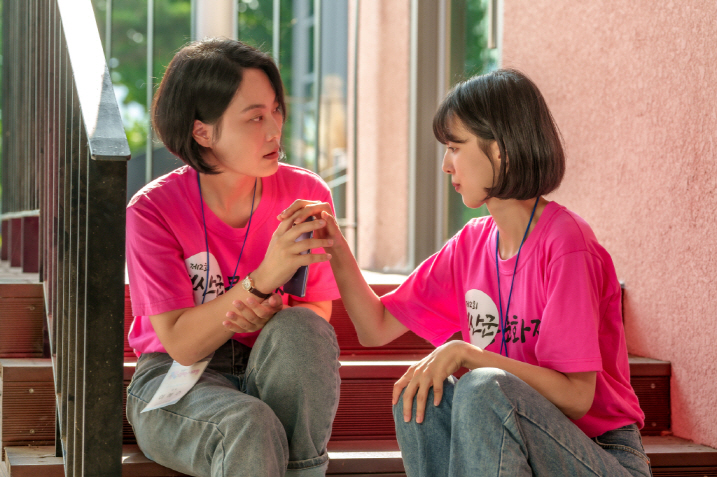
My mind struggled to follow the rather confusing narrative flow of South Korean independent film “The Conversation”. Mainly because my condition happened to be not that good during the first viewing, I did not feel like understanding everything in the film, and I thought I should give it a second chance later. After watching it again yesterday, I still remain baffled about what is about or how it is about, and I am even not sure whether I can describe well what I observed during the second viewing.

Please don’t worry, because the movie is actually not as labyrinthic as, say, Christopher Nolan’s “Tenet” (2020). We simply get a series of seemingly random conversation scenes, and they look like being connected together, but you may struggle to some degree as wondering how they can be connected in one way or another. You will also notice some of the main characters appearing more than once throughout the film, but you may wonder how their scenes can be chronologically organized.

Okay, let’s start with the opening conversation scene with a woman named Eun-yeong (Jo Eun-ji) and her two close friends Myeong-sook (Kim Soy) and Da-hye (Seong Eun-ji). As listening to these three female characters’ private conversation, we come to gather that they once studied together in France, and the mood becomes more relaxed between them as they casually talk about their past and present. On the surface, they all seem content with how their respective lives are going, but we come to sense some discontent during the next conversation scene unfolded outside.

In many of conversation scenes in the film, the camera usually sticks to its static position, and that aspect is particularly exemplified by one interesting scene entirely unfolded inside a taxi going to somewhere. The camera only focuses on the female passenger in the back, and she looks apparently drunk, so we are not so surprised when she gets her smartphone dropped outside the taxi. Nevertheless, she does not seem to care that much about this accidental loss, and that leads to a long conversation between her and the taxi driver, who is incidentally not shown on the screen but may be the guy presented in one of the subsequent scenes in the film.

In case of the conversation scene set in a cafe, we observe two female characters meeting and then interacting with each other a bit before approached by some foreign dude. The movie goes back to Eun-yeong and her two friends, and, as they clumsily try to speak in French, we wonder whether the previous scene reflects some past experience of theirs in France.

Around that point, the movie shifts from ladies to guys. In the scene between two male characters, they simply talk about a book given to one of them by the other, but their conversation does not go anywhere as they are virtually circling around one spot. Because of one of these two guys happens to be accompanied with a baby, you may wonder whether he is married to one of Eun-yeong’s two friends who also has a baby, but the movie does not give any clear answer for that.

The subsequent sequence is unfolded among three male characters including Seung-jin (Park Jong-hwan), who later turns out to be connected with Eun-yeong. While having a little barbecue party on the rooftop of the residence belonging to one of them, these three guys talk and talk, and we get some little amusement as they come to know a bit more about each other.

After the conversation scene between two male characters who may be more than close friends, the movie gradually comes to focus on Eun-yeong and Seung-jin. During their first scene set in a coffee shop, they look like total strangers to each other, but we wonder whether they are doing a sort of role-playing, and that impression lingers on us when they meet each other again in an empty movie theater.

In the end, the movie arrives at a little private moment between Eun-yeong and Seung-jin, who now behave more like a married couple although nothing in their following conversation confirms that. As they come to bicker with each other over some petty matter, the mood becomes a bit more absurd, and it is implied that this is not the first time Eun-yeong gets frustrated with Seung-jin.

All these and other conversation scenes in the film are competent in addition to being supported well by its main cast members including Jo Eun-ji and Park Jong-hwan. Jo is particularly good during her two scenes with Kim Soy and Song Eun-ji, and I wish the movie kept focusing more on their engaging characters for getting us to know their characters more. In case of Park, he is also supported well by Kwak Min-gyu and Kwak Jin-moo, and he and Jo are convincing in the playful interactions between their characters.

“The Conversation” is the second feature film directed by director/writer Kim Duk-joong, who previously made a feature film debut in “The Education” (2019). Compared to “The Education”, “The Conversation” is more lightweight in comparison, but it did not click with me well in terms of storytelling and characterization, so I cannot recommend it despite some admiration on direction and acting. It is not bad at all, but, folks, I am still scratching my head even at present.

Posted in Movies | Tagged , | Leave a comment

The Layover (2023) ☆☆☆(3/4): Their one accidental night in Busan

South Korean independent film “The Layover” gives us three different two-handers unfolded within a limited background at one accidental night. Although it is rather plain and simple in terms of story and character, the movie is engaging mainly thanks to its good direction and the solid performances from its small main cast, and I appreciate some unexpected emotional moments during each of its three acts.

The movie opens with introducing its six main characters one by one, who are on the same airplane leaving for US. Due to some serious engine problem, their airplane has to land in Busan, so all the passengers eventually have to get off and then stay for one night there, and the six main characters of the movie happen to check in the same local hotel.

The first story is between a lad named Seon-woo (Lee Han-ju) and a young woman named Soo-jeong (Jung Soo-ji). Although they are total strangers to each other, Seon-woo cannot help but attracted to Soo-jeong, and Soo-jeong does not seem to mind this at all. After he clumsily introduces himself to her, they come to spend some time at a hotel bar, and, what do you know, they come to reveal themselves to each other more than expected as they continue to spend more time together.

This is certainly not so different from Sofia Coppola’s “Lost in Translation” (2003), and there is even a brief moment which will remind you of the last scene of that sublime masterpiece. Regardless of whether it is just a short nocturnal romance between them, they will probably never forget that night between them – even though their respective life courses will never converge again. Lee Han-ju, who was hilariously obnoxious in “Unboxing Girl” (2020), and Jung Soo-ji are flawless as their characters tentatively revolve around each other, and Jung is particularly good when her character tells a bit about her complicated feelings about a recently diseased family member of her.

In contrast, the second story focuses on the growing friction among one recently engaged couple: Gyoo-hyeong (Kang Gil-woo) and Ji-won (Kim Si-eun). They are going to meet Gyoo-hyeong’s parents living in US, and they look comfortable to be with each other on the surface, but we cannot help but notice some tension between them right from their first scene in the film.

As they check in their hotel room, they seem to get more relaxed for a while, but there suddenly comes a serious issue about which they really need to talk right now. Without telling Ji-won at all, Gyoo-hyeong made a rather selfish decision for his life and career, and Ji-won is not so pleased about that for good reasons. After all, she also has her own life and career, but her fiancé did not show much consideration about that, and this consequently makes her question whether she can really go on with their relationship.

During that crucial moment, the camera simply observes them from its mostly static position, but their increasingly tense interactions feel more palpable to us. Although you can already guess what will eventually happen between them, the movie keeps holding our attention to the end, and Kang Gil-woo, who has appeared in a number of notable South Korean independent films such as “A Distant Place” (2020) and “Chorokbam” (2021), and Kim Si-eun, who was one of the main characters in “Black Light” (2020), do not take any misstep as their characters come to let out more frustration and resentment between them along the story.

The third story is about a middle-aged woman named Eun-sil (Byun Joong-hee) and her daughter Yoo-jin (Kang Jin-ah). Eun-sil is going to have some big medical surgery in US, and Yoo-jin accompanies her mother for providing emotional support, but Eun-sil cannot help but become anxious in addition to often complaining about how she has frequently been neglected by her children.

And this goes on even as they try to have a rest and then sleep in their hotel room. In the end, Eun-sil suggests that she and Yoo-jin should spend some time outside, and that leads to a long private conversation mainly revolving around old disappointment and resentment between them. No matter how much Yoo-jin tries for her mother, Eun-sil still thinks she is not appreciated enough by her children despite everything she did for them for many years, and she also keeps pointing out her daughter’s currently unmarried status.

Of course, their conversation comes to reveal more of themselves to each other in a melodramatic way, and it is interesting to watch how they push and pull each other during this part. While Byun Joong-hee is relatively showier, Kang Jin-ah, who was wonderful in “The Slug” (2020), ably complements her co-star from the beginning to the end, and their effortless interaction on the screen is the main reason why the third story is the most satisfying one in the bunch.

On the whole, “The Layover”, which is incidentally the fifth feature film by director Choi Chang-hwan, is a modest but enjoyable work, and I admire how it succinctly and intimately presents its three different stories within its rather short running time (81 minutes). I have not yet seen Choi’s previous four feature films including “Back from the Beat” (2018), but, as far as I can see from “The Layover”, he is another promising independent South Korean filmmaker, and I guess I can have some expectation on whatever will come from him next.

Posted in Movies | Tagged , , , | Leave a comment

Dungeons & Dragons: Honor Among Thieves (2023) ☆☆1/2(2.5/4): All substance but no style

“Dungeons & Dragons: Honor Among Thieves” does not have much of a sense of awe and wonder to distinguish itself enough. While it has more humor and spirit than expected, my mind kept comparing the movie with countless fantasy adventure films during last 25 years such as, yes, Peter Jackson’s the Lord of the Rings trilogy, and I became more aware of how uncharacteristic the movie is in many aspects.

At least, the movie is surprisingly not that bad, considering that it is another blockbuster film based on that popular board game produced by Hasbro. As your average nerdy boy mindlessly and relentlessly occupied with getting top grades except when focusing on books and movies, I never played “Dungeons & Dragons” in addition to having no interest in that at all throughout my childhood years, and to be frank with you, I only knew about the 2000 film of the same name, which is not exactly the highpoint for everyone involved with it.

The story, written by Chris McKay and Michael Gilio and then developed into the screenplay by Gilio and directors Jonathan Goldstein and John Francis, is pretty familiar to anyone who has watched at least one recent fantasy adventure film or drama series. At first, we are introduced to several different main figures one by one, and they soon come to band together for accomplishing one mission after another along the story before reaching to the ultimate goal of their bumpy quest.

That ultimate goal is a certain powerful magical object which can resurrect only one dead people, and Edgin Darvis (Chris Pine), a bard who became the member of some guardian group and then turned to thievery after tragically losing his dear wife because of his little unwise choice, really needs this magical object for getting his wife back for him and his young daughter Kira (Chloe Coleman). While he is currently incarcerated in some big prison along with his barbarian partner Holga Kilgore (Michelle Rodriguez) after getting caught for his previous heist, he already has an escape plan for Kira and himself, and we soon see how they execute his risky escape plan in the end.

After their fairly successful escape from the prison, Edgin and Holga embark on searching for Forge Fitzwilliam (Hugh Grant), who managed to run away with all those jewelries and that magical object at that time. Forge was also supposed to take care of Kira instead of Edgin, and it seems that she grows up well under his care while he becomes the new lord of some big city, but, alas, there is one big problem. Forge lied to Kira that her father abandoned her for a selfish reason, so Kira is not exactly excited to see her father again, and Forge is already ready to send Edgin and Holga back to the prison.

It turns out that Forge has a big secret plan behind his back. Along with an evil wizard named Sofia (Daisy Head), who was actually the mastermind of that heist gone wrong for Edgin and Holga, Forge has been preparing to hold a certain big event for the people of the city, and Edgin and Holga are just a minor annoyance to Forge compared to what he will get in exchange of helping Sofia accomplish her diabolical mission.

Anyway, once they manage to escape from Forge, Edgin and Holga look for anyone to help them getting his daughter back. First, they persuade Simon Aumar (Justice Smith), a young clumsy sorcerer who once worked with them, to join the group again, and Simon introduces them a female shapeshifter named Doric (Sophia Lillis). Later in the story, they approach to a dude named Xenk Yendar (Regé-Jean Page), and he agrees to take them a certain dangerous place where one helpful item has been stored.

While our several main characters bounce from one stage to another as expected, the movie provides a number of silly but funny moments, and you can see that its directors and writers are having a goofy fun with their source material. For example, I was especially amused by the scene where our several main characters try to get some information from a bunch of buried corpses to be revived temporarily and then die after answering five questions, and I also enjoyed the silly touches involved with one big fat dragon, which certainly needs some lifestyle change like me.

Although the main characters of the story are more or less than broad cardboard figures, the main cast members of the film clearly have a ball with their respective roles. While Chris Pine and Michelle Rodriguez complement each other well as a contrasting duo, Justice Smith, Sophia Lillis, Chloe Coleman, Chloe Coleman, and Regé-Jean Page are solid in their supporting parts, and Smith and Page contribute a considerable amount of wit and humor to the movie like Hugh Grant, who effortlessly steals the show whenever he enters the screen.

In conclusion, “Dungeons & Dragons: Honor Among Thieves” is not satisfying enough for me due to its several weak aspects. No, it is not a bad film at all, and I was entertained to some degree while appreciating the game efforts from its cast and crew members, but it does not have anything particularly new or fresh beyond its very familiar genre stuffs. As you know, any good fantasy adventure film needs both style and substance, and the movie is all substance but no style – and that is a disappointment to say the least.

Posted in Movies | Tagged , , | Leave a comment

A Man Called Otto (2022) ☆☆☆(3/4): A solid American remake starring Tom Hanks

In his 2009 review on “Everybody’s Fine” (2009), my late friend/mentor Roger Ebert pointed out that its lead actor, Robert De Niro, is better than many other actors in many things but playing nice is not one of them. While watching Tom Hanks in Marc Forster’s new film “A Man Called Otto”, I felt what is exactly opposite to Ebert’s response to De Niro in “Everybody’s Fine”. Sure, Hanks is one of the best actors of our time just like De Niro, but, let’s face it, playing gruff is not exactly his specialty, and I must point out that he feels a bit too mannered and strained especially during the first act of the movie.

At least, we can admire how much he tried to do something different in “A Man Called Otto” and two other movies in last year, though the overall result was not that good in my trivial opinion. While I have not seen Robert Zemeckis’ “Pinocchio” (2022) yet (I hope I will never come to watch it someday, considering how much it was lambasted by both critics and audiences), I can tell you instead that Hanks was often awkward and distracting in Baz Luhrmann’s latest work “Elvis” (2022), and it was rather understandable that Hanks was slapped with a Razzie award for his deeply flawed performance in “Elvis” a few weeks ago.

Although he is visibly strained at the beginning of “A Man Called Otto”, Hanks fortunately gets better bit by bit once his character shows more of human decency along the story. To be frank with you, I felt quite distant to the story and characters at first, but the movie and Hanks gradually won my heart and mind during next 2 hours, and that is certainly a considerable achievement in my viewpoint.

If the title of the movie sounds familiar to you, you have likely seen its Swedish original version “A Man Called Ove” (2015), which is based on the novel of the same name by Fredrik Backman. David Magee’s screenplay surely changes many things in the original film as transferring the story and characters to a suburban area in Pittsburgh, Pennsylvania, but it is mostly faithful to the Swedish version on the whole, and Magee and Forster did a mostly adequate job of balancing their movie well between comedy and drama.

At the beginning, the movie succinctly establishes the melancholic daily life of Otto Anderson, Hanks’ grumpy lead character. Since he lost his dear wife several years ago, this old dude has lived alone in his suburban house without interacting much with his neighbors including a guy who was once his best friend, and he also becomes more tired of living than before. During the opening scene unfolded in a local supermarket, he purchases a piece of rope for hanging himself later, but he only finds himself arguing a lot with an employee due to a silly trivial matter involved with the price of the rope.

When Otto is about to hang himself in his residence, something comes to distract him at the last minute. A Latino woman named Marisol (Mariana Treviño) and her family happen to be moving into a residence right across from his residence, and he cannot help but notice how clumsy Marisol and her husband handle their moving process. Fortunately, Otto’s suicide attempt is failed at the same time, and he promptly goes outside for taking care of the matter for himself.

Quite grateful to Otto’s little help, Marisol begins to approach closer to Otto as a good neighbor, and that certainly annoys Otto a lot. As he comes to interact more with her than expected, he gets involved more with Marisol and her family, and there is a darkly amusing moment when his another suicide attempt is aborted again by Marisol.

Of course, Otto gradually opens himself more to not only Marisol but also several others in his neighborhood and a certain scene-stealing stray cat, and we also get to know more about Otto’s life via a series of flashback scenes. We see how young Otto, played by Truman Hanks (He is one of Hanks’ sons, by the way), instantly fell in love with a young pretty woman who would eventually become his wife. We see how Otto’s friendship with that guy was developed and then broken due to a rather petty reason. And we see how Otto’s wife was the light of his life throughout their married life – especially after one devastating accident which smashed their simple wish forever.

As his character slowly comes out of his sullen exterior, Hanks exudes more gentle humanity as you can expect from him, and he is also supported well by a number of good performers to watch. While Mariana Treviño brings a considerable amount of warmth and spirit to her character, Cameron Britton, who has been more notable since his chilling appearance in Netflix drama series “Mindhunter”, and Manuel Garcia-Rulfo are also solid in their respective comic supporting roles, and the special mention goes to Mack Bayda, a male transgender actor who holds his own little place well in the film.

On the whole, “A Man Called Otto” is not exactly necessary in addition to being one or two steps below the Swedish original version, but it is a mostly solid remake at least. I still prefer the drier sense of humor in the Swedish original version, but this remake version does have some merit even though Hanks’ less-than-perfect acting can be an acquired taste for some of you. Yes, I can think of a bunch of other notable actors who can be more natural in playing gruff (How about Bill Camp or Tracey Letts, for example?), but he did try, and I appreciate that at least.

Posted in Movies | Tagged , | Leave a comment

Mona Lisa and the Blood Moon (2021) ☆☆☆(3/4): A Girl Escaped

Ana Lily Amirpour’s third feature film “Mona Lisa and the Blood Moon” is a saucy genre flick which intrigued me via its distinctive mood and style. While it is pretty simple in terms of story and characters, the movie tries to mix many different stuffs together in its colorful main background, and I observed its stylish attempt with some curiosity and amusement.

The story mainly revolves around a Korean girl named Mona Lisa Lee (Jun Jong-seo), who has been incarcerated in a mental hospital near New Orleans, Louisiana for more than 10 years due to some mental problem. She has been mostly mute and unresponsive in her safety cell, but then she somehow comes to acquire an ability of controlling minds at her will, and she soon escapes from the mental hospital without much difficulty.

Not long after she arrives in New Orleans, Mona Lisa happens to encounter Bonnie “Bonnie Belle” Hunt (Kate Hudson), a local stripper who gets herself into a minor trouble when she comes across Mona Lisa. Thanks to a little help from Mona Lisa, Bonnie is saved from that small trouble of hers, and she subsequently takes Mona Lisa to her shabby residence once she sees that she can benefit a bit from Mona Lisa’s supernatural ability.

Bonnie has lived with her young son Charlie (Evan Whitten), and Charlie is not so particularly pleased to see Mona Lisa at first, but it does not take much time for him to befriend her later. As your average lonely angry boy who has been often neglected by his mother, Charlie comes to sense similar loneliness and helplessness from Mona Lisa as they come to spend more time with each other, and she responds to him with some tender comradeship in exchange.

Meanwhile, Bonnie is mostly occupied with how she can exploit Mona Lisa’s special power for her own benefit. Because of being quite innocent, Mona Lisa lets herself manipulated by Bonnie to commit several criminal deeds. After all, there is nowhere else to go for her at present and, above all, being sent back to that mental hospital is certainly the last thing she wants right now.

Of course, the situation soon becomes more serious as they are pursued by a local police officer who had a very nasty experience during his accidental encounter with Mona Lisa. Once he gets a piece of information about Mona Lisa and Bonnie’s current criminal activity, he quickly embarks on locating them in a certain lurid area in New Orleans, and he also tries to find any possible way to protect him from Mona Lisa’s mind control ability. At one point in the middle of the story, he visits a local voodoo priestess for any potential help, and we accordingly get a little moment of amusement from that.

Around that narrative point, the movie becomes a bit more tense than before, but it still takes time in having us immersed more in its stylish ambience. Thanks to cinematographer Pawel Porgorzelski, who is mainly known for his notable collaboration with Ari Aster in “Heredity” (2018) and “Midsommar” (2019), the movie is amply packed with palpable Southern atmosphere, and Porgorzelski’s commendable visual work on the screen is often enhanced by the impressive score by Daniele Luppi, who incidentally received the Soundtrack Stars Award when the film was shown at the Venice International Film Festival two years ago.

At the center of the movie, Jun Jong-seo, a wonderful South Korean actress who has shown more of her talent and versatility since her crucial supporting role in Lee Chang-dong’s “Burning” (2018), gives a strong performance to carry the film to the end. While Amirpour’s screenplay does not specify much its heroine in details, Jun fills her rather enigmatic character with enough presence and intensity, and Mona Lisa comes to as another elusive but striking heroine to compare with that vampire girl in Amirpour’s acclaimed debut feature film “A Girl Walks Home Alone at Night” (2014).

Around Jun, several main cast members ably hold each own place. Although she has often unfortunately wasted her talent and star quality since her Oscar-nominated breakthrough turn in Cameron Crowe’s great film “Almost Famous” (2000), Kate Hudson demonstrates here that she is still an interesting performer to watch, and she deftly balances her character between better and worse sides without any excuse. While Craig Robinson, who can be serious enough as shown from Chad Hatigan’s little independent film “Morris from America” (2016), dials down his usual comic personality well again, Ed Skrein completely slips into his small but important supporting role, and young performer Evan Whitten is convincing in his several key scenes with Jun in the film.

In conclusion, “Mona Lisa and the Blood Moon” is relatively less successful than “A Girl Walks Home Alone at Night”, but it reminds us again that Amirpour is one of more interesting filmmakers during last several years. Yes, the movie is another usual case of “style over substance”, but I enjoyed its mood and style enough to care about its story and character, and you will not easily forget Jun’s performance in the end. As recently shown from two very different South Korean films “The Call” (2020) and “Nothing Serious” (2021), she is on the way to becoming one of the best actresses in South Korean cinema, and I sincerely hope this small oversea film will be another stepping stone for her promising acting career.

Posted in Movies | Tagged , , | Leave a comment

Cocaine Bear (2023) ☆☆1/2(2.5/4): This bear is pretty wild and high…

“Cocaine Bear” is as cheerfully silly and gory as you can expect from its very title. Outrageously developed from one amusing real-life incident, the movie goes all the way for gore and absurdity, and the resulting shocks and laughs are almost enough to carry its one-joke promise to the end. I wish it had more flesh and bones to be chewed by its titular bear figure in terms of story and characters. but I will not deny that I was often amused even while recognizing its noticeable weak points.

I must tell you that that real-life incident is surely preposterous but far less dramatic than what is depicted in the film. In 1985, a drug smuggler threw away loads of cocaine packages from his airplane before jumping from the airplane in the middle of a flight over Knoxville, Tennessee, but unfortunately, he fell to his death due to a little but fatal problem. Not long after that, a certain bear in a nearby forest region happened to ingest a considerable amount of cocaine from one of those discarded cocaine packages, and this bear was eventually found dead because of its overdose (It was subsequently stuffed and displayed at a mall in Kentucky, by the way).

The screenplay by Jimmy Warden goes much further from this utterly ridiculous real-life incident. In the movie, that bear in question becomes not only quite high but also very, very, very violent after ingesting lots of cocaine, and it goes without saying that its consequent brutal rampage along the story leads to lots of shock and awe for us. During its first scene in the film, a European couple unluckily come across the bear in the forest, and it surely gives them something they will never forget during the rest of their remaining life.

After that, we are introduced to a bunch of characters who may all be on the target list of our bear. There is a criminal organization boss who must retrieve those cocaine packages as soon as possible, and this figure, played by late Ray Liotta (The movie is dedicated to his memory), instructs one of his underlings to go to the forest along with his rather unenthusiastic son, who has been quite depressed to lose his loving wife recently. When the body of that pilot is found, a local detective instantly senses a chance to catch that criminal organization boss, and he quickly embarks on searching for anything to lead him to his longtime adversary.

Meanwhile, we are also introduced to two local kids who decide to skip their school just because they want to have a little special time together in the forest. No, their plan does not involve with sex at all, but they are old enough to know what they accidentally come across in the forest, and you will surely get some amusement as they “innocently” talk and discuss about what they are going to do with what they have just found.

It does not take much for these two kids to realize that they are in a very serious danger, and they certainly get a fair share of terror just like many other characters in the story. In case of a local nurse who is incidentally the single mother of one of these two kids, she simply wants to know where the hell the kids are right now, but, along with two other unfortunate supporting characters, she soon finds herself terrorized by the sudden appearance of the bear, who is eager to ingest cocaine more and more despite being quite high and violent.

Although it is essentially your average CGI animal figure, the bear, who is incidentally nicknamed “Cokey the Bear” by Boston Globe movie critic Odie Henderson, is indubitably the most fun character in the film, and director Elizabeth Banks, who recently tickled us a lot as accompanied by a dude wearing a big bear suit at the Academy Awards ceremony, and her crew have lots of crazy and bloody fun with this big furry animal figure. While the movie comes to lose some of its comic momentum later in the story, it is perked up whenever the bear appears on the screen, and our bear character also turns out to have a little wacky surprise involved with its gender.

I must point out that the human characters in the story are less substantial in comparison, though a number of recognizable performers in the film do try as much as they can do for filling their cardboard roles. While Keri Russell is the most sympathetic one in the bunch (Matthew Rhys, her co-star in the acclaimed TV drama series “The Americans”, briefly appears in the film, by the way), O’Shea Jackson and Alden Ehrenreich play their criminal characters straight even during their most outrageous moment in the movie, and Jesse Tyler Ferguson, Isiah Whitlock Jr., and Margo Martindale are reliable as usual, though they are rather under-utilized in my inconsequential opinion. In case of Brooklyn Prince, a young performer who was utterly unforgettable in Sean Baker’s “The Florida Project” (2017), she demonstrates here that she grows up a lot besides being on the road to a promising adult acting career, and I admire how willing she is to go for some naughty laugh for us.

In conclusion, “Cocaine Bear” is not as hilarious as I expected when I watched its trailer a few months ago, but it reminded me of what critic Pauline Kael once said: “The movies are so rarely great art, that if we can’t appreciate great trash, there is little reason for us to go.” Yes, “Cocaine Bear” is not even a great trash, but it is a fairly solid one at least, and I think you will be entertained more than me if you just want to spend your remaining free time.

Posted in Movies | Tagged , , , | Leave a comment