Polite Society (2023) ☆☆☆(3/4): A feisty genre exercise to cherish

“Polite Society” is a little but feisty genre exercise to cherish for good reasons. As an energetic mix between martial arts action movie and coming-of-age comedy, it kicks and punches all the way for giving us a bunch of outrageously spirited fun moments, and you will also enjoy how it is deliciously peppered with distinctive style and cultural elements to be savored.

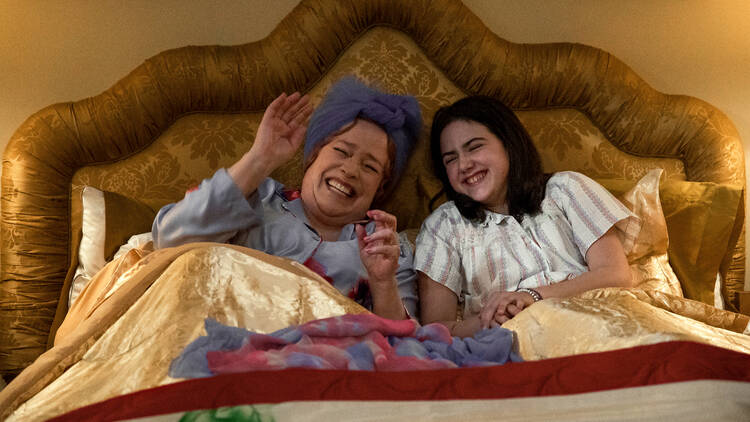
At first, we are introduced to Ria (Priya Kansara) and her older sister Lena (Ritu Arya), and the movie quickly establishes these two young Pakistani-British girls’ respective personalities as they go through another day in their neighborhood in London. While Lena does not know what to do next after recently quitting her art school, Ria is quite determined to become a stuntwoman someday as frequently honing her martial art skills, and Lena sincerely supports Ria’s aspiration as her dependable older sister.

And then there comes an unexpected change into their daily life. On one day, they and their parents are invited into a big traditional part held at the old country manor of a wealthy family friend named Raheela (Nimra Bucha), and what we get next is a sort of the 21st century version of Jane Austen movie mixed with Pakistani cultural elements. Besides Ria and Lena, many other young ladies are invited to the party, and all of these ladies are eager to draw the attention of Raheela’s son Salim (Akshay Khanna), who happens to be an eligible bachelor in addition to being a very successful geneticist.

Unlike many of those young ladies at the party, Ria and Lena do not give a damn about Salim at first, but, what do you know, Ria is shocked to learn later that Salim proposes to Lena and Lena actually accepts his proposal. Naturally, Ria tries to protest, but her parents support Lena’s decision, and Lena does not have any problem with her decision to marry Salim. After all, she feels rather frustrated after quitting her art school, and it seems that marrying a nice rich guy like Salim is a much better option for her life.

What follows next is a series of comic moments showing Ria’s clumsy attempt to stop her older sister’s marriage by any means necessary. With some help from her two best friends, she tries to dig up anything suspicious about Salim for changing her older sister’s mind, but, not so surprisingly, that only adds more strain and conflict to her increasingly estranged relationship with Lena. So far, Lena looks perfectly fine to be with Salim or her future mother-in-law, and we wonder whether Ria simply does not accept well how things change between her and her older sister due to her older sister’s upcoming wedding.

However, Ria eventually discovers that there is something sinister about Salim and his mother. While it is apparent that Salim is your average mama’s boy behind his dashing appearance, he and Raheela look like having some insidious plan behind their back, and, as your typical domineering mother, Raheela is not going to let Ria to ruin her son’s upcoming wedding at any chance.

For fighting against this mighty opponent, Ria’s particular set of skills surely come handy to her, though she is still not so confident about whether she can actually save her older sister. The movie generates some good laughs when she tries to demonstrate her martial art skills in front of her schoolmates at one point early in the story, but it still cares about her hope and aspiration nonetheless, and it surely takes some risk along with its heroine when she must act right now for saving her older sister later in the film.

As the center of the film, Priya Kansara is alternatively funny and electrifying in her dexterous performance balanced well among comedy, drama, and action. Besides looking believable in many of physical action scenes in the film, she also anchors the movie well with unadorned sincerity and gravitas, and that is the main reason why several deliberately exaggerated moments in the film work on the emotional level even while tickling us a lot. When the movie tries a bit of song and dance moment during its climactic part, Kansara gives another impressive moment to be appreciated, and we come to root for her character more than before.

Around Kansara, director/writer Nida Manzoor, who incidentally makes a feature film debut here after making several short films, assembles a number of colorful performers. Besides looking both cordial and sinister as required, Nimra Bucha chews every moment of hers in the film with sheer gusto, and she does not disappoint us at all when her character eventually reveals her devious design on her son’s marriage. Ritu Arya fills her seemingly thankless role with enough life and presence, and she and Kansara ably convey to us well the considerable emotional bond between their characters during several key scenes of theirs. In case of several other main cast members, Akshay Khanna, Shobu Kapoor, and Jeff Mirza are well-cast in their respective supporting roles, and Seraphina Beh, Ella Bruccoleri, and Shona Babayemi provide extra fun as Ria’s schoolmates.

Overall, “Polite Society” is quite entertaining for its deft handling of several different genre ingredients, and it surely shows that Manzoor is another promising filmmaker to watch. As far as I can see from the movie, she is a competent filmmaker who knows how to engage and entertain us, and I guess I can have some expectation on what may come next form her.

Posted in Movies | Tagged , , , | 1 Comment

Smugglers (2023) ☆☆☆(3/4): Female divers who become smugglers

South Korean film “Smugglers” simply has a fun with juggling its various colorful criminal characters, and I enjoyed that. Although you can clearly see where it is sailing right from the start, you will gladly go along with that while being entertained by the game efforts from its solid main cast members, and the result is one of more entertaining products during this summer season in South Korean theaters.

The movie, which is mainly set in a small fictional port city in the 1970s, begins with the extended prologue part establishing the conflict between its two female main characters: Chun-ja (Kim Hye-soo) and Jin-sook (Jung-ah). Along with several other local women, they have worked as female divers, called “hanyeo”, for Jin-sook’s father, but their work has recently been jeopardized by the pollution caused by nearby chemical plants, and that is how they later come into the world of smugglers along with their boss. Things seem to get much better for everyone for a while thanks to their little smuggling activities, but, of course, there eventually comes a moment where they come to face the consequence of their criminal action, and the following tragedy breaks Jin-sook’s heart while also making her quite angry about Chun-ja. After all, Chun-ja manages to escape and then is disappeared, and everyone thinks she is the one who betrays them all.

Two years later, we see Chun-ja working as a small-time black market operator in Seoul. Because she has done her business without any permission from a powerful (and ruthless) smuggler called Sergeant Kwon (Zo In-sung), she soon finds herself being about to be eliminated by Sergeant Kwon and his right-hand guy, so she quickly suggests one seemingly good business idea for him. She is going to establish a new smuggling route for him, and she is willing to go back to her old place for that even though she is well aware that she will not be welcomed much there.

Anyway, once she succeeds in convincing Sergeant Kwon, Chun-ja promptly goes to her old place and then starts her little criminal project along with Ok-bun (Go Min-si), a charming but opportunistic young woman who has run a little coffee shop there. Because Jin-sook and other female divers are necessary for her plan, Chun-ja contacts with a guy who once assisted Jin-sook’s father but now becomes a local criminal boss, and he is certainly willing to help her a bit because of whatever he may get as a new business partner for Sergeant Kwon.

When she soon comes to learn of Chun-ja’s return, Jin-sook is naturally not so pleased to say the least. Although she and her fellow female divers have worked for that local criminal boss from time to time, getting associated with Chun-ja again is the last thing they want, and Jin-sook even swears in front of Chun-ja that she and her female fellow divers will not work for Chun-ja at any chance.

However, not so surprisingly, Chun-ja’s offer eventually becomes the one Jin-sook and her fellow female divers cannot refuse, but things become a little more complicated in the meantime. There is a local customs officer who has been watching on whatever is going on among Chun-ja and her associates, and Chun-ja also has a little plan for her survival when the situation gets much riskier later in the story.

Although it takes some time for building up its narrative momentum during its first half, the screenplay by director/co-producer Ryoo Seung-wan and his co-writer Kim Jeong-yeon deftly rolls the story and characters to the expected climactic part, and it also provides some seriousness as paying attention to the estranged relationship between its two female main characters. While they do not like each other much, Chun-ja and Jin-sook subsequently find themselves sticking together for beating their opponents, and it is not much of a spoiler to tell you that Chun-ja actually has her own reason for running away from Jin-sook and others at the time.

When it eventually arrives at the climatic part, the movie does not disappoint us at all with a thrilling underwater action sequence, and the main cast members keep holding our attention with their good performance. While Kim Hye-soo, who is still one of the most interesting South Korean actresses at present even though she has been active for more than 30 years, is the most prominent member in the group, she does not overshadow her fellow cast members at all, and her showy acting is often complemented well by Yum Jung-ah’s more grounded performance. While Zo In-sung and Park Jeong-min are effective as Chun-ja’s two different criminal associates, Kim Jong-soo is also well-cast in his supporting role, and the special mention goes to Go Min-si, who effortlessly steals every moment of hers in the film.

On the whole, “Smugglers” is another good genre film from Ryoo, who has steadily worked since his debut feature film “Die Bad” (2000). Although I did not like “The Battleship Island” (2017) much, his next film “Escape from Mogadishu” (2021) reminded me that he is still a good director who knows how to thrill and entertain us, and “Smugglers” shows him trying something a little different. As mainly driven by the vivid personalities of its main female characters, the movie surely makes a considerable contrast with many of his usually male-dominant films, and that is sort of refreshing in my trivial opinion. To be frank with you, mainstream movies in South Korea really need more female characters these days, and “Smugglers” may be a small but significant sign of change.

Posted in Movies | Tagged , , , | Leave a comment

They Cloned Tyrone (2023) ☆☆☆(3/4): They indeed did…

Netflix film “They Cloned Tyrone”, which was released yesterday, is a modest genre mix which is often very familiar but also engaging enough in its own way. Definitely reminiscent of a bunch of notable African American films ranging from those classic Blaxploitation flicks of the 1970s to Jordan Peele’s “Get Out” (2017) and Boots Riley’s “Sorry to Bother You” (2018), the movie wildly swings back and forth between social satire and conspiracy thriller for more thought and amusement, and you will simply go along with that once you get accustomed to how it is about.

The opening part of the film feels like your average African American crime movie. First, we are introduced to a young drug dealer named Fontaine (John Boyega), and then we observes how he gets himself into a trouble with some rival drug dealer in his slum neighborhood. In the end, right after visiting a local pimp named Slick Charles (Jamie Foxx) at a local motel for some little business issue between them, Fontaine gets shot multiple times outside the motel, and that seems the end of his life story.

However, what do you know, we see Fontaine waking up at his shabby residence in the very next morning without any sign of trauma, and Slick Charles is naturally confused and frightened when Fontaine subsequently visits the motel again. Although Fontaine do not remember anything about what occurred on the previous day, Slick Charles and one of his prostitutes, Yo-Yo (Teyonah Parris), did witness that incident, and Fontaine decides to look for the answer to this befuddling matter of his along with Slick Charles and Yo-Yo.

What follows next is a series of funny moments which make these three main characters have more doubt and question about their surrounding world. It looks like there has been some hidden conspiracy involved with their slum neighborhood, and they come to see more signs and clues as they try to get to the bottom of their increasingly peculiar circumstance. For example, they happen to find an underground laboratory where a certain kind of substance is being produced, and they later discover that this substance is actually one of special ingredients used by, surprise, a certain popular fried chicken brand among black people.

Because of the very title of the movie, it is not much of a spoiler to tell you that Fontaine eventually comes to learn that he is actually a clone, but there are some small, nice surprises I will let you behold for yourself. I will not tell you much here, but I can tell you instead that things become more preposterous when a certain supporting character played by Kiefer Sutherland enters the picture later in the story, and the movie shifts itself onto the realm of John Carpenter’s classic B-action films and their numerous juniors such as Kleber Mendonça Filho and Juliano Dornelles’ “Bacurau” (2019) when Fontaine and several other characters eventually decide to fight against the insidious conspiracy on them and many other black people out there.

While it does not reach to the devious horror satire of “Get Out” or the no-holds-barred farce of “Sorry to Bother You”, the screenplay by director Juel Taylor and his co-writer Tony Rettenmaier takes its time to build up some comic momentum along the story, and the movie has enough mood and details to hold our attention. Although the story is clearly set in the 21st century background, Taylor and his crew members including cinematographer Ken Seng deliberately fill the screen with grainy texture in retro style, and we are amused more as observing the blatantly old-fashioned interior design of those hidden underground places to be discovered by Fontaine and his gangs.

As the center of the film, John Boyega plays as straight as possible just like he did in his breakout performance Joe Cornish’s “Attack the Block” (2011), another preposterous but interesting genre flick which depends a lot on Boyega’s considerable talent and charisma. Compared to his rather strained lead performance in “Naked Singularity” (2021), Boyega’s quietly intense acting here in this film looks much more convincing as dutifully carrying the film to the end, and he also has some fun when he is required to do some multi-tasking during the climatic part (This is not a spoiler, right?).

With Boyega firmly holding the ground, the two main cast members of the film have each own moment to shine. Although his prime period mainly represented by his Oscar-winning performance in Taylor Heckford’s “Ray” (2004) may be already passed, Jamie Foxx is still an interesting actor to watch, and he brings a flamboyant sense of fun to his supporting character. Besides, he is also matched well by Teyonah Parris, a wonderful actress who has steadily advanced since her key supporting turn in Justin Simien’s “Dear White People” (2014).

On the whole, “They Cloned Tyrone” is an enjoyable genre mix to be appreciated for its mood, style, and performance, and Taylor, who previously wrote the screenplay for “Space Jam: A New Legacy” (2021), did a solid feature film debut here. The movie is a bit overlong (The epilogue scene, which explains the title of the movie, is rather perfunctory in my humble opinion), but it succeeds as much as intended at least, and I will not grumble for now while savoring its several effective satiric moments.

Posted in Movies | Tagged , , , , , | Leave a comment

Emily the Criminal (2022) ☆☆☆1/2(3.5/4): As she tumbles into crime

“Emily the Criminal”, which is currently available on Netflix in South Korea, follows a young desperate woman who happens to tumble into crime out of her growing financial desperation. As phlegmatically observing her criminal descent, the movie slowly builds up the tension surrounding her increasingly tricky circumstance, and it is also strongly held by one of the best movie performances of last year.

Aubrey Plaza, who has been showing more of the serious sides of her talent since her notable supporting turn in TV sitcom series “Parks and Recreation”, plays Emily Benetto, a college dropout who has tried to earn her meager living in LA. As shown from the opening scene, Emily has tried to get any job better than her current menial job, but, unfortunately, there is a little but notable criminal record of hers in the past, and her latest job interview is eventually botched because of that.

And we get to know a bit about how economically desperate Emily has been during recent several years. Although she did not graduate, she still has to pay off her tuition loan which is no less than 70,000 dollars, and, to make things worse, she can barely afford to pay off its interest only, no matter how hard she works everyday. On one day, one of her co-workers introduces her to a rather shady part-time job opportunity for earning 200 dollars per hour at least, and she does not hesitate to grab it, even though she does not feel so comfortable about this seemingly good chance from the beginning.

Of course, it does not take much for her to see what kind of job she has to do for earning as much as promised to her. She and a bunch of other people gather at a place run by a guy named Youcef (Theo Rossi) and his cousin, and Youcef gives them a generous warning in advance on what he is going to ask them to do. He and his cousin have run a little but lucrative credit card theft operation, and they always need someone to use those stolen credit cards for buying expensive stuffs to be sold by Youcef and his cousin later. Discerning well what kind of risk she will take, Emily initially decides to leave along with a few others, but then she changes her mind because, well, she really needs money right now.

The first job she will have to do looks like a piece of cake. Once she receives one of those stolen credit cards, she will go to a local shopping mall where she is supposed to buy a big TV, and all she needs to do is not drawing any unnecessary attention before she eventually walks out of the shopping mall and hands that purchase TV to Youcef.

When Youcef later suggests another job which may earn her more money, Emily is not so willing at first, but, of course, she comes to let herself get more associated with Youcef’s criminal operation as being tempted by more money to come. Although she has to face more risk, she cannot resist what she gets in exchange for that, and it actually look like she will finally solve her current financial problem.

And there also comes the possibility of a new start for her. When she meets and talks a bit with an old college friend of hers, this friend says that she may help Emily get hired at her current workplace where Emily can fully utilize her considerable artistic talent, and Emily is certainly eager to grab this lucky opportunity even though her friend does not promise her much.

Meanwhile, Emily also finds a possibility of romance from Youcef, who comes to like her a lot and even teaches her a bit on his credit card theft skills. At one point, he gladly shows her an empty house where he may achieve his own American dream, and Emily become more attracted to this small-time criminal while also committing one credit card theft after another.

Not so surprisingly, there eventually comes a point where everything begins to fall apart for its heroine, but the movie keeps its detached non-judgmental attitude to the end even when things become quite dire for its heroine. Virtually being cornered in one way or another, Emily comes to cross more than one line in the name of survival, and that even amazes her criminal associate.

Without making any excuse or compromise on her character, Plaza’s commendable performance firmly holds our attention to the end. What Emily does along the story is often criminal to say the least, Plaza ably conveys to us her character’s sheer desperation, and we come to understand and empathize more with Emily even when she lets herself sink further into crime. In case of several substantial supporting performers in the story, Theo Rossi and Megalyn Echikunwoke are effective in their respective parts, and Gina Gershon briefly appears as the haughty boss of Emily’s aforementioned friend later in the film.

“Emily the Criminal” is the first feature film by director/writer John Patton Ford, who deservedly received the Best First Film Screenplay Award at the Film Independent Spirit Awards early in this year. Thanks to his skillful handling of story and character as well as Plaza’s top-notch efforts, the movie is a compelling mix of character study and thriller genre, and it will be interesting to see what he will give us next in the future. In short, this is one of better films of last year, and you should really check it out if you have not watched it yet.

Posted in Movies | Tagged , | Leave a comment

The Deepest Breath (2023) ☆☆☆1/2(3.5/4): Freediving into the depths of the ocean

Netflix documentary film “The Deepest Breath”, which was released yesterday, amazed me, chilled me, and touched me more than once. There are a number of incredible moments showing professional freedivers challenging themselves to the end of their physical limits in the depths of the ocean. There are some gut-wrenching moments showing how risky and dangerous every attempt of theirs really is. And there is also a poignant love story between two different people at the pinnacle of their extremely demanding profession.

At the beginning, the documentary looks into the life and career a well-known Italian female freediver named Alessia Zecchini, which is presented mainly via the interviews of several people associated with her including her father. Even when she was very young, Zecchini became determined to become a professional diver once she found her passion toward the ocean and diving, and she impressed even seasoned professional divers a lot with her considerable potential when she was only 17. Although she was subsequently not allowed to participate in national diving competitions later due to her rather young age, she did not give up at all as preparing herself more and more, and she eventually distinguished herself as a rising star diver a lot several years later.

Once it seemed that she accomplished as much as she could inside pools, Zecchini’s interest quickly moved onto freediving, which was much more challenging to her to say the least for many good reasons. First, one should be able to hold his/her breath long enough for diving down toward a certain point deep into the sea, and that is relatively easier compared to big risks and challenges following that. When one later has to swim up to above the water, one has to consider everything including the remaining amount of the oxygen in his/her lungs, and, as explained to us in the documentary, there may be hell to pay if any of these factors happens to go wrong at any point.

Nevertheless, many professional freedivers have kept diving as long as they are allowed by their physical condition because of being drawn to not only the challenges upon them but also the wonder and beauty of the ocean, and Zecchini was no exception as she began to test herself at the following freediving competitions. She had already quite determined to break the world record held by a very famous female freediver to whom she looked up for years, and, probably except herself, it looked like there was nothing to stop her from reaching for that seemingly impossible goal.

When Zecchini later participated in the renowned annual freediving competition held in the Bahamas, she came across a well-known Irish safety driver named Stephan Keenan, and the documentary parallels his life story with Zecchni’s during its first hour. Just like Zecchini, Keenan always went for new challenges and adventures as leaving his home country and then going to here and there in Africa, and that was how he eventually found his lifelong profession later. During his accidental stay at a certain seaside town in Egypt which has a challenging place spot for any ambitious freediver, he became quite interested in freediving, and then he began to work as a safety diver for freedivers because that is also pretty challenging in its own way. Just like freedivers, those safety divers also usually have to depend on the limited amount of oxygen in their lungs, and that means they constantly have to pay attention to not only freedivers’ safety but also their own safety.

And the documentary shows and tells more about the sheer risk and danger of freediving. A number of archival footage clips show some disturbing moments of life and death which really happened in the middle of the competitions, and you will get chilled more as hearing about how human brain can be instantly shut down under the extreme conditions of freediving. Unless those safety divers swiftly work on this alarming emergency, called “blackout”, within one or two minutes, there will be considerable irreversible damage on brain, and this can actually lead to death in the worst cases.

Zecchini and Keenan surely witnessed and experienced numerous incidents of blackout, but that still did not deter either of them at all. Zecchini later agreed to train more under Keenan’s guidance in that seaside town of Egypt, and Keenan was willing to help and train her as much as possible. As they spent more time together, they became closer to each other, and it seemed that they finally found a lifelong soulmate from each other while sharing more passion and dedication toward freediving.

Because the documentary already set a subtle mournful undertone right from the beginning, you will have a pretty idea about what would happen to Zecchini and Keenan on one day of 2017, even though you do not know anything about them like I did before watching the documentary. All I can tell you for now is that director/writer Laura McGann deftly presents what happened at that time via the vivid and palpable mix of interviews, archival footage clips, and some reenactment shots, and the overall result is quite powerful as coupled with the undeniable human poignancy observed from the last interviewer of the documentary.

In conclusion, “The Deepest Breath” is compelling and informative for its close look into freediving and the two interesting human figures at the center of its narrative. As a frequently neurotic guy with considerable aversion to any kind of risk and danger, I initially observed their passion and dedication from the distance, but then I came to admire them a lot more than expected, and that says much about the emotional power of this remarkable documentary.

Posted in Movies | Tagged , , , , | 1 Comment

Barbie (2023) ☆☆☆(3/4): Gerwig’s silly but delightful romp with Barbies

Greta Gerwig’s latest film “Barbie” is a silly but delightful romp proudly embracing its glitzy artificial qualities to the end. Yes, it surely feels contradictory at times as boldly wielding messages of female empowerment and liberation via those well-known brand doll figures criticized for the inherent objectification of female bodies, but it cheerfully recognizes its imperfections while trying to have all the fun and glee it can have with its numerous doll figures, and I came to enjoy and savor that much more than expected.

At first, the movie quickly introduces us to its fantasy world along with Helen Mirren’s dryly humorous narration. This world, called “Barbieland”, is full of Barbie doll figures including the one played by Margot Robbie, and the movie goes all the way for artificial silliness as casually depicting how everything goes swell and same at every pinky day for every Barbie doll figure in this world, which is in fact not so far from the TV sitcom fantasy world of “Pleasantville” (1998) in many aspects.

On one day, Robbie’s character suddenly begins to experience a sort of mental/physical problem for no apparent reason, and that surely causes a serious trouble in her comfortable paradise. After consulting a bit with “Weird Barbie” (Kate McKinnon), she decides to go over to LA of our world for solving her problem, and she soon starts her journey along with one of Ken doll figures played by Ryan Gosling, who volunteers to accompany her just because, well, she has been the sole reason of his existence.

What follows next when these two doll figures arrive in LA is not so different from what Amy Adams’ fairy tale princess character experiences in “Enchanted” (2007). They surely draw lots of attention and ridicule right from the beginning due to their colorful appearance and outfit, and both of them naturally become quite befuddled as struggling with a sort of culture clash in one way or another.

Anyway, the main goal of Robbie’s character is finding a certain young girl who has been personally connected with her for years, but, of course, things do not go that well for her when she finally seems to locate that young girl. Right from their first encounter, Robbie’s character gets harsh feminist lessons on Barbie doll figures, and that surely throws her into more confusion, though she subsequently comes across someone who do remember and recognize her.

Meanwhile, Gosling’s character goes through his own hilarious misadventure, and that eventually leads to the bitingly humorous lampoon of patriarchy as he wholeheartedly absorbs its every toxic aspect. As a result, we later get an uproarious moment when he willfully turns Barbieland into your average male fraternity house, and that surely throws another big blow into the seemingly impeccable worldview of Robbie’s character.

While having lots of naughty fun from the frequent clash between its fantasy world and the real world along the story, the screenplay by Gerwig and her partner Noah Baumbach also finds some sincerity as Robbie’s character comes to empower herself through several moments of enlightenment thanks to two human figures she happens to befriend during her bumpy adventure. When she eventually arrives at an important moment of choice for herself after those good life lessons of hers, the movie becomes a little more serious than before, and the following ending comes with a little poignancy to be appreciated.

Above all, the movie seldom loses its lightweight sense of fun as often buoyed by the considerable comic intensity of Robbie’s another terrific performance. While initially amusing us a lot with her deft mix of charm and manic spirit, Robbie gradually builds up her character’s hilarious but ultimately touching emotional journey along the story, and she does not miss any comic beat even when she is going to deliver the final line of the film, which will tickle you a lot if you muse more on a certain physical aspect of Barbie dolls.

Gerwig assembles a bunch of notable performers here and there around Robbie. As the two substantial characters of the real world, America Ferrera and young performer Ariana Greenblatt hold the ground for Robbie with enough gravitas, and Will Ferrell gleefully chews every minute of his in contrast as demanded by his cartoonish role. In case of many various cast members playing Ken or Barbie doll figures in the film, all of them surely have a field day together, and Gosling, who looks as physically well-shaped as he did in “Crazy, Stupid, Love” (2011), does not hesitate to commit himself to every silly aspect of her character. As a matter of fact, he and several other hunky male cast members in the film even do a big musical dance number later in the story, and I am sure this stupendously blatant moment of overkill will amuse not only millions of female audiences out there but also numerous gay audiences who have ever played with Ken doll figures.

On the whole, “Barbie” may look rather broad and superficial compared to Gerwig’s two previous works “Lady Bird” (2017) and “Little Women” (2019), but it has enough spirit and humor for our entertainment at least. Sure, Gerwig could do better, but I also think she deserves to have some casual break after her significant achievement in “Lady Bird” and “Little Women” – just like Sofia Coppola did in “Marie Antoinette” (2006) after “The Virgin Suicides” (1999) and “Lost in Translation” (2003).

Posted in Movies | Tagged , , , | 2 Comments

God’s Country (2022) ☆☆☆(3/4): Her isolated pain and anger

I had some idea about what “God’s Country” is about after watching its trailer in last year. In fact, the movie did not surprise me in that aspect when I finally watched it yesterday, but it actually surprised me in how it is about. While working as a slowly tense genre flick on one level, it also works as an interesting character study on the other level, and I admire how the movie balances itself well between its two different things before eventually arriving at the inevitable finale waiting for its solitary heroine.

At the beginning, the movie gradually establishes its heroine’s ongoing personal loss and grief. Cassandra “Sandra” Guidry (Thandiwe Newton) is an African American woman who lived with her old mother at some remote rural area of Montana during last several years, but now her mother passed away, and there is no one around her in her house except her pet dog. She surely tries to focus more on her college job, and her colleagues show some support and condolence, but that reminds her more of being utterly alone now.

On one day, Sandra notices a big red truck on the driveway of her property, and she feels annoyed just because its driver enters her property without any permission from her. It soon turns out that the driver and his friend simply come for hunting, and she may just have to ignore them for a while, but she only becomes more determined to block them as much as possible.

Not long after she gives them a couple of warnings, two disturbing incidents follow, so Sandra naturally calls for the local police. She is visited by the acting sheriff of the area, and he is rather impressed by how she thoroughly keeps several evidences of the incidents, but, to her frustration and exasperation, he does not help her much on the whole. Thanks to her remembering the license plate of that truck, Sandra and the sheriff actually can locate the driver, but the sheriff only warns the driver a bit, and he frankly admits to Sandra that there is nothing else he can really do for her at present.

To her annoyance, the driver and his friend keep entering Sandra’s property as before, and that is when she decides to handle the situation for herself. As revealed later in the story, she actually had a certain kind of professional career before beginning to teach at the college, and there is a quiet but bitter scene where she calmly reveals to the sheriff about how she came to quit her previous job and then move to Montana along with his mother.

However, the mood becomes a bit more introspective to our little surprise when Sandra follows and then confronts the driver. As observing a bit of humanity from the driver, she decides to show more tolerance and understanding, and it looks like their little conflict can be resolved once both of them step back a bit for avoiding any more trouble.

While recognizing this small possibility of resolution, the screenplay by director/co-producer Julian Higgins and his co-writer Shaye Ogbonna, which is based on James Lee Burke’s short story “Winter Light”, rolls the story and characters toward more conflict step by step. In case of that friend of the driver, he is really a nasty piece of sh*t, and Sandra’s encounter with this deplorable dude only increases her anger and frustration. In addition, she also comes to conflict a lot with the new dean of her college department, and she is reminded again of how fragile and isolated she really is at her workplace as the only colored female faculty member of the department.

During the last act, the movie eventually becomes more intense than before with several devastating moments, but it still sticks to its dry and pensive attitude as before, and it is also held together well by the strong acting by Thandiwe Newton, a wonderful British actress who has steadily advanced during last 30 years since her charming performance in John Duigan’s criminally overlooked coming-of-age drama “Flirting” (1991). Effortlessly embodying her character’s strong will as well as vulnerabilities, Newton did a commendable job of conveying to us her character’s inner turmoil along the story, and she is particularly terrific when her character comes to have a complex moment of introspection around the end of the story.

Around Newton, several good performers come and go as effectively functioning as her counterparts. Jeremy Bobb has a couple of nice moments as his sheriff character shows some compassion and understanding to Sandra, and Joris Jarsky and Jefferson White make a good contrast with each other as those two unpleasant intruders in the story. Kai Lennox and Tanaya Beatty are solid in their small but substantial supporting roles, and Beatty has a little standout moment when her supporting character finds herself in a very tricky circumstance due to Sandra’s unwise act later in the story.

In conclusion, “God’s Country” did its own things well even while reminiscent of many other similar genre films such as, yes, Sam Peckinpah’s “Straw Dogs” (1971), but, unfortunately, it was forgotten quickly after it got a limited theatrical release in US in last year. In my humble opinion, it deserves some more attention considering Newton’s strong lead performance, and you will not be disappointed if you are looking for any kind of fresh genre variation.

Posted in Movies | Tagged , | Leave a comment

God’s Creatures (2022) ☆☆☆(3/4): After her son returns

It took some time for me to get accustomed to what “God’s Creatures” attempts to achieve. Subtly shrouded in moody disturbance, this little Irish psychological drama slowly and gradually unnerves us as its ordinary heroine comes to realize something horrible about her son, and, despite its predestined finale, it leaves a considerable impression on us thanks to its good direction and several fine performances.

The story set in a little rural seaside town where Aileen O’Hara (Emily Watson) and many other women earn their living at a local seafood processing factory. As these ladies go through another usual workday, a male body is found in the sea, and it soon turns out that the dead man is the son of a close colleague of Aileen, who apparently got himself drowned while doing some unlicensed fishing.

Not long after the funeral of this unfortunate lad, Aileen’s son Brian (Paul Mescal) suddenly returns to his hometown after several years of absence. Although he did not correspond much with his family while he was supposed to be somewhere in Australia, Aileen is happy to see her son again, and her son seems ready to work hard for earning his living. As a matter of fact, he soon embarks on working on an abandoned oyster farm still belonging to the family, and Aileen is willing to help him via a bit of stealing at her workplace.

However, the movie frequently reminds us of something bad to happen sooner or later. While cinematographer Chayse Irvin constantly fills the screen with a gray sense of anxiety, the score by Danny Bensi and Saunder Jurriaans unsettles us at times via disconcerting percussion sounds, and that makes us more aware of the awkwardness among Aileen and her family members. Aileen still tries to support her son as much as she can, and her son seems grateful to her for that, but we cannot help but sense some distance between them. In case of Aileen’s husband, he often regards his son with reserved suspicion without saying much, and, not so surprisingly, there is a good reason for that.

Meanwhile, we get to know a bit about a young local woman named Sarah (Aisling Franciosi). She recently ends her relationship with her lousy husband, and she receives some sympathy from many other women in the town including Aileen, but she does not know what to do next for her life. As she frankly admits at one point, she has been so accustomed to her little hometown that leaving the hometown looks impossible to her, even though she is quite tired of many things including her husband.

Once its several main characters are fully established during its first half, the screenplay by Shane Crowley, which is based on the story by Crowley and co-writer/producer Fodhla Cronin O’Reilly, eventually sets things in motion via one offscreen incident. I will not go into details here, but I can tell you instead that Aileen is reminded again of how much she has looked away from her son’s very unpleasant nature behind his seemingly likable façade, and this naturally leads to several conflicts along the story. She instantly does what is necessary for her son, but then she cannot possibly ignore the following consequence of her choice, and that makes her all the more conflicted.

While this is surely a familiar genre story, directors Saela Davis and Anna Rose Holmer keep things rolling under the subtly tense atmosphere surrounding the main characters in the film. Not many things are expressed on the surface, whatever is churning among them often feels palpable to us nonetheless, and that is the main reason why the movie still holds us tight even when it finally arrives at the inevitable conclusion.

Emily Watson, who has seldom disappointed us since her haunting Oscar-nominated breakthrough turn in Lars von Trier’s “Breaking the Wave” (1996), is quietly intense as her character desperately tries to hold herself behind her calm and weary appearance. She is particularly wonderful during a key scene later in the story where her character eventually becomes more forthright with her son, and we are not so surprised by her character’s following decision because Watson’s expressive face tells us everything we need to know.

Although the supporting characters of the film are rather underwritten in comparison, two of its main cast members bring more than required to their respective parts. While Paul Mescal, who recently garnered a well-deserved Oscar nomination for Charlotte Wells’ “Aftersun” (2022), ably balances his untrustworthy character between charm and menace, Aisling Franciosi, who previously gave a strong performance in Jennifer Kent’s “The Nightingale” (2018), holds her own small place well as another substantial character in the story, and she is especially heartbreaking when her character sings a folk song in front of others during their little local ritual.

Overall, “God’s Creatures” demands some patience for its slow narrative pacing, but you may find it more engaging than expected because of its good mood and solid acting. To be frank with you, I was not sure whether I liked it or not during the first viewing, but I decided to give it another chance because I was not exactly in a good condition at that time, and I came to appreciate its strong points more during the second viewing. It is still rather modest, but it is better than I thought at first, so I recommend you to give it a chance someday.

Posted in Movies | Tagged , | Leave a comment

The Velvet Queen (2021) ☆☆☆(3/4): A meditative look into the Tibetan wildlife

French documentary film “The Velvet Queen” is often awe-inspiring whenever it calmly and meditatively observes all those wide and beautiful landscapes of one mountainous area of Tibet. Closely following one tenacious attempt to document a certain rare local animal species on camera, the documentary vividly presents the sheer wonder of nature and wildlife on the screen, and that is more than enough to compensate for its several notable shortcomings.

The documentary mainly revolves around a prominent nature photographer named Vincent Munier, who incidentally directed the documentary with Marie Amiguet, and Sylvain Tesson, a writer who later wrote a book about their little joint quest for documenting the snow leopard inhabiting in that mountainous area of Tibet. Because this animal species has been quite elusive even for seasoned professionals like Munier for many years, Munier is quite determined to accomplish this seemingly impossible task from the beginning, and Tesson is willing to follow and observe Munier’s efforts to the end even though he is not that experienced in comparison.

Of course, Munier and Tesson must wait and search for many days without any promise on eventual success, and we see how they must often be patient and careful in their ambitious mission. First, they must find any suitable spot where they may find a snow leopard, and then they should hide themselves as much as possible without drawing any attention because snow leopard is quite cautious and watchful to say the least.

As they keep waiting for any chance to capture snow leopard on their camera, the documentary often looks around the nature environment and the wildlife inside it. Even in this cold and harsh environment, many different species have flourished for many years without any interference from our human world, and Munier and Amiguet, who also serve as the cinematographers of the documentary along with Léo-Pol Jacquot, did a splendid job of filling the screen with a considerable sense of awe and wonder. While there are a number of truly stunning landscapes shots to behold, there are also a bunch of wonderful shots of numerous wildlife animals to amaze you, and I particularly like one scene later in the documentary where Munier and Tesson explore a big cave which has been apparently inhabited by one animal species after another. Each of these certain animal species left behind its own trace inside the cave, and that makes the cave looks like a sort of natural history museum.

In contrast, the human parts of the documentary are not so interesting in my humble opinion. Via his ubiquitous narration throughout the documentary, Tesson reflects a lot on not only nature and the humanity but also his life and career, but, despite his sincere and serious attitude, his narration often sounds like the audiobook version of your average self-discovery book, and I must confess that my mind often got distracted instead of attentively listening to his words. In case of Munier, he sometimes muses on how much he feels comfortable and peaceful outside the human world, but, folks, that is what we usually hear from many other professional wildlife photographers out there.
That is probably why my attention was often drawn to a few other human figures at the fringe of Munier and Tesson’s narrative. When the opening scene shows two local guys who are also trying to photograph wildlife animals, I got interested in getting to know them more, but, to my little disappointment, the documentary does not delve much into who they are. In case of one substantial scene involved with a local family, we get some amusement as observing Tesson’s clumsy interaction with a little young boy, but that is all we can observe, and I wish the documentary paid more attention to these local people.

Anyway, Munier and Tesson’s pursuit of snow leopard still engages us as their cameras continue to capture one wonderful moment of nature after another. At one point, the documentary shows us one of Munier’s old photographs which happens to have a little glimpse of a snow leopard by accident, and that makes us more interested in whether they will succeed in the end. Once they find a spot where snow leopard may pass by, they plant a small camera at that spot for the constant monitoring, and it later shows them more of how many animals pass by that spot every day and night.

What eventually occurs in front of their camera is presented well with enough dramatic effect, and this brief but crucial moment is further enhanced by the sparse but undeniably effective score by Nick Cave and Warren Ellis. As a matter of fact, I wonder whether the documentary would be more effective if it were simply accompanied with Cave and Ellis’ score instead of frequently depending on Tesson’s rather redundant narration.

In conclusion, “The Velvet Queen”, which won the César Award for Best Documentary in France early in last year, is not entirely without weak aspects, but its strong aspects will linger on your mind for a long time after you watch it. Sure, we cannot complete dissociate ourselves from our human civilization as busily living day by day, but we sometimes need to be slowed down for more reflection on ourselves and our life on the Earth, and the documentary certainly reminds me of how important that really is.

Posted in Movies | Tagged , , , , , | Leave a comment

The Truffle Hunters (2020) ☆☆☆(3/4): Of Truffle and Men

Documentary film “The Truffle Hunters” is compelling whenever it simply observes a number of old guys who happen to be well-experienced truffle hunters operating in the woods of the Northern Italy area. Although the documentary does not give any information on who they are as decidedly sticking to its austere attitude, you will be fascinated with how they work and struggle day by day, and they will leave a lasting impression on you when it is over.

After the sublime opening scene where the camera slowly descends upon a wide forest where one truffle hunter is working along with his dog, the documentary introduces us to several different truffle hunters one by one, and we get to know a bit about how they work season by season. While they all have each own favorite territory for truffle hunting, they always depend on their dogs for detecting those truffles buried under the ground, and we observe how much they are attached to their dogs in one way or another.

When three truffle hunters meet in middle of a forest for having some conversation, they talk a lot about how it is sometimes hard and difficult to find truffles. As you know, truffle is still impossible to cultivate artificially besides being quite rare, and the documentary shows us how truffles are purchased and auctioned at high prices via a couple of wholesalers who look a lot more dapper than those truffle hunters.

Of course, many of truffle hunters are very discreet about where they hunt for truffles. At one point, an old truffle hunter talks with some younger guy, and this younger guy tries really hard to persuade the old truffle hunter to reveal his usual truffle hunting site, but the old truffle hunter adamantly refuses to tell anything. Yes, that truffle hunting site may be hidden forever from others once he dies some time later, but he possibly cannot give up what has been a valuable lifeline for him for many years.

And we also get to know how truffle hunters are usually cautious about the possible danger to their dogs. Due to the considerable competition for hunting truffles, some nasty guys deliberately place poisoned baits here and there in the forest, and one particular scene shows a truffle hunter takes his dog to a guy specializing in dog muzzle. They frankly recognize that the dog will not be comfortable for a while, but this is the best solution for preventing it from getting poisoned.

In case of a very old truffle hunter named Carlo, he is often eager to go outside for hunting truffles with his dog just because he is still alive and well, but that is not approved much by his wife, who wants him to stay more in their house because of her sincere concern. At one point, the camera simply observes their private conversation from the distance, and we come to gather that they have already talked about his retirement more than once.

The most amusing figure in the documentary comes from a retired truffle hunter, who has lots of things to talk and write about to say the least. He often spends his private time in front of a typewriter which looks as old as him, and there is a little funny moment when he harshly rejects an offer from a local wholesaler.

In case of that wholesaler, he has his own matters to deal with. Besides handling frequent negotiations with those truffle hunters, he also has to deal with his fellow wholesalers because they are all fastidious about each own territory just like those truffle hunters. There is a brief but humorous scene where he sincerely apologizes to one of his fellow wholesalers not so pleased about his recent minor business mistake, and I must say that I could not help but think of those classic gangster movies such as, yes, “The Godfather” (1972).

We are also introduced to a quiet old gentleman who occupies a higher echelon of the local truffle industry. We see him getting tested for his olfactory ability (After all, truffle evaluation depends a lot on how it smells), and then the documentary simply shows him savoring slices of truffles sprinkled on a small fried egg at some posh restaurant. The documentary does not seem to make any particular point on this silent moment, but it makes a somber contrast with the following scene which shows a little unfortunate incident involved with a truffle hunter’s dog.

All these and many other scenes are phlegmatically presented on the screen without any comment or explanation, but it is evident that directors/producers Michael Dweck and Gregory Kershaw, who also serve as the cinematographers of the documentary, care and respect those truffle hunters shown in the documentary. I wish the documentary delved more into their daily work and life, but Dweck and Kershaw still did a competent job on the whole, and the documentary often looks terrific with gorgeous landscape shots to admire.

Overall, “The Truffle Hunters” requires some patience from you because of its dry and austere approach to its main subjects, but it is a rewarding experience to be cherished for several good reasons including its close and vivid observation of truffle hunting. Although it does not show any opinion on the truffle industry, I will be reminded of its memorable moments when I come across truffle at a fancy restaurant, and that is a sort of achievement in my inconsequential opinion.

Posted in Movies | Tagged , , | Leave a comment