The Saint of Second Chances (2023) ☆☆☆(3/4): An Owner’s Son

Mike Veeck is an interesting guy who also has had a pretty curious life and career, and Netflix documentary film “The Said of Second of Chances”, which was released a few weeks ago, could not possibly be less entertaining at all if it just focused on what he says in front of the camera. As a matter of fact, I often found a certain part of the documentary rather distracting for a reason I will talk about later, but, fortunately, I mostly remained engaged during my viewing as observing the ups and downs of Veeck’s life and career with enough curiosity and amusement.

As some of you know, Veeck was the son of legendary MLB (Major League Baseball) franchise owner Bill Veeck, and the early part of the documentary pays attention to how much Veeck tried to distinguish and prove himself in the 1970s. While he was not a hot shot MLB franchise owner anymore during that period, Veeck’s father decided to have the last shot of his via buying and then running the Chicago White Sox, and he eagerly recruited his son into his new business plan simply because he believed in his son.

Right from his very first day in the Chicago White Sox, Veeck was very determined to show others that he was more than the owner’s son, and, for a while, it seemed that he could actually succeed in that. While his father’s casually likable public image drew lots of affection from the fans of the Chicago White Sox, Veeck enthusiastically developed a series of showy events for drawing more audiences to their home ground, and many of them actually worked to his delight. As a matter of fact, these ridiculous ideas of his, which looked too showy at that time, have been frequently used in the MLB games these days, and he was certainly proud of his rather brilliant idea on how to generate more excitement from each home run, though that turned out to be much more cumbersome than expected.

Because his father and Chicago White Sox were constantly in the need of more money, Veeck really had to push the limit by any means necessary, and, not so surprisingly, this eventually led to a disaster to remember on July 12, 1979. For the extra entertainment for the audiences in the home stadium of the Chicago White Sox, Veeck planned a big event involved with the increasingly popular backlash against disco music, but this event soon went out of control on that day, and the following catastrophic moment smashed not only his career but also his father’s. Although his father willingly took all the blame from that incident, Veeck ended up being ridiculed and criticized a lot in public, and that was the beginning of the darkest period of his life.

While hitting the bottom of his life in one way or another, Veeck eventually found a way to rise up and then save himself. Around the time when he met a woman who would become his second wife, he pulled himself up more for doing anything for getting him back in business, and, what do you know, there indeed came the second chance for his life and career. He was asked to handle a little independent baseball team in Minnesota, and, though he was well aware of how low his new job was compared to his former position in MLB, he took the offer without much hesitation.

What followed next is a remarkable case of redemption. Because there was no bottom to hit in his career, Veeck fearlessly went all the way for promoting the status of that little independent baseball team, and, again, many of his outrageous tactics worked well enough to boost the public image of his team. Just like his father, Veeck simply wanted the audiences to experience a lot more than merely watching a game, and the audiences surely got experiences to remember fondly thanks to him.

In case of his players, Veeck was quite open to give a chance to almost anyone out there. For example, he gladly recruited a legless guy because this physically disabled guy simply wanted to play baseball as much as he could, and he also did not mind at all about allowing a female player to have a professional career of her own in his team. In case of a certain infamously disgraced MLB player who is incidentally interviewed in the documentary, even Veeck hesitated a bit as all of American major baseball teams rejected this player after this player screwed up in an epic scale, but he changed his mind after reminded by his no-nonsense wife that this player deserved the second chance as much as he once did.

Although he did not make a glorious comeback as he hoped in the end, Veeck chose to become a better husband and father to his family, and his personal story with his two children is certainly a big weepie for any good father out there. Although he was not exactly a perfect father, Veeck tried his best once he saw what was the most important in his life, and the documentary becomes quite poignant when Veeck and other interviewees reminisce about Veeck’s close relationship with his daughter, who left her family too early due to her rare terminal illness.

On the whole, “The Saint of Second Chance”, directed by Jeff Malmberg and Morgan Neville, is fairly enjoyable, but it is less effective whenever it switches to the redundant reenactment scenes with Charlie Day playing young Veeck. I wonder whether this part would be less distracting if Veeck were played by a much less famous actor instead, and I also think Malmberg and Nevill should have trusted Veeck’s engaging presence as a storyteller more. In my trivial opinion, he looks like someone who can easily entertain and amuse you a lot at a bar as you are sipping a glass of bear right next to him, and it is a bit of shame that the documentary does not put much trust on him.

Posted in Movies | Tagged , , , | Leave a comment

Love Reset (2023) ☆☆(2/4): Love after divorce – and amnesia

I am not an ideal audience for South Korean film “Love Reset”. To be frank with you, I do not like comedies simply resorting to cheap gags and apparent jokes instead of being driven by genuine personalities and absurdities, and “Love Reset” often does such a rote and boring thing despite being quite aware of how clichéd it is from the beginning in terms of story and character. I am totally fine with its self-awareness, but, seriously, does it bring anything surprising enough to tickle or amuse me? HELL NO!

As a romantic comedy, it seems to try something a bit different at first. The story opens with the sequence showing how its two main characters, Jeong-yeol (Kang Ha-neul) and Na-ra (Jung So-min), ended up marrying despite some obstacles on their way to the eventual wedding. First, Jeong-yeol did not come to their wedding ceremony while Na-ra was waiting just because this petty and pathetic lad was afraid of full commitment, and that surely hurt Na-ra’s feelings, but, probably because she still loved him, she accepted his subsequent apology and then got really married with him later despite the strong objection from her parents.

However, after two years, things become quite changed between Jeong-yeol and Na-ra, who cannot possibly stand each other now as seeing more negative things from each other. In the end, they agree that they get divorced as soon as possible, but they have to answer a lot in front of the divorce court judges, and they certainly clash a lot with each other under your average “she-said-he-said” circumstance.

Anyway, it looks like divorce is the only solution for their increasingly acrimonious conflict, but there is a little problem to handle for both Jeong-yeol and Na-ra. They receive a 30-day divorce settlement period for more thought and consideration on their nearly settled situation, and that makes them more bitter to each other, but then, what do you know, something quite unexpected occurs not long after they leave the courthouse. In the middle of their latest argument, they happen to have a big car accident, and both of them later wake up to find themselves -are you ready for this?- almost totally amnesiac about their respective pasts.

Because both Jeong-yeol and No-ra do not have any memory on their relationship, their families and friends think this unfortunate incident of theirs may be the best for both of them. However, after listening to their doctor, No-ra’s mother decides that her daughter and Jeong-yeol should stay together for their recovery process at least before their divorce is eventually permitted several weeks later.

This is certainly a familiar comic situation of two different people awkwardly stuck together for a while, but, alas, the screenplay by director Nam Dea-joong and his co-writer Bang Gi-cheol, is utterly clumsy and superficial in case of character development. For instant, we are supposed to root for its two main characters as getting to know them more along the story, but neither of them is not particularly engaging or likable to hold our attention. While he was your typical petty jerk in the past, Jeong-yeol becomes nicer and tamer simply because of his memory loss, but the movie does not bring much personality to him beyond that as merely pushing him and Na-ra along its contrived plot. Even during the last act where things get more serious for Jeong-yeol and Na-ra, we do not get much sense of whatever Jeong-youl and Na-ra come to see from each other, and that is why its expected finale does not work as well as intended.

To make matters worse, most of supporting characters in the film are ludicrous caricatures which belong more to the artificial world of third-rate sitcoms. For instance, one of Jeong-yeol’s friends is mostly quiet and silent as always occupied with the bitcoin dealing on his smartphone, but we all can discern from his very first appearance that 1) he will certainly function as a running gag in the background and 2) he will eventually open his mouth when that is required.

I also feel sorry for the two lead performers in the film, who deserve better than this considering how they show some comic chemistry between them at times. I am not familiar with their previous films, but, as far as I can see from the movie, Kang Ha-neul and Jung So-min are good comic performers, and I can only hope that they will appear in better films where their presence and talent can be utilized more efficiently. In case of several other main cast members in the film, Jo Min-soo manages to generate some amusement as Na-ra’s stern and unflappable mother, and Hwang Se-in, who plays Na-ra’s unruly younger sister, acquits herself well as getting a few moments to stand out.

Despite its constant awareness of many of its genre clichés and conventions, “Love Reset” does not freshen them much on the whole, and that really bored and frustrated me a lot. As a matter of fact, when I was watching the movie along with a bunch of audiences around this noon, I frequently found myself weakly humming the tunes of several songs from Jonathan Demme’s great concert film “Stop Making Sense” (1984) just for cheering me up a bit. Or, is this actually the reflection of my unconscious wish to watch its resent 4K restoration version on big screen someday, I wonder?

Anyway, I observed that the other audiences around me laughed much more than me during the screening, so you may laugh a lot more than I did during my viewing, but I would rather recommend other recent South Korean romantic comedy “HoneySweet” (2023) instead. Yes, I gave that film only 2.5 stars out of 4 a few months ago, but, thanks to the mediocre boredom of “Love Reset”, I am now wondering now whether I was a bit too harsh to that film at that time. Seriously, maybe I should give that film another chance someday.

Posted in Movies | Tagged , , , , , | Leave a comment

The Eternal Memory (2023) ☆☆☆(3/4): If we knew them more…

Chilean documentary film “The Eternal Memory”, which won the Grand Jury Prize when it was premiered at the World Cinema Dramatic Competition of Sundance Film Festival early in this year, simply observes the small and big struggles of an Alzheimer’s disease patient and a woman who has loved him for more than 20 years. This is surely a strong emotional stuff, but I wonder whether it would be more powerful if it let us get to know more about who they are.

The main subject of the documentary is the daily life of Augusto Góngora and Paulina Urrutia, who married several years ago but actually lived together as a couple for more than two decades. When Góngora turned out to be suffering Alzheimer’s disease, Urruitia stood by him as his devoted spouse, and the documentary chronicles several years of their struggle before his eventual death early in this year.

At first, Góngora looks pretty well on the surface. He is well aware of how his mind is being faded day by day, so he and Urrutia often focuses on remembering one thing after another in their shared past, which is reflected a bit via occasional archival footage clips. While she was a prominent actress during that time, he was a progressive journalist who was passionate about chronicling all those bloody injustices committed under that dark period of dictatorship in Chile during the 1970-80s, and the illness during his later years is sort of ironic considering how much he tried for preventing the public from forgetting that dark and violent time in the past.

No matter how much he tries, Góngora slowly succumbs to his illness bit by bit despite his spouse’s sincere efforts. At one point, we observe how much Urrutia tries to get her husband involved in her latest theater project, but he still looks like a child who does not understand much what is going on around him. He surely appreciates his wife’s efforts, but he cannot help but feel lost at times, and, to the frustration of both him and his wife, his mental condition only gets deteriorated more and more as time goes by.

In the end, there comes a point where we wonder whether Urrutia really should take her husband to any suitable facility. In addition to more erratic behaviors, Góngora becomes more dependent on his wife, and the situation becomes all the worse as not only Chille but also the whole global world is shaken by the COVID-19 pandemic during the beginning of this decade. As more isolated than before, Góngora comes to show more anxiety and confusion, and Urrutia only can provide him comfort and assurance as much as possible while standing by him as usual.

What follows next in the documentary is often pretty painful to watch to say the least, and you may have some doubt on the warts-and-all approach of the documentary to Góngora and Urrutia’s increasingly challenging daily life. In case of one certain big moment, the camera closely observes another confusing incident of Góngora without any intervention, and we are only relieved as watching him subsequently handled by his wife.

In my humble opinion, this and several certain moments in the documentary could be more harrowing or poignant if we get to know more about the life and career of Góngora and Urrutia, but director/writer/co-producer Maite Alberdi, who was previously Oscar-nominated for “The Mole Agent” (2020), adamantly sticks to her dryly detached storytelling approach while occasionally becoming a bit sentimental. Although the documentary shows us some highlights in the life and career of Góngora and Urrutia, we never get the full picture of their respective contributions to the Chilean society, and we also do not learn that much about Góngora’s two kids from his previous relationship. There is a bittersweet moment between Góngora and one of his two kids, but it did not linger much on my mind because I did not get to know that much about his two kids.

Nevertheless, the documentary still engages us via a number of raw emotional moments generated between Góngora and Urrutia. Even when he could not recognize her at all, she continued to try as much as she could for the man she had dearly loved, and she did stand by her man to the end. She was indeed a remarkable woman, and it is a shame that the documentary does not delve much into her life or personality. I understand that the documentary tries to be restrained as much as possible for avoiding any possibility of sentimentality or exploitation, but I still want to know more about not only Góngora but also Urrutia, who must have had her own interesting life during that gloomy period of dictatorship in Chile during the 1970-80s.

On the whole, “The Eternal Memory” is less amusing compared to “The Mole Agent”, but Alberdi and her crew members handled their main subject with enough sensitivity and respect at least, and the result is another notable documentary of this year. Yes, it could be a bit less detached while showing more about its two engaging human figures, but it still left enough impression on me at least, so I recommend you despite some reservation. After all, there are not many things as devastating as helplessly watching a loved one losing mind day by day, and the documentary did a commendable job of conveying that painful truth to us without any pretension.

Posted in Movies | Tagged , , , , , | 1 Comment

Scrapper (2023) ☆☆☆1/2(3.5/4): And then her dad comes…

“Scrapper” is a modest but endearing character drama film revolving around the strained human relationship between two very different characters. Right from when they meet each other for the first time, you will know where the story is heading, but you will gladly go along with that as amused and then touched by how their relationship is developed along the story.

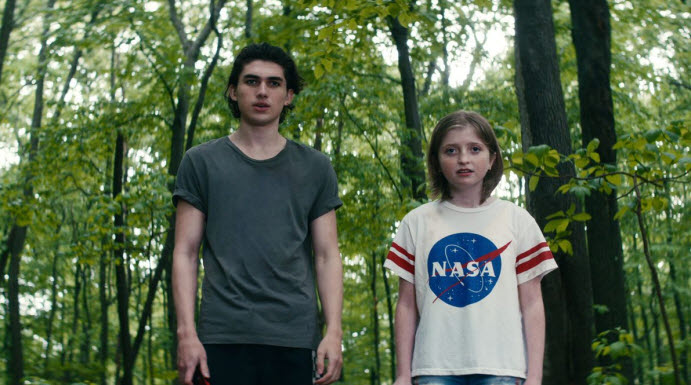
At the beginning, the movie quickly establishes the daily life of a 12-year-old girl named Georgie (Lola Campbell). Because her single mother recently died due to some terminal illness, Georgie has lived alone in their little residence for a while, but, as reflected by her plucky response to a certain familiar saying appearing right before the opening scene, she has been pretty all right with living all by herself, and we get some amusement as how she does that. Besides routinely checking on her current stage of grief, she always cleans her residence everyday, and she also often earns a bit from stealing bicycles outside while often absent in her elementary school. In case of those social workers assigned to her, she lied to them that she has living with an uncle (His name is one of many little funny things in the film, by the way), and she certainly makes sure that this deception of hers works.

The only person who knows what Georgie has been doing is Ali (Alin Uzun), one of the neighborhood boys who has been Georgie’s best friend. He does not even tell anything to his single mother mainly because Georgie’s residence can be a little private place where he and Georgie can freely spend time together. He simply lies to her mother that he and Georgie will be fine with her uncle, and his mother becomes more interested in meeting her uncle someday.

On one day, there comes an unexpected change into Georgie’s daily life. A lad suddenly comes into the backyard of her residence, and, what do you know, this lad turns out to be her father who left her and her mother several years ago. Because she does not remember her father a lot, Georgie does not trust or like Jason (Harris Dickinson) much from the beginning, but he is determined to stay in her residence as long as he wants, and Georgie has no choice because he may expose her ongoing lie to those social workers.

What follows next is how Georgie and Jason gradually accept each other more than before. Although he looks more like a big brother instead of a good father, Jason tries his best for taking care of Georgie, though that is the last thing she wants from him now. He willingly presents himself as someone to take care of her instead of her uncle, and he also gives a bit of advice to her when she happens to clash with Ali at one point.

Meanwhile, the movie comes to pay more attention to the emotional status of Georgie, who is not as fine as she looks on the surface just like many other people struggling with personal grief. There is a room where she can be totally alone, and what is inside that room reflects more about how much she has struggled with her immense loss caused by her mother’s death.

Despite the remaining gap between him and Georgie, Jason tries his best for making things better for her, and we get a series of sweet moments as they tentatively approach closer to each other. Besides teaching her a little on how to steal a bicycle more efficiently, he tells a bit about his past with her mother, and there is a humorous scene where he and Georgie try a little conversation play at a local train station.

Without resorting to any cheap sentimentality, the screenplay by director/writer Charlotte Regan, who made a feature film debut here after making several short films, sticks to its low-key tone while occasionally throwing some offbeat touches to enjoy. The situation surrounding its main characters is sometimes explained by a number of minor supporting characters looking and talking directly into the camera, and I also like a couple of nice humorous moments involved with those little spiders in Georgie’s residence, though they will surely make a friend of mine wince a lot due to his arachnophobia.

Above all, the movie is held together well by its two lead performers. Young newcomer Lola Campbell is superb in her unadorned natural acting balanced well between innocence and shrewdness, and Regan also did a fabulous job of drawing solid supporting performances from a group of other young performers including Alin Uzun. On the opposite, Harris Dickinson, who has been a new talented actor to watch since I came across his breakout performance in Eliza Hittman’s “Beach Rats” (2017), ably supports his young co-star without never overshadowing her at all, and he is also quite convincing as his character comes to show more care and affection along the story. Although he is absent in a certain key scene around the end of the story, we can feel his character’s sincerity as we observe Georgie’s response to a certain stuff left by his character, and that is the main reason why the ending is so poignant to say the least.

In conclusion, “Scrapper”, which won the Grand Jury Prize for the World Cinema Dramatic Competition when it was shown at the Sundance Film Festival early in this year, is a small but precious gem to cherish thanks to Regan’s skillful handling of story and characters as well as the excellent works by Campbell and Dickinson. It is exactly what you can expect from the story premise, but it handles the story and characters much better than you may think, and I assure you that you will find it quite touching in the end.

Posted in Movies | Tagged , | 1 Comment

Kim’s Video (2023) ☆☆1/2 (2.5/4): Searching for Kim’s Video

The main subject of documentary film “Kim’s Video” is certainly something which will draw any serious movie fan’s attention. As a guy who spent a lot of time in a number of local video rental stores in my hometown when he was young and wild, I observed the story of one certain video rental store in New York City with some interest and fascination, but I must say that I was a bit disappointed to see that the documentary itself does not have enough depth to engage me.

During the early part of the documentary, co-director David Redmon, who also produced and edited the documentary along with his co-director Ashley Sabin in addition to handling its cinematography, reminisces about how movies have been a big part of his life since his childhood years in Texas during the 1980s. Once he got fascinated with movies, he devoured one movie after another just like I did during my childhood and adolescent years, and that eventually took him to New York City later.

While living in the Brooklyn region, Redmon came to learn about Kim’s Video, which was a motherload of various types of movies to be enjoyed by many different movie fans ranging from the Coen Brothers to Alex Ross Perry. Established by a young South Korean immigrant named Yong-man Kim, who was incidentally once an amateur filmmaker, this huge video rental shop had thousands of VHS copies of various types of films, and we see a bit of how Kim and his employees tried to collect many different films inside and outside US as much as possible. As a matter of fact, they did not hesitate at all to commit copyright infringement in the name of love toward movies, and there is a little amusing episode involved with Jean-Luc Godard’s “Histoire(s) du cinéma” (1988).

Kim’s video rental business flourished during the 1980-90s as a part of the counterculture of New York City, but then its period was quickly over things began to change around the 1990s. As the era of digital medium began, VHS video tapes became less appealing even to hardcore movie fans, and, above all, what Kim’s Video had passionately done for years was slowly moving into the Internet. In the end, Kim decided to shut down his beloved video rental shop in the early 2000s, and its location becomes quite different now as shown from the opening scene of the documentary.

At least, Kim tried to save what he and his employees had passionately collected for years, and that was how the history of Kim’s Video got a stranger-than-fiction epilogue. Kim searched for any facility or institution which would willingly store all those VHS copies belonging to him, and, he eventually decided to hand them to a little city located in Sicily, Italia just because it looked like the city officials were eager to make his collection as a popular sight for tourists to come in addition to storing it with care.

However, when Redmon and his few crew members came to that city in 2017, it did not take much time for them to sense something fishy. To their surprise, Kim’s collection had been forgotten for years even though it arrived in the city with lots of fuzz in 2009, and the facility storing Kim’s collection had virtually been abandoned without much care or attention, though a security alarm was activated not long after Redman and his crew members sneaked into the facility at one point.

Redmon certainly tries to find out how Kim’s collection has been abandoned for years, and that is where the story becomes a bit weirder with a bit of the sense of danger. The transfer of Kim’s collection to that Sicilian city was involved with an untrustworthy local politician who may be connected with, surprise, the local Mafia organization, and this seedy politician certainly did not tell anything much to Redmon no matter how much he tried. Redmon got some information from several other local interviewees including one old prosecutor, but the mystery surrounding Kim’s collection remained elusive while becoming a little riskier than before – especially when one of the interviewees suddenly died not long after his interview with Redmon.

Of course, Redmon later approached to Kim, and they eventually met while Kim was attending some unspecified business meeting in South Korea, but Kim did not clarify the situation much to Redmon. Even at the end of the documentary, Kim remains as a rather vague figure even though he and his video rental shop are supposed to be the center of the story, and I wonder whether Redmon and his crew were quite limited from the beginning in case of getting to know more about Kim and his business. 

During its last act, the documentary moves onto a little heist project planned by Redmon and several accomplices of his for saving Kim’s collection. This looks amusing at first, but I became more aware of the self-conscious attitude of the documentary, and I was also often distracted by Redmon’s frequent utilization of many different clips from a number of various films. He is indeed a big movie fan, and I understand that well as a fellow movie fan, but you may become annoyed like I did as he keeps comparing his journey experiences to a bunch of films such as “Blue Velvet” (1986) and “Goodfellas” (1990).   

Overall, “Kim’s Video” may be worthwhile to check out if you have ever heard about its main subject, but the result is sometimes frustrating mainly due to its uneven and shallow narrative. Although the odd epilogue of the history of Kim’s Video is certainly interesting, the documentary could focus on who Kim really was or how much Kim’s Video meant to its employees and customers out there, and, in my inconsequential opinion, that would bring more depth to what happened to Kim’s collection in the end. Yes, it is surely driven by the love and passion toward movies, but, as many of you know, making a good and solid documentary needs more than that.

Posted in Movies | Tagged , , , | Leave a comment

The Wonderful Story of Henry Sugar (2023) ☆☆☆1/2(3.5/4): Wes Anderson Meets Roald Dahl Again

Wes Anderson’s short film “The Wonderful Story of Henry Sugar”, which was premiered at the Venice International Film Festival early in this month and then was released on Netflix on this Wednesday as the first of a four-part series of shorts adapted from Roald Dahl’s short stories, is a little but undeniably charming piece of work which will surely delight any fan of Anderson’s films out there. While this is another typically mannered work of his, Anderson, who previously adapted Dahl’s children book “Fantastic Mr. Fox” for his 2009 stop-motion animation feature film, fills the film with an ample of amount of wit and style as expected, and it is certainly the terrific starting point for the rest of the series to come after it (“The Swan” and “The Ratcatcher” are already released while “Poison” will come tomorrow, by the way).

Like Anderson’s recent works such as “The Grand Budapest Hotel” (2014) and “The French Dispatch” (2021), the film is rather complex in its overall narrative structure. At first, we are introduced to Dahl played by Ralph Fiennes, and then the movie delves into the story of a British dude named Henry Sugar (Benedict Cumberbatch), which is incidentally associated with an unbelievable tale involved with an old Indian guy who happened to develop an uncanny ability to see things without using his eyes at all.

If you are not so familiar with Dahl’s original short story, I will simply let you delighted by how the story of the film effortlessly hops from one point to another – and how Anderson and his crew members including his longtime cinematographer Robert Yeoman superbly handle the mood and details on the screen. As usual, Yeoman’s camera observes the characters and backgrounds from distantly static positions, and the scene composition is as precise and meticulous as you can expect from Anderson, but Anderson and Yeoman sometimes break away from their usual mode deliberately. For example, when that old Indian Man, played by Ben Kingsley, demonstrates his special ability in front of the two doctors played by Dev Patel and Richard Ayoade, the camera quickly follows after Kingsley’s character at one point, and the result is dramatically effective while never disrupting the detached overall mood of the film.

Via Kingsley’s character, the mood becomes as colorful as Anderon’s previous film “The Darjeeling Limited” (2007). As Kingsley’s character enters a remote jungle area where a certain great yogi guru has lived alone, the film ably shuffles several different backgrounds for our delight and entertainment, and what is eventually exchanged between Kingsley’s character and that yogi guru character is another amusing moment for us.

The film engages us more as Cumberbatch’s titular character later tries to test himself after accidentally encountering a written record left by Patel’s doctor character. Because he is an affluent guy who does not have much to do in his comfortable daily life, Sugar is eager to focus on developing any potential inside him, and, what do you know, his little experiment turns out to be much more successful than he imagined.

The last act of the film is initially fun to watch as Sugar tests himself with more confidence, but then there comes Dahl’s usual last-minute twist. Sugar is surely excited about his newly regained ability at first, but, not so surprisingly, he becomes rather depressed about his remarkable success, and that reminds me of the ironic dilemma inside being the master of the universe. If you can correctly know and predict everything in the universe, that may be pretty awesome to you for a while, but then you may also be dreadfully crushed by the absolute absence of uncertainty in everything including your death.

While sharply recognizing the absurd irony of Sugar’s circumstance, the film pulls out a surprisingly sweet final moment which will grow on your mind after it is over, and that reminds me again of how many of Anderson’s best works have considerable emotional qualities behind their dryly detached attitude. Although I was not totally enthusiastic when I watched his latest feature film “Asteroid City” (2023) a few months ago, I still could sense the melancholic feelings lingering around the screen, and that is the main reason why I admire it to some degree even though I still do not think it is one of his better works.

Anderson assembles a much fewer number of performers here than before, but it is evident that he still has lots of fun with handling them as his usual deadpan dolls to play in front of the camera. While Benedict Cumberbatch demonstrates a more humorous side of his intense talent, Ralph Fiennes and Ben Kingsley are constantly compelling even though they are demanded to deliver their lines as flatly as possible just like many of Wes Anderson movie performers. In case of Dev Patel and Richard Ayoade, they also find each own source of humor just like their fellow main cast members, and I sincerely hope that they will work for Anderson again someday.

As I said before, I initially regarded Anderson’s films as a sort of acquired taste, but I gradually changed my opinion as getting more accustomed to his films, and he has been one of my favorite filmmakers during last several years. “The Wonderful Story of Henry Sugar” is surely a quintessential Wes Anderson film, but it also shows Anderson trying something different in his usual artistic territory, and I am glad to report here that he accomplishes as much as intended while impressing us again.

Posted in Movies | Tagged , | 1 Comment

Cobweb (2023) ☆☆☆(3/4): One crazy filmmaking day

South Korean film “Cobweb”, which finally arrived in South Korean movie theaters yesterday after being shown at the Cannes Film Festival early in this year, is about one crazy filmmaking day to watch. Although it stumbles from time to time besides being a bit too long, the movie delivers a fair share of entertainment on the whole, and you may appreciate it more if you are familiar with the South Korean films during the 1960-70s.

Set in South Korea in the early 1970s, the movie opens with the artistic dream of a prominent filmmaker named Kim Yeol (Song Kang-ho). Kim has been making his latest work, and he and his cast and crew members are almost at the end of their shooting period, but Kim comes upon a seemingly brilliant idea about his new film, which is incidentally titled, yes, “Cobweb”. Inspired by that dream of his, he decides to change the finale a bit, and it looks like all he and his cast and crew members will have to do is working for two more days before the following post-production process.

However, not so surprisingly, things do not go that well for our filmmaker hero right from the start. His production team members manage to have all the cast members come to the big studio building of their production company, and his technical crew members quickly prepare for this sudden shooting, but the president of the production company, who is incidentally the wife of a famous director who was Kim’s mentor before his untimely death, is not so willing to allow that for understandable reasons. Kim’s revised screenplay must be checked by those government censorship officials first, but Kim is already determined to ignore this routine procedure while being so occupied with his artistic vision, and he naturally comes to clash a lot with the president before the president eventually leaves for Japan.

In contrast, the president’s niece, Mi-do (Jeon Yeo-been), is willing to help and support Kim as much as possible as a fervent admirer of Kim’s movies. Once her aunt is gone, she actively pushes the cast and crew members into the shooting as Kim wants, and everything seems to be going fairly well for everyone including Kim as the camera begins to roll on the set.

Of course, the situation gradually becomes messy and chaotic in one way or another. For instance, Kim’s lead actor seems to be very close to one of the actresses of the movie, and that becomes more evident to everyone else around them, no matter how much they try to hide that from others. They and the other cast members often express their confusion and frustration with Kim’s revised finale, but Kim simply pushes them forward after belatedly coming to realize that he must finish the shooting before the end of the day. In addition, there also comes a grouchy censorship official later, and we get an absurd moment from Mi-do’s hasty attempt to hold this official at one spot while Kim and his crew and cast members are hastily working in the other spots inside the studio.

The main pleasure of the movie comes from how Kim’s artistic vision randomly bounces along the story. At first, he thought that he and his crew members will just need to shoot a few big scenes, but they come to shoot much more than he originally planned, and this certainly frustrates not only his crew members but also the cast members of the film. At one point in the middle of the story, he has no choice but to play a certain minor supporting character for himself, and what follows next is a hilarious moment of narcissistic acting to amuse you.

After the chaotic spirit of its first half, the screenplay by Shin Yeon-shick, who also directed a fair share of films including “The Fair Love” (2010) and “The Russian Novel” (2013), comes to lose some of its comic momentum during the second half as the situation becomes more serious and daunting for Kim and others around him. While he is still determined to make a masterpiece to remember, he is still blocked here and there as before, and he also comes to face the fact that he should make a bit of compromise for protecting his artistic vision.

Kim’s movie in the story occasionally functions a pastiche of the South Korean filmmaking during the 1960-70s as demanded, and director Kim Jee-won and his crew members including Oscar-nominated editor Yang Jin-mo and cinematographer Kim Ji-young surely have a field day as recreating the recognizable qualities of those old South Korean film of the 1960-70s. I am sure that this aspect of the film will be appreciated more by the audiences of older generations including my parents, and I really want to know how my parents will respond to a number of key filmmaking moments in the film.

While Song Kang-ho, who has been the ever-dependable stalwart of South Korean Cinema during last three decades, diligently holds the center with another fine performance of his, several other performers in the film leave some impression even though many of supporting characters in the story remain on the level of broad caricatures. While Jeon Yeo-been steals the show with her character’s irrepressible enthusiasm, Im Soo-jung, Oh Jung-se, and Krystal Jung have each own moment to shine, and I also enjoyed the brief cameo appearance by Jung Woo-sung, who previously worked with Song in Kim’s previous film “The Good, the Bad, and the Weird” (2008).

On the whole, “Cobweb” is not entirely without flaws, and I still wonder whether it can be improved more via cutting around 20 minutes, but it is at least more entertaining compared to the glaring failure of Kim’s recent film “Illang: The Wolf Brigade” (2018). It certainly does not reach to the greatness of Federico Fellini’s “8 1/2” (1963) or François Truffaut’s “Day for Night” (1973), but it has some goodies to be savored including Song’s entertaining acting, and I will not deny that I chuckled more than once at last night.

Posted in Movies | Tagged , , , | Leave a comment

Dr. Cheon and Lost Talisman (2023) ☆☆1/2(2.5/4): Your average TV pilot

South Korean film “Dr. Cheon and Lost Talisman” is a curious case of how a sub-standard piece of work can be redeemed at times by the compelling presence of its engaging lead actor. Whenever the camera looks at him, he is somehow always entertaining and interesting to watch, and it is a shame that the movie itself is more or less than your average TV pilot instead of being, uh, cinematic.

Gang Dong-won, who has been one of the most prominent star actors in South Korean cinema since “Jeon Woo-chi: The Taoist Wizard” (2009) and “Secret Reunion” (2010), plays Dr. Cheon, who is supposedly a fake shaman but turns out to be more resourceful and gifted than expected. During the opening part hilariously featuring the two main cast members from “Parasite” (2019), Dr. Cheon and his technical assistant Inbae (Lee Dong-hwi) visit a rich family who seems to be in the need of some exorcism, and Dr. Cheon and Inbae skillfully handle the situation even though their plan does not go that well at the last minute. Yes, they are surely conning this wealthy family, but Dr. Cheon does not have much qualm on that because, well, he simply gives them what they want – and he is pretty good at sensing and then providing whatever his clients want.

Not long after they finish their latest job, Dr. Cheon and Inbae are approached by a young woman named Yoo-kyung (Esom). Dr. Cheon is not so eager to take her case because she looks too serious to handle for him, but then he quickly changes his mind once he sees a big bag of cash she brings to him, so he and Inbae soon follow her as she leads them to a little rural village where she has resided with her younger sister.

Right from their arrival in the village, Dr. Cheon senses something weird and suspicious, and his suspicion is confirmed when he subsequently confronts what Yoo-kyung has been struggling with in her house. She believes that her younger sister is possessed by some bad spirit, and she also thinks she can see spirits and ghosts. Dr. Cheon is skeptical at first, but, what do you know, he soon comes to realize that what he is handling is not a merely troubling domestic problem at all, and that is when he becomes much more serious than before. As a matter of fact, he is actually from a family of shamans, and his father, who has incidentally been dead for years, was one of the most powerful ones in the country.

Through an old associate of Dr. Cheon, we get to know about what happened to Dr. Cheon when he was young. There was a mighty evil figure quite hungry for more power and influence just like Harry Potter’s arch-nemesis, and this figure in question eventually targeted Dr. Cheon’s father as a part of his diabolical plan. Although Dr. Cheon’s father could stop his opponent before he died, his opponent, who has been imprisoned for years by an almost unbreakable talisman made by Dr. Cheon’s father, is now planning to escape, and he is targeting Yoo-kyung for snatching her psychic ability, which happens to be crucial for his escape.

The story eventually revolves around Dr. Cheon and several other main characters’ bumpy quest for locating where the two divided parts of that talisman are as well as where that powerful evil figure in question is lurking. While he remains imprisoned in his secret lair, this evil dude can exert some strong psychic power from the distance while being assisted by a group of disciples, and there is a spooky action scene later in the story where Dr. Cheon and Yoo-kyung have to deal with one possessed attacker after another.

In the meantime, the movie shows some sense of humor from time to time. Although its special effects mostly look cheap and silly on the whole, the performers in the film play as straight as possible even when surrounded by a lot of rudimentary CGIs on the screen. I was particularly amused by how they mostly look serious during one goofy scene involved with a certain shaman who may actually help their urgent mission, and I also like when the movie goes all the way for flashier special effects in the middle of the climax sequence.

However, the movie does not have enough space for character development, and many of its main characters feel rather underdeveloped on the whole. In case of the main villain of the story, he surely looks as scary and gruesome as required, and Huh Joon-ho did a fairly good job on that, but he is still no more than the villain of the week while his disciples do not have much personality beyond their evil appearance.

Anyway, Gang steadily holds the center with his engaging performance which becomes sort of endearing along the story with his character’s cool and detached attitude, and I am actually interested in watching whatever he will do next in the possible sequels to come. While she is sometimes limited by her thankless supporting character, Esom is effective as Gang’s counterpart, and Lee Dong-hwi, Kim Jong-soo, and Park Jeong-min are also fun to watch in their respective comic supporting roles.

Overall, “Dr. Cheon and Lost Talisman”, directed by Kim Seong-sik, is merely the opening chapter for its franchise (It is based on Fresh and Kim Hong-tae’s popular webtoon “Possessed”, by the way). At least, it is mildly watchable mainly thanks to the good efforts from Kang and several other main cast members. and, considering the positive reactions from many audiences around me I observed yesterday, it may succeed enough in the local box office to produce the following sequels. Seriously, I really hope that I will be more entertained in the next time.

Posted in Movies | Tagged , , | Leave a comment

Road to Boston (2023) ☆☆(2/4): Running with tedious nationalism

South Korean film “Road to Boston” is so shamelessly corny and old-fashioned that I cringed a lot more than once while watching it yesterday. Here is a dramatic real-life story which is surely worthwhile to tell for good reasons, but the movie unfortunately soaks this interesting story in heavy-handed melodrama coupled with blatant nationalism, and it actually feels pretty boring and tedious despite being less than 2 hours.

At first, the movie shows us the historical injustice involved with a Korean marathoner named Sohn Kee-chung (Ha Jung-woo), who has been regarded as one of the legendary Korean athletes in the 20th century since he won the marathon race at the 1936 Berlin Summer Olympics. As many of you know, Korea was occupied by Japan at that time, so Sohn had to wear the Japanese flag on his uniform all the time as officially being a Japanese runner, and a little gesture of defiance at the time of his monumental glory could almost finish his athletic career later.

After 11 years later, Korea and its people are now free, and Sohn has been openly respected as a national hero in Seoul, but he feels rather bitter and sour while being retired for a while. Right after Japan left Korea after the end of the World War II in 1945, Korea was divided in half by US and the Soviet Union, and Sohn still cannot bring his family from the north side as this division becomes more solidified day by day.

On one day, Sohn is approached by Nam Sung-yong (Bae Seong-woo), a friend/colleague of his who incidentally finished third at the 1936 Berlin Summer Olympics marathon race. Nam has been training a bunch of lads who may become as good as him and Sohn someday, and Nam suggests that Sohn should coach these lads for the upcoming Boston International Marathon, which is incidentally the first international marathon race to be held after the World War II. Sohn is not so eager to accept this proposal of his colleague, but, of course, he eventually agrees to be back in action because somebody must succeed his invaluable legacy.

One of these lads under Sohn’s coaching is Suh Yun-bok (Im Si-wan). As shown from his first scene in the film, he has already shown his considerable potential as a long-distance runner, but Sohn does not like Suh that much just because he thinks Suh is too cocky and willful. In case of Suh, he surely wants to be a marathoner as good as Sohn, but he must do a number of menial jobs first for taking care of his sick mother, so Nam has to provide a bit of unofficial help for persuading Suh to join the team.

What follows next will not surprise you much if you are a seasoned moviegoer like me. Yes, Sohn surely gives Suh and others hell for reminding them that they really should train themselves hard for representing their country. Yes, Suh and Sohn certainly come to conflict a lot with each other, but then they come to recognize and respect each other. Yes, the movie definitely overuses its loud and sentimental score whenever Sohn galvanizes Suh and other trainees including Nam, who volunteers to run again even though he is a bit too old considering his current age.

We might not mind these and many other clichéd stuffs at all if director/writer Kang Je-gyu, who has been known for his two successful films “Shiri” (1999) and “Taegukgi” (2004), paid more attention to storytelling and characterization. His screenplay is frequently riddled with bad dialogues and clumsily nationalistic speeches, and the movie also often hurries itself too much without any engaging character development. While its three main characters feel rather flat and quotidian, many of supporting characters around them are more or less than broad caricatures, and this glaring flaw is particularly evident from several perfunctory female roles in the film.

During its last act involved with the Boston International Marathon, the movie underwhelms us more with its mediocre presentation of what is supposed to be a dramatic race to excite and touch us. It merely hops from one point to another without any real sense of narrative momentum, and we are only distracted more due to its many crummy aspects including the overbearing score which constantly forces more sentimentality and nationalism upon us. Furthermore, it is quite evident that Kang and his crew members did not shoot this part in Boston (They did it at several locations in Australia instead, by the way), and I cannot possibly give any good excuse if the movie is roasted by the members of the Boston Society of Film Critics for the sheer lack of authentic mood and details.

The main cast members of the film diligently try, but they are ultimately limited or wasted by their superficial roles. While Ha Jung-woo is merely required to raise his voice from time to time, Im Si-wan does not leave much impression despite his committed efforts, and Bae Seong-woo and Kim Sang-ho manage to acquit themselves fairly well despite mostly being demanded to function as the comic relief element of the story.

In conclusion, “Road to Boston” is another disappointing mainstream South Korean film of this year. When the movie was over, I was already ready to run to some other South Korean released on the same day, and that surely says a lot about its utterly exasperating failure. In my humble opinion, these three real-life figures are indeed remarkable athletes to remember, but, folks, they deserve much better than this crappy flop.

Posted in Movies | Tagged , , , , , | 1 Comment

Cassandro (2023) ☆☆☆(3/4): Meet Cassandro

“Cassandro”, which was released on Amazon Prime in last week, is less flamboyant while also being more earnest than expected. Based on the real-life story of a gay American-born Mexican luchador (professional wrestler), the movie sensitively focuses on its characters as paying some attention to those wrestling matches at times, and I enjoyed its down-to-earth qualities enough to overlook its rather glaring weak aspects.

Set in the early 1980s, the movie tells the tale of Saúl Armendáriz (Gael García Bernal), a young Mexican American gay man who works as a mechanic in El Paso, Texas while occasionally crossing the Mexico-US border to participate in lucha libre wrestling matches held in Ciudad Juárez, Mexico. During the opening sequence, we see how he prepares himself as “El Topo” before entering the ring, and we also get to know about a bit about how a wrestling match is set and then played before its audiences.

Because he has been rather bored and tired with being “defeated” by those more famous wrestlers, Saúl is willing to hone his skill and style more, and that is how he begins his modest training under a female trainer named Sabrina (Roberta Colindrez). As he becomes more confident day by day, he considers playing an exótico, an unmasked wrestler in drag, but he has a different idea about how to play his role. Usually, exóticos are expected to lose on the ring for making their opponents look better, but Saúl wants to win in his matches, and Sabrina is willing to help him as much as she can.

However, we do not get your average training montage sequence because, well, as many of you know, the outcomes of those wrestling matches are always determined from the very beginning. When Sabrina tries to persuade a promoter to end the match with Saúl as the winner, the promoter is not particularly interested at first, but then he changes his mind later as watching how much the audience gradually become enthusiastic about Saúl, who incidentally presents himself as “Cassandro”. As observing how Saúl wins his audiences’ enthusiasm along the match, I came to have more understanding of how some of those popular WWE wrestlers could transfer their success in the ring to the screen. After all, besides all those wrestling skills to wield, they have styles and personalities to draw and engage audiences as entertainers, and I guess that is the key to the success of Dwayne Johnson or David Bautista in Hollywood.

Once he finds his own professional ground, Saúl soon finds himself becoming pretty popular in Mexico, and his mother Yocasta (Perla De La Rosa), who has always supported him a lot even after he came out of his closet when he was 15, is certainly excited about that. Although she was initially not so eager to watch her son’s matches because of her understandable concern, she eventually becomes one of his No.1 audiences just like Sabrina, and there is a little poignant moment when she firmly defends his son to one of those homophobic audiences around the ring.

While surely feeling hurt a lot by all those homophobic insults hurled at him during his matches, Saúl does not mind this much mainly because he has been focusing on how to get the recognition of his absent father. Although he left his son and Yocasta shortly after learning that his son is gay, Saúl still often reminisces about those happy childhood times when he and his father spent time together while watching the wrestling matches on TV, and he sincerely hopes that his father will watch him on TV at least.

Meanwhile, the movie also focuses a bit on Saúl’s romantic relationship with one of his fellow wrestlers, which is unfortunately the weakest part of the story. Right from when their eyes meet early in the film, they click with each other while not showing anything to others around them, and Saúl and Gerardo (Raúl Castillo) eventually begin a little affair of theirs although Gerardo is a married guy with several children. However, when Saúl later comes to learn that Gerardo will never leave his family at any chance, their romance ultimately fizzles without much fuzz, and Saúl’s attention is soon diverted to a young hunky drug dealer named Felipe (Benito Antonio Martínez Ocasio)

Despite this weak subplot, the movie continues to hold our attention via its unadorned realistic approach to the story and characters under the good direction of director/co-writer Roger Ross Williams, who won an Oscar for his short documentary film “Music by Prudence” (2010). Several wrestling matches in the film feel rather plain on the surface, but they are depicted with enough spirit and cheer in addition to functioning as a crucial part of the story.

Above all, Gael García Bernal, who has always been interesting to watch more than 20 years since Alejandro González Iñárritu’s “Amores perros” (2000) and Alfonso Cuarón’s “Y tu mamá también” (2001), diligently carries the film with his another good performance, and he is supported well by several fine supporting performers around him. While Roberta Colindrez and Perla De La Rosa are solid in their respective parts, Raúl Castillo brings some charm to his rather thankless role, and that makes a big contrast to the rather colorless acting of Benito Antonio Martínez Ocasio, a musician who is also known as “Bad Bunny”.

In conclusion, “Cassandro” could be improved more here and there in my inconsequential opinion, but it is still worthwhile to watch mainly due to Bernal’s commendable efforts on the screen. The movie is much milder than I imagined, but this little queer drama film engaged enough on the whole, so I will not be grouchy about its weak points for now.

Posted in Movies | Tagged , , , , | Leave a comment