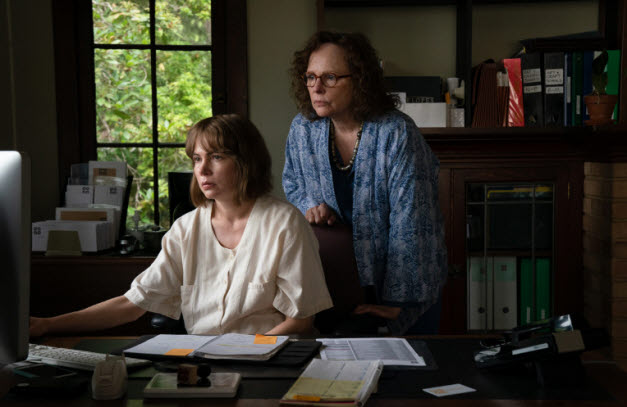
No One Will Save You (2023) ☆☆☆(3/4): Katilyn Dever carries the whole show

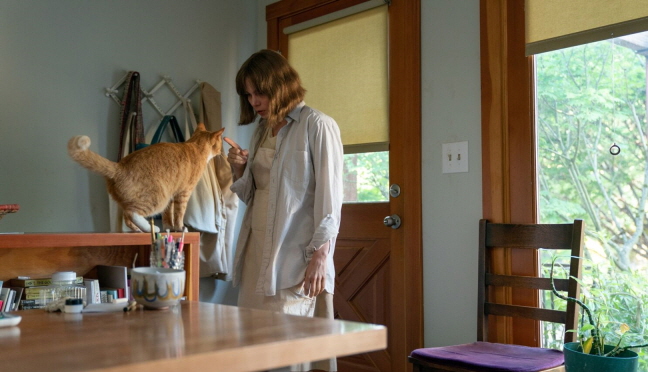
“No One Will Save You”, which is currently on Disney+ in South Korea, is a little horror film which depends a lot on its talented lead actress’ strong performance. Nearly wordless throughout the film, she deftly swings around several different emotional modes ranging from fear to despair, and her skillful acting firmly carries the film even during its rather shaky last act.

Katilyn Dever, a wonderful actress who has steadily impressed us since her harrowing supporting turn in Destin Daniel Cretton’s little but undeniably powerful independent drama “Short Term 12” (2013), plays a young girl named Brynn, and the opening part of the film succinctly establishes how isolated Brynn’s daily life is. She lives alone in a big cozy house located in the middle of a forest area, and she does not interact much with others even when she drops by a nearby village at one point early in the film. When she happens to notice two certain persons she seems to know, she only watches them from the distance while also hiding from their sight, and we gather that there is some disagreeable past between her and them.

Anyway, as she returns to her home later and is subsequently about to sleep at night, Brynn suddenly hears some strange sounds from somewhere inside the house, and that is where the movie starts to become more suspenseful. She carefully gets out of her upstairs bedroom, and then she sees something is moving in the downstairs kitchen. Naturally quite terrified, she tries not to make any unnecessary noise, but, of course…

Now I have to be a bit more discreet about describing the rest of the film, but now I sincerely suggest to you that you stop reading my inconsequential review if you have already become interested in watching it. Although its promotional poster does not hide at all what is exactly menacing its heroine, I think it is better for you not to know anything about that especially if you really want to enjoy the movie as much as possible.

After an intense moment of hide and sick between her and that mysterious entity, Brynn naturally tries to handle the situation as much she can, but, as you can already guess from the very title of the film, there is no one around her to help her while it also seems that there is no possible way to get away from her increasingly disturbing circumstance. Yes, she could just go to the police, but then she comes across the last persons she wants to face right now. Furthermore, as shown from one brief but frightening moment, it also looks like whatever is menacing her does not want her to leave the area at all.

Like many other terrified horror movie heroines, Brynn gradually comes to confront her personal demons as getting scared more and more along the story. It is eventually revealed later in the story that there was indeed some bad incident in her past, and we are not so surprised to see that the only line in the entire film comes from her old guilt associated with that incident.

Meanwhile, the movie keeps accumulating more suspense and terror around its heroine, and director/writer/co-producer Brian Duffield, who previously made a feature debut with “Spontaneous” (2020), and his crew members including cinematographer Aaron Morton have a field day with serving us one tense moment after another. There are several nice scary scenes to corner our heroine here and there, and I particularly like a chilling overhead shot showing a number of signs on the ground which clearly show us the overwhelming magnitude of her circumstance.

Despite getting frustrated or despaired again and again, Brynn somehow does not lose her will to survive and escape, and she comes to us an engaging character for whom we can root along the story. Although she does not say or express much on the surface except looking quite scared at times, Dever, who also participated in the production of the film as one of its executive producers, ably fills her archetype role with enough nuances and details, and her good performance diligently holds the whole show together from the beginning to the end.

In case of the main source of the menace against Brynn in the film, this story element is a fairly effective genre tool for generating enough horror and suspense to hold our attention, but I must tell you that it is also one of several weaker aspects of the movie. Although the special effects in the film are not bad at all on the whole, the movie actually works better whenever it simply focuses more on Dever’s terrified face while not showing anything else much on the screen. In addition, we never get to know anything about why Brynn and her surrounding environment were targeted from the beginning, and the movie does not explain that much even during the finale where our heroine fully confronts what has been terrifying her so much.

Overall, “No One Will Save You” did not really scare me a lot, but I enjoyed its little genre exercise in addition to appreciating Dever’s commendable efforts and the competent direction of Duffield, who is mostly known for writing the screenplays for several notable genre films such as “Love and Monsters” (2020) and “Underwater” (2020). Although it is not the scariest film of this fall, the movie achieves as much as well while generating enough thrill and entertainment, so I will not grumble for now.

Posted in Movies | Tagged | 1 Comment

The League (2023) ☆☆☆(3/4): Leagues of Their Own

Documentary film “The League” looks over the mostly overlooked history of the African American baseball leagues during the early 20th century. As a guy not so knowledgeable about its main subject except, yes, Jackie Robinson, I observed the documentary with constant fascination and interest, and I certainly came to learn a lot in the end as often entertained by its engaging presentation of the relatively unknown parts of the American sports history.

At first, the documentary details on how racial segregation was imposed upon the Major Leagues in US around the beginning of the 20th century. While African American baseball players were actually allowed to play with White players during the late 19th century, they were gradually pushed out from fields mainly due to racism, and that was just a tip of how racial segregation became more prevalent in the American society during the early 20th century.

While they were more discriminated in one way or another, many African Americans moved to the northern cities including New York City or Chicago, where they had less problem with racism and discrimination compared to many other parts of the country including those Southern states. As they formed their own communities in these northern cities, a number of various business activities followed, and baseball happened to be one of them because, well, African American people wanted to watch baseball games as much as White people.

At first, a bunch of independent African American baseball teams were established here and there, and then they eventually came to band together to form several regional leagues once the owners of teams including Reuben Foster saw the considerable business potential from that. Besides being a pretty good baseball player during his younger years, Foster was also quite a clever and charismatic figure who could easily persuade his competing baseball team owners, and he soon became the major driving force behind the regional league established by him and others.

And he and others surely had quite a success thanks to not only a number of exceptional players ranging from Josh Gibson to Satchell Paige but also thousands of African Americans eager to watch their favorite players. As a matter of fact, their Christian churches even stepped back a bit, and, considering how unflappable African American churches usually are, that says a lot about the growing popularity of baseball among African Americans at that time.

And those remarkable African baseball players during that period seldom disappointed their enthusiastic fans out there. As shown from a series of archival clips, they often dynamically and excitingly demonstrated a lot of their athletic skills in one way or another, and that makes an amusing contrast with the relatively dull sights from those White players of the Major Leagues during that time.

The final goal of Foster and other African American baseball team owners was to get recognized and then accepted by those influential White figures of the Major Leagues, but, not so surprisingly, racial discrimination still stood on their way as before. Judge Kenesaw Mountain Landis, who became the first Commissioner of Baseball in 1920 after handling the infamous Black Sox Scandal, adamantly refused to do anything about the racial desegregation of American baseball, and he kept sticking to his bigotry until his death in 1944.

Around the time of Judge Landis’ death, the situation looked more optimistic as both the American society and the Major Leagues could not ignore the social demands from African Americans anymore. Thanks to their considerable contribution to the World War II, African Americans were able to step forward more than before, and those White power players of the Major Leagues came to notice more of how much racial desegregation could benefit their business via those talented African American baseball players out there including, yes, Jackie Robinson.

Of course, the documentary delves a bit into how much Robinson had to struggle after being recruited by the Brooklyn Dodgers. While millions of African Americans surely had lots of expectation on him, there were also lots of White racists he had to face whenever he was on the field, and it was really fortunate that Robinson had all the right stuffs for enduring and then prevailing before eventually opening the door for his fellow African American players.

However, Robinson’s historical accomplishment turned out to be a double-edged blessing for the people of the African American baseball leagues. They all surely welcomed Robinson’s amazing success, but, as some of them already sensed, this also signified the end of their days of glory and success. Once the barrier was broken, many of those Major League teams including the Brooklyn Dodgers did not hesitate to snatch more and more of talented African American players, and this consequently led to the gradual demise of the African American baseball leagues within next few years.

In conclusion, “The League” amply and succinctly presents its fascinating historical subject despite its rather short running time (103 minutes), and director Sam Pollard, who previously directed a number of acclaimed documentaries including “MLK/FBI” (2020) and “Citizen Ashe” (2021), did a commendable job of handling the main subject with enough care and respect. I wish the documentary shows and tells more, and that is just a minor weak point, and I gladly recommend you to check it out someday.

Posted in Movies | Tagged , , , , , | Leave a comment

Citizen Ashe (2021) ☆☆☆(3/4): More than a good tennis player

Documentary film “Citizen Ashe” looks into the life and athletic career of Arthur Ashe (1943-1993), a talented tennis champion who has been known mainly for being the first African American to win the US Open in 1968. Although he was less prominent in case social activism compared to some of his contemporary African American athletes such as Muhammad Ali or Kareem Abdul-Jabbar, Ashe actually was quite more active than his mostly relatively mild public image suggested, and it is interesting to observe how he was changed in one way or other as going his way as usual.

The early part of the documentary focuses on how Ashe happened to find his athletic talent while growing up in his hometown Richmond, Virginia. In 1955, Ashe began playing tennis along with several other local boys under a local African American coach who really cared about encouraging them more for better life, and it did not take much time for Ashe to show more of his potential during next several years. When he eventually became a confident tennis player with a fairly good game record, he decided to move to Missouri for more freedom for his life as well as his burgeoning sports career, and then he got a full athletic scholarship at UCLA in California.

During his college years at UCLA during the early 1960s, Ashe came to distinguish himself more as a promising young college tennis player, but he did not have much hope about becoming a professional tennis player. After all, there were not many options for his future professional athletic career at that time, he actually considered joining the US Army for becoming an officer someday. In fact, he later joined the ROTC (Reserve Officers’ Training Corps), and he could have been sent to Vietnam if his brother, who was serving in the US Army at that time, had not chosen to do the second tour in Vietnam in exchange for keeping Ashe in US.

Thanks to his brother’s wise choice, Ashe continued to show more prominence in his athletic career while staying in US, and then he found himself at the right moment to boost his position further. As the Open Era began in 1968, both amateurs and professionals were allowed to compete together in the Grand Slam tournaments including the US Open, and that led to more career opportunities for promising young players like Ashe. He surprised everyone as winning the US Open at that time, and it did not take much time for him to become another famous African American athlete to notice.

Of course, as the American society was troubled more and more by racial tension during the late 1960s, Ashe was often asked to be more outspoken about racism and discrimination just like many other prominent African American athletes during that time, but he was rather reluctant for understandable reasons. As a man who was constantly scrutinized even at the beginning of his athletic career, he was more accustomed to being less provocative while holding himself as much as possible, and making any unnecessary noise was the last thing he wanted.

Because of his less active stance, Ashe was not regarded that well by some of prominent African American figures during that time, but he did care a lot about racism and discrimination nonetheless. He was surely supportive of Dr. Martin Luther King Jr. from the beginning, and, as shown from a number of TV interview clips, he actually did not hide his personal opinions on the racism and discrimination against African Americans at all. As a matter of fact, he also made an active public stance against the apartheid policy of the South African government when he was about to participate in a big tournament to be held in South Africa in 1973, and he surely left a big impression on the Black citizens of South Africa when he subsequently came there.  

Meanwhile, Ashe’s career reached to another peak when he won at the Wimbledon in 1975. During the final, he defeated his longtime opponent Jimmy Connors, and you will be amused a bit by how rude and arrogant Connors was in contrast to Ashe’s more much reserved attitude. While recognizing Connors as one of his toughest opponents, Ashe did not have anything good to say about Connors, and Connors even sued Ashe for libel.

Around the time when he played against John McEnroe in 1978, Ashe became more aware that his prime was being over, and his unexpected heart attack and the following surgery eventually put the end to his athletic career. Ironically, he subsequently became a new coach to handle McEnroe, and the documentary makes an interesting point on how their contrasting personalities somehow complemented each other despite lots of personal/professional clashes between them during next several years. McEnroe, who looks much milder compared to when he was young and wild, frankly talks about his tumultuous relationship with Ashe during that period, and that is certainly another amusing moment in the documentary.

Overall, “Citizen Ashe” is both engaging and informative in its respectful presentation of its human subject. Although I think it could pay a bit more attention to Ashe’s later years when he became all the more active for civil rights and social justice, directors Rex Millerv and Sam Pollard did a solid job of juggling various archival records and interview clips for giving us a vivid and interesting portrayal of one exceptional African American athlete, and you should definitely check it out especially if you do not know much about him like I did before watching it.

Posted in Movies | Tagged , , , , , , | Leave a comment

Gran Turismo (2023) ☆☆1/2(2.5/4): From a gamer to a professional racer

The story promise of “Gran Turismo” sounded quite preposterous to me when I heard about the film a few months ago, and it is a shame that its unbelievable true story is reduced into a bland conventional underdog sports drama story. Yes, it surely delivers fun and excitement to some degree, but it does not have enough energy and personality to distinguish itself, and my mind simply checked out its every clichéd moment one by one when I was watching it during an early Sunday morning screening.

The movie is based on the real-life story of Jann Mardenborough (Archie Madekwe), a young British lad who was initially a top-notch gamer of that famous racing simulation video game called Gran Turismo but then became a professional race car driver thanks to a rather outrageous training program promoted by Nissan. Yes, as reflected by what is shown in the film, Mardenborough and several other skilled gamers were really trained to become real professional race car drivers, and he and his colleagues actually showed some notable results at a number of prominent international competitions including the 24 Hours of Le Mans in France.

The early part of the film shows how that unorthodox training program for Mardenborough and other gamers was started by Danny Moore (Orlando Bloom), an ambitious marketing executive of Nissan. After succeeding in persuading his bosses in Tokyo, Japan, Moore quickly embarks on recruiting and selecting ideal gamers to be trained, but he also has to find someone good enough to teach and train them, but, not so surprisingly, nearly all of trainers on his list show no interest in his proposal. In the end, he approaches to someone at the bottom of the list, and that is Jack Salter (David Harbour), an American trainer who was once a prominent professional race car driver in the past. Just like many others, Salter shows understandable skepticism at first, but then he accepts Moore’s offer mainly because he cannot stand the arrogant attitude of a well-known professional race car driver for whom he has worked for a while.

Meanwhile, Mardenborough is excited to get a chance to become a real professional race car driver thanks to his prominent game scores, but his father is not so impressed to say the least. As a man who was once a promising professional soccer player but ends up being stuck with a menial job, his father understandably keeps saying that he should be more realistic about his life, but Mardenborough is still determined to do his best for entering the world of professional racing, and we subsequently see him and a group of other recruits beginning their training process under Salter’s supervision.

Right from their first day, Salter does not pull any punch on how much they will endure and compete, and they surely come to experience how much driving a real race car is different from playing their favorite video game. For example, they need to improve their physical strength a lot in one way or another, and they are also often reminded that there is always considerable risk and danger once they begin to drive fast along the racetrack.

It is not much of a spoiler to tell you that Mardenborough eventually distinguishes himself more and more despite being around the bottom of the rank at first, but the screenplay by Jason Hall and Zach Baylin does not bring much life and personality to its hero, and this serious flaw consequently undermines Archie Madekwe’s sincere efforts. Although he is not a bad actor as far as I can see, Madekew sometimes struggles with his character’s rather flat personality, and he also does not have much chemistry with Maeve Courtier-Lilley, who is unfortunately stuck with a perfunctory love interest role.

In case of several racing sequences in the film, they are fairly good on the whole, but director Neill Blomkamp and his crew members sadly resort to frantic camerawork and choppy editing a bit too much in my humble opinion. There are some thrill and excitement as expected, but we feel rather distant to whatever is happening across the screen, and we are not so involved much in what is being at stake for Mardenborough and several other characters including Salter.

At least, several main cast members in the film acquit themselves well despite their broad archetype supporting roles. Although he often chews his several big moments more than required, Orlando Bloom’s possibly intentional overacting makes an amusing contrast to the low-key no-nonsense attitude of David Harbour, who has been one of the most dependable character actors working in Hollywood since his breakout Emmy-nominated turn in Netflix TV series “Stranger Things”. Although he has to handle a bunch of clichéd moments along the story, Harbour delivers them with enough conviction, and he is the main reason why the movie works from time to time. In case of Djimon Hounsou, he does not have much thing to do besides looking stern as Mardenborough’s disapproving father, but I must point out that he does more acting here compared to when he appeared in a number of Marvel Cinematic Universe and DC Extended Universe flicks.

Overall, “Gran Turismo” is not as awful or ludicrous as I worried, but it is still not good enough for recommendation despite several enjoyable elements in the film, and I can think of several better alternatives right now. To be frank with you, I sometimes wonder whether I overrated James Mangold’s Oscar-winning film “Ford v Ferrari” (2019), but that thrilling movie, which is also based on a real-life story associated with professional racing, has enough spirit and personality to propel its familiar story and characters at least, and maybe you will have a better time if you watch that solid racing drama film instead.

Posted in Movies | Tagged , , , , | Leave a comment

The Eight Mountains (2022) ☆☆☆(3/4): A friendship among mountains

The best thing of “The Eight Mountains” is the cinematography by Ruben Impens, who gives some of the most stunning landscape shots I have ever seen during this year. Although I was a bit tired due to watching and then reviewing two films in row before watching the movie, my rather sleepy eyes were constantly fixated on what is so vividly and crisply captured by Impens’ camera from the beginning to the end, and that was a bit more than enough for compensating for the slow and elusive narrative flow of the film, which baffled and frustrated me from time to time.

Based on the Italian novel of the same name by Paolo Cognetti, the movie mainly revolves around a longtime friendship between its two different characters: Pietro (Luca Marinelli) and Bruno (Alessandro Borghi). In 1984, young Pietro’s parents happened to rent a little cottage in one small rural village in the middle of the Italian Alps area for spending some summertime away from a city where they and their son lived, and that was how young Pietro, played by Lupo Barbiero, befriended young Bruno, played by Lupo Barbiero. Mainly because Bruno was the only boy around Pietro’s age in the village, Pietro was encouraged to hang around with Bruno, and they quickly became each other’s best friend during their first summer.

Since that, Pietro and his parents continue to spend every summer in Bruno’s village, and he certainly often looks forward to that, and so does his father. He sometimes takes Pietro to those high mountains around the village, and Bruno also comes to join them later. At one point, they all climb up to one big and snowy mountain, and that is where Pietro unfortunately comes to have his first experience of mountain sickness.

Probably because he is their son’s best friend, Bruno’s parents come to care a lot about Bruno’s welfare and education, so they persuade Bruno’s uncle and aunt, who have incidentally taken care of Bruno due to his parents’ respective absence, to let Bruno live with them and their son. However, Pietro does not like this decision much because he thinks Bruno is happy enough in his village, and Bruno is not particularly enthusiastic about this change either.

Anyway, the situation is abruptly changed later because Bruno’s mostly absent father takes away Bruno from the village instead. Several years later, Pietro, who now becomes a teenager played by Andrea Palma, accidentally comes across Bruno, who also grows up a lot as being played by Francesco Palombelli. However, they simply and silently recognize each other from the distance, and that has been all for them during the next 15 years.

In the meantime, the movie also focuses on Pietro’s rebellious conflict with his father. He wants to be a writer, but his father does not approve much of that, and that eventually leads to several years of estrangement before his father’s untimely death. Quite saddened and devastated, Pietro returns to the village for getting to know his diseased father more, and Bruno gladly welcomes him while ready to show a little isolated place bought by Pietro’s father some years ago. He wants to build a cabin there as Pietro’s father always wanted, and Pietro willingly agrees to help his friend’s little personal project as much as possible.

It seems that there is indeed a strong bond between Bruno and Pietro, but the screenplay by Felix van Groeningen, a Belgian filmmaker who has mainly been known for his Oscar-nominated film “The Broken Circle Breakdown” (2012), and his co-director/co-writer/wife Charlotte Vandermeersch frequently regards Bruno and Pietro’s relationship from the distance without clarifying or illustrating their friendship that much on the whole. No, there is not any homosexual undertone around their private moments, and I appreciate that the movie simply wants to depict a plain male friendship with considerable sincerity and honesty, but the depiction of their relationship development in the film is often a little too dry and opaque for me. In fact, it is rather difficult for me to understand why Bruno is so special to Pietro, and the movie is all the more elusive about how Bruno exactly feels about his friendship with Pietro, because the story is mainly presented via Pietro’s viewpoint.

In the end, what ultimately remains on my mind is all those breathtaking landscape shots in the film, which is a very good reason for watching the movie in a big screening room. While being shot in the screen ratio of 1.33:1, the landscape shots in the film are often astounding to say the least, and I frequently found myself wondering more about how they actually shot these haunting visual moments. As a matter of fact, some of these moments look quite risky for the crew members as well as the performers, who surely took some safety measures during the shooting.

In conclusion, “The Eight Mountains”, which won the Jury Prize along with Jerzy Skolimowski’s “EO” (2022) when it was shown at the Cannes Film Festival early in last year, seems more interested in capturing the natural beauty of its main background than delving into its two main characters’ longtime relationship, and that made me constantly feel distant to the overall result even though I patiently follow the story and characters to the end. Mainly thanks to its top-notch visual quality, it was a mostly rewarding journey on the whole at least, but I think you should be aware of what it is about as well as how it is about in advance, so I recommend it with some reservation.

Posted in Movies | Tagged , , | 1 Comment

The Creator (2023) ☆☆☆1/2(3.5/4): A knockout SF film from Gareth Edwards

Gareth Edwards’ latest film “The Creator” intrigued me and then engaged me much more than expected, and that is quite an achievement. Yes, its story premise and ideas are quite familiar to say the least, but the movie handles its story, character, and background with a lot of curiosity, intelligence, and sincerity. As a matter of fact, its relatively quieter and smaller moments for building the characters and the futuristic world inhabited by them feel more important to me, though I also really appreciate the considerable skills and efforts put into those expected epic moments in the film.

At the beginning, the movie succinctly establishes its futuristic alternative world where artificial intelligence (AI) technology has been developed much faster than ours. At first, the humanity embraced AI with fascination and enthusiasm, but US and most of western countries became quite hostile to a certain disastrous incident which wiped out the downtown area of LA. This eventually led to the beginning of a long battle between the US Army and the New Asia, where many AI robots such as androids called “Simulants” want to live freely and peacefully along with humans.

When we are introduced to an American soldier named Joshua (John David Washington, who has gradually emerged as a distinguished actor even though occasionally channeling his father Denzel Washington in terms of his voice tone), he has been secretly trying to track down a certain mysterious figure known as the creator/savior to many AI robots out there, but, alas, his undercover operation subsequently gets botched with another personal loss in his life. Five years later, he is approached by the two figures from the US Army, and they have a mission to be accepted by him. There is a powerful secret weapon developed by that mysterious figure associated with AI robots, and they need Joshua to locate and then destroy that weapon. Although he is not so reluctant at first, Joshua eventually agrees to accept the mission mainly because he wants to meet again someone who was very important to him in the past.

That person in question a young woman named Maya (Gemma Chan), and a number of brief flashback moments show us more of how much she and Joshua loved each other around the time of his undercover operation. He approached to her as a part of his undercover operation, but he found himself caring about her much more than expected. Although her character is another typical case of a tragic female figure hovering over the hero’s mind, Chan fills her rather conventional character with enough warmth and presence at least, and she and Washington are believable in their few intimate moments in the film.

Anyway, Joshua soon goes to a certain remote spot in the New Asia along with a bunch of soldiers led by a tough commander played by Allison Janney, and he and other soldiers subsequently invade a secret facility where that secret weapon is supposed to be stored. When a certain big bunker inside the facility is opened, Joshua encounters that secret weapon, and, what do you know, it turns out to be a little AI robot girl. When it seems that this little AI robot girl has some information about Maya, Joshua decides to focus more on his personal business instead of the mission, and he and the little AI robot girl consequently find themselves chased by not only the US Army but also the local authorities of the New Asia.

Rather than hurrying the story and characters, the screenplay by Gareth and his co-writer Chris Weitz takes its time for developing the characters and their futuristic world more. While Joshua’s strained relationship with that little AI robot girl, who is casually nicknamed “Alfie” at one point, is handled with enough care and sensitivity, the movie also pays a lot of attention to building up its futuristic background with lots of style and details to be appreciated. For example, several urban locations in the film will definitely take you back to Ridley Scott’s classic SF film “Blade Runner” (1982), and it is not surprising that many of AI robot characters in the movie poignantly feel more human than most of human characters in the film besides Joshua and Maya. Cinematographers Greig Fraser, who recently won an Oscar for Denis Villneuve’s “Dune” (2021), and Oren Soffer did a stunning job of vividly presenting many different landscapes on the screen, and the production design by James Clyne is simply superb as constantly providing awe and wonder which deserve to be savored at big screening room.

In case of several action sequences in the film, they are presented with enough dramatic impact accompanied with an aching sense of horror and tragedy. The US Army in the movie incidentally has a gigantic battleship floating above the Earth for attacking any base of AI robots in the New Asia, and how it mercilessly attacks will probably remind you of how horrific and devastating the attacks of the Death Star felt in Gareth’s previous film “Rogue One: A Star Wars Story” (2016). At one point later in the story, the movie just watches the destruction of a base from the distance, but it still feels quite devastating to us nonetheless, and the South Asian landscapes in the film being invaded the US Army will also evoke the Vietnam War at times.

Above all, we actually come to care about Alfie and the journey she takes along with Joshua, and young performer Madeleine Yuna Voyles does a lot more than holding her place well among Washington and the other notable main cast members including Ralph Ineson, Veronica Ngo, and Ken Watanabe. Like Alicia Vikander’s AI robot character in Alex Garland’s little SF masterpiece “Ex Machina” (2014), Voyles brings uncanny qualities to her AI robot character, and, though you may not be surprised by her hidden origin or her special abilities, it is touching to observe her “emotional” growth along the story. In my skeptical viewpoint, AI and the humanity will regard each other forever over the gap which may never be filled for good reasons, but isn’t it nice to imagine that AI entities can learn and acquire the best qualities of the humanity?

In conclusion, “The Creator” a knoukout Hollywood blockbuster film which actually cares about amazing and attracting us with ideas and visuals, and Edwards demonstrates again that he is one of the most dependable genre filmmakers out there. Since his admirable first feature film “Monsters” (2010), he has steadily advanced with “Godzilla” (2014) and “Rogue One: A Star Wars Story”, and now here comes his best work to date. Even though I was rather dissatisfied with the screening condition of a sneak preview I attended with many others, the movie really captivated and excited me, and I will certainly soon watch it again under a better screening condition.

Posted in Movies | Tagged , , , | 1 Comment

Flora and Son (2023) ☆☆1/2(2.5/4): As she learns music

John Carney’s new musical film “Flora and Son” tries to do two different things together, and the result is rather uneven in my inconsequential opinion. On one hand, we have an engaging drama about one accidental online relationship between two very different characters, and that works mainly thanks to the good chemistry between its two main cast members. On the other hand, we also have a dysfunctional family drama revolving around the heroine of the movie, but this part is unfortunately often distracting while never getting mixed that well into the overall story.

Eve Hewson, an Irish actress who has steadily advanced during last several years since her supporting role in Paolo Sorrentino’s “This Must Be the Place” (2011), plays Flora, a single divorced mother living with her adolescent son in Dublin, Ireland. The opening scene of the movie shows Flora having another wild night at a local nightclub, and it does not take much time for us to gather that she has not been a very good mother to her son. As a matter of fact, her son, Max (Orén Kinlan), does not like being around her, and he prefers to stay in her ex-husband Ian (Jack Reynor) just because his father is less meddlesome in comparison.  

Anyway, Flora still tries a bit for being a good mother to her son, and she has earned their living via babysitting, though she is not exactly a model babysitter as reflected by one brief moment early in the film. When she happens to spot an abandoned guitar on one day, she does not hesitate to take it and then get it fixed for giving it to Max as his birthday present. After all, Max has been interested in music, and Flora sincerely wants to encourage him just like her ex-husband, who was once a promising musician before eventually giving up his career later.

However, Max does not give much damn about his birthday present, mainly because he is more interested in electronic music. Quite angry and frustrated about this, Flora subsequently decides to learn a bit about playing guitar, and that is followed by the amusing montage sequence showing her checking out a series of guitar lesson YouTube clips one by one. While not so impressed by many of these YouTube clips, she happens to notice Jeff (Joseph Gordon-Levitt), a young but retired musician living in LA. Although his online lesson fee is not that cheap, Flora contacts with him anyway, and they soon come to have the first online lesson between them.

While their first online lesson does not end up that well mainly due to Flora’s rather inappropriate behavior driven by several glasses of wine, Flora sincerely apologizes to Jeff later, and Flora finds herself learning more and more from Jeff as she continues the online lesson with him during next several weeks. He may not be a good musician, but he is a fairly good teacher at least, and he makes her more interested and passionate about music than before.

As they become closer to each other despite the long distance between them, Flora shows more of herself to Jeff, and Jeff also comes to show more of himself to her while steadily being tactful with Flora’s playfully flirtatious attitude. He presents a little song written by him some time ago, and, though she is still a novice in terms of musical talent, Flora sees the considerable possibility in his song. While his song is not that good, she feels that it can be improved here and there, and Jeff certainly appreciates her feedback as gradually finding his old passion rejuvenated thanks to her.

This part of the story works mainly thanks to the effortless interactions between Hewson and her co-star. Although his performance is often confined in the monitor of Flora’s laptop, Joseph Gordon-Levitt flawlessly interacts with his co-start throughout their several key scenes, and that is the main reason why we do not have any problem with Flora frequently imagining Jeff being right next to her during their online lessons.

However, the subplot about Flora’s troubled relationship with her son is relatively less engaging due to several plot contrivances. Despite Orén Kinlan’s earnest efforts, Max is not developed as well as Flora or Jeff, and his relationship with Flora often fluctuates between two opposite ends a little too jarringly. When Max lets Flora participate in his little musical project, things seem to get better for both of them, but then the plot throws another conflict between them later in the story, and the following resolution feels contrived instead of being organically developed from the story. In addition, Jack Reynor, who was incidentally terrific in Carney’s previous film “Sing Street” (2016), does not have much to do as being stuck in his thankless supporting role, though he and Hewson has a little naughty scene showing how their characters still care about each other their estranged relationship.

In conclusion, “Flora and Son” is not so satisfying compared to Carney’s several previous films including “Once” (2007), which is incidentally his best work to date. Sure, it does not disappoint us in case of serving its big musical finale as expected, and the original songs by Carney and his co-composer Gary Clark are mostly solid, but I still think the movie could be more improved in terms of story and characters. Anyway, I will not stop you from watching it, but I would rather recommend you to watch “Once” or “Sing Street” first if you have not seen either of them yet, and you may thank me for that later.

Posted in Movies | Tagged , , | Leave a comment

Hatching (2022) ☆☆1/2(2.5/4): Her issues get hatched…

It is difficult not to be impressed by the offbeat qualities of Finnish horror film “Hatching”. Besides several memorably gruesome moments of body horror to be admired for the considerable skills and efforts behind them, the movie mostly works mainly because of its increasingly unnerving mood coupled with interesting subjects including dysfunctional mother and daughter relationship, and that is enough for compensating its several notable weak aspects.

The movie opens with the banally wholesome introduction of a young girl named Tinja (Siiri Solalinna) and her suburban family by her mother, who is incidentally your average social media influencer. Inside their glaringly artificial domestic environment filled with lots of shiny and glassy stuffs, Tinja’s mother cheerfully presents her and her family in front of her smartphone, and her husband and their children go along with that without much complaint – until a crow suddenly enters their home and then spoils everything as flying to here and there inside their house.

Anyway, Tinja manages to catch this bird in the end. When she gives it to her mother, her mother snaps its neck without any hesitation to the little shock of Tinja, and then she tells her daughter to take the dead bird to a trashcan outside their house. During the following night, Tinja wakes up to have a rather horrific experience involved with that dead bird outside the house, and then she takes a little egg to her house after noticing it at the spot.

Of course, it turns out that this egg is not just a normal bird egg at all. As Tinja takes care of it in her bedroom, it grows much bigger than before, and there eventually comes the moment of, yes, hatching. While quite surprised by what comes out of the egg, Tinja decides to take care of this supposedly avian creature, and she even names it “Alli”.

After that narrative point, the screenplay by Ilja Rautsi alternates between Tinja’s handling of this creature and her increasingly exasperating relationship with her mother. For boosting her online image further, Tinja’s mother wants her daughter to excel herself more at the following gymnastics competition, and that certainly pressures Tinja a lot – especially when a nice girl who recently moved in the house right next to Tinja’s turns out to be a serious competitor for Tinja.

Tinja gets some consolation from taking care of Alli as much as possible, but it also seems that her negative feelings seem to be channeling into Alli. As time goes by, Alli resembles Tinja more and more, and Tinja and Alli even form a sort of psychic link between them. Whenever Tinja gets asleep, Alli is driven by all the anger and frustration repressed inside Tinja, and the following consequences are not so pretty to say the least.

When Tinja comes to realize what is going on, she is naturally quite horrified, but she also becomes very conflicted about how she should handle her situation. When she and her mother happen to spend several days at the house of her mother’s lover, Alli naturally follows her as expected, and Tinja is nervous about what may happen to her mother’s lover, who turns out to be a pretty nice and considerate guy.

In the meantime, the movie keeps serving us a series of disturbing moments, some of which will make you wince for good reasons. I cringed as watching how Tinja feeds Alli like its mother bird, and I was also unnerved a lot by when Tinja must make a choice immediately due to the next horrible thing to be committed by Alli in the middle of what may be a very important moment for her and her mother.

Around that narrative point, the movie stumbles more than once as struggling to balance itself between the two problematic relationships at the center of the story. In addition, many of other characters in the story besides Tinja and her mother are not particularly developed well, and Tinja’s father and son are almost non-existent even during the climactic part where Tinja and her mother somehow come to stick together in front of their little domestic problem.

Nevertheless, the movie remains fairy engaging thanks to director Hanna Bergholm’s competent direction. She and her crew members including did a skillful job of maintaining the eerie ambience on the screen from the beginning to the end, and the special mention goes to the crew members of the special effects and make-up department. Although the production budget of the film is modest, the overall result is pretty impressive on the screen, and young performer Siiri Solalinna is convincing as ably going back and forth between her two roles later in the movie. On the other hand, Sophia Heikkilä is utterly uncompromising in depicting all the toxic sides of Tinja’s mother, and it is a shame that the movie does not delve further into the dysfunctional relationship between her character and Tinja.

“Hatching” is incidentally Bergholm’s first feature film, and she demonstrates here that she is a good filmmaker who knows how to attract and then engage us. Sure, the movie is not entirely without flaws, but it is still a solid genre film packed with a number of strong points, and it will be interesting to see what may come next from her in the future.

Posted in Movies | Tagged , , | Leave a comment

The Blue Caftan (2023) ☆☆☆(3/4): A quiet triangle at one caftan store

“The Blue Caftan”, which was selected as the Moroccan submission to Best International Film Oscar in last year, is about three good people who happen to find themselves facing their matters of heart in one way or another in their little world of tradition and craftmanship. Just like they carefully handle those lovely clothes in the film, the movie subtly and sensitively handles their hidden emotions below the surface, and it is often poignant to see how they try their best to deal with their tricky personal circumstance.

Saleh Bakri, a Palestinian actor who was one of the supporting characters in “The Band’s Visit” (2007), plays Halim, a middle-aged guy who has run a caftan store along with his wife Mina (Lubna Azabal, who was unforgettable in Oscar-nominated film “Incendies” (2010)) in Salé, Morocco. Although things have been not so good for their business as handmade caftans become less popular, Halim and Mina keep going nonetheless, and we come to see more of how much he has depended on his wife while he mostly focuses on making those beautiful caftans in his workplace behind the counter.

And then there comes a little change via a handsome young man named Youssef (Ayoub Missioui), who happens to be hired as a new apprentice of the shop. Although both Halim and Mina do not much expect much from him because they have seen so many other lads merely come and then go, Youssef somehow feels different to Halim, and Halim cannot help but become more conscious of Youssef as mentoring him day by day.

Not so surprisingly, it is gradually revealed that Halim is a gay man who has been hiding his sexuality for many years behind his stoic and reserved appearance. The movie often shows him visiting a local bathhouse where he can have a quick hookup in a private place, and we also see how Mina has accepted her husband’s closeted status just because she really loves him despite their incompatibility. Although they have been more like business partners/roommates instead of real spouses, Halim appreciates Mina’s affection and devotion nonetheless, and that is the main reason why Mina has been content with her rather barren married life.

As a woman who has known and understood her husband well, Mina soon comes to sense what has been going on between her husband and Youssef. At one point, she has been rather hostile to Youssef due to a little matter involved with a supposedly missing roll of fabric, and that certainly adds more tension among her and the two men in the store.

However, as already shown to us earlier in the film, Mina has been quite ill, and there eventually comes a point where she must stay at her home as her illness gets worsen hopelessly. After being told that there is nothing he can do for her except standing by her to the approaching end, Halim does not hesitate to stop working for a while, even though he has been working on a certain expensive caftan for some snotty customer.

The mood surely becomes a little more melodramatic, but the screenplay by director Maryam Touzani, who previously made a feature film debut with “Adam” (2019), and her producer/co-writer Nabil Ayouch takes its time as usual while never losing its human dimensions. Throughout the film, we often observe more details on Halim’s craftmanship, and the movie is constantly filled with melancholic qualities as he is frequently reminded of how his old traditional craft has been overlooked and forgotten bit by bit. There are not many craftsmen like him out there, and there is a little bittersweet moment when he examines a very old caftan which still looks gorgeous but will probably be never made again.

Touzani also did a commendable job of immersing us into Halim and Mina’s little isolated world. Cinematographer Virgine Surdej’s camera usually sticks around the main characters and their respective viewpoints, and their surrounding environment is seldom opened up until the very last shot of the film, while we occasionally hear the sound of the nearby beach from the distance. As a result, we are reminded more that Halim and Mina have had only each other despite the emotional distance between them, and that is why it is so moving to see what Mina does for Halim later in the story.

The movie depends a lot on its three main cast members, who are all convincing in their respective roles. Quietly holding the center as required, Bakri slowly lets us to sense his character’s growing emotional conflict along the story, and he is especially terrific when Halim is barely holding his feelings when he could respond more to Youssef. On the opposite, Azabal is equally powerful as vividly illustrating Mina’s complex emotion, and she and Bakri effortlessly embody a long history between their characters. While Youssef is relatively less developed in comparison, Ayoub Missioui holds his own place well between Bakri and Azabal, and he is effective when his character come to show more care and sincerity than expected.

On the whole, “The Blue Caftan” is a slow and restrained drama of repressed feelings and thoughts, so it takes some time for you to get accustomed to its rather dry storytelling and leisurely narrative pacing. Nonetheless, this is still an engaging human story filled with not only empathy and compassion but also specific mood and details to be appreciated, and it will come to you as another interesting window to others different from you.

Posted in Movies | Tagged , , | 1 Comment

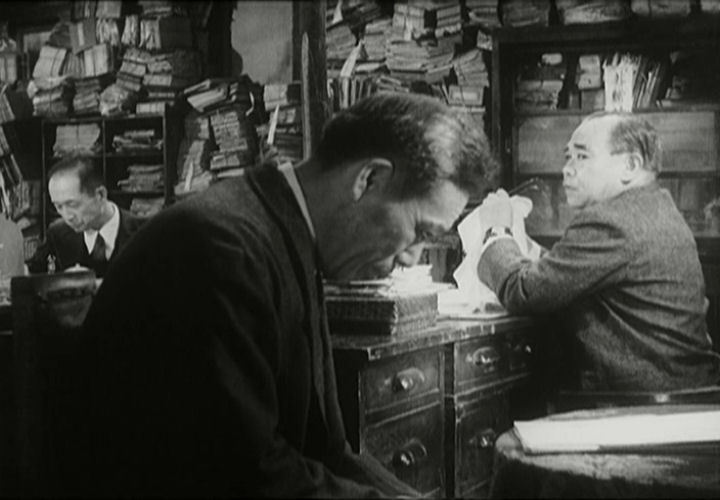
El Conde (2023) ☆☆☆1/2(3.5/4): Pinochet the Vampire

Pablo Larraín’s new film “El Conde”, which was released on Netflix in last week not long after it was shown at the Venice International Film Festival, is a horror black comedy which depicts a notorious real-life Chilean dictator as a 250-year-old vampire. This sounds like a mere one-joke premise on the surface, but the movie is willing to go for more gore and grotesqueness for its dark laugh and ridicule, and you will be often amused by how it makes acerbic points on evil and fascism under its austerely deadpan storytelling approach.

Mainly set in an unspecific remote and isolated rural area, the movie initially establishes how things have been depressing for Augusto Pinochet (Jaime Vadell) since he faked his death several years ago. There was a time when he has been quite thirsty for not only blood but also many different revolutions ranging from the French one in the late 18th century to the Russian one in early the 20th century, but, after becoming a powerful dictator in Chile, 1973, he found himself losing the will to live and suck blood more. As a matter of fact, the main reason of faking his death is that he simply wants to die quietly without having to answer for many of those crimes committed under his dictatorship.

As he has stopped ingesting human blood, Pinochet has become much more aged and fragile, but it seems that there is still a desire for blood and life somewhere inside him. At one point early in the film, a figure in full military attire surreptitiously flies to Santiago at one night, and we surely get a series of gruesome moments including the one showing a human heart vigorously ground in a blender (According to the English narrator of the movie, this particular human organ is a delicacy for vampires).

Naturally, the world outside Pinochet’s residence is shaken by this bloody killing, and that prompts his several human children to visit their vampire father, but, not so surprisingly, their father’s welfare is the last thing to concern them. Unabashedly greedy and opportunistic, they all want him to reveal any information involved with the family’s secret fortune gathered during their dictatorship era, but this turns out to be rather difficult due to Pinochet’s equally depraved wife and his longtime right-hand guy, who has incidentally served him for decades since the Russian revolution and surely enjoyed every brutal and sadistic moment of his during Pinochet’s dictatorship period.

Pinochet’s children try a little scheme to persuade their father, and that is why a young nun comes to Pinochet’s residence as a confidential accountant to sort out all those hidden assets of his. Although she is not a certified public accountant, this young nun turns out to be pretty good at what she is supposed to do on the surface, and Larraín and his co-writer Guillermo Calderón, who won the Screenplay award together at the Venice International Film Festival, have a lot of naughty fun as the young nun later corners Pinochet’s children in one way or another during her separate interviews with them.

Willingly quite oblivious to all those evil deeds committed under their father’s dictatorship, these dirty rotten people impertinently justify their ownership of those hidden assets, and so does Pinochet. Probably because of his unspeakable nature, he does not have much problem with being accused of lots of other crimes including torture and murder, but, ironically, he does not want at all to remembered as a scumbag who stole lots of assets from the country.

Meanwhile, the situation surrounding Pinochet becomes more absurd – especially when he somehow regains the lust for life and blood as being seduced by that young nun. Even though she does not hide much what she was ordered by her church from the very beginning, he cannot help but attracted more to her, and his wife, who has remained as a human as he has insisted for many years, is not so amused at all when it looks like her husband is eager to give the young nun the eternity of which she has been denied.

Around that narrative point, the movie springs up more darkness coupled with eerie surrealism, and the following scenes shine with a lot of twisted humor. Cinematographer Edward Lachman, who has been known for his frequent collaborations with Todd Haynes, provides a series of wonderful visual moments full of stark black-and-white beauty, and I particularly enjoyed when the young nun comes to experience a sort of liberating unholiness at one point later in the story. By the way, if you think the mostly offscreen narrator of the movie sounds rather familiar, you will not be surprised much when this figure in question finally makes an appearance in the last act, and this figure surely adds extra black humor to what has been so humorously built up along the story.

Although he drew my attention a lot with his compelling Oscar-nominated film “No” (2012), I found many of Larraín’s following works rather cold and distant despite also being compelling enough for recommendation in each own way. “El Conde”, which incidentally means “The Count” in Spanish, is no exception with its dryly cerebral handling of mood, story, and character, but it ultimately works well a sharply droll mix of horror and black comedy on the whole, and I found myself amused more than expected when I watched it at last night. In my humble opinion, this is one of Larraín’s more interesting works, and I wholeheartedly recommend you to give it a chance someday.

Posted in Movies | Tagged , , , , | 2 Comments