Fingernails (2023) ☆☆(2/4): Can true love be measured?

“Fingernails”, which was released on Apple TV+ on last Friday, starts with an intriguing story promise. What if being truly in love can be actually measured? What if the result of such a measurement is different form what one is feeling right now? Although exploring these and other story potentials for a while, the movie unfortunately straddles on without any clear direction before arriving at its fizzling anti-climactic ending, and that is a shame considering the solid efforts from its main cast members.

At first, the movie gradually establishes its supposedly futuristic setting, though nothing looks so fancy or cool in its mundane background. In this world, a machine which can actually test true love was developed a few years ago, and this has certainly affected numerous relationships out there. If the result is zero negative instead of being somewhere between 50 and 100%, that means the couple in question is not really in love with each other at all, and it is mentioned later in the story that more than 80% of the test results during the first several years showed negative (Imagine how many hearts were broken as a consequence).

Of course, there has also been the need for “strengthening” the test result, so there are a number of institutes for helping the couples in need. As shown in the film, the couples in need will go through a series of sessions for increasing the intimacy and affection in their relationship, and it seems this mostly works although it does not always guarantee the positive test result.

Anyway, Anna (Jessie Buckley) gets interested in being hired in one of such institutes mainly because she has not exactly been sure about whether she is really in love with her boyfriend Ryan (Jeremy Allen White). They already tested themselves before, and the result was pretty positive to say the least, but Anna cannot help but feel like being less in love with him than before. Sure, they have lived together as being comfortable with each other’s presence, but it seems to her that something has been gone missing between them, and that is why she wants to know more about how true love can be measured.

After meeting the supervisor of the institute, Anna is assigned with Amir (Riz Ahmed), a more experienced employee who actually devised several sessions for those couples coming to the institute. In case of one of those sessions, they will be placed in a movie theater, and then their love will be tested via a sudden emergency. After all, one is surely ready to sacrifice oneself for the other if one is truly in love with the other, right?

And we get to know about how true love is confirmed by that machine in the end. All a couple to be tested has to do is getting one of their respective fingernails to be pulled out as a sample to be tested, and that will surely make you wince even though the movie thankfully does not show much of this unpleasant process. Now I wonder whether anesthesia can be an option, but I guess that probably interferes with the measurement.

Stoically sticking to its dry and detached tone, the screenplay by director/co-producer Christos Nikou and his co-writers Sam Steiner and Stavros Raptis doles out one small absurd moment to another as Anna and Amir work on a bunch of new couples to be tested. At one point, the relationship strength of a couple is tested via one trying to locate the other only via the sense of smell, and it looks like this actually strengthen the trust and affection in their relationship, though they eventually become quite nervous just like any other couple when the time for their test comes.

Meanwhile, Anna finds herself gradually attracted to Amir. Although Amir seems to be happy and confident with some other woman, Anna’s eyes still cannot help but drawn more to him, and she begins to have more doubt on her current relationship with Ryan. After all, she did not tell him much about her new job from the beginning, and she becomes more aware of the emotional gap between them. As a matter of fact, they look more like roommates instead of lovers, no matter how much they are nice and affectionate to each other.

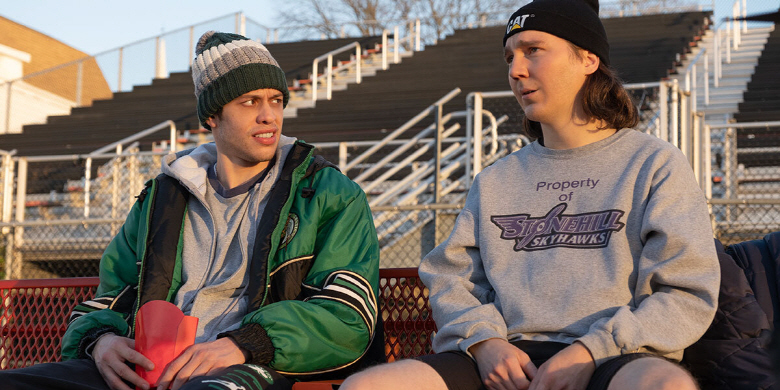
Of course, things become more complicated when it seems that Amir also has some feelings toward Anna, but the movie merely hangs on their romantic potential without much interest, and we become more aware of its rather thin narrative and shallow characterization. Jessie Buckley and Riz Ahmed are engaging as their characters tentatively revolve around each other with more mutual feelings, but the movie often hesitates to move them forward for more emotion and drama, and Buckley and Ahmed’s good performances are mostly under-utilized despite their solid low-key chemistry. In case of Jeremy Allen White and Luke Wilson, they are unfortunately limited by their thankless supporting roles, and White, who has been more prominent thanks to the acclaimed TV comedy series “The Bear”, is particularly wasted without having many things to do.

On the whole, “Fingernails” is often disappointing for not pushing its compelling story ideas enough, and we can only appreciate how much its talented main cast members try to make it work as much as possible. Compared to Nikou’s promising debut feature film “Apples” (2020), this is a major letdown, and I can only hope that he will soon move onto better things.

Posted in Movies | Tagged , | Leave a comment

Wingwomen (2023) ☆☆1/2(2.5/4): Ladies are simply having a fun…

French Netflix film “Wingwomen”, which came out a few days ago, is a flawed but enjoyable crime comedy simply having a fun with its three female main characters. Whenever they gather on the screen, the movie cheerfully coasts along the leisurely chemistry among them, and you may forgive a number of weak aspects in the film as occasionally amused by their comic interactions throughout the story.

At first, we are introduced to Carole (Mélanie Laurent) and Alex (Adèle Exarchopoulos), a female criminal duo who have been worked and lived together since they came across each other a long time ago. During the opening scene, they are finishing their latest heist job despite several setbacks including the deadly drones chasing after them, and the movie generates some wry laugh from how they smoothly handle their work while also casually bickering with each other to the end.

Nevertheless, Carole and Alex love and care a lot about each other as longtime friends/colleagues. When she is notified that she is pregnant, Carole begins to consider retirement more seriously than before, and Alex is also willing to retire along with her for having a less eventful life together, but, needless to say, that is the last thing wanted by their boss/mentor Marraine (Isabelle Adjani). When Marraine gives another heist job to handle, Carole naturally refuses at first, but then Marraine shows her old protégé how ruthless she can be for getting what she wants, and Carole has no choice but to accept that heist job while promised that it will be the last one to be done by her and Alex.

The target of that heist job in question is a certain valuable artwork currently being exhibited at a building located in Corsica, and what Alex and Carole will have to do looks pretty simple. First, they must steal the blueprint of that building, and then, after some preparation assisted by two local criminal figures, they will infiltrate into that building later. In addition, they will also be allowed to have a sort of private vacation there in the meantime thanks to the courtesy of their boss.

Because they happen to need one more person for their heist job, Carole and Alex approach to Sam (Manon Bresch), who will work as their getaway driver due to her considerable driving skill shown during her first scene in the film. As these three ladies spend some time together in Corsica, Alex and Carole gladly accept Sam as the new member of their team, and Sam is happy and excited to be around her two new friends/colleagues while becoming less guarded than before.

Even when these three ladies embark on their heist job later in the story, the movie maintains its loose narrative pacing as before, and the overall result leans more toward comedy and personality instead of thriller and suspense. Our three criminal ladies surely must be careful as much as possible during their risky work, but they are clearly having a ball with working together, and the movie subsequently adds extra absurdity when they are about to enter the final stage of their heist plan.

Although its main characters are mostly broad archetypes, the screenplay by Cédric Anger and Christophe Deslandes, which is based on the comic book of the same name by Jérôme Mulot, Florent Ruppert, and Bastien Vies, colorfully depicts their plucky personalities while throwing a few unexpected plot turns into the story. In case of one particular sex scene between Alex and one of the two aforementioned criminal figures, it tickles us when they come to try something kinky, and then it catches us off guard when the situation abruptly becomes quite risky with lots of shattered glass on the floor.

The movie comes to lose some of its narrative momentum during its last act, and the following ending is a blatant cop out to say the least, but it still works to some degree while its three main performers effortlessly click together as before. Mélanie Laurent, who also directed the film, and Adèle Exarchopoulos, who has steadily advanced since her breakout turn in “Blue is the Warmest Color” (2013), are certainly enjoying every juicy moment between them in the film, and Manon Bresch also holds her own place well between Laurent and Exarchopoulos as the third member of the group. In case of several supporting performers in the film, Philippe Katerine and Félix Moati have each own little fun as the two criminal associates of our three criminal ladies, and Isabelle Adjani, who somehow does not seem to be aged much even though it has been more than 45 years since her haunting Oscar-nominated performance in François Truffaut’s “The Story of Adele H.” (1975), is certainly another entertaining element in the film as playing her evil character with gusto.

Overall, “Wingwomen” is not good enough for recommendation in my trivial opinion, but it is not a total waste of time at all mainly because Laurent and her fellow cast members are apparently having a fun time together as reflected by a series of video clips shown during its end credits. Although it may look rather frivolous compared to her previous film “The Mad Women’s Ball” (2021), Laurent demonstrates here that she can be fairly good at lightweight stuffs just like she could competently handle the serious period drama of “The Mad Women’s Ball”, and I think she will continue to impress us as a good director just like she has done as a talented actress.

Posted in Movies | Tagged , , , | Leave a comment

Nyad (2023) ☆☆☆(3/4): As she tries again and again

Netflix film “Nyad”, which was released on last Friday, is a standard biopic based on one extraordinary real-life story. While it is often fascinating to observe how persistently its real-life heroine tries again and again, the movie later becomes rather repetitive to my little disappointment, and it is fortunate that it remains anchored well by the charismatic presence of its two ever-reliable lead actresses.

Annette Bening, who has been one of the most gracefully aged actresses in Hollywood during last two decades, plays Diana Nyad, an American long-distance swimmer who was once quite famous for her several notable swimming records during the 1970-80s as shown from a series of archival footage clips. Shortly after her disastrous attempt to swim from Havana, Cuba to Key West, Florida in 1978, Nyad retired from her professional swimming career, and we see how she has comfortably spent her retirement period along with her best friend Bonnie Stoll (Jodie Foster) in 2010, but then she cannot help but feel dissatisfied as reflecting more on whether she will just live like this for the rest of her life.

Eventually, Nyad decides to do swimming again. At first, it is simply a rather long exercise at a local swimming pool, but she became more confident as finding that she is still a fairly good swimmer with enough stamina despite being over 60, and that leads her to one very risky idea. She is going to try again on swimming from Havana to Key West just like she did many years ago, and Stoll agrees to help and support her as much as she can even though she has some skepticism about her best friend’s ambitious goal.

After checking out her current skill and ability as a long-distance swimmer in Mexico, Nyad becomes more determined to accomplish her goal, and Stoll recruits several good experts who will assist them. One of these people is a well-experienced navigator named John Bartlett (Rhys Ifans), and his first meeting with Nyad does not go that well to say the least, but he is eventually persuade to join the team by Stoll as discerning more of Nyad’s strong determination.

When Nyad and others subsequently come to Havana in 2011, things look promising at first, but, as Bartlett and Stoll already worried, there are many obstacles besides that long distance between Havana and Key West, which is more than 100 miles (160 km). The swimming route is often riddled with strong currents which will definitely test Nyad’s physical strength in one way or another, and there are also many other dangers including sharks and jellyfishes. In addition, she needs to be constantly monitored and supported by her crew members, who certainly should focus on her condition minute by minute just in case.

The screenplay by Julia Cox, which is based on Nyad’s autobiography “Find a Way”, has some fun with how Nyad and her crew members prepare for Nyad’s ambitious long-distance swimming step by step. For avoiding those sharks, she hires a couple of divers who have a special electronic equipment to repel sharks, and she also approaches to a jellyfish expert later in the story. At one point early in the film, she explains to a bunch of curious kids a bit about how arduous her long-distance swimming can be, and I must say that I was a little disappointed that the movie does not delve that much into a little but important matter involved with excrement.

When the story subsequently moves onto Nyad’s first attempt, directors Elizabeth Chai Vasarhelyi and Jimmy Chin, who previously won an Oscar for their documentary film “Free Solo” (2018), and their crew members including cinematographer Claudio Miranda do not disappoint us at all as filling the screen with a considerable amount of realism and verisimilitude as required. You can really feel how daring and exhausting Nyad’s attempt really is, and Benning is utterly convincing in her committed acting as her character strenuously copes with one obstacle after another before eventually failing to everyone’s disappointment.

Nevertheless, Nyad is not daunted at all as subsequently trying again and again, and that is where the movie becomes less interesting than before. As zealously trying more to achieve her goal, Nyad becomes rather distant to not only others around her but also us, so we come to observe her subsequent attempts from the distance. In case of a series of flashback scenes from her past, these scenes feel mostly perfunctory without much depth, and the movie only scratches the surface of Nyad’s adolescent sexual trauma associated with her swimming coach.

At least, the movie works whenever it focuses on the long and complex relationship between Nyad and Stoll, and Bening and her co-star Jodie Foster, whose wrinkled face is as natural as Bening’s, shine as their characters often push and pull each other throughout the film. While the other main cast members of the film are mostly stuck with their thin supporting roles, Rhys Ifans sometimes steals the show from Benning and Foster as their no-nonsense navigator, and he has a little touching scene when his character confides to Stoll on why he stands by Nyad as much as Stoll.

On the whole, “Nyad” could be more improved in several aspects, and you also may be bothered by its several historical inaccuracies, but it is mostly watchable thanks to not only its directors’ competent direction but also Bening and Foster’s solid performances. Despite being over 60 at present, these two great actresses do not lose any of their talent or presence yet, and I can only hope that they keep going for whatever may come next in their respective acting careers.

Posted in Movies | Tagged , , | 1 Comment

Green Night (2023) ☆☆1/2(2.5/4): Her manic pixie girl

“Green Night” is a little murky noir film which works best whenever it focuses on the wild and compelling relationship between its two very different main characters. Although I found myself quite frustrated with several vague aspects of its plot, I observed their relationship development with curiosity at least, and it is a bit shame that the movie does not push its story and characters more instead of throwing more disorientation and confusion onto the screen.

The movie, which is set in Seoul and its surrounding metropolitan area begins with a little naughty variation of Meet Cute moment between its two main characters. Jin Xia (Fan Bingbing) is a Chinese woman who has worked as an inspector in the port custom of Inchon not long after marrying some South Korean guy, and the opening scene shows her accidental encounter with a mysterious young green-haired South Korean woman. As Jin Xia scans her body, the young woman seems to be interested in drawing Jin Xia’s attention for no apparent reason as your average manic pixie girl, and Jin Xia subsequently finds herself followed by the young woman not long after the young woman makes a little fuss in front of Jin Xia due to a petty issue with her shoes.

Although she could simply say no to the young woman from the beginning, Jin Xia eventually lets the young woman into her little shabby apartment, where she has stayed away from her husband. He is apparently quite abusive to her as reflected by a few wounds on her face, and Jin Xia certainly wants to get away from her husband as soon as possible. However, she needs a considerable amount of money for being allowed to stay in South Korea after her divorce, and her husband keeps calling her to her annoyance.

While still not knowing what to do with the young woman, Jin Xia belatedly comes to realize that she gets herself into a big trouble because of the young woman, who, not so surprisingly, turns out to be a drug mule. Jin Xia promptly reports this to her direct supervisor, but, what do you know, it is subsequently revealed that her direct supervisor is also involved with a certain drug organization the young woman works for. When Jin Xia is quite at a loss, the young woman quickly offers a chance to earn lots of money right now, and Jin Xia agrees to accompany her even though being well aware of how risky that will be for both her and the young woman.

As they try to sell what the young woman has been carrying, the movie goes deep into the underworld hidden inside a local fishery market area. At one point, they approach to a certain drug dealer who looks like one of many fishmongers in the market, and the mood becomes tense as it turns out that this drug dealer is not someone they cannot mess with at any chance.

When the young woman later causes a big problem for both her and Jin Xia, Jin Xia has no choice but to call for some help from her husband, and we get to know a bit more about their abusive relationship as he lets his wife and the young woman into his residence. At first, he looks overly courteous to Jin Xia, but it does not take much time for him to reveal his monstrous side, and that leads to a big shocking moment of violence.

As a result, Jin Xia becomes more panic and desperate before while getting more stuck with the young woman. Maybe she could simply just go away from this problematic figure, but Jin Xia somehow finds herself gradually attracted to her. At one point, They happen to get a little place where they can be safe and alone for a while, and it soon turns out that the feeling is quite mutual between them, so they instantly let themselves driven by their burgeoning romantic passion. Fan Bingbing and her co-star Lee Joo Young are convincing as their good performances generate enough erotic heat on the screen, and then we get a little tender scene where their characters open themselves a bit more to each other.

However, the movie does not support its two lead performers’ solid efforts enough in my inconsequential opinion. The screenplay by Chinese filmmaker Han Shuai and her co-writer Lei Sheng does not clarify many things in the story as simply having its two main characters bounce from one narrative point to another, and that frequently distracted me during my viewing. As a crime noir drama, the story can surely be as confusing as allowed by its genre, but I think a bit of clarification or explanation could help us get engaged more in the story. In fact, you may find yourself scratching your head a bit on a number of ambiguous story elements just like I did after the movie was over.

Nevertheless, the movie is still interesting to some degree as a genre film made in South Korea by a Chinese filmmaker, and Han Shuai and her crew members including cinematographers Matthias Delvaux and Kim Hyun Seok did a competent job in case of technical aspects. The mood and details of the film are fairly authentic with considerable realism, and I could clearly discern that they did enough study and research before the shooting.

In conclusion, “Green Night” is not entirely satisfying, but it was not a waste of time at all for attempting to mix Chinese and Korean elements together. It does not reach to the level of Park Chan-wook’s recent film “Decision to Leave” (2022) in that aspect, but I will not deny that I was entertained to some degree. After all, Fan Bingbing driving a motorcycle on South Korean alleys and streets isn’t something I and South Korean audiences see everyday, is it?

Posted in Movies | Tagged , , | Leave a comment

Promise (2023) ☆☆☆(3/4): A boy missing his departed mother

South Korean documentary film “Promise” is a seemingly simple but undeniably poignant personal diary from a filmmaker father and his sensitive 9-year-old boy still missing his departed mother a lot. While wisely avoiding any cheap sentimentalism via its calm and restrained attitude, the documentary gradually reveals their quiet sadness and longing along its narrative, and the result often shines with sublime poetic beauty to be appreciated.

Since he lost his wife a few years ago, director/writer Min Byeong-hoon, who has been known for several acclaimed works such as “Pruning the Grapevine” (2006) and “Touch” (2012), has taken care of his little son Si-woo alone in their little residence located in Jeju Island, and the early part of the documentary shows us his mundane daily life with his son. As his father’s camera steadily follows after him, Si-woo looks as spirited as any kid around his age can, and you may smile as watching him cheerfully walking along the road to his elementary school.

However, as reflected by the opening part of the documentary, both Min and his little son have been haunted by the memories of his departed wife since her death. Si-woo sometimes cannot help but miss his departed mother at night, and his father tries his best for consoling his son, with the camera calmly and respectfully observing them from the distance. Although Min also surely misses his departed wife a lot, he knows too well that he must be someone to lean on for his son, so he usually keeps his feelings to himself as much as possible.

As the documentary often watches Min from the behind, we can only guess how much he has grieved. He sometimes works alone with his digital video camera in the middle of those wide landscapes of Jeju Island, and the somberly detached mood of these impressive shots convey to us a lot about whatever he has felt inside his grieving mind, even though neither he nor the documentary does not reveal much on the surface.

Meanwhile, Si-woo happened to write a little poem to express the longing for his departed mother, and that gives Min a little helpful idea for his son. As telling his son that his mother promised to meet her son in the heaven someday, Min suggests that Si-woo should write more poems as a sort of prayer to his mother and God, and Si-woo soon begins to write a number of poems one by one for expressing and processing more of his current feelings.

As Si-woo doles out one poem after another, we come to know and understand more of his emotional state – and how he gets more emotionally matured day by day. He is still sad whenever he thinks of his departed mother, but he also gets more accustomed to her absence, and he and his father become closer to each other as he gladly shares his poems with his father.

Min humbly allows his son’s poems to take the emotional center of the documentary, and many of these poems are accompanied with a number of stunning landscape shots to remember. Instead of merely functioning as visual backgrounds, these wonderful shots actually elevate Si-woo’s plain but sincere poems with more poignancy, and I particularly like one brief but impressive moment showing a vast field suddenly becoming quite snowy via a smooth transition of time.

Above all, we can also sense how Min and his son go through each own healing process via the passage of time. As they go through one season after another, their daily life becomes less melancholic, and there is a touchingly humorous moment from when they play a little card game together in one evening. When his birthday comes, we cannot help but notice that Si-woo looks more matured than before, and we all can agree that his departed mother would be proud of him if she were really watching from somewhere above our world.

Later in the documentary, Min takes his son to where his departed wife was buried. Their little but moving private moment is followed by a montage sequence mainly consisting of several different video clips played in backward, and this sequence beautifully summarizes Min and his son’s deep feelings toward his departed mother. Both Min and his son are well aware that they should move on no matter what, but they cannot help but miss their loved one nonetheless, and that is further emphasized by a certain little recorded moment from their past.

Overall, “Promise” is a solid personal piece of work which often shines with lots of thoughtful sensitivity, and many of its fabulous moments have grown up on me after I watched it in this afternoon. I must confess that my condition was not so good during the screening, but I did feel something special from the documentary despite that, and I guess I should revisit it sooner or later for more appreciation.

By the way, as shown from the documentary, Si-woo wrote more than 20 poems, and I came to learn later that Min actually published a collection of his son’s poems before the documentary was released in South Korean theaters a few days ago. To be frank with you, I am rather obtuse to poetry as an utterly straightforward guy who usually prefers prose more, but I guess I should check out that poem collection for feeling and understanding more of the emotional undercurrents of the documentary.

Posted in Movies | Tagged , , , , , , | Leave a comment

Sly (2023) ☆☆1/2(2.5/4): Sly on Stallone

Netflix documentary film “Sly”, which is released on this Friday, sometimes shows a bunch of fancy stuffs inside Sylvester Stallone’s house, and that tells a lot about how it is about his life and career. While Stallone, who is often called “Sly”, is sincere and engaging as talking about many things in his life and career, the documentary merely follows his words without much of new insight or perspective, and we are only left with some admiration on how he has managed to endure during last several decades while always remembered for his two iconic movie characters.

Stallone’s life story is certainly remarkable to say the least. The early part of the documentary focuses on how much he struggled during his early years, and he tells us a bit about his unhappy childhood years under his deeply flawed parents. After several problematic years during his early adulthood period, he eventually got interested in acting thanks to an acting teacher, and he soon moved to New York City for building up his career, though, just like many other young performers coming to New York City, he had to go through a very difficult time which would test his will and resilience in one way or another.

Anyway, Stallone was hungry enough to play any role for supporting himself. While he was often discontent with being usually cast as a young thug as shown in Woody Allen’s “Bananas” (1971), he kept trying nonetheless as appearing here and there in a number of films (No, he does not mention anything about that certain softcore porn film made in 1970, which was incidentally his second feature film according to IMDB), and then there came a little breakthrough moment via Martin Davidson and Stephen Verona’s “The Lords of Flatbush” (1974). Again, he played a young hoodlum, but this movie made him more confident about his acting, and that prompted him to move to Hollywood for more opportunities to grabbed by him.

Of course, things did not go well for him in Hollywood at first as he could not get any good part to interest him, but he decided to write screenplays for himself, and that was how he came to write the screenplay for “Rocky” (1976). At first, his titular character was heavily influenced by those young hoodlum characters in Martin Scorsese’s “Mean Streets” (1973), but he gradually fleshed out his titular character here and there, and he was all the more determined to play this character of his once he completed the screenplay at last. As a matter of fact, he could get paid quite a lot for not playing his character, but he remained adamant to the end, and that was the first forward step to his eventual stardom.

When “Rocky” became one of the most successful films of 1976 while also garnering three Oscars including the one for Best Picture, Stallone’s status was virtually skyrocketed to the top, but then he came to face the pressure and expectation from his huge stardom. He had to prove himself that he was another exciting American actor after Robert De Niro and Al Pacino, but his subsequent films such as “F.I.S.T.” (1978) were not so successful, and that made him go for “Rocky II” (1979) and several following sequels during next 10 years.

Meanwhile, he also came to play another iconic movie character in “First Blood” (1982), which was also followed by several sequels just like “Rocky”. Thanks to “First Blood” and the two sequels during the 1980s, Stallone became a huge action movie star of that decade, and Arnold Schwarzenegger, who was his main competitor during that period, makes a few amusing comments on how Stallone often kept advancing ahead of him.

To my little disappointment, the documentary does not go that deep into some of Stallone’s worst films during the 1980-90s. While we only get a brief glimpse on some promotional stuffs associated with “Rhinestone” (1984) and “Cobra” (1986), Stallone only shows some regret on his few attempts on comedy including “Stop! Or My Mom Will Shoot” (1992). He agreed to appear in that disastrous flop just because Schwarzenegger pretended to be interested at that time, and Schwarzenegger surely got the last laugh for that.

In the end, Stallone returned to his usual territory as shown from “Cliffhanger” (1993) and “Daylight” (1996) while also trying to demonstrate more of his acting talent in James Mangold’s “Cop Land” (1997), but he found himself less popular than before as entering the 21st century. Nevertheless, he did not give up at all as making “Rocky Balboa” (2006) and “Rambo” (2008), and then he moved onto “The Expendables” (2010), which led to another hit series of his after Rocky and Rambo (He does not talk anything about how forgettable the series has become these days, by the way).

On the whole, “Sly”, directed by Tom Zimny, only shows and tells as much as we know about him, and I think it could delve deeper into Stallone’s life and career. For example, the documentary could show more about his troubled relationship with his father, which was resolved to some degree when his father was about to die. In addition, I wish he could talk a bit about playing Rocky again in Ryan Coogler’s “Creed” (2015) and the following 2018 sequel, which were surely another peak in his acting career (He even received an Oscar nomination for the former, as many of you remember). At least, Stallone can still hold our attention as before, and I think he will go on as usual while ready for whatever will come during the rest of his ongoing life and career.

Posted in Movies | Tagged , , , | Leave a comment

Talk to Me (2022) ☆☆☆(3/4): Playing with possession

“Talk to Me” is a little but impressive Australian horror flick which handles its familiar horror materials better than expected. As a seasoned moviegoer, I surely knew what I would get from it from the very beginning, but I still could enjoy how it skillfully pushes its story and characters toward its expected ending, and the overall result is much more effective and enjoyable than “The Exorcise: Believer” (2023).

After the disturbing prologue scene presented via a nice long take shot, the movie quickly establishes the moody personal circumstance of an adolescent girl named Mia (Sophie Wilde). Since her mother’s unexpected death, she has been coping a lot with her following grief during last two years, and one particular shot succinctly conveys to us how she has been emotionally distant to her father despite his sincere efforts for reaching to her more.

Mia has actually leaned and depended more on her best friend Jade (Alexandra Jensen), and we soon see them going to a little evening gathering along with Jade’s younger brother Riley (Joe Bird) and Jade’s current boyfriend Daniel (Otis Dhanji). Daniel was incidentally Mia’s ex-boyfriend, but both Mia and Jade do not mind hanging around with Daniel together, and Daniel also does not feel that uncomfortable about being with them either.

Anyway, the main point of that little evening gathering attended by them and several other boys and girls in their neighborhood is a sort of amateur séance held by Hayley (Zoe Terakes) and Joss (Chris Alosio), who recently happened to acquire a certain mysterious object to be used for their evening event. On the surface, this object in question is just a a severed and embalmed hand, but Hayely and Joss eagerly tell others that this is actually a supernatural medium to the spirits of dead people out there. All one has to do is holding the severed hand in handsake position and then saying “Talk to me” for contacting with whatever one can summon, and, if one really wants to experience spiritual possession after that point, one should simply say “I let you in”.

Mia and many others are not so serious about this stuff at first, but, what do you know, the situation becomes quite serious for Mia once she holds the severed hand. She immediately sees a rather disturbing figure right in front of her, and then everyone is quite surprised (and entertained) after she says “I let you in” as expected.

As several others including Daniel subsequently go for each own experience of spiritual possession, Mia becomes less scared of the severed hand, and then she begins to wonder about how she can contact with her mother’s spirit via the severed hand. She does not know how to do that at all, but she is still tempted by that slight possibility nonetheless.

She and Jade later hold another gathering in Jade’s house, and then, what do you know, there comes a rather unlikely chance for Mia. She is certainly eager to talk more with her mother’s spirit, but, not so surprisingly, she soon comes to face the dire consequence of her unwise choice, which deeply affects not only her but also several others around her.

This is surely your typical cautionary horror tale, and directors Danny and Michael Philippou, who have mainly been known for their horror comedy YouTube channel RackaRacka, keep us engaged as gradually dialing up the level of suspense and dread along the plot. While the movie throws several genuinely spooky moments, the sense of doom begins to hover around Mia, and we come to fear more for what may happen next to her and some other main characters in the story.

In addition, the screenplay by David Philippou and Bill Hinzman, which was developed from the concept by Daley Pearson, takes its time for story and character development. Mia’s inner turmoil along the story is depicted with enough emotional details, and we come to understand how she lets herself driven into more despair and madness later in the film. Compared to Mia, the other main characters in the movie are under-developed in comparison, but they are also presented as believable human figures at least, and that is the main reason why several key scenes in the film feel not only just shocking but also quite devastating.

The main cast members of the movie are all solid in their convincing performance. While Sophie Wilde diligently holds the emotional center of the film, Alexandra Jensen and Joe Bird occupy each own place well around Wilde, and Otis Dhanji, Zoe Terakes, and Chirs Alosio are well-cast in their respective supporting parts. In case of Miranda Otto, whom you may remember for her substantial supporting turn in Peter Jackson’s The Lord of the Rings film series, she is mostly stuck with a rather thankless role, but she has her own little moment when her character happens to have a little private conversation with Mia at one point later in the story.

Overall, “Talk to Me” is a well-made genre piece to be appreciated for a number of good reasons, and it also demonstrates that Danny and Michael Philippou are competent filmmakers who really know how to interest and then engage audiences. They indeed made a promising start for their burgeoning filmmaking career, and it will be surely interesting to see what may come from them next.

Posted in Movies | Tagged , | 1 Comment

Silver Dollar Road (2023) ☆☆☆1/2(3.5/4): This is indeed their land

Documentary film “Silver Dollar Road”, which was released on Amazon Prime in a few weeks ago, tells the story of how one ordinary African American family has fought for their little precious land in South Carolina for many years. While it is often infuriating to see how much they have endured due to those greedy bastards out there, it is also touching to see how they have tried to stick to their family land as much as possible, and the documentary did a splendid job of presenting their interesting life story.

At first, the documentary introduces us to Gertrude Reels, an old African American woman who has been the matriarch of her family for several decades. She and many other family members of hers have lived on a piece of land located in a little county of South Carolina, which was acquired by one of their ancestors around the early 20th century. They are all certainly proud of how their family has kept their family land mostly intact despite many obstacles including, yes, racism, and the documentary shows us how much their lives have linked with their land in one way or another.

However, things have not been that good for them to say the least since the 1980s. As the surrounding areas were redeveloped step by step, the area owned by the Reels family drew more attention because of its considerable potential for redevelopment, and it was naturally targeted by a local association of land developers eager to covert the area into a lucrative resort spot. Because this change can lead to a much more land tax than before, the Reels family, who incidentally cannot afford to pay that much due to their rather poor economic condition, strongly objected to this change from the beginning, and that consequently led to the long and complicated legal dispute between them and those greedy land developers.

Gertrude and many other family members of hers were certainly determined to fight as much as they could, but their fight was uphill from the very start. For example, their opponent’s lawyers argued that the Reels family had no legal rights on the land at all, and the Reels family were mostly helpless while not getting much help from a series of lawyers hired by them. Only two of these lawyers of theirs are interviewed for the documentary, and one of the family members bitterly reminisces about how one local lawyer virtually swindled lots of money out of the family after giving a false promise to them.

The Reels family were disappointed or frustrated again and again during next several decades, but they had no choice but to keep fighting as usual, as reflected by the two prominent family members. Melvin Davis, one of Gertrude’s sons, has worked as a local fisherman for most of his whole life, and giving up his house and land is certainly the last thing he wants. In case of his brother Licurtis Reels, he cannot possibly imagine living outside his family land just like Melvin, and, above all, he strongly believes that it is his duty to keep the family land as long as he is alive.

And we see how much these two men suffered for protecting their family land. Melvin and Licurtis were sued for not leaving the land in the early 2010s, and to their family’s anger and frustration, they were eventually incarcerated for their ‘crime’ for no less than 7 years. As they respectively recollect how difficult it was for them during that gloomy period, the documentary presents broad but striking sketches depicting their many depressing experiences inside the county prison, and it is evident from them that both of them are still haunted by their despairing hopelessness during that time.

The documentary sharply points out the deep social roots of the systemic racism against not only the Reels Family but also many other local African American people. Snatching the lands from emancipated African American people by any means necessary was pretty common during the late 19th century, and this trend has been actually continued while insidiously disguised by the legal system biased against African American people.

Although the documentary, which is based on Lizzie Presser’s ProPublica/The New Yorker article “Kicked Off The Land”, lags a bit sometimes as juggling many different members of the Reels family, it is clear to us that director/writer Raoul Peck, who was initially asked to be one of the executive producers of the documentary but then decided to direct it after reading Presser’s reporting, cares a lot about his human subjects. While silently angry about their ongoing legal predicament which may end with their immense loss, the documentary also vividly captures their spirit and humanity, and their human moments will linger on your mind for a while after the documentary is over. The family bond among them is palpable especially during a cheerful family meeting shown around the end of the documentary, and you can clearly sense how they may prevail in the end as their pride and dignity are maintained generation by generation.

On the whole, “Silver Dollar Road”, whose title comes from the main road inside the land of the Reels family, is another interesting documentary from Peck, who was Oscar-nominated for his previous documentary “I Am Not Your Negro” (2016) and then gave us HBO miniseries “Exterminate All the Brutes” a few years ago. Although it feels a little milder compared to these two previous works of his, the documentary is often powerful as regarding its human subjects with compassion and empathy, and it is certainly one of the better documentaries of this year. This is indeed their land, and you will never forget them as well as their land.

Posted in Movies | Tagged , , , , | 1 Comment

The Boogeyman (2023) ☆☆1/2(2.5/4): Be afraid of darkness…

“The Boogeyman” did not scare or impress me much. I must confess that I was often afraid of sleeping in my dark bedroom at night when I was a little young boy, but the movie failed to touch upon my childhood fear and dread during that time, and I was mildly entertained from time to time by several fairly good moments without much care or attention to its predictable plot and superficial characters.

The story mainly revolves around a psychiatrist named Will Harper (Chris Messina) and his two daughters Sadie (Sophie Thatcher) and Sawyer (Vivien Lyra Blair). He recently lost his dear wife due to an unfortunate accident, and both he and his daughters are still coping with her death. While he tries to do his best for comforting and supporting his daughters, there is still some emotional distance between him and them, and that is particularly evident from Sadie, who has to deal with how she often draws the attention of everyone at her high school due to her mother’s death.

On one day, Will is suddenly approached by one very disturbed man who clearly needs some help. Because this guy desperately insists that he must have a conversation with Will, Will reluctantly agrees to listen to him for a while, and the guy tells him about an unbelievable story about how he lost all of his three kids to some scary mysterious entity. Naturally, Will becomes more worried, so he decides to do what anyone would do under his situation, but, alas, that leads to another traumatic experience for his daughters as well as him.

On the surface, the guy seemed to be actually responsible for the death of his three kids, but, of course, the mood soon becomes ominous inside Will’s house as days go by. When Sawyer tells Will and Sadie about something scary lurking behind the closet door of her bedroom, they do not believe her much because they think she is simply afraid of darkness, but then Sadie also begins to sense something around inside their house. At first, it is just a dark stain on the ceiling of her bedroom, but more ominous incidents happen not long after that, and Sadie becomes more convinced that something is really menacing her family, especially after she sneaks into her father’s office and then checks the recording of his conversation with that ill-fated man.

Around that narrative point, we are supposed to brace ourselves more, but the movie shows its bag of tricks too early in my humble opinion. Even before the end of its first act, the movie reveals that its titular entity is real (Is this a spoiler?), so there is not much intrigue or suspense no matter how much it attempts to scare us in one way or another. When the titular entity is fully revealed at last, the movie comes to lose more tension as this entity does not look as spooky or interesting as when it often lurks in darkness, and that is another major letdown of the movie.

In addition, the movie is also deficient in terms of story and characters. Will and his daughters’ ongoing emotional struggles with his wife’s death are a merely story setup without generating much human depth, and the same thing can be said about a subplot involved with one of Sadie’s schoolmates. It seems at first that this subplot is becoming crucial as Sadie gets some help from this character later in the story, but then the movie quickly discards this subplot in the end without much afterthought.

Anyway, the movie is not boring at least as director Rob Savage and his crew members including cinematographer Eli Born occasionally provide some effective moments of terror to be appreciated. I liked a creepy scene associated with a little trial by the psychiatrist of Will’s two daughters, and I also enjoyed when Saide enters the nearly abandoned house of someone who may provide the information about what has been menacing her and her family. There are so many candles in the house that I wondered how many candles that character actually bought – and how much time it took for that character to install all those candles here and there inside the house.

I appreciate the diligent efforts of its main cast members for making their characters as convincing as possible, though some of them are under-utilized at times. Sophie Thatcher, who has been mainly known for TV drama series “Yellowjackets”, and Vivien Lyra Blair, whom you may recognize for her substantial supporting turn in TV drama series “Obi-Wan Kenobi”, gradually become as the center of the story, but Chris Messina is sadly stuck with his thankless role without many things to do, and that is another disappointment in the film. In case of David Dastmalchian, he looks suitably alarming during his brief appearance, and LisaGay Hamilton provides a little warmth to the story despite her merely functional supporting character.

On the whole, “The Boogeyman”, which is based on the short story of the same name by Stephen King, is not wholly without engaging qualities, but it still feels subpar even compared to the recent mid-level movie adaptations of King’s horror works such as “It” (2017) or “Gerald’s Game” (2017). To be frank with you, that boogeyman character in classic animation film “The Nightmare Before Christmas” (1993) is more memorably evil, scary, and, above all, entertaining, and maybe you should watch it instead for your cold autumn night.

Posted in Movies | Tagged , , | Leave a comment

Yellow Door: ’90s Lo-fi Film Club (2023) ☆☆☆(3/4): When they were young cinephiles

Netflix documentary film “Yellow Door: ‘90s Lo-fi Film Club”, which was released a few days ago, looks into the memories of a little club of young South Korea cinephiles in the early 90s. Although they did not know that much about movies, they eagerly and passionately studied and analyzed many different movies they could get from here and there, and one of them incidentally became one of the greatest filmmakers of our time.

As some of you have already guessed, that guy is none other than Bong Joon-ho, who recently finished the shooting of the next film after his Oscar-winning work “Parasite” (2019). Due to his considerable prominence at present, he naturally draws a lot more attention from us compared to many other interviewees, but they also have each own interesting story to tell, and it is often fun to see how Bong and others’ stories are mixed or clashed together to generate the portrayal of their youthful cinephile period.

How they became interested in movies was a happy accident associated with the ongoing social change in the South Korean society during that time. After the end of the dictatorship period in the late 1980s, many young people in South Korea really needed something else to occupy their mind as their democratization movement was nearly being over, and movie was one of such things. As a result, numerous film clubs were established here and there around a number of university campuses, and the one founded by Bong and his friends was one of the earliest ones during that time.

Probably because many years have passed since then, not only Bong but also his friends do not clearly remember their old film club history at times, and some of them muse that this is not so far from the enigmatic circumstance of Akira Kurosawa’s classic film “Rashômon” (1950). For example, their respective memories on how they came to name their film club “Yellow Door” do not match well with each other, and we are not entirely sure about the real origin of its name even at the end of the documentary.

Anyway, all of them remember well how enthusiastic all of them were about movies. As reading a few available books on movies and the history of cinema, they became determined to watch movies as many as possible, and they even did not hesitate to obtain many pirate video copies of a number of certain films they were so eager to watch. Bong happened to be charged with the management of their considerably large video collection, and he and others are amused a little as reminiscing about how fastidious Bong was about keeping the maintenance record of their video collection.

As time went by, they became more serious about movies, and, once they saw that they could not learn that much at their universities, they decided to take care of this matter for themselves. They often analyzed their favorite films shot by shot via a VHS player equipped with several different play options including playing forward or backward frame by frame, and Bong even made a number of storyboards based on the certain key shots of several classic films including Francis Ford Coppola’s “The Godfather” (1972). When Bong told Coppola about that right before giving him the honorary award at a local film festival in France many years later, Coppola seemed touched as much as Martin Scorsese was when Bong sincerely honored him right after winning his Best Director Oscar for “Parasite”.

Of course, the next step for Bong was making a film for himself, but, to our little amusement, his first film project is still an embarrassment for him even at present. According to IMDB, he started with making three short films in 1994, but he actually made a stop-motion animation short film before that, and it looks like he will suppress it as long as possible, just like Stanley Kubrick hid his first feature film “Fear and Desire” (1953) for a long time before his death.

As the documentary shows several brief clips from that little unofficial debut work of Bong, Bong’s friends, who were incidentally the only people who ever watched it all via a little private screening held not long before New Year’s Eve, fondly remembered how interesting their experience was. They did not expect that much at first, and Bong was quite anxious and embarrassed even before it was started, but, what do you know, the result was fairly engaging while also showing Bong’s nascent potential as a filmmaker.

After that point. Bong went further as purchasing a rather expensive video camera. While sometimes shooting wedding ceremonies for earning some money (It will be a hoot for any cinephile to see any of his old wedding ceremony videos, by the way), he made the aforementioned short films before his first feature film “Barking Dogs Never Bite” (2000), and, as all of you know, that was followed by one of the most remarkable filmmaking careers during last two decades.

Meanwhile, Yellow Door was slowly going down as Bong and others came to realize that fun was over and it was the time for them to move on in each own way. Although Bong’s friends are not as successful as him, each of them has apparently been leading each own good life, and the friendship among them is still palpable when they gather together for some online talk at one point early in the documentary.

In conclusion, “Yellow Door: ‘90s Lo-Fi Film Club”, directed by Lee Hyuk-rae, will provide you an interesting look on the origin of the ongoing prime period of South Korean cinema, and I will not deny that I felt a bit nostalgic as remembering my growing enthusiasm toward movies during that time. I was as lucky as they were because I could access to numerous different films and filmmakers ranging from Alfred Hitchcock to Quentin Tarantino thanks to the growing public interest on movies, and I am now reflecting more on how much that wonderful time has shaped me as a movie reviewer, if not a movie critic. I still have lots of stuffs to learn just like I did during that time, and the documentary delightfully reminds me that I should never forget who I was as a little nerdy cinephile prick.

Posted in Movies | Tagged , , , , | Leave a comment