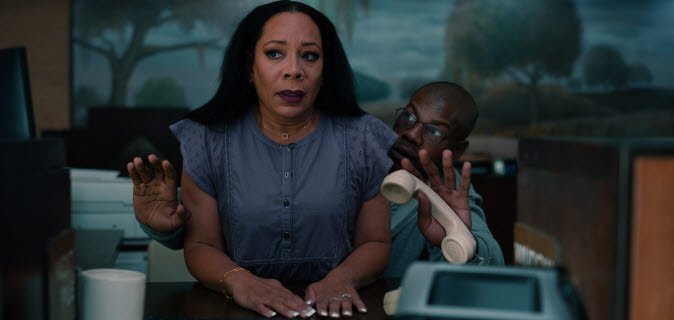
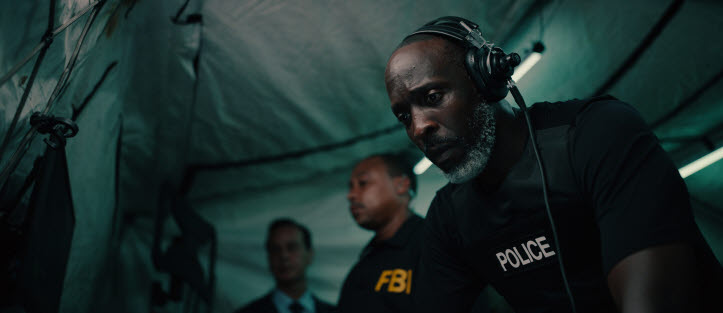
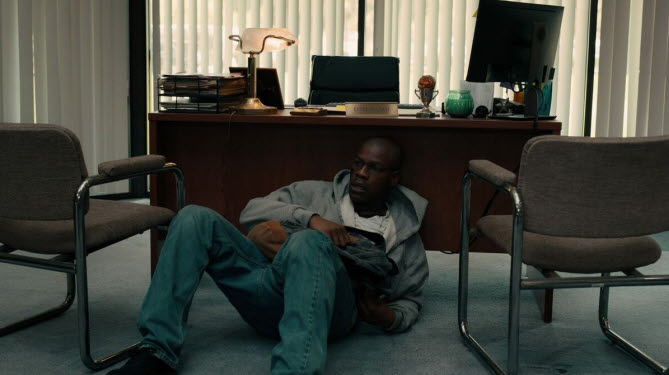
Dicks: The Musical (2023) ☆☆1/2 (2.5/4): A wacky musical of deliberate bad taste

I guess I am not an ideal audience for “Dicks: The Musical”. As shown from a series of footage clips during its end credits, the people behind and in front of the camera go all the way for making a wacky musical of deliberate bad taste, and its anarchically trashy sense of humor will be surely appreciated by the admirers of John Waters movies. However, this is basically one-joke musical comedy film which feels rather thin despite its running time (86 minutes), and I only got more impatient as rolling my eyes a lot for good reasons.

Aaron Jackson and Josh Sharp, who also made a little off-Broadway musical adapted by them (Its name is not something I can willingly type here, by the way), play Craig and Trevor, two hot-shot salesmen in New York City who are your average alpha white heterosexual male jerks. Their deliberately obnoxious opening number blatantly emphasizes their cocky attitude from the beginning to the end, and you may be a bit amused by the homosexual undertone of this unabashedly flamboyant musical scene.

Anyway, Craig and Trevor subsequently find themselves working in the same office due to a sudden company merger, and they instantly compete with each other for being the real top dog salesman of the office (Please don’t ask me what the hell they actually sell). Despite the growing competition between them, they become a bit closer to each other after discerning how much they look similar to each other, and, what do you know, they soon come to realize that they are actually identical twins who happened to be separated from each other not long after their birth (Jackson and Sharp actually looking quite different on the screen is another inside joke for us, by the way).

Quite delighted by this discovery of theirs, Trevor and Craig decide to make their respective single parents reunite with each other just like those two twin girls in “The Parent Trap” (1998). Of course, they quickly come to see how challenging this personal mission really is, because their parents, Harrison (Nathan Lane) and Evelyn (Megan Mullally), are not so interested in reuniting with each other from the beginning.

These two very, very, very eccentric people turn out to have each own issue which will seriously jeopardize Craig and Trevor’s plan. Harrison is revealed to be a gay or bisexual more inclined to men, and he is also mostly occupied with taking care of a couple of certain little hideous creatures which are clearly moving puppets. In case of Evelyn, she has had a serious problem with her certain body part, which looks like something we may see if David Cronenberg ever tries to make a children’s program with no interference at all.

Nevertheless, our two goofy heroes do not give up at all. They deliberately make their parents meet each other at a posh restaurant, and, of course, Harrison and Evelyn come to see that they still have some feeling toward each other despite the sexual obstacles between them. Nathan Lane, whom I still fondly remember for seeing him on the stage of the St. James Theatre in New York City when he performed in Mel Brooks’ acclaimed hit musical “The Producers” along with Matthew Broderick in early 2004, does not hesitate to rise below bad taste during the following song and dance scene, and Megan Mullally, who has been known well for her own distinctive comic talent, complements Lane well as his equal comic match.

While Lane and Mullally constantly steal the show from them, Sharp and Jackson are relatively less colorful in comparison, but nobody can possibly deny that they have enough zeal and spirit for frequently going over the top throughout the film. Whenever they are not singing or dancing, they always throw themselves into the Overacting with a capital “O”, and you may appreciate their cheerfully no-hold-barred efforts even when you observe their relentless shticks from the distance with more annoyance.

Under the direction of director/co-producer Larry Charles, who is no stranger to shocking us with deliberate bad taste for laughs considering his previous works such as “Borat! Cultural Learnings of America for Make Benefit Glorious Nation of Kazakhstan” (2006) and “Brüno” (2009), the movie keeps going for more tasteless comic moments, and I must confess that it often tested my own limits even though I think I am mostly open for almost anything in case of comedy. I will not deny that I was tickled a lot as watching Megan Thee Stallion, who plays Craig and Trevor’s domineering boss, giving a showstopper musical scene to remember, but I winced more than once as observing how the movie later tries something truly scandalous in the name of love. I will not go into details here for not spoiling any naughty fun for you, but I can tell you at least that Bowen Yang, who has been known for his funny comic sketches during the recent seasons of “Saturday Night Live”, is having some irreverent fun with playing, surprise, God.

On the whole, “Dicks: The Musical” is not totally without fun and amusement, but I did not enjoy it enough for recommendation because of often feeling rather distant or annoyed during my viewing. In my humble opinion, its many wacky materials work better on stage than screen, and I will be interested to considerable degree if I come upon an opportunity to see the revival of Jackson and Sharp’s original musical on the stage. As far as I can see, they do have some talent and potential, and I can only hope that they will soon move onto better things to come in the future.

Posted in Movies | Tagged , , , , | Leave a comment

Hit Man (2023) ☆☆☆1/2(3.5/4): The story of a fake hit man

Richard Linklater’s latest film “Hit Man”, which was released on Netflix in last week, is a delightful black comedy packed with lots of wit, humor, and personality to be appreciated. What we get here is often typical to the core, but its offbeat comic spirit is charming and infectious to say the least, and we gladly go along with that even when things become a little more serious than expected later in the story.

The story, which is loosely based on the real-life story of the 2001 Texas Monthly magazine article of the same name by Skip Hollandsworth (He previously collaborated with Linklater in “Bernie” (2011), by the way), mainly revolves around Gary Johnson (Glen Powell), who is your average nerdy college professor but actually has a more exciting job to do behind his back. He has closely worked with the local police in New Orleans, Louisiana as a tech guy mainly because of his considerable skill and knowledge on those electronic stuffs, and this has surely brought some fun and excitement into his rather mundane bachelor life.

However, there comes a little change for this unofficial part-time job of his on one day. Because an undercover cop supposed to disguise himself as a professional hit man for one particular sting operation gets himself suspended for a while due to some serious misdemeanor, Gary is asked to do the job instead of operating inside a van as usual, and, what do you know, he does the job much better than anyone expected. Sure, he is a bit nervous at first, but he turns out to be pretty convincing in his performance, and that is the beginning of another fun and excitement for him.

As its hero subsequently tries many different things for a series of other similar sting operations, the movie has a lot fun with how he easily and confidently fools his targets in one way or another. After all, most people do not know that much about how those professional hit men actually look or behave (I do not know either, by the way), so Gary can freely change his appearance among various disguises created by himself, and he feels all the more liberating in addition to being quite proud of helping the police more. As a matter of fact, his new job makes him a lot more enthusiastic about his college lectures on psychology and philosophy, mainly because he can observe real bits of human nature as having the close encounters with various persons eager to eliminate their respective troubles by any means necessary (A lesson: any kind of human service can be a valuable conduit to the knowledge on human nature).

And then he happens to encounter a woman named Madison Figueroa Masters (Adria Arjona), who incidentally wants him to kill her mean husband simply for her freedom. As listening to her, Gary finds himself getting quite sympathetic to her, so he ends up persuading her not to hire him instead of getting her caught on the spot, but then he accidentally gets involved more with her later. No matter how much he tries to stay on the line between him and her, the romantic heat becomes more evident to both of them, and that naturally leads to some big trouble for them.

After that narrative point, the movie becomes relatively darker than before as approaching to the areas of film noir thriller, but it never stops its comic dance even during this part. As things get quite more complicated along the story, our hero must try to outsmart a few figures who can jeopardize the circumstance at any point, and there eventually comes a point where he becomes a bit more serious about his supposedly fake persona, but we keep getting amused more as his story takes one absurd plot turn after another.

The movie surely depends a lot on the talent and presence of Glen Powell, who also wrote the screenplay along with Linklater besides serving as one of its producers. As already shown from his breakout notable turn in Linklater’s previous film “Everybody Wants Some!” (2016), Powell can be effortlessly smart, funny, and charismatic just like Matthew McConaughey, and he gives us several priceless moments of hilarity in addition to generating the palpable chemistry between him and Adria Arjona during several key scenes. Right from their first moment in the film, he and Arjona instantly click well with each other, and their comic interactions throughout the film is another source for amusement for us.

Besides Powell and Arjona, the movie also has a bunch of equally colorful supporting performers to enjoy. As three different police figures around Gary, Retta, Austin Amelio, and Sanjay Rao have each own comic moment to shine, and the special mention goes to a number of different minor supporting performers playing those various persons targeted by Gary and his police colleagues, who all contribute much to the local background and atmosphere of the movie.

Overall, “Hit Man” is another witty and engaging work from Linklater, who has seldom disappointed me since I watched “Before Sunrise” (1995) and then “Before Sunset” (2004) around 20 years ago. While it does not reach to the greatness of the Before Trilogy and “Boyhood” (2014), the movie is on par with many of his better works such as “Waking Life” (2001) and “School of Rock” (2003), and it is certainly nice to see Linklater bouncing back from the disappointment of “Where’d You Go, Bernadette” (2019). In short, this is one of more enjoyable offerings from Netflix during this year, and you will be definitely surer about its lead actor’s rising stardom than before.

Posted in Movies | Tagged , , , | 1 Comment

Shooting Stars (2023) ☆☆1/2(2.5/4): The Best Years of Their Lives

“Shooting Stars”, which is currently available on Netflix in South Korea, is a standard biographical sports drama film which plays and then delivers as much as expected. While any good sports drama film needs to do more than that in my inconsequential opinion, the movie is not boring at all mainly thanks to the genuine sense of friendship and camaraderie among its main characters, and it is a shame that the movie is content with simply playing within its genre conventions instead of being driven by more spirit and personality to distinguish itself.

The movie, which is based on the name of the same memoir written by LeBron James with some assistance from Pulitzer-winning writer Buzz Bissinger, is about how much James and his three close friends/colleagues distinguished themselves during their early years in Akron, Ohio. Even when they were no more than 10 years old, they all were quite determined to pursue their future basketball career, and they are surely expected to go together to one certain well-known local high school when they are about to start their first high school year several years later.

However, Dru Joyce III (Caleb McLaughlin) has a different opinion. Mainly because of his rather short height, he is not going to be allowed to play with James (Mookie Cook) and their friends Willie McGee (Avery Wills) and Sian Cotton (Khalil Everage) in the same group, and that naturally makes him look for the other option. When he comes to learn that a certain famous university basketball coach becomes the new basketball team coach of some other high school in their neighborhood, Joyce boldly approaches to this coach for showing his considerable potential and talent, and he also succeeds in convincing James and the others to go to that other high school instead.

It is indeed a bold gamble, but it is succeeded much better than anyone expected. Once they prove their worth as a dream team to be excited about, James and his friends begin to excel themselves game by game even during their first year, and it certainly looks like the sky is the only limit for them, especially as James draws a lot of public attention as a very promising player who can be as famous as, say, Michael Jordan or Kobe Bryant.

Of course, we all know what will eventually happen around the end of the story, and the screenplay by Frank E. Flowers, Tony Rettenmaier, and Juel Taylor thankfully does not waste any time as steadily rolling its main characters from one expected point to another. While there surely come some moments of conflicts and doubts later in the story, the movie does not put too much emphasis on these more serious moments, and it continues to jump and bounce along the story as its main characters go all the way for more athletic accomplishment on their way.

In case of basketball game scenes in the film, director Chris Robinson and his crew members including cinematographer Karsten Gopinath and editor Jo Francis do not disappoint us at all. Even if you do not know that much about basketball (Full Disclosure: I am one of such persons), you can easily and instantly follow the flow of those basketball games in the movie without much confusion, and you may gladly go along with a number of deliberately stylized shots during the basketball game scenes in the film.

However, the movie often stumbles in case of bringing more life and personality to its main characters. While Mookie Cook, Calebe McLaughlin, Avery Wills, and Khalil Everage generate effortless chemistry together on the screen in addition to being quite convincing in those basketball game scenes, it takes some time for us to get accustomed to their roles because their characters are a bit too flatly streamlined to engage us more. As a matter of fact, James in the movie is actually the least interesting member in the bunch despite his future fame and success to come, and I must confess that he sometimes feels to me like the exact opposite of what my late mentor/friend Roger Ebert wrote at the beginning of his 1968 review on William Wyler’s “Funny Girl” (1968): “The trouble with “Funny Girl” is almost everything except Barbra Streisand.”

Fortunately, the movie at least does not forget that its dramatic power lies in the longtime friendship among James and his fellow team members, and the earnest youthful energy from these four performers playing James and his three friends lifts up the movie at times. In addition, several other main cast members mostly acquit themselves well despite their functional supporting parts. While Scoot Henderson manages to leave some impression as another key player who comes to join James and his friends as the fifth member of the group, Wood Harris, Algee Smith, Natalie Paul, and Dermot Mulroney are effectively cast as the crucial adult figures in the story, and both Mulroney and Harris surely deliver their respective big speech scenes as well as you can expect from your average basketball drama movie.

On the whole, “Shooting Stars” is rather deficient compared to its numerous seniors including, yes, “Hoosiers” (1986), but it is fairly watchable thanks to its competent aspects including the diligent efforts from its main cast members. I wish the movie delved deeper into its main characters and then dug up more spirit and personality to observe and remember, but I was entertained to some degree during my viewing, so I will not stop you at all if you want something causal for killing your spare time.

Posted in Movies | Tagged , , , , , | Leave a comment

Star of Ulsan (2022) ☆☆☆(3/4): Her gloomy daily life in Ulsan

South Korean independent film “Star of Ulsan” is a tough stuff to watch for good reasons. As following the gloomy daily life of one strong-willed woman and several others around her, the movie presents a daunting slice of life to observe, and you will admire how it avoids any cheap pity or sentimentality before eventually earning a little but precious sign of hope and endurance at the end of its grim but undeniably powerful human drama.

At the beginning, the story, which is set in a South Korean industrial port city named Ulsan, introduces its several main characters one by one. First, we are introduced to a middle-aged woman named Yoon-hwa (Kim Geun-soon), and then we see her getting suddenly injured on her hand while working at a local shipyard as usual. Although she may have to get some rest for recovering a bit from her serious physical injury, she tries to keep working as before, but then she is notified that she will be laid off sooner or later. Mainly because she has diligently worked there instead of her dead husband for around 20 years, Yoon-hwa naturally becomes quite exasperated, but it looks like there is really nothing she can do about that, even though it is possible that the company is very unfair to her from the beginning.

Yoon-hwa has endured a lot for providing a better lite to her two children, but neither of her two children does not appreciate her sacrifice that much, and they see no future in their increasingly hopeless hometown. While he managed to graduate as a college student, Se-jin (Choi Woo-bin) does not seem to be trying more for getting employed, and he has actually been more occupied with earning a lot via Bitcoin. In case of Kyeong-hee (Jang Min-young), she is not interested in going to college at all, and we see how she attempts to pursue the career of a makeup artist even though she does not get much attention despite her frequent online promotion.

We are also introduced to several family members of Yoon-hwa’s dead husband. Her dead husband’s uncle and aunt happen to need a considerable amount of cash for their loser son who recently got divorced, and they are going to persuade Yoon-hwa to agree on selling a certain piece of family real estate which has belonged to her for many years, though they know too well that Yoon-hwa will instantly object to that.

However, the situation surrounding that real estate asset turns out to be quite complicated. When it seems that she really needs to bribe her direct supervisor for not getting laid off, Yoon-hwa naturally checks whether she can draw a quick loan from that real estate asset, but she only comes to learn instead that her son has been making a much bigger mess than she thought at first. Needless to say, her son soon finds himself getting cornered in more than one way as expected, and it seems that there is not any easy way out for him at all.

What happens next among Yoon-hwa and her several family members is not so pleasant to say the least. When they all eventually gather at Yoon-hwa’s residence, the tension among them is palpable to us even though they do not tell everything to each other, and we come to brace ourselves more as things get gloomier for them along the story.

And we also get to know more about how much each of them is pressured under more despair and hopelessness. No matter how much she fights and protests against the unfair treatments at her workplace, Yoon-hwa only gets herself cornered more and more, and that consequently makes her rather hostile to some of her close colleagues. While Se-jin turns out to have a really desperate motive behind his very unwise Bitcoin speculation, Kyeong-hee becomes more willing to get out of the city as soon as possible, and one of a few tender moments in the film comes from how she bonds with a schoolmate of hers via their shared wish. In case of Yoon-hwa’s in-laws, they are not bad people at all, and they also are as despaired as Yoon-hwa and her two children, while still feeling quite conflicted about their precious family asset.

This is surely depressing to watch at times, but the movie keeps us engaged via its solid storytelling and vivid characterization, and the main cast members are believable in their respective roles. Kim Geum-soon, who recently drew my attention more for her stellar performance in Jeong Ji-hye’s notable debut feature film “Jeong-sun” (2002), firmly holds the center with her uncompromising performance, and she willingly embodies warts and all for bringing more life and personality to her unforgettable character. Choi Woo-bin and Jang Min-young hold well each own place around Kim as having each own moment to shine, and Do Jung-hwan, Im Hyeong-tae, Byun Joon-hee, and Lim Jung-min are also solid in their crucial supporting roles.

Overall, “Star of Ulsan”, which is incidentally the first feature film of director Jung Ki-hyuk, is definitely not something you can casually watch on Sunday afternoon, but it is worthwhile to watch for several good reasons including its strong lead performance. Although nothing is certain for everyone including Yoon-hwa even at the end of the story, they somehow find more will and strength for enduring a bit more at least, and you may sincerely hope that they will somehow prevail in the end.

Posted in Movies | Tagged , , | Leave a comment

A Lonely Island in the Distant Sea (2021) ☆☆☆(3/4): As his life goes on…

South Korean independent film “A Lonely Island in the Distant Sea”, which I belatedly watched only after it unexpectedly won the Grand Prize at the Wildflower Film Awards in South Korea, simply and leisurely rolls along with its plain hero’s life. As he goes through a series of small ups and downs along the story, the movie patiently engages us via a subtle balance between humor and drama coupled with some sincere moments of self-reflection, and it is alternatively amusing and touching to observe for us how things change for him and several others around him in one way or another.

At the beginning, we get to know its hero’s current life status. While he was once a promising young sculptor many years ago, Yoon-cheol (Park Jong-hwan) has been stuck with making simple sculptures to be used for science museums, and he has been fine with that just because 1) that has supported his living day by day and 2) he has no particularly interest in rebooting his old artistic career. While her adolescent daughter Ji-na (Lee Yeon) shows some artistic potential just like he did, they have been distant to each other for some time since his divorce, and they do not talk that much with each other when he comes to her high school for a small trouble of hers.

Meanwhile, Yoon-cheol later encounters Yeong-ji (Kang Kyung-hun), a female college lecturer who instantly becomes interested in Yoon-cheol after their first meeting even though there is nothing particularly attractive about him. She eventually lets him stay more round her, and it looks like they can be a bit more serious about their developing relationship.

However, not so surprisingly, things do not go as well as he hopes. When Yoon-cheol lets himself become rather distant from Yeong-ji due to doing some work outside South Korea, she eventually decides to break up with him, and Yoon-cheol belatedly realizes how much he really needs her. He naturally pleads her not to leave him, but she remains adamant nonetheless, while also sharply pointing out his faults on their relationship.

And there comes another unexpected happening to Yoon-cheol. After wandering more and more since deciding not to pursue her artistic aspiration, Ji-na eventually decides to become a Buddhist monk, and she promptly embarks on her preparation period after shaving her head. Naturally perplexed by his daughter’s decision, Yoon-cheol keeps asking her whether she is really serious about that, but she remains unflappable in her decision, while also totally being in piece with herself in contrast to her wild time in the past.

While the movie calmly moves from one episodic moment to another, we observe a number of subsequent changes in Yoon-cheol’s life. After he later comes upon the dead end of his current status, he decides to stay more around her daughter, and he soon finds himself working as a handyman for Ji-na, who is now called “Do-maeng”, and her female mentor. In addition, he also comes to open a little noodle shop at a nearby town, which gradually becomes profitable enough to support him despite its uneventful first days.

Getting more settled than before, Yoon-cheol starts to take care of several problems in his life. Although he and his daughter are now more like an employee and an employer, they find themselves opening themselves more to each other than before, and that is why it is poignant for us to see when Ji-na becomes more affectionate to her father later in the story. When Yoon-cheol meets Yeong-ji again, he shows more care to his ex-girlfriend for a good reason, and Yeong-ji surely appreciates this considerate gesture of his.

These and many other little personal moments in the film are presented well with unadorned poetic sensitivity under the dexterous direction of director/writer Kim Mi-yeong, who previously made a feature film debut with “Upstanding Man” (2016). For example, the key moments in the movie are thoughtfully composed on the wide screen of 2.35:1 ratio without drawing too much attention at all, and we accordingly get more immersed into its reflective mood as coming to care more about the story and characters.

Furthermore, Kim draws solid performances from her main cast members. Park Jong-hwan, who recently played a small but crucial supporting role in Eom Tae-hwa’s “Concrete Utopia” (2023), steadily carries the film as subtly conveying to us the slow but gradual inner changes of his character, and his effective performance comes to function as the stable ground for his fellow main cast members. While Lee Yeon, who previously drew my attention for her supporting turn in Byun Sung-hyun’s Netflix film “Kill Boksoon” (2023), is convincing in her character’s dramatic change along the story, Kang Kyung-hun is also wonderful in her supporting part, and the special mention goes to Park Hyun-sook, who always steals the show as Ji-na’s no-nonsense mentor.

In conclusion, “A Lonely Island in the Distant Island” is one of more interesting South Korean films of last year, and Kim shows here considerable potential as another talented South Korean filmmaker to watch. Although I have not watched “Upstanding Man” yet, “A Lonely Island in the Distant Island” impressed me enough on the whole, and I will certainly have some expectation on whatever will come next from her.

Posted in Movies | Tagged , , , | Leave a comment

Her 5th Room (2024) ☆☆☆(3/4): She simply needs to have her own private space…

South Korean documentary film “Her 5th Room” is a small but intimate personal story about one middle-aged woman who simply needs to have her own private space. As closely and sensitively observing her struggle for privacy and independence, the documentary often gives us aching emotional moments to remember, and we are eventually touched by when she finally decides to step forward more for what she has yearned for many years.

She is the mother of director/co-producer Jeon Chan-young, and the documentary opens with Jeon moving from Busan to her family residence in Daegu. For around 30 years, Jeon’s mother has lived with her husband and parents-in-laws in a two-story house, and Jeon tells us how her mother’s status has been upgraded a bit during last several years. When they married many years ago, Jeon’s mother and her husband were allowed to occupy a small room together while the big main bedroom belonged to her parents-ln-laws. After her father-in-law died and then she became the breadwinner of the family after her husband lost his job, Jeon’s mother was allowed to have the main bedroom. However, she subsequently decides to move up the room on the second floor, mainly because she really needs a place where she can work without any interruption from her other family members including her husband.

Jeon’s mother has worked as a qualified freelance counselor, and we see how she works here and there when she is not working in her family residence. At one point early in the documentary, she gives a little lecture to a group of people who come with their respective foreign spouses, and it is apparent that she is really proud and passionate about her current profession.

However, Jeon’s mother is still not that happy as often feeling like an outsider who has just been stuck with others in the house for years. When she was a young country girl who got fallen in love with her future husband, everything seemed to be going well for both of them, but they found themselves depending a lot on his parents in many ways after their wedding, and she was expected to take care of a lot things in the house for many years just because she was the wife of the only son of her parents-in-laws.

Moreover, her husband has not been much help to her for many years. Right from his first scene in the documentary, it is apparent that he is a useless old bum who has taken everything for granted, and we later get to know more about his worse sides. For example, he often drinks a lot whenever he gets a chance, and then he frequently annoys and interrupts his wife even though she has a lot of works to do besides those usual domestic stuffs to handle.

And then there comes an eventual breaking point for Jeon’s mother later in the documentary. Her mother-in-law suddenly makes an unexpected decision involved with the ownership of the family residence, and this hurts her feeling for good reasons. As the camera calmly observes their conversation from a static position, Jeon’s mother cannot help but show more and more of her anger and frustration while arguing with her mother-in-law, and this moment is often painful to watch for us.

In addition, her husband’s drinking habit gets worse day by day. At the funeral of one of her close family members, he happens to clash with some of her family members while getting quite drunk, and this surely exasperates his wife more than ever. In the end, Jeon’s mother and her children come to have a sort of intervention meeting between them and her husband, and we come to learn more about how much she and her children have endured and dealt with her husband’s alcoholism and occasional domestic violence.

While rightfully siding with her mother, Jeon also tries to give a fair chance to her father at least even though she comes to dislike her father more than before. Later in the documentary, she shows him several key moments in the documentary, but he just casually recognizes that he is indeed the villain of her documentary, and he does not even feel much regret or repentance on that. You may come to feel some pity to this incorrigible old man who still does not grasp at all how much he has hurt his family members for many years, and then you will become more disgusted when he drinks a lot again to cause another annoyance for his wife.

After that, Jeon’s mother finally decides that enough is enough, and what she does next is quite sensible to say the least. Now she feels more hopeful and optimistic than ever, and that makes a big contrast with her husband’s more pathetic status. While she is ready to move onto the next chapter of her life, he does not seem to know what to do next, and that will probably be continued to the end of his life.

On the whole, “The 5th Room” works as a sincere and touching family story, and Jeon presents her family members with enough care and respect despite her complex feelings about some of them. Although it could show us more in my humble opinion, the documentary is fairly solid and impactful within its rather short running time (81 minutes), and the result is one of more engaging South Korean documentaries of this year.

Posted in Movies | Tagged , , , , | Leave a comment

Godzilla Minus One (2023) ☆☆☆(3/4): One of the better Godzilla flicks

Japanese film “Godzilla Minus One”, which was belatedly released on Netflix a few days ago in South Korea, is one of the better Godzilla flicks I saw during last 30 years. While you surely get as much as you can expect whenever the titular character enters the screen, the movie also shows some care to a number of human characters in the story, and that certainly distinguishes itself from several recent Godzilla movies from Hollywood.

You do not need to see other Japanese Godzilla films first, because, as reflected by its very title, the movie is a reboot which takes the series back to the late 1940s. During the opening scene, we are introduced to a kamikaze pilot named Kōichi (Ryunosuke Kamiki), and then we see his first encounter with Godzilla, which occurs not long after he lands on the Japanese military base located in some small island. It is apparent to the lead mechanic of the base from the beginning that Kōichi is fleeing from his deadly duty, but that becomes a rather trivial matter once Godzilla appears and then attacks the base, and this certainly traumatizes Kōichi.

Anyway, he eventually returns to Japan along with many other soldiers once the World War II is over, and he is all the more devastated to see that all of his family members in Tokyo were dead due to the air raids on Tokyo. As Kōichi tries to rebuild his life, he happens to get associated with a young woman named Noriko (Minami Hamabe), and Noriko comes to live along with him and a little orphan baby girl she happened to acquire not long before she met him.

While Tokyo and its citizens subsequently go through a recovery period during next several months, things gradually get better for Kōichi and others around him. He gets a rather risky job which can provide enough money to support not only him but also Noriko and the baby, but Noriko is also willing to work for getting more money for them, and a neighbor of theirs, who happened to lose all of her children during the war, is ready to take care of the baby in the meantime.

The movie slowly establishes the imminent danger to be unleashed upon Tokyo and its citizens. Once Godzilla gets enlarged and empowered by the latest hydrogen bomb test by the US military, it is promptly going toward Tokyo, but both the US military and the Japanese government are not so willing to take any big action against this impending disaster for a complicated political reason.

Needless to say, Kōichi, whose job is incidentally removing numerous military underwater mines, and his several colleagues soon behold how unstoppable Godzilla really is, and that surely throws him into another panic. As Godzilla makes its expected appearance, the movie does a nice variation of the certain scene of Steven Spielberg’s “Jaws” (1975), and you will surely be reminded of that memorable line from when Roy Scheider’s character confronts that big white shark for the first time in that film.

Once Godzilla arrives in Tokyo, the movie certainly goes for more shock and awe for us. As it stomps here and there around one area of Tokyo, we are served with a series of spectacular moments to admire. In this film, Godzilla is a wrathful force of nature which attacks upon the city and its people with no mercy at all, and you will be chilled and then entertained when Akira Ifukube’s famous theme from those classic Godzilla flicks is boldly played on the soundtrack in the middle of this sequence.

The second part of the film mainly revolves around Kōichi and many other human characters’ attempt to stop Godzilla by any means necessary. One of his colleagues, who happens to be a former Naval weapons engineer, turns out to have a plan, and, though they are not so sure about whether it will eventually succeed or not, they decide to go all the way for saving people from more possible disasters to come via Godzilla.

It goes without saying that Kōichi becomes a key figure in this highly perilous mission, and his personal drama comes to function as a human element to hold our attention during the eventual climactic part. While Godzilla is still the main star of the film, Ryunosuke Kamiki holds his own place well even when his character is overwhelmed by Godzilla, and several other main cast members including Minami Hamabe, Yuki Yamada, Sōsaku Tachibana, Hidetaka Yoshioka, Kuranosuke Sasaki, and Sakura Ando, whom you may remember for her poignant performance in Hirokazu Kore-eda’s “The Shoplifters” (2018), are also well-cast in their colorful archetype supporting roles.

In conclusion, “Godzilla Minus One” is a solid piece of entertainment which is more enjoyable than those recent Hollywood Godzilla films, and director/writer Takashi Yamazaki, who deservedly received a Best Visual Effects Oscar early in this year, did a competent job of bringing some new and fresh energy into its longtime franchise. Considering what is shown around the end of the film, there will certainly be more Godzilla films to come (Godzilla is as hard to kill as Jason Voorhees or Michael Myers, you know), and I am ready for them after throwing more of my inconsequential snobbism on many of Godzilla flicks. They may be really trashes, but please remember what late critic Pauline Kael once said: “The movies are so rarely great art, that if we can’t appreciate great trash, there is little reason for us to go.”

Posted in Movies | Tagged , , , | Leave a comment

Jim Henson: Idea Man (2024) ☆☆☆(3/4): A man behind the Muppets – and more

Ron Howard’s new documentary film “Jim Henson: Idea Man”, which was released on Disney+ in last week, is an affectionate tribute to Jim Henson, who was the main creative mind behind many delightful things including “Sesame Street” and “The Muppets”. Looking around many highpoints in Henson’s illustrious career, the documentary gives us a closer look into his artistry and humanity, and it is often compelling to observe how he drove himself further and further before his untimely death in 1990.

Mainly consisting of archival photographs and video clips coupled with the occasional interview clips from Henson’s several colleagues and family members, the documentary initially shows and tells us on how everything was begun during Henson’s early years. While he showed some artistic potential during his childhood years, Henson actually got interested in becoming a puppeteer later during his high school years, and his interest grew more when he was studying in a college where he met his future wife Jane, who soon became his creative/romantic partner despite their considerable personality difference.

When he subsequently went to Europe in the late 1950s, Henson got more creative input from the mastery and dedication of many different European puppeteers, and he was ready to push himself more as he eventually began to make a series of TV comedy sketches consisting of the puppets made by him and his collaborators. Of course, many of these puppet characters were the seniors to numerous Muppet characters such as Cookie Monster, and Kermit the Frog was actually one of the early ones. Voiced by Henson himself, Kermit the Frog was more or less than the extension of Henson’s personality, and I must say that it is rather fascinating to observe Kermit the Frog appearing in several black and white TV shows during that period.

While becoming more successful than ever thanks to his Muppets, Henson never stopped at all as trying one different thing after another. As entering the 1960s, he tried a number of various things ranging from his Oscar-nominated short film “Time Piece” (1965) to a Broadway production project which was not sadly realized, and he even attempted to design a disco hall which feels more like the exhibition rooms for installation art in my humble opinion.

And then something unexpected came into his life and career. Henson and his colleagues including Frank Oz were asked to create a children’s program for National Educational TV (NET), and, yes, that led to one of the most successful children’s programs in the American TV history. Mainly thanks to the sheer artistic creativity and dedication of Henson and his colleagues, “Sesame Streets” became a phenomenal hit right from its first year, and its enduring legacy cannot possibly be exaggerated. After all, I and my younger brother were exposed to English thanks to the VHS box set of Sesame Street episodes during our kindergarten period, and we still fondly remember Big Bird and many other lovable Muppet characters.

Nevertheless, Henson was not totally satisfied yet as an ambitious workaholic. He was already eager to move onto creating something else, and that actually led to another huge success. When Henson and his colleagues worked on “The Muppets” in England, nobody expected that much from their new project, but, what do you know, the show became quite popular while also getting a bunch of notable guest stars such as Roger Moore and Rita Moreno.

After becoming quite successful in TV, Henson prepared himself for making a feature film. Making “The Dark Crystal” (1982) was very challenging for him and his colleagues to say the least, but, again, they try their best in pushing themselves more and more, and the result was a memorable fantasy film which incidentally managed to earn enough money despite competing against a certain big movie coming from Steven Spielberg at that time.

Of course, being a hardcore workaholic gradually affected not only Henson himself but also his family members. Although he loved his wife and their five children, his work always came first, and that certainly caused occasional conflicts between him and his wife despite their affection and respect toward each other. Although his children have no hard feeling on their father, they remember how their father was often absent due to his works, and it is touching to see how Henson sincerely tried to support and encourage their respective professional careers during his later years.

Despite the critical and box office failure of his second feature film “Labyrinth” (1986), Henson was still ready for doing more stuffs, though he began to slow down himself a bit. Around the time when he sold his production company to Disney, he seemed to be ready for the next possible chapters of his life and career, but then he suddenly died not long after that, and everyone around him was quite devastated. Nonetheless, Henson showed some sense of humor via his will and the instruction on his funeral, and you will be alternatively amused and moved by that.

Overall, “Jim Henson: Idea Man” is a solid documentary to engage and touch us, and Howard, who has recently made a series of notable documentaries which are actually better than his recent feature films such as “Hillbilly Elegy” (2020), handles his human subject with enough care and respect. Yes, it could have shown more, but the result is fairly satisfying on the whole, and you may want to learn more about Henson’s life and career after watching it.

Posted in Movies | Tagged , , , , | Leave a comment

I’ll See You in My Dreams (2015) ☆☆☆(3/4): As her remaining days go by

“I’ll See You in My Dreams”, which happens to be one of the movies recently available on Netflix in South Korea, is a little intimate character drama which turns out to be a bit more sensitive and thoughtful than expected. On the surface, it is another familiar drama about life, aging, and love, but it goes deeper into the story and characters without never overstepping at all, and the result is alternatively humorous and poignant.

At the beginning, the movie gradually establishes the daily life of Carol Petersen (Blythe Danner), an aging widow who has comfortably and quietly led her single life since she lost her husband due to a big accident around 20 years ago. Mainly thanks to the insurance money she received after her husband’s unfortunate death, Carol can still live alone in a cozy Californian house along with her old pet dog, and she is not so interested in living with several old friends currently residing in a nearby retirement community, though she often spends some time with them.

And then there come several small changes to interrupt Carol’s comfortable daily life. First, her pet dog has to be euthanized for some serious medical condition involved with its old age, and she is certainly devastated by the loss of her longtime companion. As she sleeps alone in the house later, she is suddenly disturbed by the appearance of a little rat appearing from somewhere inside the house, which comes to disturb her more along the story.

Meanwhile, there comes a new guy who comes to clean the pool of Carol’s house. He is a lad named Lloyd (Martin Starr), and she subsequently suggests him that they should have some wine together. Despite their considerable age difference, Carol and Lloyd find themselves becoming more casual with each other, and Lloyd comes to tell her more about himself than expected, though both of them are not so sure about what may happen next between them.

To us, it seems that another guy Carol comes across at a local supermarket is more suitable for her. He is a retired man name Bill (Sam Elliott), and he does not hesitate to show her that he is really interested in getting to know her, even though they are total strangers to each other from the beginning. She comes to learn later that he is actually known well in her friends’ retirement community, and then she does not hesitate when he approaches to her again not long after she has a pretty dissatisfying speed dating time to our little amusement. 

As Carol spends more time with him, it turns out that Bill is a pretty cool guy who can actually be a new love in her life. While knowing well that he is approaching to the closing chapter of his life just like Carol, Bill is willing to go for more fun and happiness instead of resorting to the boredom of retirement, and Carol eventually opens herself more to him as they talk with each other on his big boat (Its name is one of many little amusing things in the film, by the way).

In the meantime, Carol comes to befriend Lloyd more. There is a funny and thoughtful scene where they express their very different views on living, and Lloyd, who is incidentally a struggling poet/musician, becomes more impressed when Carol demonstrates a bit of her old singing skill in front of him and others at a local bar during its karaoke night.

The screenplay by director/editor/co-producer Brett Haley and his co-writer Marc Basch thankfully avoids setting a gratuitous triangle among Carol and these two different men coming into her life. As a wise and thoughtful woman, Carol surely knows what may be better for her in the end, and then she goes along with that when she really feels right about that. Her following decision is handled well with enough sensitivity and thoughtfulness, and then she comes to realize that she cares more than expected when another unexpected thing occurs later in the story.

As the center of the movie, Blythe Danner, whom I usually remember for playing the no-nonsense wife characters in several notable movies ranging from “The Great Santini” (1979) to “Meet the Parents” (2000), diligently carries the story with her unadorned but graceful performance to remember. While we only get to know a bit about her character’s past, Danner fills the character with enough life and personality to observe, and she is particularly good when she subtly conveys to us some wistful sadness inside her character around the end of the film.   

Haley assembles a number of colorful performers around Danner. While Martin Starr and Sam Elliott are effective as the two different male figures revolving around Danner’s character, June Squibb, Rhea Perlman, and Mary Kay Place, who have all been quite dependable veteran performers for many years, often provide some extra humor as Carol’s close friends, Malin Åkerman briefly appears as Carol’s caring daughter.

On the whole, “I’ll See You in My Dreams”, which is Haley’s second feature film after “The New Year” (2010), is worthwhile to watch for not only Danner’s wonderful acting but also its solid storytelling. In my inconsequential opinion, this is surely one of many little overlooked films, and you will not easily forget the movie and Danner’s performance for a while after watching it.

Posted in Movies | Tagged , | Leave a comment

For Love and Life: No Ordinary Campaign (2022) ☆☆☆1/2(3.5/4): So they step forward…

Documentary film “For Love and Life: No Ordinary Campaign”, which was released in Amazon Prime in last week, presents an extraordinary story about a bunch of people trying to make some change in the American healthcare system for themselves as well as many others out there. While its running time is short (83 minutes), the documentary is mostly solid as fully packed with enough enlightenment on its main subject, and you will be reminded more of the importance of the advance of medical care and treatment.

The main focus of the documentary is one couple who has fought hard for their future for many years since one of them was diagnosed to have one of the most terrible diseases known to the mankind. The name of that disease is amyotrophic lateral sclerosis (ALS), which is also known as Lou Gehrig’s Disease. Due to some pathological mechanism which is still not specified even at this point, the motor neuron cells inside the brain of ALS patients suddenly begin to die at a certain point, and this serious medical condition leads to the growing weakness of muscles before the eventual death within a few years for being incapable of breathing (We all need some muscle movement for breathing, you know).

For Brian Wallach and his wife Sandra Abrevaya, life had been pretty good for them before that bad news hit their happy life. Both of them were the key participants of Barack Obama’s 2008 US Presidential Campaign, and they instantly clicked with each other when they encountered each other for the first time as contributing a lot to the growing enthusiasm surrounding Obama (How optimistic most of us felt during that old time…). A few years later, Brian and Sandra married and then had two kids between them, and everything seemed to be going pretty well for both of them as they also advanced a lot in each own career in Washington D.C.

And then Brian noticed a little problem in the movement of one of his hands. While he initially disregarded it without much concern, this soon led to more serious medical symptoms, and that is how he came to learn that he has ALS. Both he and his wife were certainly quite devastated because ALS has been regarded as an incurable terminal disease for many years, but then Brian decided to take some active actions for not only himself but also others. Coming to know that there had not been much progress in the medical research on the medical treatment on ALS patients, he decided to organize a non-profit organization for ALS patients and their families, and his wife went along with that plan although she knows too well how much her husband would have to work for establishing and then managing the organization.

At first, the main purpose of their organization was increasing more public awareness of ALS. Along with numerous fellow ALS patients and their family members, Brian and Sandra has passionately worked on how to draw more attention from the public and the media, and they effectively used the social media applications as shown from that famous ice bucket challenges spread around the Internet.

However, as Dan Tate Jr., a lobbyist who also has ALS, pointed out later, the ice bucket challenge worked as much as they hoped, but, just like many other social media events, people mostly forgot about what the hell it was all about from the beginning even before several years passed. To make more changes, they had to convince the US parliament and government to pay more attention to the ALS research, and they also had to persuade National Institute of Health (NIH) to provide more funding for that.

So, again, Brian and Sandra tried to accomplish this goal as much as possible along with their fellow activists including Steve Gleason, a former professional American football player who has worked as an advocate of ALS since his ALS diagnosis as shown in documentary film “Gleason” (2016). They met a number of politicians willingly paying attention to their desperate status, and their voices were certainly heard as the several important laws on ALS patients were smoothly passed in the US Congress and then the US Senate. As a result, many of ALS patients can access a lot more easily to those newly developed drugs in the trial stages than before, and there also come more attention and funding to the ALS research.

Needless to say, the research on ALS treatment is still in research and development stages even at this point, but the documentary points out how desperate Brian and many other ALS patients are as the clock is ticking inside their worsening body day by day. They all are certainly willing to try anything for living and being with their loved ones as long as possible, and they may actually live much longer than expected as hopping from one experimental cure to another during next several years.

On the whole, “For Love and Life: No Ordinary Campaign”, is a powerful documentary on how to bring some more change to the American society and its flawed systems, Director/co-producer/co-editor/cinematographer Christopher Burke did a commendable job of handling its main subject with enough care and respect. Things are still gloomy for Brian and many of his ALS patients out there, but they keep fighting with some hope and optimism, and you will surely learn some valuable life lesson from that.

Posted in Movies | Tagged , , , , , | Leave a comment