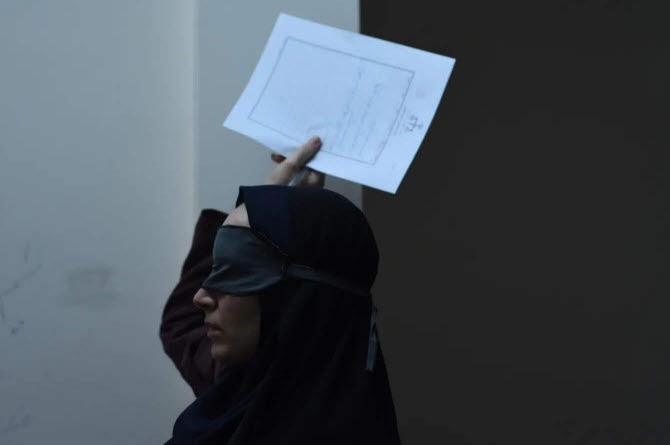
How to Have Sex (2023) ☆☆☆(3/4): A female coming-of-age tale about sex

British film “How to Have Sex” will strike you hard at first while its adolescent heroine and her two female friends go wild for some fun and excitement. As clearly reflected by the very title of the film, they are willing to go all the way for sex, and the movie frankly depicts what drives them toward more fun and excitement as slowly focusing on the inner turmoil of its heroine, who turns out to be a lot less confident and vulnerable than she looks at first.

The main background of the film is a party resort of Malia on the Greek island of Crete, where a girl named Tara (Mia McKenna-Bruce) and her two friends Skye (Lara Peake) and Em (Enva Lewis) come for enjoying a rites-of-passage holiday just like many other girls and boys around her age. Once they arrive in Malia, they have a little fun time together on the beach near to the resort, and that is just the beginning to be followed by lots of excitement during next several days and nights.

As they freely throw themselves into one wild moment and another along with many others around them, we get to know a bit more about each other of them. While Em is almost certain about going to college after her high school graduation, Tara and Skye are not so sure about what to do next, because their grades will not be enough for going to college. In addition, Tara also feels rather insecure just because she has never had sex unlike her two friends, so she lets herself driven more by not only her growing curiosity but also the peer pressure from them.

And then it looks like there is a good chance for her first sex. Tara and her friends happen to draw the attention from a boy staying next to their room along with his two friends, and this lad, who is called Badger (Shaun Thomas), gladly invites them to join him and his two friends Paddy (Samuel Bottomley) and Paige (Laura Ambler). Spending more time with Badger and his two friends, Tara becomes more interested in getting closer to Badger, and it seems that Badger is also attracted to her.

While its main characters continue to throw themselves into more fun and excitement, the movie gradually immerses us into the heated atmosphere surrounding them and many others, and director/writer Molly Manning Walker, who incidentally made a feature film debut here in this film after making several short films (She also recently served as the cinematographer of Charlotte Regan’s debut feature film “Scrapper” (2023), by the way), and her crew members including cinematographer Nicolas Canniccioni did a commendable job of imbuing the screen with a considerable degree of realism and verisimilitude. Never feeling obtrusive at all, the camera fluidly moves here and there around the characters during several key sequences in the film, and we come to feel more like an invisible bystander around the main characters.

It is not much of a spoiler to tell you that our young heroine comes to have sort of a rude awakening around the middle of the story, and that is where the story accordingly becomes more uncomfortable than before. Letting herself become more confused and intoxicated after that point, she eventually gets what she wants, but, not so surprisingly, it is not exactly what she hoped for, and that consequently causes a lot of anxiety and shame in her mind.

Now this sounds like your average cautionary tale, but the movie firmly sticks to its non-judgmental position while conveying to us more of its young heroine’s devastation and disillusionment during the aftermath. At one point, we see her walking alone in the middle of an empty street which looks quite different to her now, and this brief but strikingly stark image conveys to us everything we need to know about her current state of mind.

Nevertheless, the movie also does not resort to any cheap melodramatic moment, even when Tara gets more confused and devastated during its last act. There is a little moment of emotional ventilation between her and one of her friends around the end of the story, but the movie wisely does not overplay this moment at all, and we are touched as sensing a bit of hope for its young heroine during the very last shot.

Walker draws good natural performances from her young main cast members, who are all believable as filling their respective parts with enough youthful energy. Gradually holding the center, Mia McKenna-Bruce ably illustrates her character’s tricky emotional journey along the story, and she is especially heartbreaking when her character goes through more pain and humiliation later in the story. While effortless in their casual interactions with McKenna-Bruce on the screen, Lara Peake and Enva Lewis hold their own place well around their co-star, and Shaun Thomas, Samuel Bottomley, and Laura Ambler are also solid in their substantial supporting roles.

On the whole, “How to Have Sex”, which won the top prize of the Un Certain Regard section when it was shown at the Cannes Film Festival early in last year, is engaging for its frank and sensitive depiction of adolescent sexuality, and Walker demonstrates here that she is another new interesting filmmaker to watch. I am certainly impressed by her deft handling of story, mood, and character, and it will be interesting to see what may come next from her.

Posted in Movies | Tagged , , , , | 1 Comment

Sandstorm (2023) ☆☆1/2(2.5/4): A sandy league of their own

South Korean documentary film “Sandstorm” reminds me that there are still many things I don’t know much about. Looking around several female athletes quite passionate about their respective professional athletic careers, the documentary attempts to illuminate its rather obscure main subject for more enlightenment for the audiences, and it works to some degree even though it is occasionally hampered by its rather scattershot narrative flow.

At the beginning, the documentary provides some background information. Traditional Korean wrestling, which is called “Ssireum”, was only for male players for many centuries, but female players were eventually allowed into the national league around 1999, and there have actually been a number of notable local competitions for female players in South Korea during last 25 years.

During the first half of the documentary, we are introduced to three young female players one by one: Choi Hee-hwa, Kim Da-hye, and Yang Yoon-seo. Although they respectively belong to different categories (There are four separate categories in their league, by the way), they all want to be the best one in their respective categories, and they all look up to Im Soo-jeong, who has been quite legendary for being an almost invincible national league champion for more than 10 years.

Needless to say, all of these three young female players want to surpass their idol and then become a champion just like many other female players out there. As a matter of fact, they all trained along with Im in the same group, and we get the glimpses of the genuine camaraderie among them and Im, who is certainly proud of having juniors to follow her footsteps even though also being quite determined to hold her champion title as long as she can.

The documentary surely serves us a series of archival footage clips showing the annual local competitions attended by many female players. Although I must point out that these competitions look less popular and crowded compared to the male counterparts, those female players all look quite enthusiastic nonetheless, and they are certainly ready to do their best whenever they come upon the ring for their latest game.

The most interesting part of the documentary comes from the other seasoned female professional player besides Im. Her name is Song Song-hwa, and she gladly talks about how she got interested in Ssireum. She was just a plain housewife at first, but then she became quite passionate about Ssireum even though she was already a bit too old compared to many other female players, and, what do you know, she eventually became one of the most prominent players in the league.

Of course, there inevitably comes a point where Song did not feel strong enough to play against many of her juniors. After having another painful moment of defeat, she came to have a little bittersweet ceremony for her official retirement, and she subsequently moved onto the second chapter of her athletic career. Besides becoming a mentor to her many juniors, she often works as a referee, and she has also been a board member of the national league during last several years.

In case of Im, she thinks she can still go on even after failing to defend her champion title, and the documentary pays more attention to her as she faces a number of serious setbacks. While she surely tries to feel young at heart as playing against many of her juniors, her physical condition is sometimes less ideal than she wishes, and that is quite evident when she has an interview with her doctor at one point later in the documentary.

Needless to say, Im becomes concerned about what will be next for her career and life, and she is also often worried about what she and many other female players have struggled to maintain for so many years. Mainly because their competitions usually do not get much public attention compared to their male counterparts, there have not been enough financial supports for them, and their considerable achievement can be faded into the past someday if that troubling trend is not rectified in one way or another.

I wish the documentary would delve more into this serious issue, but it is unfortunately too busy with juggling its several main figures within its rather short running time (79 minutes). I certainly understand that it wants to present all of them as equally as possible, but it only ends up scratching the surface instead of simply letting us get to know any of these interesting ladies more. Furthermore, I also think it could go into more detail on their games, and that could lead to more understanding and appreciation on their efforts and skills.

Director Park Jae-min did a fairly competent job on the whole with care and respect, but “Sandstorm” could be improved more for being a better presentation of its intriguing main subject. Although it is not satisfying enough for recommendation, you may get interested in watching it if you do not know anything about its main subject, and you will probably also want more information in addition to being reminded again that, as many people often say these days, girls can indeed do anything.

Posted in Movies | Tagged , , , , | Leave a comment

The Berefts (2023) ☆☆(2/4): A fake marriage for better life

South Korean independent film “The Berefts” is another grim social drama about several economically disadvantaged people around the bottom of the South Korean society. As dryly following its main characters’ struggle for better life, the movie attempts to make some points via their misery and despair along the story, but the overall result is not exactly interesting enough to hold our attention due to its weak story and bland characterization, and it only gave me hollow dissatisfaction in the end.

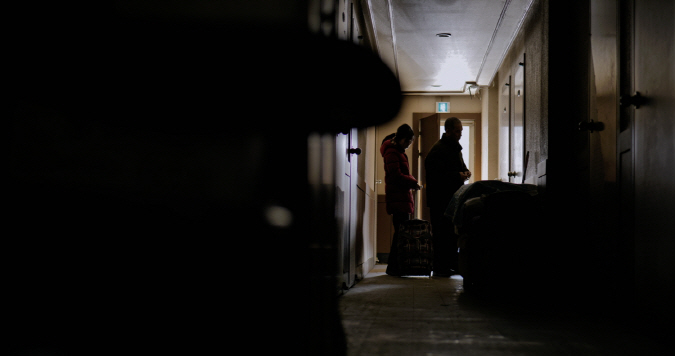
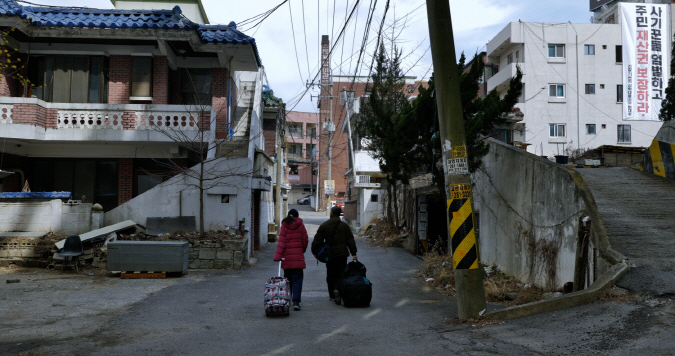
At the beginning, we are introduced to a middle-aged guy named Moon-ho (Lim Hoo-sung) and his mentally disabled adult daughter Go-eun (Lee Soon-jung), and the early part of the movie depicts how they go through their shabby daily life day by day. Without any place where they can stably stay, they move from one spot to another as depending on whatever Moon-ho can earn or get day by day, and he does not even hesitate to use his daughter’s mental disability just for getting what she wants.

On one day, there comes a small but tempting opportunity for better life. Along with a young single father named Do-kyeong (Lee Do-in), they get themselves involved with a seemingly lucrative real estate scam via a local broker, and all Moon-ho will have to do is having his daughter marry Do-kyeong before Do-kyeong applies for a special supply apartment for newlyweds. Once his application is accepted, that broker is going to handle the rest, and Do-kyeong and Moon-ho are promised that they will be regarded enough for their participation in this real estate scheme.   

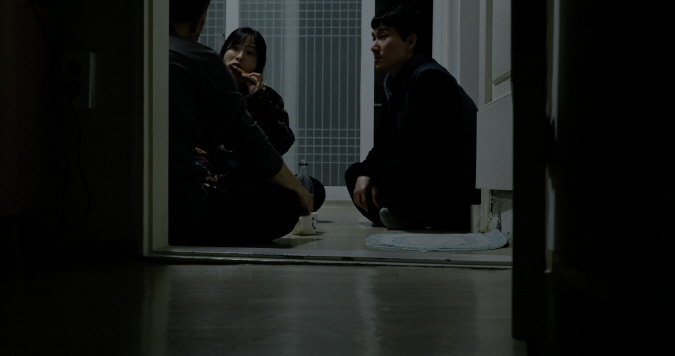
However, of course, there is a catch from the very beginning. After they get married officially as planned, Do-kyeong and Go-eun should live together for a while for avoiding any possible suspicion, but both Go-eun and her father do not mind this inconvenience much. After all, they still need a place to stay right now, and Do-kyeong is willing to accommodate his “wife” and her father in a little residence recently rented by him.

What follows next is how these three people try to live together as a “family”. As getting accustomed to their new place, Moon-ho and his daughter help Do-kyeong whenever Do-kyeong does some part-time jobs outside for earning the living for his “family” and his little daughter, and Do-kyeong also receives some extra help from his sister, who has no problem at all with taking care of both his little daughter and Moon-ho’s daughter.

Needless to say, things soon begin to go wrong no matter how much Moon-ho and Do-kyeong try. Moon-ho comes to realize that it is really impossible for him to buy any suitable apartment for him and his daughter regardless of how much the real estate scam will eventually benefit him, and Do-kyeong also gets a dose of harsh reality after applying for that special supply apartment for newlyweds later. As a result, he and Moon-ho come to clash more with each other, while Go-eun remains helpless as before.

What eventually occurs during the last act is supposedly devastating, but the screenplay by directors/writers Hur Jang and Keong Beom, who incidentally made a feature film debut here in this movie, is too hesitant and clumsy in terms of story and character development. While we never get to know that much about any of its main characters, the movie also constantly remains distant because it apparently wants to avoid any possibility of becoming your average misery porn. Accordingly, we come to observe its story and characters from the distance without much care or attention.

Moreover, I was sometimes distracted by how it handles Go-eun in a rather mediocre way. Because of her mental disability, we certainly become concerned about whatever may happen to her, and the movie thankfully avoids any cheap attempt on exploitative melodrama, but it also seems to have no idea on how to give more detail and personality to this character. Although Lee Soo-jung’s solid acting manages to fill her seriously blank role to some degree, Go-eun is still more or less than a mere plot element to roll along the plot, and that looks quite problematic to me.

In case of several other main cast members in the film, they also try their best in filling their respective spots as much as required. Lim Hoo-sung, a veteran actor who has been mostly known for his stage performance, brings some gritty human qualities to his character, and he is especially effective when his character later tries to get hired at a little vineyard run by an estranged family member of his. Nothing much is said between Moon-ho and that family member of his on the surface, but we can clearly sense many years of estrangement between them. Despite being stuck in a thankless role, Lee Do-jin has a few good moments for himself, and Ji Sung-eun brings a bit of warmth to the movie as Do-kyeong’s caring sister.

In conclusion, “The Berefts” does not distinguish itself enough from many other moody South Korean social drama films out there as often hesitating to delve further into its characters’ growing desperation. It is certainly well-intentioned, but the overall result sadly failed to engage me, and I can only hope that its directors will soon move onto better works after this underachieving debut of theirs.

Posted in Movies | Tagged , , , , | Leave a comment

Conclave (2024) ☆☆☆1/2 (3.5/4): Into a papal election

“Conclave” feels totally tense and serious with its utterly pulpy story material, and that is the main reason of its entertaining success. Closely confining itself within its isolated main background along with the story and characters, the movie vividly and palpably illustrates how serious and cautious its main characters are about their impending matter to be resolved as soon as possible, and we are totally engaged in their increasingly tricky situation.

The story begins with the sudden death of the incumbent pope in the Vatican. Once his death becomes official, Cardinal Lawrence (Ralph Fiennes), a liberal British cardinal who is incidentally the Dean of the College of Cardinals, promptly prepares for the Conclave, which is the secret election meeting for selecting the next pope to succeed the previous one. Numerous cardinals around the world quickly come to the Vatican for this time-honored private meeting, and then they will vote together in private again and again during an indefinite period until someone gets enough number of votes as required.

Because of the importance in selecting the head of the Catholic Church, Cardinal Lawrence and his staff members surely pay a lot of attention to isolating the Conclave from any interfering influence from the world outside as much as possible, and the movie has some moments of fascination as observing how thoroughly they work on the security matters of the Conclave. They make sure that the selected place for the Conclave is completely insulated from the outside, and we see how those arriving cardinals go through some security check before entering where they are going to stay during next several days at least.

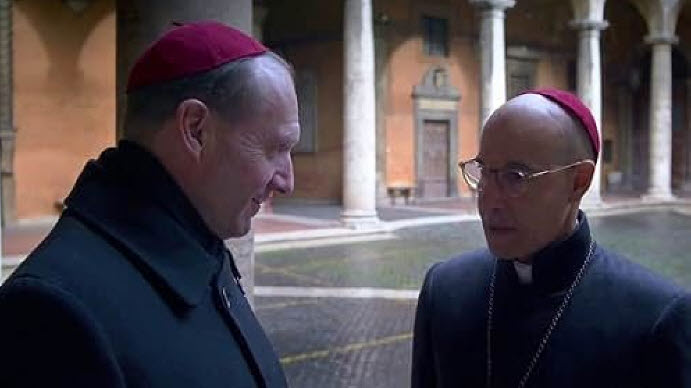
As every voting member of the Conclave including Cardinal Lawrence gather together, it is clear that there are several front runners in the group, and we get to know each of them bit by bit. On one hand, there is Cardinal Bellini (Stanley Tucci), an American cardinal whom Cardinal Lawrence is willing to support due to their shared liberal viewpoint. On the other hand, there is Cardinal Tedesco (Sergio Castellitto), an ultra-conservative cardinal who is not only quite ambitious but also very determined to push the Catholic Church more toward conservatism in contrast to the previous pope. In the middle of these two very different cardinals, there is Cardinal Adeyemi (Lucian Msamati), a cardinal who actually has a fairly good chance of becoming the first black pope in the history but does not agree much with Cardinal Lawrence due to his rather staunch conservative position.

Because Cardinal Bellini is getting less favorable among the voters as they vote one time after another, Cardinal Lawrence begins to consider supporting Cardinal Tremblay instead, a Canadian cardinal who may not be better than Cardinal Bellini but looks relatively more suitable than the two other front runners. However, it soon becomes quite possible that Cardinal Tremblay was not totally honest with Cardinal Lawrence from the very beginning, and that throws Cardinal Lawrence into more conflict. As several others around him suggest, maybe he should come forward as another main candidate, but that is the last thing he wants, because he has actually wanted to resign from his current position for getting closer to more believers out there.

Once its ground is set and ready, the screenplay by Peter Straughan, which is based on the novel of the same name by Robert Harris (He also served as one of the producers, by the way), deftly doles out one unexpected plot turn after another, and director Edward Berger, who has become more prominent thanks to his Oscar-winning German film “All Quiet on the Western Front” (2022), and his crew members including cinematographer Stéphane Fontaine and editor Nick Emerson did a stellar job of building up suspense on the screen. As they come to vote again and again within their isolated space, the dry but gradually anxious mood surrounding Cardinal Lawrence and several other main characters is more accentuated to us, and the tactfully edgy score by Voker Bertelmann frequently reminds us of how much they feel pressured with a lot of uncertainty in front of them.

Around the point where it delivers its last surprise, the story feels a bit too preposterous in my inconsequential opinion, but everything remains held well together under Berger’s skillful direction while also firmly anchored by the quiet intensity from another strong performance from Ralph Fiennes, who may get an Oscar nomination for this film in the next year. Looking mostly reserved as demanded on the surface, Fiennes subtly conveys to us his character’s deep faith and integrity besides the growing inner turmoil behind his unflappable façade, and we come to care more about whether his character can eventually lead the conclave to the right choice for their church.

Fiennes is also supported well by a bunch of good performers, who are all quite good at suggesting whatever their characters are actually hiding behind their back. While John Lithgow and Stanley Tucci are dependable as usual, Sergio Castellitto, Lucian Msamati, Brían F. O’Byrne, Jacek Koman, and Carlos Diehz are well-cast in their respective crucial supporting parts, and Isabella Rossellini distinguishes herself during one particular scene as the sole substantial female character in the story.

Overall, “Conclave” is an efficient genre piece which will satisfy the audiences with its many top-notch qualities from the beginning to the end. To be frank with you, I and a friend of mine were not surprised much by the finale as we correctly guessed it to some degree in advance, but we were quite captivated and entertained nonetheless, and I see no particular reason to prevent me from highly recommending it. It may not be one of the best films of this year, but it is surely one of the most entertaining movies of this year.

Posted in Movies | Tagged , , , , | 2 Comments

The Monk and the Gun (2023) ☆☆☆1/2(3.5/4): In the middle of modernization

“The Monk and the Gun”, which was the Bhutanese entry for Best International Film Oscar in last year (It was included in the shortlist around the end of last year, by the way), takes its time for its little deadpan human comedy about the democratization in Bhutan during the late 2000s. Yes, as told to us at the beginning of the film, the country and its people came to have the first democratic election only after its king willingly abdicated his in 2006, and the movie gives us a series of small hilarious moments before eventually culminating to the sublime finale which shows some hope and optimism for Bhutan and its people.

The story is set in a remote rural village located somewhere outside Thimphu. As the whole country is about to prepare for the first democratic election, many people in the village feel rather confused about this sudden social/political change, and that is why several government officials come to the village for some enlightenment. They are going to preside over a mock election for everyone in the village, and they hope that this may help the villagers experience and then understand democracy a bit more than before. 

However, not so surprisingly, their work turns out to be much more challenging than expected. While many villagers do know about the upcoming election thanks to a few TVs in the village, most of them do not know that much about how to vote, let alone what and how to prepare in advance for voting. For example, many of them do not know well what is actually necessary for the voter registration process, and this certainly frustrates the government officials a lot right from the beginning.

We also observe how things recently get quite complicated for one certain male villager and his family due to the upcoming election. While many of his neighbors and family members are going to vote for one of the two candidates in their area, he is pretty vocal about supporting the other candidate for a little understandable personal reason, and this naturally causes some conflict between him and others. As a matter of fact, his little daughter is often bullied and ostracized at her local school due to her father’s political stance, and his wife, who is incidentally tasked with assisting those government officials, is not so pleased about this situation to say the least.

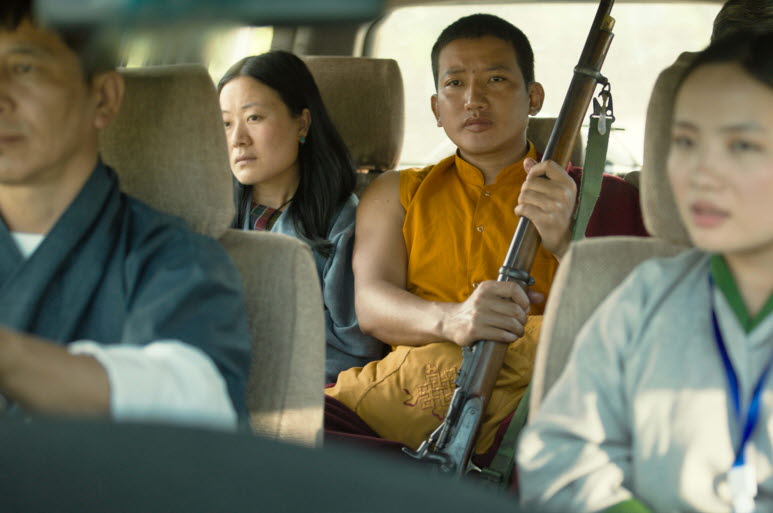
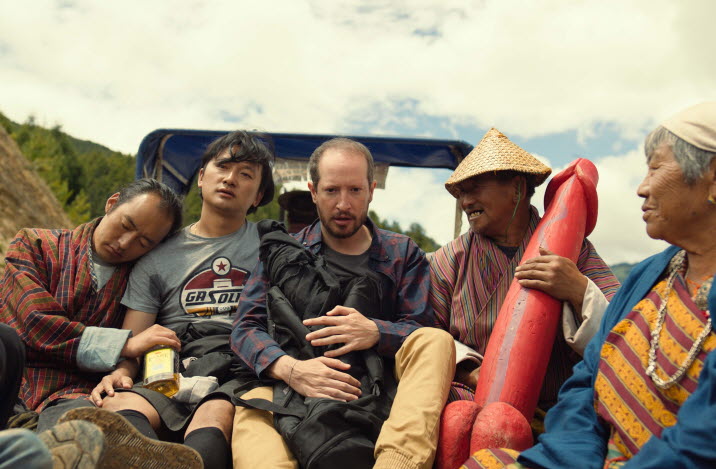
In the meantime, the movie also pays attention to one American visitor and his local guide, who come together for buying one old gun from one of the villagers. Regardless of how valuable it actually is, this American guy is ready to pay as much as possible for the gun, and the guide is willing to take some risk just because this illegal purchase will benefit him a lot, even though the local police are already looking for them.

When the American dude and his guide finally arrive in the villager and then meet their seller, the movie gives us one of its funniest moments as they are quite flabbergasted by the absurd outcome of their attempt to make a reasonable deal with their seller. I will not go into details here, but I can tell you instead that the movie simply lets this comic situation get developed step and step, and you will be certainly tickled by what happens in the end.

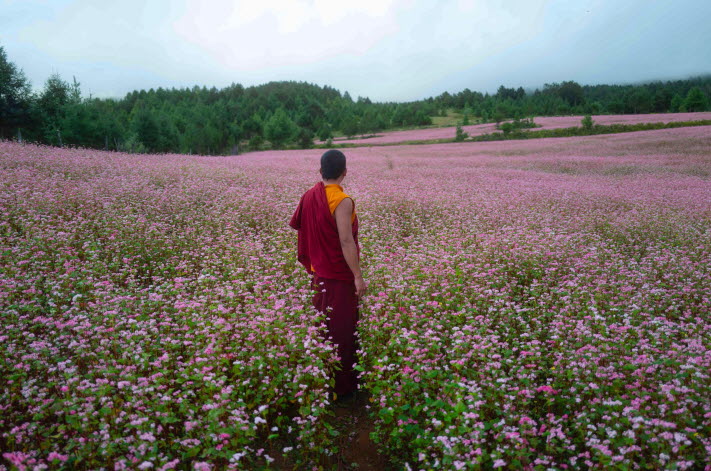
This moment subsequently leads to a funnier circumstance thanks to a respectable old Buddhist monk living in a nearby temple. After hearing about the upcoming election via his old little radio, the monk instructs one of his apprentices to get two guns for him within a few days before the full moon, and his apprentice dutifully follows his master’s instruction. After looking here and there around the village, the apprentice eventually comes to some guy’s house, and, what do you know, that guy is the owner of that old gun.

For avoiding spoiling any fun for you, I will just tell you instead that I admire how the screenplay by director/writer/co-producer Pawo Choyning Dorji, who previously drew some attention due to garnering a surprise Oscar nomination for his first feature film “Lunana: A Yak in the Classroom” (2019), patiently rolls its multiple narratives together without hurrying itself at all. As cinematographer Jigme Tenzing, who previously collaborated with Dorji in “Lunana: A Yak in the Classroom”, vividly presents a number of lovely mountainous landscapes, we become more immersed in the daily life of the villagers in the film, and we are alternatively amused and fascinated with their human responses to more modernization coming into their environment. Even when the story eventually reaches to the climatic part where we come to see why the old monk wants two guns, the movie firmly sticks to its slow narrative pacing despite generating some suspense around that point, and this leads to another funny moment, which comes with not only ironic absurdity and poetic justice but also a certain symbolic object which will definitely induce some good laughs from you.

In conclusion, “The Monk and the Gun” is modest but genuinely funny and engaging for how it handles the specific aspects of the story and characters with humor and respect. With this charming little film, Dorji succeeds in advancing further from what was admirably achieved in his previous work, and I will surely look forward to watching whatever he may do next after the well-deserved critical success of his first two feature films. Yes, this is one of those “slow movies”, but it is also a wonderful crowd-pleaser in my humble opinion, and you should not miss a chance to watch it.

Posted in Movies | Tagged , , , , | 1 Comment

Memoir of a Snail (2024) ☆☆☆1/2(3.5/4): A melancholic but funny animation film

Australian animation feature film “Memoirs of a Snail” is deeply melancholic but also undeniably humorous and touching. While often being quite sad and moody just like its heroine throughout the story, the film also shows a lot of wit, style, and heart as her life somehow goes on with some unexpected moments of comfort and happiness, and it is certainly one of the best animation films of this year.

The story begins with the death of an old lady named Pinky (voiced by Jacki Weaver), who has been the best friend to a woman named Grace Pudel (voiced by Sarah Snook) during last several years. Now being left alone inside her house filled with a number of pet snails and many other things, Grace comes to feel sadder and lonelier than before, and that is how she comes to reflect on how her life has been frequently filled with a lot of sadness and loneliness for many years.

During her childhood years, Grace grew up along with her twin brother under their widower father after their mother died not long after their birth. Although their father was not exactly a very good father, he tried his best for earning the living for him and his two kids before becoming a paraplegic due to an unfortunate accident, and young Grace (voiced by Charlotte Belsey) and her brother Gilbert (voiced by Mason Litsos and then Kodi Smit-McPhee later in the story) always had each other despite their rather imperfect life environment.

Sadly, Grace and Gilbert subsequently get separated from each other when their father unexpectedly dies. Now becoming orphans, they are respectively sent to different foster homes, and Grace comes to live along with an eccentric couple who is often too self-absorbed to pay real attention to Grace despite being well-intentioned at times. Needless to say, Grace comes to miss her twin brother more, and she and Gilbert are often consoled by the letters exchanged between them during next several years.

However, Gilbert is sent to the foster parents who are much worse than Grace’s. Gilbert’s foster parents, who incidentally run an apple orchard in addition to being your average hypocritical Christian fanatics, already have several other foster kids, and these kids and Gilbert are constantly abused and exploited by this deplorable couple day by day. As communicating with his twin sister more and more during next several years, Gilbert hopes to escape from his horrible foster parents as soon as possible, but the possibility of escape seems beyond his reach, and his situation becomes all the more desperate when his foster parents later come to find something of which they do not approve at all.

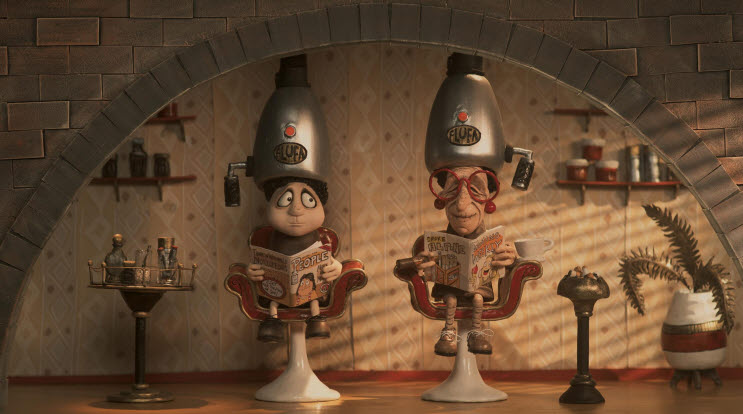
The story is indeed very sad, dark, and depressing to say the least, but the film sometimes shows some sense of humor from time to time while filling the screen with the engaging qualities of its distinctive clay animation style. Many characters in the story are presented as simple and broad figures, but they are imbued with each own colorful human personality, and the film even features not only a bit of nudity but also some sexual perversion (It is rated for R in US for good reasons, by the way).

Moreover, the film is constantly filled with small and big details to be observed and cherished. As Grace becomes more introverted during her following young adult years, her little residence is filled with numerous things and stuffs as shown from the beginning of the film, and you will admire more of the painstaking efforts from director/writer Adma Elliot and his crew, who all surely worked a lot on every frame of their film.

Above all, the story works as a moody but sensitive coming-of-age tale. Although she often gets mired in despair and misery in one way or another, Grace is usually supported and comforted a lot by Pinky, who gladly takes Grace under her wing after their accidental encounter and helps Grace coming out of her shell a bit more than before. Around the end of the story, Pinky comes to help Grace again even after her death, and we are reminded more of the value of kindness and compassion.

The voice cast members of the film are solid in their respective roles. Young performers Charlotte Belsey and Mason Listos are flawlessly connected with their respective adult counterparts, and Sarah Snook and Kodi Smit-McPhee are supported well by a bunch of colorful voice cast members including Eric Bana, Dominique Pinon, Tony Armstrong, Nick Cave, and Jacki Weaver, who always lightens up the mood whenever her lovable character appears on the screen.

On the whole, “Memoir of a Snail” is simply unforgettable as deftly balancing itself among humor, melancholy, and sincerity, and Elliot, who won a Best Short Animation Film Oscar for “Harvie Krumpet” (2003), gives another powerful work to remember after his previous animation feature film “Mary and Max” (2009), which I incidentally chose as one of the best films in 2010. As a guy diagnosed to be on the autism spectrum, its sensitive and poignant story about the unlikely friendship between a young girl and an older autistic guy came quite close to me, and I still remember how much I was moved around the end of that animation film. In case of “Memoir of a Snail”, both I and a friend of mine were touched a lot in the end, and I was not surprised at all when he told me later that he felt the need to call his sister right now. Yes, this is a really wonderful animation film, and you should check it out as soon as possible.

Posted in Movies | Tagged , , , , , | 2 Comments

Flow (2024) ☆☆☆1/2(3.5/4): A cat’s adventure

Animation feature film “Flow”, which was selected as the official submission of Latvia for Best International Film Oscar in this year, is a simple but enchanting fantasy tale which alternatively baffles and dazzles us. Without any dialogue at all, the film just presents a series of gorgeous visual moments as following the little adventure of one small cat and its several animals which happen to accompany that cat, and it is surely another excellent case of how original an animation film can be via ideas and images.

In the beginning, the film succinctly establishes its fantasy background. After we are introduced to a little black cat, we get the first action scene in the film as the cat is running away from a bunch of dogs after taking away a fish they have just caught, and then there comes a stunning scene featuring a herd of deer running away from a sudden big wave of water coming into the forest.

The cat manages to save itself, and then it comes across an abandoned big house filled with numerous stuffs left by whoever once lived there a long time ago. It seems that the world has been devoid of human beings for years, and we often see a number of small and big animal sculptures in and around the house. The cat surely shows some curiosity just like any cat would, and then it comes to make the attic of the house as its little comfortable shelter.

However, the water keeps rising (Is this an allegorical reflection of the global climate disruption in our world?), and the cat has no choice but to leave the house as looking for a higher spot. In the end, it comes across a boat with a capybara on board, and these two animals also come to rescue a lemur and then one of those dogs chasing after the cat at the beginning of the film. Needless to say, these four animals do not get along well with each other on the boat, and we accordingly get several little humorous moments from that. 

The film simply observes how its animal characters come to make a sort of communication among them mainly via their sounds and physical movements, and it trusts us enough to let us gather the developing relationship drama among them. As a matter of fact, director/co-producer/co-writer/co-producer Glints Zilbalodis and his crew members actually recorded and then used the sounds of several real animals, and that certainly brings some authenticity to the animal characters in the film (A small trivia: they could not get the right sounds in case of the capybara, so they instead recorded the sounds from a baby camel).  

 The story gets a little more interesting when the cat and its animal companions later encounter a bunch of big secretary bird. After one of these big birds happens to join the cat and its animal companions, they eventually reach to a huge but empty city partially immersed in water, and the film naturally gives us several moments of awe and wonder as its animal characters regard here and there in the city. Wondering what they exactly feel and think about the city as their boat keeps sailing as before, I was again reminded of what W.G. Sebald once said: “Men and animals regard each other across a gulf of mutual incomprehension.”

And the movie continues to enchant and baffle us more as its animal characters’ journey on the water is taking them to somewhere on the horizon. Although it is often evident that the production budget of the film is rather small, Zilbalodis and his crew did a splendid job of filling the screen with enough style and details to cherish, and the overall result is impressive enough to hold our attention even though we are often confounded about what the film is actually about. While Zilbalodis and his crew entirely depended on an open-source software named Blender, nothing looks cheap or shabby in their simple but striking animation, and the cat and several other animals in the film are presented as vivid characters to remember despite their rather broad appearance.

In my humble opinion, the film is a plain but haunting fable of friendship and solidarity which touchingly reminds us that we cannot live totally alone by ourselves. Sure, our feline character prefers to be alone as much as possible, but then it only ends up getting more associated with its accidental animal companions along the story, and there is some genuine poignancy around the end of its adventure story (You should stay during the following end credits for a brief but crucial post-credit scene, by the way).    

The film is surely a big leap from Zilbalodis’ previous animation feature film “Away” (2019), where he did almost everything in its production and post-production stage. That animation film is extremely simple in terms of story and characters while having no dialogue at all just like “Flow”, but it is also fairly engaging mainly thanks to Zilbalodis’s competent handling of mood, style, and detail, and it will show you that he already developed his own animation touches even at that point.

In conclusion, “Flow” is one of the best animation films of this year, and it confirms to us that Zilbalodis is a talented animation film director to watch. While it surely requires some patience at the beginning, it is quite a rich visual experience to behold and admire, and it is definitely more rewarding than, say, “Moana 2” (2024). Believe me, “Flow” will provide a more satisfying sailing adventure in terms of story and character, and that will be appreciated by both young and adult audiences.

Posted in Movies | Tagged , , , | 2 Comments

The Land of Morning Calm (2024) ☆☆☆1/2(3.5/4): A fisherman’s insurance scam

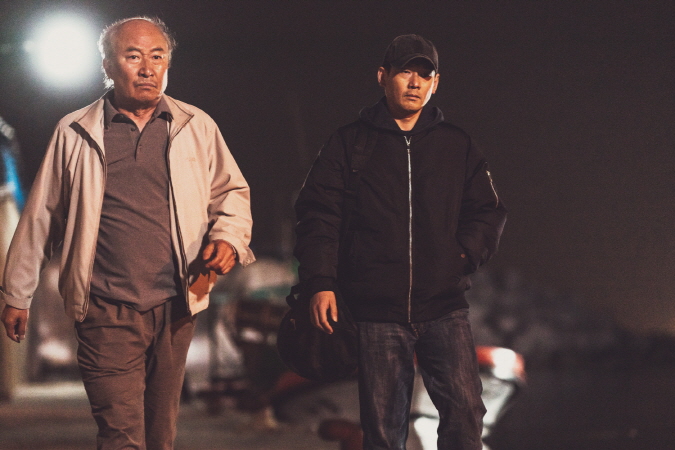
You will not easily forget the old but tough hero of South Korean film “The Land of Morning Calm”, which won three awards including the Best Film Award at the New Currents section of the Busan International Film Festival a few months ago. Although he is not a nice or pleasant dude at all, he is presented as a complex human figure to observe as we get to know more about him and his nearly hopeless life environment along the story, and it is compelling to watch how bluntly but sincerely he struggles for what should be done for a few others around him.

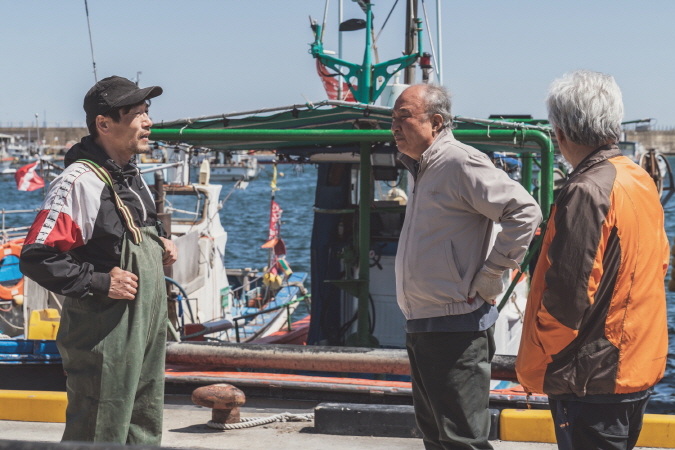
In the beginning, the movie slowly establishes the daily life of its hero in a little seaside village located somewhere on the east coast of South Korea. For many years, Yeong-gook (Yoon Joo-sang) has earned his meager living as a local fisherman in that village just like many other guys in the town, and the movie slowly lets us gather their desperate economic status. Many of them surely need some extra help due to their age, but there are not many young people in the village, and even foreign workers are usually not available to them. At least, Yeong-gook has a local lad named Yong-soo (Park Jong-hwan), but Yong-soo is not particularly dedicated to their work, and he actually has a little scheme for getting out of his hometown village.

We soon see Yeong-gook helping Yong-soo’s plan a bit. During one early morning, they go out to the sea as usual, but only Yeong-gook returns to the port, and then he flatly reports to the local police that Yong-soo fell into the sea. Naturally, the local police and several other local fishermen quickly embark on the search for Yong-soo, and both Yong-soo’s mother and his Vietnamese wife certainly become quite panic as fearing for the worst.

The plan of Yong-soo, who is actually alive and well in his hiding place, is pretty simple. Once his death becomes official on the record after the local police fails to find his body, his wife will accordingly receive a considerable amount of insurance money, and then they will go together to somewhere in Vietnam with that money, though his wife does not know anything at all just like his mother. As a matter of fact, she is so genuinely devastated by the growing possibility of his death that she is taken to a local hospital after having an unexpected medical emergency.

Because he really wants to help both Yong-soo and his wife, Yeong-gook tries to handle the situation as much as he can, but, of course, things do not go as well as he and Yong-soo hope. While nobody suspects them at all, the insurance company is actually quite ready to give the money to Yong-soo’s wife, but the official confirmation on his death is necessary for that. In addition, it turns out later that the search for Yong-soo’s body can actually be continued a lot longer than he and Yong-soo thought at first, regardless of whether the body can be really found or not in the end.

As Yeong-gook gets more frustrated and exasperated alone by himself, the movie observes more of how life has been quite despairing for him and many others in the village. As a local guy who gets hired by Yeong-gook shortly after his unwelcomed return bitterly admits to Yeong-gook at one point later in the story, the village has already been going down and down toward the bottom for many years without much hope or future, and Yeong-gook and many other local fisherman have no choice but to try to keep going anyway despite being constantly aware of their despairing status of life.

The movie also pays some attention to Yong-soo’s wife, who becomes quite desperate due to her husband’s absence. Without him, she finds herself all the more vulnerable to the racial prejudice of many villagers, and they casually gossip a lot about that insurance money right in front of her just because of their petty jealousy. Yong-soo’s mother, who still desperately hopes to see her son alive, is certainly willing to stand by her daughter-in-law as sharing their concern, but we sense that there has always been a considerable distance between them nonetheless.

While the situation becomes melodramatic as expected around the last act, the screenplay by director/writer Park Ri-woong keeps focusing on adding more detail and depth to its main characters, and his main cast performers are all effective in their respective parts. Yoon Joo-sang, a 75-year-old veteran actor who has steadily appeared here and there in numerous South Korean movies and TV dramas for more than 30 years, is often electrifying as flawlessly embodying the complicated human qualities of an aged but strong-willed man with a fair share of flaws including his hot temper, and it is definitely one of the best South Korean movie performances of this year. While Yang Hee-kyung, who also has a long and respectable acting career just like Yoon, is equally intense as Yong-soo’s devastated mother, Park Jong-hwan and Park Won-sang are solid in their key supporting roles, and the special mention goes to Vietnamese actress Khazsak Kramer, who does more than holding her own place well among the other main cast members.

On the whole, “The Land of Morning Calm” is the impressive second feature film from Park, who previously made a notable feature film debut in “The Girl on a Bulldozer” (2021). You may not like Yeong-gook that much even in the end, but you will come to have some understanding and empathy on him after the haunting last shot of the film, and that is what a really good movie can do for us in my inconsequential opinion.

Posted in Movies | Tagged , , | 1 Comment

The Seed of the Sacred Fig (2024) ☆☆☆1/2(3.5/4): A tense Iranian family/political drama

Iranian film “The Seed of the Sacred Fig”, which was recently selected as the German submission to Best International Film Oscar, is a masterful work which will hold your attention from the beginning to the end. Deftly balancing itself between political and family drama throughout its rather long running time (167 minutes), the movie often unnerves us as closely observing the toxic effect of patriarchy and theocracy on one plain family, and the result is one of the most interesting movies of this year.

The story behind the production of the movie has been known quite well to many of us since it was premiered at the Cannes Film Festival early in this year, where it received the special award from the jury of the festival. Director/writer/co-producer Mohammad Rasoulof, who previously won the Golden Bear for “There Is No Evil” (2020) at the 2020 Berlin Film Festival, and his crew and cast members had to make their film under absolute secrecy as Rasoulof got into more legal conflict with the Iranian government just like some of his fellow Iranian filmmakers including Jafar Panahi, and then the Iranian government sentenced him to 8 years in prison, shortly after he managed to escape and then attended its premiere at the Cannes Film Festival.

Despite many limits during its production and post-production period, Rasoulof’s film never looks rough or shabby at all in addition to being quite brave and ambitious. While it can be regarded as a chamber family drama in modest scale, the movie seldom feels stuffy or limited thanks to the splendid efforts from cinematographer Pooyan Aghababaei and editor Andrew Bird, and the main cast members of the film, who surely took a lot of risk as closely working with Rasoulof, are all believable as ordinary people you may come across in the middle of Tehran.

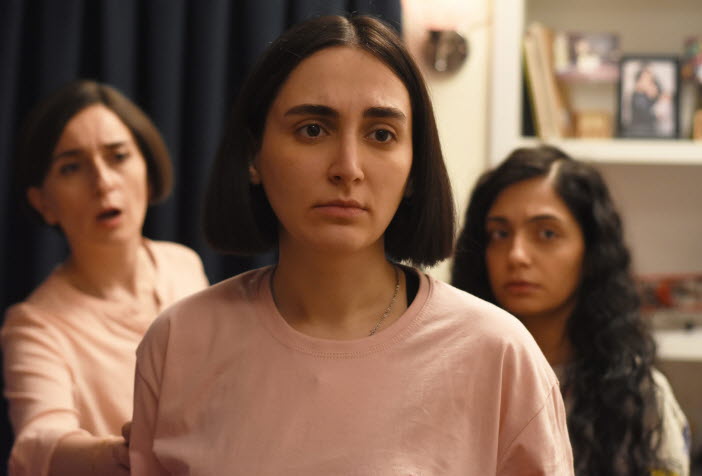
The story, which is set in Tehran around 2022, opens with the recent promotion of Iman (Missagh Zareh), who is the father in the family at the center of the story. For many years, he has worked in the Revolutionary Court in Tehran, and now he seems to get finally rewarded when he is newly appointed as an investigating judge. Although there are still a few more steps he has to go up for his career, this promotion will certainly benefit him as well as his family a lot, and his devoted wife Najmeh (Soheila Golestani) is naturally happy to hear this good news from him.

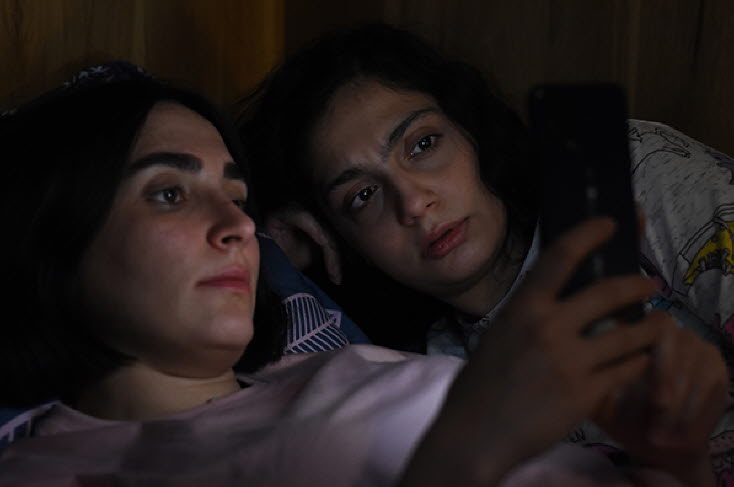
However, their two young daughters, Rezvan (Mahsa Rostami) and Sana (Setareh Maleki), are not so excited or impressed. After all, their parents have rarely told them about their father’s job throughout their whole life because of the secretive aspects of their father’s job, and they do not care that much even when their mother firmly emphasizes to them that they should be much more careful in their behavior and appearance for not causing any trouble to affect their father’s position.

We soon see the signs of the troubles to come into this family. As the Iranian society becomes agitated more and more due to the increasing number of riots and demonstrations outside, the mood in the family apartment gets gradually tense day by day as Najmeh and Iman come to conflict more with their daughters, who come to care more about the ongoing political situation in their country after a friend of theirs gets seriously injured and then unjustly arrested. No matter how much Iman and Najmeh try to get things under control, Rezvan and Sana come to show more defiance and disobedience instead, and that certainly frustrates and exasperates both of their parents.

While mostly sticking to what is happening inside the apartment of the family, the movie also shows us more of how things became more volatile in Tehran during that time. It occasionally presents a series of raw footage clips showing not only riots and demonstrations but also some police brutality, and this surely puts more dramatic tension on the ongoing personal drama among its main characters, especially when a certain important item given to Iman is disappeared at one point in the middle of the story. Because this incident can actually destroy his whole career, Iman becomes quite determined to get to the bottom of this troubling situation, and it goes without saying that both Najmeh and her daughters come to see how cruel and authoritative he can really be.

I will not go into details on how this family conflict eventually reaches to the inevitable breaking point, but I can tell you instead on how its main cast members ably carry the story and their characters to the dry but undeniably intense climax which somehow reminds me of Stanley Kubrick’s “The Shining” (1980). While Missagh Zareh is effective as a plain dude who lets himself driven further by the misogyny and theocracy of his system despite his initial compunction, Mahsa Rostami, Setareh Maleki, and Soheila Golestani, who all courageously ignored the certain oppressive rules on female Iranian actresses for the film (They were all supposed to wear a hijab in front of the camera, for example), are impressive in each own way as the heart and soul of the film, and Golestani is particularly devastating as Najmeh comes to have more doubt and frustration on her relationship with Iman later in the story.

In conclusion, “The Seed of the Sacred Fig” is another superlative Iranian film after Panahi’s equally acclaimed movie “No Bears” (2022), which I and South Korean audiences belatedly watched early in this year. Considering not only how that fierce public demand for social change in Iran was eventually ended in 2023 without much difference but also how fascism and totalitarianism have been raging all over the world during last several years, this defiant piece of work feels all the more bitter to say the least, but the allegorical aspects of its powerful human drama made me reflect a bit on how every totalitarian regime is bound for eventual collapse when it begins to regard its own people as the enemies of the state. The problem is, when will that ever happen to Iran and its people?

Posted in Movies | Tagged , , | 2 Comments

Moana 2 (2024) ☆☆1/2(2.5/4): A middling second chapter not sailing that far

Disney animation film “Moana 2” is a middling second chapter compared to its promising predecessor, and that is a big disappointment for all of us. Sure, it looks as terrific as you can expect from any decent Disney animation these days, but it feels relatively deficient due to its weak storytelling without much narrative development, and it only comes to function as a mere prelude for whatever may come next.

 At the beginning, we see how much things have been changed for Moana (voiced by Auli’i Cravalho) and her island people since she saved the island as well as her clan via her epic adventure depicted in “Moana” (2016). Becoming more confident than before, Moana is quite willing to sail further from her island for finding any other island and people out there, and her father, who is incidentally the chief of her clan, is certainly ready to support her more just like many other members of her clan.

However, Moana suddenly has a striking vision not long before she embarks on another exploration across the ocean. It turns out that there is a certain mythic island which has been hidden by some powerful entity for many years, and she must find that island for restoring the broken connection among many other people living across the ocean. Knowing that this exploration will be much more demanding than the previous ones, she recruits several other members of her clan, and most of them gladly join her as expecting to have a lot of fun and excitement together, though they are all quite inexperienced to say the least from the very beginning.

Meanwhile, the story also focuses a bit on Moana’s demigod friend Maui (voiced by Dwayne Johnson), who happens to be stuck in a big trouble due to that powerful entity and Matangi (voiced by Awhimai Fraser), a mysterious figure supposedly working under that powerful entity. Again, Johnson has some fun with his character’s irrepressible swagger, but, to our frustration, this subplot simply meanders with some silly gags before eventually joining the main narrative of the story (This is not a spoiler at all, folks). 

The film unfortunately spends too much of its running time before our plucky heroine joins her demigod friend, and, to makes matters worse, the story does not have enough personality and substance to justify that. While Moana’s pet pig and chicken are surely your average animal sidekicks as before, Moana’s three companions are no less than perfunctory plot elements despite their colorful attitudes and appearances, and the film sadly does not allow much character development as hurriedly rolling its main characters from one narrative point to another.

The film certainly serves us a series of visual spectacles as expected, but none of them are particularly inspired in my trivial opinion. Sure, they look crisp and colorful, and that was quite evident to me when I watched the film at the Dolby Cinema screening room of a local theater, but they are not impressive or original enough to linger on your mind. As watching the climax full of storm and thunder, I could not help but reminded of what I saw from “Twisters” (2024) several months ago. As observing those little coconut creatures appearing in the middle of the film, I could not help but think of “Minions” (2015). As beholding the huge and complex spaces inside a certain giant creature, my mind instantly went back to another recent Disney animation film “Strange World” (2022).

Moreover, a number of songs in the film are not very memorable even though they serve the story and characters fairly well on the whole. I will not deny that I smiled a bit as listening to Awhimai Fraser delightfully performing “Get Lost” with some gusto, but the soundtrack of “Moana 2” is mildly pleasant while being merely passable in the end, and you may come to miss more of those catchy songs in “Moana”. To be frank with you, I still fondly remember how powerfully Auli’i Cravalho performed Lin-Manuela Miranda’s Oscar-nominated song “How Far I’ll Go” in “Moana” and then at the following Academy Awards ceremony, and I have to tell you that the soundtrack of “Moana 2” does not have anything equal to that, though I appreciate how it respectfully utilizes the ethnic musical elements throughout the story.

While it is a shame that the film does not have enough space for their good chemistry, Cravalho and Johnson still click well together during their several key scenes later in the film, and I wish to see much more of that in the next film. In case of several other voice cast members of the film, Hualālai Chung, Rose Matafeo, David Fane, Temuera Morrison, and Rachel House dutifully fill their respective spots as required, and Morrison and House deserve some praise for doing a lot more than required despite their rather brief appearance.

In conclusion, “Moana 2”, directed by David Derrick Jr., Jason Hand, and Dana Ledoux Miller, is not a total waste of time at all, but it is dissatisfying for just warming up a bit for the next sequel instead of sailing further than what was promised at the end of its predecessor. It is surely well-made in technical aspects, but we all know well that Disney Animation Studios can do better than this, and we can only hope that it will really enchant and entertain us in our heroine’s next adventure.

Posted in Movies | Tagged , , | Leave a comment