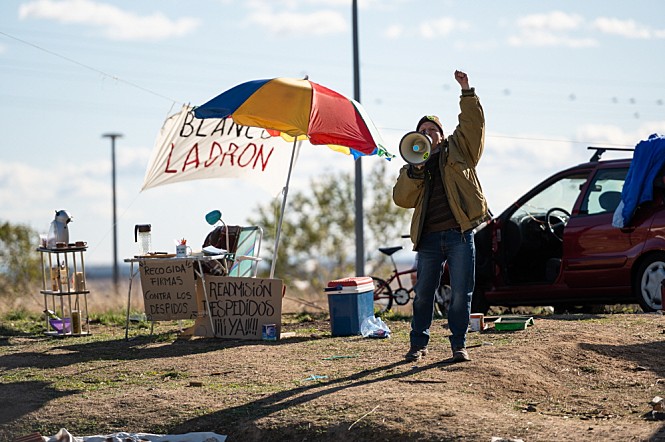
One Second (2020) ☆☆☆(3/4): A movie screening in the middle of desert

Chinese film “One Second” works best whenever it focuses on that fascinating power of movie. Although it is a bit too broad and simple in terms of story and characters in my humble opinion, I could not help but amused and touched by one particular scene where the camera looks at many audiences eager to watch a film at the shabby movie theater of their little desert town. As a matter of fact, this moment instantly reminded me of what François Truffaut once said: “The most beautiful sight in a movie theater is to walk down to the front, turn around, and look at the light from the screen reflected on the upturned faces of the members of the audience.”

The movie, which is set during the Cultural Revolution era of the 1960s, mainly revolves around the nameless hero played by Zhang Yi, and the opening scene shows him going through a vast and remote desert area alone by himself. When he subsequently arrives at a village, it turns out that he wanted to attend the local screening of a certain film, but, unfortunately, the screening was already over, and those film reels of that movie are already ready to be delivered to some other village in the area.

Anyway, it seems that all our hero will have to do is accompanying or following after the guy in charge of delivering the film reels to that village, but then there comes a little trouble. He happens to spot someone attempting to take one of the film reels, so he instantly follows after this figure, and, to his surprise, this figure turns out to be a young girl. He manages to retrieve the film reel from the girl, but then, to our little amusement, the situation goes wrong for him, and he only ends up arriving at that village without the film reel.

Meanwhile, everyone in that village is looking forward to watching the movie, though they already watched it more than once. The guy in charge of the movie projector is enjoying all the attention he can get from others in the village, but then it turns out that there is another problem besides that stolen reel. While that stolen reel is fortunately returned to the movie projector guy thanks to our hero’s accidental encounter with the girl in the village, the propaganda newsreel part preceding the film itself happened to be severely tarnished and entangled during the delivery process, and this must be untangled and cleaned up as soon as possible because of being the mandatory part of the upcoming screening.

What follows next is pretty amusing to say the least. Under the command and guidance of the movie projector guy, lots of village people embark on a makeshift film restoration process, and the movie has a lot of small fun with this rather crude but fairly effective work process. After they carefully untangled the tarnished film reel step by step, they hang it on clotheslines for getting it cleaned up by distilled water frame by frame (How they get distilled water is one of little nice touches in the film, by the way), and you may chuckle a bit as watching how they later try to dry it before spooling it in the end.

Meanwhile, there is still some tension between our hero and the girl, who finds herself getting involved with him more than she wanted. When he comes to learn more of her desperate daily life, he feels sorry for her, but he is more occupied with getting what he wants from the upcoming screening. He is actually not interested in the movie itself at all, but he really wants to watch the newsreel part for a personal reason, and he is determined to get what he wants by any means necessary.

Although the drama between our hero and the girl is rather contrived, the movie continues to engage us as paying attention to small details involved with the movie screening. You may feel some nostalgia as observing the movie projector guy working a bit on his old movie projector before the screening is finally started, and the audiences’ active reactions to the whatever is projected on the screen will surely remind you of why we go to movie theater, though that is not that possible at present due to the ongoing COVID-19 pandemic.

Mainly due to its weak characterization, the movie stumbles more than once around the finale and the following epilogue scene, and I do not think the epilogue scene works as well as intended, but there are still lots of things to admire thanks to director Zhang Yimou’s unadorned but competent direction. He and cinematographer Zhao Xiaoding often fill the screen with dry and stark ambiance via wide shots of desert landscapes, and that further accentuates its main characters’ despair and desperation. While Zhang Yi functions as the stoic center of the film as required, Liu Haocun’s plucky acting ably complements her co-star’s low-key performance, and Fan Wei is also effective as revealing some human depth inside his seemingly pompous supporting character.

On the whole, “One Second” is a minor work in Zhang’s long filmmaking career, but I admire it to some degree because its simple but intimate drama sometimes reminded me of his notable early works such as “Raise the Red Lantern” (1991) and “The Story of Qui Ju” (1992). Although he has usually made bigger movies such as “Hero” (2002), “Curse of the Golden Flower” (2006), and “Shadow” (2018) these days, he still can go back to his old territory as previously shown from “Coming Home” (2014), and I can only hope that he will do that more frequently.

Posted in Movies | Tagged , , | Leave a comment

The Climb (2019) ☆☆☆1/2(3.5/4): Scenes from a friendship

“The Climb” is a small but hilarious comedy film about the bumpy friendship between its two ordinary main characters. As they alternatively push and pull each other over the story, the movie gives us a number of wonderful comic moments to be savored, and it is also rather touching to see how their problematic relationship eventually reaches to a sort of equilibrium around the end of the story.

During the opening scene, we meet Kyle (Kyle Marvin) and Mike (Michael Angelo Covino), who have been each other’s best friend for many years since their childhood years. They are doing cycling somewhere in Southern France, and they talk a bit about Kyle’s upcoming wedding and his fiancé Ava (Judith Godrèche), but then Mike comes to confess something which may jeopardize his best friend’s wedding. His revelation leads to the first funny moment in the film as he and Kyle argue with each other while also trying to keep cycling as before, and cinematography Zach Kuperstein’s camera steadily accumulates comic momentum via a plain but technically impressive unbroken shot.

Anyway, Mike and Kyle consequently become distant to each other, but then there later comes an unexpected incident which devastates Kyle a lot. Mired in so much grief, Kyle only comes to embarrass himself in front of others, and that is when Mike comes for helping and consoling him a bit. Both of them certainly feel awkward to be with each other, but it looks like they are on the way to reconciliation, and the movie impresses us more as deftly presenting this dynamic emotional moment in another commendable extended shot.

The following sequence, which is also fluidly presented in unbroken shot, initially shows Kyle being in a relationship with Marissa (Gayle Rankin), who was once his girlfriend during their high school years. Although he knows well that his mother and other family members do not approve much of her, he is willing to marry her as soon as possible, and we get another hilarious moment in the film when he tries something amusing for her in their little private place, which is incidentally the basement of his family house.

While Kyle and Marissa later try to enjoy Thanksgiving Day along with his family, his mother notifies to him that she invited Mike to their upcoming Christmas dinner just because Mike has been like another family member for years and is also in the need of some solace and support. Kyle does not feel that good about having his friend around Marissa, but, what do you know, he only ends up going to a ski resort along with not only Marissa but also Mike.

As observing the interactions among these three characters, we come to sense something being developed amid them, and, not so surprisingly, there eventually comes a point where Mike and Marissa have an emotional clash during Kyle’s absence. Believing that Marissa is not good enough for his best friend, Mike is willing to go a bit further for his best friend, but Marissa turns out to be a formidable match for him, and that leads to another funny moment for us.

I will not go into details on what will occur between Kyle and Mike next, but I can tell you at least that the screenplay by director Michael Angelo Covino and his co-writer (and real-life friend) Kyle Marvin, who also co-produce the film together in addition to acting together on the screen, keeps catching us off guard via a number of unexpected moments. In case of the long-take sequence unfolded on a frozen lake on one cold winter day, it looks like a mere counterpart to the opening scene, but then it comes to delve more into Kyle and Mike’s emotional bond as each of them confide more to each other, and then there comes a sudden moment which can be regarded as a punchline for this comic situation.

The movie, which was developed from Covino’s 2018 short film of the same name, depends a lot on the comic chemistry between Marvin and Covino, who are consistently believable throughout a series of ups and downs in their characters’ relationship development. Although the movie does not give us much of their characters’ background information, Marvin and Covino effortlessly convey to us the long history between their characters as well as their flawed but ultimately enduring emotional bond, and their characters come to us as engaging human figures to observe with some amusement.

Around Marvin and Covino, several other main cast members fill their respective spots as required. Gayle Rankin and Judith Godrèche are effective as two different women who happen to get themselves entangled with Kyle and Mike’s relationship, and Rankin is particularly wonderful when her character shows Kyle and others how much she is willing to take a chance with Kyle despite all those remaining matters around and between them. In case of Talia Balsam and George Wendt, they simply come and go as Kyle’s parents, but Balsam has one little nice moment when her character provides a mix of pep talk and advice to Mike at one point.

Although it was shown at the Un Certain Regard section of the Cannes Film Festival early in 2019 (It received the Jury Coup de Coeur award there, by the way), “The Climb” was released in US around the end of 2020 due to the ongoing COVID-19 pandemic, and then it was unfortunately forgotten shortly after that. In my humble opinion, this is indeed an overlooked gem which needs more attention, and I recommend you to check it out as soon as possible.

Posted in Movies | Tagged , | Leave a comment

Memoria (2021) ☆☆☆1/2(3.5/4): Searching for one particular sound

To be frank with you, it took some time for me to get accustomed to the works of Apichatpong Weerasethakul, a Thai filmmaker who has been more notable to me and many other moviegoers since he won the Palme d’Or award at the Cannes Film Festival for “Uncle Boonmee Who Can Recall His Past Lives” (2010). I merely admired that rather baffling film with some reservation, but I still remember many of its interesting moments, and I guess maybe I should revisit it someday. In case of “Cemetery of Splendor” (2015), it also baffled me at first when I belatedly watched it a few years ago, but then it turned out to be a more engaging experience than expected.

Weerasethakul’s latest film “Memoria”, which won the Grand Jury award when it was shown at the Cannes film festival in last year and then was selected as Colombia’s entry to Best International Film Oscar, is as slow and ambiguous as you can expect from him, and it will certainly requires some patience from you, but, in my trivial opinion, it is an experience you will not forget easily. Although I do not think I totally understand what it is exactly about, I appreciate a lot how it is about from the beginning to the end, and I am already ready for the second viewing for savoring its subtle mood and details more.

The free-flowing narrative of the film mainly revolves around Jessica Holland (Tilda Swinton), a Scottish woman who lives in Medellín, Colombia while running a modest local gardening business there. She comes to Bogotá as her sister, who lives there along with her Colombian husband and their little kid, is in a hospital for some illness, and we get a plain but meditative moment of sisterhood as the camera serenely looks at their little wordless private moment in the hospital for a while.

We also see Jessica trying to get to the bottom of one small but enigmatic matter with which she has been increasingly obsessed. As shown from the opening scene, she happened to hear a strange sound at one night, and she subsequently gets some help from a young sound expert introduced to her via her sister’s husband. As they try to find that mysterious sound in that expert’s workplace, the camera simply observes them, and we become more fascinated as that expert’s ongoing process gradually gets closer to what Jessica heard at that night.

Once they find a certain sound sample which almost matches to her description, that sound sample is skillfully manipulated in one way or another for making it closer to that sound, and that makes us more aware of the thoughtful sound design of the film, which naturally becomes one of the key factors in its leisurely narrative development. There are several seemingly mundane scenes in the film, and they look rather inconsequential at first, but then they will draw the attention of your ears bit by bit, and that is one of the main reasons why you should experience it a big screening room equipped with a fairly good sound system.

Around the middle point of the film, the situation becomes a bit more baffling for Jessica. When she goes to that sound expert’s workplace for getting more professional help, that sound expert is gone for no apparent reason, and she is baffled to see that nobody knows or remembers that sound expert at all. After it becomes apparent to her that only she can hear that mysterious sound, she visits a doctor during her visit to some rural site, and she gets some pills from the doctor, but that does not look like a good option as she listens to the doctor’s sincere advice involved with the possible side effects of those pills.

During the last act of the film, Jessica comes across a guy going through his daily work in his remote place, and the mood becomes more pensive as the camera steadily watches their tentative interactions from the distance. It may be just a sheer coincidence, but it turns out that there is a little common thing between this guy and that sound expert, and Jessica eventually goes to his little residence along with him. I do not dare to go into details on what happens next between them, but I can tell you instead that you will be more attentive to the soundtrack if you have already been engaged enough in its mood and details. What is eventually revealed at the end of Jessica’s journey will catch you off guard, and some of you may find it too off-the-wall, but, at least, that somehow makes sense with what has been organically developed during the rest of the movie.

As the center of the film, Tilda Swinton, who has diligently and impressively worked in numerous various films for more than 30 years, is dependable as usual. While effortlessly tuning her acting to the overall low-key tone of the film, she dutifully carries the film with subtle human touches, and her unadorned lead performance is supported well by several substantial main cast members including Jeanne Balibar, Juan Pablo Urrego, Daniel Giménez Cacho, Agnes Brekke, and Elkin Díaz, who holds his own place well beside Swinton during their two long but compelling scenes later in the film.

In conclusion, “Memoria”, which is incidentally Weerasethakul’s first foreign language film, is a challenging work to say the least, but it will engage you a lot once if you accept his distinctive cinematic mood and style. Yes, this is surely not something you can casually watch on Sunday afternoon, but I assure you that its mood and images will linger on your mind for a long time once it is over, and you will probably find yourself willing to listen more during its end credits.

Posted in Movies | Tagged , , | 2 Comments

French Exit (2020) ☆☆1/2(2.5/4): Almost penniless in Paris

“French Exit” has some charm and spirit to be appreciated despite being a bit too flawed in my inconsequential opinion. While it is buoyed to some degree by its delightful lead performance, the movie often stumbles and meanders mainly due to its rather thin narrative and broad characterization, and this weak aspect is still glaring to me even when I reflect on its several nice moments to remember.

Michelle Pfeiffer, who is still exuding her undeniable star presence even though it has been more than 40 years since she made a film debut, plays Frances Price, a carefree Manhattan socialite who has lived with her son Malcolm (Lucas Hedges) for years since her husband’s death. As she is going through another uneventful but luxurious day of hers, she gets a phone call from her estate manager, and her estate manager has a very bad news for her and her son. As her estate manager has warned for last several years, her bank account is totally empty now, and she has no choice but to sell not only her expensive apartment but also every valuable stuff inside it.

Consequently, she and her son become virtually homeless, but there comes an unexpected little help from her close friend Joan (Susan Coyne), who still stands by her best friend as before. Joan happens to own a little apartment in Paris which has been unoccupied for some time, and she is willing to allow Frances and her son to live there at least for a while.

Frances hesitates at first, but she eventually accepts this generous offer from her friend, and we soon see her and her son (and her black cat) on a big transatlantic cruise ship. Although the money from selling everything belonging them is not that much to say the least, Frances still behaves as if nothing was changed in her life at all, and her son quietly nurses his emotional wound from his recent breakup with his girlfriend Susan (Imogen Poots), but then he finds himself being attracted to a young woman named Madeleine (Danielle Macdonald). Madeleine happens to be working as a medium on the ship, and we later get a small amusing moment when the ship doctor shows Malcolm the bodies of several recently deceased people on the ship including the one whose death was prophesied by Madeleine right before that.

While that apartment in Paris looks much more modest than her previous residence in Manhattan, Frances is ready to settle there, but she does not seem to have any idea on what to do next for herself and her son. When a local neighbor, who has been a widow for years and also actually knew her, approaches to her mainly because of loneliness, she is understandably annoyed a bit at first, but then she accepts this widow’s dinner invitation because, well, there is nothing else to do for her. Although she is a bit bored to be with her new neighbor, she comes to feel a little sorry, and she eventually lets her new neighbor hang around her more.

As Patrick deWitt’s screenplay, which is based on his novel of the same name, leisurely jaunts from one episode to another, several other characters also come to revolve around Frances and her son. When her cat is lost at one point, Frances becomes quite adamant about finding it as soon as possible for a rather absurd personal reason, and she comes to believe that Madeleine will help her on that, though both her and her son do not know where Madeleine is at present. When her new neighbor recommends a local private investigator, Frances does not hesitate at all, and this private investigator gets himself involved with them more than expected. In addition, Susan, who was initially not so interested in starting over with Malcolm as going back to her old boyfriend, comes to change her mind, and that consequently leads to a very awkward circumstance among them and several other people around them later in the story.

This is a fairly good setup for more laughs for us, but the movie somehow fails to generate enough comic momentum to engage us. I enjoyed how it keeps its straight attitude along with its main cast members even during a couple of séance scenes, and I was also amused by a brief scene involved with Frances’ impulsive suicidal letter, but, to my disappointment, the movie is mostly spinning its wheels without much character or narrative development.

At least, director Azazel Jacobs, who previously drew my attention for his small underrated coming-of-age drama film “Terri” (2011), has Pfeiffer and several good performers to notice. While deftly handling her character’s numerous colorful moments in the film, Pfeiffer also lets us have some glimpses of her character’s humanity, and she and Lucas Hedges, who is no stranger to playing youthful characters with emotional issues, click well together during their several key scenes. In case of the other main cast members, Valerie Mahaffey, Imogen Poots, Susan Coyne, Danielle Macdonald, and Isaach de Bankolé fill their respective spots as much as demanded, and the special mention goes to that adorable black cat who often steals the show in the movie.

In conclusion, “French Exit” is not entirely without fun, but it did not engage me enough during my viewing, and my mind frequently went somewhere even while my eyes were savoring the game efforts from Pfeiffer and several other main performers in the film. As many of you know, she is still a wonderful actress, and I certainly hope that she will keep going as usual.

Posted in Movies | Tagged , , | Leave a comment

The Last Vermeer (2019) ☆☆☆(3/4): Better to be a forger than a traitor

“The Last Vermeer” is a modest period drama film which becomes compelling whenever its untrustworthy but undeniably fascinating real-life figure enters the screen. Here is an unabashedly opportunistic dude who cleverly duped many others including the Nazis during the World War II while also benefiting himself a lot, and it is rather amusing to observe he came to get away with his criminal deeds in addition to rebranding himself as a national folk hero.

However, the main focus of the movie lies on the other main character in the story, and the early part of the movie quickly establishes what this character is doing in the Netherlands not long after the end of the World War II in 1945. Heaps of valuable artworks were recently found inside a covert storage site of the Nazis in Germany, and it is the job of Captain Joseph Piller (Claes Bang) to track down any Dutch person who helped the Nazis collecting some of these artworks during the wartime. As a Dutch Allied officer of Jewish descent, Piller certainly has no sympathy for Nazi collaborators at all, and he is already determined to do his job to the end along with his dependable assistant Minna Holberg (Vicky Krieps).

One of the most valuable items in the bunch is a certain famous painting by Dutch painter Johannes Vermeer, which was regarded as one of the most valuable artworks in the Netherlands before the war. During the war, it was bought by one of Hilter’s most prominent inner circle members, and Piller is quite interested in who actually arranged this traitorous purchase at that time. Along with his right-hand guy Esper Vesser (Roland Møller), he soon tracks down someone who may give the information on that figure in question, and that is how they subsequently arrive at the front door of the house belonging to a guy named Han van Meegeren (Guy Pearce).

While Piller does not hide his intention at all during his first encounter with van Meegeren, van Meegeren remains surprisingly aloof and casual even as being taken to a prison later, and Piller later comes to see that he is not the only one interested in whatever van Meegeren may tell. As a matter of fact, a bunch of local detectives from the Dutch government are also sent for investigating van Meegeren, and Piller does not trust these guys that much mainly because he knows well how willing the Dutch government is to cover up some of Nazi collaborators in the Netherlands.

In the end, Piller comes to take van Meegeren to a safer place for preventing any contact between van Meegeren and anybody else besides him, and then van Meegeren makes some curious demands for drawing something. It is clear that he does know something about that Vermeer painting, but he is not someone who will tell everything instantly, and, for now, he only gives Piller a few clues for his ongoing investigation.

As he goes further into who van Meegeren was during the wartime, Piller comes to suspect and despise van Meegeren more. Although he was once a talented and promising painter, van Meegeren subsequently let himself pursue money and pleasure more instead of art, and he did not mind at all getting associated with the Nazis and some of those Nazi collaborators just because that suit well his luxurious hedonistic lifestyle.

However, Piller subsequently finds himself passionately defending van Meegeren after finally coming to learn about what van Meegeren actually did before and during the wartime. While he might be not that good enough to distinguish himself as an artist, van Meegeren found his calling in art forgery, and his forgery skills were so good that even those respectable Vermeer experts were thoroughly fooled by his several results, which were simply presented as Vermeer’s newly discovered works.

The second half of the movie mainly revolves around the following trial whose outcome depends on whether Piller can prove van Meegeren’s forgery in front of the judges, and the screenplay by John Orloff, Mark Fergus, and Hawk Ostby, which is based on Jonathan Lopez’ book “The Man Who Made Vermeers”, is rather heavy-handed during this part. I do not know how much the movie was actually close to its real-life story, but several big moments during this part feel artificial in my humble opinion, and the movie also goes a bit too far for dramatic effects at one certain point around the expected finale.

Nevertheless, the movie still engages us mainly due to the showy lead performance by Guy Pearce, who is simply fun as savoring every delicious moment of his in the film. Ably balancing his sly and elusive character between fascination and distrust, Pearce brings some necessary humor and energy into the story, and his flamboyant appearance is also complemented well by the stoic appearance of Claes Bang, who does as much as he can do for filling his relatively thankless role. In case of several other notable performers in the film, Roland Møller and August Diehl are unfortunately stuck with their functional characters, and the same thing can be said about Vicky Krieps, who is reliable as usual but often feels under-utilized.

Directed by Dan Friedkin (No, he is not related to William Friedkin), “The Last Vermeer” is rather plain on the surface, and I think it could be much more interesting if it delved more into van Meegeren’s life and career, but it is mildly recommendable for its several good elements including Pearce’s enjoyable acting. It did not surprise me much, but I was entertained enough at least, so I will not grumble for now.

Posted in Movies | Tagged , , , , , | Leave a comment

A Hero (2021) ☆☆☆1/2(3.5/4): Another complex moral drama from Asghar Farhadi

Iranian film “A Hero”, which was released on Amazon Prime in US in last week, is another knockout work from Asghar Farhadi, a masterful Iranian filmmaker who suddenly became quite more prominent to many of us thanks to his great film “A Separation” (2011). After deservedly receiving an Oscar for “A Separation”, Farhadi has seldom disappointed us during last 10 years, and I am glad to report here that “A Hero” is as compelling and enthralling as you can expect from his latest work.

At first, the movie slowly lets us gather its hero’s difficult current circumstance. Due to his failure to pay off lots of debt caused by his big business failure, Rahim Soltani (Amir Jadidi) has been imprisoned for several years, but he is recently allowed to have a two-day leave outside the prison, and we see him going to some old historical site where his brother-in-law Hossein (Alireza Jahandideh) works. It turns out that Rahim has some plan for persuading his creditor to withdraw the complaint against the payment of a part of his debt, and Hossein is certainly willing to help.

Rahim’s plan is based on a handbag acquired on a street by coincidence. This handbag contains a small but very valuable property on a street, and Rahim and his girlfriend Farkhondeh (Sahar Goldoost), whom he will marry once he is released, are going to sell it for getting enough money to convince his creditor, though his creditor is still not willing to reply to him for a personal reason to be revealed later in the story.

However, as he is trying to sell this valuable property along with Farkhondeh, Rahim comes to have second thoughts. While he is still tempted to use it for his own benefit, he also comes to feel some conscience, so he decides to look for the real owner of that property. He and Farkhondeh later put a notice with a telephone number to his prison here and there in the city, and, what do you know, a woman soon contacts with those prison authorities on the phone, and then this woman comes to Hossein’s house or retrieving that property.

Although she does not say much about herself, it looks like this woman is the real owner of that property, and she even gladly gives some little reward for that after leaving Hossein’s house. Once they come to learn about Rahim’s good deed, those prison authorities want it to get reported widely on the media mainly for enhancing the public image of their prison, and Rahim gladly goes along with that because that may benefit him more.

And things subsequently go quite well for him during next several days. After his story is reported on TV, he finds himself regarded as a hero by many people in the city, and a certain prominent charity foundation is willing to help him via collecting enough money for getting him released. As a matter of fact, a considerable amount of money is quickly collected from numerous people shortly after Rahim’s young son Siavashi (Saleh Karimaei), who incidentally has struggled with a speech impediment, tries to make a statement for helping his father in front of others, and Rahim even gets a job offer from the city government.

However, the situation soon becomes much more complex than expected. While Rahim’s creditor is not so eager to settle his financial matter with Rahim, Rahim subsequently faces a serious obstacle when he later attempts to get hired as promised by the city government. The official handling his case adamantly demands more verification on what really happened, and that leads Rahim into a series of more troubles. To make matters worse, the negative rumors about him are spread around in the city, and that makes him and a few others around him more desperate and frustrated than before.

As its hero’s circumstance becomes increasingly messy due to several unwise actions of him and some other characters in the story, Farhadi’s dexterous screenplay steadily grabs our attention as gradually accumulating tension and suspense under the screen. While we are not so surprised to learn later that Rahim was not totally honest from the beginning, we are caught off guard by how that leads to more absurdity and desperation around him, and there is a painfully ironic moment later in the story as he may have to make another lie for saving his face as much as possible.

As usual, Farhadi, who received the Grand Prix when the movie was shown at the Cannes Film Festival in last year, draws good performances from his main cast members. While never making any excuse on his character’s unlikable aspects, Amir Jadidi gives an unadorned but strong performance as the tarnished human center of the film, and he is also supported well by several other cast members including Sahar Goldoost, Mohsen Tanabandeh, Maryam Shahdaei, Alireza Jahandideh, and Sarina Farhadi, who is incidentally Farhadi’s daughter and previously gave a memorable supporting performance in “A Separation”. The special mention goes to young performer Saleh Karimaei, and he is simply heartbreaking during one crucial scene where his character is pushed to do something for Rahim even though he is not so willing to do it from the start.

Overall, “A Hero”, which was selected as Iran’s official submission to Best International Film Oscar in last year and then was included in the shortlist in last month, shows Farhadi back in element after his previous film “Everybody Knows” (2018), which is fairly engaging but feels rather subpar compared to “A Separation” and many of his other works including “The Past” (2013) and “The Salesman” (2016). In short, this is another highlight of last year, and I assure you that its very last scene will linger on your mind for a while after it is over.

Posted in Movies | Tagged , , | 2 Comments

The Eyes of Tammy Faye (2021) ☆☆1/2(2.5/4): The Eyes of Jessica Chastain

It goes without saying that Jessica Chastain is one of the most interesting actresses working in Hollywood during last 10 years. Since she suddenly drew our attention via a string of stellar supporting turns from “The Help” (2011), “Take Shelter” (2011), and “The Tree of Life” (2011), she has steadily risen with a bunch of various performances including that unforgettably intense Oscar-nominated acting in “Zero Dark Thirty” (2012), and that certainly made me admire more of her considerable talent.

In case of Michael Showalter’s new film “The Eyes of Tammy Faye”, Chastain, who is also one of its producers, surely does as much as she can do for the role she was determined to play for years since she watched Fenton Bailey and Randy Barbato’s 2000 documentary film of the same name. While often immersed in heavy makeup, she grandly and vividly projects disgraced American TV evangelist Tammy Faye Bakker’s irrepressible flamboyance on the screen, and she is certainly ready to go deep inside her character via her considerably committed performance, but, sadly, the movie itself only ends up scratching the surface without any clear direction. To be frank with you, I still do not know whether it simply laughs at its heroine’s absurd and ridiculous aspects or tries to understand what really makes her tick, and that only gives me more dissatisfaction in the end.

Abe Sylvia’s screenplay, which is adapted from the aforementioned documentary, follows a series of ups and downs in Tammy Faye’s life and career, and the early part of the film depicts how eager Tammy Faye was to grab attention from others even during her poor and miserable childhood period. Just because she is the reminder of her Christian mother’s shamefully failed first marriage, young Tammy Faye, who is played by young performer Chandler Head, is frequently pushed aside, but she is not discouraged at all as often praying to Jesus, and she surely impresses her mother’s fellow parishioners when she boldly enters their church and then demonstrates something quite memorable in front of them.

Several years later, Tammy Faye grows up to become your average Christian college student. On one day, she becomes attracted to a male student named Jim Bakker (Andrew Garfield) mainly because of his youthful charm and energy, and it does not take much time for them to move quickly along several next steps of their budding relationship. After discerning how eager both of them are to devote themselves to evangelism, they instantly quit their college, and they soon become a married preacher couple working from one spot to another.

Jim later turns out to be not so reliable in case of handling their financial matters, but then he and Tammy Faye luckily get themselves associated with a popular TV evangelist named Pat Robertson (Gabriel Olds), who willingly gives them their first break in the world of TV evangelism industry. Thanks to his charming presence and her plucky spirit, Jim and Tammy Faye swiftly rise to the top of their field during next several years, and then they even come to have their own successful TV network as the TV evangelism reaches to the peak in the 1980s. As lots of money is donated from millions of Christian viewers everyday, they live in a big and luxurious house full of expensive stuffs, and Tammy Faye is glad to see that her mother is impressed a bit despite being stern as before.

Of course, this glittering paradise of her and her husband eventually turns out to have many problems behind it. While Jim gets their business into a number of serious financial troubles, he and Tammy Faye find themselves more estranged from each other, and she also becomes a drug addict as constantly pushing herself into her TV work. Feeling lonely and isolated, she becomes tempted to lean on some other guy, but then she comes to clash with her husband over that matter, and she only ends up confessing about her infidelity on TV as suggested by her increasingly untrustworthy husband.

As too busily covering one incident after another in Tammy Faye’s life and career, Sylvia’s screenplay fails to generate much human depth to her, and that consequently makes Chastain’s diligent efforts look more like belonging to a superficial TV comedy sketch. While there are some glimpses of her character’s human complexity as briefly reflected by Tammy Faye’s open public support of sexual minority people and AIDS patients, these interesting elements are simply brushed aside in the end as the movie eventually focuses more on how Tammy Faye and her husband’s business was completely ruined in 1989, and we only come to observe her from the distance without getting to know or understand her much.

Around Chastain and Garfield, whose acting is also hampered a lot by his underwritten role (He was much better in Lin-Manuel Miranda’s recent debut feature film “tick, tick… BOOM!” (2021), by the way), several main cast members dutifully fill their respective spots despite having not many things to do on the whole. While Cherry Jones is seriously under-utilized as Tammy Faye’s disapproving mother, Gabriel Olds and Vincent D’Onofrio, who is nearly unrecognizable as Jerry Falwell, have some little fun while looking as sanctimonious as possible, and it is too bad that they are demanded to do no more than the caricature versions of their respective notorious real-life figures.

In conclusion, “The Eyes of Tammy Faye” is not entirely without fun and entertainment thanks to Chastain’s lead performance, but it ultimately feels like a passable demonstration of her undeniable acting talent, and it is also a big letdown compared to Showalter’s previous work “The Big Sick” (2017). That comedy drama film was much more engaging and entertaining in terms of story and characters, and I would rather recommend you to watch it instead of this disappointing misfire.

Posted in Movies | Tagged , , , , | 3 Comments

The Worst Person in the World (2021) ☆☆☆1/2(3.5/4): Several vivid slices of her ongoing life

Joachim Trier’s new film “The Worst Person in the World” cheerfully and thoughtfully rolls along with its ordinary but unforgettable heroine’s life, and I like that a lot. As observing those small ups and downs in her private life, I somehow came to reflect more on how my own private life has been these days, and I eventually felt a little better about my life in addition to wanting to tell her that she is certainly not the worst person in the world. After all, I have been no better than her at all in case of handling life and love since I entered adulthood 22 years ago, and, knowing so well how one can often feel quite bad about oneself, I frequently observed her story with knowing smiles during my viewing.

Consisting of a prologue, 12 chapters, and an epilogue, the movie mainly revolves around a young woman named Julie (Renate Reinsve), and the prologue gives us the overview of her several years of adulthood. At first, she was eager to study medicine, but then she subsequently decided that she was more interested in psychiatry, and then she later moved onto photography once it looked like to her that she fit better in that field.

In case of her private life, we see her quickly attracted to a guy who did some modeling for her photography, but then she comes across Aksel (Anders Danielsen Lie), an acclaimed comic artist who is considerably older than her. Despite their age gap, it does not take much time for them to get closer to each other, and, what do you know, they eventually start to live together in his residence.

Several years later, their relationship seems to be more stable than before, but we soon come to sense some strain between them. When Aksel suggests that they should have a child, Julie does not wholly agree to his suggestion, and she becomes more uncertain about having a child when she and Aksel go to the house of one of Aksel’s friends, who incidentally has a wife and several kids. As watching Aksel’s friend and his family, Julie considers changing her position on having a child, but then she and Aksel come to witness some imperfections in the married life of Aksel’s friend, and that seems to solve their relationship issue for now.

However, Julie finds herself subsequently becoming more distant to Aksel. Although they have been pretty accustomed to each other, she cannot help but feel rather discontent about the current state of her life, and then she suddenly comes across the possibility of another romance at a party into which she impulsively slips during one evening. She happens to be spotted by a guy named Elvind (Herbert Nordrum), and she willingly lets herself attracted to this guy as they talk more and more with each other. While they do not cross the line between them at all, they come to feel more of the mutual attraction between them as they playfully interact with each other, and she becomes more aware of her discontent with her relationship with Aksel.

Now the movie may look like your average romantic comedy drama to you, but the screenplay by Trier and his usual collaborator Eskil Vogt frequently surprises us as avoiding those familiar genre clichés and conventions, and the result is quite moving at times in addition to often being very humorous. We get some laughs as our heroine unpredictably bounces from one point to another during her bumpy emotional journey, but we also come to understand and emphasize with her more than expected. Furthermore, the movie pays considerable attention to several other characters in the story including Aksel, who probably understands Julie more than anyone else in the story even though he is not exactly an ideal life partner for her.

As the story casually flows in one direction or another, Renate Reinsve’s strong performance, which deservedly received the Best Actress Award when the movie was shown at the Cannes Film Festival several months ago, keeps holding our attention from the beginning to the end. Thanks to her nuanced natural acting, we gradually come to sense her character’s gradual maturation over the story, and that is why it is touching to see the eventual arrival point of her character’s emotional journey. While there is some bittersweet feeling, life is still going on for her as before, and the movie simply lets us gather that she will be probably fine regardless of whatever will come next in her ongoing life.

Reinsve is also supported well by two main cast members surrounding her. Without overshadowing Reinsve at all, Anders Danielsen Lie, who previously collaborated with Trier in “Reprise” (2006) and “Oslo, 31 August” (2011), effectively complements her during their several key scenes, and he and Reinsve are especially terrific when their characters try to cope with a serious situation which is very painful for both of them. As another man in the story, Herbert Nordrum makes a good contrast with Lie, and we can easily discern what our heroine sees from his character.

On the whole, “The Worst Person in the World”, which was selected as Norway’s submission to Best International Film Oscar a few months ago and then was recently included in the shortlist, is another fabulous work from Trier. I did not like his first feature film “Reprise” enough, but then he impressed me a lot with his next film “Oslo, 31 August”, and then he gave us “Louder than Bombs” (2015) and “Thelma” (2017), which are also interesting to watch in each own way. Although its title is not exactly disarming or uplifting, the movie, which is incidentally the last chapter of his Oslo trilogy after “Reprise” and “Oslo, 31 August”, is much more charming and elevating than you may think, and I am glad to report you here that it is indeed one of best movies of last year.

Posted in Movies | Tagged , , | 2 Comments

Bergman Island (2021) ☆☆☆(3/4): A gentle and playful film set in Bergman Island

Mia Hansen-Løve’s new film “Bergman Island” is a gentle and playful drama which will amuse and delight you if you are admire the works of both the director and Ingmar Bergman. While often mentioning Bergman’s life and career, the movie also sensitively focuses on what is happening to and around its heroine, and we gladly go along with that even when it shifts itself a bit into what she has been struggling to create.

The movie is set in Fårö, a big Baltic Sea island of Sweden which incidentally was the main staying place for Bergman. Besides living there for several decades, Bergman often shot some of his great films such as “Through Glass, Darkly” (1961) and “Shame” (1968) there, and, as shown from the film, the island has been a well-known tourist spot with many of Bergman’s private places having been preserved fairly well since he passed away in 2007.

In the beginning, the movie opens with a filmmaker couple arriving in Fårö for some respite and, of course, creative inspiration. While Tony (Tim Roth) is looking forward to having a good time there, Chris (Vicky Krieps) is not so sure about that from the start, and we later observe how different they are in case of their respective opinions on Bergman’s life and career. While Tony is your average hardcore Bergman fan, Chris is not exactly enthusiastic about Bergman’s works, and she also makes a critical point on Bergman’s messy personal life when she and Tony have a little conversation with others at one point.

Anyway, under the tranquil ambiance of the island, both Tony and Chris embark on writing separately, but Chris cannot help but feel frustrated as her writing does not go that well in contrast to Tony. He turns out to be writing much more than her when she looks into his notebook during his absence, and she finds herself becoming more distant to him as she comes to prefer to be alone for a while. He is eager to do some tour around the island, but she simply wants to walk around here and there without anyone, and that is how she later happens to come across a nice lad willing to provide some guide for her.

While Hansen-Løve’s screenplay leisurely moves from one episodic moment to another, the movie gradually immerses us into the quiet and soothing mood of the island, and it occasionally amuses us as showing various spots associated with Bergman’s life and career. If you are quite familiar with his notable works including “Persona” (1966) and “Scenes from a Marriage” (1973), you may easily recognize some of them with a bit of amusement, and I will not deny that I was tickled a little as observing Tony and Chris in Bergman’s private screening room for watching “Cries and Whisperers” (1972), which is certainly not as feel-good as Chris hopes.

It is not much of a spoiler to tell you that Chris finally comes to have a nice story idea, but then the movie takes an interesting narrative turn as she and Tony discuss about how she should end her story, which is mainly about two ex-lovers coming to the island for a wedding. Although they have been distant to each other since their breakup, Amy (Mia Wasikowska) and Joseph (Anders Danielsen Lie) cannot help feel attracted to each other again as they come to spend more time between them, and, of course, their unexpected romantic situation comes to evoke those chamber drama films of Bergman. They do feel happy as rekindling their old romance, but then they are also reminded of the emotional gap still remaining between them, and that is where Chris is hesitating about what to do with her two main characters next.

Well, all I can tell you for now is that Chris eventually finds a rather neat way to end her story, and that brings some extras amusement for us. In case of the ending outside her story, a number of things remained unresolved between Chris and Tony even during the very last shot, but that is pretty much like how life goes on for many of us, and we smile a bit as seeing Chris having a little happy moment of hers.

Hansen-Løve also draws well-rounded performances from her four main performers. As the first pair in the story, Vicky Krieps and Tim Roth are smooth and effortless as conveying to us a sense of shared life between their characters, and Krieps, a Luxembourgish actress who has been more prominent during last several years since her terrific breakthrough turn in Paul Thomas Anderson’s “Phantom Thread” (2017), deftly handles her character’s emotional arc along the story as ably supported by Roth. In case of Mia Wasikowska and Anders Danielsen Lie, they also hold each own place well on the story besides having enough chemistry between them on the screen, and they also have a little fun with their parts when the movie steps back a bit from their characters’ drama around the ending.

In my inconsequential opinion, “Bergman Island” is one or two steps below what Hansen-Løve achieved in “Father of My Children” (2009) and “Things to Come” (2016), but it is still engaging for its solid storytelling and enjoyable performances. Although it could delve a little deeper into its main subjects, the movie made me reflect a bit on why and how I have admired Bergman’s many works since I watched “Wild Strawberries” (1957) on TV in the early 2000s, and I appreciate that as also coming to hope to visit Fårö someday. That is virtually impossible for now for the reason we all know, but I include that in my trivial bucket list at least, you know.

Posted in Movies | Tagged , , , | Leave a comment

Downton Abbey (2019) ☆☆☆(3/4): Downton Revisited

“Downton Abbey”, which continues what was supposedly ended at the end of the final season of the popular British TV drama series of the same name, is a fairly entertaining historical drama film to enjoy. For reviewing this film, I actually watched all the 52 episodes of the TV drama series during last several months, and I can tell you now that the movie is a solid encore to follow its TV drama series.

The movie, which is set in 1927, mainly revolves around Downton Abbey as usual, which is a big old British manor which has been owned and managed by Robert Crawley (Hugh Bonneville), the 7th Earl of Grantham, and his dear family members for years. When they are beginning another day in their manor, a letter is delivered from none other than the Buckingham Palace, and not only Robert and his family but also their servants and maids are both nervous and excited for a good reason. The King of England and his queen are going to stay at Downtown Abbey for one day as going through their routine tour in the country, and that means everyone in Downtown Abbey will have to do their best for serving their highly honorable guests.

Like its TV drama series, the movie gradually gains its narrative momentum as going back and forth between its upstairs and downstairs people. While Mary Talbot (Michelle Dockery), Robert’s eldest daughter who has been managing the estate along with her deceased sister’s Irish husband Tom Branson (Allen Leach), is ready to get everything under control, Edith Pelham (Laura Carmichael), Mary’s another sister who became the Marchioness of Hexham at the end of the TV drama series, gladly comes to Downton Abbey along with her husband, and their mother Cora (Elizabeth McGovern), their grandmother Violet (Maggie Smith), and Mary’s mother-in-law Isobel (Penelope Wilton) are also quite willing to give extra help and support for what may be the grandest day for everyone in Downton Abbey.

In case of a bunch of servants and maids in the estate, many of them are all delighted by the prospect of serving their king and queen, and Mr. Carson, the ex-butler of Downton Abbey who retired as being succeeded by Thomas Barrow (Robert James-Collier), is certainly glad to be back in action for this special occasion, but he and other downstairs people soon face a big annoyance when a group of royal servants and maids arrive in advance. Besides mostly being pretty haughty, these royal servants and maids insist that they should be in the front line when it is the time to serve the king, the queen, and other honorable guest, and Mr. Carson and other employees in Downtown Abbey including Elsie Hughes (Phyllis Logan), who is still the housekeeper of Downton Abbey after marrying Mr. Carson, are certainly not amused at all.

With these two main dramas being developed on the center stage, the screenplay by writer/co-producer Jullian Fellows, who also wrote nearly all of the episodes of the TV drama series, also juggles several other subplots. There is a little romantic trouble between Daisy Mason (Sophie McShera) and Andy Parker (Michael C. Fox) in the downstairs, and then there is a private issue between Edith and her husband in the upstairs, and then there is also a rather suspicious circumstance involved with a stranger who approaches to Tom not long after arriving in the nearby town.

And there is Maud (Imelda Staunton), Lady Bagshaw, who has been the queen’s lady-in-waiting and is also an estranged cousin to Robert. Because Maud is not so willing to make Robert inherit all the assets currently belonging to her, Violet has been not so friendly to Maud for years, and she is more pissed off when she later comes to learn that Maud is going to leave everything to her faithful maid, who happens to befriend Tom not long after she and her lady arrive in Downton Abbey.

While we all know that nothing particularly big or serious will happen when the king and his queen arrive as expected, the movie keeps engaging us as busily rolling its story and characters, and director Michael Engler, who has been mainly working in TV and actually directed several episodes of the TV drama series, did a competent job on the whole. The production qualities of the film are as good as we can expect, and its real locations including Highclere Castle in Hampshire, UK certainly bring some necessary authenticity to the screen.

Above all, the main cast members of the movie are commendable in their effortless ensemble performance as before. While Hugh Bonneville, Maggie Smith, Elizabeth McGovern, and Michelle Dockery are the most prominent ones in the bunch, many dependable veteran members including Jim Carter, Phyllis Logan, Allen Leach, Laura Carmichael, Sophie McShera, Michael C. Fox, Robert James-Collier, Brendan Coyle, Joanne Froggatt, Lesley Nicol, Kevin Doyle, Raquel Cassidy, Penelope Wilton, and Matthew Goode easily slip into their respective familiar roles as before, and Imelda Staunton and Tuppence Middleton also hold each own place well as the two new main characters.

Overall, “Downton Abbey” is basically more or less than a special TV episode, but it is a well-made one equipped with enough style and substance, and you certainly should not miss it if you enjoyed its TV drama series. As a matter of fact, there will soon be another Downton Abbey movie in this year, and I am already interested in watching that upcoming film.

Posted in Movies | Tagged , , , , | Leave a comment