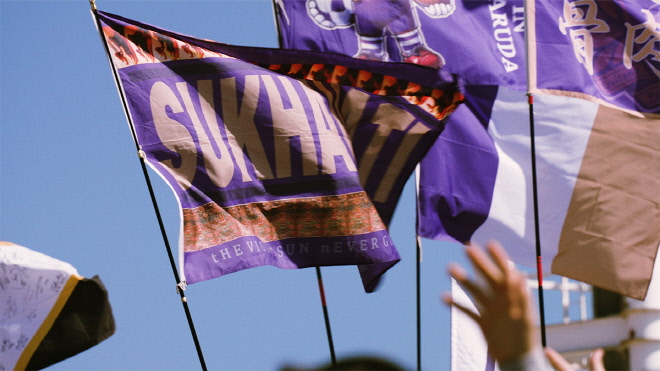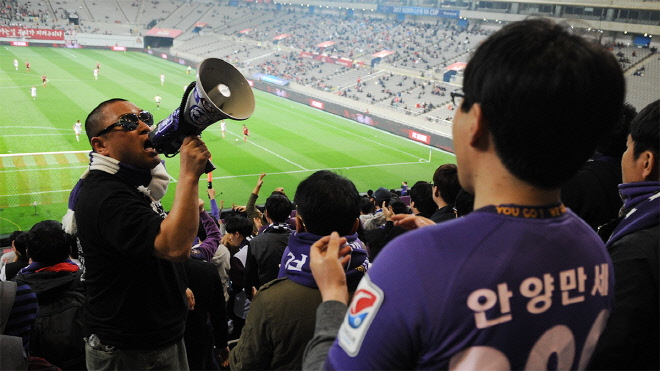
South Korean independent documentary film “FC Sukhavati” presents a dramatic real-life story about the hardcore supporters of a minor football club. Although their football club has not always been satisfying during last two decades, they have diligently and sincerely supported their football club as much as possible because they actually earned their football club via lots of efforts and struggles, and the documentary is often touching as closely observing their deeply personal passion and enthusiasm.
At the beginning, the documentary shows and tells how Anyang, one of those numerous satellite cities surrounding Seoul, happened to have its own professional football club in 1996. As the South Korean society continued its rapid social/economic development during the 1980s, the South Korean government, which was under the dictatorship of President Chun Doo-hwan at that time, blatantly promoted sports industry as a way to distract its citizens from more demand for democratization, and this led to a considerable growth and advance in South Korean sports industry during the next decade.
At first, not many people were enthusiastic when Anyang LG Cheetahs moved from Seoul, but, what do you know, it gradually drew more fans and supporters during next few years. Around the early 2000s when the South Korean society was swept by the excitement surrounding the 2002 FIFA World Cup to be held in both Japan and South Korea, Anyang LG Cheetahs became one of the most prominent professional football clubs in the South Korean football league, and its supporter group were also known a lot for how passionately they rooted for their team.
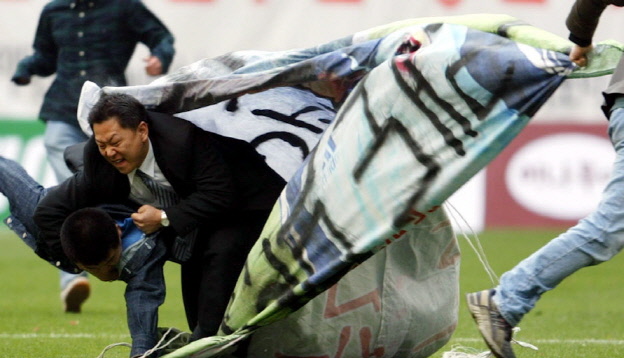
Directors Baru Na and Shin Ho-bin interview several key members of the supporter group, and each of them has each own interesting story to tell. Although the time when they were young and wild is gone now, they are all proud of being a part of something far bigger than themselves, and they all eagerly talk about how much they cheered for their team in one way or another. At some point, they and others began to use a special type of gunpowder to generate red flare for cheering for their team more, and this eventually became a sort of trademark for their group.
However, their good time did not go that long. Not long after the 2002 FIFA World Cup, Anyang LG Cheetahs suddenly moved back to Seoul and then became FC Seoul. Needless to say, many members of its supporters were quite exasperated and devastated to say the least, but they were reminded again and again that there was nothing they could do for stopping this irreversible change.
During next several years, some of the hardcore supporters desperately tried to keep their group intact at least, but, of course, their group slowly crumbled as many of the members quit and then supported some other local professional football club instead. Every member in the documentary bitterly remembers this dark period of theirs, and some of them also look back on when they boldly committed some radical acts of demonstration in the middle of big football games.
Eventually, the supporters stuck together under one particular cause around the early 2010s. They demanded to the city government that their city should have its own professional football club again, and the mayor was actually willing to support the cause as much as he could, but, not so surprisingly, he and the supporters soon faced a number of political obstacles. For example, there were a considerable number of city council members against having a professional football club again, and this certainly frustrated the supporters more than once.
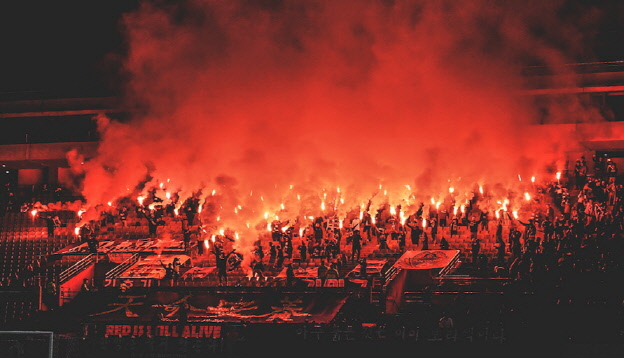
Fortunately, thanks to the diligent efforts from them as well as the mayor, the supporters finally came to have a new professional football club. Now the name of their group was changed to FC Anyang Supporters RED, and they usually wear purple uniforms, but they still use that red flare as before because, well, there was not any better alternative for that.
During its second half, the documentary emphasizes the remarkably strong bond between FC Anyang and its supporter group. Knowing well how hard they tried and fought for getting their own professional football club, the members of FC Anyang Supporters RED never say any bad word to those FC Anyang players while always showing full support and respect, though they can be quite aggressive just like any other football support group out there. When their team happened to have a big game with FC Seoul on one day, they gave FC Seoul a lot of hell with one huge group act, and that was certainly something to be remembered by everyone at the spot.
The mood later becomes a little dramatically tense as the documentary focuses on one particularly important game for FC Anyang and its supporters, but it still takes time for observing the achingly human moments observed from its main subject. Yes, these supporters in the documentary may look silly and ridiculous at times, but it is difficult not to be amused and then touched by how they and many others got emotionally connected together for their precious football team. Just like life, being a football club supporter can be hard and frustrating at times, but there also sometimes come some moments to be savored and cherished by them, and you will understand that well if you have anything you are privately passionate about (In case of me…. well, do I really have to tell you?)
In conclusion, “FC Sukhavati”, whose title incidentally comes from a Sanskrit word associated with the name of the city in the documentary, deserves to be labeled as a “feel-good documentary” for its crowd-pleasing moments, and you will certainly smile a bit as observing the universal aspects of countless soccer fans around the world. I still observe them from the distance, but I come to have some understanding and empathy in the end, and that is what a good documentary can do in my inconsequential opinion.