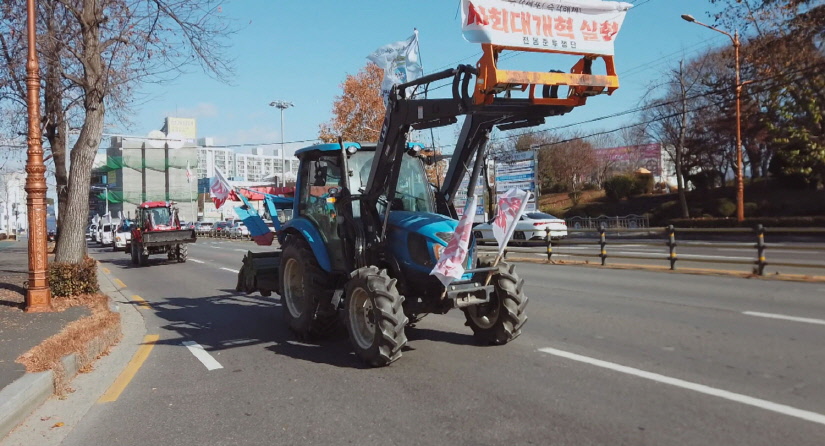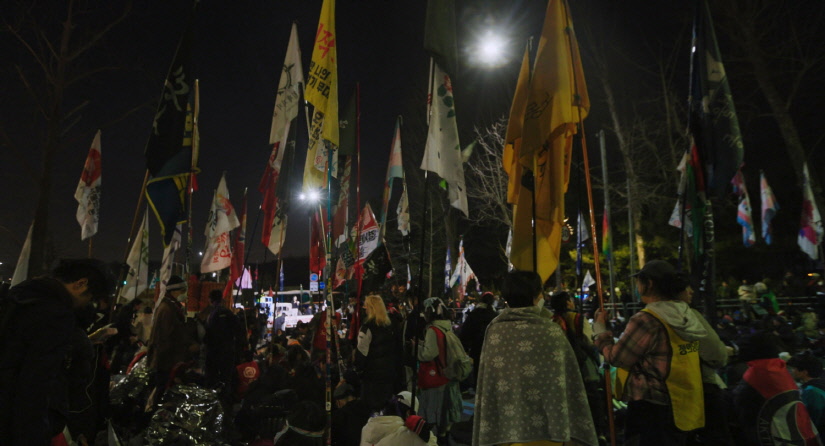
South Korean documentary film “The Longest Night: Namtaeryeong” focuses on that unlikely moment of democratic solidarity on the one day of December 2024. On that day, thousands of various South Korean citizens showed up to support and then defend a group of rural farmers protesting against President Yoon Suk-yeol and his vile coup d’état attempt, and the documentary often touches us as giving as a vividly personal look into that important incident to remember.
I must tell you that what happened on the night of December 3rd, 2024 is still disturbing the South Korean society even at this point. President Yoon, who will be remembered as one of the most despicable politicians in the South Korean democracy history, suddenly declared the martial law on TV just because he and his far-right wing government got cornered more and more by the opposition parties due to his and his cronies’ incompetence and corruption, and that was surely a shock to the system for many of us at that time. To be frank with you, I slept a bit too early on that day, and I was certainly baffled and confused a lot when I checked the morning news on the very next day.
Fortunately, thanks to many brave citizens and politicians willing to stand their ground against President Yoon on that day, his coup d’état attempt was eventually thwarted within several hours, but we had to endure and fight more during next several months for getting this detestable prick impeached and then arrested. Due to the interference from his equally loathsome governing party, it took several more weeks for the South Korean Parliament to get him suspended, and most of us were quite more angered and frustrated to say the least. However, he eventually got impeached on April 4th, 2025 and then went through several trials on his considerable charges, though we witnessed more of how much our society was divided thanks to numerous hateful far-right wing nuts not so far from those vile people supporting that orange-faced prick in the White House.
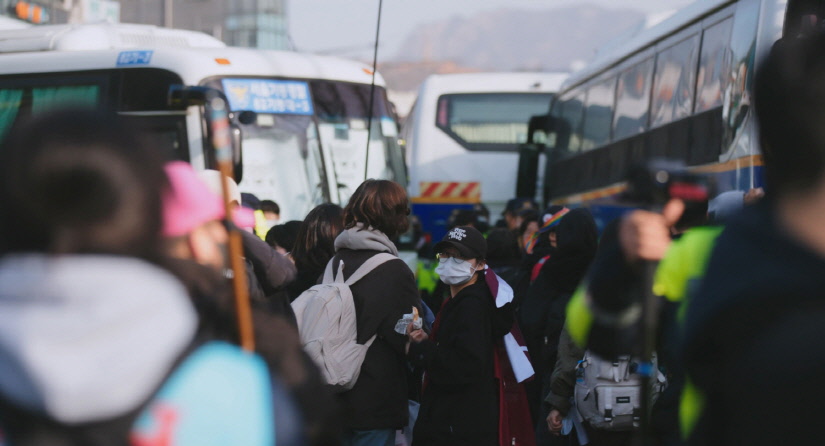
Nevertheless, we also saw how many of us were ready to defend our democracy during this very dark time. Many ordinary citizens came outside for protesting more against President Yoon and his governing party in Seoul and many other major cities in South Korea, and a various number of groups ranging from labor unions to LGBTQ+ groups also stepped forward for showing their support and defiance. I must confess that I could not help but feel skeptical about President Yoon’s impeachment at that time mainly because of the deep corruption inside the South Korean Justice Department under his firm control, but I came to feel more hope and optimism as watching these various citizens’ efforts from the news reports, and I was certainly relieved and then excited when he finally got what he truly deserved from the very beginning.
One of these many civil demonstrations happened on December 21st, 2024, and the documentary closely follows how this demonstration got much bigger than its initiators expected. At first, it was just simply a big association of farmers coming to Seoul by their tractors for their own demonstration in the city, but they were unjustly blocked by the police at a certain spot in the city, which is called, yes, Namtaeryeong. Once the news was spread out on the Internet via Twitter and several other online social media networks, a lot of citizens gradually came to Namtaeryeong for supporting the cause of the farmers, and they found themselves sticking together much longer than expected despite the increasingly cold weather of the following winter solstice night.
As shown from a heap of raw video footage clips and online social media records, what happened on that night was quite remarkable to say the least. No matter how much the police oppressed them in one way or another, the demonstrators showed more defiance and solidarity, and more and more people joined them at Namtaeryeong as the demonstration received a considerable amount of support from here and there on the Internet. Once it was reported that the demonstrators got hungry and cold, many people willingly donated money, food, and many other stuffs necessary for enduring that cold night. As a matter of fact, a number of South Korean people outside their country quickly gathered some money together for renting and then sending several buses equipped with heater, and this certainly helped the demonstrators a lot.
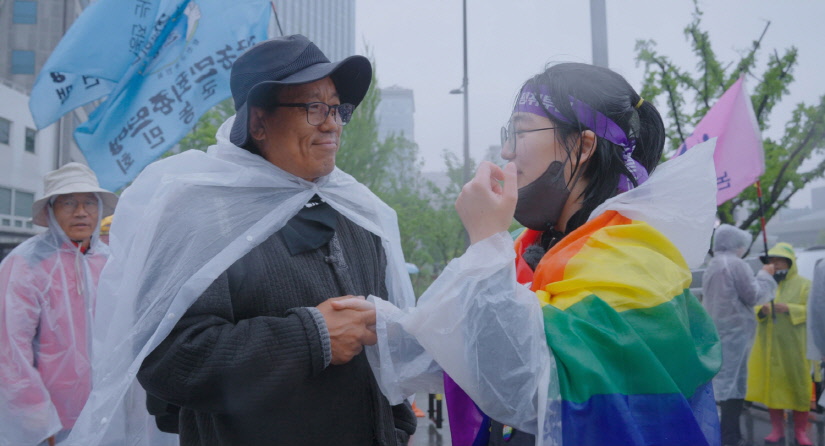
As the demonstration went on, its participants singed or danced together for maintaining their spirited defiance to the end, and some of them actively came forward for delivering their personal statements for not only South Korean democracy but also themselves. It is notable that many of the demonstrators were young women and members of LGBTQ+ groups, and they did not hesitate to present themselves as who they are at all, while also galvanizing their fellow demonstrators a lot with their passionate speeches.
In the end, the police allowed the farmers to go to the downtown area of Seoul for their planned demonstration, but this was not the end of the story at all, and the documentary becomes all the more powerful as showing how this unlikely solidarity of that night influenced many of its participants. As learning more of the value of solidarity, many LGBTQ+ participants came to show more solidarity to a number of social causes, and one of the most touching moments in the documentary is several labor union members gladly and openly marching along with LGBTQ+ people during the 2025 Queer Parade in Seoul.
Overall, “The Longest Night: Namtaeryeong”, directed by Kim Hyun-ji, is often revealing as powerfully presenting a big picture on its main subject, and I particularly admire how democratic it is as simply observing and listening to various figures one by one. They are surely all different from each other in one way or another, but they firmly stuck together during that very cold night, and that was a small but significant beginning for understanding, compassion, and empathy among them. Although I frequently feel pessimistic about where our society is going right now, I am also often reminded of how valuable hope and solidarity really are especially right now, and I am glad to report that the documentary is one of such cases.