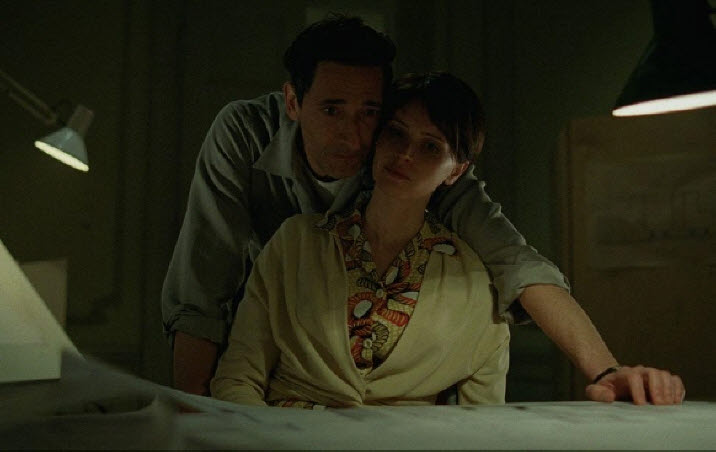
The Brutalist (2024) ☆☆☆1/2(3.5/4): An ambitious piece to behold and admire

Brady Corbet’s latest film “The Brutalist” is an ambitious piece to behold and admire. While often boldly trying to emulate the style and form of those Hollywood classic epic drama films of the 1950-60s, it also brings a considerable amount of modern touch and sensibility to its story and characters, and the result is utterly spellbinding, regardless of how you feel about this adamantly monumental film.

The story of the movie feels like a typical American immigrant tale at first. Its hero is László Tóth (Adrien Brody), a Hungarian-Jewish Holocaust survivor who emigrates to America in 1947. Before the World War II, he worked as an architect, but now he is virtually a nobody just like many other emigrants, and he can only hope that his cousin living in Philadelphia, who has run a little furniture shop, will provide him a job and a place to stay.

Anyway, once he arrives in Philadelphia, László is gladly greeted by his cousin, and we observe how he tries to bring some architecture sensibility of his to those handmade furniture pieces to be sold. On one day, he and his cousin are requested to renovate the library in a big house belonging to a wealthy businessman named Harrison Lee Van Buren (Guy Pierce) for a surprise birthday gift for him, and the movie patiently follows how László and his crew make the library look quite different than before.
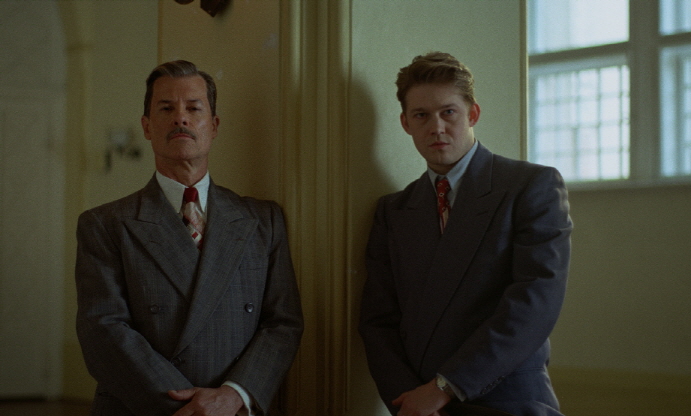
However, Van Buren is not so amused when he arrives at his house earlier than expected. Consequently, the situation becomes very difficult for László during next few years, but, what do you know, Van Buren changes his mind when his new modern library comes to draw a lot of attention later, and he is ready to help László in more than one way. Besides hiring László as the architect of a grand new big building to bear the name of his family, Van Buren also helps László’s wife and niece, who also managed to survive the Holocaust just like László, coming from Hungary to US at last.

It is not much of a spoiler to tell you that László eventually becomes conflicted about the issues of principle and integrity as coming to clash with his rich sponsor more and more along the story. While he seems ready to support László all the way at first, Van Buren gradually shows more of his heartless sides as things do not seem to be going well from his viewpoint, and László’s wife Erzsébet (Felicity Jones) begins to notice how her husband becomes more distant from her as he struggles to stick to his artistic integrity in front of Van Buren and others.

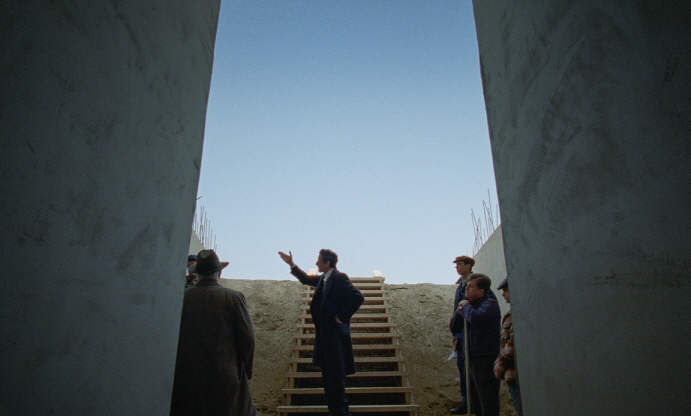
As the screenplay by Corbet and his co-writer Mona Fastvold steadily builds up the story and characters with more details, the movie constantly impresses us with a number of stunning visual moments to be appreciated. Cinematographer Lol Crawley did a superlative job of filling the screen with vivid and realistic period atmosphere (The movie was actually shot via the VistaVison process and cameras for accentuating that, by the way), and the result is seamlessly mixed with the occasional archival footage clips from the 1950-60s. The editing by Dávid Jancsó is precise and efficient in maintaining the narrative pacing throughout the film, which is incidentally more than 3.5 hours including the 15-minute intermission part. The score by Daniel Blumberg feels a little too simple and restrained, but it still plays a crucial part in setting the tone of several key scenes in the movie.

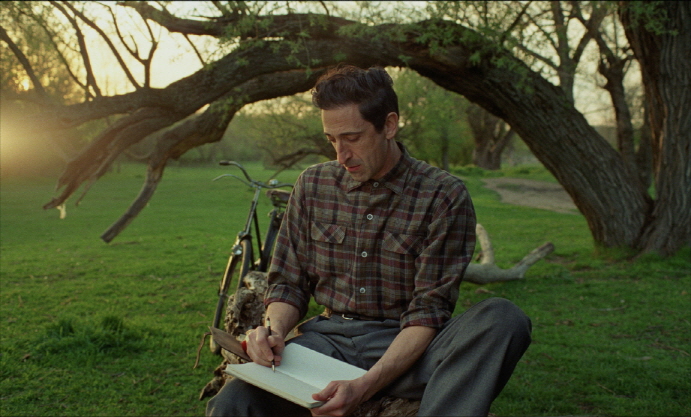
Above all, the movie depends a lot on the hauntingly soulful acting of Adrien Brody, who was deservedly Oscar-nominated for his best performance since his Oscar-winning turn in Roman Polanski’s “The Pianist” (2002). While never making any excuse on his character’s many human flaws, Brody deftly illustrates his three-dimensional character’s inner conflicts along the story, and he is compelling to watch whenever he subtly suggests whatever is churning behind his character’s seemingly passive appearance.
Around Brody, Corbet assembles several good performers, who have each own moment to shine in one way or another. While Guy Pearce is suitably obnoxious as a rich man who turns out to be more brutal and controlling than he seems at first, Felicity Jone, who was Oscar-nominated along with Brody and Pearce, manages to overcome her rather thankless role, and Joe Alwyn, Raffey Cassidy, Stacy Martin, Alessandro Nivola, Jonathan Hyde, and Isaach de Bankolé are also solid in their substantial supporting parts.

On the whole, “The Brutalist”, which received 10 Oscar nominations including the one for Best Picture (It also won the Silver Lion for Best Director when it was premiered at the Venice International Film Festival in last year, by the way), is quite impressive for its masterful technical qualities as well as its confident handling of story and character. Although I am a bit less enthusiastic about it than many others because it is not wholly perfect due to several notable flaws including a few abrupt narrative turns during its second half, this is surely not something we can see everyday, and its mesmerizing moments still linger around my mind even at this point.

Now I am reminded of what my late friend/mentor Roger Ebert wrote about Paul Thomas Anderson’s “There Will Be Blood” (2007): “…“There Will Be Blood” is not perfect, and in its imperfection we may see its reach exceeding its grasp. Which is not a dishonorable thing.” In my trivial opinion, his words can also be applied to “The Brutalist”, and I wonder whether it will look greater than before when I revisit it someday.
Posted in Movies | Tagged , , , | 2 Comments

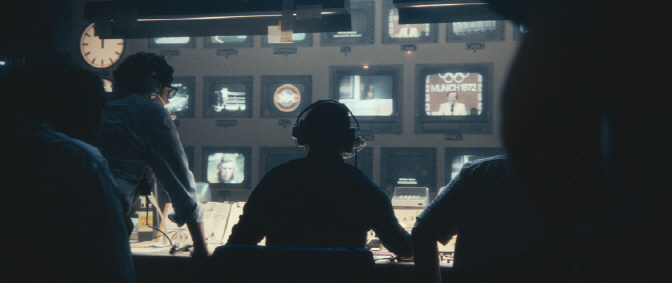
September 5 (2024) ☆☆☆(3/4): The Munich Massacre of 1972 via live TV 

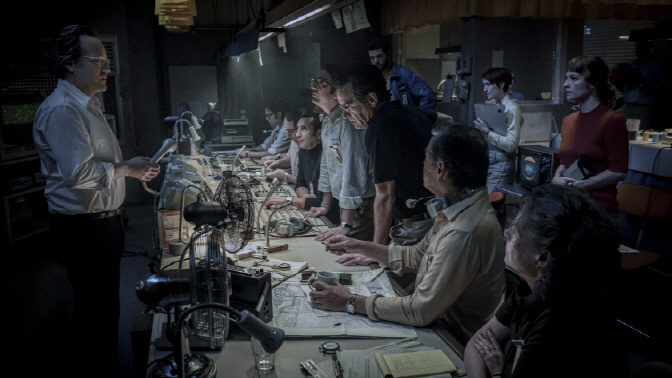
It is always interesting to watch professionals doing their best, and “September 5” is one of such prime examples. Here are a bunch of professionals simply trying to do their job well under one extraordinary circumstance which drew the attention of the whole global world during that time, and the movie is often riveting while also indirectly provoking some thoughts and reflection from us.

 At the beginning, we see how things were quite exciting in Munich, West Germany during the first week of September 1972. The 1972 Summer Olympics was being held, and the West German government was eager to promote the new era of the country after World War II. The American Broadcasting Company (ABC) was in the middle of its first live coverage of the Summer Olympics, and the opening part of the film shows how the ABC sports crew are going through another busy day in Munich.

However, a shocking incident happened in the middle of the early morning of the next day. A bunch of Palestinian terrorists broke into one of the buildings for the Olympic athletes where the Israeli athletes and coaches were staying at that time, and then these terrorists held 11 hostages as demanding the release of 200 Palestinian political prisoners held by the Israeli government. While the Israeli government did not bend to this demand at all, the West Germany government tried to resolve the situation as soon as possible, but, as many of you know, that eventually led to a disastrous outcome.

The movie closely follows how the ABC sports crew instantly embarked on reporting this horrible incident. Once they get confirmed on what is really going on, they all busily prepare for the live TV coverage of that incident, and the movie ably immerses us into the increasingly tense atmosphere surrounding them. While they surely have considerable advantages as the only American broadcasting company which can broadcast the hostage situation on live TV, they can still be beaten at any point by many other competitors out there who are also quite determined to be the first in line, and the movie shows a bit of humor from how they try to get closer to the ongoing hostage situation by any means necessary. At one point, one of them disguises himself as an American athlete for freely going back and forth between the crew and a certain famous TV reporter without any interference from the local police, and that leads to a brief but hilarious moment later in the story.       

Under the permission from Roone Arledge (Peter Sarsgaard), who is the President of ABC Sports, Marvin Bader (Ben Chaplin), who is the head of operation at ABC Sports, allows Geoffrey Mason (John Magaro) to handle their ongoing live TV coverage, and Mason is certainly ready to prove his worth to others around him. With some invaluable help from a female German employee who often serves as a translator, Mason and his crew members keep catching on the latest development of the hostage situation and then reporting it on live TV, and it seems that this will be the finest moment of their career.   

However, as the situation becomes more and more serious, the ABC sports crew members become more aware of the ethical aspects of their live TV coverage. They are certainly concerned about how things can get quite worse at any minute, and they are also quite worried about whether they can actually show that on live TV. Furthermore, they belatedly come to realize that those terrorists are also probably watching their live TV coverage, and that makes Mason very conflicted about whether their live TV coverage actually jeopardizes the whole circumstance.

Firmly maintaining its dryly objective viewpoint, the screenplay by director Tim Fehlbaum and his co-writers Moritz Binder and Alex David, which was incidentally Oscar-nominated a few weeks ago, keeps rolling the story and characters with considerable efficiency. While simply observing how they work together, the movie lets us get to know its main characters bit by bit, and it also steadily accumulates its narrative momentum thanks to the taut and efficient editing by Markus Förderer. As a result, we never feel lost amid many different characters working inside the limited background, and you will also be marveled to see how the movie did a seamless job of incorporating archival footage clips into the story. 

The main cast members of the film are all convincing in their respective parts. Peter Sarsgaard and Ben Chaplin are dependable as usual, John Magaro, who has become one of the most reliable performers working in Hollywood during last several years, fills the center with another fine performance, and he is also supported well by a bunch of other good performers including Zinedine Soualem, Benjamin Walker, and Leonie Benesch, who was memorable in Oscar-nominated German film “The Teachers’ Lounge” (2023) and holds her own place well as the sole substantial female character in the story.

Overall, “September 5” is an engaging historical drama to be admired for its focused handling of its main subject, and I was often entertained by its authentic period mood and details while appreciating its thoughtful sides. Although it does not spell out any particular message on the surface, the movie makes us muse more on some ethical issues of journalism observed from the story, and it goes without saying that these issues are still relevant even at this point. Yes, you may think it could show and tell more about its main subject, but it did its job fairly well within its rather short running time (95 minutes), so I will not complain for now.

Posted in Movies | Tagged , , , , , | 1 Comment

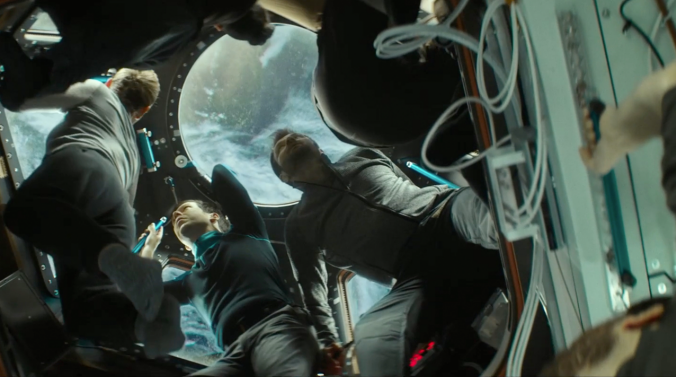
I.S.S. (2023) ☆☆1/2(2.5/4): A thriller inside the International Space Station

“I.S.S.”, which is currently available on Netflix in South Korea, is a modest space thriller film about several astronauts suddenly finding themselves under a rather tricky circumstance. While it is often hampered by plot contrivance and superficial characterization, the movie has some entertaining moments to enjoy at least, and it certainly reminds me again of why I am still not so willing to go to the space. 

The movie opens with the arrival of two American astronauts at the International Space Stain (ISS). They are Dr. Kira Foster (Ariana DeBose) and Christian Campbell (John Gallagher Jr.), and we soon see them gladly welcomed by the four astronauts who have already been staying inside the ISS for a while. Besides Gordon Barrett (Chris Messina), who is also an American, the other three astronauts are from Russia, and they and the American astronauts are supposed to work together harmoniously inside the space station, regardless of whatever is going on between their countries at present. Because she happens to have her first day inside the ISS, Dr. Foster is naturally a bit nervous, but she gradually gets accustomed to the zero-gravity environment of the space station while starting to work on her science project and befriending her fellow astronauts more.

However, something serious occurs on one day. The continents of the Earth are suddenly covered with what looks like nuclear bomb explosions, and it soon becomes apparent that a war is started between US and Russia. Via his emergency communication line, Barrett is instructed that he and his fellow American astronauts should take over the space station by any means necessary, and they naturally begin to regard the Russian astronauts with growing suspicion, because the Russian astronauts probably also received the same order from their country.

During its first half, the movie steadily accumulates the sense of uneasiness around its few main characters, and there are several effective scenes including a suspenseful one where one of the American astronauts must go outside the space station for fixing an antenna alone by himself. With only Dr. Foster assisting him via their radio communication, he must be careful with each of his physical movements, because, as many of you know, even a very small movement can be quite perilous in the zero-gravity environment.

Around its middle point, the screenplay by Nick Shafir unfortunately eliminates all the ambiguity surrounding the main characters, and that is where the movie becomes less engaging. Without providing enough ground for character development from the beginning, the main characters remain to be more or less than flat archetypes, and we do not get to know that much about any of them along the story. For example, there is a brief moment when the movie delves a bit into Dr. Foster’s personal life, but this feels rather perfunctory instead of making her a bit more interesting at least. In case of several other characters in the story, they are mostly defined by their appearance and attitude, and you will not be so surprised by how they will come to function as mere plot elements later in the story.  

During the last act, the movie naturally attempts to generate more suspense to accompany its eventual climax, and the overall result is mildly entertaining despite more distracting plot contrivance along the story. While a certain plot turn at one point later in the film is quite artificial to say the least, that leads to one intense physical fight scene, and I also like a key scene where the three main characters must be very tactful to each other with one sharp object to be used in one way or another.     

Director Gabriela Cowperthwaite, who has been mainly known for her acclaimed documentary film “Blackfish” (2013), and her crew members including cinematographer Nick Remy Matthews did a credible job of establishing the zero-gravity environment on the screen. Yes, this has not been a novelty anymore because of Alfonso Cuarón’s “Gravity” (2013) and a number of other recent space films following that ground-breaking masterpiece, but “I.S.S.” looks fairly realistic in its limited background as far as I can see.

The main cast members of the film fill their respective roles as much as possible. While Ariana DeBose, who has become more notable thanks to her Oscar-winning breakthrough turn in Steven Spielberg’s “West Side Story” (2021), manages to bring some personality to her rather underwritten role, Chris Messina and John Gallegher Jr. do a bit more than required by their rather thankless parts. In case of Masha Mashkova, Costa Ronin, and Pilou Asbæk, they acquit themselves well even though they are usually demanded to look like hiding something behind their back, and Asbæk, a Danish actor who was terrific in Oscar-nominated Danish film “A War” (2015), is especially good as his character goes through a series of conflicts along the story.

In conclusion, “I.S.S.” does not bring anything particularly new to its familiar genre territory, and it has already been fading in my mind even though I watched it early in this morning. Yes, that high standard set by “Gravity” is surely something which cannot be surpassed during next 10 years at least, but “I.S.S.” feels subpar even compared to many other space films out there, and I am already ready to move onto whatever I am going to watch next.

Posted in Movies | Tagged , , , | Leave a comment

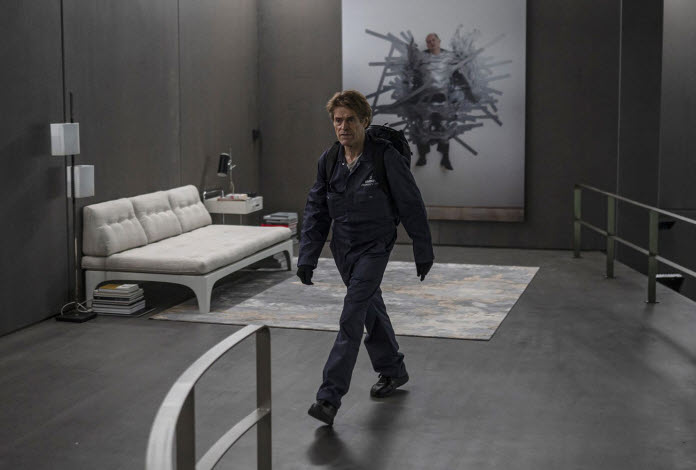
Inside (2023) ☆☆(2/4): A man who gets trapped

I guess any good performer is bound to go for the challenging task of carrying a movie alone by his or her sheer talent and presence. While Ryan Reynolds pushed his acting ability as much as possible while being the whole show of “Buried” (2010), Robert Redford demonstrated alone that he still could be very engaging just with his own presence in “All Is Lost” (2013), and Mélanie Laurent also went all the way alone by herself in recent Netflix film “Oxygen” (2021).

In case of “Inside”, which is currently available on Netflix in South Korea, Willem Dafoe, who is going to have the 70th birthday in this year, willingly throws himself into a similar challenge, but I do not think the movie provides enough materials for him to play during its 105-minute running time. Sure, he has been one of the most compelling character actors working in Hollywood, but even he cannot overcome the thin and tedious narrative of the film, and that is a shame to say the least.

At first, the movie, which is directed by Vasilis Katsoupis, looks promising as Dafoe’s criminal character breaks into the penthouse apartment of a big building located somewhere in the middle of New York City. This apartment belongs to some rich guy who happens to be an avid art collector, and it surely looks more like an exhibition site rather than a residence to live, as being decorated with many different artworks here and there.

What Dafoe’s character, whose name in the end credits is probably a winking nod to a certain Pixar animation film where Dafoe voiced one of the supporting characters, tries to steal the three valuable paintings of Egon Schiele. While he easily finds two of these paintings within a few minutes, the last one seems to be hidden somewhere beyond his reach, so he decides to give up on that before it is too late for him.

And then there soon comes another big problem. For some unknown reason, the security system of the apartment happens to have an error at the last minute, and he consequently gets trapped inside the apartment while also getting disconnected from an accomplice of his, who is supposed to handle any problem with the security system. No matter how much he tries again and again, it looks like there is no possible way out for him, and the situation becomes all the worse as the temperature control system of the apartment also goes haywire.

Now this looks like a classic setup for thriller, but the screenplay by Ben Hopkins, which is developed from the story idea by Katsoupis, only comes to meander instead without much narrative development. While the mood becomes a bit suspenseful as its criminal hero struggles to deal with the temperature problem inside the apartment, the movie mostly feels static and languid as failing to generate enough narrative momentum, and its sole main character’s desperate struggle becomes all the more monotonous for us as a result, though you may be amused a bit by several darkly amusing moments showing how he handles his biological needs. As the water line is somehow cut off, he soon needs to search for any possible way to get water, and he also must find and then secure anything to eat for himself.   

I think the movie is intended to be a sort of existential thriller rather than a conventional one, but it often falters in terms of characterization. Although we get to know a bit about its criminal hero at the beginning of the film, the movie does not flesh him out a lot on the whole, and we simply observe his plight from the distance without much care. Around the narrative point where he is thrown into more despair and madness, the movie seems to be going nowhere just like him, and it even attempts a couple of hallucinatory moments which do not work at all in my humble opinion.

While getting bored more and more along the story, my mind often went astray as reflecting more on what a versatile actor Dafoe really is. Since he made quite an impression on us via a number of striking performances during the 1980s, this legendary actor has steadily entertained us as appearing in a number of notable films such as “Shadow of the Vampire” (2000) and “The Florida Project” (2017), and he is still one of the most diligent performers in Hollywood as shown from his recent supporting turns in “Poor Things” (2023) and “Nosferatu” (2024).      

Although he does not have much to do here except looking despaired or frustrated throughout the whole film, Dafoe manages to find a way to fill his rather superficial character with some human details, and he succeeds in preventing the movie from becoming a total bore. Besides looking quite fit despite his old age, he is utterly committed on the screen at every second, and his solid efforts here in this film surely deserve to be served by a better one somewhere inside it.

In conclusion, “Inside” is not entirely a waste of time mainly thanks to its charismatic lead actor, but I remain quite dissatisfied without remembering much of anything else in the film besides his solo performance. It is certainly a good challenge for not only him but also the director and his crew members, but the overall result is not so interesting besides being quite inferior to those several movies mentioned at the beginning of my review. As a matter of fact, you will have a much productive time with any of them, so I sincerely recommend them instead.

Posted in Movies | Tagged , | Leave a comment

Mulholland Drive (2001) ☆☆☆☆(4/4): An ultimate David Lynch film

Somebody must be sad, regretful, and fading away. That is a lingering impression I get whenever I visit David Lynch’s 2001 film “Mulholland Drive”, which happens to be re-released here in South Korean theaters not long after Lynch’s death in last month. Although I still have no clear idea on who that person really is in the movie, many of its strikingly enigmatic moments are still quite compelling to watch, and these fascinating moments keep me wondering about what it is about while also mesmerized by how it is about.

On the surface, the first half of the movie seems to be your typical Hollywood adventure story. A young aspiring actress named Betty Elms (Naomi Watts) comes to Hollywood, while being full of hope and dream just like many other countless young actresses out there in Hollywood. Fortunately, she is allowed to stay in a nice and comfortable apartment belonging to her actress aunt during her aunt’s temporary absence, and she is certainly determined to do her best for the upcoming audition.

However, right from her first day in Hollywood, she encounters someone quite unexpected. It turns out that there is a mysterious young woman hiding inside the aunt’s apartment, and this young lady is quite confused and scared due to being not able to remember who she is. All she can remember is that she had a car accident on Mulholland Drive, and she eventually presents herself as “Rita” (Laura Harring), a name which she instantly got from the old poster of a certain famous Rita Hayworth film.

Sincerely feeling sorry for Rita, Betty tries to help her as much as possible, but we already know that there is something sinister happening somewhere out there in Hollywood. As shown from the opening scene, somebody wants to eliminate Rita, and both the local police and those figures associated with that incident are already looking for her. In case of the latter, they are also probably the ones pressuring a certain promising young movie director for having some “right girl” cast as the lead role of his upcoming movie.

However, of course, things go pretty weird here and there as you can expect from a David Lynch film, and the movie throws small and big moments to intrigue and then puzzle you. There is a darkly absurd moment where a guy who inadvertently causes much more mess than planned. There is a truly spooky scene where a man tries to show his friend what has been scaring him in his recurring dream. There is a charmingly cheerful old-fashioned musical moment which subtly spreads an ambiguous tone under the surface. And there is also a disturbing scene where Betty and Rita discover something very, very, very unnerving in the middle of their own Nancy Drew adventure.

After a certain narrative point later in the story, all these and many other things in the film are re-arranged and then reassembled to leave us with more interest and bafflement. As the movie continues to blur the line between reality and dream, we become more doubtful about not only Rita but also Betty, and we keep getting puzzled as not totally discerning what is actually happening around them.

In my trivial opinion, I think the movie is more or less a stream of unconsciousness swirling inside a mind riddled with a lot of guilt and sadness. Fragments of memories and experiences simply come and go without making much sense at all, and the last act of the film, which incidentally becomes quite more ambiguous than before, may reflect the painful awakening of that mind toward the emerging harsh reality, though I cannot tell you anything certain about the actual reality beneath the story and characters.

Yes, it is quite possible that everything in the film is not real at all, but what a spellbinding experience it is. While frequently resonating with its main background in one way or another (After all, Hollywood itself has been regarded as a sort of dream factory, right?), the movie playfully bounces around numerous various elements ranging from show business satire to lesbian erotica, and the overall picture is often astounding for Lynch’s artistic ambition and confidence. You may scratch your head from time to time, but you cannot take your eyes away from the movie at all because Lynch always gets things under control in his own way, and we do not complain much even when the movie eventually ends with more mystery and puzzlement.

As many of you know, the movie was initially produced as the pilot episode of a TV drama series planned by Lynch himself. We will never know what Lynch would have presented if that TV drama project of his had been green-lighted (Would it have been something like the subsequent third season of “Twin Peaks”, I wonder?), but what he developed further from that pilot episode led to another breakthrough in Lynch’s career, and he became highly regarded more than before thanks to that (The excerpt from Roger Ebert’s enthusiastic 2001 review: “David Lynch has been working toward “Mulholland Drive” all of his career, and now that he’s arrived there I forgive him for “Wild at Heart” (1990) and even “Lost Highway” (1997).”).

Above all, “Mulholland Drive” shows more of heart and soul like Lynch’s previous work “The Straight Story” (1999). Yes, Betty and Rita are certainly archetypes just like many other colorful figures in the story, but many of emotional moments between them are handled with sincerity and sensitivity, and Naomi Watts and Laura Harring, who became more notable thanks to the critical success of the movie, are simply terrific as fluidly modulating their good performances along the dream narrative of the film. Even though we are not so sure about Betty and Rita’s respective real identities, we care about their dreamy drama nonetheless, and that is the source of the lingering sadness and regret hovering over the movie.

Although it has been almost 25 years since it came out, “Mulholland Drive” remains as the pinnacle of Lynch’s long and illustrious filmmaking career. You may not like all of his works, but each of them is distinctive for his own style to be cherished, and you will agree that he was indeed one of the greatest filmmakers of our time. Good night, Mr. Lynch, it has been really a pleasure to admire and appreciate your cinematic art.

Posted in Movies | Tagged , , , | Leave a comment

Black Box Diary (2024) ☆☆☆1/2(3.5/4): As she steps forward as a survivor

Documentary film “Black Box Diary”, which received an Oscar nomination a few weeks ago, is a personal chronicle of one young female journalist who courageously stepped forward in public as the survivor of a high-profile case in Japan several years ago. Mostly sticking to her viewpoint, the documentary focuses on how much she struggled for standing against the sexist sides of the Japanese society and its legal system during next several years, and her painful story of defiance and struggle feels quite important even at this point.

She is Shiori Itō, and the documentary, which is directed and co-produced by Itō herself, opens with what happened to her at one late night of 2015. At that time, she was a promising young journalist working in Tokyo, but she was raped by a certain influential journalist, who was incidentally the Washington D.C. bureau chief of the Tokyo Broadcasting System. Despite being quite drunk, she naturally tried to resist this vile dude, but he eventually took her to his hotel room as shown from a video clip from the security camera of that hotel, and that is where that horrible incident occurred.

After struggling to process what happened to her at that night for a while, Itō reported her traumatizing incident to the local police, but, not so surprisingly, the local police were not so willing to do the investigation. The first investigator assigned to her case actually became more sympathetic to her as delving more into the details of her case, but he was soon replaced with some other investigator for no apparent reason, and he later told her that the chief of the Tokyo Police nullified the arrest warrant for her rapist at the last minute.

Needless to say, her rapist was quite an influential figure with a lot of political and professional strings to pull. As a matter of fact, he was a very close ally/friend of many prominent Japanese politicians including Prime Minster Shinzo Abe, and Itō was surely aware of how risky it was for her to report to the local police from the very beginning.

After the Tokyo Police virtually disregarded her case, Itō became more despaired, but she eventually found some strength for coming forward to expose her rapist in public two years later. As a result, she had to endure a lot of misogyny from the media as well as the public, but there was also a considerable amount of support for her, and she is surely consoled by that while also feeling a bit better about herself than before.

Itō and her crew members including cinematographer Yuta Okamura closely followed her long and difficult struggle during next several years, and we often see how she often felt uncertain and insecure about whatever might happen next after her public allegation against her rapist. Fortunately for her, she had some close friends willingly standing by her, and she also had several lawyers ready to help her as much as possible, but she sometimes could not help but feel vulnerable from time to time, as shown from her occasional personal video clips.

Things became all the more serious when Itō’s memoir, which is titled “Black Box”, was about to be published. By coincidence, the biography of Abe written by her rapist was going to be published around the same time, which also happened to be not long before the day of an important national parliament election. Once her book got published, she would get definitely sued for defamation by her rapist sooner or later, and that made her and others around feel more pressured than before.

Above all, it seems that their opponents were willing to silence them by any means necessary. While nearly all of the local media companies in Japan remained rather silent about her allegation against that vile dude, both the Japanese government and the Tokyo Police continued to deny everything in public, and Itō and others around her became more aware of the possibility of being monitored by their opponents. At one point, she could not help but notice a certain van parked near her residence for hours, and there is a cheerful but rather alarming scene where she and a friend of hers look for any eavesdropping device in her current residence.

Because of its narrative constantly being driven by her viewpoint, the documentary looks a little too subjective at times, but Itō comes to us as a brave woman who simply refuses to be merely labeled as a victim, and you will certainly come to root for her more as observing more of her hard journey toward justice. When her rapist sued her as expected, she and her supporters surely braced themselves for more fight and struggle, and the documentary does not miss a rather ironic side of what eventually happened in the end.

Overall, “Black Box Diary”, which is incidentally not scheduled to be released in Japan yet even at this point, is worthwhile to watch for illuminating the sexism and misogyny inside the Japanese society, and it also made me reflect a lot on how the South Korean society has also been quite problematic in similar ways for many years. Sure, thanks to the #MeToo movement around the world, the women in the South Korean society are not easily silenced these days, but our society is still stuck with misogyny and sexism just like many of other countries in the world, and I can only hope that many good documentaries of the #MeToo era like “Black Box Diary” will bring more awareness to our society.

Posted in Movies | Tagged , , , , , | 1 Comment

Soundtrack to a Coup d’Etat (2024) ☆☆☆1/2(3.5/4): A Cold War plot behind jazz

Documentary film “Soundtrack to a Coup d’Etat”, which was recently nominated for Best Documentary Oscar, is a superb presentation of the hidden aspects of a political turmoil in Africa during the early 1960s. While it is simply a collage of archival records and quotes on the surface, the documentary is actually quite compelling as vividly drawing its big and complex historical picture in front of our eyes, and the result is all the more mesmerizing with our ears attuned to the soundtrack full of the jazz musicians from that time, who were connected with its main subject in one way or another.

The main subject of the documentary is the Congo Crisis around the beginning of the 1960s, when many of African countries including the Republic of Congo, which is the Democratic Republic of Congo (DR Congo) at present, became independent after many years of colonization by several European countries. As a bunch of newly independent countries in Africa and Asia soon joined the United Nations, both US and the Soviet Union began to play their Cold War diplomatic games over those countries, and, not so surprisingly, many of these countries tried to be independent from both sides as much as possible.

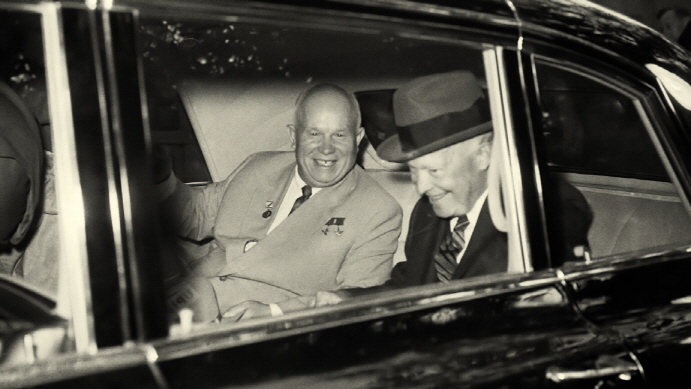
The US government, led by President Dwight D. Eisenhower during that time, had a big interest in the Republic of Congo mainly because of a huge amount of valuable resources in that country. The southern area of the Republic of Congo has many mineral mines including the ones which provided uranium to US during the World War II, and the US government was quite determined to have the Republic of Congo under its control by any means necessary – especially after Soviet leader Nikita Khrushchev openly and vigorously expressed the opposition to the post-colonial power trying to grab many African countries again.

Along with the Belgian government, which occupied Congo for many decades before its independence, the US government attempted to overthrow Prime Minister Patrice Lumumba, who was the most important political figure of the Congolese government during that time. Right from when the independence of his country became official, Lumumba and his government tried to go their way just like many other fellow African countries including Ghana, and he and Kwame Nkrumah, who was the president of Ghana during that time and was also not approved much by US and many other western countries, were the leading figures in the movement for establishing the United States of Africa.

While plotting against Lumumba and his government behind its back, the US government also tried to win the hearts and minds of the Congolese people via a certain part of the American culture: Black American Jazz. While mostly unaware of this hidden intention, many African American jazz musicians ranging from Louis Armstrong to Dizzy Gillespie gladly went to Congo as “cultural ambassadors”, and they were all certainly welcomed by the Congolese people.

As busily shuffling its multiple narrative threads, director Johan Grimonprez, who deservedly received the Special Jury Prize when the documentary was premiered at the Sundance Film Festival early in last year, mixes numerous archival materials with many different pieces of jazz music during the 1960s. The resulting juxtaposition feels just amusing at first, but the jazzy soundtrack of the documentary, which consists of numerous familiar pieces such as Louis Armstrong’s “What a Wonderful World” and Nina Simone’s “Sinnerman”, gradually sets the tone and pace as we get to know more about the hidden sides of the Congo Crisis. In the end, we are chilled and horrified for good reasons at times while discerning more of the complicated political situation surrounding the Republic of Congo.

Although their first attempt to overthrow Lumumba, which happened shortly after the independence of the Republic of Congo, was failed, that did not stop US and Belgium at all, and the documentary pulls no punch about how the United Nations did not do anything about that while keeping its appearance as usual under the leadership of Dag Hammarskjöld, who was UN Secretary-General during that time. Although there was actually some progress in the United Nations, Hammarskjöld also indirectly assisted another American plot against Lumumba, and Lumumba consequently found himself cornered more and more until his eventual death in 1961.

Mainly via the quotes from a number of various sources including “My Country, Africa” by Andrée Blouin and “Congo Inc.” by In Koli Jean Bofane, the documentary also tells us a bit about the human sufferings resulted from the political interference from US and other western countries during that time. During next several decades, the people of Congo suffered one political turmoil after another, and they and their country are still exploited a lot even at this point, as the documentary briefly but sharply reminds us from time to time (Have you ever thought about where those precious metallic parts of your smartphone come from?)

In conclusion, “Soundtrack to a Coup d’Etat” is impressive for the dexterous handling of its rather complex main subject, and I am already quite willing to revisit for more appreciation on its considerable achievement. In short, this is one of the most interesting documentaries of last year, and I assure you that you will not forget easily the rich and compelling experience provided by this extraordinary documentary.

Posted in Movies | Tagged , , , , , , , , | 2 Comments

Caravaggio’s Shadow (2022) ☆☆☆(3/4): An artist between the holy and the secular

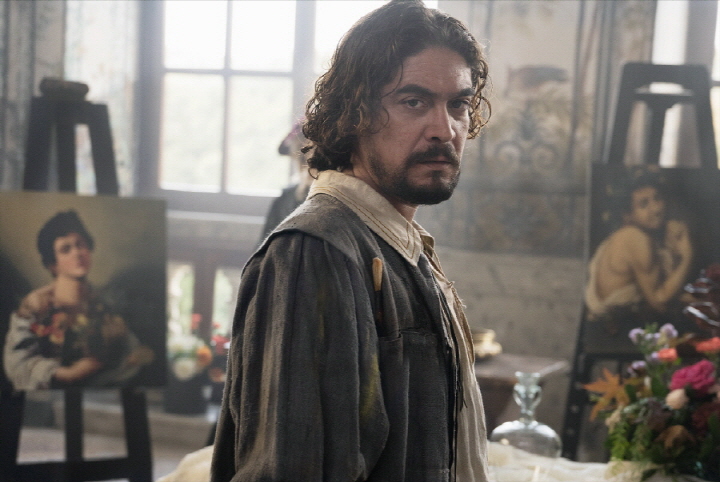
“Caravaggio’s Shadow”, which incidentally came to South Korean theaters in last month, is fascinated with what inspired Michelangelo Merisi da Caravaggio (1571 ~ 1610), who was one of the best artists in Italy around the early 17th century. Although he was a rather unpleasant men to say the least, the movie attempts to illustrate his artistic passion and struggle vividly across the screen, and the result is fairly engaging on the whole.

The movie begins with how Caravaggio, who is vigorously played by Riccardo Scamarcio (You may remember him for his substantial supporting role in Kenneth Branagh’s “A Haunting in Venice” (2023), by the way), got into a big trouble around the late 1600s. In 1606, he happened to murder some criminal dude, so he had to run away from Rome and then went to Napoli, where he could be protected by a noblewoman who was one of his most influential sponsors. During next four years, he waits there as expecting the pardon from the Pope, but the Pope is understandably reluctant while also ordering a secret investigation on Caravaggio’s life and career.

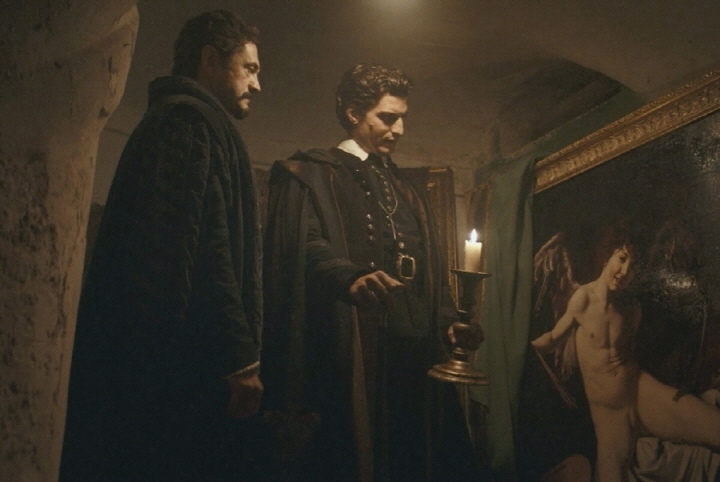
His appointed investigator, who is stiffly played by Louis Garrel, is ready to go all the way for his secret mission. Throughout the story, he interviews or interrogates a number of various people associated with Caravaggio, and each of them is certainly bound to tell the investigator everything regardless of whether they are willing to do that or not.

As these people talk in front of the investigator, the movie frequently goes back to Caravaggio’s past. In case of the aforementioned noblewoman, who is played by Isabelle Huppert, she has known him since he was the young son of one of many peasants working under her family, and she genuinely cares about him and his art, even though she is also not so willing to the cross the line between them. After all, Caravaggio is your average hedonistic womanizer, and the movie does not hesitate to show his rather fluid sexuality as shown from a brief scene where he heedlessly throws himself into one big private orgy.

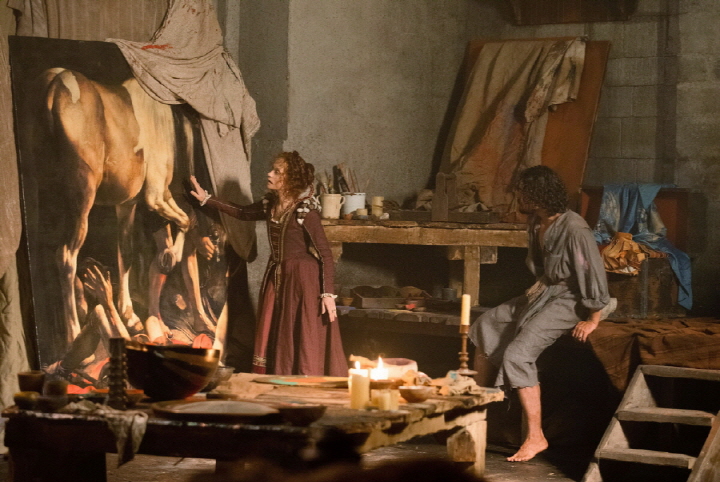
Whenever he is not in the pursuit of carnal pleasure, Caravaggio pays attention to those shabby and seedy denizens at the bottom of Rome, who were often the models for a number of his religious paintings drawn for the Catholic Church as well as many nobles in Italy. These paintings surely drew a lot of attention for their bold and striking beauty, but the Catholic Church and its head were understandably not so pleased about where Caravaggio got his artistic inspiration. In case of one of his religious paintings, he used a certain well-known prostitute as the model for the holy mother in that painting, and the Pope was certainly not amused to learn that after admiring that painting so much.

Needless to say, as his fearless paintings cause a lot of stir and anger in Rome, Caravaggio enjoys his fame and notoriety while not giving a damn about making more enemies in the city. As he mingles more with those low-life people in the city, he gets more inspiration to drive him further, and it looks like nothing can stop him at all, until that nasty incident of his happens.

While never making any excuse about Caravaggio’s many human flaws and vices, the movie observes his irrepressible artistic spirit with real curiosity and fascination, and it sometimes beholds some of his notable creations along with us for a while. Somewhere between the holy and the secular, these paintings are alternatively impressive and provocative, and that is what good artworks can do in my humble opinion.

Around the point where it approaches to its expected conclusion, the movie begins to lose some of its narrative momentum. The eventual finale is a bit too anti-climactic compared to what has been steadily built up to that point, and many of the supporting characters surrounding Caravaggio are rather under-developed as they simply come and go throughout the story, and the investigator remains to be more or less than a mere device for the frame of the story.

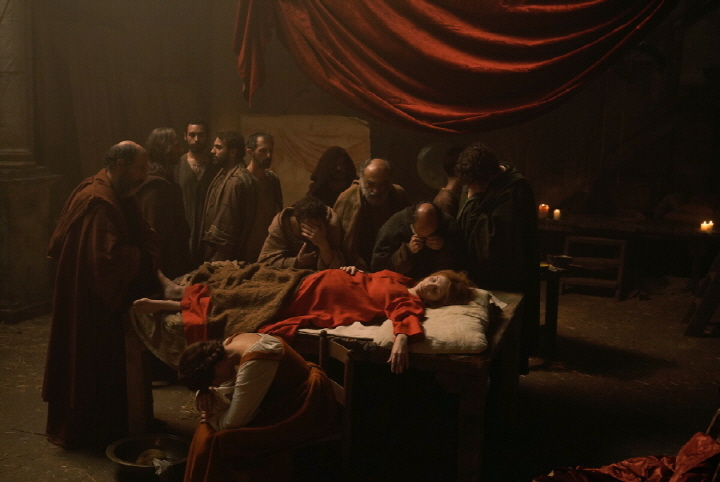
At least, director Michele Placido, who also wrote the screenplay with Sandro Petraglia and Fidel Signorile, and his crew members including cinematographer Michele D’Attanasio did a commendable job of filling the screen with palpable period atmosphere and details to be savored. As the movie often swings back and forth between the secular and holy sides of Rome, we get to sense more of what inspired Caravaggio during that time, and that is particularly evident when Caravaggio is about to draw one of his best paintings at one point later in the story, which vividly depicts the dead body of a young prostitute he knew.

Around Scamarcio’s solid lead performance, the other main cast members including Huppert and Garrel simply fill their respective spots as required. While Garrel is mostly limited by his thankless role, Huppert manages to leave some impression despite her under-written part, and she has her own little moment when her character struggles with her private feelings toward Caravaggio.

In conclusion, “Caravaggio’s Shadow” is not wholly without weak points, but I enjoyed its period mood and details enough for recommendation. It surely reminds me again that some of the greatest artists are not pleasant people at all, but it also makes me reflect on how their art can still impress us regardless of whether we can really separate art from its human creator at all.

Posted in Movies | Tagged , , , | 1 Comment

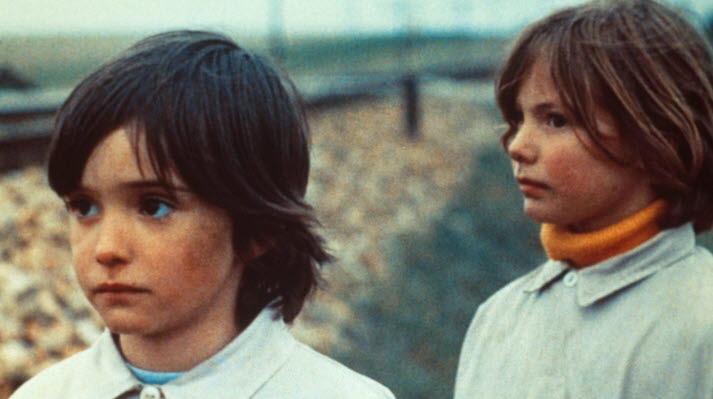
The Spirit of the Beehive (1973) ☆☆☆☆(4/4): A fantasy of silence and whispers

Víctor Erice’s 1973 film “The Spirit of the Beehive”, which is currently being shown in South Korean theaters after his recent comeback work “Close Your Eyes” (2023) came in last year, has delicately sublime qualities to be admired and appreciated. Masterfully balancing itself between the simplicity of childhood fantasy and the ambiguity of allegorical drama, the movie has a series of mesmerizing moments to intrigue or enchant you, which will linger on your mind for a long time after it is over.

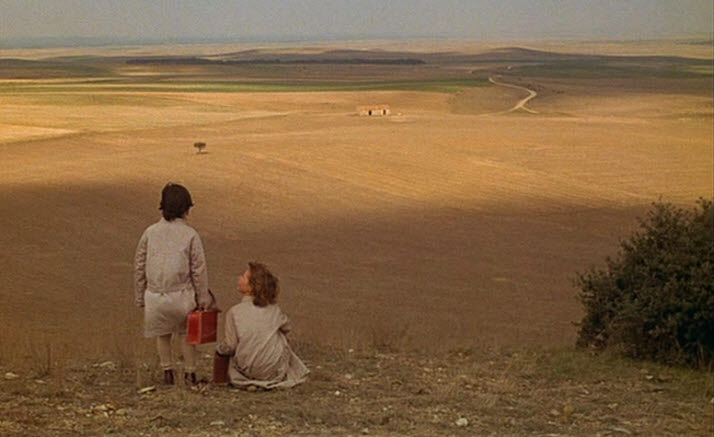
The main background of the movie is a small, isolated village located in the middle of the Castilian plateau of Spain during its post-Civil War period. At the beginning of the story, the whole town is getting quite excited by the upcoming screening of classic American horror film “Frankenstein” (1931) by a mobile cinema, and we soon see many adult and child audiences watching that film at their little town hall.

One of the audiences is a 6-year-old girl named Ana (Ana Torrent), who comes along with her older sister Isabel (Isabel Tellería). She is quite baffled when the movie, which is incidentally the censored version, does not show why and how the Monster kills that unfortunate little girl. She immediately asks Isabel, who later “explains” to her younger sister that 1) the monster actually does not kill that little girl (“Everything in the movies is fake.”) and 2) he is actually alive somewhere out there as a spirit.

Like any young innocent girl around her age, Ana believes her older sister’s harmless lie without any doubt, and we observe how this little white lie leads to Ana’s own little fantasy. After their school time is over on the very next day, they go to an abandoned barn located in the middle of the plateau outside the village, and Isabel elaborates a bit more on her lie. As a result, Ana comes to believe more in the spiritual presence of the Monster around that abandoned barn.

Meanwhile, we gradually sense a faint sense of uneasiness in their family house while noticing how distant their parents often look to each other. Their middle-aged father is mostly occupied with his beekeeping work unless he writes about honeybees inside his library. In case of their mother, she frequently writes letters to somebody, but the movie does not give much detail on the receiver of these letters, except that the receiver is probably someone to whom she was quite close before the Civil War.

These two adult figures’ frequent silence throughout the film has been interpreted as the indirect reflection of how things were grim and oppressive for many people in Spain after the end of the Civil War, which was the beginning of Francisco Franco’s dictatorship which lasted more than 30 years. As a matter of fact, the movie was made not long before the end of that gloomy period, but it was actually allowed to be released in Spain just because, besides the critical success outside Spain, those local censors thought the movie would be too “arty” to draw the public attention.

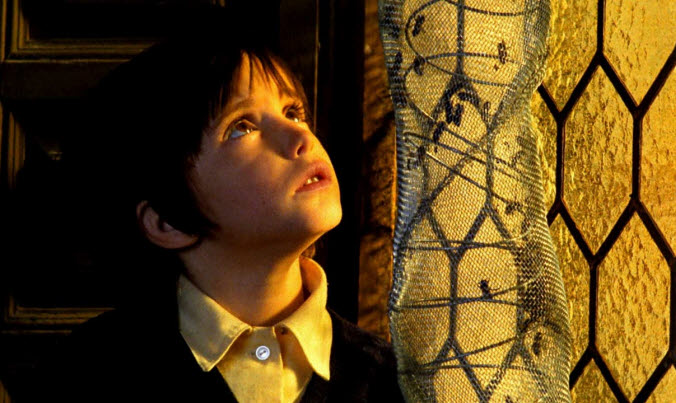
Yes, it is certainly slow and opaque as your average arthouse movie, but the movie decorates its ambiguous allegory with indelible mood and details to intrigue and then engage us more. Although he was losing his eyesight due to his terminal illness during that time, cinematographer Luis Cuadrado vividly captures the earthy beauty of the Castilian plateau on the screen, and he also imbues considerable poetic qualities to many of interior scenes inside the girls’ house. These interior scenes are visually striking as shrouded in warm and bright yellow lighting, whose honey-like hue is clearly connected with those beehives taken care of by the girls’ father.

Some of you may wonder whether the mechanical aspects of the daily life inside beehives, which is mentioned via the father’s writing more than once in the film, is a symbolic metaphor of the Spanish society oppressed under the Franco regime. Again, the movie does not specify anything at all, and it continues to stick to its restrained attitude – even when its young heroine encounters a mysterious figure who fuels her imagination more. The situation subsequently becomes a bit tense when her little fantasy inevitably clashes with the reality of the adult figures around her, and everything in the story culminates to an eerily poignant moment, not long after she inadvertently causes a big trouble for others.   

Ana Torrent, who has been steadily active during last 50 years since her acting debut here in this film (It is certainly nice to see her again in “Close Your Eyes”, by the way), is simply astonishing in what can be regarded as one of the best child performances in the movie history. Often direct and expressive in her unadorned acting, she effortlessly conveys her character’s silent emotional journey along the story, and she also clicks well with her co-star Isabel Tellería, who also has a few memorable moments of hers around Torrent.  

On the whole, “The Spirit of the Beehive”, which has been regarded as one of the greatest Spanish films during the late 20th century, is superlative even when it is simply viewed as a childhood fantasy tale. It is quite a shame that Erice only made three feature films since “The Spirit of the Beehive”, but “Close Your Eyes” demonstrated that he has not lost any of his talent yet, and it is really fortunate for me and other South Korean audiences to get a chance to see both of these two masterworks in movie theater.

Posted in Movies | Tagged , , , | 1 Comment

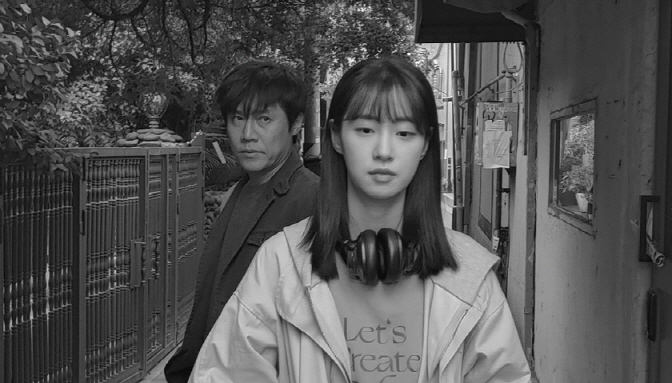
Persona a Strange Girl (2023) ☆☆☆(3/4): That elusive girl

South Korean independent film “Persona a Strange Girl” reminds me again of how the works of Hong Sang-soo have considerable influence over South Korean independent cinema for many years. Just like the works of Woody Allen have been followed by numerous similar juniors, Hong’s works also have had a fair share of juniors during last two decades, and I must tell you that some of them are fairly good while others are merely forgettable.

In case of “Persona a Stranger Girl”, the influence from Hong’s works is quite evident from the beginning to the end. First, it was shot in black and white film just like some of Hong’s works. Second, it has several extended conversation scenes, and the camera mostly sticks to its static position except when it occasionally does some panning, just like many of Hong’s works. Third, it is mainly about one beautiful but elusive young woman usually regarded by one petty male artist. To be frank with you, if I only told you these three things, you would mistake the movie for the latest work from Hong.

That elusive young woman in question is Hye-ri (Jeon Hye-yeon), who recently comes to join a little independent theater company who has been led by a middle-aged director named Hae-young (Park Ho-san). During her audition, she impresses Hae-yeong and his two colleagues a lot right from the beginning, and they are certainly curious about her as she begins to work along with several other members of the company.

Although she is quite active as a new member, Hye-ri sometimes baffles or surprises many others around her including Hae-young. For example, she is not particularly willing to hang around with many of her colleagues, and she does not tell a lot about herself while only saying that she recently studied computer engineering at Seoul National University, which is incidentally one of the most prestigious ones in South Korea. However, when the company prepares for a new production, she provides some interesting insight on the play to be performed, and it is apparent that she is a smart woman simply willing to try something different here in the company.

However, who is she really? That is the question for not only us but also Hae-yeong, who finds himself gradually smitten with her even though he does not signify much as maintaining his usual reserved appearance. As his company keeps working on their latest production, he soon begins to hear about some rumors about Hye-ri, and there are also a few professional issues to be handled in one or another.

Meanwhile, the movie sometimes pays attention to what Hye-ri does whenever she is not working in the company. She often goes to a nearby mountain, and that is where she encounters a foreign girl and the guest lead actress invited to the latest production of the company, respectively. While both of these two figures are total strangers to her, it does not take much time for Hye-ri to befriend each of them mainly thanks to her easygoing attitude, and we accordingly get some glimpse on her plucky personality.

And we also see how things can be quite unpleasant in the company. It turns out that the company has mistreated and exploited some of its young members, and Hae-young tries to handle the situation as much as possible, but he remains quite passive when one of his colleagues harshly and unjustly berates an ex-member of their company at one point in the story. In addition, the main sponsor of the company seems very interested in getting closer to Hye-ri, and that is soon noticed by not only Hye-ri but also a few others in the company.

It goes without saying that there eventually comes a moment when Hae-young confronts Hye-ri as the rumors about her grow more and more. As their conversation gets more intense, we observe that 1) she does not deserve this at all regardless of whether she was totally honest to Hae-young and others from the very beginning and 2) Hae-young is no better than many of his colleagues who casually show their misogynistic bias from time to time.

The screenplay by director/writer Jung Hyung-suk, who made a feature film debut with “The Night View of the Ocean in Yeosu” (2017), falters a bit during its rather unresolved finale, but the movie is still engaging in its dry but realistic depiction of the daily work of Hae-young and others around him. Yes, they all want to do something better and greater someday, but they are always bound by their jaded reality, and the movie generates a bit of amusement from a small subplot involved with the election for the president of some powerful association in their field.

The two lead performers at the center of the film did a credible job on the whole. While Park Ho-san steadily holds the ground with his low-key acting, Jeon Hye-yeon often exudes charm and spirit during many of her scenes in the film, and we come to respect and then care about her even though we are not so totally sure about her true self even in the end.

Overall, “Persona a Strange Girl” does not surpass its main source of inspiration, but it is still a competent work supported well by its good mood and its solid lead performances. By the way, Hong’s upcoming new film will be soon premiered at the Berlin International Film Festival and then get released in South Korea, and it will be really interesting to see whether Hong’s new film is better than this mildly enjoyable piece.

Posted in Movies | Tagged , | Leave a comment