
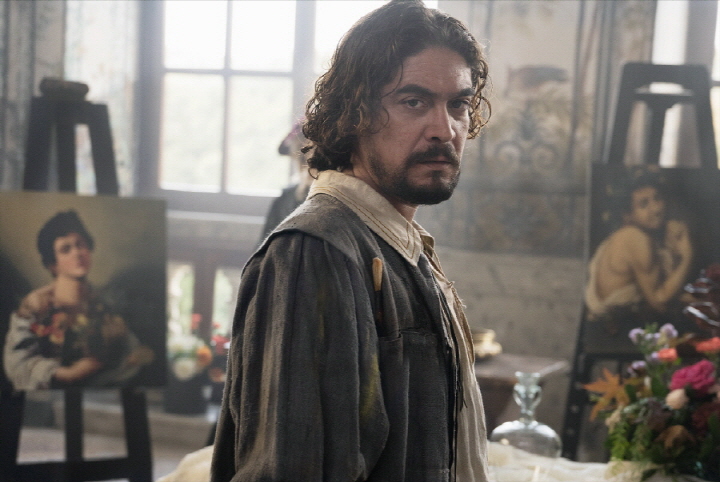
“Caravaggio’s Shadow”, which incidentally came to South Korean theaters in last month, is fascinated with what inspired Michelangelo Merisi da Caravaggio (1571 ~ 1610), who was one of the best artists in Italy around the early 17th century. Although he was a rather unpleasant men to say the least, the movie attempts to illustrate his artistic passion and struggle vividly across the screen, and the result is fairly engaging on the whole.
The movie begins with how Caravaggio, who is vigorously played by Riccardo Scamarcio (You may remember him for his substantial supporting role in Kenneth Branagh’s “A Haunting in Venice” (2023), by the way), got into a big trouble around the late 1600s. In 1606, he happened to murder some criminal dude, so he had to run away from Rome and then went to Napoli, where he could be protected by a noblewoman who was one of his most influential sponsors. During next four years, he waits there as expecting the pardon from the Pope, but the Pope is understandably reluctant while also ordering a secret investigation on Caravaggio’s life and career.
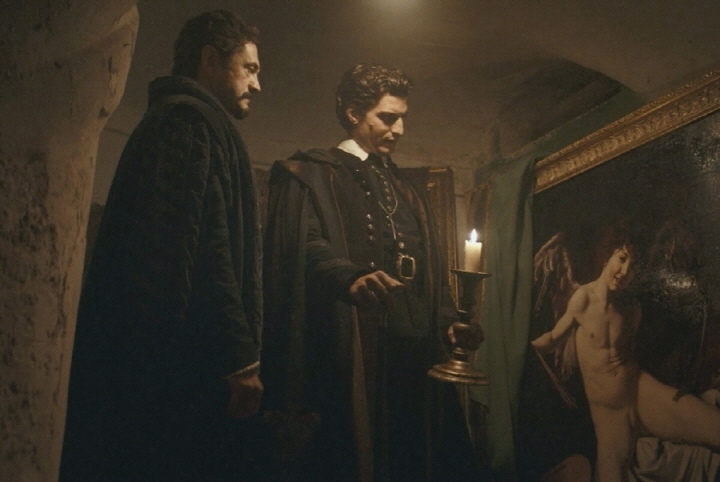
His appointed investigator, who is stiffly played by Louis Garrel, is ready to go all the way for his secret mission. Throughout the story, he interviews or interrogates a number of various people associated with Caravaggio, and each of them is certainly bound to tell the investigator everything regardless of whether they are willing to do that or not.
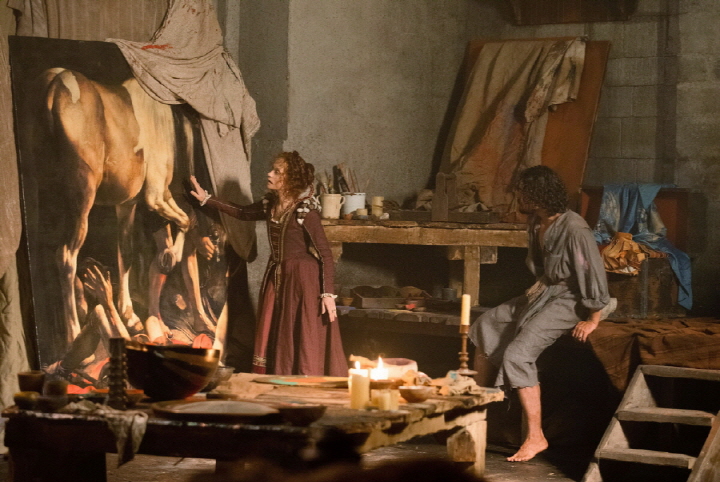
As these people talk in front of the investigator, the movie frequently goes back to Caravaggio’s past. In case of the aforementioned noblewoman, who is played by Isabelle Huppert, she has known him since he was the young son of one of many peasants working under her family, and she genuinely cares about him and his art, even though she is also not so willing to the cross the line between them. After all, Caravaggio is your average hedonistic womanizer, and the movie does not hesitate to show his rather fluid sexuality as shown from a brief scene where he heedlessly throws himself into one big private orgy.
Whenever he is not in the pursuit of carnal pleasure, Caravaggio pays attention to those shabby and seedy denizens at the bottom of Rome, who were often the models for a number of his religious paintings drawn for the Catholic Church as well as many nobles in Italy. These paintings surely drew a lot of attention for their bold and striking beauty, but the Catholic Church and its head were understandably not so pleased about where Caravaggio got his artistic inspiration. In case of one of his religious paintings, he used a certain well-known prostitute as the model for the holy mother in that painting, and the Pope was certainly not amused to learn that after admiring that painting so much.
Needless to say, as his fearless paintings cause a lot of stir and anger in Rome, Caravaggio enjoys his fame and notoriety while not giving a damn about making more enemies in the city. As he mingles more with those low-life people in the city, he gets more inspiration to drive him further, and it looks like nothing can stop him at all, until that nasty incident of his happens.
While never making any excuse about Caravaggio’s many human flaws and vices, the movie observes his irrepressible artistic spirit with real curiosity and fascination, and it sometimes beholds some of his notable creations along with us for a while. Somewhere between the holy and the secular, these paintings are alternatively impressive and provocative, and that is what good artworks can do in my humble opinion.
Around the point where it approaches to its expected conclusion, the movie begins to lose some of its narrative momentum. The eventual finale is a bit too anti-climactic compared to what has been steadily built up to that point, and many of the supporting characters surrounding Caravaggio are rather under-developed as they simply come and go throughout the story, and the investigator remains to be more or less than a mere device for the frame of the story.
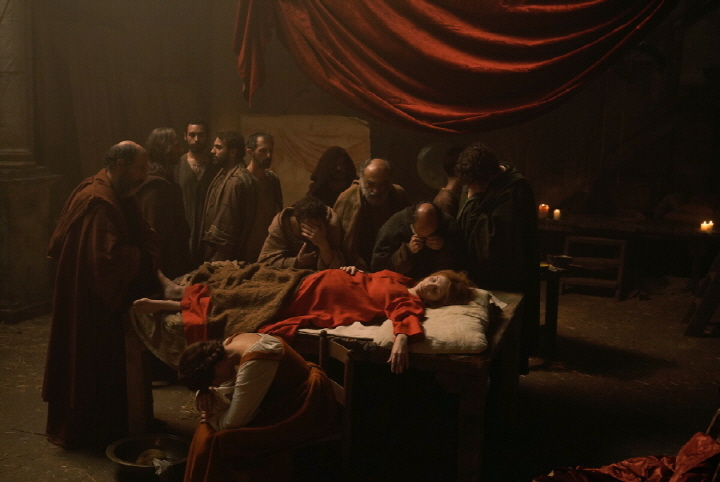
At least, director Michele Placido, who also wrote the screenplay with Sandro Petraglia and Fidel Signorile, and his crew members including cinematographer Michele D’Attanasio did a commendable job of filling the screen with palpable period atmosphere and details to be savored. As the movie often swings back and forth between the secular and holy sides of Rome, we get to sense more of what inspired Caravaggio during that time, and that is particularly evident when Caravaggio is about to draw one of his best paintings at one point later in the story, which vividly depicts the dead body of a young prostitute he knew.
Around Scamarcio’s solid lead performance, the other main cast members including Huppert and Garrel simply fill their respective spots as required. While Garrel is mostly limited by his thankless role, Huppert manages to leave some impression despite her under-written part, and she has her own little moment when her character struggles with her private feelings toward Caravaggio.
In conclusion, “Caravaggio’s Shadow” is not wholly without weak points, but I enjoyed its period mood and details enough for recommendation. It surely reminds me again that some of the greatest artists are not pleasant people at all, but it also makes me reflect on how their art can still impress us regardless of whether we can really separate art from its human creator at all.


And you can see some of Caravaggio’s paintings at first hand at Seoul Arts Centre until next month.
What’s On | Performance·Exhibition | Seoul Arts Centerhttps://www.sac.or.kr/site/eng/show/show_view?SN=66041
[https://www.sac.or.kr/site/main/file/thumbnail/uu/59f578640abc40169c233c22837e3911.jpg]https://www.sac.or.kr/site/eng/show/show_view?SN=66041
What’s On | Performance·Exhibition | Seoul Arts Centerhttps://www.sac.or.kr/site/eng/show/show_view?SN=66041
Hangaram Art Museum An open space at the Seoul Arts Center.. The museum has three levels above ground and one level underground with six galleries , storage rooms, and art shops, which are equipped with temperature and humidity adjustment and lighting facilities. gallery 1 and 2 are located on the first floor, gallery 3 and 4 on the second floor, and gallery 5 and 6 on the third floor.
http://www.sac.or.kr
SC: Thanks for your information.