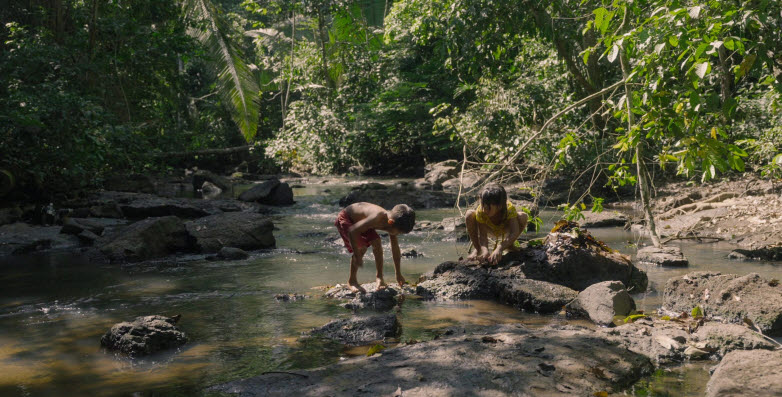
2022 documentary film “The Territory”, which is currently available on Disney+ in South Korea, focuses on the defiant struggle of a bunch of indigenous tribe people living in one Amazon rainforest area of Brazil. While it occasionally shows the viewpoint of their main opponents, it is clear that the documentary puts more emphasis on those indigenous tribe people and their rights to defend their territory, and it is often infuriating for us to see how more injustice was thrown upon them in one way or another.
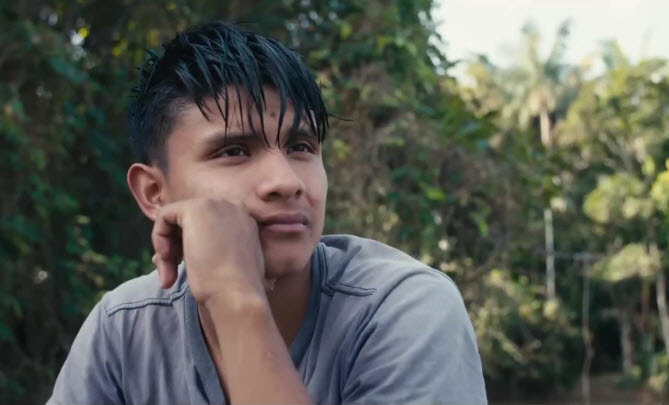
At first, we are introduced to the two central figures of the documentary: Bitaté Uru-eu-wau-wau and Neidinha Bandeira. The former is a 19-year-old member of the Uru-eu-wau-wau tribe, and the documentary gives a brief piece of information on this obscure indigenous tribe who has been resided in the Amazon rainforest area for many centuries. It was only after 1980 that the tribe made a direct contact with the world outside, but this change unfortunately led to the death of many tribe members caused by those infectious diseases from the outside world, and only around 200 tribe members remained around the late 2010s.
Nevertheless, Bitaté and many other tribe members including Ari Uru-eu-wau-wau stood their ground in their territory, even though it has been steady encroached here and there by numerous settlers and farmers eager to turn the rainforest area into farms and ranches since the 1980s. No matter how much they tried to defend their territory, the farmers and settlers kept destroying its rainforest step by step, and things got all the worse when Jair Bolsonaro became the new president of Brazil in late 2018. He and his government tacitly encouraged the farmers and settlers to destroy more of the rainforest, and Bitaté and his tribe members became a lot more frustrated than before.
At least, they could get some help from the outside mainly thanks to Bandeira, a passionate local activist who has been very close to the tribe for many years. In fact, she has been pretty much like another mother for Bitaté, and we see them often closely working together for their common cause. While being fully aware of how she is not welcomed much by many of those local people, Bandeira does not flinch at all for what she really believes in, and her daughter accepts that well even though she is often concerned about safety as much as her mother.
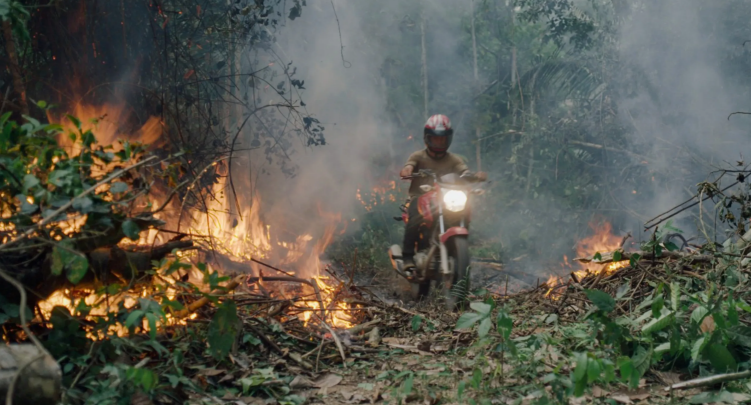
Meanwhile, the documentary also pays attention to several settlers and farmers on the opposite position, who had no problem at all with showing their belief and the considerable damage they often cause in the rainforest. At one point, we see two settlers casually set small fire at one spot in the rainforest, and we soon see the sheer ecological horror resulted from that. Everything around the spot is burned to the ground, and it is all the more chilling when you consider how many unknown plants and animals, which could actually be very valuable for the humanity, might be destroyed there forever.
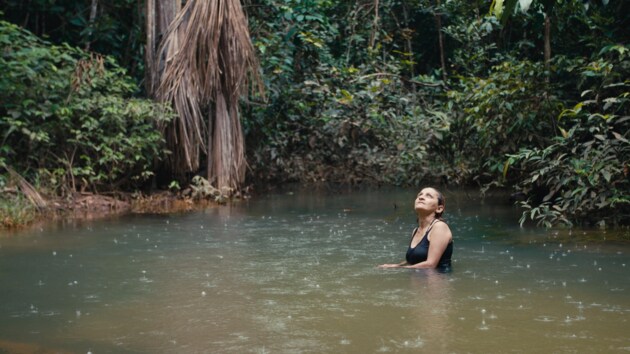
And we also come to reflect more on how much the Amazon rainforest has been important for all the living organisms on the Earth for several million years at least. We all know well that it is regarded as the “lung” of the Earth mainly because it has produced a substantial amount of oxygen every year, and that is why it must be preserved for not only the humanity but also all other animal and plant species around the world (Yes, plants also need oxygen as much as we and other animals).
However, to our exasperation, this ecological importance seems to be the last thing to be considered for those farmers and settlers. They regard the Amazon rainforest as their own American Wild West to be conquered and then civilized, and they regard Bitaté and his tribe people as a mere nuisance to get rid of as soon as possible, while having no idea on how they may also be thrown away by the rich and powerful in the end. As backed by the Brazilian government much more than before, these incorrigible people cornered Bitaté and his tribe more and more, and then there came a tragic incident involved with one of the key tribe members.
The situation became all the more despairing for Bitaté and his tribe because of the COVID-19 pandemic in early 2020. Their community was devastated as consequently losing around 5% of its population, but they kept trying to stand their ground nonetheless, and they eventually established a de facto police apparatus for protecting their territory more than before. Using not only drones but also digital video cameras, they recorded and reported more of their defiant stand against the unjust system, and this actually drew more attention from the media and public in the end. After that, the settlers and farmers had to step back a bit due to their bad public image, but, as reflected by one infuriating scene shown in the middle of the end credits, they were stopped at all, and the documentary informs us a bit on how much the Amazon rainforest was destroyed under President Bolsonaro and his government.
In conclusion, “The Territory”, which was included in the shortlist for Best Documentary Oscar in 2022, feels immensely urgent right from the beginning, and director/co-producer/co-cinematographer Alex Pritz, who deservedly won Exceptional Merit In Documentary Filmmaking for the documentary along with his producers including Darren Aronofsky in 2023, did a competent job of presenting his main human subjects with considerable care and respect. While it could show and tell more in my humble opinion, it accomplishes its mission fairly well within its rather short running time (86 minutes), and its many angry moments will linger on your mind for a while after it is over.