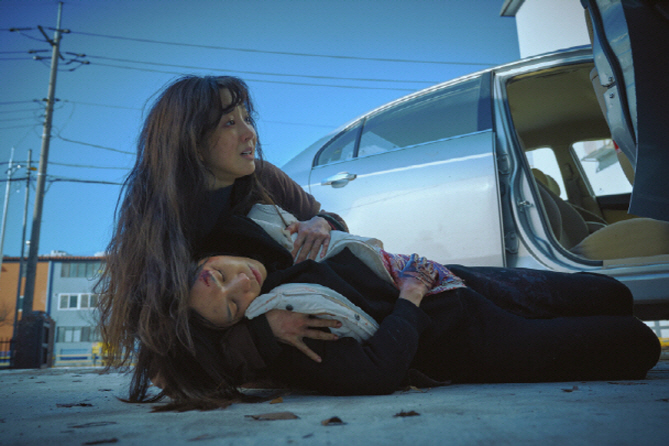
Babygirl (2024) ☆☆1/2(2.5/4): Her object of kinky desire

“Babygirl” is about the risky sexual transgression of a woman supposed to have all. While not fully delving into what really makes her tick, the movie intrigues us with the oddly dynamic interactions between her and her much younger sex partner, and it is a rather shame that the movie hesitates to go further with its lurid and disturbing sexual elements later in the story.  

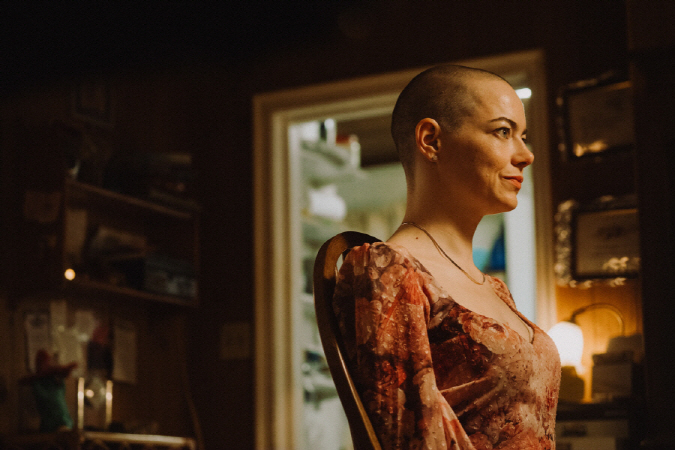
 Nicole Kidman plays Romy Mathis, the female CEO of some promising robotic automation company in New York City. As preparing for a very important moment for her company, she is introduced to a bunch of new interns, and her attention is drawn to Samuel (Harris Dickinson), a handsome lad she incidentally encountered not long before the formal introduction between them. At that time, something about him tantalized her, and he seems to be aware of that even though he does not signify much on the surface.

After Romy is assigned to Samuel as his mentor during the following internship, we come to sense more of the weird sexual tension between them. As Romy gets attracted more to him, Samuel seems to toy with her in one indirect way or another. As they continue to push and pull each other, it looks like he wants to play some morbid game of power and desire, and she is quite willing to go along with that when he makes a small but significant forward move later.  

What happens between them in a rather cheap hotel room will alternatively fascinate and disturb you for good reasons. It is apparent from the beginning of the story that Romy has nurtured a kinky sexual fantasy involved with subjugation and obedience, and Samuel seems to be the one who may fully satisfy her at last. Even though she hesitates more than once, she cannot help but do whatever she is driven to do by him, and he seems to be enjoying this as much as she does.

Needless to say, their relationship is totally inappropriate in more than one aspect, but Romy still cannot help herself. No matter how much she tries to draw the line between herself and Samuel, she always finds herself attracted to their kinky play of sex and power, and then, to her little dismay, Samuel also begins to cross some lines bit by bit.

 As observing more of how happy and stable Romy’s private life with her husband Jacob (Antonio Banderas) and their two daughters, we wonder more about the psychological motivation behind her increasingly tricky sexual transgression. At one point, it is implied that she had a rather unconventional childhood in the past, and that seems to be the origin of her growing desire for being subjugated, but the screenplay by director/writer Halina Reijn, who previous made “Bodies Bodies Bodies” (2022), does not provide any simple explanation. It simply presents her behaviors and feelings on the screen, and this surely generates more intrigue for us.

However, the movie stumbles more than once during its last act, where the situation between its two main characters becomes rather mellow and soapy. Compared to all those odd and kinky moments unfolded between them, what eventually happens later in the story feels quite anti-climactic in comparison, and it looks like the movie itself gets scared right before going further along with its two main characters. In case of a subplot involved with one of the female employees working under Romy, it ends up being half-baked despite some interesting potential shown at the beginning, and that is another disappointment in the movie.

Nevertheless, there are still some good elements to engage us, and one of them is the committed performance of Kidman, who incidentally received the Best Actress award when the movie was shown at the Venice International Film Festival in last year. Although we never get to know much about what is really behind her character’s dark impulse, Kidman ably handles several key moments of naked emotions besides showing considerable commitment, and the result is another notable performance to be added to her admirable acting career. 

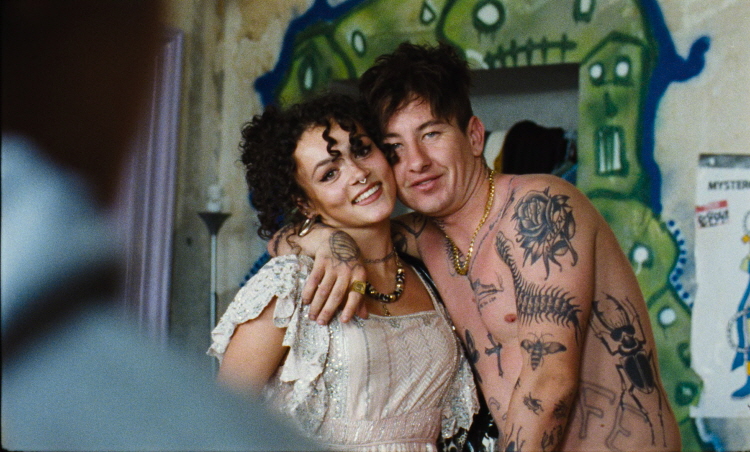
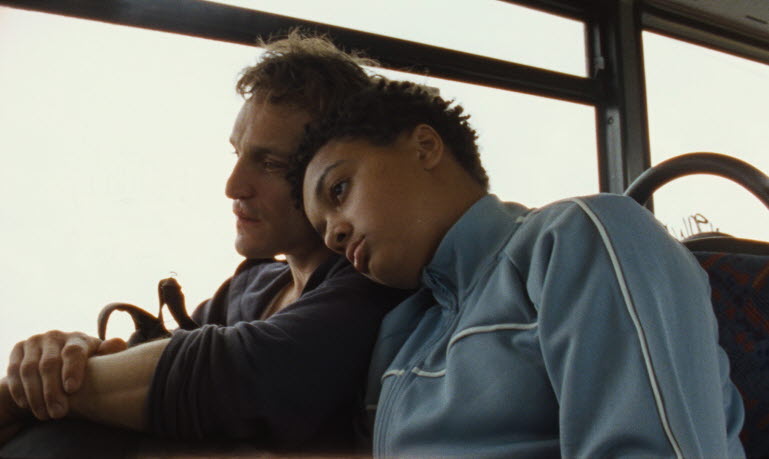
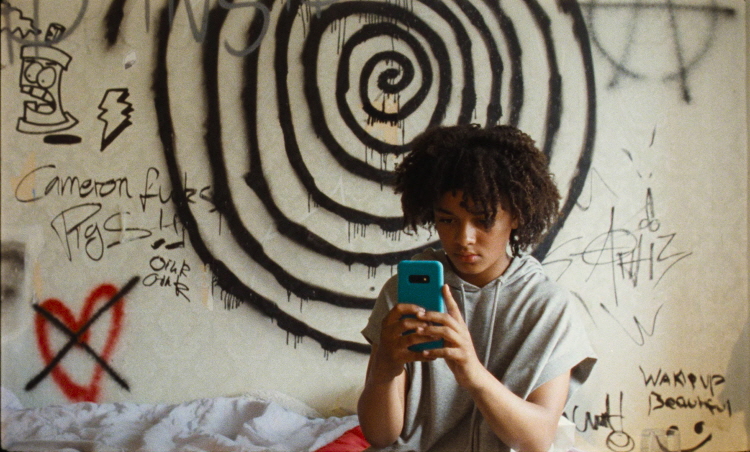
On the opposite, Harrison Dickinson, who has been more notable during last several years since his breakthrough turn in Eliza Hittman’s “Beach Rats” (2017), is simply fabulous as subtly suggesting the unpleasant sides of his elusive but compelling character. Right from his very first scene in the film, he holds his own place well in front of his co-star, and he is particularly effective whenever his character says one thing but also seems to be suggesting the other thing.

Around Kidman and Dickinson, Reijn places a number of good performers, though most of them are limited by their rather thin supporting parts. While Antonio Banderas, who could have played Dickinson’s character if the movie had been made around 30 years ago, is mostly stuck with his thankless role, Sophie Wilde, Vaughn Reilly, and Esther McGregor (Yes, she is the daughter of Ewan McGregor) leave some impression despite their under-developed characters.

Overall, “Babygirl” attempts to be a mix of Luis Buñuel’s “Belle de Jour” (1965), Michael Haneke’s “The Piano Teacher” (2001), and a bit of Stanley Kubrick’s “Eyes Wide Shut” (1999), but the result is not satisfying enough for recommendation. Although its first two acts are fairly tantalizing, what followed next fizzles to my disappointment, and I would rather recommend any of the three films mentioned above.

Posted in Movies | Tagged , , | Leave a comment

The Godfather Part II (1974) ☆☆☆☆(4/4): An ambitious sequel equal to its predecessor

Francis Ford Coppola’s 1974 film “The Godfather Part II”, which was re-released in South Korean theaters not long after “The Godfather” (1972) was shown first, tries to do two different things together at once. Whether this is really successful is rather debatable, the movie is an ambitious sequel equal to its predecessor in terms of scope, and it surely has a number of great elements to shine inside its darkly epic crime drama.

The movie consists of two main stories. The first one, which is actually the real center of the story considering that it occupies around the two thirds of the running time (200 minutes), illustrates what happens several years after the ending of “The Godfather”. It is 1958, and Michael Corleone (Al Pacino) and his criminal organization have grown much with more power and influence since they moved to Nevada from New York City. During the sequence clearly reminiscent of the opening sequence of “The Godfather”, Michael meets a number of various people in private while the big party for his son’s First Communion is being held outside his big house, and we are introduced to some new characters besides Tom Hagen (Robert Duvall) and several other notable supporting characters from the first film.

Everything feels fine on the surface with Michael quietly exerting his power and influence over others around him just like his father did, but, of course, there soon comes a big problem. Probably because of the ongoing expansion of his criminal business, Michael is ambushed by a sudden attack on him and his wife, and he must find whoever is associated with this attack, while also trying to close a big upcoming business deal with Hyman Roth (Lee Strasberg), an aging but powerful Jewish mob boss who once worked under Michael’s father.

Just like the predecessor, the film juggles numerous characters along its story, which becomes more complicated as unfolding its sprawling narrative among several different places besides Nevada. Michael later goes to Cuba for finally settling his business with Roth, but the situation becomes much trickier than expected due to the increasingly unstable political mood in Cuba. Not long after his return from Cuba, there come two different bad news for Michael, and they make him all the more paranoid and suspicious about everything around him, though he still mostly keeps his thoughts and feelings to himself as usual.

Although the story sometimes becomes a bit too murky and complex for us to process and understand the ongoing plot against Michael, the screenplay by Coppola and his co-writer Mario Puzo, which is partially based on Puzo’s bestseller novel of the same name, keeps things rolling via excellent writing and solid characterization. As Michael descends further into his criminal darkness, the story doles out small and big moments between him and several other characters around him, and we become more engaged in his drama even though we are often chilled or devastated by how much he lets himself driven by his ruthless pursuit of power and safety.

In contrast, the other part of the story, which depicts the past of Michael’s father, sometimes looks like something solely existing for lightening up the overall mood a bit. We see how his father had to leave his hometown in Sicily, Italy in 1901. We see how he entered the world of crime after growing up and then trying to raise his own family in New York City in 1917. And we see how he eventually took the first steps toward his powerful status shown in the first film.

On paper, the criminal ascent of Michael’s father is supposed to be a dramatic part to complement Michael’s moral descent, but, as revisiting the film at a local movie theater at last night, I felt that the former interrupts the narrative flow of the latter to some degree as they are intertwined with each other throughout the movie. Robert De Niro, who won a Best Supporting Actor Oscar, did a good job of embodying the recognizable aspects of Marlon Brando’s Oscar-winning performance in the first film without cheaply imitating them at all, but his character’s drama does not have much surprise compared to Micheal’s, and I also heard that De Niro’s Italian speaking in the film has not been received that well by many native speakers (This is why I do not have much objection on the AI-correction on the Hungarian speaking in Brady Corbet’s “The Brutalist” (2024)). At least, it is clear that Coppola’s production designer Dean Tavoularis had a field day as filling the screen with vivid period atmosphere and details to bring more epic qualities to the movie, and he deservedly won an Oscar (The movie garnered total six Oscars including the ones for Best Picture and Best Director, by the way).

In the end, the restrained but undeniably powerful performance by Al Pacino, who was Oscar-nominated again after “The Godfather” and Sidney Lumet’s “Serpico” (1973), is the one which ultimately takes the center. Although we become more and more distant to his character along the story, Pacino keeps engaging us with subtle nuances to observe, and that is why several striking moments of his character in the film are so effective.

In case of a bunch of other supporting performers around Pacino, they are all splendid as having each own moment to stand out. While Lee Strasberg and Michael V. Gazzo, who were Oscar-nominated along with De Niro in the same category, are terrific in their respective parts, Diane Keaton, Robert Duvall, Talia Shire, who also received a well-deserved Oscar nomination, and John Cazale are equally wonderful as being effortlessly back in their familiar roles, and Keaton, who sadly passed away a few weeks ago, and Shire provide some female perspective on the adamantly male-dominant qualities of the movie.

On the whole, “The Godfather Part II” may be one small step down from the almost perfect achievement of its predecessor, but it has firmly and steadily occupied its position during last five decades. Coppola surely reaches for more greatness here, and the result may not be entirely successful, but I was totally absorbed in the story and characters again. That says a lot about its own greatness, folks.

Posted in Movies | Tagged , | Leave a comment

Stiller & Meara: Nothing Is Lost (2025) ☆☆☆(3/4): Remembering his famous parents

Documentary film “Stiller & Miller: Nothing Is Lost”, which was released on Apple TV+ a few days ago, presents an intimate personal perspective on the life and career of one famous American husband-and-wife comedy team. Although their life and career were often riddled with one issue after another, they stuck together to the end via a lot of love, respect, and understanding, and the documentary is often engaging as closely examining their life and career with considerable care and honesty.

They are Jerry Stiller and Anne Maera, who are incidentally the parents of director/co-producer Ben Stiller. When his father died several years after his mother passed away in 2015, Stiller and his older sister decided to sell their family apartment in New York City, and we see him looking into a bunch of archival records left by his parents. His father often recorded a lot of stuffs here and there throughout his and his wife’s life and career, and the documentary is mainly driven by the excerpts from those numerous recordings and home video clips made by his father.

The early part of the documentary focuses on how Stiller’s parents became quite famous not long after they came across each other in the 1950s. As they got closer to each other and then eventually married in 1954, they came to find the comic potential between their talent and presence. Although Anne wanted to be a serious actress, Jerry instantly saw her natural talent and how she could be a perfect comic counterpart for him, and they quickly distinguished themselves together as an excellent comic duo during next several years. 

When they came to have two kids in the 1960s, they became more determined to have more success for their career, and they eventually got a big break thanks to appearing in the Ed Sullivan Show. While they were certainly very, very, very nervous right before their very first appearance in this legendary American variety TV show, they deftly impressed and entertained millions of audiences out there in the end, and, what do you know, they were frequently invited to the show while enjoying more success to come into their career.

However, there were also a number of issues in their career as well as their private life, and the documentary does not pull any punch on that. As your average perfectionist, Jerry was frequently driven toward being quite fastidious, and that often exasperated Anne, who was more relaxed and natural compared to her husband. While this personality contrast between them was crucial in the success of many of their humorous skits, they could not help but clash a lot with each other, and Stiller and his older sister still remember well those frequent clashes between their parents during their childhood years.

And they also remember how usually their parents were absent in their childhood years due to their busy career. Although Jerry and Anne sometimes let their kids a bit more into their life and profession, they were mostly too occupied with their works, and Stiller, who has also been a busy and consummate entertainer for many years just like his parents, ironically sees a lot of his parents from himself as reflecting more on the considerable distance between him and his own family in the past. When he talks with his wife and two kids respectively, Stiller is touchingly frank about the flawed aspects of his private life, and his family members respond to his honesty with warm recognition and acceptance.

The documentary later delves a bit into how unhappy Jerry and Anne were during their respective early years. While Jerry’s father did not support much of his aspiration to become a good comedian, Anne was deeply traumatized by her mother’s suicide which happened during her childhood years. Nevertheless, both of them really tried hard for being good parents to their kids, and Stiller and his older sister are certainly thankful to their parents’ efforts, though they were sometimes burdened a lot by their parents’ fame and success.

Around the 1980s, Jerry and Anne eventually found how to balance their relationship between life and career as they respectively tried something different outside their comedy team. Anne actively pursued her longtime aspiration to be recognized as a serious actress and the following results were quite rewarding for her (She received a Tony nomination for her supporting performance in the 1993 Broadway production of “Anna Christie”, for instance). Jerry also ventured into a number of movies and TV series alone by himself, and some of you probably remember well his Emmy-nominated guest performance in TV comedy series “Seinfeld”.    

I must point out that “Stiller & Meara: Nothing Is Lost” becomes rather repetitive especially during its second half, and its frequent change in the screen ratio feels a bit too distracting in my trivial opinion. Fortunately, this and several other weak aspects are mostly compensated by its undeniably sincere and respectful attitude. While clearly recognizing and accepting many human flaws of their parents, Stiller, who will incidentally become 60 in the next month, also shows a lot of affection and respect toward his parents, and that is why his documentary works as a wonderful personal tribute to his loving parents. They were indeed talented people besides being quite interesting to observe, and you may want to know more about their considerable achievements after watching this solid documentary.

Posted in Movies | Tagged , , , , , | Leave a comment

The Rules of the Game (1939) ☆☆☆☆(4/4): A comedy of manners right before World War II

Jean Renoir’s 1939 film “The Rules of the Game” has been regarded as one of the greatest works in the movie history, and it deserves such admiration like that for good reasons. While it is still a very witty class comedy of manners which gives a sharp and biting commentary on the European society right before World War II, the movie is also often quite compelling for its vibrantly timeless cinematic qualities from its top-notch technical aspects, and it does not feel aged at all just like many of other great films out there.

The title of the movie refers to the social rules and codes supposedly maintaining the status quo for all of the main characters in the story, and most of the most amusing moments of the movie come from how many of them casually do not follow their social rules and codes that much while a few others actually do in contrast. In case of André Jurieux (Roland Toutain), a famous aviator who has just made another world record at the beginning of the story, he has been in love with Christine (Nora Gregor) even though she is married to a rich Jewish aristocrat, and he is not so pleased when Christine does not show up at all during what is supposed to be one of the grandest moments in his life. As a result, he impulsively expresses his bitter private feelings in front of a group of reporters, and this certainly embarrasses Christine.

In case of her husband Robert (Marcel Dalio), he is not concerned that much because 1) he is usually occupied with collecting sophisticated (and expensive) toy machines and 2) he has also been involved with some other woman behind his back. As his wife becomes rather distressed due to André, he briefly considers breaking up with his mistress, but, not so surprisingly, he quickly changes his mind when he visits her later. After all, everything is fine as long as both he and his wife do not tell or ask anything about their respective infidelities, and it seems that they will be able to continue their pretension as before.

Things eventually become a bit more complicated when André is subsequently invited to a country manor belonging to Robert because of some persuasion from André and Christine’s mutual friend Octave, who is incidentally played by Renoir himself. Even while knowing well how it will be rather awkward between André and him, Robert does not object to this at all, and Christine seems willing to put some distance between her and André for a while.

Needless to say, both Christine and André soon find themselves emotionally entangled more with each other than before. Although she manages to keep her reputation as high as before while respectfully welcoming André in front of many of her guests, Christine only becomes more attracted to him, and, to our little amusement, it later turns out that there is some other dude who has also been in love with her just like André. In case of Robert, he must deal with his mistress who is also invited, and this certainly causes more troubles inside his country manor.

As humorously illustrating the absurdities among these and many other members of high society, the movie also pays attention to what is going on among Robert’s and his guests’ servants, who are no better than their employers on the whole as often mirroring the moral callousness of their employers. In case of Christine’s personal maid Lisette (Paulette Dubost), she is married to Robert’s gamekeeper Edouard (Gaston Modot), but she does not love him that much while being willing to have some fun of her own. When a poacher comes to join the serving staff of Robert’s country manor after ingratiating himself a bit with Robert, she does not mind flirting with this dude, and Edouard is not so amused to say the least.  

While cheerfully juggling numerous figures in one way another, the movie immerses more into their little closed world, and cinematography by Jean Bachelet is inarguably crucial for that. His camera frequently moves as attentively following the characters’ actions and movements, and the deft utilization of deep focus throughout the film often makes us more aware of what is happening in the background as well as the foreground. The achievement by Bachelet here in this film is remarkable, considering that 1) deep focus and several other cinematography techniques used in the film were quite new and challenging at that time and 2) the overall result still looks effortless on the whole.

Meanwhile, the indirect but acerbic social commentary of the film gradually emerges from its busy and labyrinthine narrative. There is a hunting sequence which is now regarded as the critical reflection on how many people in Europe remained callous and indifferent to what would soon shake up their world. And there is an inevitable moment of violence and tragedy around the end of the story, which is incidentally preceded by a textbook comic situation of mistaken identity. 

It is rather ironic that the movie could have been lost forever right after its theatrical release in France in 1939. Despite being one of the most expensive movies during its time, the movie was a critical and commercial flop, and then it was heavily cut down from 113 minutes to 85 minutes by Renoir himself. Its original negative was deemed to be destroyed after its storage place was heavily bombed during World War II, but the movie fortunately went through an extensive restoration process in the late 1950s. Although it does not contain one minor scene, the resulting restored version was wholeheartedly approved by Renoir himself, and the movie has remained around the top of many lists of great movies during last seven decades.

 In conclusion, “The Rules of the Game” still shines as a masterpiece which has influenced a bunch of subsequent films such as Robert Altman’s “Gosford Park” (2001), which is also a quintessential upstairs/downstairs comedy film about class and manner. When I watched it for the first time in the early 2000s, it was just a homework for me as a young movie fan, but now I came to admire and appreciate it more after revisiting it yesterday, and I am certainly willing to learn and feel more from this great film.

Posted in Movies | Tagged , | Leave a comment

French Cancan (1955) ☆☆☆1/2(3.5/4): There is no business like French show business

Jean Renoir’s 1955 film “French Cancan” is often exuberant for its colorful mood and spirit. As a fictional story about the foundation of the Moulin Rouge in Montmartre of Paris, the movie cheerfully goes up and down along with its almost unflappable hero and many various characters, and the result is one of the best works from one of the great filmmakers in the 20th century.

The hero of the film is Henri “Zizi” Danglard (Jean Gabin), a middle-aged impresario who has run a little Parisian nightclub called “Le Paravent Chinois”. Although his nightclub has been known for his beautiful belly dancer Lola de Castro (María Félix), it is not exactly profitable enough for him at present, and it later turns out that his financial situation is not very good to say the least.

Nevertheless, as a seasoned but passionate show business guy, Danglard cannot help but drawn to another possibly good idea for his show business. When he later comes to a simple dance hall in Montmartre along with Lola and several admirers of hers, he observes how joyfully people doing an old-fashioned dance called, yes, cancan, and then the idea for presenting a cancan show soon comes to his mind. In addition, he also notices one particular young lady dancing with considerable spirit and charm, and he subsequently approaches to her with an offer she cannot refuse.

Danglard’s idea is simple but bold. He is going to buy the dance hall and then turn it into a big cabaret, and he is willing to take a big chance even though his financial status is still not so positive. Fortunately, one of Lola’s admirers, who is incidentally quite rich, soon becomes willing to finance Danglard’s new project thanks to a little persuasion from Lola, and we soon see Danglard working on the project along with a bunch of figures including Nini (Françoise Arnoul), the aforementioned young girl who comes to show more passion toward show business under Danglard’s guidance.

Of course, just like many other show business stories, there comes one setback after another. For example, Lola, who still has some feelings toward Danglard, is not amused as Danglard and Nini get attracted to each other, even though she knows well what a womanizer Danglard is. This eventually leads to a hilarious group fight scene, which consequently jeopardizes the construction of Danglard’s cabaret.

The movie has some fun with how Danglard remains phlegmatic and practical as steadily pushing his project in one way or another despite those setbacks. Even when he has to leave an expensive hotel due to another financial problem of his, he keeps his appearance as usual, and, above all, he continues to prepare for the cancan show as before.

Meanwhile, the story also focuses on a little romantic complication of Nini, who already finds herself surrounded by more than one admirer besides Danglard. There is a young baker who was quite close to her before she met Danglard, but he wants her to give up her aspiration toward show business. There is also a young foreign princess who has been madly in love with her right from when he saw her for the first time, but she does not love him much even though she is touched by how sincerely he promises her a lot of things including jewelry.

It is not much of a spoiler to tell you that Danglard’s cabaret is eventually completed and then opened for many audiences to come, and the movie does not disappoint us at all once the show begins. Besides the cancan show, Danglard also presents several different shows to entertain and excite his audiences, and Renoir and his crew members including cinematographer Michel Kelber skillfully present the growing excitement among the audiences as one good show after another is presented on the stage.

When the moment for the cancan show eventually arrives, the movie brings more spirit and energy to the screen as those lovely dancers including Nini joyfully present their dancing skills in front of their enthusiastic audiences, and Renoir also did a nice job of delivering a feel-good ending for everyone in the story. Regardless of all those conflicts among them, they are all swept by the joy and excitement around them, and they all feel really happy and spirited for a while at least.

Like any good show business movie, the movie is packed with many colorful characters to remember, and the main cast members effortlessly embody their respective roles. While Jean Gabin, who is often regarded as one of the best actors in the French cinema during the 20th century and also previously collaborated with Renoir in several films including “Grand Illusion” (1937), steadily holds the ground with his gently graceful acting, a number of different performers including Françoise Arnoul and María Félix have each own moment to shine, and you will be also delighted by the brief appearance of several notable French singers including Édith Piaf, who does not need any introduction or explanation at all because of her own distinctive singing voice.

On the whole, “French Cancan” is quite charming and entertaining for not only its vibrant mood and style but also its witty handling of story and characters. I must confess that I was rather tired and sleepy when I watched it at a local arthouse movie theater during last evening, but my interest and spirit soon got perked up within 30 minutes, and I really felt like watching an excellent show in the end. Folks, that is what a good show business movie can do in my trivial opinion.

Posted in Movies | Tagged , , , , , | Leave a comment

Seven (1995) ☆☆☆1/2 (3.5/4): A gruesome masterwork by David Fincher

David Fincher’s 1995 film “Seven”, whose 4K remastered version is currently shown in selected theaters in South Korea, is a gruesome but undeniably compelling thriller to admire and appreciate. While it is surely as grim, unpleasant, and disturbing as your average serial killer flick can possibly be, the movie engages us with a considerable amount of style and mood first, and then it haunts our mind much more than expected with its weary human attitude to the sheer evil and nihilism presented in the story.

At first, the movie, which is set in some anonymous city, briefly establishes the nascent partnership between two very different cops: Detective Lieutenant William Somerset (Morgan Freeman) and Detective David Mills (Brad Pitt). Having been quite tired of what he has faced for many years, Somerset is planning to retire within a week, and that is why he does not welcome much being partnered with Mills, your typical rookie detective who is rather indiscreet and impulsive besides being too cocky and confident.

On the next day, these two cops are assigned to a case which baffles and shocks both of them a lot. An extremely obese dude was found dead inside his house, and it is clear that somebody forced him to eat a lot of food for hours right before his eventual death. As a seasoned investigator, Somerset instinctively senses that this is not a simple case at all, and, of course, another equally grotesque murder happens on the very next day.

It does not take much time for Somerset to realize that these two murders are just the beginning for several next killings to happen. The killer in question is executing his murderous plan according to the Seven Deadly Sins mentioned in the Bible and several works of literature including Dante Alighieri’s “The Divine Comedy”, and Somerset and his partner come to see more of how deviously patient and methodical the killer is. In case of the third killing, it is apparent that the killer has been carefully preparing for this for at least one year, and there is some twisted sense of humor from how the killer leads the police from the second murder to the third one later in the story.

While the identity of the killer functions as sort of MacGuffin to hold our attention, the screenplay by Andrew Kevin Walker gradually develops its two main characters via several small but crucial personal moments. While we get to know more about Mills and his pretty wife Tracy (Gwyneth Paltrow in one of her early roles), we also come to learn more of how weary Somerset has been about his work and the despairing enviornment surrounding him and many others in the city. As a wise and well-experienced old man, he certainly knows a lot about how evil man can be – and how apathic and uncaring one can be as living in the city for years.

Nevertheless, though he usually sticks to his reserved appearance, Somerset is also capable of compassion and empathy, and there is a little poignant moment between him and Tracy, who later comes to him for getting some advice on a certain personal conflict behind her warm and bright appearance. He quietly listens to her, and then he tells her a bit about a certain personal choice of his in the past. Although he does not signify much on the whole, we sense some bitter feelings behind his phlegmatic attitude, and so does Tracy.

While never flinching from the gruesome details of the murders in the story, the movie constantly fills the screen with a lot of dark but palpable ambiance. Fincher and his cinematographer Darius Khondji frequently utilize the high contrast between light and shadow in many of the interior scenes in the film, and this accentuates the sense of dread and horror as Somerset and Mills delve more into their increasingly fiendish case. The city in the movie looks as rainy and moody as that futuristic city in Ridley Scott’s “Blade Runner” (1982), and we are often overwhelmed by the depravity and despair felt from the streets and alleys of the city.

In the end, the movie eventually culminates to the confrontation between our two detectives and the killer, but it takes time for arriving at its starkly nihilistic finale, and that depends a lot on what is precisely exchanged among the three main performers during this part. Morgan Freeman and Brad Pitt complement each other well besides imbuing their archetype roles with enough sense of life; Freeman is absolutely terrific as eventually becoming as the main voice of reason and morality in the story, and Pitt holds his own place fairly well even though his character is rather flat compared to Freeman’s. In case of the actor who plays the killer in the film, I will not talk a lot about him because 1) he is still a surprise for anyone watching the film for the first time and 2) he has been quite infamous for the reason many of you know well, but I can tell you instead that he is quite effective as subtly conveying to us his character’s unfathomable depravity and confident intelligence behind his understated appearance.

In conclusion, “Seven” is one of the best works in Fincher’s interesting filmmaking career. Although I do not like some of his works such as “The Curious Case of Benjamin Button” (2008), he has never made any lousy movie yet, and it is interesting to observe how he has often focused on the dark and unpleasant sides of humanity as shown from “Zodiac” (2007), “The Girl with the Dragon Tattoo” (2011), and recent Netflix drama series “Mindhunter”. I may not totally embrace “Seven”, but its grim but vivid presentation of the dark sides of the humanity remains fresh and compelling as before thanks to his skillful direction, and I am glad to revisit at a big local theater.

Posted in Movies | Tagged , , , , | Leave a comment

My Missing Aunt (2025) ☆☆☆(3/4): Her erased aunt

South Korean independent documentary film “My Missing Aunt” presents a modest but intimate personal story to tell. Looking into how one promising young woman was unjustly erased by her own family, it makes some sharp point on the sexist influence of patriarchy upon women, and you will also come to reflect more on how the South Korean society has not been free from that yet.

The story begins with when director/writer Yang Ju-yeon came to know about a hidden secret inside her supposedly harmonious family. On one day, her father happened to talk about his eldest sister when he was a bit drunk, and that baffled Yang a lot because her father or many other family members of theirs had never talked about this hidden family member in question. As becoming more curious about the aunt she had never known, Yang decided to delve more into who she was, and the documentary follows her subsequent investigation.

Although both of her parents were not so willing to talk about her hidden aunt because she unfortunately killed herself around 50 years ago, it did not take much time for Yang to find some old stuffs associated with he aunt, including an old photograph album belonging to Yang’s paternal grandmother. That photograph album has a number of photographs showing Yang’s aunt during her childhood and adolescent years, and they made Yang all the more curious about who her aunt really was.

Thanks to the old records from a high school where her aunt studied, Yang could locate several classmates of her aunt, who were all willing to tell many things about her aunt. According to them, Yang’s aunt was a smart and confident girl who wanted to be an artist someday, and it later turns out that she went to a local university after her high school graduation. Yang interviews several people who knew her during her college time, and they all fondly remember how spirited she often was.

However, just like many other young women during that time, Yang’s aunt also found herself often frustrated and suffocated mainly due to her family. Although her father made sure that all of his five children received a fair amount of education, he always put his two sons first even though Yang’s aunt was his eldest child. When she asked for the permission to study in Seoul, he said no without any hesitation, and this certainly broke her heart.

As coming to learn more about how her aunt struggled with gender bias and discrimination, Yang reflects more on how frequently she has faced the same problems throughout her own life. In a home video clip showing her birthday party, her father’s camera often showed more attention to her younger brother even though she should be the focus of the home video, and her grandfather was no better than that.

Later in the documentary, Yang has an honest conversation with her father in front of the camera. Although he visibly feels awkward as listening to his daughter, Yang’s father frankly admits that, despite his sincere efforts to love both of his two children equally, he had usually put Yang’s younger brother above her a bit because of those sexist ideas handed from his father, and that leads to more conversation between him and his daughter.

Meanwhile, Yang came to learn more about the rather suspicious circumstance surrounding her aunt’s suicide. According to the people close to her at that time, she had a very close relationship with some young man, but, not so surprisingly, this dude turned out to be quite petty and possessive, and she really tried hard to break up with him as soon as possible.

In the end, Yang’s aunt killed herself with a bottle of poison in that guy’s residence on one day of 1975, but, to her bafflement, Yang could not find any police record on this serious incident. It is apparent that her family covered that up just for avoiding getting their reputation tarnished in public, and they even changed the date of her death when they applied for her death certification later.

As wondering whether her aunt really committed suicide at that time, Yang’s mind naturally muses more on how many women get beaten or killed in the South Korean society every year – and how often the South Korean society has overlooked that mainly due to its male-dominant aspects. Although many of South Korean women came to speak and shout louder during last several years, they have been often ridiculed or persecuted by many men out there nonetheless, and that says a lot how much the South Korean society needs to be changed in case of gender equality.

Nevertheless, the documentary shows a bit of hope and optimism as Yang actively persuades her father to do something important for his forgotten eldest sister. Although too much time has passed since her death, Yang is determined to remember and honor her aunt as much as possible, and that is followed by a brief but quietly poignant private moment between her and her father.

Overall, “My Missing Aunt” presents well its engaging personal story within its rather short running time (78 minutes), and I appreciate how Yang handles her personal project with genuine care and passion. In short, this is another interesting South Korean documentary of this year, and its haunting main human subject will linger on your mind for a while after it is over.

Posted in Movies | Tagged , , , , | Leave a comment

Exit 8 (2025) ☆☆☆(3/4): Trapped in a loop

Japanese film “Exit 8” is simple but effective in its rather limited setting. Based on the 2023 Japanese video game of the same name, the movie follows the desperate struggles of a few figures helplessly trapped in a seemingly endless loop of subway hallways, and it is often fun to watch how it ably balances itself between repetition and variation before eventually reaching to its expected final stage.

The movie opens with an anonymous man riding a subway along with many others. While he is merely spending some time on his smartphone, there comes an unexpected phone call from his ex-girlfriend, who notifies him that she has just found that she is pregnant. Needless to say, he becomes quite confused and conflicted to say the least, while also being quite indecisive about what to do about this circumstance.

Anyway, as he tries to talk more with his ex-girlfriend after getting off from the subway later, something really perplexing happens to him. He goes through a series of stairs and hallways while looking for an exit, but then he suddenly finds himself walking along an almost empty hallway. At first, this does not surprise him much, but then he comes to realize that he is actually walking the same hallway again and again.

The movie takes some time for us to get accustomed more to this strange setting. Along this very odd hallway, there are several advertisements on the left wall while there are three steal doors on the right, all of which are incidentally locked. In addition, our hero always comes across some guy walking from the opposite end of the hallway, and it is evident that this figure is nothing more than one of the mere details of this weird hallway.

Our hero soon comes to learn the simple golden rule of the hallway. Whenever he walks along the hallway, he must confirm whether there is any kind of anomaly in the hallway. If there is really any anomaly to notice, he must turn back and walk in the opposite direction. If there is not anything different at all, he must walk along the hallway as before. If he is correct in his observation, he can move up to the next level before eventually arriving at “Exit 8”. If he is not correct, he will be back to the first level.

Now, this seems pretty easy at first, but, of course, things gradually become tricky for our hero as he struggles to advance stage by stage. At first, it is not so difficult to notice an anomaly along the hallway, but, just like many other video games, the hallway becomes more challenging at the higher levels. For example, our hero is stopped by something quite unexpected at one point, but he is not so sure about whether this is actually an anomaly or not, and that naturally generates some suspension on the screen.

As steadily rolling its story and characters in one direction or another, the movie tries a number of interesting variations on its limited setting. As the camera of cinematographer Keisuke Imamura smoothly and fluidly follows the actions of our hero, we become more engaged and watchful as the movie pulls out small and big surprises along the hallway, and you may have some fun if you notice any anomaly before our hero does. The score by Yasutaka Nakata and Shohei Amimori is effective in generating more tension and dread on the screen, and the movie also shows some twisted sense of humor via a certain famous classic piece by Maurice Ravel, whose repetitive rhythm certainly resonates with the narrative structure of the movie.

Although the characters in the film are more or less than the figures to be moved here and there as required, we come to care a bit about some of them later in the story, and the movie adds a bit of extra drama to the main story via that walking dude and a few other figures appearing in the hallway. For example, one of these figures becomes an unexpected ally for our hero later in the story, and our hero’s relationship with this particular figure makes him reflect more on his life – and what he really should do about that situation involved with his ex-girlfriend.

Under the competent direction of director/co-writer/co-director Genki Kawamura, who previously made a feature film debut in “A Hundred Flowers” (2022), the small main cast member of the film are all believable in their respective parts. As the main center of the film, Kazunari Ninomiya is particularly good when his character comes to face more of his human flaws along the story, and he is also supported well by Yamato Kochi, Naru Asanuma, Kotone Hanase, and Nana Komatsu.

On the whole, “Exit 8”, which incidentally received the Best Poster Design award when it was premiered at the Midnight Screenings of the Canne Film Festival early in this year, is a fairly enjoyable case of video game adaptation which actually made me interested in playing its original video game someday. While certainly reminiscent of several other similar genre films such as “Cube” (1997), the movie has its own style and mood to distinguish itself, and it also may make you reflect a bit more on how mindlessly we often go through our daily life. After all, repetition is always bound to bore and then numb you, isn’t it?

Posted in Movies | Tagged , , | 1 Comment

Good Boy (2025) ☆☆☆(3/4): From a dog’s viewpoint

“Good Boy” is a little genre film which tries something different, and I like that. Mainly driven by the viewpoint of one good dog, the movie unfolds its rather simple horror story step by step, and the growing sense of fear and dread along the story is more palpable to us as it adamantly sticks to the limited viewpoint of its lead animal character.

At first, the movie establishes how things are not good for the male owner of a dog named Indy. For some unspecified reason, his health has been seriously deteriorated for a while, and he is eventually sent to a hospital after his sister belatedly finds his unconscious body, but he decides to get out of the hospital and then go to his grandfather’s house, which is incidentally located in the middle of some remote forest area.

Through Indy’s viewpoint, we already see some bad signs unnoticed by the owner. During the opening scene, the dog senses something quite insidious, which seems to have some toxic influence on the owner’s increasingly bad health. When the owner goes to the his grandfather’s house in the middle of one dark and rainy night along with his dog, the dog senses that insidious entity again, but, again, the owner does not notice anything even though it is apparent to us from the beginning that his grandfather’s house is not a good place to stay to say the least.

Anyway, Indy keeps trying to stand by its owner as your average good dog, and the owner, whose face is seldom shown on the screen mainly because the camera usually follows the dog’s viewpoint, looks a bit more relaxed than before. At one point, he goes for a walk outside his house, and he seems soothed a bit by his trusted dog, regardless of how sick he really is at present.

However, there soon come more ominous signs to disturb Indy in one way or another whenever its owner is not looking. It often hears some strange sounds heard from somewhere inside the house, and there are also several typical moments including a door suddenly being moved a bit for no apparent reason. Needless to say, the dog becomes all the more disturbed and terrified, but the owner remains occupied with his worsening condition as before. His concerned sister often calls, but he gets only annoyed by that, and he even becomes rather harsh to his dog later in the story.

Director/co-producer/cinematographer/editor Ben Leonberg, who also wrote the screenplay along with Alex Cannon, trusts his audiences enough. There are a number of wordless key scenes depending a lot on the dog’s responses and behaviors, and they are fairly effective despite some clichéd elements including an old neighbor living not so far from the house. Although we can usually see as much as Indy within its limited viewpoint, we become more aware of whatever is approaching to its owner, and we come to empathize more with its emotional disturbance, especially when Sam Boase-Miller’s unsettling score is played on the soundtrack.

As a result, the movie so completely immerses us into the dog’s viewpoint around the middle point of the story that we do not mind at all even when it goes a bit deeper into Indy’s unconsciousness more than once. That is rather conventional, but it gives us some more understanding on how much Indy is scared about whatever is happening around it and its owner. After all, the owner is virtually the center of Indy’s small world, and we can only imagine how terrible it will be for Indy to lose its owner.

When the story arrives at its expected finale, the mood becomes all the more tense and ominous than before. Sensing more of how much its owner is menaced by something inside the house, Indy becomes more determined to take some action for saving its owner, and you will certainly root for it more as it goes through a bit of action. What eventually happens may not surprise you much, but there is some little poignancy as we are reminded again of how loyal a dog can be.

It surely helps that the animal performer of the film is actually quite convincing from the beginning to the end. Not so surprisingly, Leonberg, who is incidentally the owner of Indy, spent around 300 days for drawing the right reactions and behaviors from Indy in front of the camera, but the result looks quite seamless on the screen. Regardless of whatever it felt or thought about whatever its owner was doing behind his camera at that time, Indy did a good job of functioning as the center of the story, and it is also quite likable just like any good dog. While there are also a handful of human performers in the movie, the main focus of their acting how to serve or enhance Indy’s “performance” more, and we easily accept Indy as the main star of the film.

Overall, “Good Boy” occasionally feels rather slight in terms of narrative, but it is taut and efficient during its relatively short running time (72 minutes). I must confess that I am mostly a cat person, but the movie appealed to me more than expected, and I admire the considerable efforts shown from the screen. In short, Leonberg, who previously made several short films before making a feature film debut here, deserves all the praise for his modest but commendable achievement, and it will be interesting to see how he will advance further after this promising beginning for his filmmaking career.

Posted in Movies | Tagged , , | 1 Comment

Frankenstein (2025) ☆☆☆1/2(3.5/4): The Shape of Creation

Guillermo del Toro’s latest film “Frankenstein”, which happens to be released in South Korean theaters before getting released on Netflix a few weeks later, is certainly something he is born to make. After all, he is an undeniably talented filmmaker of darkly vivid and fantastic imagination, and his utterly impressive adaptation of Mary Shelley’s classic horror novel will solidify his status more just like many of his other excellent works in the past.

As many of you know well, the story is about an ambitious medical doctor named Victor Frankenstein (Oscar Isaac) and his monstrous creation. As shown from the early part of the film, Dr. Frankenstein has been quite obsessed with conquering death since he lost his dear mother during his childhood years, and we later get a grotesque scene where he proudly presents the latest result of his obsessive medical study in front of many scholars and doctors in London.

While his presentation is not welcomed much on the whole, the doctor is approached by Henrich Harlander (Christoph Waltz), a wealthy arms manufacturer who is incidentally the uncle of the fiancée of the doctor’s younger brother. He is willing to finance the doctor’s ongoing experiment on exchange for doing some favor for him later, and the doctor cannot possibly say no because he really needs more money and support for reaching to the breakthrough point of his experiment someday.

Harlander happens to have a right place for the doctor’s experiment, which is a big abandoned castle located somewhere in Scotland. As the doctor and his benefactor furnish this moody place step by step, del Toro and his production designer Tamara Deverell, who previously collaborated with him in “Nightmare Alley” (2021), have a lot of fun with filling the screen with a bunch of darkly fascinating stuffs to observe, and the movie also has some gory fun with how the doctor collects his “materials” for his experiment thanks to Harlander, who surely knows well where he can get them as a merchant of death.

Meanwhile, the doctor also finds himself gradually attracted to Lady Elizabeth Harlander (Mia Goth) once he meets her in Harlander’s house. While she is soon going to marry his younger brother, he cannot help but be impressed by her intelligence and independent spirit, and she also seems to be interested in getting closer to him even though she still finds him too arrogant and egoistic. She does not flinch at all about whatever he is studying, but she instantly senses the possible trouble from that, and that always holds her back from him. 

Anyway, everything in the doctor’s experiment eventually culminates to its finishing point in the middle of one dark and stormy night (What do you expect, folks?), and the movie naturally pulls all the stops for this expected highlight moment. As the score by Alexandre Desplat, who won his second Oscar for del Toro’s previous film “The Shape of Water” (2017), becomes quite tense and bombastic as required, cinematographer Dan Lausten, who also worked in “The Shape of Water”, unleashes a series of overwhelming visual moments on the screen, and then we soon see the eventual result of the doctor’s experiment.

Of course, what the doctor creates in the end horrifies and disgusts him a lot, and that is when the movie shifts itself more toward his creation. While this creature looks quite hideous on the surface, it gradually shows a lot more intelligence and sensitivity than expected. As a matter of fact, there is a brief but poignant moment of communication between him and Elizabeth at one point later in the story, and this will certainly remind you of that oddly touching romance between the heroine of “The Shape of Water” and that mysterious creature in that film.

While the story steadily heads toward its predetermined finale, the movie constantly mesmerizes us with its superb visual qualities. I still remember its many grand touches including the striking crimson dress of the doctor’s mother and the huge library belonging to the doctor’s father, and these and many other interesting details certainly contribute a lot to the overall Gothic atmosphere of the film.

Above all, the complicated conflict between the doctor and his creation continues to hold our attention to the end. While Oscar Isaac, who is no stranger to playing a mad scientist considering his memorable performance in Alex Garland’s Oscar-winning film “Ex Machina” (2014), fills his role with a lot of fierce arrogance, Jacob Elordi brings enough pathos and sensibility to the doctor’s creation while also looking fearful and intimidating as required. Several notable cast members including Lars Mikkelsen, David Bradley, Felix Kammerer, Christoph Waltz, and Charles Dance are well-cast in their respective supporting parts, and Mia Goth, who also plays the doctor’s mother besides Elizabeth, brightens up the film a bit with her interestingly uncanny presence.       

 On the whole, “Frankenstein” is a first-rate horror film which is also as good as you can expect from del Toro, who has never disappointed me and many other audiences throughout his long and illustrious career packed with a number of distinctive achievements to enjoy and cherish. I think it is too good and epic to watch at home, and I strongly urge you to grab a chance to watch it at movie theater as soon as possible – especially if you admire del Toro’s works as much as I do.

Posted in Movies | Tagged , | 2 Comments