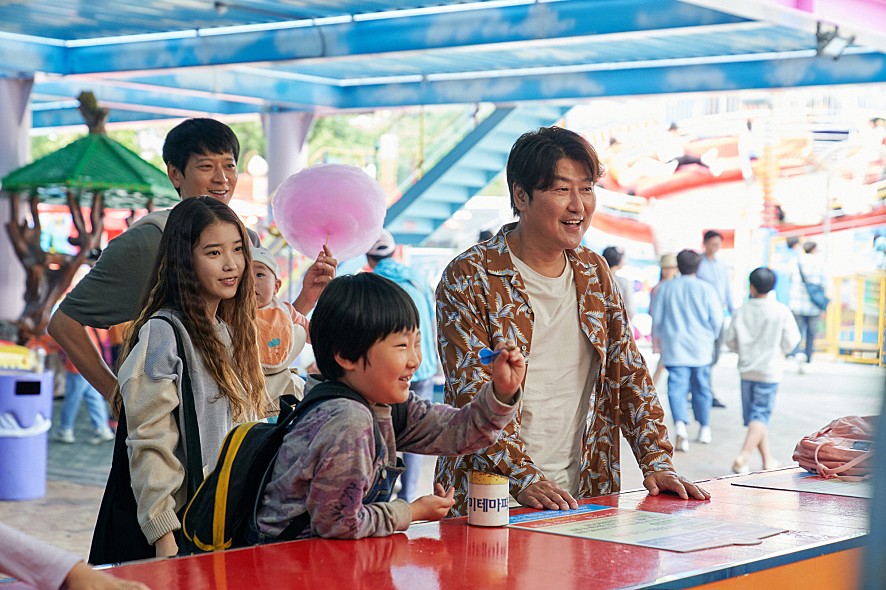
On the Count of Three (2021) ☆☆☆(3/4): Their little suicidal adventure.

Personally, suicide is not a laughing matter at all to me. To be frank with you, I was suicidal more than once throughout my 39-year life, and, as far as I remember, I actually attempted to kill myself twice. Although the reasons for my suicide attempts feel rather silly whenever I reflect on those depressing moments, I also remember well how I was not so willing to live another day to say the least, and I am glad that I eventually managed to keep going in both cases.

That is the main reason why I am usually quite sensitive to movies about suicide, and some of them annoyed or infuriated me for the crass handling of their serious main subject, but I am happy to report that Jerrod Carmichael’s debut feature film “On the Count of Three” amused and engaged me more than expected. While never overlooking the dark sides of its story, the movie humorously bounces from one narrative point to another along with its two deeply troubled characters, and you will come to care more about what may happen to them in the end – even while having some good chuckles from what may be the last day of their life.

At the beginning, we are introduced to Val, played by Carmichael, and his best friend Kevin (Christopher Abbott) as they are respectively going through another desperate day of their life. A few days ago, Kevin attempted suicide, but he fortunately failed and then was sent to a local mental hospital. As he talks with a psychiatrist assigned to him, we come to gather that he already tried to kill himself several times before, and he is not so willing to cooperate with his psychiatrist because there is no solution for his ongoing mental predicament in his depressed viewpoint.

In case of Val, he looks mostly fine on the surface as beginning to work at his workplace, but he turns out to have his own mental problem even though he does not tell anything about this to others around him. When his boss notifies that he will get a promotion, he is not cheered up at all, and he has also distanced himself a lot from his girlfriend for some personal reason, even though he once considered proposing to her. At one point, he actually tries to kill himself, but he only ends up miserably failing to kill himself, and that reminds me of how miserable my two suicide attempts in the past were. I tried to suffocate myself to death in both cases, but I only found that, like him, I was not so willing to push myself beyond that grim point of no return.

Not long after that, Val comes to have another idea for his suicide. Knowing well how suicidal Kevin has been for years, he decides to commit a suicide along with Kevin, so we soon see him helping Kevin escape from that mental hospital. Val has already prepared two guns for them, and all they will have to do is shooting each other’s head at a spot right next to a local strip club.

However, not so surprisingly, it turns out that both Val and Kevin are not so willing to pull the trigger as promised to each other. While they are still fairly suicidal, they decide to enjoy themselves a bit together before finally killing each other, and, because they have nothing to lose for now, they also concoct an impromptu plan associated with someone mainly responsible for Kevin’s damaged mental status.

Now, this feels like a setup for your typical life-affirming drama, but the screenplay by Ari Katcher and Ryan Welch, which received the Waldo Salt Screenwriting Award when the movie was premiered at the Sundance Film Festival early in last year, does not soften or cheapen its story and characters at all as often wielding its morbid sense of black humor. While there are a few moments of cheerfulness for our two troubled heroes, the movie shows us more of how pathetic and pitiful they are in many aspects, and that is particularly exemplified well by when Val tries to have some reconciliation with her girlfriend later in the story. Although he is sincere in his attempt, his girlfriend sees through him right from the beginning, and she does not pull any punch at all as clearly discerning the origin of his ongoing problems.

During the last act, the situation becomes a lot more serious than before due to an unexpected narrative turn, but the movie still balances itself well between absurdity and gravitas as its two main characters inevitably arrive at a crucial point where they must respectively make a choice for each other. I will not go into details about how the movie makes an exit along with them, but I can tell you instead that it does earn the poignant feelings generated from its very last shot.

As the center of the film, Carmichael and his co-star Christopher Abbott, a talented actor who has steadily risen since his heartbreaking breakthrough performance in “James White” (2015), deftly convey to us the complicated emotional bond between their characters, and they are supported well by several notable performers, who have each own moment to shine at the fringe of the story. As Val’s no-nonsense girlfriend, Tiffany Haddish, who shows more of the serious side of her considerable talent here as she previously did in Paul Schrader’s “The Card Counter” (2021), steals every second of her brief appearance in the film, and J. B. Smoove, Lavell Crawford, and Henry Winkler are also well-cast in their small but substantial supporting roles.

Overall, “On the Count of Three” is an entertaining black comedy which deals its sensitive main subject with enough humor and thoughtfulness, and I admire Carmichael’s economic storytelling as well as how he draws good performances from himself and several other main cast members in the film. To be frank with you, I feel a bit better about my inconsequential life after watching it, and that is what good films often can do, isn’t it?

Posted in Movies | Tagged , , | 1 Comment

Foxhole (2021) ☆☆1/2(2.5/4): Three different wars

“Foxhole” is a modest war movie which presents three different wars and then clumsily tries to make some universal statements from them. Although I do not think it works as well as intended, there are several effective moments to be appreciated at least, and they are supported mostly well by its small cast members, who appear in all these three main parts of the film as playing different characters.

The first part is unfolded in one foggy battleground of the American Civil War in the 19th century. During the opening scene, the camera looks over lots of dead soldiers on a wide field, and then it suddenly focuses on one Confederate Army soldier who manages to survive but then comes to have an urgent matter of life and death due to an enemy soldier.

However, this part is not about these two soldiers but four other Union Army soldiers who happen to be digging their foxhole at a nearby spot. When they hear a gunshot from somewhere outside their spot, they certainly become nervous, and then there comes a wounded black soldier, who survived the aforementioned incident. Due to his critically injured status, he must be sent to a hospital as soon as possible, but that hospital is a bit far from their spot, and they must finish digging their foxhole before their enemies come.

Because the black soldier tells them that the enemies will come upon them after several hours, their dilemma becomes much more difficult than before. Yes, it is morally right to send the black soldier to the hospital right now, but that means two of them will be dispatched along with him, and the two remaining members will continue to dig their foxhole and then may defend their spot by themselves alone.

I wish the movie delves more into this moral dilemma before eventually moving onto the second part, but the screenplay by director/writer Jack Fessenden, who also handled the music and editing of the film, succinctly establishes the characters and their circumstance at least. The main characters are your average broad archetypes, but they slowly come to engage us as they conflict more over their increasingly urgent matter, and what eventually happens may touch you a bit even though it is not so surprising.

The second part, which is shot in black and white film, is unfolded in a battlefield of the World War I in the early 20th century. We meet five American soldiers doing a certain important mission across the no man’s land between their army and the German Army, and they must be very careful because they can be noticed and then shot by their enemies at any chance.

And then there comes one big trouble for them. While they are carrying out their mission, they come across a wandering young German soldier, and they quickly hold him in their custody, but this will jeopardize their mission because at least one of them should watch over this German soldier while others continue to carry out their mission. While some of them begin to consider killing him for their convenience and safety, others reject that option for humane reasons, and the following conflict becomes more serious as it later turns out that time is running out for them minute by minute.

Although the second part feels a bit contrived around its eventual finale, Fessenden and his crew members did a good job of generating a sense of urgency around the main characters in the film. Due to their limited production budget, this part often looks artificial, but the actors look convincing as ably conveying to us the growing conflict among their characters, and we come to care about what choice they are going to make in the end.

The third part is set in the Iraq War in the early 2000s, and it is mainly unfolded inside a Humvee military truck going somewhere. It is carrying five American soldiers, and things look mostly fine as they are casually talking with each other, but we come to brace ourselves nonetheless as our rather limited perspective often reminds us that they are virtually moving in the middle of nowhere.

Of course, these soldiers soon find themselves stuck at a remote spot due to an unfortunate incident, and, to make matters worse, they are also surrounded by enemy snipers hiding somewhere outside. They have no choice but to wait inside their truck, but, as time goes by, the chance for rescue is decreased to their frustration, and the seriously injured status of one of them also gets worse.

As their story reaches to its inevitable point, it is juxtaposed with the other two stories of the film, but, instead of making them resonating with each other, the movie only leaves a rather jarring impression as hammering its points on us again and again. Nevertheless, the main cast members try their best with their respective multiple roles, and the special mention goes to James LeGros, who gradually comes to function as the moral center of the film via his solid supporting performance.

Overall, “Foxhole” does not bring anything particularly new to its genre territories, and it does not succeed that well in handling its familiar main themes associated war and humanity, but it did not bore me at least thanks to the competent efforts from Fessenden and his good cast and crew members. Although this is only his second feature film, Fessenden demonstrates here that he is a filmmaker with some potential, and I can only hope that he will soon move onto better things to show us.

Posted in Movies | Tagged , , , , | Leave a comment

The Survivor (2021) ☆☆☆1/2(3.5/4): A boxer who survived

Barry Levinson’s new film “The Survivor”, which was released on HBO Max a few weeks ago, patiently and thoughtfully presents the guilt and trauma of one Holocaust survivor. While never sentimental or exploitative in its stark depiction of the evil and horror he endured during that grim period, the movie calmly looks into his deeply traumatized psyche as well as his harrowing struggle for closure, and the overall result is all the more memorable thanks to one of the strongest lead performances of this year.

Ben Foster, an ever-reliable character actor who can be subtly intense and powerful without never being showy at all, plays Harry Haft, a real-life Polish survivor of the Auschwitz concentration camp during the World War II. Haft was one of several notable Jewish boxers who were forced to box fellow inmates to survive, and his horrific story of survival probably feels familiar to you if you have ever watched “Triumph of the Spirit” (1989), where Willem Dafoe plays a real-life Greek Jewish boxer who was also pushed into such an impossible situation like that during that time.

The screenplay by Justin Juel Gillmer mainly focuses on the postwar period in Haft’s life. After the war was over, Haft moved to US along with his brother who also managed to survive thanks to him, and he has tried on a professional boxing career there during next several years, but things have not been going that well for him. Although he was promising at first, he has recently lost less than 6 times in low, and now it looks like he will have to retire sooner or later.

Nevertheless, Haft still wants to box more, and he really hopes to have a match with the current national champion for one personal reason. Before he was taken to Auschwitz, he was very close to a young girl in his hometown in Poland, and he wants her to learn of his survival via his big match with that champion – if she really survived as he has hoped for years.

For making that big match possible, Haft surely needs some extra publicity besides being a boxer who survived the Holocaust, and that is where a journalist named Emory Anderson (Peter Sarsgaard, who looks as suave and aloof as required) enters. Although talking about that grim period is the last thing he wants, Haft willingly tells almost everything to Anderson, and Anderson’s following article does draw more attention to Haft, though, not so surprisingly, some people are repulsed by what he did in the name of survival.

Bit by bit along the main narrative, a series of flashback scenes, which is shot in black and white film, show us what Haft suffered at the Auschwitz concentration camp. On another grueling day at the concentration camp, he happens to be noticed by an SS officer named Dietrich Schneider (Billy Magnussen) for his potential as a boxer, and, after some training, he is soon put into the ring to fight against an inmate. Whoever loses will be promptly killed, but, as Schneider sardonically points out at point, it is slightly better than being sent to a gas chamber at least.

As he keeps winning and surviving, Haft surely feels more disgusted and conflicted, but he has no choice from the beginning. He always has to depend on Schneider for his survival whenever he is not boxing, and Schneider shows Haft some generosity at times. He is cynical and rather perceptive about what is being cruelly committed by him and many other German people now, but that still does not stop him at all from having a sadistic fun and entertainment from forcing Haft into the ring, and Billy Magnussen’s effective acting does not let his supporting character turned into a merely monstrous caricature.

Meanwhile, the main narrative alternates between Haft’s training for his bit match and his accidental romantic relationship with an American Jewish lass named Miriam Wofsoniker (Vicky Krieps). You will be disappointed if you expect any exciting training montage, but the movie gives us instead several small but fine character moments between Foster and several dependable veteran actors including John Leguizamo and Danny DeVito, who shows here that he is still one of the most colorful character actors in Hollywood. In case of Foster and Krieps, they click well with each other as their characters tentatively approach closer to each other along the story, and Krieps is particularly good when her character comes to have a little serious conversation on God with Haft at one point later in the story.

Although that eventual big match of Haft is surely depicted with considerable intensity as expected, the movie goes further than that point, and that is where Foster’s performance becomes more crucial than before. In addition to constantly looking convincing in the two very different parts of the film, Foster deftly embodies his character’s guilt and trauma without any false note, and the rather somber final act is more poignant than expected as his character eventually arrives at the end of his long and difficult emotional journey with some peace of mind.

In conclusion, “The Survivor” is impressive in terms of storytelling and performance, and it is probably Levinson’s best work since his another notable HBO movie “You Don’t Know Jack” (2010). Although his prime period mainly represented by “Rain Man” (1988) and “Bugsy” (1991) may have already passed, he is still a good director nonetheless, and it is a shame that this very good film went straight to TV instead of being released in movie theaters.

Posted in Movies | Tagged , , , , | Leave a comment

Paris the 13th District (2021) ☆☆☆(3/4): Sex and Love in the city

Jacques Audiard’s latest film “Paris the 13th District” is a little romantic comedy film which lightly rolls from one point to another along with its several young characters. While the overall result is relatively milder compared to the gritty realistic qualities of Audiard’s notable films such as “Rust and Bone” (2012) and “Dheepan” (2015), it alternatively amuses and touches us as wryly observing how its main characters cope with those familiar matters of sex and love, and the resulting breezy sense of fun will linger on your mind for a while after it is over.

The movie, which is mainly set in Les Olympiades, 13th arrondissement of Paris, begins with the camera looking around its main background for a while. After that, we are introduced to Émilie Wong (Lucie Zhang) and Camille Germain (Makita Samba), and we see how they come across each other due to a little misunderstanding. When Émilie is looking for a roommate to live with her at an apartment actually belonging to her Taiwanese grandmother, Camille, who has worked as a teacher in a local high school, responds to her advertisement, but she mistakes Camille for a woman due to his name, and they are certainly flabbergasted when Camille subsequently comes to the apartment. Although she still wants to have a female roommate instead, Émilie lets Camille into the apartment, and, what do you know, he soon moves into the apartment as her roommate.

At first, Camille and Émilie agree not to get physically involved with each other, but, as shown from their first scene in the film, they eventually come to have a casual sexual relationship between them. They initially promise to each other that they will not be serious about this relationship of theirs, and they are happy to pursue their respective carnal desires together for a while, but, not so surprisingly, there comes a point where Émilie becomes a bit more serious about their relationship.

While Camile and Émilie try to deal with their consequent private problem, the movie occasionally adds small and big details on their respective lives. As she talks with her older sister or her mother on the phone, we come to discern how Émilie has been rather distant to her family members including her grandmother, who has been in a local facility for old people due to her worsening dementia. When Camille visits his family apartment, it is evident that he is not particularly close to his widower father or his sister, and he inadvertently angers his sister at one point due to his callous remark on her little but precious aspiration.

Meanwhile, the movie also comes to focus on the very difficult trouble of a young woman named Nora Ligier (Noémie Merlant), who recently moved into the neighborhood for her college education in Paris. Not long after she begins her first semester, she goes to an evening party, but, mainly due to her colorful wig, she happens to be mistaken for a certain online porn star named Amber Sweet (Jehnny Beth), and she eventually comes to quit her college because of lots of shame and humiliation caused by that.

A month later, Nora applies for a job in a local real estate agency which happens to be managed by Camille, who stops teaching not long after breaking up with Émilie. When she is subsequently hired, Nora sternly warns to Camille that she does not want any sexual approach from Camille, but, as you have already expected, they soon get closer to each other as they work closely together day by day, and they consequently move onto the next logical step for them.

However, Nora still does not feel that right about having sex with Camille. While trying to figure out the source of her problem, she comes to approaches to Amber Sweet via an online porn website where Sweet has worked, and she soon finds herself having a series of very intimate conversations with Sweet once she confides to Sweet about what happened to her a month ago.

In the meantime, Camille finds himself getting closer to Émilie after she approaches to him via text messages. This time, they agree to remain to be just friends, but Camille cannot help but feel attracted to Émilie again as they talk more with each other. In case of Émilie, she still does not know what her heart really wants as often following whatever she desires right now, and there is a spirited moment when she feels quite elevated emotionally after having a quick sex with some stranger she happens to encounter via an online application.

As these four main characters interact with each other in one way or another, the movie, which is loosely adapted from Adrian Tomine’s three short comic stories by Audiard and his two co-writers Céline Sciamma and Léa Mysius, serves us plenty of sex scenes, which are shot in black and white film with considerable honesty and sensitivity by cinematographer Paul Guilhaume. In case of the four principal performers in the film, Noémie Merlant, who previously collaborated with Sciamma in “Portrait of a Lady on Fire” (2019), is surely a standout as expected, but Lucie Zhang, Makita Samba, and Jehnny Beth hold each own place well on the whole, and I especially enjoyed how Beth and Merlant tentatively push and pull each other during several key scenes between them.

In conclusion, “Paris the 13th District” looks like a minor work in Audiard’s admirable filmmaking career, but he is clearly having a little fun along with his cast and crew members as dabbling on the territory of Éric Rohmer movies, and I appreciate its lightweight wit, vivid mood, and youthful energy. Although he recently had his 70th birthday, Audiard shows us here that he is still an energetic filmmaker as before, and that is enough for me now.

Posted in Movies | Tagged , , | 1 Comment

Umma (2022) ☆☆(2/4): Her mother returns to haunt her…

As a little American horror film peppered with some Korean cultural elements, “Umma” surely intrigued me at first but then eventually disappointed me. As a South Korean moviegoer, I appreciated a number of cultural elements in the film while also admiring the committed efforts of its leading actress, but, alas, the movie often suffers from its weak narrative and thin characterization, and I eventually came out of the screening room without much impression.

Shortly after the opening scene, the movie quickly establishes the isolated background surrounding its two main characters. Around the time when her daughter was born, Amanda (Sandra Oh) settled in a house located at some remote spot, and she and her daughter have lived alone together during next 16 years. Although she has run a small but successful beekeeping business around her house, Amanda prefers to live alone without any kind of electronic equipment for being sort of allergic to electricity, and Chris (Fivel Stewart), who is now a teenage girl, has not had much problem with her mother’s rather eccentric solitary lifestyle.

So far, life has been fairly good for Amanda and Chris, but there come two different changes into their life. On one day, a middle-aged Korean man suddenly comes to Amanda’s residence, and this man turns out to be none other than Amanda’s uncle. He sternly notifies to Amanda that her mother recently died, and he also gives her a box containing not only her mother’s ashes but also several personal items belonging to her mother.

Although he emphasizes that she should do an honor her mother, Amanda is not so willing to do that mainly because she still does not love her mother much. After all, as reflected by what is shown during the opening scene, there were some bad feelings between her and her mother in the past, and doing an honor to her mother is certainly the last thing she wants to do now. In addition, after her uncle departs, she begins to experience a number of ominous things, and it seems that this strange situation is somehow connected with her umma (It means ‘mother’ in Korean, by the way) and their old past.

Meanwhile, Amanda becomes more troubled to discover that her daughter has been actually considering going to a college. While she is supposed to support her daughter’s aspiration as a mother, Amanda cannot accept well the possibility of living alone by herself, and that accordingly leads to considerable conflict between them. While Chris is baffled by why her mother becomes more disturbed day by day, Amanda comes to clash more with her daughter, and the tension between them is fueled further by whatever seems to be hovering around Amanda.

Around that narrative point, we surely get a number of moments of shock and awe as expected, but director/writer Iris K. Shim, who incidentally made a feature film debut here, and her crew members did a good job of building up enough creepiness around the screen. Thanks to the lack of electricity in our heroine’s house, there are indeed lots of things going bump in the night, and those personal items of Amanda’s mother including an old traditional Korean dress provide extra spookiness.

However, Shim’s screenplay frequently stumbles in case of building up its two main characters and the drama between them. While we never get to know that much about Amanda’s past before the very end of the story, the screenplay does not provide much depth to Chris either, and her accidental friendship with the niece of Amanda’s old business partner is perfunctory at best and superficial at worst. As a result, we do not care that much about the growing possible danger surrounding Amanda and her daughter, and we are all the more disappointed as the movie comes to resolve everything in the story too hurriedly during its last 15 minutes.

Furthermore, I was also quite dissatisfied with how those Korean cultural elements in the story are rather under-utilized. When I saw a certain scarf with the picture of a nine-tailed fox, I came to have some expectation as a guy who once worried about whether his mother was actually a nine-tailed fox during those good old childhood years, but, sadly, the movie does not use this interesting supernatural element well enough to scare or amuse me.

Anyway, I cannot possibly blame Sandra Oh, a Korean Canadian actress who has steadily demonstrated her versatility since her breakthrough supporting turn in Alexander Payne’s “Sideways” (20014). Even when the movie becomes quite shaky during its last act, Oh’s strong performance carries it to the end, and I could willingly overlook her partially imperfect handling of Korean dialogues in the film. In case of a few other main performers in the movie, Fivel Stewart is mostly wasted due to her bland character, and the same thing can be said about Dermot Mulroney and Odeya Rush, who simply occupy their small respective spots at the fringe of the story.

In conclusion, “Umma” is a misfire which could be much better in many aspects, but it is not a total disaster at least thanks to Oh’s admirable efforts, and several more effective moments in the film show some glimpses of talent from Shim. As far as I can see, she has enough talent to move on from this disappointing dub, and I sincerely hope that I and other audiences will be more entertained in the next time.

Posted in Movies | Tagged , , | Leave a comment

Operation Mincemeat (2021) ☆☆☆(3/4): One fantastic deception operation

“Operation Mincemeat”, which was released on Netflix in US while released in theaters in case of South Korea a few days ago, is a standard World War II drama movie which does its job a bit better than expected. Although we all know how the story ends, the movie is fairly engaging thanks to its efficient handling of story and characters, and it is also supported well by a bunch of reliable performers who bring some spirit and personality to their roles. The overall result does not do more than meeting our expectation, but it accomplishes its main goals at least, and I gladly went along with that when I watched it on this Saturday morning.

The movie, which is based on the nonfiction book of the same name by Ben Macintyre, focuses a successful British deception operation of World War II which functioned as the crucial decoy for the 1943 Allied invasion of Sicily. At that time, the Allied really needed to divert the attention of their opponents from Sicily, and that was how the Naval Intelligence Division of Britain came to concoct a rather fantastic deception operation. For this operation, they actually used the corpse of some dead dude, and, as depicted in the film, this dude was carefully disguised as a military officer carrying a supposedly top-secret document.

In the beginning, the movie introduces to us its several main characters one by one. As supervised by Admiral John Godfrey (Jason Issacs) from the above, Lieutenant Commander Ewen Montagu (Colin Firth), a prominent barrister who recently joined the Naval Intelligence Division after his ‘retirement’, comes to handle the operation along with Charles Cholmondeley (Matthew Macfayden), and they and several other figures including Hester Leggett (Penelope Wilton), who has incidentally been Montagu’s longtime assistant, and Jean Leslie (Kelly Macdonald) soon embark on the first step of their operation once it is sanctioned by Prime Minister Winston Churchill (Simon Russell Beale). First, they must quickly find any corpse suitable for their operation, and, to our little amusement, that turns out to be rather hard as they contact with a number of morticians in London.

Eventually they find the corpse of a recently deceased young vagrant, and the movie gives us a series of humorous moments as Montagu and his team members work together for putting a flawless fake identity onto this dead body, who is going to be “Major William Martin”. Because it seems that this dead vagrant has no direct family member at all, making the false identity for him is pretty easy, but they need to embellish this false identity as much as possible for deceiving their enemy, so Montagu and his team members diligently work on concocting many believable details into the life and career of “Major Martin”. For instance, they decide to include the photograph of a dear girlfriend for “Major Martin” in addition to many other fake personal items, and Leslie willingly becomes that girlfriend in exchange of getting more involved in the operation.

As she and Montagu collaborate with each other more on putting extra fake details into “Major Martin”, they cannot help but feel more of the mutual attraction between each other, but Leslie belatedly comes to realize that their romantic period will not last that long. As already shown to us at the beginning, Montagu is a married guy, and Leggett later reminds Leslie sharply that he will never leave his wife at any chance because of his loyalty and integrity.

Meanwhile, the mood becomes more intense and serious as the time for the operation is approaching day by day. As a fastidious man who always suspects and worries, Admiral Godfrey still has some reservation about the success of the operation, and Cholmondeley becomes conflicted when he is instructed to watch on Montagu just because of one possible problem in Montagu’s private life. Despite these and other unexpected setbacks, Montagu and his team keep trying anyway, and the story eventually culminates to the climactic part where they are all quietly but nervously waiting for the outcome of their operation.

Around that narrative point, the screenplay by Michelle Ashford comes to lose some of its momentum as heading to its expected ending, but the movie still engages us at least under director John Madden’s competent direction. While a brief part depicting the 1943 Allied invasion of Sicily is rather redundant in my humble opinion, that functions as another remind of what is being at stake for not only its main characters but also thousands of Allied soldiers out there, and you may also appreciate how the movie humbly makes its exit as showing some care and respect to “Major Martin”.

Like any other solid British historical drama films, the movie is packed with a number of talented performers, and their ensemble work is splendid to say the least. While Colin Firth firmly holds the center as required, Matthew Macfadyen, Penelope Wilton, and Kelly Macdonald have each own moment to shine, and Jason Isaacs, Mark Gatiss, and Simon Russell Beale are also well-cast in their respective parts. As Ian Fleming, who was actually another real-life key member in the operation, Johnny Flynn does not have much to do except doing the narration in the film, but you will be amused by several scenes reflecting the sources of inspiration for those James Bond novels written by Fleming.

In conclusion, “Operation Mincemeat” may not distinguish enough among many other World War II flicks, but its 2-hour running time passes well with enough entertainment, and it also made me a bit interested in checking out the 1956 British film “The Man Who Never Was” someday, which was also based on the same real-life story. As your average reserved skeptic, I do not expect much, but I hope that film is as entertaining as “Operation Mincemeat”.

Posted in Movies | Tagged , , , , | Leave a comment

Catch the Fair One (2021) ☆☆☆(3/4): Her grim search for her younger sister

“Catch the Fair One”, which won the Audience Award when it was premiered at the Tribeca Film Festival in last year, is a gritty thriller film mainly driven by its flawed heroine’s determination and desperation. As she boldly delves into a grim and harsh world of human trafficking, the movie often unnerves us for good reasons, but it still holds our attention to the end thanks to its skillful handling of mood, story, and characters, and it is also held well together by one of the best breakthrough performances in last year.

During its early part, the movie lets us observe how a young native American woman named Kaylee (Kali Reis) struggles day by day. She was once a promising professional female boxer, but then her life and career were ruined by her drug addiction, and she has diligently tried to recover from that despite her current homeless status. She still has to depend on a local center for homeless people at every night, but she has earned her meager living via working at a small diner during daytime, and there is also one thing on which she has stubbornly focused – finding her missing younger sister.

Along the story, we slowly gather how much Kaylee was devastated by the missing of her younger sister at that time. As reflected by a brief flashback scene, Kaylee and her younger sister were very close to each other, and it is implied that her guilt about the missing of her younger sister subsequently led her to drug addiction. When Kaylee later visits her mother who has worked as a counselor for people struggling with personal loss, it is clear that they have been quite estranged from each other since that time, and their meeting only reminds them again of the old anger and resentment between them.

Meanwhile, there comes a small but significant opportunity for Kaylee’s ongoing search for her missing younger sister. She has suspected that her younger sister was kidnapped by a local sex trafficking ring, and she happens to receive a piece of information which suggests that her younger sister is being held by that local sex trafficking ring in question. Because it looks like her younger sister will soon be sold and then taken to somewhere, Kaylee decides to handle the matter for herself, so she subsequently lets herself become one of the latest young women to be handled by that local sex trafficking ring.

Of course, what follows next is not so pleasant to say the least, and we are served with a series of disturbing moments as our heroine goes deeper for finding her younger sister. At one point, she is demanded to do something she does not want at all as a recovering addict, but she has no choice at all from the beginning, and, to make matters worse, she later has to go through more humiliation for maintaining her cover. While chilling and disgusting us a lot during this scene, the movie firmly sticks to its heroine’s viewpoint, and that is the main reason why this and other disturbing moments in the film do not feel exploitative at all.

Around the narrative point where our heroine comes across several criminal figures who may know her younger sister’s whereabouts, the mood becomes grimmer and harsher than before. Never overlooking its heroine’s vulnerability, the screenplay by director/co-producer Josef Kubota Wladyka, which is developed from the story written by him and Kali Reis, also conveys to us more of her steely determination, and we are not so surprised when she attempts to go all the way for getting the information about her younger sister from one of the aforementioned criminal figures.

In the end, everything in the story culminates to the climactic part where Kaylee comes to confront the boss of that local sex trafficking ring (Is this a spoiler?), but the movie maintains its dry and phlegmatic attitude as usual without resorting to any cheap thrill or catharsis. While it delivers some shock and awe as expected, the movie stays focused on story and characters even at that point, and the final scene is accompanied with a bitter but poignant sense of closure as our heroine comes to make some peace with her guilt.

The movie depends a lot on the impressive debut performance from Reis, who is actually a professional female boxer in real life. Although she did not have any movie acting experience before appearing in this film, Reis ably embodies her character without any misstep, and her unadorned natural acting constantly galvanizes the film from the beginning to the end. Steadily maintaining her character’s hardened appearance, she palpably expresses her character’s emotional conflicts to us, and she is also fairly believable when she is demanded to do some physical actions later in the story.

In case of a few notable main cast members in the film, they humbly support Reis without overshadowing her at all. As Kaylee’s distant mother, Kimberly Guerrero has her own little moment during her scene with Reis, and Daniel Henshall and Kevin Dunn are suitably deplorable as two substantial supporting characters in the story.

In conclusion, “Catch the Fair One” is definitely not something you can casually watch on Sunday afternoon, but it is still worthwhile to watch thanks to Wladyka’s deft direction and the strong performance from Reis, who may impress us more if she goes further with her nascent acting career. Although this is only his second feature film, Wladyka demonstrates here that he is another interesting filmmaker to watch, and I guess it will be interesting to see what will come next from him during next several years.

Posted in Movies | Tagged , , | 1 Comment

We Need to Do Something (2021) ☆☆1/2(2.5/4): Hopelessly stuck in their bathroom

“We Need to Do Something” intrigued me during its first 30 minutes but then started to frustrate me during next 60 minutes. Sure, I do not mind spending 90 minutes of my life on a few main characters suddenly stuck within an increasingly claustrophobic space, but the movie unfortunately spins its wheels despite a number of effective moments to be appreciated, and it only comes to leave rather hollow impressions as frustratingly vague about whatever is terrorizing its main characters out there.

After the ominous opening shot looking over a plain suburban area, the movie goes straight into the emergency situation surrounding one ordinary family living there. Because of a tornado warning, they must shelter themselves in a safe spot in their house just in case, and that spot happens to be the bathroom. As the situation seems to worsen outside, Robert (Pat Healy) and his wife Diane (Vinessa Shaw) become more nervous, and we can only guess from their strained interactions that they have some personal problem between them, though they do not mention that directly in front of their two kids Melissa (Sierra McCormick) and Bobby (John James Cronin).

Meanwhile, things indeed get quite worse outside, though, like the main characters of the film, we have no idea on what is really going on outside their house. It looks like a big tornado comes upon their neighborhood as warned, and their house is soon affected by that, but, at least, nothing particularly bad happens to them except a brief blackout.

However, once the circumstance seems to get back to normal later, they find themselves in a very serious problem. Probably due to that big tornado, a big tree outside their house happened to collapse into their house and then block the bathroom door, and they are virtually locked inside the bathroom as a consequence. Needless to say, they attempt to call for help via their smartphones, but their smartphones do not work at all for some unknown reason, and they have no choice but to wait for any possible help from the outside.

As time goes by without any possible chance for help, the mood among Robert and his family becomes more tense as they are more aware of how they are hopelessly stuck in the bathroom. While Robert and Diane come to conflict more with each other, Melissa and Bobby come to feel more uncomfortable than before, and Melissa’s mind is often drifted to what happened between her and her accidental best friend Amy (Lisette Alexis). Although their first encounter was not so pleasant to say the least, Melissa and Amy soon befriended each other as two fellow adolescent loners, and then they came to discover the growing mutual attraction between them.

Not so surprisingly, it gradually turns out that there is a good reason why Melissa cannot help but think of her relationship with Amy even as the circumstance becomes quite dire for her and her family. For solving a little private problem of theirs, Amy and Melissa tried to use a certain kind of black magic spell, but, of course, their attempt was followed by an incident much worse than they wished, and that seems to be connected with whatever Melissa and her family is going through right now.

While she keeps hesitating to tell everything to her family, Melissa and her family become more desperate and frustrated in addition to being menaced by something outside the bathroom. Again, we cannot see anything outside at all just like them, but the main performers are very convincing as their characters are frequently horrified in one way or another, and the movie also gives us a twisted moment of black humor when its main characters have no choice but to eat something quite unpleasant for solving their hunger problem.

As observing their claustrophobic situation, we cannot help but think of how much our life has been limited by the ongoing COVID-19 pandemic, and you may come to understand and empathize a bit with their increasing stress and frustration, but the screenplay by Max Booth III, which is based on his novella of the same name, fails to develop its story premise further as going nowhere with its main characters. In addition to remaining adamantly opaque about the source of menace and terror surrounding them, it does not bring much depth to its main characters, and we come to observe from the distance what eventually happen among them during its rather uneven and jarring last act.

The main cast members of the film, some of whom incidentally participated in its production as executive producers, try their best with their underdeveloped roles, and they acquit themselves well on the whole. While Pat Healy, a wonderful character actor who has always been dependable since I noticed him in Craig Zobel’s “Compliance” (2012), and Vinessa Shaw dutifully hold the ground for Sierra McCormick’s good performance, John James Cronin and Lisette Alexis fill their respective spots as demanded, and you may be a little amused to find who provides a brief voice performance in the middle of the film.

Overall, “We Need to Do Something” works to some degree thanks to director Sean King O’Grady’s competent direction and the admirable efforts from his small cast, but it is still glaringly flawed in terms of story and characters. Although I did not feel like wasting my time during my viewing at last night, I still think it could do more than merely hanging on its barebone narrative, and I can only hope that O’Grady, who made a feature film debut here, will soon advance from this unsatisfying test run as a filmmaker with some potential.

Posted in Movies | Tagged , | Leave a comment

7 Days (2021) ☆☆☆(3/4): Matched and then stuck together

“7 Days”, which won the Best First Feature award at the Film Independent Spirit Awards a few months ago, is a lightweight human comedy about two very different people matched and then stuck together for several days. As one of recent films set in the ongoing COVID-19 pandemic era, the movie will often come close to you if you have ever been affected by the pandemic one way or another (Full Disclosure: I have recently), and you will appreciate how it deftly balanced between humor and gravitas along with its two lead performers within its limited main background.

As reflected by the opening montage consisting of several real-life Indian American couples, the movie is specific in terms of story and characters right from the beginning. Thanks to the diligent efforts of their respective mothers on an online matchmaking site, Ravi (Karan Soni) and Rita (Geraldine Viswanathan) come to have an introductory meeting between them, but both of them feel rather awkward for good reasons. Besides being total strangers, they come to see more of how much they are different from each other as talking more with each other, and the spot chosen for their little private meeting does not help the situation much because it does not feel romantic or lyrical at all.

It seems that all they can do now is courteously parting their ways some time later, but then their smartphones receive a series of emergency public notices. It is March 2020, and millions of American people are soon subjected to a nationwide lockdown as the COVID-19 virus is exponentially spreading throughout the country. At first, Ravi tries to go back to his residence as soon as possible, but then he has no choice but to stay in Rita’s nearby residence for one night, and Rita has no problem with that at all.

However, Ravi and Rita come to stay together in Rita’s residence much longer than expected as the lockdown is continued, and they get to know each other much more than they wished. For example, Ravi is your average nerdy researcher working in a local university, and he comes to confide to Rita a lot about how lonely he has been for years – and how desperate he has been about finding someone who can live with him as his spouse. In case of Rita, it turns out that she is not that honest about herself compared to Ravi, and we often get amused as Ravi comes to discover many things Rita is not willing to tell him from the beginning.

Reminded again and again of their personal differences, Ravi and Rita naturally choose to draw the line between them, but they also cannot help but interact more with each other because, well, they have only each other for now. While Rita tells Ravi about how he should be a bit more spontaneous in his repetitive daily life, Ravi finds himself caring about Rita’s rather messy private matter, and the gradual development of certain feelings between them becomes evident to us as time slowly goes by.

During its last act, the movie becomes a little more serious as the ongoing pandemic comes quite close to Rita and Ravi, who consequently depend on each other more than before. While steadily handling the story and characters with wit and humor, Director/co-writer Roshan Sethi did a competent job of conveying to us the increasing sense of suffocation and anxiety between Rita and Ravi, and that took me back to how I sometimes became anxious and frustrated during the 7-day lockdown period caused by my unfortunate COVID-19 infection in last month. I was lucky not to suffer a lot physically from that infection, but being isolated in my little residence for several days in row was not so pleasant at all, and I certainly do not want to experience that again.

Because it is basically a two-hander, the movie relies a lot on its two main performers, who dexterously pull and push each other as required by their characters’ rocky relationship development along the story. Karan Soni, who also wrote the screenplay by Sethi, is no stranger to looking timid and nerdy as shown from “Deadpool” (2016) and its following 2018 sequel, and he is alternatively funny and poignant as he brings more human depth to his seemingly plain character. On the opposite, Geraldine Viswanathan, who has been more notable since she appeared in “Blockers” (2018), is sweet and charming as a nice lass with some human foibles, and her effortless comic chemistry with Soni on the screen constantly amuses and delights enough to hold our attention to the expected finale.

In case of several supporting cast members in the film, they bring some extra humor to the story although their roles are mostly offscreen. While Zenobia Shroff and Gita Reddy are well-cast and Rita and Ravi’s respective mothers, Aparna Nancherla has her own small moment during her brief appearance in the film, and Mark Duplass, who also participated in the production of the movie, and Jeffrey Self are also solid in their small but crucial supporting parts.

Overall, “7 Days” is a modest but engaging debut work to be appreciated for its competent handling of story and characters, and now I am wondering how it and a number of notable pandemic era films such as “Together” (2021) will be regarded in the future. Yes, it seems that the worst part is being over, but the COVID-19 pandemic will never go away from us as we often remember it during next several decades at least, and I can only hope that we will be able to regard those pandemic era films with amusement and relief.

Posted in Movies | Tagged , , | Leave a comment

The Sparks Brothers (2021) ☆☆☆1/2(3.5/4): Going their way together

Edgar Wright’s music documentary film “The Sparks Brothers” looks broadly over the long, illustrious career of Ron and Russel Mael, two musician brothers who have been steadily active in their pop and rock band Sparks. To be frank with you, I never heard of them or their band albums before coming across their acclaimed musical film “Annette” (2021), but, as far as I can see from the documentary, they are pretty interesting figures to observe besides being very talented musicians who have firmly stuck to artistic vision and integrity fo years, and the documentary works well as a sweet and playful tribute to their enduring career still moving on even at this point.

At first, the documentary gives us a relatively conventional opening part detailing the early years of the Mael brothers in California during the 1950s. As their artistic talents were nurtured by their loving parents, they were also exposed to the rapid changes in American pop music via the rebellious rise of rock and rock music, and it can be said that those constantly defiant and challenging artistic choices of their band were influenced a lot by this dramatic cultural shift in the American modern society.

When they eventually formed their band together in the late 1960s, things did not look that promising to them to say the least, but then there came what can be regarded as their first major breakthrough via a music producer named Todd Rundgren, who has a rather amusing story about how he happened to get involved with the Mael brothers. Thanks to a young woman who had an on-and-off relationship with not only Rundgren but also Russel during that time, Russel and Ron came to have a chance to record their first official album in 1971, and the resulting album drew some attention although it was not as successful as Rundgren and the Mael brothers hoped.

Not long after their first album, Russel and Ron changed their band name to Sparks, and the situation gradually got better for them as they continued to work as before. When they subsequently got an offer from Britain in 1973, they accepted the offer because they thought they needed a fresh new start for their career, and, what do you know, they soon found themselves appearing as a new hot band to be introduced on TV.

Despite having the first taste of major success in UK, Russel and Ron did not want to follow the expectations from their fans and record producers around them, and, not so surprisingly, that consequently led to their eventual return to LA in 1976. As trying to search for another turning point for their career, they actually appeared as themselves in a forgotten disaster flick named “Rollercoaster” (1977), and they are not so willing to talk much about the movie itself, though they were enthusiastic about being in front of the camera because of their lifelong interest in movies (As a matter of fact, they could actually have worked with Jacques Tati(!)).

Fortunately for Ron and Russel, another turning point for them did come as they were about to enter the 1980s. In 1979, they luckily got an opportunity to work with none other than Giorgio Moroder, and their resulting album put Sparks back on the track thanks to its considerable commercial success. As they went further with their electronic music, Ron and Russel also tried many different things via a number of MTV music videos, and that certainly boosted the idiosyncratic image of their band.

However, the Mael brothers eventually let themselves become less popular again while adamantly sticking to their artistic vision and integrity as usual, and they had a particularly hard time during the 1990s. While their artistic career seemed to be stuck in a dead end, their precious movie project, which initially drew some interest from Tim Burton, was unfortunately collapsed later after Burton suddenly left the project, and, as they frankly admit in front of the camera, that was really a painful personal blow to them.

Nevertheless, Ron and Russel not only endured but also prevailed in the end. As they entered the 2000s, Sparks began to enjoy a new wave of interest, and they even came to have a sort of marathon concert event where they and other musicians had to perform each of their albums one by one during more than 20 days. In the 2010s, they and their band became more admired than before, and that was how they came to collaborate with French director Leos Carax in “Annette”, which was developed from their musical screenplay. It is a bit shame that the documentary did not show much of “Annette” because the documentary happened to come out not long before “Annette” was released in last year, but I can attest to you that “Annette” is one of more interesting films of last year, and you should really check it out for appreciating more of the undeniable talent of the Mael brothers.

For his documentary, Wright gathered a various bunch of interviewees ranging from Flea of Flea of Red Hot Chili Peppers and “Weird Al” Yankovic to Jason Schwartzman and Patton Oswalt, and he skillfully mixes the interview clips into a kaleidoscopic collage of grainy archival footage and witty animation. As the center of the documentary, the Mael brothers is constantly compelling in their straightforward frankness coupled with eccentric playfulness, and I will not deny that I was amused to observe how Ron’s funny little mustache, which was frequently compared to Hitler’s or Chaplin’s, came to look more like John Waters’ over passing years.

In conclusion, “The Sparks Brothers” is another interesting music documentary of last year, and Wright, who happened to disappoint me a bit in his latest feature film “Last Night in Soho” (2021), presents the distinctive personality and artistry of his two human subjects well with loving care and admiration. After enjoying the documentary a lot, I began to consider checking out some of the Mael brothers’ works besides “Annette”, and I guess that is a start for me.

Posted in Movies | Tagged , , , | Leave a comment