Eiffel (2021) ☆☆(2/4): Shouldn’t it focus more on the tower itself?

French film “Eiffel” is supposed to be about the story behind that historical steel tower in Paris, but it turns out to focus more on a rather plain and uninteresting romance tale which is entirely fictional in fact. No, I do not mind at all mixing some fictional elements into its real-life story, but the result is not particularly engaging without giving us any insight or emotional truth about its real-life hero, and it only works whenever its attention is swayed toward the numerous technical difficulties of his tower.

Although that tower has been one of the irreplaceable emblems of Paris for more than 100 years, things were not so easy for Gustave Eiffel (Romain Duris) right from the beginning, and the early part of the film shows us a number of obstacles on his way to what would eventually become the crowning achievement of his professional career. While he and his construction company have been well-respected for years thanks to his ambition as well a bunch of workers and engineers working under him, his proposal of building the 300-meter (around 984 feet) steel tower right in the middle of Paris for the upcoming exposition does not look exactly charming to many Parisians, and he has to fight much more for his tower even after his proposal is accepted in the end.

Besides persuading those skeptical financiers, Eiffel also needs some good publicity for his tower, and that is where Antoine de Restac (Pierre Deladonchamps) enters. As a considerably influential journalist in Paris, de Restac may change the current public opinion on Eiffel’s tower, and it surely helps that he also has some strings to pulled from the French government.

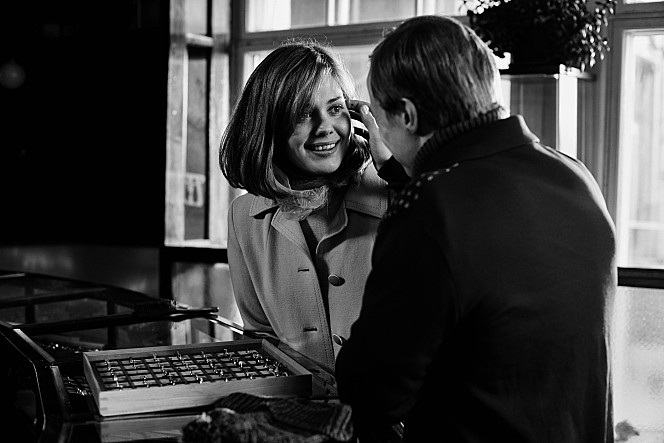
At a dinner party where he attends along with de Restac, Eiffel comes across de Restac’s wife Adrienne (Emma Mackey), who, as gradually revealed to us via a series of flashback scenes, was once very close to Eiffel. Although Eiffel tries to ignore her as much as possible, it soon turns out that Adrienne still has some feelings toward him, and, what do you know, Eiffel finds himself trembled by those old feelings between them as they meet again later.

Frequently alternating between their present and past, the movie tries to present Eiffel and Adrienne as your average star-crossed lovers, but it fails to generate enough passion and interest due to many predictable aspects. Right from when Eiffel and Adrienne meet each other for the first time, we know well that their young romance is doomed due to their considerable class difference, and we are not so surprised by how they end up being separated from each other due to her stern conservative father. In case of Adrienne’s husband, it soon becomes pretty evident to us that this petty prick will be another big obstacle for Eiffel in one way or another, and we are not so shocked when he later pushes both Eiffel and Adrienne into a moment of impossible choice.

Above all, Roman Duris and Emma Mackey somehow fail to generate enough romantic chemistry between their characters. While they are surely good performers equipped with each own presence, they often struggle with rather rote dialogues handed to them, and I must point out that Duris actually generates more interest and energy with Armande Boulanger, who plays Eiffel’s eldest daughter Claire. As a smart and independent young woman who willingly assists her father as much as she can, Claire does not step back at all in case of choosing a man to live with for the rest of her life, and Eiffel cannot say no because 1) he knows too well that she cannot be stopped and 2) he trusts her judgment even though he cannot discern what she sees from a lad who looks rather unremarkable to him.

In case of Eiffel’s tower, the movie surely gives us glimpses into how carefully and thoroughly Eiffel and his engineers and workers prepared and then worked right from their very first step, and that is actually the most interesting part in the film. I like a brief scene where Eiffel demonstrates several safety measures for his tower, and I also enjoyed the scene where Eiffel enthusiastically shows a government official how he and his engineers and workers can prepare the firm base ground for the tower.

The last act of the movie has some dramatic tension as the negative public opinion against Eiffel’s tower is increased day by day, but, sadly, the screenplay by Caroline Bongrand resolves the story too quickly and conveniently. While Duris has a mandatory moment for big speech around that point, this moment feels merely perfunctory, and then the movie hurries itself toward its expected ending without enough dramatic effect. Yes, we surely behold the emotions barely suppressed between our two main characters, but we do not see enough good reason for why we should feel sorry for them, and our eyes accordingly pay more attention to the tower, whose challenging construction process could be the source of a much more interesting story in my humble opinion.

On the whole, “Eiffle” is technically competent under the good direction of director Marin Bourboulon, and I appreciate its several good technical aspects including the score by ever-reliable Alexandre Desplat, but I remain mostly cold and distant to its story and characters without much interest. To be frank with you, the movie only reminds me that I have never been to Eiffel’s tower, let alone Paris. I guess that should be rectified sooner or later once I can afford to travel to Paris without any worry on COVID-19 virus or any other problematic pathogen in the near future.

Posted in Movies | Tagged , , | Leave a comment

Playground (2021) ☆☆☆1/2 (3.5/4) : Her little struggle at the school

“Playground”, which was selected the Belgian entry for the Best International Film Oscar in last year, is often quite difficult to watch. As firmly sticking to its little young heroine’s limited perspective, the movie closely and vividly observes her conflicts involved with cruel acts of abuse and ostracization at her school, and you may wince more than once while still paying attention to her painful plight to the end.

When we are introduced to Nora (Maya Vanderbeque), this little young girl is about to begin the first day at her school, and she is apparently quite nervous about that even though her dear father assures that everything will be fine for her. She wants to be near her older brother Abel (Günter Duret), but she is soon separated from him as he has to go to his class, and we later see her making an awkward introduction to her classroom teacher and other students in the classroom.

At least, things do not look that bad for Nora as she slowly gets accustomed to her new environment. While she still cannot help but feel awkward especially during her physical education class, she eventually comes to befriend several female students around her during their lunchtime, and she also gets considerable attention and support from her classroom teacher, who turns out to be more generous and caring than expected.

However, there is actually a big problem which Nora comes to notice right from the very first day at her school. It turns out that her older brother has been bullied by several classmates of his, and Nora is certainly shocked as watching Abel helplessly abused by those cruel bullies. Naturally, she wants to tell their father about that, but Abel prevents her from saying anything to their father at all, and he keeps getting abused everyday whenever schoolteachers happen to be absent around him and his bullies.

As Nora becomes more conflicted about what is happening to her older brother, the movie gets us more immersed in her limited viewpoint. With the frequent close-up shots of Nora, cinematographer Frédéric Noirhomme’s camera generates a suffocating sense of isolation around her, and we come to empathize more with her growing inner conflict. Yes, Nora really wants to help her older brother as much as she can, but Abel continues to reject any help from her, and the situation becomes all the more complicated when she eventually tells her father about what is happening to Abel.

What follows next is a series of chilling moments which show us how mean and cruel kids can be. At one point, Nora witnesses her older brother tormented again by his bullies, and then she faces a dilemma without any easy solution for her. She manages to tell a bit to her classroom teacher, and her classroom teacher tries to do the right thing just like Nora, but she actually cannot do that much in the end.

As Nora and Abel conflict more with each other over their complex issue, Nora also comes to find herself gradually ostracized by other female students just because she is his younger sister. When Abel is later instructed to sit right next to her during the lunchtime, Nora soon becomes a target of vicious ridicules, and she surely feels angry and miserable. As a result, she tries to distance herself from her older brother, and that inadvertently leads to another heartbreaking moment in the film.

Only focusing on what Nora and Abel have to endure at their school, the screenplay by director/writer Laura Wandel, who received the FIPRESCI Prize when the movie was shown in the Un Certain Regard section of the Cannes Film Festival in last year, wisely lets us fill some blanks outside their little world. For instance, we do not know that much about their father except his currently unemployed status, but we can clearly sense his love toward his kids whenever he is on the screen, and that is the main reason why a certain key scene between him and Nora hits hard on emotional levels.

The last act of the film is packed with sheer emotional intensity, but everything remains held together pretty well under Wandel’s calm and austere handling of story and characters, which is often reminiscent of several memorable works of the Dardenne brothers including “The Son” (2002). Like many of the lead characters of the Dardenne brothers movies, our little heroine comes to face a difficult moral circumstance where she must make a choice, and I can only tell you that I admire how the film succinctly pulls off the powerful finale which feels not only dramatically urgent but also undeniably moving.

As the little precious heart of the film, young performer Maya Vanderbeque is simply astounding in her flawless natural acting, and she and her young co-star Günter Duret are effortless as their characters’ supposedly simple relationship is dynamically shifted from one point to another along the story. In case of a few main adult cast members in the film, Karim Leklou and Laura Verlinden dutifully fill their respective spots around Vanderbeque and Duret, and Verlinden is particularly wonderful when her character comes to have a little poignant moment with Nora.

On the whole, “Playground” is another superlative work of this year which deserves more attention in my trivial opinion, and Wandel made a commendable feature film debut here after making several short films. Although its running time is only 72 minutes, the movie is still impactful enough for us, and I think it will make you reflect more on how you managed to survive a jungle called school.

Posted in Movies | Tagged , , , | 1 Comment

Cassiopeia (2022) ☆☆(2/4): A disappointingly sappy Alzheimer drama

I do not mind those “disease of the week” flicks as long as they are engaging enough for me, but South Korean film “Cassiopeia” does not do its job that well as your average disease of the week movie. While I was distracted a lot by numerous plot contrivances throughout the film, it was also difficult for me to accept its main characters because they are more or less than tools to squeeze lots of tears from us, and I only came to observe its story and characters from the distance without much care or attention.

At first, the movie deliberately disorients us as showing its heroine’s increasingly confusing daily life. Soo-jin (Seo Hyun-jin) is a divorced female lawyer who has lived with her only daughter Ji-na (Joo Ye-rim) for a while since her divorce, and she really needs someone else to take care of her daughter as recently becoming quite busy with her works. Her father In-woo (Ahn Sung-ki) willingly comes forward to take care of his dear granddaughter, and Ji-na does not mind this at all, but both of them often find themselves baffled and frustrated with how Soo-jin becomes rather erratic at times. Sometimes she is quite nice to them, but then she becomes rather edgy and harsh, and, above all, her mind often seems alarmingly forgettable.

Anyway, Ji-na will soon be sent to her father currently living in US, and Soo-jin tries to prepare her daughter as much as she can, but then she belatedly comes to learn of what is really happening to her after one very confusing incident. When she is subsequently examined at a hospital, it turns out that her brain is actually going through the early onset of Alzheimer’s disease, and this bad news certainly devastates both her and her father.

After her daughter leaves for US, Soo-jin tries to maintain her status quo as helped by her father, but, as already warned by her doctor, her medical status only gets worsen day by day. She becomes much more forgetful than before, and there eventually comes a point where she has no choice but to admit to her boss and colleagues that she cannot work anymore due to her illness. While her father still stands by her as before, she tries to get accustomed to her situation, but, not so surprisingly, she cannot help but feel angry and scared as frequently reminded of what will inevitably happen to her.

Around that point, we are supposed to care more about this grim situation of hers, but the movie fails to develop Soo-jin as a real human figure to hold our attention. While Seo Hyun-jin surely tries a lot for conveying to us her character’s increasing fear and confusion along the story, Soo-jin remains merely defined by her illness without much human detail, and a subplot involved with her problematic law firm is heavy-handed at best and manipulative at worst as pushing her into more panic and anger.

On the opposite, Ahn Sung-ki, a legendary South Korean actor who has steadily continued his long acting career during last several decades, is supposed to function as a stable counterpart to his co-star, but, unfortunately, he does not have many things to do except looking sad or concerned. While frequently emphasizing his unwavering dedication to his daughter, the movie does not delve that deep into In-woo’s rather estranged relationship with her daughter in the past, and we never feel like getting to know more him or his daughter even in the end.

In case of several substantial supporting characters in the story, they are also rather flat and underdeveloped on the whole. While In-woo’s best friend and his wife are no more than background elements, Ji-na is just your typical precocious little girl, and the movie becomes all the sappier as Soo-jin and In-woo try to hide Soo-jin’s illness from Ji-na as much as possible. In case of a part involved with a facility for Alzheimer patients and their caretakers, the movie brings a bit of realism as expected, but this part only comes to set the ground for another blatant moment of emotional manipulation later in the story, and that is followed by a series of plot contrivances for giving us a big tearjerker moment.

I must say that I was rather flabbergasted by many glaring failures of the movie because it is directed by Shin Yeon-shick, who wrote the screenplay for Lee Jook-ik’s “DongJu: The Portrait of a Poet” (2015) and later directed “Roman 8:37” (2017). While the former was a humble but undeniably poignant biographical drama film about one well-known South Korean poet, the latter was a small religious drama movie which engaged me more than expected, and both of them were often interesting in terms of story and characters. In contrast, “Cassiopeia” frequently annoyed and bored me as failing to bring any genuine feeling or insight to its story and characters, and several key scenes associated with the very title of the movie only made me more aware of its artificial aspects.

In conclusion, “Cassiopeia” is inferior to a bunch of better films out there, and my mind has already been rummaging out the best moments of these good movies. While I was touched by the calm but aching sadness felt from “Away from Her” (2006), I remain haunted by a number of devastating scenes in “The Father” (2020), and I also appreciate several poignant moments in “Iris” (2001), “The Notebook” (2004), “Memories of Tomorrow” (2006), and “Still Alice” (2014), which are rather sappy in each own way but are still much better than “Cassiopeia” nonetheless. All of these films really impressed me a lot with their respective human qualities, and I sincerely recommend you to watch any of them instead.

Posted in Movies | Tagged , , , | Leave a comment

Jurassic World: Dominion (2022) ☆☆(2/4): A sequel of dominant tedium

“Jurassic World: Dominion” is a sequel of dominant tedium which bored me and then exhausted me for many bad reasons. Besides its lackadaisical handling of story and characters, the movie seriously lacks awe and wonder in case of those big dinosaurs, and I must confess that, instead of paying a full attention to the screen, my mind was often more engaged in whatever a friend of mine was doing with his iPhone right next to me.

At the beginning, the movie shows us how much the human world has been changed during next several years since what happened at the end of “Jurassic World: Fallen Kingdom” (2018). As dinosaurs have been quickly spread around the world due to a number of reasons including illegal breeding, there have naturally been lots of discussion on how to control this serious ecological change around the world, but, as already warned by Dr. Ian Malcolm (Jeff Goldblum) in the previous film, things seem to be increasingly uncontrollable even though one certain powerful corporation and its ambitious CEO has attempted to get things under control.

Meanwhile, Owen Grady (Chris Pratt) and Claire Dearing (Bryce Dallas Howard) have been trying to protect dinosaurs as much as they can in each own way, but they are actually more concerned about Maisie Lockwood (Isabella Sermon), a very special girl whom they have hidden from the outside world during last several years. Like many other adolescent girls around her age, Maisie wants to see and experience more outside a remote spot where she is quietly residing along with Owen and Claire, and that certainly leads to a growing conflict between her and her adopted parents.

However, that little family issue of them is swiftly put aside when Maisie is later kidnapped along with an offspring of Blue, a female Velociraptor which was once trained a bit under Owen as shown in “Jurassic World” (2015). Although Blue and Owen are not that friendly to each other at present, Owen decides to rescue Maisie as well as Blue’s offspring, and Claire surely joins Owen as he embarks on tracking down those bad people who kidnapped Blue’s offspring and Maisie.

Thanks to a bit of help from two supporting characters associated with them, Owen and Claire eventually locate where Maisie is being held before taken to somewhere else, and we are soon served with a frantic action sequence which often looks like imitating the gritty realism of Jason Bourne movies. Although the result is too choppy and disorienting to hold my attention, I admire the considerable commitment shown from Bryce Dallas Howard, who willingly hurls herself into lots of risky actions through which her character has to go during this sequence. In my humble opinion, she is too good to appear in the film, but I guess she felt the need to finish her job to the end instead of handing it to some other actress.

On the other side, we see more of who is behind the kidnapping of Blue’s offspring and Maisie, and that is where Dr. Alan Grant (Sam Neill) and Dr. Ellie Sattler (Laura Dern) enter the picture. After invited to a certain remote preservation area by Dr. Malcolm, Dr. Sattler, who has been investigating one inexplicable ecological change, approaches to Dr. Grant, and Dr. Grant reluctantly agrees to join her even though he still prefers dead dinosaurs to living ones.

It is not much of a spoiler to tell you that they and several other main characters are thrown into lots of dangers thanks to not only the villain of the film but also a number of different dinosaurs including, yes, Tyrannosaurus rex. Later in the story, this big dinosaur comes to get a big moment to be compared with the climactic part of “Godzilla vs. Kong” (2021), and that is where we become much less interested in whatever will happen to the human characters who happen to be there.

However, this climactic part is not particularly fun or exciting because of its rather perfunctory special effects, and we become more aware of numerous flaws in terms of narrative and characterization. As juggling so many main characters, the movie frequently loses its narrative pacing, and many of main characters in the film remain rather bland and uninteresting despite the diligent efforts from its main cast members. While Jeff Goldblum, Laura Dern, and Sam Neill have a little fun together as they previously did in “Jurassic Park” (1993), they do not have many other things to do except often evoking some nostalgia from us. In case of Chris Pratt, he often seems to be on autopilot, and that is the main reason why Dewanda Wise, who plays one of substantial supporting characters in the story, or Isabella Sermon can easily steal the spotlight from him.

In conclusion, “Jurassic World: Dominion” is another disappointment after its two recent predecessors, and it reminds me of how its franchise has become more mundane inconsequential. The direction of director/co-writer Colin Trevorrow, who previously directed “Jurassic World”, is fairly competent, but the overall result is mostly devoid of awe or surprise, and, again, you can easily predict which main human character will be eventually eaten by those carnivorous dinosaurs in the film.

By the way, I happened to revisit “Jurassic Park” a few weeks ago for writing a bit about it. I was quite glad to see that this classic film is still a top-notch entertainment despite the considerable technological advancement in special effects during last 29 years, and, if you are rather cold to “Jurassic World” and its 2018 sequel film like I am, I suggest that you should just stick to “Jurassic Park”. Believe me, you may thank me for that later.

Posted in Movies | Tagged , , | Leave a comment

Homeroom (2021) ☆☆☆1/2(3.5/4): The class of 2020

You may wonder about how the story of Hulu documentary film “Homeroom” could have been different if it had not been for the ongoing COVID-19 pandemic. During its first half, the documentary effortlessly immerses us into the lives and activities of a bunch of politically engaged students at the Oakland High school during 2019, and we cannot help but reflect on how their world would soon be turned upside down in the very next year. Things surely became quite different for them, and that is why it is often poignant to see how they kept going nonetheless while remaining politically active as before.

Often reminiscent of the recent documentaries of Frederick Wiseman such as “City Hall” (2020), the documentary, which is the final chapter of Peter Nicks’ Oakland trilogy following “The Waiting Room” (2012) and “The Force” (2017), simply presents what Nicks and his cinematographer/co-producer/co-writer Sean Havey closely and vividly captured on the camera inside the Oakland High School in Oakland, California. We see a number of various moments unfolded here and there inside the school, and then the documentary gradually comes to revolves around several senior students quite willing to voice the opinions of them and many other students on a certain public issue in the city.

That public issue in question was the presence of police officers in the schools in the city, and many students and parents strongly demanded the removal of those police officers from the schools for their understandable concerns. Some of those city administrators flatly argued that the schools need police officers for safety, but most of students and parents protested that police officers do not make the schools safe at all, and their arguments took my mind back to how police officers did not help at all during that recent tragic shooting incident in Texas.

In case of Denilson Garibo, a student governing board representative who slowly becomes the unassuming center of the documentary thanks to his natural charisma and spirit, he was certainly passionate about this issue, and he and his fellow student representative Mica Smith-Dahl tried their best at the public school administration board meeting, but their opinions did not draw much attention from the adult board members. When the board eventually decided to let police officers inside the schools as before, Garibo and Smith-Dahl expressed their bitter disappointment and frustration, but, again, nobody in the board paid any particular attention to their thoughts and feelings.

Meanwhile, time passes by as usual for them and other students at their school. A brief scene shows the joy and excitement of the 2019 homecoming day of the school, and then we look at a number of students preparing for their little musical performance to be held in early 2020. Garibo and many of his friends are now focusing on their college application, and they are certainly looking forward to taking the first step toward their upcoming adulthood. When they hear about the first news about COVID-19, they are not particularly concerned, but we cannot help but notice a few students wearing mask just in case.

Of course, the situation subsequently became pretty bad for them and many others in city as the whole country was swept by the first wave of COVID-19. Their school was closed as demanded, and a number of online videos show how they struggled with the following lockdown day by day. At one point, the camera looks around the empty rooms and corridors of their school, and that makes a striking contrast to all those lively moments shown to us during the first half of the documentary.

However, Garibo and his friends including Dwayne Davis were not daunted about this at all as paying more attention to current social issues. When the tragic death of George Floyd sparked massive public protests in many American cities including Oakland, they did not hesitate at all to participate in a big protest in the city, and their protest later culminated to where they and many others showed a sign of solidarity in front of the residence of the mayor of Oakland.

In the end, there came a small but significant change for them and many other students in the city. Not long after their protest, several adult members of the school administration board came to change their positions, and that subsequently led to the agreement on the removal of police officers from the schools in the city. That was certainly a progress to be celebrated by Garibo and many other students, though they were still limited a lot by the ongoing pandemic as later reflected by their online graduation ceremony.

To be frank with you, I wish it showed more of their activities inside and outside the school, but “Homeroom”, which won the Jonathan Oppenheim Editing Award when it was premiered at the Sundance documentary early in last year, is still excellent enough to recommend, and I appreciate how it indirectly resonates with Nicks’ previous documentary “The Force”, which is incidentally about the deeply flawed aspects of the Oakland Police (I have not watched yet “The Waiting Room”, which looks into the daily matters inside one hospital of Oakland). Sometimes I have serious doubts about our future, but the documentary reminds me that, at least, there is still lots of hope and energy from many young people out there, and I can only hope that they will be more supported and encouraged instead of being ignored and blocked.

Posted in Movies | Tagged , , , | Leave a comment

Hommage (2021) ☆☆☆1/2(3.5/4): Her journey of restoring a film

South Korean film “Hommage” reminds me again of that considerable gap between me and many old South Korean films in the past. Like many other audiences, I usually regard them as something no more than inconsequential artifacts, but, regardless of whether they were lost forever or not, they all are worthwhile to be remembered and researched as the parts of the South Korean movie history, and the movie makes a good point on that as poignantly resonating between past and present.

At first, the story mainly revolves around Ji-wan (Lee Jung-eun), a middle-aged female independent filmmaker who has been quite frustrated with how her filmmaking career has been going nowhere for years. Mainly because her latest movie does not draw enough audiences just like her previous works, Ji-wan and her producer, who has also been her best friend, cannot find any chance for the investment on their next film, and, as her best friend is going to quit her movie-producing career, she becomes more doubtful about whether she can go on or not.

In case of her private life, things have been not that good for her either. Her husband comes to show more of his discontentment on how she has often neglected him and their son as focusing more on her filmmaking career, and their son, who is a college student, does not hesitate to tell her that she has not achieved much as a filmmaker, though he still cares about his mother as reflected by his little gesture of affection at one point.

While she struggles to write the screenplay for her next film, Ji-wan is approached by an old colleague of hers on one day. He offers a little film archive project in the need of a supervisor, and, though she is not so eager to do another work at present, Ji-wan eventually accepts the offer mainly due to her current financial difficulties.

However, the job turns out to be more demanding than Ji-wan expected. They want to restore “A Woman Judge” (1962), the third and last film directed by a real-life South Korean female director Hong Eun-won in the 1960s, and they recently discover an old print of that film, but the second part of this print is heavily damaged on the soundtrack. Naturally, they will have to re-record all the dialogues in that damaged part, so Ji-wan embarks on searching for anything to help the restoration process. Thanks to Hong’s daughter who has preserved lots of stuffs from her mother who died around 20 years ago, Ji-wan can find the original screenplay written by Hong, but she still needs more information and help, so she begins to look for anyone associated with the production of “A Woman Judge”.

Around that narrative point, the movie gradually blurs the border between fact and fiction. As Ji-wan meets several characters probably based on real-life persons who actually worked with Hong during that time, we get to know more about how difficult it really was for Hong and a few other female filmmakers during that time. Hong was in fact the second female filmmaker in the South Korean cinema history, and, needless to say, she had to constantly struggle with sexism before eventually quitting her filmmaking career. Just imagine how things would have been different for South Korean cinema if she and other fellow female filmmakers had been allowed to have artistic/professional freedom as much as Kim Ki-young or Im Kwon-taek during that period. She could have been admired as much as Ida Lupino, you know.

Looking more into “A Woman Judge” as well as Hong’s tragically short filmmaking career, Ji-wan comes to reflect more on how her life and career have been stuck at a dead end for years. Sure, things have been changed a lot for her and many other contemporary South Korean female filmmakers, and there was a time when she was considerably promising, but she has been neglected more as she gets older year by year. When she later happens to have an unexpected medical problem, she comes to reflect more on that universal question we are bound to ask sooner or later in our life: Is that all there is?

I will not go into details on how the screenplay by director/writer Shin Su-won pulls off a small but precious glimpse of hope and optimism for its heroine, but I can tell you instead on how effortlessly Lee Jung-eun, who has been more prominent thanks to her breakthrough supporting turn in Bong Joon-ho’s Oscar-winning film “Parasite” (2019), carries the film via her unadorned acting. While she never seems to strive for emotional effects, Lee subtly but palpably conveys her character’s feelings and thoughts to us, and she steadily holds the film even when the film enters the realm of fantasy. In case of several main cast members surrounding Lee, Kwon Hae-hyo and Tang Jun-sang provide some humor as Ji-won’s two close family members, and Lee Joo-sil has a very poignant moment later in the story as one of a very few surviving persons associated with “A Woman Judge”.

In conclusion, “Hommage” is as sincere and respectful as its very title suggests, and it is surely another compelling work from Shin, who previously drew my attention for “Pluto” (2012) and “Madonna” (2014). As showing genuine care and respect to Hong and other female South Korean filmmakers in the past, she also seems to be ready for what may be the next chapter of her filmmaking career, and I sincerely hope that she will remain as active as before.

Posted in Movies | Tagged , , , | 1 Comment

Emergency (2022) ☆☆☆(3/4): One unlucky night of theirs

“Emergency”, which was released on Amazon Prime on this Friday, is an interesting mix of campus comedy and social commentary. Although its overall result does not always work, the movie keeps rolling till the expected finale thanks to the game efforts from its young main cast members, and I enjoyed its several funny moments while also musing on its edgier moments involved with certain relevant social issues in the American society.

At first, the movie feels like your typical buddy comedy unfolded in one college campus. Our two young heroes are Kunle (Donald Elise Watkins) and Sean (RJ Cycler), and the movie quickly establishes the longtime relationship between these two African American lads. Although they are quite different from each other in many aspects, they have been close friends for years, and Sean is eager to have a big fun time along with Kunle during one particular evening when a number of fraternity houses in the campus are going to hold each own evening party. He has been planning to attend all these fraternity parties with Kunle, and that might bring some distinction to them later.

However, despite his willingness to join his friend in this wild campus adventure, Kunle is mostly occupied with his college study. He has actually studied in a microbiology lab in the campus, and we see him paying a lot of attention to culturing some bacteria strains. If he makes some significant progress from that, that will help him a lot when he goes to Princeton University in the next semester, though he has not told anything about that to his friend yet.

When they eventually embark on executing their plan, Kunle and Sean soon come across two different troubles. When he left his laboratory along with Sean, Kunle forgot locking up a faulty refrigerator where those bacteria cultures of his are stored, and that means, to Sean’s annoyance, he must go back to the laboratory as soon as possible.

However, that problem is nothing compared to what Kunle and Sean subsequently encounter when they go to their residence for getting their car. They find an unconscious young Caucasian girl on the floor of their living room, and their roommate Carlos (Sebastian Chacon), a Latino dude who is your typical nerd occupied with online video games, has no idea on who the hell this young girl is. When Kunle immediately attempts to call 911, Sean stops him for good reasons. Yes, this young girl, who is apparently quite drunk, needs to be taken to a hospital as soon as possible, but, needless to say, three colored lads with an unconscious white lass will not look that good to those police officers who will come to the scene immediately if they call 911.

In the end, Kunle and his friends decide to take the young girl to a nearby hospital or somewhere else for themselves, but, of course, things do not go that well from the very beginning. When their first plan is hilariously failed, they resort to the other plan, but, not so surprisingly, their circumstance only gets worse and worse no matter how much they try. In addition, it later turns out that there is something important revealed later from the young girl, and that leads to one of the funniest moments in the film, though, sadly, it is already shown in the trailer.

Meanwhile, we are also introduced to two Caucasian college students named Alice (Madison Thompson) and Maddie (Sabrina Carpenter), who turns out to be the young girl’s older sister. While they are enjoying themselves at a certain fraternity house, they belatedly come to realize that Maddie’s younger sister, who is supposed to be around them, is gone missing, and they understandably become quite frantic. Fortunately, they can locate the current whereabouts of Maddie’s younger sister via her smartphone, and they and a certain dude soon embark on their urgent search.

It is not much of a spoiler to tell you that these two different narratives eventually converge during the last act, but the screenplay by KD Dávila, which is developed from the 2018 short film of the same name written by him (It won the Special Jury Prize at the 2018 Sundance Film Festival and the Grand Jury Prize at the 2018 SXSW, by the way), deftly goes back and forth between comedy and drama, and director Carey Williams, who made a feature film debut here after making several short films including the aforementioned one, did a competent job of maintaining enough momentum to engage us. Although the finale is rather blatant, the movie still does not lose its sense of humor, and you may smile a bit while reflecting more on its social issues.

Williams also draws solid performances from his main cast members. While RJ Cycler and Donald Elise Watkins effectively complement with each other throughout the film, Sebastian Chacon holds his own place well between them, and Maddie Nichols, Sabrina Carpenter, Madison Thompson, and Diego Abraham are also well-cast in their respective supporting roles.

In conclusion, “Emergency”, which won the Waldo Salt Screenwriting Award when it was premiered at the Sundance Film Festival early in this year, may disappoint you if you expect it to be as uproarious and raunch as, say, “Superbad” (2007), but it has enough humor and gravitas at least. In short, this is one of better new films available on streaming services, and I am sure you will enjoy it if you admire its several notable seniors including “Dear White People” (2014).

Posted in Movies | Tagged , , , , | Leave a comment

Becoming Cousteau (2021) ☆☆☆(3/4): Meet Jacques Cousteau

Documentary film “Becoming Cousteau”, which is currently available on Disney+ here in South Korea, looks into the life and career of Jacques Cousteau, a famous French marine explorer who brought considerable innovation into marine exploration in addition to making those memorable documentary films about the endless wonder of oceans and sea creatures. Besides informing us a lot on his life and career via its skillful mix of various archival materials, the documentary also works as a vivid and intimate human portrayal to engage and touch us, and you will be certainly moved by how he kept going even during the last chapter of his life.

At first, the documentary shows and tells us about how Cousteau became interested in diving during his early years. Around the time when he joined the French Navy, young Cousteau aspired to be a pilot someday, but his aspiration was subsequently dashed because of an unfortunate car accident. As recovering after that accident, he came to try diving as a part of healing process, and, what do you know, he became quite passionate about not only diving but also exploring underwater world.

During the late 1930s, he and his two colleagues gained considerable reputation as “three diving musketeers” as frequently diving together in the beach areas of Southern France, but their enthusiastic diving activities were soon suspended as the World War II was started in 1939 and then their country was occupied by the Nazi Germany in the following year. Once the war was over in 1945, Cousteau and his colleagues resumed their marine exploration, and that led to a number of crucial technological developments including the first open-circuit, self-contained underwater breathing apparatus for divers. Thanks to this invention, they could explore underwater world more easily than before, and they also could record their explorations via their special waterproof cameras.

During the 1950s, Cousteau’s marine exploration reached to the peak as he and his team members sailed around here and there in the world via their old British minesweeper ship. Cousteau frequently filmed a lot of their marine exploration during that time, and that led to his ground-breaking documentary film “The Silent World” (1956). When the film was shown at the Cannes Film Festival, it was a huge critical success besides winning the Palme d’Or award, and he became all the more famous around the world when the documentary subsequently garnered the first Oscar for him (He later won two more Oscars, by the way).

Not long after that, Cousteau was approached by several American TV broadcasting companies, and that eventually led to his classic TV documentary series “The Undersea World of Jacques Cousteau”. From 1968 until 1976, he and his teams brought their awesome marine explorations into the homes of millions of people around the world, and that certainly boosted his fame and reputation in public.

However, around that point, Cousteau became more aware of the growing environmental crisis in the global world, and he also came to discern some undeniable errors of his marine explorations. Sure, he was simply curious and passionate about underwater world, but many of his marine explorations happened to be financed by those big oil companies, who have always been one of the major reasons behind the marine pollution around the world. Realizing how his marine explorations were a part of the problem, Cousteau could not help but feel bitter about his achievements, and he became more despaired when one of his two sons, who was as passionate about marine exploration as his father, died due to a plane crash incident.

Nevertheless, Cousteau did not resort to despair and misery at all. As becoming a passionate environment activist, he established a global non-profit organization for spreading environmental messages more around the world, and he actually achieved several important things in the process. Via his fame and reputation, he made many leading politicians around the world listen to him, and he was actually invited to the United Nations’ International Conference on Environment and Development in 1992.

The documentary skillfully shuffles a bunch of numerous archival records and footage clips, and the resulting collage is commendable on the whole. While we get close glimpses into Cousteau’s marine explorations, we also get to know more about Cousteau as a human being with some glaring flaws. As frequently occupied with his professional passion, he was not a very good father to both of his two sons, and he was not so faithful to his first wife either. For many years, he remained quite close to a woman who would eventually become his second wife later, but he never left his first wife till her death, and she had no problem with that because, as the daughter of a seaman family, she was happy to manage his ship and its crew.

Overall, “Becoming Cousteau” is engaging in addition to being fairly informative, and director/co-producer Liz Garbus, who previously directed “What Happened, Miss Simone?” (2015) and “All In: The Fight for Democracy” (2020), handles her human subject with enough care and respect. I wish it showed more of his life and career, but the documentary did a good job of summarizing his life and career on the whole, so I will not grumble for now.

Posted in Movies | Tagged , , , , , , | Leave a comment

Chip ’n Dale: Rescue Rangers (2022) ☆☆1/2(2.5/4): They’re back… with lots of IPs

My mind mildly alternated between nostalgia and annoyance while I watched “Chip ’n Dale: Rescue Rangers”, which was released on Disney+ on last Friday. Because that old Disney TV animation series of the same name has occupied a small but special place among my good old childhood memories for years, I was certainly delighted to see its two little heroes back in action, but I was also sometimes distracted by the overwhelming smorgasbord of intellectual properties in the film, and I must confess that my judgment on the film frequently went back and forth between 2.5 and 3 stars during my viewing.

At first, the film quickly establishes its fantasy world which is virtually the extension of what we saw from “Who Framed Roger Rabbit?” (1988). For many years, human and animation figures have nicely co-existed together, and the opening scene shows the early years of its two main characters: Chip (voiced by John Mulaney) and Dale (voiced by Andy Samberg). Mainly because they were the only two chipmunk animation figures in their school, Chip and Dale quickly befriended each other right from their first encounter, and they went to Hollywood together several years later. Although their first years of acting in Hollywood were not that easy, they eventually became pretty popular because of their TV animation series, and they and several other cast members enjoyed their big success during next several years.

However, getting tired of being sort of second banana to Chip, Dale attempted to begin his own career to Chip’s dismay, and that led to the serious downturn for both of them as their TV animation series was eventually canceled. After giving up his acting career, Chip has earned his living via selling insurance, and Dale, who is turned into a computer graphic animation figure thanks to a ‘surgery’, still tries to revive his popularity despite many other previous failures.

And then there comes one serious case which gathers them together after many years of estrangement. When an old colleague of theirs calls for a certain addiction problem, Chip quickly comes to help this dude, and that is how he comes across Dale, who was also called just like Chip. When their colleague is vanished not long after that, Chip has no choice but to work along with Dale as before for finding their colleague, and Dale is certainly excited because they can be back in business together if they successfully solve the case together and then gain lots of publicity.

While getting some assistance from a plucky human female detective named Ellie Steckler (KiKi Layne), Chip and Dale delve more into the case as following a few clues, and, of course, they soon discover a diabolical criminal scheme involved with a certain famous Disney animation character. I will not go into details on the identity of this villain, but I can tell you instead that Will Arnett has another juicy fun after a number of colorful voice performances during recent several years, and it is a shame that the film does not mention anything about his character’s infamous arch-nemesis.

Once its main characters are established, the film throws lots of actions and gags into the screen as expected, and some of those comic moments in the film are funny enough to draw chuckles from us. While I was tickled by an impromptu rap scene between our two little heroes, I was constantly amused by many different kinds of animation figures appearing in the film, and my biggest laugh in the film comes from an unexpected parody of “Terminator 2: Judgment Day” (1991).

However, my mind and eyes also often became tiresome due to heaps of various intellectual properties popping up and here throughout the film. Besides all those familiar stuffs from Disney, the film also borrows lots of other stuffs from other companies including Sony and DreamWorks, so we are served with not only that notorious CGI version of Sonic the Hedgehog but also those dreadful cat figures from, yes, “Cats” (2019). Sure, it is surely a fun to see those numerous references in the film for a while, but it depends a bit too much on flaunting all the intellectual properties it can possibly amass, and that aspect becomes rather vulgar and grotesque during the climax sequence for good reasons.

Anyway, John Mulaney and Andy Samberg are well-cast in their respective roles, and the comic chemistry from their contrasting voice performances keeps holding our interest to the end. Eric Bana, Seth Rogen, Dennis Haysbert, Keegan-Michael Key, and J.K. Simmons also have each own small fun with their respective animation characters in the film, and KiKi Layne functions well as a solid counterpart to Chip and Dale while playing straight as much as she previously did in “If Beale Street Could Talk” (2018) and “The Old Guard” (2020).

In conclusion, “Chip ’n Dale: Rescue Rangers” does not reach to the sublime qualities of “Who Framed Roger Rabbit?”, but it is not a bad animation film at all thanks to director Akiva Schaffer’s competent direction, though I would rather recommend you to watch “Who Framed Roger Rabbit?” or that Disney TV animation series instead. In my inconsequential opinion, both of them have a lot more wit and imagination than this rather shallow amalgam of intellectual properties, and, to be frank with you, I really want to revisit either of them right now.

Posted in Movies | Tagged , , , | Leave a comment

The Valet (2022) ☆☆☆(3/4): So he becomes her fake lover…

“The Valet” does not feel that fresh to say the least, but it turns out to be more likable than expected. While this is the American remake version of the 2006 French film of the same name directed by Francis Veber, it is also instantly reminiscent of countless other comedy films ranging from “Notting Hill” (1999) to “Marry Me” (2022), but it did a fairly good job of entertaining us during its 2-hour running time, and I also appreciate several moments which are genuinely sweet and poignant to my little surprise.

Like “Notting Hill” and “Marry Me”, the movie mainly revolves around the unlikely relationship between two very different persons. While Antonio Flores (Eugenio Derbez) is a plain Mexican American dude who has been one of the countless parking valets working in LA, Olivia Allan (Samara Weaving) is a big Hollywood star actress in contrast, but they happen to come across each other by coincidence when she and her married billionaire lover happen to be spotted by a couple of paparazzi during one evening. Because both she and her lover must avoid a public scandal for their respective reasons, Antonio is subsequently requested to disguise himself as Olivia’s lover for a while, and he accepts the request mainly because he will be rewarded with enough money for getting his separated wife back.

As Antonio and Olivia hang around with each other in public for those hungry paparazzi, the movie generates a series of expected comic moments from how awkward Antonio looks and feels as suddenly thrown into spotlight along with his ‘girlfriend’. As everyone wonders what exactly she sees from him, he tries his best with some assistance from her, but he still looks pretty awkward, and, to make matters worse, there are already a couple of private investigators watching on him and Olivia.

Steadily maintaining the comic tension around its two main characters, the screenplay by Bob Fisher and Rob Greenberg thankfully does not push them into conventional romantic relationship. As spending more time with each other along the story, Antonio and Olivia come to open themselves more to each other, and they soon find themselves confiding a lot to each other on their respective matters of heart. While Olivia remains conflicted about what she should do with her apparently untrustworthy lover, Antonio desperately wants to reunite with his separated wife, but it is apparent to us from the very beginning that his wife does not have much compunction on exploiting his remaining feelings toward her. Just because she feels jealous after seeing him being with Olivia, she tries to attract his attention, and Antonio cannot help but drawn to the possibility of their reunion, while being pretty oblivious to what is being developed between him and a certain nice lady in his neighborhood.

Besides this main narrative, the movie also juggles several subplots, and the best part comes from Antonio’s aging mother Cecilia (Carmen Salinas), who, to his little embarrassment, recently happens to find the second romance in her life. When her son comes to learn of that, Cecilia does not feel any shame about that at all, and that subsequently leads to an amusingly sweet scene where Olivia is greeted by not only Cecilia’s family members and neighbors but also her lover’s family members not long after she happens to stay at Antonio’s home after one eventful night.

During the last act, we certainly get a big moment of conflict between our two main characters, but the movie keeps things rolling even when the mood becomes a bit more serious than before. Although the finale is delivered in a way too neat and convenient in my humble opinion, it has some elements of surprise at least, and I will not deny that I got some good laughs from that.

The movie depends a lot on the comic chemistry between its two lead performers, who complement each other well in addition to being believable in their respective characters’ growth and development along the story. While less flamboyant compared to his recent supporting turn in Oscar-winning film “CODA” (2021), Eugenio Derbez is funny and engaging in his earnest performance, and Samara Weaving, who has already shown her considerable comic talent in “Ready or Not” (2019), is often touching as her character gradually earns our sympathy. Never softening her character at all, Weaving effectively conveys to us how Olivia comes to find her better self along the story, and she is particularly good when Olivia comes to find some real comfort from those Mexican dished made by Cecilia.

In case of a number of supporting performers in the film, their colorful performances spice it up to say the least. While Max Greenfield is as obnoxious as required, Diany Rodriguez, Noemi Gonzalez, Marisol Nichols, and Betsy Brandt bring some personality to their rather thankless roles, and Ravi Patel and John Pirruccello are always fun to watch as two different private investigators who get much closer to each other than expected. Carmen Salinas is inarguably the ace in the hole, and, considering that she passed away several months ago, her work here in the film feels all the more moving.

Overall, “The Valet”, which is directed by Richard Wong, is an enjoyable product which does its job as well as intended. Because I have not seen the original French version, I cannot tell you whether it is an improvement over the original French version, but I can tell you instead that it is better than I thought when I watched its trailer some time ago, and I am willing to check out the original French version someday.

Posted in Movies | Tagged , , , | Leave a comment