Slate (2021) ☆☆☆(3/4): The way of a heroine

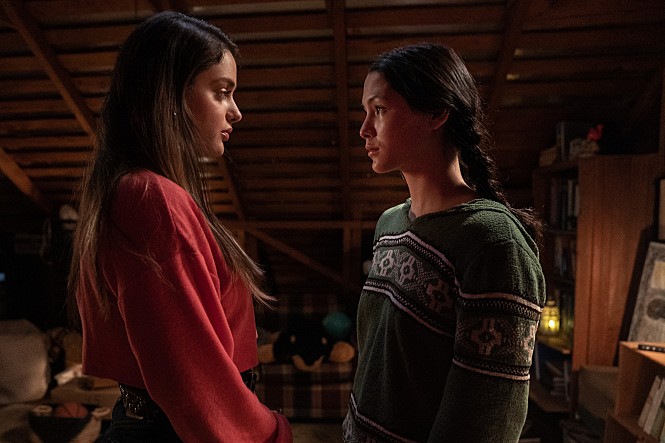
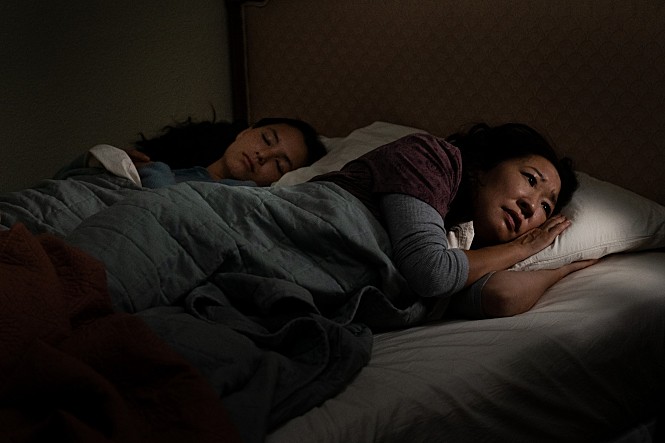
South Korean independent film “Slate” is a little fun action fantasy tale which does its job better than expected in its modest genre playground. While clearly reminiscent of “The Wizard of Oz” (1939) due to its fantasy story premise, the movie brings enough style, humor, and personality to its familiar plot and characters, and it is alternatively funny and exciting as deftly swinging back and forth between comedy and drama.

At the beginning, we get to know about its heroine’s longtime personal aspiration. Since she was a little girl, Yeon-hee (Ahn Ji-hye) has dreamt of becoming an action movie star someday, but, alas, that dream of hers has seemed to be out of her reach for years no matter how much she tries. She has a rather impressive résumé thanks to many years of preparation, but nobody is particularly interested in hiring her, and she is not so pleased when her latest job interview turns out to be actually the one for the stand-in for the lead actress of some action film.

However, mainly because she really needs money at present, Yeon-hee has no choice but to agree to work as the stand-in. She subsequently goes to a certain spot where the director of that action film and its cast and crew members are supposedly working, but, to her bafflement, there is no one on the spot except her and her best friend who happens to accompany him.

While walking around in this place alone for a while, Yeon-hee comes across a certain small object, and then something quite strange happens. She is somehow transported to a sort of parallel world, and she is certainly flabbergasted when the place is now an ancient village full of anachronistic mood and details. At first, she thought they were just shooting the movie, but it does not take much time for her to realize what is going on around her, and she later encounters another figure who was also transported to this odd parallel world.

Meanwhile, Yeon-hee also gets involved in the troubling circumstance surrounding the chief of the village and many other villagers. For many years, these people have been harassed and exploited by some powerful gang organization, so they have hoped for someone mighty enough to save them from this ongoing predicament, and Yeon-hee happens to be mistaken for a legendary swordman. Although she knows well that she can actually get herself killed, Yeon-hee has no problem with being that legendary swordman because this may finally fulfill her longtime dream of being a heroine, and she boldly comes forward when the villagers are in danger again.

After having her first success from her clash with a bunch of petty bandits, Yeon-hee begins to enjoy her rather risky role-playing, but her opponents, led by a dying but powerful dude, turn out to be quite more dangerous than expected. In case of one particular opponent, this figure can exert some supernatural power besides wielding his lethal swordsmanship, and there is a creepy scene where he cruelly torments Yeon-hee via conjuring one painful personal nightmare for her.

In the meantime, things get a bit more complicated when that legendary swordman arrives in the village without getting noticed at all to his perplexity. While he soon comes to discern what Yeon-hee is doing, he does not do anything at all as focusing more on taking care of a little mute boy he happens to come across, but it goes without saying that he will eventually get involved in Yeon-hee’s situation.

As it enters its last chapter, the screenplay by Jo Bareun becomes a little more serious than before, but it never loses any sense of fun at all. While we cannot help but amused by its ridiculous fantasy setting, the movie keeps its straight face to the end, and, above all, it remains sincere about Yeon-hee’s gradual development along the story. As fighting with her opponents, she comes to face more of her fear and insecurity, and she actually comes to learn something valuable for her life and career around the time when she finally confronts the final villain of the story (Is this a spoiler?).

I must say that a number of action scenes are rather modest in terms of scale, but they are all well-executed on the whole, and it surely helps that many of its cast members actually put themselves into these action scenes. Thanks to that, the action scenes in the film feel mostly smooth and fluid without getting choppy at all, and we accordingly become more involved in the story and characters.

Besides looking quite convincing in these action scenes, Ahn Ji-hye ably carries the film, and she is also supported well by several colorful main cast members including Lee Min-ji, Park Tae-san, Jo Sun-ki, Jong Ho, and Lee Se-ho, who have each own little fun with their respective dual roles in the movie. Regardless of whether their roles are serious or not, they play as straight as possible, and that is the main reason why the movie works.

Overall, “Slate” is a fairly enjoyable genre piece equipped with enough wit, style, and heart, and it is a shame that the movie was quickly forgotten after it was released in South Korean theaters in last April without much noise. I regret missing at that time, but now I watched it, and I gladly recommend you to give it a chance someday.

Posted in Movies | Tagged , , , | Leave a comment

Zombie Crush in Heyri (2020) ☆☆(2/4): Girls’ tepid fun with zombies

South Korean independent film “Zombie Crush in Heyri” is too mild as a zombie flick while also being not so funny as a comedy film. While I appreciate its earnest attempt to mix two very different genre elements to some degree, the overall result is often woefully tepid and incompetent in many aspects, and that is really a shame considering the game efforts from its three principal actresses. Whenever they are together on the screen, they click fairly well with each other, but the movie does not give them any genuinely funny or scary moment to handle, and I only came to lose my patience more and more during its frustratingly languid 2-hour running time.

After the opening scene involved with a certain silly YouTuber, the movie, which is mainly set in the Heyri Art Village in Paju (It is one of those satellite cities surrounding Seoul, by the way), introduces us its three main female characters: Jin-seon (Gong Min-jung), Hyeon-ah (Lee Min-ji), and Ga-yeon (Park Sojin). Because Jin-seon’s father is going to open a local art center, Jin-seon and her two friends are expected to give a little celebratory performance during the opening ceremony, but the opening ceremony is disrupted by a little protest from one angry local artist, and that certainly displeases many attendees besides Jin-seon’s fathter, though Jin-seon and her two friends are not bothered much in contrast.

Our three young ladies usually hang around together in a cafe run by Ga-yeon, and we get to know a bit about what Ga-yeon has attempted to sell besides coffee. As a self-proclaimed witch, Ga-yeon has made several different kinds of magic potions, and she really believes her magic potions are useful although one of them was recently banned by the Ministry of Food and Drug Safety. At one point, she attempts to make a new magic potion to sell along with her friends, but, of course, that does not work out that well in the end, though their disastrous failure unintentionally draws a few more customers to the cafe.

It seems to Jin-seon and her two friends that their daily life in the Heyri Art Village are going nowhere except occasional small happenings around them, but then something serious suddenly happens on one day. In the morning, Jin-seon and Hyeon-ah are just spending some time together in Jin-seon’s house shortly after Jin-seon’s parents went outside, but then a series of strange things happen. First, Jin-seon’s family pet dog is disappeared for no apparent reason, and then there comes a public alert message to both of Jin-seon’s and Hyeon-ah’s smartphones. Baffled by the lack of any clear information in that public alert message, Jin-seon decides to go outside for getting to know what the hell is going on, and, of course, it does not take much time for us to recognize several glaring signs of zombie catastrophe.

After belatedly coming to realize their perilous situation, Jin-seon and Hyeon-ah quickly shelter themselves in Jin-seon’s house, and then they try to contact with Ga-yeon, who happens to be stuck in her cafe. As time goes by without much change at all, Jin-seon eventually decides to escape along with her two best friends, and her electric car comes handy as being parked right in front of the house.

After slowly building up its story setting as well as its main characters during its first 30 minutes, the movie seems to get things rolling at last as our three young ladies take a forward step, but, unfortunately, it only comes to spin its wheels instead. While many of its supposedly comic moments are curiously flat and strained, the movie also fails to generate enough tension to engage us, and, above all, those zombies in the film are not so terrifying at all. I understand that this is a low-budget independent film, but directors Jang Hyeon-sang and Kim Joon-sik do not succeed much in overcoming their budgetary limits as often resorting to cheap zombie movie clichés, and this only reminded me again of how much I have been tired of zombie flicks during last several years.

Furthermore, the screenplay by Hwang Ho-gil and Jang Hyeon-sang merely slouches from one narrative spot to another without generating much momentum to hold our attention. Although it gets a bit more interesting later in the story thanks to a little unexpected moment of discovery, the story still falters and stumbles a lot without much humor or suspense, and we do not care much even when it eventually arrives at the climactic part as expected.

The main cast members of the movie do try their best with their respective parts, but I must confess that I could not help but become distracted by the rather stiff delivery of their lines throughout the film, and that made me more aware of how their efforts are not utilized that well at all on the screen. Gong Min-jung, Lee Min-ji, and Park Sojin manage to acquit themselves well thanks to their natural charm and presence, but they still deserve much better in my inconsequential opinion, and the same thing can be said about several other main cast members including Jo Seung-gu and Kim Joon-sik.

In conclusion, “Zombie Crush in Heyri” is another disappointing recent South Korean zombie flick after “#Alive” (2020), and, after being so frustrated and disappointed, my mind is already wondering about how even I could improve it despite the lack of any experience on screenplay writing or filmmaking. I am sort of glad that I did not have to watch it at a movie theater, but, folks, I am still reeling from wasting 2 hours of my life.

Posted in Movies | Tagged , , , | Leave a comment

The Bad Guys (2022) ☆☆☆(3/4): Can they possibly be…. good?

DreamWorks animation feature film “The Bad Guys” is fairly predictable in terms of story and characters, but I must admit that it made me chuckle more than once during my viewing. As the comic story about a bunch of criminal misfit characters trying to look good on the surface at least, the movie lacks surprise due to its very conventional narrative, but it cheerfully bounces along with its colorful main characters while equipped with enough wit and energy, so I decide to be a bit more lenient about a number of notable shortcomings in the film including its rather shaky background setting.

Mainly set in an LA-like city where humans and anthropomorphic animals somehow co-exist, the movie opens with the latest heist of its five anthropomorphic animal characters: Mr. Wolf (voiced by Sam Rockwell), Mr. Snake (voiced by Marc Maron), Ms. Tarantula (voiced by Awkwafina), Mr. Shark (voiced by Craig Robinson), and Mr. Piranha (voiced by Anthony Ramos). As criminals, these five different figures look rather too transparent due to their inherent appearances, but they work pretty well together on the whole nonetheless, and they certainly have enjoyed all the fun and notoriety from many criminal activities of theirs without getting caught by the local police.

When Diane Foxington (voiced by Zazie Beetz), who is incidentally one of the most prominent public figures in the city, later makes a sarcastic comment which belittles them on TV, Mr. Wolf and his criminal colleagues are not amused at all, so they soon come to plan another heist which will bring more notoriety to them besides humiliating Foxington, but then there comes an unexpected moment for Mr. Wolf. While he and his colleagues are about to commit that heist in question, he happens to have a little experience of being good, and then, to his surprise, he finds himself having a sort of emotional elevation.

When his and his colleagues are unfortunately arrested not long after that, Mr. Wolf and his colleagues get a lucky opportunity via Professor Rupert Marmalade IV (voiced by Richard Ayoade), a famous scientist who is very interested in having them participate in his little rehabilitation experiment. Because he is actually eager to be good instead of being bad as before, Mr. Wolf accepts Professor Marmalade’s offer without hesitation, and Mr. Wolf’s colleagues go along with that after being persuaded by him in private.

As Mr. Wolf and his colleagues take their first step of rehabilitation, we surely get a series of broad moments of gags and jokes as they fumble in one way or another. Because Mr. Wolf promised to his colleagues in advance that they will soon do another big heist after seemingly becoming ‘rehabilitated’, Mr. Wolf and his colleagues try their best, but, of course, it is not easy to suppress their bad behaviors, and one of the biggest laughs in the film comes from when they attempt to save one little cat on a palm tree.

Nevertheless, Mr. Wolf becomes more drawn to being good than before, and that naturally makes him more conflicted as the time for another heist is approaching. While he surely cares a lot about his dear criminal colleagues as usual, he may have to say goodbye to his criminal life as suggested by Professor Marmalade at one point later in the story, and, not so surprisingly, his colleagues become suspicious about his true motive.

What follows next during the last act is not particularly surprising either, but the movie, which is based on the children’s graphic novel of the same name by Aaron Blabey, keeps things rolling before reaching to the climactic part, which is incidentally packed with lots of busy actions as expected. It is not much of a spoiler to tell you that Mr. Wolf and his colleagues eventually come to find their better sides in addition to being reminded of the strong friendship among them, but the film steadily maintains its sense of fun and excitement even at that point, and its overall result is good enough to wash away my dissatisfaction with “Doctor Strange in the Multiverse of Madness” (2022), which I incidentally watched on the same day.

Director Pierre Perifel and his crew members including composer Daniel Pemberton did a competent job of bringing enough spirit and personality to the film, and the overall result is further enhanced by the effortless comic interactions among the principal voice cast members of the film. While Sam Rockwell has lots of fun with bringing slick charm to his criminal character, Marc Maron, Awkwafina, Craig Robinson, and Anthony Ramos have each own moment to shine in addition to providing extra wit and energy to the film, and Ramos is utterly uproarious when he comically utilizes his excellent singing talent (Remember how good he was in “Hamilton” (2020) as well as “In the Heights” (2021)?). As substantial supporting characters in the film, Zazie Beetz, Richard Ayoade, and Alex Borstein are also solid, and Beetz clicks well with Rockwell as their characters slyly pull and push each other along the story.

In conclusion, “The Bad Guys” does not exceed my expectation much, but it succeeds as much as intended at least, and I often noticed how several young audiences in the screening room actively responded to it with frequent laughs. Because a local multiplex chain happens to be showing several classic films of Yasujirō Ozu at present, I would rather recommend them to experience the gentle humanism of this great Japanese filmmaker’s simple but sublime works instead, but they did have a good time with “The Bad Guys”, so I will not grumble for now.

Posted in Movies | Tagged , , , | Leave a comment

Doctor Strange in the Multiverse of Madness (2022) ☆☆1/2(2.5/4): In the Multiverse of Blandness

“Doctor Strange in the Multiverse of Madness” does not bore or entertain me much as another mundane Marvel Cinematic Universe (MCU) product. Sure, there are occasional moments of interest, but the movie is also limited by not only numerous previous MCU products but also whatever will come during next several years, and watching it accordingly felt like a homework to me rather than real fun and entertainment.

The story begins at the point not long after the finale of “Spider-Man: No Way Home” (2021), and we soon see Dr. Stephen Strange (Benedict Cumberbatch) preparing for attending the wedding of his former girlfriend Christine Palmer (Rachel McAdams). Although he still has some feelings toward her, Strange is willing to congratulate her nonetheless, and she surely appreciates that when they later come to have a little private conversation.

However, something quite serious suddenly happens right at that point, so Strange has to come forward for saving the day as usual, and that is how he encounters a young mysterious woman named America Chavez (Xochitl Gomez). Although she does not trust Strange much at first for an understandable reason, she has no choice but to trust Strange and his close colleague Wong (Benedict Wong), and she tells them about her very urgent circumstance. Besides being a singular entity among the infinite number of universes out there, Chavez is actually capable of opening portals among them, but she still cannot control her power that well, and there is a certain powerful figure quite determined to snatch and then exploit Chavez’s power for attaining a certain personal goal.

Because the trailer of the movie does not reveal much, I should be discreet about describing the main antagonist of the film, but I think you may easily guess about that figure in question if you remember what was briefly shown at the very end of “Spider-Man: No Way Home” – or if you watched two recent MCU TV miniseries. Although I did not watch either of these two MCU TV miniseries, I did not have much problem in following the story despite some holes and gaps to be filled supposedly via these two MCU TV miniseries, so you will probably not need to check them out right now before watching the movie.

Anyway, Strange, Wong, and a bunch of members of their organization try to stop the main villain of the movie, but, not so surprisingly, they are soon overwhelmed by the villain’s enormous power, which is incidentally based on a certain ancient book of dark magic. For fighting against the villain’s powerful dark magic, Strange comes to search for another kind of ancient magic book along with Chavez, and her special power certainly helps them a bit as they bounce from one alternative universe to another.

The movie provides some amusement as briskly shuffling a number of different moods and styles during this part, but the resulting sense of fun is quickly dissipated as Strange and several other main characters continue to fight against their mighty opponent as before. Just like any other MCU products, we are served with lots of CGI action scenes, but many of them feel curiously bland and unimpressive, and we are just pushed toward the expected climax while not getting much fun or excitement.

This is all the more disappointing because the movie happens to be directed by Sam Raimi, who gave us not only the Evil Dead trilogy but also that old Spider-Man trilogy in the 2000s. Here in this movie, he seems to be a merely hired director as he was once in “Oz the Great and Powerful” (2013), without having much chance to go wild or imaginative. The only consolation for us is that he attempts a bit during the climax part at least, and, though I do not dare to spoil your entertainment here, I can assure you that you will be delighted a little if you have fondly remembered the Evil Dead trilogy like I have.

In case of Benedict Cumberbatch and several other main cast members in the film, they try as much as possible, though not all of them are as successful as intended. Cumberbatch easily slips into his familiar role, and he has some fun with playing several different versions of his character along the story, but the movie does not allow him to go further with that as busily juggling so many things in the story. While I was entertained to see Benedict Wong, Elizabeth Olsen, Rachel McAdams, Chiwetel Ejiofor, and Michael Stuhlbarg, they are simply required to fill their respective spots as demanded, and Xochitl Gomez is unfortunately stuck with her thankless role, though I believe she has enough pluck and presence for whatever she will do next in those possible sequels to follow.

Overall, “Doctor Strange in the Multiverse of Madness” is not a total waste of time thanks to some good moments to be appreciated, but it still merely functions as a perfunctory opening to whatever will come next from MCU, and I am dissatisfied with how its mighty franchise prevents Raimi from wielding more wildness and personality. Compared to how the concept of multiverse is so entertainingly explored and utilized in “Spider-Man: Into the Spider-verse” (2018), the movie feels mediocre to say the least, and it is also one or two steps down from “Spider-Man: No Way Home”. As a matter of fact, my mind is already ready to move on while not remembering much, and I can only hope that I will be a bit more entertained by next MCU products to come.

Posted in Movies | Tagged , , | 1 Comment

Crush (2022) ☆☆☆(3/4): A likable high school queer comedy film

“Crush” reminds me of how things seem to have changed these days. As a mainstream American high school queer comedy film, it proudly and cheerfully depicts its main characters’ sexuality without any shame or hesitation, and I appreciate that a lot while enjoying its sweet mix of humor and sincerity. Yes, as many of us know too well, there is still a considerable amount of social/cultural backlash against millions of sexual minority kids out there, but that is why such films like this mean a lot to them, isn’t it?

The story mainly revolves around the longtime romantic yearning of a high school kid named Paige Evans (Rowan Blanchard). For several years, Paige has been carrying a torch for her schoolmate Gabriel Campos (Isabella Ferreira), but Gabriel has seemed to be out of her reach as one of the most popular girls in their school, and Paige has been quite frustrated about that while not knowing what to do with her old crush on Gabriel.

At least, Paige can focus on honing her artistic skill and talent more for getting accepted into some prestigious art school after her graduation, but then there comes a little trouble which may seriously jeopardize her plan. During last several months, somebody nicknamed “KingPun” has been drawn a series of unauthorized murals here and there in the school, and, due to one unlucky coincidence, Paige finds herself becoming the prime suspect. Although there is no incriminating evidence against her, the principal of the school is ready to get her suspended right now, so Paige has no choice but make a deal with the principal. Besides joining the fast track team of the school as needed, she will also have to find the true identity of that mysterious person as soon as possible.

Along her best friend Dillon (Tyler Alvarez) and his girlfriend Stacey (Teala Dunn), Paige embarks on finding who KingPun is, and she also tries hard as much as she can for being a fairy competent member of the school fast track team. As watching many clumsy trials of hers, my mind was taken to how miserable I often was during those terrible physical education classes during my childhood and adolescent years, and I certainly felt some sympathy toward her despite getting some chuckles from this broad comic moment.

Anyway, Paige turns out to be able to run well at least, and she is later instructed to be coached by one of her fellow team members. Because Gabriel is incidentally one of her team members, she surely hopes to be coached by Gabriel, but, to her disappointment, she is assigned to AJ (Auliʻi Cravalho) instead, who is Gabriel’s tomboy twin sister.

Around that narrative point, I bet that some of you will quickly discern what will happen next along the story. Yes, it is not much of a spoiler to tell you that our heroine is surprised to find that her heart is now being attracted to AJ after they come to spend more time together. Yes, our heroine still has to sort out her complicated feelings between Gabriel and AJ, and there inevitably comes a point where everything is exposed around these three main characters. In case of that matter surrounding the true identity of King Pun…. well, I only can tell you that you must watch more movies if you still cannot figure that out even during the middle act.

The screenplay by Kirsten King and Casey Rackham is often predictable and conventional to the core, but it is still engaging nonetheless as constantly providing humor and sincerity along its heroine’s bumpy emotional journey. While we often chuckle at several silly comic moments of hers, there is also enough gravitas under her aspiration and romantic yearning, and that is why the expected finale works well as drawing some cheers from us. I also enjoyed a subplot associated with Dillon and Stacey’s playful (and sexually charged) competition on the upcoming student president election, and this subplot also gets a nice payoff moment around the end of the story.

Furthermore, the movie is held together well by the spirited efforts from its main cast members. As the center of the story, Rowan Blanchard is plain but plucky as required by her role, and she and Auliʻi Cravalho, who recently drew our attention for her excellent voice performance in Disney Animation film “Moana” (2016), are fun to watch as their characters are tentatively attracted to each other. While Isabella Ferreira, Tyler Alvarez, and Teala Dunn bring ample amount of life and personality to their respective supporting characters, Aasif Mandvi, Michelle Buteau, and Megan Mullally dutifully fill their small spots as several adult characters in the story, and Mullally effortlessly steals the scene as a single mother who is always willing to talk openly about sex and romance with her dear daughter.

Directed by Sammi Cohen, “Crush” is pretty conventional just like several recent high school queer films such as “Love, Simon” (2018), but it has enough charm and personality for our entertainment at least. Sure, this is not something as great as, say, “Carol” (2015), but it does its job as well as intended in addition to contributing a bit to the growing representation of sexual minority kids in American movies during last several years, and I am certainly pleased about this recent welcoming change. I still have some doubts as your average discreet pessimist, but things are indeed changing, I guess.

Posted in Movies | Tagged , , , , , , | Leave a comment

Firebird (2021) ☆☆1/2(2.5/4): Their forbidden romance during that grim period

“Firebird” is an old-fashioned tale of two gay lovers limited and suffocated by the grim oppression of their society. While it does not bring anything particular new to its genre territory unlike many notable predecessors such as “Brokeback Mountain” (2005), the first half of the movie works to some degree mainly thanks to the engaging romantic tension between its two main characters who are trapped inside their small isolated environment drenched in good old machismo, and it is a shame that the movie subsequently begins to fizzle as expanding its scope during its second half.

The story, which is based on Sergey Fetisov’s memoir “The Story of Roman”, is initially unfolded via the viewpoint of young Sergey (Tom Prior), who was going through his mandatory military service at a Soviet Air Force base located in the border area of Estonia in 1977. As many of you know, the Cold War era was reaching to another peak during that time, and the early part of the film shows us how Sergey and many other privates always have to be ready for any possible real emergency in addition to enduring lots of mistreatments from their direct superior. Like many others around him, Sergey has been pretty tired of his ongoing military service, and that is the main reason why he refuses a recent good offer which may start a promising military career for him.

Whenever he is free, Sergey often hangs around a fellow private named Volodja (Jake Thomas Henderson) and a young woman named Luisa (Diana Pozharskaya), who has worked as the secretary of the base commander. While Volodja is clearly interested in getting closer to Luisa, Luisa is actually more interested in Sergey, but, as reflected by a brief scene where Sergey’s camera comes to focus more on Volodja than Luisa, Sergey is a gay, and he is certainly discreet about his sexuality because homosexuality has been considered as a serious crime in the Soviet military.

And then an unexpected change comes on one day via Roman (Oleg Zagorodnii), a hotshot pilot who is recently transferred to the base. Not long after Sergey is assigned to Roman as his driver, Roman shows some interest in Sergey as recognizing Sergey’s sensitive sides, and they soon become quite close to each other as Roman gladly encourages Sergey’s artistic talent. Besides providing Sergey a private spot where they can develop films together, Roman also takes Sergey to a local theater in the nearby city for showing the rehearsal for the ballet performance of Igor Stravinsky’s “Firebird”, and Sergey is certainly grateful about that.

Eventually, there comes a fateful moment when Sergey and Roman recognize their mutual attraction and then let themselves swept by that strong emotion between them, but they also know too well that they must be very careful even when they are helplessly driven by their developing love. There are always ears and eyes spying around them, and things soon become quite serious when Roman happens to draw the attention of a KGB officer at the base, who instantly senses something fishy from Roman when he throws a few questions to Roman during their private meeting.

This increasingly risky circumstance comes to dampen the relationship between Sergey and Roman, but, not so surprisingly, their emotional bond turns out to be stronger than they thought. When his military service period is finally over, Sergey applies for some prestigious drama school in Moscow as suggested by Roman, and he is certainly happy when he is eventually accepted and starts to study there, but then Roman comes into his life again with more complications. Still feeling attracted to Roman, Sergey lets Roman to be around him again, but, of course, they are reminded again of how much they are trapped in their world with no bright future for them.

What follows next in the story is predictably melodramatic to say the least, and that is where the movie falters more than once. While we get to know more about how much Sergey has been suppressed by his homophobic society for years since a certain traumatic incident which is not so far from what has painfully haunted Heath Ledger’s character in “Brokeback Mountain”, Roman remains to be a rather distant character, and several key scenes between him and his family feel merely perfunctory without much depth.

As a result, the second half of the film often feels like an extended epilogue, but the movie is still carried well by the solid efforts from two lead performers even during that part. While Tom Prior, who also adapted Fetisov’s memoir along with director Peeter Rebane, is full of youthful sensitivity as required, Oleg Zagorodnii effectively complements his co-star with his more reserved appearance, and they are also supported well by a number of supporting performers including Jake Thomas Henderson, Margus Prangel, Nicholas Woodeson, and Diana Pozharskaya, who did a good job of bringing some spirit and personality to her rather thankless role.

If it were made around, say, 20 years ago, “Firebird” would probably draw much more attention for its main subjects. Sure, this is a well-made romance period drama which has some good things to enjoy besides its two engaging lead performers, but, in my humble opinion, it does not distinguish itself enough compared to many other recent gay drama films, so I will let you decide on whether you should check it out or not.

Posted in Movies | Tagged , , , | Leave a comment

I Want to Know Your Parents (2022) ☆☆1/2(2.5/4): Parents worse than their kids

I came to have some reservation as watching South Korean film “I Want to Know Your Parents”, which is finally released here in South Korean theaters after being suspended for several years due to the allegations of sexual harassment on one of its main cast members. The movie is a competent piece of work on the whole, but I observed its story and characters from the distance with growing uneasiness and disgust during my viewing, and it also did not surprise or shock me much even when things got more complicated later in the story.

The movie opens with one terrible incident which will shake up the lives of its main characters in one way or another. At a lake not so far from some prestigious middle school, the unconscious body of one of its male students is found, and he is quickly taken to a hospital, but he remains unconscious during next several days. The headmaster of the school quickly holds a private meeting in his office, but he only invites the parents of four other students instead of that student’s widow mother, and there is a good reason for that. It turns out that student left a suicide note to his temporary class teacher, and his suicide note reveals that those four students have been bullying him for months.

While the teacher, played by Chun Woo-hee, sincerely wants some justice for that poor student, others at the meeting have a very different idea. The headmaster prefers to handle the situation as quietly as possible, and the parents of those four students are quite willing to cover up everything for their very selfish reason. Regardless of how much they actually care about their kids, the parents all want their kids’ supposedly promising future not to be tarnished by this unfortunate incident at any chance, and they actually have enough power and influence to do that.

And we see how the parents attempt to cover up the incident with some assistant from the headmaster, who promptly takes away that suicide note from that teacher. In case of a divorced lawyer played Sul Kyung-goo, he surely knows a lot about the criminal laws, and he begins to check out whether there will be anything which may lead their kids to any possible legal trouble. In case of a doctor played by Oh Dal-soo (This actor is the one accused of sexual harassment, by the way), he happens to be the head chief of some big hospital, so he arranges the transfer of that unfortunate student to his hospital. In case of a grandparent played by Kim Hong-pa, he happens to be ex-police commissioner, so he has some strings to be pulled behind his back. In case of a teacher played Ko Chang-seok, he and that teacher work in the same school, so he naturally begins to watch on her just in case.

As these rotten parents systemically work together, the movie, which is based on the Japanese play of the same name by Seigo Hitzawa, gives us a number of very uncomfortable scenes. It is not much of a spoiler to tell you that their kids bullied that poor student a lot just because of being different from them, but several disturbing flashback scenes will show you how cruel and nasty kids can be, and you will be chilled or disgusted by that. Watching how heartlessly their parents cover up the incident by any means necessary, you will see that these horrible kids are indeed the apples not falling that far from their trees, and you will be more repulsed as watching how their parents casually disregard the emotional devastation of that student’s poor mother.

In the end, not so surprisingly, Chun’s teacher character comes to disclose everything in public, and the movie subsequently enters the areas of courtroom drama after more police investigation on the incident. As delving more into what really happened around the time of that student’s suicide attempt, Sul’s lawyer character comes to see that there were some complex aspects behind the incident, and that surely reminds him again that what a lousy father he has been to his apparently problematic son.

What is eventually revealed during the last act will not surprise you much, especially if you are a seasoned moviegoer like me. Furthermore, the movie has become so cynical and pessimistic around that narrative point that its overtly melodramatic finale does not work as well as intended, and we are only reminded again of how those four students’ parents are no better, if not worse, than their kids.

The main cast members of the film are effective in their respective parts. Although his character is quite disgusting to say the least, Sul Kyung-gu provides some gravitas to the story, and Chun Woo-hee, who incidentally worked again with Sul in “Idol” (2019) after this movie, functions well as the voice of conscience in the story. Oh Dal-soo, Ko Chang-seok, and Kim Hong-pa are effectively deplorable as required by their despicable characters, and Moon So-ri is rather limited by her thankless supporting part.

In conclusion, “I Want to Know Your Parents” works to some degree because of director Kim Ji-woon’s good direction and the solid efforts from its main cast members, but many of its main characters are just banal and unpleasant people without much human interest or insight, and I do not know whether it is worthwhile to endure their superficial wickedness for around 2 hours. I do not mind feeling bad, but the movie merely made me feel bad without much entertainment or enlightenment, and that is all, folks.

Posted in Movies | Tagged , , , , , , | 1 Comment

December Spring (2021) ☆☆1/2(2.5/4): At his father’s funeral

In my inconsequential opinion, South Korean film “December Spring” is a bit too generous to its rather unlikable hero. While it is often amusing to observe how awkward he looks under a very serious family situation during its first two acts, the movie unfortunately stumbles more than once as clumsily trying to draw pity and sympathy from us during its last act, and that is a shame considering the fairly good efforts from its lead actor and several supporting performers surrounding him,

During the opening scene, the movie succinctly establishes the ongoing circumstance of Ho-seong (Son Hyun-joo) and his several family members. His father recently passed away, and Ho-seong’s mother and his younger brother Jong-seong (Park Hyuk-kwon) have certainly been grieving over his father’s death, but he does not care much about that as still feeling quite bitter about his father. When he was sent to a prison 8 years ago due to his longtime involvement with a local gang organization, Ho-seong and his father became more distant to each other, and he presides over the funeral along with Jong-seong just because that is what he is expected to do as his father’s older son.

As he and other family members handle those visitors who come and then go, we get to know more about how Ho-seong has been estranged from his two children, who dutifully assist Ho-seong and Jong-seong without much complaint even though they do not care that much about their father. While Ho-seong’s son is an aspiring young actor, Ho-seong does not understand his son’s hope and ambition much, and Ho-seong’s son has been accustomed to that. In case of Ho-seong’s daughter, she is soon going to get married, but she does not feel that comfortable when her fiancé comes for showing condolence to her family. After all, having a criminal father is something one cannot be that proud of, isn’t it?

Anyway, it looks like there will not be much problem or annoyance at the funeral except Ho-seong’s alcoholic childhood friend who has already drunken a lot, but we sense a trouble when a certain type of guys begin to appear one by one. Most of them turn out to be Ho-seong’s old criminal associates, and they are all supposed to behave well just like any other visitors, but Ho-seong’s family members cannot help but feel nervous as these criminal figures often gather here and there inside and outside the funeral building. Ho-seong emphasizes to his concerned mother that nothing serious will happen because of them, but it turns out that, as reflected by one brief moment, he is also worried behind his sullen façade.

While he is a bit pleased to get some attention from many of his criminal associates, Ho-seong is also reminded of a certain hard fact about his current status. While he was in the prison, many of his criminal associates moved on without looking back at him at all, and they are not so willing to help his return to their mean streets. Above all, he is no longer that tough guy feared by a lot of thugs years ago, and it goes without saying that he will probably end up being poor and alone during the rest of his life.

And then there comes to Ho-seong a little good idea when he checks all those money envelopes given to him and his family by many visitors to the funeral. I will not go into details for not spoiling your entertainment, but I can tell you instead that I enjoyed how Ho-seong’s following scheme is smoothly developed and then executed step by step.

Of course, not so surprisingly, things eventually go beyond Ho-seong’s control later, and that is where the movie becomes less engaging than before. While we come to learn of the personal motive behind his dirty scheme, Ho-seong remains to be your average petty sullen thug, and we still observe him from the distance even when he becomes a little more expressive later in the story. In addition, the movie sometimes tries too hard for generating laughs from us, and that distracting aspect is exemplified well by Ho-seong’s childhood friend, who is more or less than a buffoon to do one silly thing after another.

Nevertheless, the movie is held together to some degree by Son Hyun-joo, a South Korean character actor who has steadily worked for more than 30 years. Unlike the movie itself, Son depicts many human flaws of his character without any excuse, and that is why the overlong epilogue scene has a bit of poignancy, though his solid performance still deserves something edgier and more uncompromising.

In case of several other performers surrounding Son, they did their best for filling their stereotype roles as much as they can. While Park Hyuk-kwon complements Son well during a number of key scenes between them, Jung Suk-yong is unfortunately stuck in overacting modes as demanded by his clownish role, and Park Sojin, Jung Ji-hwan, and Son Sook are well-cast in their respective supporting parts.

In conclusion, “December Spring”, which is directed by Lee Don-ku, is not wholly successful mainly because of its weak storytelling, and I wish Son and several cast members of the film were allowed to delve more into their characters. To be frank with you, the movie is thankfully less boring than many funerals I had to attend, but I still think it could be more entertaining, and I will let you decide on whether my assessment on the film is correct or not.

Posted in Movies | Tagged , , , , , | Leave a comment

You Are Not My Mother (2021) ☆☆☆(3/4): Is she really her mother?

“You Are Not My Mother” is a small creepy horror film swirling around one serious family problem. Although it becomes less interesting when its dark family secret is eventually revealed during its last act as expected, it still holds our attention on what is being at stake for its main characters at least, and I enjoyed a number of quiet but disturbing moments in the movie.

After the unnerving prologue scene featuring a baby in one possibly serious danger, the movie gradually establishes the mundane and melancholic suburban daily life of an Irish teenage girl named Char (Hazel Doupe). While she is frequently ostracized at her high school as your typical loner, she does not get much affection or support at her family home, and the early scenes of the film show how much she is distant from her mother as well as her grandmother. Although she cares a lot about Char, Char’s grandmother usually maintains her reserved attitude, and we later come to learn that Char’s mother has struggled a lot with her mental illness.

On one day, something strange suddenly happens to Char and her family. Her mother is gone missing for no apparent reason, and both Char and her grandmother become quite concerned to say the least, but then, what do you know, Char’s mother soon returns with no explanation at all on what really happened to her. On the surface, she seems fairly fine, and it looks like she just needs some extra medication for treating her current mental illness, but Char’s grandmother is not relaxed at all – even when Char’s mother gladly prepares a dinner for her family.

In case of Char, she also often cannot help but feel that there is something wrong about her mother. While they remain distant to each other as before, her mother begins to act rather weirdly as days go by, and there is a chilly scene where Char happens to witness something very disturbing from her mother at one night. It is clear that Char’s grandmother knows what is really happening, and she is still not so willing to tell that all to her granddaughter, and Char naturally becomes more frustrated in addition to feeling more trapped and isolated inside her house than before.

Because of its very title as well as other similar horror flicks such as “The Hole in the Ground” (2019), you will probably not be surprised that much by what is explained later in the story, but the movie engages us more via its increasingly ominous mood surrounding Char and other few main characters around her. After another serious incident happens, the interior of her house comes to feel more insidious along with more strange behaviors from her mother, and the story eventually culminates to its expected climactic point when Halloween evening is started outside.

Although its main characters are no more than simple and broad archetypes, the screenplay by director/writer Kate Dolan, who previously made several short films before making a feature film debut here, did a succinct job of imbuing her main characters with enough details and nuances to be observed. For example, we are just mildly annoyed when Char’s grandmother made a little mistake in the kitchen, but we later come to gather that was not a mistake at all. Although the movie does not show or tell much about Char’s relationship with her mother in the past, their awkward interactions speak volumes to us about that, and we also come to understand how that eventually drives our heroine to one desperate action during the finale.

Once it shows us every card held behind its back, the movie comes to lose its unnerving ambiguity, but Dolan and her crew members including cinematographer Narayan Van Maele continue to deliver effective moments of terror as before. Although a subplot involved with Char’s several nasty schoolmates is rather contrived in my trivial opinion, that sets the ground for an intense moment of confrontation for our heroine, and this moment works better than expected despite its modest setting.

Like any good horror flicks, the movie depends a lot on the talent and presence of its three main performers, who are all excellent as subtly suggesting the darkness underneath the screen via their low-key acting. While Hazel Doupe earnestly holds the ground as an adolescent girl who must cope with many different issues inside and outside her home, Carolyn Bracken deftly balances her character between two dark possibilities, and Ingrid Craigie, a veteran Irish actress who was incidentally one of supporting characters in John Huston’s last film “The Dead” (1987), is equally solid as the other crucial part of the story.

On the whole, “You Are Not My Mother” does not break any new ground in its genre territory, but it chilled and entertained me enough at least, and some of its key moments incidentally took me back to a certain preposterous childhood memory of mine. Due to my rather complicated relationship with my mother, I often imagined that my mother was actually an old fox with nine tails which eats human liver to live more, and, to be frank with you, I was actually afraid whenever my father was absent at night. In the other words, “You Are Not My Mother” is something not so far from what I would concoct during that wild time, and I am sure that it would be appreciated a lot by my younger self.

Posted in Movies | Tagged , , | Leave a comment

You Won’t Be Alone (2022) ☆☆☆(3/4): The tale of a shapeshifting witch

“You Won’t Be Alone” is a little strange film mainly revolving around one woman who happens to become an entity equipped with one certain supernatural power. Although it is rather elusive in terms of story and characters, the movie often gives us mesmerizing moments while phlegmatically following its heroine’s bumpy journey, and it earns a little genuine poignancy when it eventually arrives at the finale along with her.

At the beginning, the movie, which is set in some rural mountain area of the 19th century Macedonia, shows how its heroine, named Nevena (Sara Klimoska) happened to be marked by an old witch named Maria (Anamaria Marinca) when she was just a little baby. While Nevena’s mother was going through another usual day with her daughter in their little village, Maria suddenly appeared in front of them for taking away Nevena, and her mother desperately plead with the witch for some mercy. Maria accepted her plea, but she is going to take away Nevena anyway once she becomes 16, so Nevena’s mother consequently attempted to fool the witch via hiding her little daughter in a nearby cave.

When she eventually grows up to be 16, Nevena is eager to experience the world outside while still stuck in that cave, but her mother is more concerned than before. Of course, she and Nevena are soon found by Maria, and Maria is certainly ready to keep her dark promise on Nevena. After killing Nevena’s mother, she assumes the appearance of Nevena’s mother, and Nevena has no choice but to accept Maria as her new mother.

While Nevena stays around Maria, we come to gather that Maria has wanted to have her own daughter. Once Nevena also becomes a shapeshifter just like her, Maria shows and teaches Nevena a lot of things including how to change her appearance, which is not so pleasant to say the least. After killing an animal or a human being, all she will have to do is putting some flesh and blood into the opened cavity inside her body, and then she can be transformed into the very entity she has just killed.

However, as time goes by, Nevena and Maria come to conflict a lot with each other mainly because Nevena wants to experience the world more while Maria does not approve of that at all. After Maria eventually abandons Nevena, Nevena goes to a nearby village, and that is the beginning of her journey. She quickly assumes the appearance of a young peasant woman she happens to encounter and then kill, and, as she clumsily tries to live as that woman in the village, the movie makes some pointed observation on how things were usually hard and difficult for women in the past due to their patriarchal system.

While experiencing the hardships of being a woman, Nevena naturally becomes curious about man, and she takes the next logical step when she encounters a young man not long after discarding that peasant woman’s appearance. Not so surprisingly, she often finds herself limited by what men are expected to do, and others around her are so disturbed by her odd behaviors that they even perform a sort of exorcism upon her male body at one point.

Meanwhile, Maria continues to hover around the story, and the movie brings some human complexity to her via an old folk tale about her. As a woman who has been denied of many things including her own happiness, Maria cannot help but feel more bitterness and jealousy as Nevena is experiencing and enjoying human life via one human identity after another, and she is not so pleased at all especially when Nevena comes upon what may be a real happiness for herself later in the story.

Although it is often driven by its heroine’ internal monologue, the movie sticks to its distant attitude to the story and characters in a way not so far from the works of Terrence Malick, and director/writer Goran Stolevski, who made a feature film debut here after making several short films, and his cinematographer Matthew Chuang give us a number of lyrical visual moments which are seemingly random but then come to generate a solid narrative flow onto which we can hold. Besides Nevena and Maria, many of other characters in the film are no more than mere plot elements, but they look convincing as the parts of the period background at least, and Stolevski and his crew members did a splendid job of establishing their realistic period atmosphere on the screen.

In case of the main cast members of the film, they are all believable in their respective parts. While Sara Klimoska functions well as the center of the film, Noomi Rapace, Carloto Cotta, and Alice Englert are seamlessly connected with Klimoska as required by the story, and Anamaria Marinca, who was unforgettable in Cristian Mungiu’s great film “4 Months, 3 Weeks and 2 Days” (2007), has some vicious fun with her witch character as looking quite unrecognizable due to lots of make-up.

Although it may frustrate you to some degree due to its dry and austere storytelling approach, “You Won’t Be Alone” will eventually interest and fascinate you if you are ready for something quite different. Yes, this is another your typical arthouse which will require some patience from the very beginning, but I assure you that it will linger on your mind much longer than what we usually watch at local multiplex theaters these days.

Posted in Movies | Tagged , , | 2 Comments