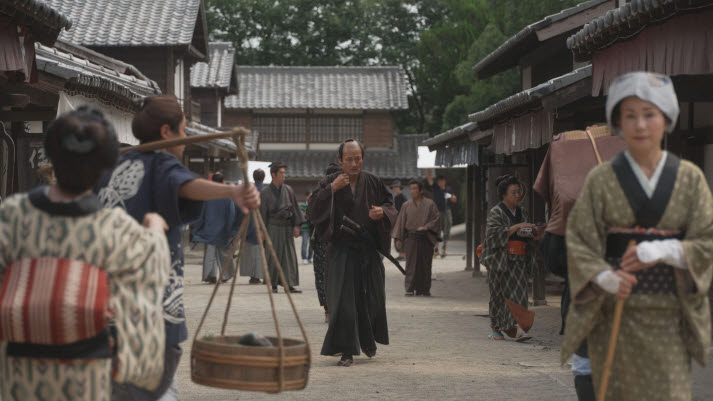
2023 Japanese film “A Samurai in Time” keeps its attitude as straight and sincere as possible, and that makes it all the more amusing for us. Its story premise is quite familiar to say the least, but the movie handles the story and characters with enough humor and skill, and it also shows some genuine poignancy later in the story.
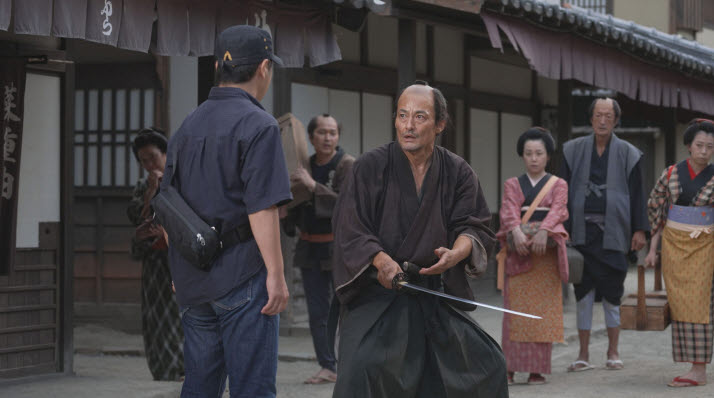
The opening scene introduces us to Kosaka Shinzaemon (Makiya Yamaguchi), a samurai of the Aizu Domain in Kyoto during the late 19th century. When he and his colleague attempt to strike upon a samurai of their opposing domain, Kosaka and his target happen to be struck by a sudden lightening, and, what do you know, Kosaka later wakes up to find himself transported to a movie studio in 2007. Because this movie studio is mainly for period films and TV dramas, he does not draw much attention from others, who all mistake him for one of those extra performers on the set.
Needless to say, Kosaka is quite baffled to see the ongoing shooting process at one of the sets in the movie studio, and he certainly becomes much more shocked to see how much his country looks different in the 21st century. Fortunately, he later finds a place to stay thanks to the chief priest of a nearby old temple recognized by him, and he also gets some extra help from Yuko Yamamoto (Yuno Sakura), a young plucky lady who has incidentally worked as an assistant director at the movie studio.
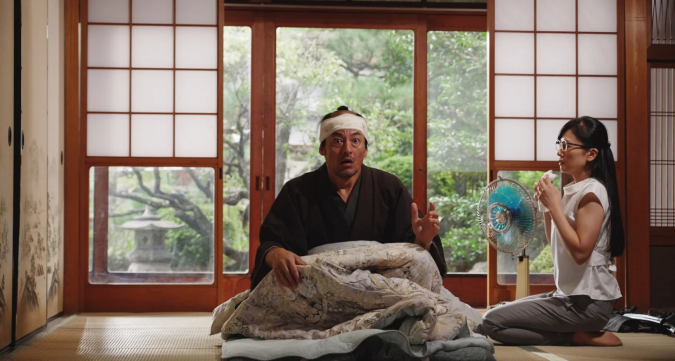
As Kosaka understandably does not tell much about himself, both the priest and Yuko think he is just an extra performer a bit too serious about his small part in the movie studio, and Kosaka soon finds himself really working as an extra performer for the studio once it is noticed that he has all the right qualities to look like a real samurai. He is rather reluctant at first, but, of course, he turns out to be quite good as a stunt performer for shooting sword fight scenes. After all, he has trained himself a lot on swordsmanship for years, and he surely knows how to wield sword – and how to look realistic in being “cut down” by his opponent’s sword.
One of the most humorous scenes in the film is when our samurai hero requests to be mentored by an old sword master who has worked in countless period TV dramas and movies for many years. Despite their considerable age difference (I will let you decide on which one is actually older), Kosaka instantly touches the master’s heart with his good old traditional values and ethics, and he certainly comes to learn a lot from this old man, who gladly imparts his own knowledge and skill to him step by step,
As getting more accustomed to his new world and situation, Kosaka quickly rises to considerable prominence as a skilled stunt performer in the studio, and then there comes an unexpected big chance for him. A famous movie star is about to make a period drama film which will be a glorious comeback to his old genre, and Kosaka happens to draw this dude’s attention. He even visits Kosaka in person for persuading Kosaka to work along with him, but Kosaka becomes all the more reluctant to work with him – until he is eventually persuaded by Yuko.
The movie becomes more humorous as things gradually become uneasier between Kosaka and his famous co-star for their matters of pride and honor. While the director of the movie and his crew members including Yuko certainly notice the growing tension between their two lead performers, they simply think that Kosaka and his co-star are just quite committed to their respective roles, and the director, who is your average cocky filmmaker, enjoys this “chemistry” between his two lead performers without much second thought.
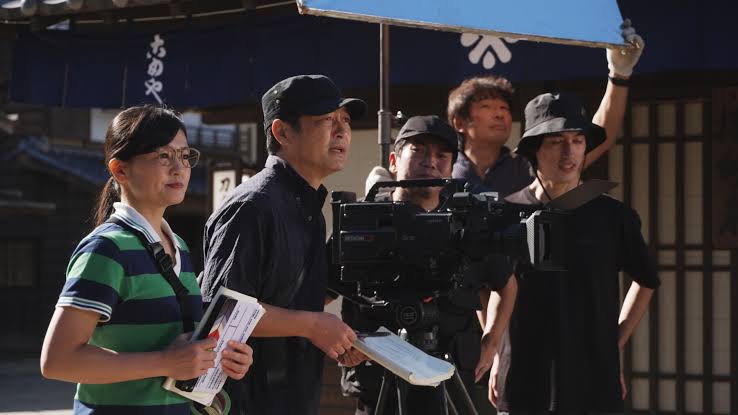
Of course, the movie becomes a bit more serious when Kosaka happens to learn more about the historical background of his movie later in the story, but it still maintains its absurd sense of deadpan humor as before. As becoming more serious about not only his role but also his movie, Kosaka is determined to push himself a lot more than required for the grand finale of his movie, and his co-star unhesitatingly goes along with that to the shock and surprise of everyone on the set.
Although it understandably steps back a bit during its climactic part, the movie still balances itself well between humor and tension, and so do its main cast members. Makiya Yamaguchi ably swings back and forth between absurdity and pathos along the story, and he is also surrounded by several solid supporting performers including Norimasa Fuke, Rantaro Mine, and Yuno Sakura. While Fuke clicks well with Yamaguchi during several key scenes of theirs in the film, Mine is both amusing and touching as Kosako’s mentor, and Sakura, who also incidentally served as the assistant director of director/writer/editor/cinematographer Jun’ichi Yasuda, holds her own place well as another substantial character in the story.
Overall, “A Samurai in Time” is a modest but likable fantasy comedy film, and I was entertained enough by a number of strong qualities including witty storytelling and good comic performances. Although its production budget was less than 30 million yen, the movie is fairly slick and competent as far as I observed from the screen, and it is not so surprising that the movie became an unexpected sleeper hit in Japan two years ago (It eventually earned one billion yen at the local box office, by the way). In short, this is a small but enjoyable gem worthwhile to check out, and I assure you that you will not be disappointed.