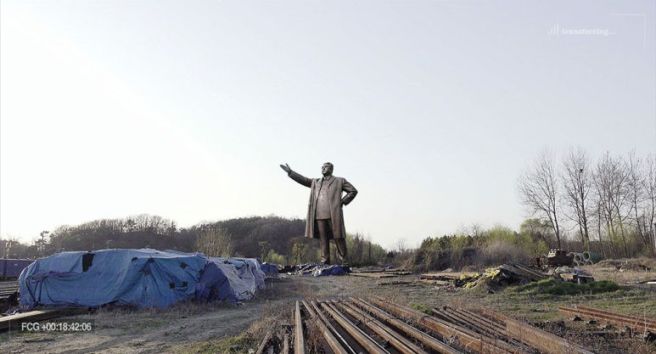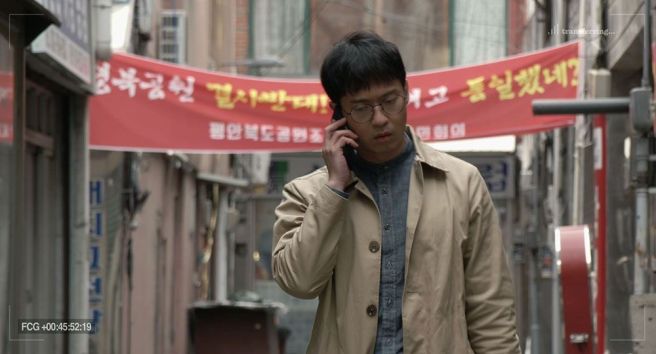
South Korean independent film “2035: The Green Light” intrigued me at first and then frustrated me a lot later. At first, it comes to us as a rather amusing mockumentary comedy about the sudden unification of South and North Korea and its aftermath, and you may be tickled by several absurd moments during this part. However, it unfortunately becomes uneven and less fun as entering the area of found footage horror later in the story, and you may get bored with all those genre clichés thrown onto the screen.
The movie, which is set in 2035, did a fairly good job of establishing an alternative history line at the beginning. In 2024, a mysterious wildfire occurred in the North Korean side of the military demarcation line between South and North Korea. As a result, thousands of North Korean citizens and soldiers fled across the military demarcation line, and this unbelievable incident eventually led to the collapse of the North Korean government and then the unification of South and North Korea. The following fake news footage clips show how much things have changed in Korea during next 10 years, and we get little funny moments from the straightforward interviews from several different South Korean people, who all surely have a lot to talk about this unexpected historical incident.
The story mainly revolves around Steven Park (Oh Tae-kyung), a Korean American reporter who returns to Korea for investigating on a strange thing involved with that wildfire which caused the unification. There is a video footage clip showing a number of weird green lights in the middle of that wildfire, and one of his colleagues has already gone missing not long after going to Korea for investigation.
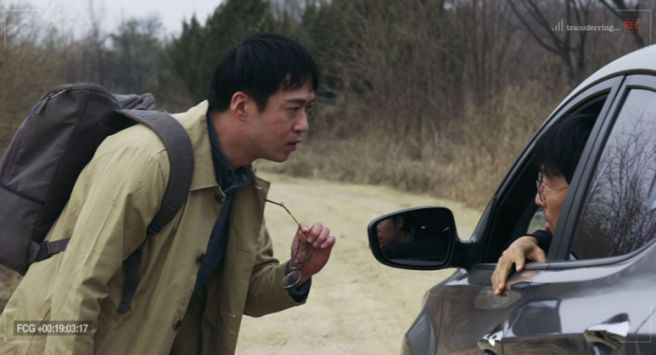
Along with his local assistant Kim Deok-jung (Yoo Il-han), Steven searches for anyone who can tell them more about those green lights, but they only find themselves more baffled about what really happened at that time. They manage to locate several figures who may tell anything about those green lights, but some of them do not seem to know anything while others are quite reluctant to talk about anything to them.
Nevertheless, as becoming all the more curious about those green lights, Steven and Deok-jung continue their investigation, and the movie has a little fun with how things have changed in the Korean society during last 10 years. Most of their interviewees are incidentally North Koreans, and we hear a bit about how they have been treated like second-rate citizens as struggling to adjust themselves to the sudden social change thrown upon them. While many of them have some past to hide, they are willing to give some information anyway, and Steven and Deok-jung get closer to the secret behind the green lights. It turns out that there was a covert experiment involved with the nuclear weapon development program of the North Korean government, and whatever happened there seems to be linked with not only that wildfire but also the green lights.
All these and other things in the film are presented in a mockumentary style as the two digital cameras held by Deok-jeong and Steven constantly follow their bumpy search for the truth. This certainly looks a bit amusing at first due to their utterly serious attitude, but the movie does not seem to know how to build more comic momentum from this potentially funny setup. It simply doles out one silly figure after another in front of Steve and Deok-jeong’s cameras, and the performers playing these absurd characters in the film only show the classic examples of Overacting 101. As many of you know well, it is always the best to play straight in a comedy film – especially if it is a mockumentary comedy film.
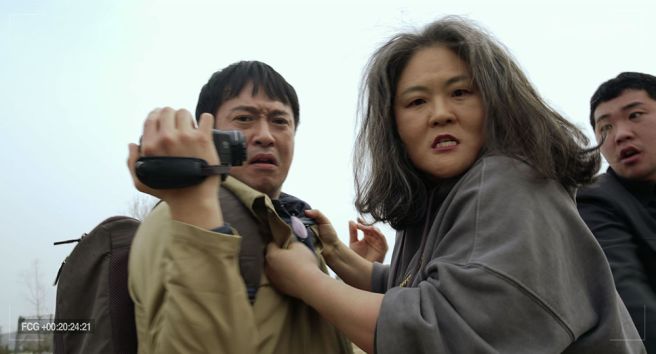
During its second half, the screenplay by director Park Jae-in and his co-writer Kim Dong-ha shifts itself onto found footage horror mode, but this tonal change is quite incoherent and jarring to say the least. While instantly reminiscent of those countless found footage horror films ranging from “The Blair Witch Project” (1999) to “REC” (2007), the movie does not provide much thrill or horror as merely mired in genre conventions, and we come to observe its predetermined narrative arc without much interest.
Above all, the movie often feels flat in terms of character development. Its two main characters are more or less than bland plot elements, and, even when they are in the middle of a big danger, they constantly bicker with each other as becoming more frantic (or idiotic) along the story. As a result, we do not care about them much even when things become all the more disturbing for them later in the story. Oh Tae-kyung and Yoo Il-han try their best at least, but their diligent efforts are often limited by their cardboard characters, and that is another disappointing aspect of the movie.
In conclusion, “2035: The Green Light” is a flawed genre film which mildly amused me without much satisfaction despite its intriguing story setting. In my trivial opinion, the movie should have learned more from better gerne flicks including not only “The Blair Witch Project” and “REC” but also “This Is Spinal Tap” (1984) and “What We Do in the Shadows” (2014), a very funny mockumentary comedy horror film which did a better job of mixing horror and comedy than “2035: The Green Light”. All these four genre films are more effective and entertaining, and maybe you should watch any of them instead.