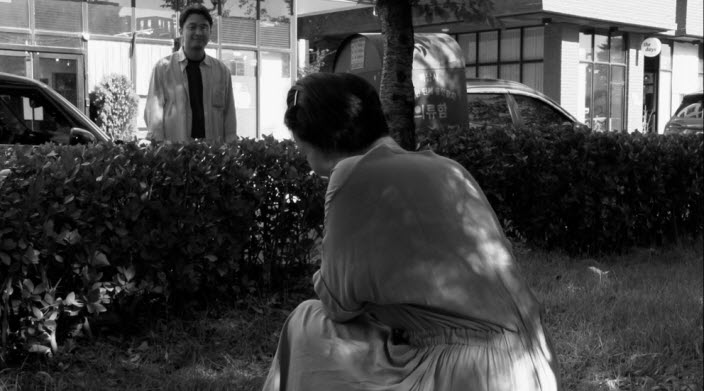
Hong Sang-soo’s new film “The Day She Returns” is interesting for how it tries some playful variation in its repetitive narrative structure. As phlegmatically observing three interviews and one acting class of its actress heroine, the movie has its several acts overlapped with each other in one way or another, and we get more amusement as the line between reality and fiction gets blurred a bit later in the story.
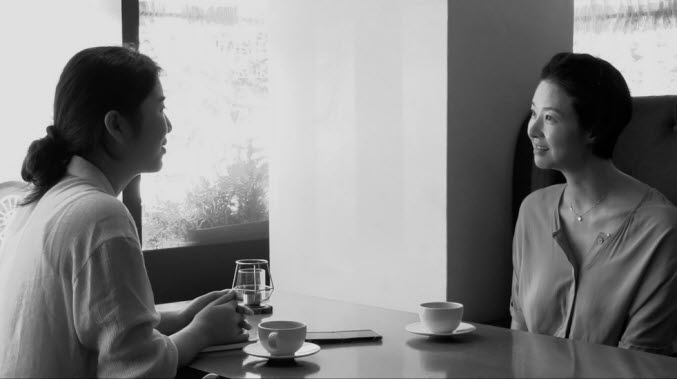
As its actress heroine, Bae Jeong-su (Song Seon-mi), goes through several individual interviews at a small restaurant one by one along the story, we get to know a bit about her career and personal life. Not long after her divorce, she was approached by some famous independent filmmaker, and she decided to be back in business because 1) the filmmaker’s script is quite good and 2) she wants to make a new start after her divorce.
In case of the first interviewer, who is a young female reporter, the mood is initially cordial between her and Jeong-su, but the mood becomes rather awkward between them as the interviewer asks a few uncomfortable questions to Jeong-su. At least, Jeong-su tries to wrap up the interview with some meaningful last comment for this interview, but then she only finds herself struggling to explain what she said.
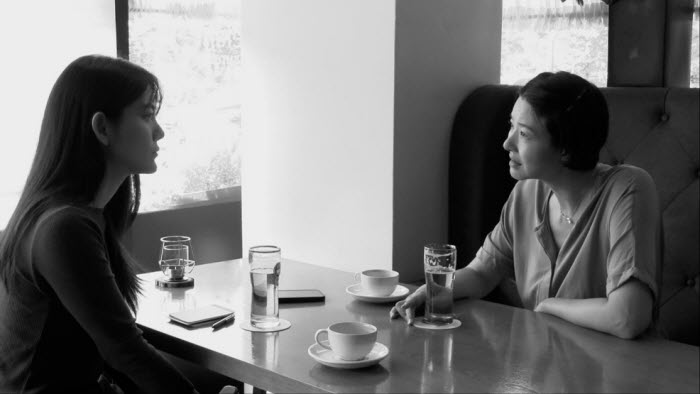
In contrast, the second interview is relatively more comfortable for her. Some other young female reporter comes after Jeong-su has a brief break time, and what Jeong-su says to this reporter is not so different from what she said during the previous interview, but she feels more confident and relaxed in this time. As a result, the mood becomes more cheerful between her and the reporter, and they even order two glasses of beer around the end of their interview (This is quite a restraint considering how often many of Hong’s movie characters drink a lot).
In case of the third interview, Jeong-su talks again about her career and personal life in front of some other female reporter. What she says is pretty much same as what she did during the two previous interviews, but we notice some variations as she gives more details on how her personal life has been. As a matter of fact, it turns out that she took an acting class as a part of the preparation for her new movie, and she is soon going to have another session of her acting class.
During its last part, the movie becomes more interesting as observing Jeong-su attending her acting class. Her acting class teacher instructs her to write a short script based on the memories of her three interviews, and she and some other student of the acting class, who is also a young woman, are going to give a performance based on that script.
What follows next is a curious situation going back and forth between reality and fiction. At first, Jeong-su and her fellow student confidently interact with each other during the first several minutes, and everything seems to be going fairly well between them. Soon, they try a bit of improvisation rather than following what Jeong-su wrote, which, as we gradually notice, is basically an amalgamation of all those three interviews of hers.
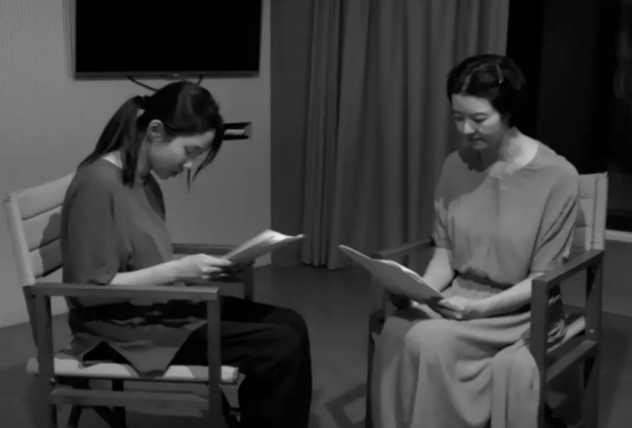
However, as they try improvisation more and more, Jeong-su and her fellow student come to struggle to maintain their performance, though we are often not so sure about whether the growing awkwardness between them is real or not. For finding any cue for their performance, they come to check Jeong-su’s script more and more, and it sometimes looks like they really have no idea on what to say next to each other.
While it is simply regarded as a storytelling exercise, the movie is still fairly engaging thanks to the competent direction of Hong, who also served as the writer/editor/composer/cinematographer of the film as usual. Every scene in the film is quite plain and simple on the whole, but their rather long dialogues are fluid and natural enough to hold our attention. Hong later adds a bit of notable visual touch during the last act, and that is rather distracting in my humble opinion, but it is at least more tolerable than his disastrous visual experiment in “In Water” (2023), which looks very blurry from the beginning to the end as everything on the screen is deliberately out of focus.
Anyway, the movie mainly works as the showcase of its lead actress’s considerable talent and presence. Song Seon-mi, who has steadily appeared in Hong’s several films including “Woman on the Beach” (2006) and “Walk Up” (2022), splendidly supports the film without any strain, and she also did a commendable job of bringing subtle individual nuances to the three interview scenes and the following acting class scene. In case of several other cast members including Park Mi-so and Kim Seon-jin, they simply step aside as Hong’s camera usually focuses on Song’s face and performance, and you will not probably remember much of them as their faces are not shown that much on the screen.
In conclusion, “The Day She Returns” will amuse and entertain you if you are familiar with many of Hong’s previous works such as “The Day He Arrives” (2011), which is also equally amusing for its deliberately repetitive narrative structure. He disappointed me a bit in several recent films such as “By the Stream” (2024) and “What Does That Nature Say to You” (2025), but Hong entertains me enough in this time, and I think it is one of the more interesting South Korean films of this year.