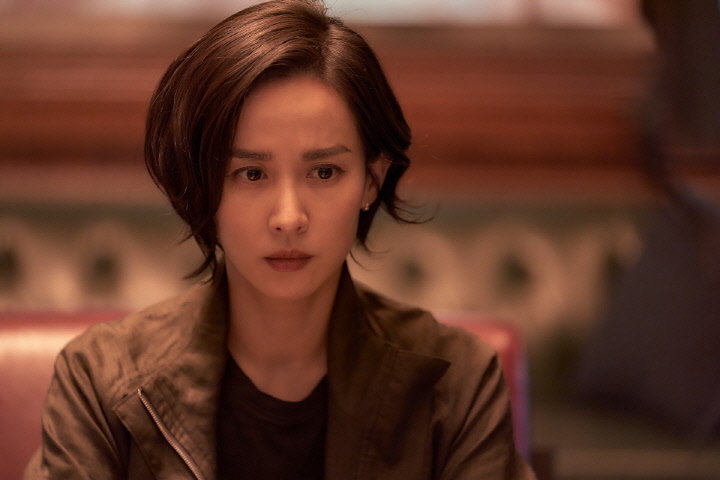
South Korean film “Murder Report” is a taut and efficient thriller about one female journalist having an exclusive interview with a serial killer. Now you will instantly get a pretty good idea about what you will get, and the movie surely has a fair share of expected twists and turns along its increasingly intense and disturbing plot, but its effective handling of story and characters will constantly hold you on the edge at least.
Cho Yeo-jeong, who has been mainly known for her wonderful performance in Bong Joon-ho’s Oscar winning film “Parasite” (2019), plays that journalist in question, and the opening part of the film quickly and succinctly establishes how she is drawn to an unlikely opportunity for scoop. A man calls her for a private interview, and he promises to her that he is going to tell her a lot about how he killed no less than 11 people. This certainly sounds very preposterous to say the least, but the journalist cannot resist this unbelievable chance mainly because she needs any kind of scoop to save her recently damaged career right now.
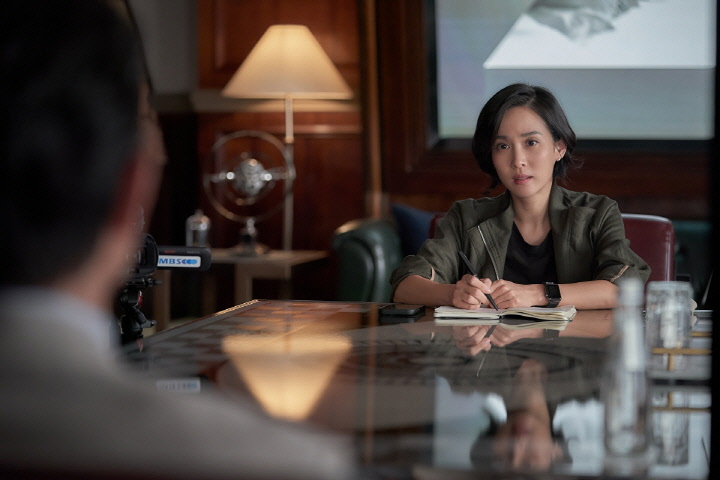
We see how she takes some caution in advance before going to a hotel suite where she and that mysterious guy are going to meet during one evening. She is accompanied with a detective who is incidentally her boyfriend, and, once her interviewee arrives, he is going to monitor the suite from a room right below it via hidden cameras and microphones.

Needless to say, she and the detective are surprised a lot when her interviewee fully reveals himself without any fear or concern at all. As promised to her in advance, the interviewee willingly shows and then proves to her that he is indeed a serial killer, and he seems quite prepared to answer any hard question thrown from his interviewer. For example, he does not hide his real occupation at all, and he also gladly talks about how he was turned into a serial killer some time ago.
And he also reveals that he wants this interview because he thinks he needs to check upon the certain moral aspects of his hideous crimes. Many of his victims were brutally murdered in one way or another, but, while unhesitatingly accepting his responsibility, he does not feel any particular guilt about all these murders committed by him, just because these killings are regarded as sort of “cure” by his intelligent but undeniably twisted mind.
No, his “cure” is not for those victims, but it is actually for a number of certain figures respectively associated with them, and it seems he really believes that he simply did what was the best for these figures in question. Imagine a cross between Dr. Hannibal Lector in Jonathan Demme’s “The Silence of the Lambs” (1991) and the “righteous” serial killer hero of American TV series “Dexter”, and you will get a fairly good idea on what kind of man this dude is.
While naturally quite horrified by her interviewer’s story, the journalist cannot leave the suite right now. Sure, she wants to record more from their ongoing interview, but there is another big reason besides that. The interviewee told her that he is going to kill another person not long after the sunset, but she can actually stop this only if she continues the interview as long as he wants.
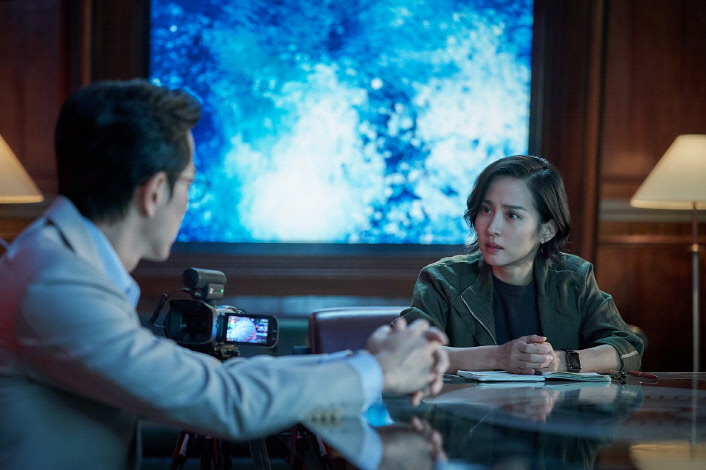
However, that turns out to be much more challenging than expected as her interviewee often toys with her in one way or another. At one point, he coldly demonstrates to her how dangerous and ruthless he can really be, and she feels like getting trapped more and more – especially when it belatedly turns out that her several safety measures were utterly useless from the very start (Is this a spoiler?).
Deftly accumulating the tension across the screen, the movie delves more into its gray moral area, and our journalist heroine is accordingly pushed toward a certain inevitable point already waiting for her in advance. No matter how much she struggles to stick to her objective journalistic viewpoint, her interviewee always seems to be one or two steps ahead of her, and we come to brace ourselves more as he methodically unfolds a number of hidden cards behind him along the story.
Except a few scenes involved with the detective, the movie is basically a two-hander, and its two lead performers click well with each other from the beginning to the end. While Cho masterfully swings back and forth across the whole gamut of emotions along the narrative, Jung Sung-Il, who previously gave a solid supporting performance in Kim Sang-man’s Netflix movie “Uprising” (2024), is subtly creepy as smoothly complementing Cho’s showier acting with his unflappable appearance, and their solid duo performance ably carries the film to the end even when the story becomes a bit more predictable during its last act.
In conclusion, “Murder Report”, which was shot in 2023 but then was belatedly released in local movie theaters in last year, often feels a bit too generic in several aspects (Its opening title sequence is clearly influenced too much by David Fincher’s “Seven” (1995) and countless other serial killer flicks out there, for example), but director/writer Cho Young-jun did a competent job on the whole. Yes, this is quite uncomfortable to watch to say the least, but I was entertained enough while also musing a bit on a number of tricky moral questions from the film, so I recommend it with some caution.