
Buster Keaton’s 1924 film “Sherlock Jr.” is an enduring masterwork to be cherished and admired. While it is very hilarious to observe those typically deadpan comic moments expected from Keaton’s phlegmatic screen persona, it also has a series of inspired moments which will still surprise you for sheer technical mastery and all those highly risky physical stunts done by Keaton himself. In the end, you will be all the more impressed by how much the movie dexterously accomplishes in a rather short running time (45 minutes).
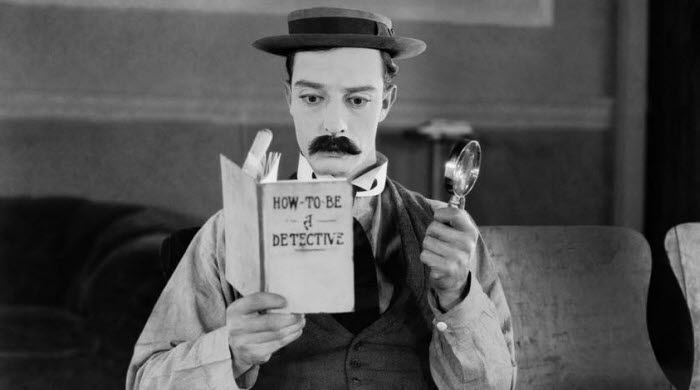
Like he did in many of his notable works including “The General” (1926), Keaton plays a plain ordinary guy who simply wants to be recognized and loved. While he just works as a projectionist at a local movie theater, this dude also aspires to be a great detective like, yes, Sherlock Holmes someday, and we get some small laugh as he attentively reads a little elementary guidebook on how to be a good detective.
Besides this earnest personal aspiration of his, the projectionist wants to win the heart of a pretty young girl in his town. It seems that she is also interested in him, and he is surely ready to impress her as much as possible, but, alas, he is too poor to buy any good present for his courtship. At one point early in the film, he actually comes upon a lucky chance for getting a few dollars more for buying an expensive present for her, but then there come several absurd moments upon him, and we surely get amused more as he is quite baffled by how he ends up losing more instead of gaining more.
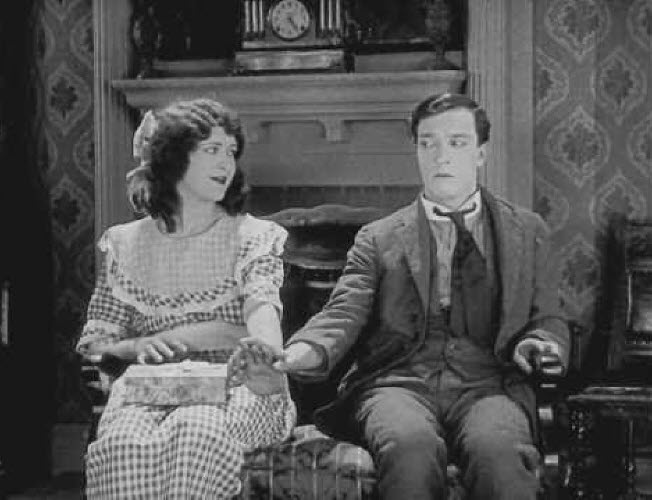
Anyway, the projectionist manages to impress that girl via a little simple deception, but there soon comes another trouble. She happens to draw the attention of some handsome but mean guy, and, to the projectionist’s frustration, it does not take much time for this rotten dude to get more attention from her. To make matters worse, he later frames an act of theft on the projectionist, who is all the more depressed after being rejected by that girl for the crime he did not commit.
While it is not much of a spoiler to tell you that our hero is eventually vindicated, the real surprise of the movie comes from what occurs to him before that point. He goes back to the movie theater, and then he gets asleep in his projection room while a movie is being projected onto the screen in front of many audiences. Suddenly, he finds himself leaving his body and then entering the screen, and, after clumsily and hilariously trying to adjust himself to this new environment, he becomes “Sherlock Jr.”, who must solve a case involved with an expensive pearl necklace right now.
This surreal moment in the film still looks amazing even at present for its masterfully effortless execution. Needless to say, Keaton and his crew including cinematographers Elgin Lessley and Byron Houck prepared a lot for shooting this memorable moment, but everything flows so well across the screen that you will wonder more about how they could possibly achieve that. Yes, they used a lot of practical visual effects here and there, but the overall result is quite seamless to say the least – especially when the background on the screen is continuously and busily changed in one way or another to our hero’s confusion. In fact, you will be amazed more after learning more about the painstaking efforts behind this humorously chaotic moment (Keaton and his crew used surveyor’s instruments to position him and the camera at exactly the right distances and positions for generating the illusion of continuity on the screen).
Keaton also demonstrates well here in this film that he is an almost peerless master of physical comedy. In case of one comically suspenseful scene where “Sherlock Jr.” plays billiards along with two bad guys ready to get rid of him by any means necessary, its comic momentum is gradually increased as Keaton’s character manages to evade one hidden danger after another while being totally oblivious to his perilous situation, and we later get a nice big laugh from a payoff moment involved with one lethal cue ball, which is incidentally numbered 13.
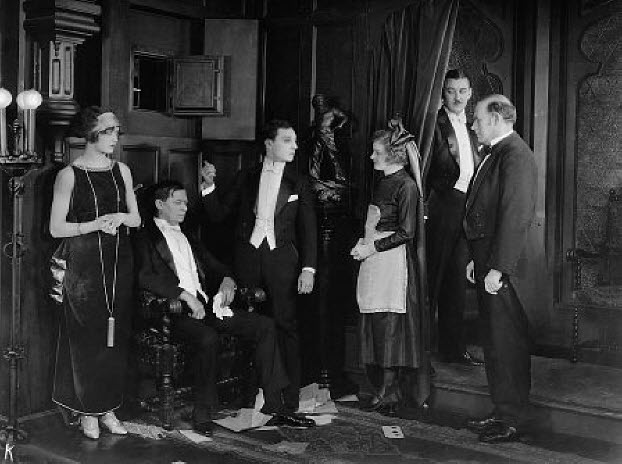
When the story becomes quite frantic during its climactic part, the movie serves us a lot of physical action scenes packed with a lot of thrill and humor. As many of you know, Keaton did not hesitate to throw himself into all those risky physical stunts at all during the shooting, and it is still marvelous to see how he bounces from one perilous moment to another with his own graceful physical agility. For instance, I still marvel at the scene where his character goes through a small suitcase and then disappears, and you will appreciate more of his and his crew’s efforts after learning more about how they shot this unbelievable comic moment via an old vaudeville trick from his father.
As a matter of fact, Keaton got himself seriously injured when he and his crew was shooting one particular scene where he should be hanging off a ladder connected to a huge water basin for a while. Nonetheless, he kept going as before, and, after suffering from severe migraines during next several years, he belatedly came to learn how serious this injury of his actually was when he came to a doctor in 1935.
On the whole, “Sherlock Jr.”, which is currently being shown at selected local movie theaters in South Korea along with Keaton’s several other works such as “The General” and “Our Hospitality” (1923), is a great film whose comic surreal qualities remain quite fresh and alive even after more than a century. Any film from Keaton during his prime period in the 1920s can be a good start for you, but, “Sherlock Jr.” surely comes first along with “The General” in my humble opinion. Believe me, after watching either of them, you will be surely eager to get to know more about his undeniable contribution to the 20th century cinema.



 Seongyong's Private Place