

First, I must confess that animation feature film “KPOP Demon Hunters”, which was released on Netflix a few weeks ago, willingly goes into a musical territory not so familiar to me to say the least. Yes, despite being a South Korean dude, I have not paid much attention to K-POP like I showed no particular interest to hip-hop during my adolescent years (Full Disclosure: I was quite a tight-ass autistic kid during that time), but the film turns out to be both enjoyable and accessible to my little surprise, and I am especially grateful to it for presenting what can be regarded as the inner animal inside myself.
The story is basically a mix between superhero origin story and show business melodrama. At the beginning, we are introduced to a very popular female K-Pop trio group who are actually the latest generation of the time-honored singer warriors fighting against the demons of the underworld, and the opening sequence shows their latest battle which happens right before the last concert of another world tour of theirs.
Besides fighting against those demons eager to suck and then deliver human souls to their mighty master, the ultimate task of Rumi (voiced by Arden Cho), Zoey (voiced by Ji-young Yoo), and Mira (voiced by May Hong) is fortifying and then sealing the spiritual portal to the underworld once for all, and it looks like they are almost close to getting their mission accomplished. Once Rumi writes another powerful song to be spread around millions of fans out there, the portal will be sealed forever at last, and then they may be able to concentrate on their music business more than before.
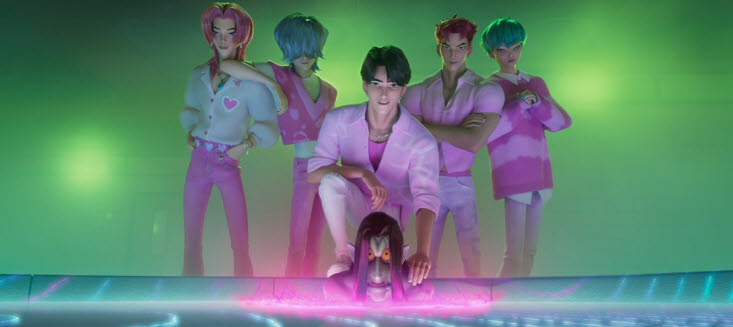
Of course, the master of those demons in the underworld is not so amused about this impending prospect, and one of those demons comes with a special plan for not only thwarting their opponents but also getting much more human souls than before. That demon in question is a former human singer named Jinu (voiced by Ahn Hyo-seop), and he is going to introduce himself and four other singings demons as, surprise, a new hot male K-Pop group to compete against their opponents.
Jinu’s devious plan turns out to be quite successful right from the beginning. After all, he and his fellow singing demons sing and dance pretty well on the whole, and, most of all, their sexual appeal is literally irresistible, as frankly and broadly recognized by their opponents when these two opposing groups happen to encounter each other.
Needless to say, Rumi becomes quite pressured about writing something to stop the growing popularity of Jinu and his fellow demon singers, but then there are two big issues for her. First, she was actually born as a hybrid between demon and human, and she has been hiding this serious truth even to her two comrades mainly because of their mentor’s firm advice. Second, she and Jinu find themselves more attracted to each other despite the ongoing hostility between their respective groups, and it does not take much time for him to realize her true nature.
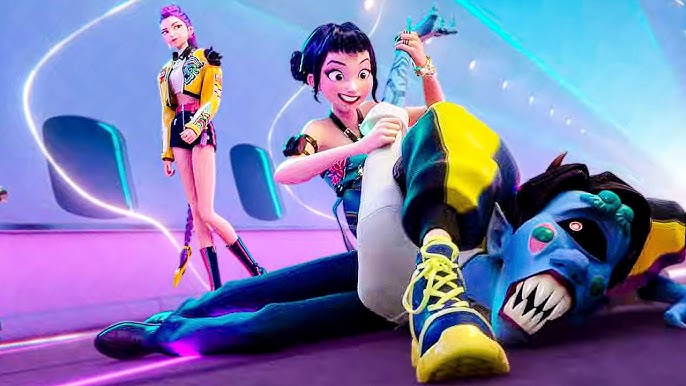
Around this narrative point, you can easily guess what will happen next in the story. The film does not go further than whatever you may expect, but it compensates for its rather predictable story and characters with a lot of style and personality to be savored. While Rumi and her two comrades are more or less than stereotypes to say the least, they are also depicted with a considerable amount of charm and spirit, and that is the main reason we come to root for them more along the story. In case of how it illustrates Seoul and its many different citizens, I must say that the film is not exactly realistic or authentic in terms of mood and details, but I must also recognize that directors Maggie Kang and Chris Appelhans, who also wrote the screenplay with Danya Jimenez and Hannah McMechan, did their homework on Seoul fairly well (I was especially tickled by the scene involved with a Korean medicine clinic, by the way).
In addition, the soundtrack of the film is pretty effective as far as I observed during my viewing. Besides functioning well as a part of the story, the original songs in the film are good enough to be recognized then embraced by those countless K-Pop fans out there, and they are also accompanied with a lot of style to engage and then excite us. The overall result is clearly influenced a lot by Oscar-winning animation film “Spider-man: Into the Spider-verse” (2018) and its 2023 sequel (Yes, it is produced by Sony Pictures Animation), but this is still distinctive enough with a lot of local and cultural touches to be appreciated and cherished, and some of my favorite moments come from Jinu’s adorably freakish pet demon tiger, which can be regarded as not only Korea’s answer to Cheshire Cat but also the animal illustration of myself on a rare smiling mode.
In conclusion, “KPOP Demon Hunters” is a delightful surprise during this summer season, and it is a shame that the film went to Netflix instead of getting shown in movie theaters (I would love to observe how enthusiastically its target audiences would respond to its many big musical moments). Anyway, it looks like the opening chapter for whatever may follow next, so there may come a sequel someday. Considering a lot of positive responses from both critics and audiences, that seems quite possible now, and I guess we can have some expectation on that.


I love the movie off dis story I love Rumi ,Zoey , Mira ,juni😁💞💝💖💘
SC: Thanks for your lively comment.
Pingback: 10 movies of 2025 – and more: Part 2 | Seongyong's Private Place
Pingback: My Prediction on the 98th Academy Awards | Seongyong's Private Place