
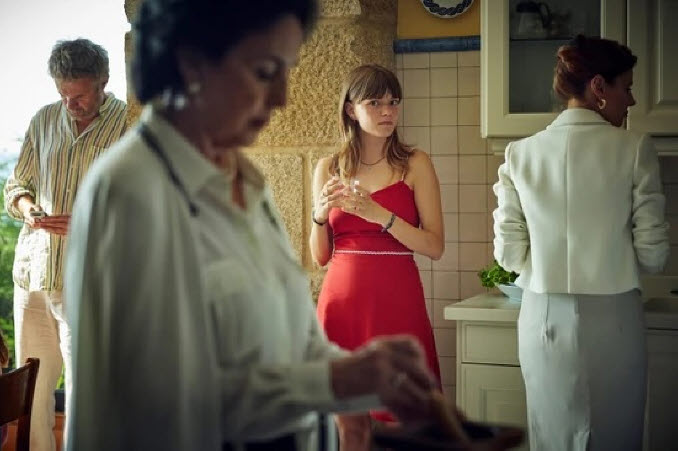
Spanish filmmaker Carla Simón‘s latest film “Romería” is about an adolescent girl getting to know more about her dead parents right before entering her adult life. While it initially looks like a typical mix between family drama and coming-of-age tale, the movie fills the screen with a lot of distinctive sensitivity and realism as its heroine comes to learn more about her parents along the story, and we do not mind at all even when it delves into a realm of fantasy for a while later in the story.
The movie is pretty much like a spiritual sequel to Simón’s previous film “Summer 1993” (2017), which is about a little young girl coping with her changed situation due to the early death of her parents. Just like that movie, “Romería”, which is incidentally set in a Spanish port city named Vigo during several days of July 2004, has autobiographical elements from Simón’s early life, and that is quite evident to us whenever its young heroine records a lot of things with her digital video camera in the film.
At the beginning, the movie gradually establishes young heroine’s purpose of visit to Vigo. Before Marina (Llúcia Garcia) was born in the late 1980s, her parents lived together in the city for a while, but they became separated from each other around the time of Marina’s birth, and both of them eventually died not long after that. Marina was subsequently raised by her mother’s family members in Barcelona, but now she needs to be recognized on her father’s death certificate for her upcoming scholarship application, and this requires some legal help from her father’s family.
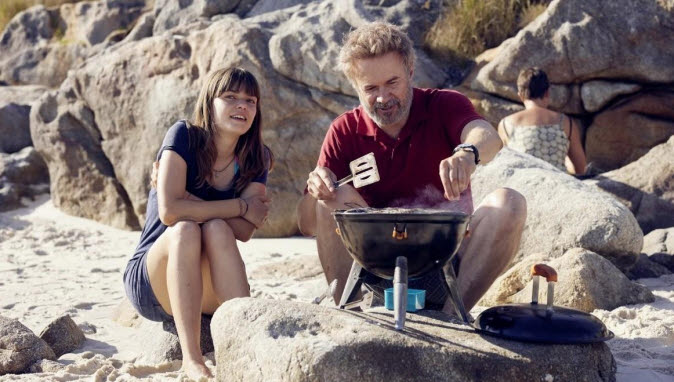
Although she has never met them before, most of her father’s family members cordially welcome Marina right from her first day in Vigo. One of her uncles gladly lets her stay in his family boat along with his several family members, and it does not take much time for Marina to get friendly with her several cousins including Nuno (Mitch Martín). At one point early in the story, she enjoys some free time along with her cousins in the sea, and it looks like she will have a pretty good time in Vigo while eventually getting what she needs from her father’s family.
Meanwhile, she also becomes all the more curious about how her parents lived in the city during that time. Fortunately for her, Marina happens to have an old diary from her mother, and her mother’s diary comes to function as a sort of guidebook for her. She visits an old apartment building where her parents once resided, but a lot of things have gone or changed since that, and she cannot find anyone remembering her parents there.
In case of her father’s family members, they are mostly casual in their conversations with Marina, but it is apparent that her father and his death have been a skeleton in the closet even though Marina knows a bit about what caused her parents’ death. When she subsequently meets her paternal grandmother, she is not very nice to Marina to say the least, and her paternal grandfather prefers to pay all of Marina’s college tuition rather than getting her officially recognized on his son’s death certificate.
Nevertheless, Marina gets to know about her parents bit by bit as spending more time with her father’s family members. While they did love each other a lot, her parents’ romantic relationship was eventually deteriorated by their pretty wild lifestyle filled with a lot of drug and alcohol, and that was followed by a grim period about which many of her father’s family members are still not so willing to talk to Marina.
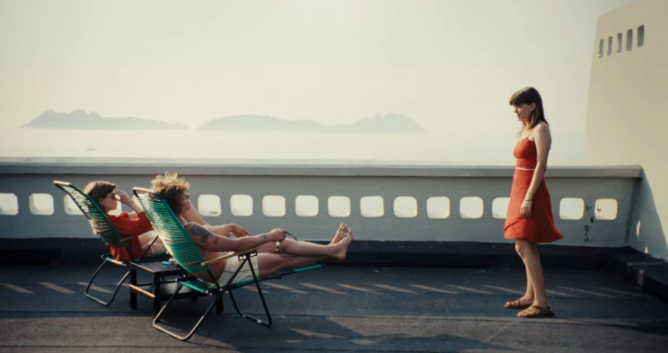
I must say that I have no idea on how much the story overlaps with Simón’s real-life story, but she did a good job of imbuing the movie with considerable verisimilitude to draw our attention. Although it takes some time for us to discern the family relationships among Marina and a bunch of other characters surrounding her, they come to us as realistic human figures to observe thanks to the natural interactions among the main cast members of the film, and we accordingly become more engaged in Marina’s personal quest along the story.
When Marina comes to experience a mixture of fantasy and memory later in the story, this feels a bit too jarring at first, but the movie keeps holding our attention as freely moving across a series of personal memories associated with Marina’s parents. Regardless of what exactly happens to her at that point, we come to sense considerable emotional maturation from our young heroine, and that is why the last scene comes with genuine poignancy.
Simón also draws good performances from her main cast members. While newcomer Llúcia Garcia earnestly holds the center as required, several other main cast members including Mitch Martín, Tristán Ulloa, Celine Tyll, Marina Troncoso , and José Ángel Egido are well-cast in their respective supporting parts, and the special mention goes to a certain stray cat in the film, which always steals the show whenever it appears on the screen.
In conclusion, “Romería” is another distinguished work from Simón after “Summer 1993” and “Alcarràs” (2022). With these three wonderful films, she demonstrates that she is a talented filmmaker with her own artistic sensitivity. and I will certainly have some expectation on how she will advance further from this considerable artistic achievement of hers.


![Light Show [Explored 2026-10-09]](https://live.staticflickr.com/65535/55578539818_958ce4fa9c_s.jpg "Light Show [Explored 2026-10-09]")


