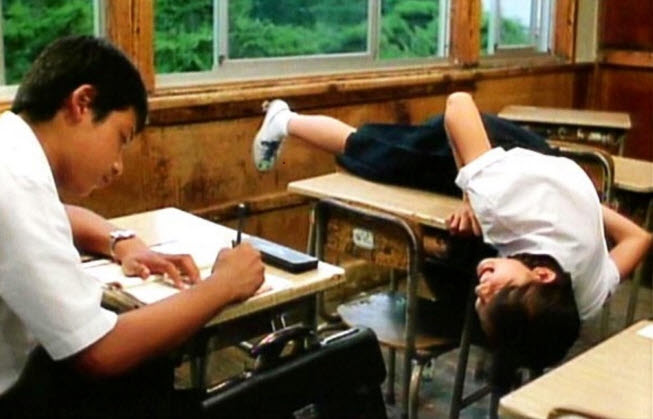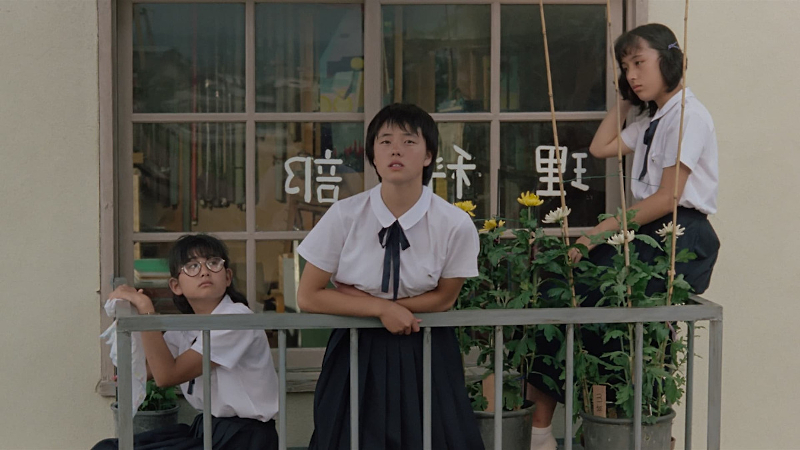
Shinji Sōmai’s 1985 film “Typhoon Club”, which happened to come out around the time when John Hughes’ “The Breakfast Club” (1985), is an adolescent drama which turns out to be darker and more disturbing than expected. Watching some of its main adolescent characters being stuck inside their school later in the story, you may be reminded a bit of “The Breakfast Club”, but the movie goes for something far less cheery, and its haunting moments of anxiety and frustrations will linger on your mind for a while.
Mainly set in some rural town outside Tokyo, the movie opens with a group of middle school girls trying to have a little fun nighttime at the swimming pool of their school. As they freely dance together around the swimming pool, it soon turns out that there is a boy in the swimming pool, and the girls’ following thoughtless prank on this boy leads to an unfortunate incident which actually could kill him.
As the next day begins, we get to know more about the girls, the boy, and his two male classmates. It is clear to us that one of the girls, Rie (Youki Kudoh), likes one of the boy’s two friends, but Mikami (Yuichi Mikami) is not particularly interested in being more than a close friend to Rie, mainly because he is more occupied with studying more for going to a good high school later.
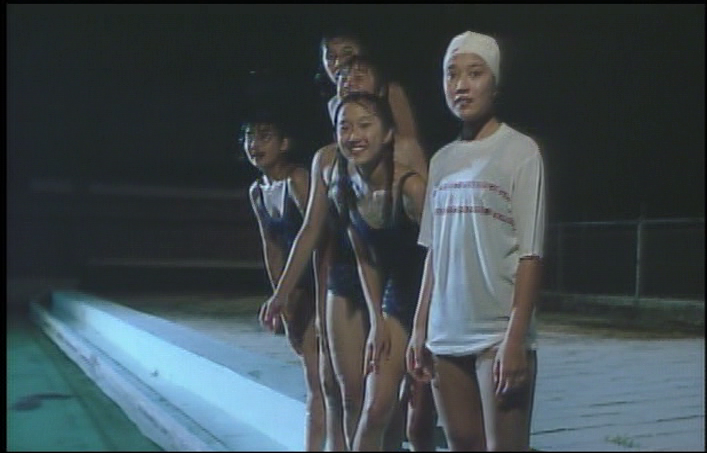
However, Mikami does not know what to do with his life except doing whatever he is expected to do by his parents, and his two male friends have no idea either as being more aware of being hopelessly stuck in their town just like many others in the school. At one point, we see one of them showing a rather disturbing behavior when he enters his shabby family home, and we later come to have a fairly good idea on what has been going on between him and his father, who is clearly your typical alcoholic loser.
Meanwhile, the girls turn out to be as anxious and frustrated as the boys. They try some transgression to distance themselves from their growing daily ennui, and we are not so surprised when two of them try a bit on their burgeoning curiosity on sexuality. In case of Rie, we observe more of how much she is troubled behind her perky façade, but Mikami remains oblivious to that as usual while being mired in his own ennui, and that eventually prompts her to do something quite drastic later in the story.
As these main adolescent characters aimlessly sway in one way or another, we become more aware of the absence of any good adult to guide or support them. We seldom see their parents throughout the film, and their schoolteachers are not particularly interested in them except shepherding them to the next level of their education process. In case of their mathematical teacher, we get an absurd scene where his students come to learn more about how pathetic he really is, and they surely come to respect him much less than before.
While leisurely doling out one episodic moment after another along the narrative, Yuji Kato’s screenplay slowly dials up the level of emotional tension with a big typhoon approaching to the town hour by hour. Around the point where the eventual storm warning is announced, things get a lot more intense, and then there comes a very disconcerting sequence where one of the girls is terrorized and then physically violated to some degree by one of the boys.
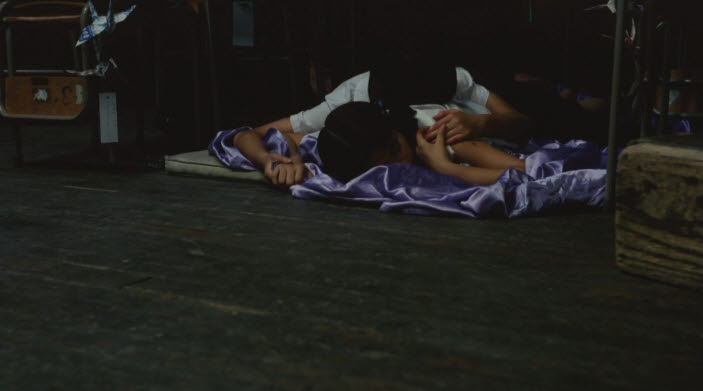
Even at that point, the movie firmly maintains its phlegmatically sobering attitude while refusing to allow any easy way out for its adolescent main characters. When Mikami and his several classmates get themselves trapped inside the school as the typhoon is raging more and more outside, they feel more frustrated than ever, but their following attempts for any emotional ventilation do not give them much catharsis at all, and their drab reality is about to return on the very next day.
Their desperate emotional struggles are not so pleasant to watch to say the least, but they are handled with enough care and sensitivity under Sōmai’s skillful direction, and the same thing can be said about the subplot involved with Rie’s misadventure outside the town. There is an uncomfortable indoor scene between her and one adult guy, but it is presented with considerable tactfulness at least while unnerving us a lot for good reasons. I also appreciate how Sōmai and his crew members including cinematographer Akihiro Itô shows some restraint in case of a striking scene involved featuring full frontal nudity and lots of rains, and you will be relieved to know that they really took some caution in advance for shooting this highly risky scene.
Overall, “Typhoon Club” will catch you off guard as a sort of antithesis to “The Breakfast Club”, so you probably should know in advance what and how it is about. I must confess that I felt a bit impatient during my viewing, but I eventually came to accept its thoughtful approach to story and characters, and I become more interested in checking out several other works of Sōmai, who surely deserves more attention considering how he has been cited as a major influence to many different current Japanese filmmakers such as Hamaguchi Ryûsuke and Kuorsawa Kiyoshi. It does feel like an acquired taste, but the movie is still worthwhile to watch for its mood and storytelling, and it will certainly surprise you especially if you are looking for something different.