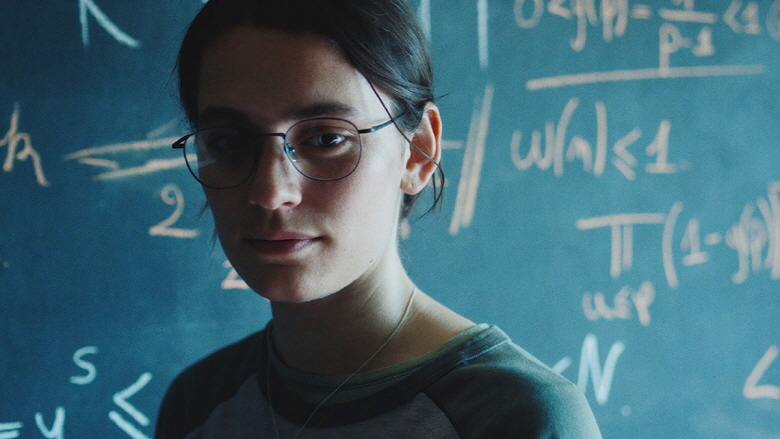
“Marguerite’s Theorem” engaged me more than expected even though I did not know that much about Goldbach’s conjecture, which has been one of the most challenging mathematical matters for more than 250 years. As closely and intimately sticking to its brilliant but vulnerable heroine’s state of mind, the movie lets us understand and emphasize more with what makes her tick, and we accordingly care more about her and her immensely demanding academic project.
At the beginning, the movie observes its math prodigy heroine, Marguerite Hoffmann (Ella Rumpf), preparing for what may be a big breakthrough for her academic career, and she is alternatively confident and anxious about what she has been strenuously working on during last several years under her thesis director’s guidance. While she is almost sure about the success of her upcoming thesis presentation on Goldbach’s conjecture, she is also well aware of any possibility of error, but then she hesitates to get some help from Lucas (Julien Frison), a hunky male student who recently moves to her graduate school for studying under her thesis director.
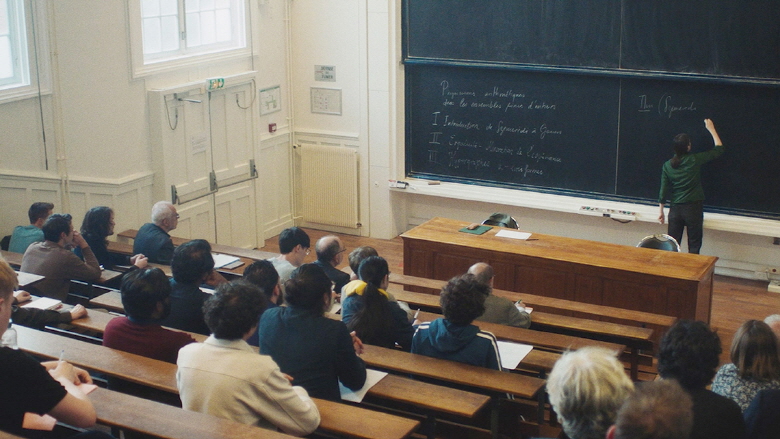
When her thesis presentation eventually begins, Marguerite tries her best for presenting the result of her mathematical study, but, alas, it soon turns out that there is a big error she should have noticed from the very beginning. Quite overwhelmed by this glaring error of hers, Marguerite walks away from her academic audiences, and then she decides to quit her study and then leave her graduate school after her thesis director, who is clearly not so pleased about her academic breakdown, recommends her to study under some other professor in the department instead.

Although she does not know what to do next for her future, Marguerite gradually comes to find a way to climb up from the bottom for now. First, she gets a cheap place to stay thanks to Noa (Sonia Bonny), a young dancer she happens to befriend later. Second, she becomes quite interested in a Chinese poker game named Mahjong via the Chinese landlord of her current staying place, and, what do you know, she soon discovers that she is pretty good enough to earn some cash as playing Mahjong on behalf of her Chinese landlord.
Not so surprisingly, as her brain is frequently working on the probabilities associated with Mahjong games, Marguerite slowly finds her mathematical groover back. Once she gets a small but compelling idea on proving Goldbach’s conjecture in the middle of one Mahjong game, her mind is instantly driven by the tantalizing possibilities coming from that idea, and she is all the more motivated when she comes to learn later about what her former thesis director and Lucas have been working on at present.
Meanwhile, just like many other smart but socially awkward people, Marguerite comes to learn more about how to interact more with others around her, who remind her in one way or another that there is more to life than mathematics. Noa gladly shows Marguerite how to have more fun outside whenever she is not working on her new academic project, and there is a little amusing scene where Marguerite comes to have her first moment of sexual orgasm via the impulsive encounter with a total stranger. After having a moment of reconciliation with Lucas, Marguerite suggests that he should join her ongoing academic project, and she surely comes to learn the value of academic collaboration while working with him more and more.
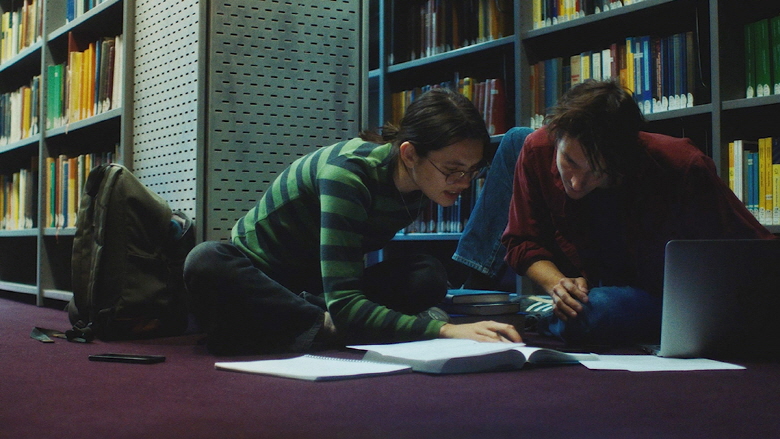
Now you probably have a good idea on where its story and characters are going, but the screenplay by director Anna Novion and her co-writers Mathieu Robin, Marie-Stéphane Imbert, and Agnès Feuvre does not hurry itself as leisurely adding more details to its story and characters. Later in the story, we get to know more about Marguerite’s rather strained relationship with her mother Suzanne (Clotilde Courau), and it is poignant to see how they come to find a way to reconnect with each other later in the story. In case of Marguerite’s former thesis director, he was inarguably not so considerate to her when she hit the bottom at that time, but he still respects her academic talent and passion at least, and he simply steps aside when Lucas needs more time for working with Marguerite.
Although the finale is a bit too convenient in my humble opinion, it still works under Novion’s competent direction. Unless you studied mathematics at university or graduate school, you will probably do not understand much of whatever our heroine is passionately writing on several big blackboards, but you will come to pay more attention to the joy and excitement felt by her, and Ella Rumpf, who previously appeared in Swiss film “The Divine Order” (2017), is believable in her character’s intense academic process unfolded across those big blackboards. As a matter of fact, Novion consulted with French mathematician Ariane Mézard for the more realistic depiction of mathematical works in the film, and Mézard actually made some real academic progress on Goldbach’s conjecture while collaborating with Novion.
In conclusion, “Marguerite’s Theorem” is a modest but touching human drama which balances itself well between the matters of heart and mind, and you may get some understanding on why those challenging mathematical problems such as Goldbach’s conjecture have always fascinated and excited those smart and intelligent people like its heroine. While these problems may not be solved all even at the end of the human civilization, they will keep trying to the end as many others did before, won’t they?