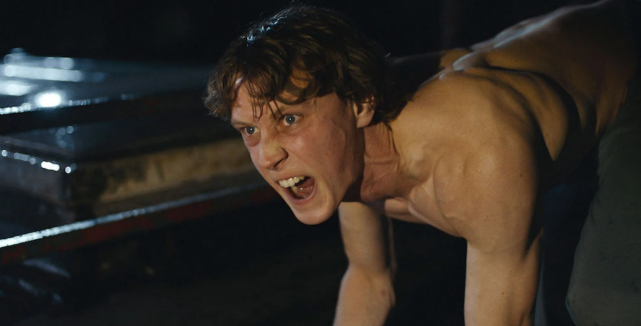
It is really hard for us to discern what kind of point “Wolf” is actually trying to make. Mainly in set in a special psychiatric facility for mental patients who think they are animals trapped inside human body, the movie merely presents one disturbing moment after another from both sides, and we become more aware of its superficial aspects in terms of story and characters.
At the beginning, we are introduced to a lad named Jacob (George MacKay), who, as reflected by the opening scene where he moves alone inside a forest while being completely naked, thinks he is a wolf. Knowing well that he has a “problem”, he subsequently lets his parents accompany him to a mental hospital for patients who are suffering “species dysphoria” just like him, and we soon him beginning his first day at this mental hospital and then getting introduced to several other patients.
Under the benevolent but occasionally strict care from Dr. Mann (Paddy Considine) and his staff members, Jacob and other patients in the mental hospital are often forced to face each own delusion in one way or another. In case of a girl who believes she is a parrot, she has been allowed to wear a bird attire as desired, but we later see how cruelly she is reminded of the undeniable fact that she cannot fly at all as a, well, human being.
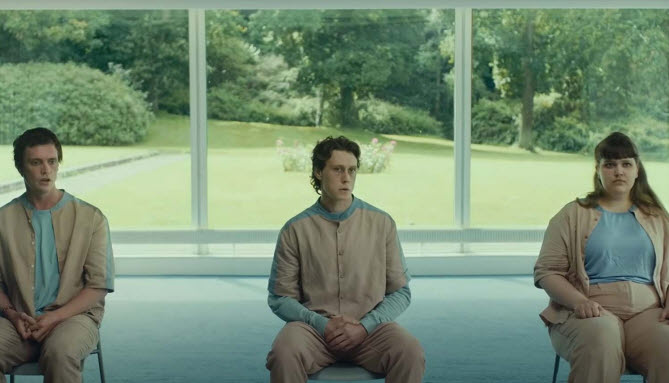
It looks like all Jacob will have to do is obeying to whatever is expected from him while often admitting that he is not a wolf at all, but, not so surprisingly, that is not so easy for him from the very beginning. He sometimes cannot help but behave like a wolf whenever nobody is watching, and then he later gets himself closely associated with a young woman named Cecile, who incidentally thinks she is a wildcat. After having an accidental nocturnal encounter between them, Jacob and Cecile get to know each other more as spending more time together, and we come to gather how things have been desperate for Cecile. While most of the patients in the mental hospital can leave anytime once they get cured, Cecile does not have anyone to take her out of the mental hospital, and it later turns out that she has been stuck there for years due to one of the staff members, who has been virtually a controlling mother figure to her.
And we continue to observe what Jacob and other patients have to endure everyday. They frequently watch the video clips emphasizing how human being is superior to animals in many aspects, and some of them actually seem to show some progress as behaving more like human beings instead of animals. As a matter of fact, the mental hospital even has a “graduation” ceremony for those cured patients to leave.
Of course, Jacob gradually comes to see more of what a cruel and harsh place the mental hospital to him and other patients. Dr. Mann, who is naturally nicknamed “Zookeeper”, does not hesitate to use a number of extreme tactics if that is deemed necessary in his viewpoint, and there is a hurtful moment when he sadistically demands one of his patients to climb a tree like a real squirrel before that patient gets some serious injury as a consequence.
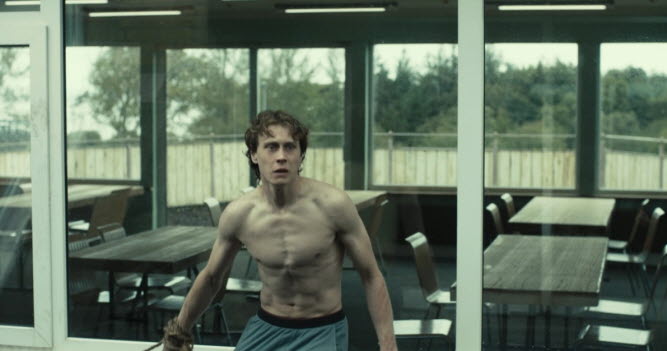
Around that narrative point, the story feels more like a metaphor on those toxic facilities for “curing” LGBTQ people, and it looks like we are supposed to side more with Jacob and other patient characters, but the screenplay by director/writer Nathalie Biancheri adamantly sticks to its detached position without giving much substance to the story and characters. Yes, we are certainly repulsed by those “therapeutic” methods of Dr. Mann and his staff at times, but we are also distant to the “madness” of Jacob and other patient characters. Sure, it may be better to let them be themselves outside, but their behaviors sometimes look quite pathological, and we come to have more doubt on their mental conditions while not caring that much about them.
At least, we can appreciate the considerable professional commitment observed from George MacKay, Lily-Rose Depp, and several other main cast members in the film. MacKay is particularly good whenever he embodies the deeply troubled aspects of his character, and he and Depp are fearless during a key scene where their characters shoe more of their animalistic sides to each other. On the opposite, Paddy Considine is quietly intense behind his unflappable façade, and he has a very unnerving moment later in the film when his character must show his patients who the boss is.
On the whole, “Wolf”, which is currently available in Netflix in South Korea, has an intriguing story promise to draw our attention, but the result is too murky and confused to our dissatisfaction. Under Bicnaheri’s competent direction, the main cast members surely did their best, but the movie still feels tediously solemn and shallow without leaving much impression, and you may wonder whether it needed some extra humor and substance for reaching to the level of Yorgos Lanthimos’ notable psychological drama film “Dogtooth” (2009), which did a much engaging job of pushing the weird madness of its main characters to the end without any compromise. Although I was not quite enthusiastic about “Dogtooth” at that time, I still vividly remember many of its truly twisted moments even after more than 10 years, so you should probably check out that deeply uncomfortable but oddly fascinating movie instead.