Sleep (2023) ☆☆☆(3/4): Her husband’s disturbing sleeping problem

South Korean film “Sleep” seems to be a certain kind of story and then ends up becoming something much different. This is an odd mix of horror thriller and black comedy swinging back and forth somewhere between “The Exorcist” (1973) and “Repulsion” (1965), and I appreciated this interesting genre hybrid even though I often observed its story and characters from the distance while being more aware of its plot mechanism.

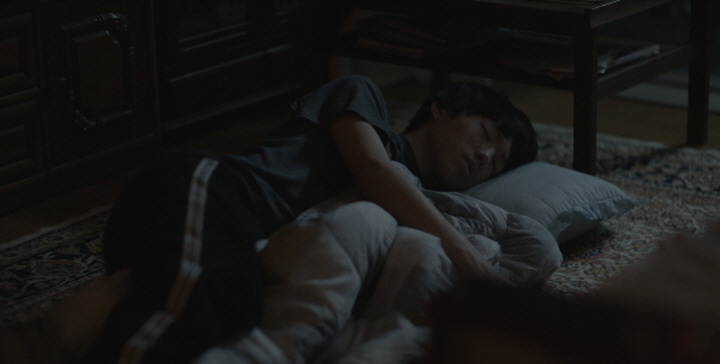
The movie begins with the disturbing opening scene showing how something weird begins to happen for Soo-jin (Jung Yu-mi) and her husband Hyeon-soo (Lee Sun-kyun) in the middle of one night. She happens to see husband going through a sort of sleepwalking, and then she is more disturbed as things go bump in their little apartment no apparent reason. While she looks around here and there in the apartment, the movie naturally dials up the level of suspension and dread, and we accordingly get a nice variation of a certain genre cliché around the end of the scene.

However, Hyeon-soo does not remember anything about what happened to him at last night, and Soo-jin becomes more baffled and concerned as Hyeon-soo continues to show a series of peculiar sleepwalking behaviors. At one point, he suddenly seems to be so hungry that he devours a number of raw stuffs in the refrigerator, but, again, he has no memory about that at all, and that certainly unnerves Soo-jin more to say the least.

After Hyeon-soo almost gets himself killed later due to his ongoing sleep problem, he and his wife eventually go to a clinic for finding what is really happening to Hyeon-soo. The doctor is willing to help them as much as possible in addition to giving some advice in addition to prescribing a drug for Hyeon-soo, but that does not satisfy Soo-jin much. As things do not get better for her and her husband at all, she worries more while also coming to sleep less than before, and she has a good reason for that. She is currently going through the later stage of her pregnancy, and endangering her baby is surely the last thing she wants.

However, no matter how much she tries in one way or another, it seems that there is not any sensible way to solve their little domestic problem. When her mother drops by the apartment along with a shaman later in the story, the shaman ominously warns to Soo-jin and her husband that there is a ghost in the apartment, and that seems more possible to Soo-jin as she struggles more with her increasingly frustrating situation day by day. Is it possible that there is actually a ghost somewhere in the apartment? Is it really true that the ghost has some insidious purpose behind its frequent haunting of Soo-jin’s apartment?

As Soo-jin’s state of mind gets more troubled by this frightening possibility, the movie doles out more disturbing moments coupled with some dark sense of humor. Some of them may make you wince for good reasons, but the movie thankfully presents these scenes with enough skill and restraint at least, and you may actually be amused a bit by one particular scene which may take you back to that infamous moment in “Fatal Attraction” (1987).

Maybe she should have distanced herself from her husband from the very beginning, but Soo-jin lets herself stuck with her husband just because of her firm belief in marriage, and she becomes more obsessed with solving their domestic problem. Not so surprisingly, there eventually comes the breaking point for her, and that is where the movie becomes more ambiguous about what is actually going on around her.

Around that narrative point, director/writer Jason Yu’s screenplay puts more distance between us and its heroine, but the movie still holds our attention nonetheless thanks to Yu’s competent direction. As cinematographer Kim Tae-soo frequently stays around its two main characters in their supposedly cozy domestic environment, a sense of isolation around them feels more palpable along the story, and that is further accentuated by Soo-jin’s several absurdly drastic measures against her husband’s sleep problem. When their apartment is turned into something quite different around the end of the story, we are quite surprised at first, but we also see the inevitability of this sudden change, and we come to brace ourselves as its main characters are driven further into their extreme circumstance.

The movie depends a lot on its two lead performers, who show considerable commitment as their respective characters swirl around each other from one end to the other. While Jung Yu-mi does a good job of embodying her character’s gradual emotional disturbance along the story, Lee Sun-kyun steadily functions as her solid counterpart throughout the film, and Kim Gook-hee provides a bit of cheerfulness at the fringe of the story as one of the neighbors in the apartment building.

On the whole, “Sleep” is a well-made genre flick to be admired for its commendable technical aspects, and Yu, who previously worked as the assistant director Bong Joon-ho’s “Okja” (2017), demonstrates his considerable filmmaking skills here. Although this is his first feature film, he clearly knows how to engage and entertain us, and it will be interesting to watch whatever will come next from him in the future.

Posted in Movies | Tagged , , , , , | 2 Comments

Joy Ride (2023) ☆☆☆(3/4): Asian Girls Trip

The arrival of “Joy Ride” is sort of inevitable in my trivial opinion. After boys had all those raunchy funs in numerous R-rated comedy films such as “Superbad” (2007) and “The Hangover” (2009) during last two decades, girls also went all the way for adult comic materials as shown in a number of recent female comedy films such as “Girls Trip” (2017), and now it is young Asian ladies’ turn for throwing themselves into anything for shock and laugh.

The movie opens with the prologue scene establishing the relationship between it two different Asian female characters: Audrey Sullivan (Ashley Park) and Lolo Chen (Sherry Cola). When young Lolo moved to a suburban neighborhood of Seattle, Washington along with her Chinese immigrant parents, she felt rather isolated because of their race, but, what do you know, there soon came young Audrey, who was incidentally adopted by her Caucasian foster parents a few years ago. Although their first encounter was rather awkward, Audrey and Lolo quickly befriended each other, and the following montage scene shows their developing friendship during next several years.

As your average Asian American overachiever not so different from when I was young and wild for better grades, Aubrey subsequently becomes a promising young lawyer, but Lolo has been relatively less successful as an aspiring artist who wants to pursue more her own artistic vision involved, uh, body positivity. As a matter of fact, she has been lived at Audrey’s residence for several years because she does not have to pay rent, and Audrey does not mind at all as her best female friend.

On one day, Aubrey is assigned to handle a very important business deal in China. Mainly because she cannot speak Mandarin well, Lolo comes to accompany her as her unofficial translator, and Lolo also invites her eccentric cousin Deadeye (Sabrina Wu) to join them later. Aubrey is naturally not so pleased about that, but she is going to join her old college friend Kat (Stephanie Hsu) in Beijing, China anyway, so she does not object to that.

Once these four young ladies gather together, the movie embarks on throwing lots of raunchy comic moments which will often make you cringe while also generating some good laughs. At a fancy nightclub where she meets and then tries to convince a certain Chinese business to accept that deal, Aubrey comes to have a much wilder night than she has ever imagined, and we are served with a couple of amusingly embarrassing moments involved with her body’s rather sensitive response to alcohol.

Meanwhile, for making her friend look good in front of that Chinese businessman, Lolo happens to lie a bit about Aubrey’s biological mother, so Aubrey and her friends start a journey for meeting her biological mother. After all, there is enough information for locating her biological mother who seems to be living somewhere in a local city outside Bejing, and all they will have to do next is going to that city, which is incidentally where many of Lolo and Deadeye’s family members reside.

Of course, their following journey turns out to be much bumpier than they thought. There is a hysterical moment involved with a seemingly nice American girl they happen to encounter on a train, and then there comes a comically sexual sequence involved with a certain real-life American basketball player and several other players in his group, one of whom turns out to have a little past between him and Kat. As a promising actress who has tried to be discreet and exemplar just like Aubrey despite her wild college days, Kat surely becomes nervous to say the least, and that leads to one big hilarious moment to remember.

After it reaches to its highpoint where our young ladies do an impromptu K-POP performance for going to Seoul, South Korea for a reason I will not reveal here, the screenplay by co-producers Cherry Chevapravatdumrongb and Teresa Hsiao, which is based on the story written by them and director/co-producer Adele Lim, comes to lose some of its comic momentum as the mood predictably becomes a bit more serious than before. More conflict among Aubrey and her friends follows as expected, but the movie thankfully does not lose its sense of humor even at this point, and we keep cheering for all of its four main characters as before.

It surely helps that the movie is constantly buoyed by the good comic chemistry among its four main cast members. While Stephanie Hsu, who was recently Oscar-nominated for her superlative breakout turn in “Everything Everywhere All At Once” (2022), is the most prominent one in the bunch, Ashley Park and Sherry Cola steadily hold the center of the film as their contrasting characters pull and push each other throughout the story, non-binary actor Sabrina Wu has their own moments to shine with their straightforward deadpan appearance.

Like “Crazy Rich Asians”, (2018), “Joy Ride” brings some fresh air of racial diversity to its familiar genre territory, and it is also fairly enjoyable thanks to its unabashedly raunchy comic moments which tickled and amused me enough even while I winced a lot for understandable reasons during my viewing. Yes, it is rather refreshing to see Asian female characters boldly and actively going forward for their sexual desire, and I can assure you that the movie will not disappoint you at all in that aspect.

Posted in Movies | Tagged , , | Leave a comment

Bad Axe (2022) ☆☆☆1/2(3.5/4): An Asian Immigrant family in the time of COVID-19

Documentary film “Bad Axe” presents an intimate personal portrayal of one Asian immigrant family struggling to live and run their little business during the COVID-19 pandemic. While it is heartening to see how this family strenuously stick together for enduring that gloomy period, it is also often disturbing to observe occasional moments of racism and prejudice against them, and you will come to reflect more on how the American society has shown more of its deplorable aspects during last several years.

The story of the documentary is unfolded mainly via the camera of director/co-producer/cinematographer David Siev, who happened to come back to his little rural hometown, Bad Axe of Michigan, shortly before the whole country went into the lockdown period in early 2020. His camera closely follows his several family members including his parents, and it shows how things were quite hard and difficult for them during that time. Although the situation was relatively less dire for them and many others in their little town compared to many big cities in US, their small restaurant business was certainly struck hard by the ongoing COVID-19 pandemic, and it became quite possible that they had to shut down the restaurant for an indefinite time.

Nevertheless, David’s parents, Chun and Rachel, did not give up at all, and neither did David’s two sisters Jaclyn and Raquel. David and his two sisters still remember when their parents struggled a lot for settling in the town in the late 1990s, and Jaclyn and Raquel were willing to help their parents’ restaurant business as much as possible. While Jaclyn handled those business matters, Raquel busily cooked in the kitchen, and it looked like they and their parents could still run the restaurant even as the pandemic continued to threaten the country and its people more and more.

To Chun, his and his family’s struggle with the pandemic was just another big obstacle to confront. He was a young Cambodian refugee who managed to survive the Killing Fields period in Cambodia along with his mother and several siblings, and he is certainly proud of realizing his own small American dream. Besides running a solid family restaurant of his own, he and his wife Rachel, who is incidentally a Mexican American, has had a steady and loving relationship between them, and they certainly appreciate their dear children’s efforts for maintaining their precious restaurant.

However, as the family kept struggling to make ends meet, the American society got more disturbed by not only the pandemic and the increasing racial tension associated with it. As President Donald J. Trump irresponsibly caused more racism against not only Asian citizens but also many other colored people in US, Chun and his family could not help but more disturbed at times, and his children naturally came to pay more attention to the Black Lives Matter movement.

When a Black Lives Matter protest was held in the middle of the town, David and his two sisters surely joined the protest, and that was where they came to see how ugly and deplorable some of their mostly conservative neighbors could be. Shortly after they and a bunch of other protesters began their march, they confronted several armed (and masked) white supremacists, and, not so surprisingly, the local police did not do anything about that.

The circumstance became more unnerving when Chun and his family found their life and business threatened in one way or another. When one of David’s sisters showed more of her political opinion on the Internet, some nasty people called to the restaurant, and we also see several rude white people willfully refusing to wear mask inside the restaurant. In addition, some of those white supremacists seemed ready to target the family, and Chun willingly shows his daughters how to handle firearms at one point later in the documentary.

In case of David, he came to discern that he could not be totally distant to what he had closely recorded. He initially began his documentary project as a love letter to his hometown, but, as his promotional trailer for fund-raising drew some vicious responses on the Internet, he started to consider shifting the focus of his documentary more to the immigrant experience of his family. Besides vividly capturing those good and bad times among his family members, he also places himself right in front of the camera, and he tries to be as candid as possible about his personal thoughts and feelings.

After the pandemic eventually passed its peak, things got a bit better for David and his family. While they still had to be careful about social distancing, their restaurant slowly got back in business, and they also received lots of support from many residents of Bad Axe. They were certainly relieved and delighted when that orange-faced phony failed to get re-elected in the 2020 US Presidential election, but I must confess that I observed this feel-good moment with some worry and skepticism because of how that detestable scumbag may actually return to the White House in 2025.

In conclusion, “Bad Axe” is compelling as a vivid and touching slice of Asian American immigrant life in the middle of American heartland, and Siev, who received the Audience award in addition to Special Jury Recognition when the documentary was shown at the SXSW Film Festival early in last year (It was also included in the shortlist for Best Documentary Oscar early in this year, by the way), handles his personal subject with lots of care and respect. In short, this is one of the better documentaries of last year, and it surely deserves your attention as a empathetic window to others different from you.

Posted in Movies | Tagged , , , , , , , | Leave a comment

It Ain’t Over (2022) ☆☆☆1/2(3.5/4): Inside Yogi Berra

To be frank with you, I only vaguely heard a bit about Yogi Berra once before watching documentary film “It Ain’t Over”. Berra was a legendary baseball player mostly known for his rather humorous quotes, and the documentary shows that he was much more than that, and I found the documentary quite informative and engaging despite being a nerdy South Korean dude who does not have much interest in any sports, let alone baseball.

After the prologue part showing Berra somehow overlooked in the 2015 national poll for the greatest living baseball players in US, the documentary immediately goes back to his early years. He was born to a poor Italian immigrant family living in St. Louis, Missouri, and he already showed considerable potential as an athlete even when he was very young. In 1942, he eventually entered the Minor League as a new rookie to watch, but then he willingly joined the US Army as the country belatedly went into the World War II, and he actually participated in the Normandy Landings in 1944.

Shortly after the war was over, Berra went back to the Minor League as playing for the New York Yankees, and it did not take much time for him to rise to the Major League as he quickly became quite prominent as a skillful batter. Mainly due to his rather plain attitude and appearance, he also drew lots of attention for being a sort of oddball among his more prominent fellow team members including, yes, Joe DiMaggio, and the documentary shows us how much he was caricatured in public even during that time.

However, Berra did not give much damn about that as going his way as usual, and he gradually became someone who did a lot more than being an endearing mascot of his team. Under his new team manager who was quite strict and demanding to say the least, he trained himself a lot for playing as a catcher, and his team members came to depend more on him on the field before. Any good catcher was supposed to be constantly aware of lots of elements on the field besides those balls to catch, and Berra’s considerable experience as a catcher later helped him move onto the next step of his professional career.

Even as his popularity went up and up, Berra remained humble and casual as he was before. When the Brooklyn Dodgers, which could have Berra in 1942 if its team president handled the situation more honestly, had Jackie Robinson as the first African American Major League player, Berra did not hesitate to welcome Robinson even though they were going to play against each other as much as possible. As a matter of fact, they later had one unforgettable moment to remember on the field, and that was actually one of a few times when Berra happened to lose his usual laid-back attitude. He often insisted during the rest of his life that the umpire made a wrong judgment at that moment, though, as far as I can see, Robinson did arrive at the spot right before Berra caught the ball.

Around the early 1960s, Berra came to see that he was not young enough to play on the field, and he subsequently became the new manager of the New York Yankees in 1963. His first several years as a team manager had a fair share of ups and downs, and then he unfortunately got fired, but he quickly moved to the New York Mets. Although nobody expected that much from this, Berra surprised everyone as making the New York Mets have much more victories than expected, and that was the main reason why the New York Yankees eventually brought him back later.

Next several years was another career highlight for Berra, but this glorious period was unfortunately ended with a very bitter moment. In 1985, he was callously fired by the team owner, and that certainly hurt his feeling a lot. In fact, he swore that he would not be associated with the New York Yankees at any chance, and he stuck to his pledge until he came to have a moment of reconciliation with the team owner in public around 15 years later.

Meanwhile, Berra’s public image grew more as usual. He often appeared in a number of commercials, and his amiable appearance was certainly crucial in the success of these commercials. Furthermore, his jolly persona also inspired a certain classic TV animation series I often watched when I was a kid (My little musing: “So that was the reason why his name felt so familiar to me at first….”).

The documentary sprinkles several amusing quotes from Berra along its narrative, and I must say that, as many interviewees in the documentary in the film ranging from Derek Jeter to Billy Crystal agree, these quotes are not merely funny but actually quite meaningful in plain sight. One of the most famous sayings of his is “It ain’t over ‘til it’s over”, and this rather silly quote really tells much about his attitude about his life and career. After all, he surely went on and on for fully living his life until it was really over for him, and that will make you admire him more as a wise and decent human being.

Overall, “It Ain’t Over” is a loving and insightful tribute to Berra’s life and career, and director/writer Sean Mullin did a commendable job of juggling various archival records and interview clips. Berra was indeed one of the greatest figures in the American baseball history, and some of those plain but undeniably wise quotes of his may stay in your mind for a while after you watch this wonderful documentary.

Posted in Movies | Tagged , , , , | 1 Comment

You Are So Not Invited to My Bat Mitzvah (2023) ☆☆☆(3/4): A mildly pleasant product from the Sandler family

Probably because I am a South Korean nerd who was mostly occupied with getting good grades except when reading a book or watching a movie, many of American coming-of-age drama or comedy films feel like alien stories from very different worlds, and recent Netflix film “You Are So Not Invited to My Bat Mitzvah” is no exception. While this is another typical adolescent tales of many ups and downs, it comes with a specific cultural background to observe, and it is also quite surprising considering that it is actually another Netflix product produced by Adam Sandler.

Here in this film, Sandler often willingly steps aside for his several family members to shine. As the young Jewish heroine of the film, his daughter Sunny Sandler gives a spirited performance which may lead her to more interesting stuffs in the future, and her older sister Sadie Sandler is also effective as the heroine’s wise-cracking older sister. As Sandler steadily holds the ground along with Idina Menzel as the heroine’s parents, Sandler’s wife Jackie Sandler plays the mother of the heroine’s best female friend, and ever-reliable character actor Luis Guzmán plays her converted Latino husband.

Oh, I forget to tell that, as reflected by the very title of the movie, the story mainly revolves around the upcoming Bat Mitzvah ceremony of Stacy (Sunny Sandler) and her best female friend Lydia (Samantha Lorraine). As watching how many of their schoolmates having each own fancy Bat Mitzvah one by one, both Stacy and Lydia are more determined to have each own Bat Mitzvah of lifetime, and Stacy even does a presentation on her ambitious Bat Mitzvah plan in front of her parents, who naturally tell her that she should be more realistic about her Bat Mitzvah.

Anyway, everything mostly seems to be going fairly well for Stacy and Lydia. While Lydia gladly helps Stacy on her Bat Mitzvah speech, Stacy works on a video to be played at Lydia’s Bat Mitzvah party, and they are quite hopeful about their big bright future after their respective Bat Mitzvah ceremonies. After all, who cannot possibly be excited about officially entering adulthood?

However, of course, the situation becomes rather tricky between Stacy and Lydia because of a handsome boy who has been Stacy’s longtime crush. Once she happens to draw a bit of attention from him, Stacy naturally wants to attract him more, and that leads to when she attempts one risky act when many others including him is watching her. As advised by Lydia, she could just stop at any point, but she did that in the end anyway, and, despite fortunately not getting hurt at all, she accidentally gets herself humiliated in front of others for a different reason. Quite angry and frustrated about this, Stacy comes to clash more with Lydia, and their conflict goes further when Stacy later happens to witness something going on between Lydia and that boy.

Around that narrative point, you can easily see where the story is heading, but the screenplay by Alison Peck, which is based on the young adult novel of the same name by Fiona Rosenbloom, takes some time for more character development along the story. While often making the circumstance messier due to her several unwise choices including the one represented by the title of the movie, Stacy also tries to fix the resulting problems as much as possible, and she and the movie surely earn the little poignancy shown around the end of the story.

In addition, Peck’s screenplay pays considerable attention to a bunch of supporting figures surrounding Stacy. Although many of them are no more than broad caricatures, the screenplay fills them with engaging personalities, and they also become more likable than expected in each own way. For instance, a rabbi schoolteacher played by Sarah Sherman feels a bit too cartoonish at first, but she turns out to be more understanding and caring than expected, and Sherman somehow makes her wacky character rather endearing instead of totally distracting.

In case of the relationship development between Stacy and Lydia, its dynamic course over the narrative of the film is believable, and Sunny Sandler and Samantha Lorraine are effortless as their characters’ relationship sways in one direction or another. As both of their characters cope with their complicated matters of heart, Sandler and Lorraine convey well to us their characters’ gradual growth along the plot, and we come to care more about their relationship than before.

Around these two young promising actresses, Adam Sandler and several other adult notable adult cast members dutifully occupy their respective spots without overshadowing them at all. Sandler shows a bit softer side of his screen persona as a no-nonsense father who sometimes shows some tough love to his dear daughter, and it is also a little amusing to see he and Menzel in a marital relationship completely different from the one they played in the Safdie Brothers’ intense comedy thriller film “Uncut Gems” (2019).

On the whole, “You Are So Not Invited to My Bat Mitzvah” does not break any particular new ground in its genre territory, but it is probably the best thing coming from the partnership between Sandler and Netflix during last several years. Besides having shown more serious sides of his acting talent these days, Sandler also seems to show some maturation as a producer, and I sincerely hope that he will make bad comedy films less frequently than before.

Posted in Movies | Tagged , , , , , | Leave a comment

Violent Night (2022) ☆☆(2/4): An insipidly violent Christmas flick

“Violent Night”, which is currently available on Netflix in South Korea, wants to be a viciously and violently funny Christmas flick, and I do not mind that, but, boy, what an insipid piece of work it is. While its one-joke comic premise may be amusing to you for a while, this utterly joyless movie soon becomes quite stale and tedious amidst lots of merely mean violent moments, and my mind kept thinking of a number of better alternatives to be watched around the end of this year.

The story promise is very simple: Santa Claus as a killing machine against some bad guys out there. The bad guys in the film are a bunch of mean criminals who invade a big mansion in the middle of some isolated snowy area on Christmas Eve, and they soon hold its very rich owner and her family as hostages as a part of their vicious criminal plan. When Santa, played by David Harbour, later drops by the mansion for giving the present for a little sweet girl who is one of the hostages, he surely gets involved into the situation more than he wants, and he comes to demonstrate his old particular set of skills.

It would be more shocking and amusing if Santa were a seemingly mild and gentle figure, but the movie does not hide its bitter viciousness at all right from the opening scene showing Santa being as depressed and drunk as Billy Bob Thornton’s anti-hero character in “Bad Santa” (2003). He morosely complains a lot about how people have been quite disappointing to him these days, and that makes me wonder how he managed to keep working during last several centuries of the human history, which surely had a lot of much worse things to depress him.

Around the time when Santa flies to the aforementioned mansion despite quite drunk, we are introduced to a number of other characters who happen to have a Christmas family meeting there, and many of them are quite despicable to say the least. The owner of the mansion is a domineering matriarch who does not hesitate to use dirty words in front of her little granddaughter, but her family members do not say much mainly because of her immense wealth, and only her granddaughter is willing to enjoy Christmas sincerely in contrast to many others around her.

When this little girl is about to go to bed as expecting a nice present to receive in the next morning, those bad guys swiftly hold the mansion under control, and then there comes their boss. This dude, played by John Leguizamo, turns out to have been quite spiteful about Christmas, and, for his little twisted amusement, he even gives his underlings silly alias associated with Christmas (One of them is called “Gingerbread”, for example).

As watching the bad guys trying to break into the underground safe while holding several hostages, my mind was instantly reminded of, yes, “Die Hard” (1988). After he comes across one of the bad guys and then happens to kill that bad guy during the following fight, Santa becomes a reluctant hero to save the day just like Bruce Willis’ character in that classic action thriller film, and you may have a déjà vu when he has a private conversation scene with that little girl via walkie talkies in the middle of the story.

In case of that little girl, played by young Leah Brady, she cannot help but excited a bit as she gets a chance to do something not so far from, surprise, “Home Alone” (1990), and what she does next should not be imitated by many young kids out there. Although her little booby traps are not as elaborate as the ones devised by that little boy in “Home Alone”, they result in some violent and bloody moments which will definitely remind you that the movie is not exactly ideal for your Christmas family meeting.

All these and many other mean and violent moments could be acceptable if they were accompanied with enough wit, style, and substance, but the movie unfortunately does not have any of them. While many of its supposedly comic moments are flat and bland without much laugh for us, those violent action scenes in the film are curiously tepid despite occasionally making you cringe or wince for good reasons, and, above all, it is quite deficient in terms of story and character. As the story slouches toward its expecting ending without much narrative momentum, we become more distant to its characters who are no more than cardboard characters to be killed or threatened, and it is really disheartening to see its cast members struggling to sell their boring and uninteresting characters as much as possible.

In case of Harbour, he has some fun with his character’s gruff personality while being a sort of saving grace of the film, but it is still a shame that he is not allowed to do anything as funny and vicious as whatever Thornton did in “Bad Santa”. While the other main cast members including Leguizamo and Brady are thoroughly wasted, Beverly D’Angelo manages to leave some impression even though she often seems bored about whatever is going on around her.

“Violent Night” is directed by Tommy Wirkola, a Norwegian filmmaker who previous made “Dead Snow” (2009) and its 2014 sequel film. Both of these snowy and gory horror comedy films are a little too flawed in my inconsequential opinion, but they are relatively more enjoyable compared to the disappointing incompetence of “Violent Night”, and maybe you should watch them or several aforementioned films instead during the upcoming winter season.

Posted in Movies | Tagged , , , | Leave a comment

The Meddler (2015) ☆☆☆(3/4): What’s next for her life?

Lorene Scafaria’s “The Meddler”, which is currently available on Netflix in South Korea, is a likable comedy drama about one middle-aged lady trying to figure out what is next for her life. As she interacts with a number of people around her along the story, the movie cheerfully goes back and forth between comedy and drama, and it is often energized by the enduring presence and talent of its lead actress.

Susan Sarandon, who gives one of her best performances during last 20 years in this film, is Marnie Minervini, a middle-aged widow who recently moved from New York City to LA after her rich husband’s death mainly because her daughter Lori (Rose Byrne) is living there. As your average wealthy widow with so much money but so little to do for now, Marnie usually pays lots of attention to Lori, but Lori does not welcome this much as mostly occupied with her current personal/professional struggle.

In addition, Marnie also gets herself involved with the lives of some other people because, well, she really cares about them and wants to help them as much as she can. When one of Lori’s friends happens to have a baby shower party, she attends the party instead of her daughter. When a lesbian friend of Kori’s friends laments about not having a big wedding ceremony with her wife, Marnie does not hesitate to plan and finance the wedding ceremony for her and her wife simply because she can afford to do that. In case of a young black guy she happens to befriend at an Apple store where he works, she gives him lots of support and encouragement in exchange for helping her bit on handling her new iPhone, and he eventually decides to be more active about what he is going to do with his life.

However, Marine’s relationship with Lori remains rather strained as usual. She just wants to help and support Lori more, but she is only reminded of how she often does not understand her daughter much. For example, she suggests that her daughter should try to start again with her ex-boyfriend, but that is the last thing Lori wants for now, and she also becomes more occupied with the story development of the pilot episode of a possible TV series.

Marnie even goes to Lori’s therapist for understanding her daughter more, but, of course, the therapist does not tell anything about whatever was exchanged between her and Lori. Instead, she asks Marnie about her feelings about her recent personal loss from her husband’s death, and it is apparent that there is something not entirely resolved yet for her even though she feels ready to move forward.

When her daughter later goes to New York City due to the shooting of that TV pilot episode, Marnie becomes more occupied with paying attention to others around her. While she keeps preparing the upcoming wedding ceremony for the aforementioned lesbian couple, she also takes care of a sick old lady at a local hospital where she works as a volunteer, and she also often takes that young black man to a college where he begins to study.

And then there comes an unexpected opportunity of new romance via Randall Zipper (J.K. Simmons), a retired police officer she happens to encounter not long after she accidentally gets hired as an extra on a movie set. When they meet again, something seems to click between them although she is not exactly in good condition for an understandable reason, and he willingly shows her more of himself and his life, but she wonders whether she is really ready for the second romance in her life.

Without leaning too much toward drama or comedy, Scafaria’s screenplay bounces from one episodic moment to another for more character development, and not only Marnie but also several other characters around her come to us real human characters to observe. While Marnie is basically your typical rich white lady, we come to like her more than expected as she shows more heart and common sense along the story, and the movie also imbues its several supporting characters with enough life and personality, though a subplot involved with that young black man feels rather under-developed (At least, you may enjoy watching Jerrod Carmichael when he was less prominent than now).

Above all, Sarandon keeps holding the center of the film even when it seems to meander from time to time. Although her prime period mainly represented by five Oscar nominations and one Oscar win has passed, Sarandon is still a wonderful actress as recently shown from her Emmy-nominated performance in TV miniseries “Feud”, and she ably balances her character between humor and poignancy without any cheap laugh or sentimentality. Around her, Rose Byrne and J.K. Simmons, who has been one of ever-dependable character actors in Hollywood during last 20 years, have each own moment to shine, and Byrne is especially good during a funny and touching scene between her and Sarandon later in the film.

On the whole, “The Meddler” is a little gem too good to be forgotten in obscurity mainly due to Sarandon’s funny and charming performance. To be frank with you, I saw a lot of my own mother from her character, and now I wonder whether I will get much more calls from her if she happens to be widowed someday. She still denies my homosexuality, but she cares about me nonetheless, and maybe I should be a bit more considerate later.

Posted in Movies | Tagged , | Leave a comment

Her Hobby (2023) ☆☆☆(3/4): How they bond together

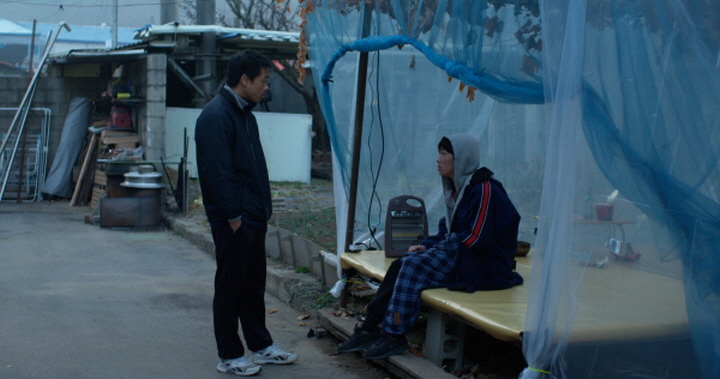
South Korean film “Her Hobby” is a little country noir thriller revolving around one unlikely solidarity between two very different women. As one gets empowered thanks to some help and encouragement from the other, the movie gradually reveals the seedy and deplorable sides of their country village neighbors around them, and we get chilled at times as observing how these two women come to drastic measures for taking care of some personal matters.

At first, the story is unfolded mainly via the viewpoint of Jeong-in (Jung Yi-seo), a young divorce woman who came to her little rural hometown village some time ago. She has lived in her grandmother’s house, but her grandmother, who feebly but wholeheartedly welcomed her granddaughter into her house, recently passed away, and now she is the only one living in the house. While quite feeling alone, she is frequently annoyed by those busybody neighbors in the village who often willfully come into the house without any notice in advance, but she has to tolerate them because 1) she has to work for them for earning her meager living day by day and 2) she has nowhere else to go above all.

As Jeong-in is working as usual on another summer day, there comes a little change in the village. Some young woman from Seoul moves into a big house right above Jeong-in’s house, and everyone in the village is naturally curious about who this new neighbor is. All they can know about her is that she is pretty affluent as reflected by her clothes and some other expensive stuffs belonging to her, and they are not so pleased when she turns out to be quite haughty and confident without being not so friendly.

As this mysterious woman’s neighbor, Jeong-in also cannot help but curious about her, and, of course, they eventually come across each other under a rather awkward situation. To Jeong-in’s little surprise, Hye-jeong (Kim Hye-na) shows some generous care and consideration to Jeong-in, and, what do you know, Jeong-in gradually finds herself interacting more with Hye-jeong. Despite being often elusive as usual, Hye-jeong gladly shows more of herself to Jeong-in, and Jeong-in surely appreciates that because nobody in village has been that nice to her except the young South Asian wife of one of her neighbors.

Meanwhile, we see more of the ugly and deplorable sides from many of those village people. There is a despicable young delivery guy who turns out to be more problematic but has been tolerated by many of village people just because he is, well, one of them. There is also a middle-aged man who has been very mean and rude to Jeong-in, and we are not so surprised to learn that this detestable dude is the main reason why Jeong-in always sleeps with a certain sharp object right next to her at every night. When it is later revealed that Jeong-in’s grandmother saved a considerable amount of money for her granddaughter, many of village people attempt to meddle more with Jeong-in for utterly selfish reasons, and this consequently leads to the realization of her worst fear.

Now I should be more discreet about detailing how the screenplay by Lee Yong-yeong, which is based on the short story of the same name by Seo Mi-ae, unfolds its darkness step by step. As Hye-jeong advises her that she should consider herself and her life above all else, Jeong-in slowly becomes more motivated to confront her increasingly tricky circumstance, and that results in some deadly consequences as expected.

Watching Jeong-in’s disturbing inner transformation along the story, I was reminded of “Bedevilled” (2010), another disturbing South Korean film about the loathsome human evil inside a remote rural town and the following wrathful retribution from a woman who has been abused and exploited for years. Although “Her Hobby” is less violent and more restrained in comparison, it has a fair share of vengeful anger under the surface, and that is evident when Jeong-in shows cold rage and contempt to a certain figure later in the story. While not admitting anything at all, she indirectly conveys to that figure in question what she did for her belated revenge, and that figure certainly gets what she implies between her phlegmatic but undeniably spiteful words.

The movie depends a lot on the quiet but palpable intensity emanating from Jung Yi-seo, who has been more notable since her brief appearance in Bong Joon-ho’s Oscar-winning film “Parasite” (2019). Even when she does not say at all, we can feel Jeong-in’s suppressed torment and anger behind her weary detachment, and that is the main reason why the last act of the film works with considerable dramatic catharsis around the screen. On the opposite, Kim Hye-na ably complements her co-star in addition to filling her relatively less developed role with enough presence and allure, and she is fun to watch whenever her character subtly encourages Jeong-in to be more, uh, active in taking care of her impending troubles.

Overall, “Her Hobby”, directed by Ha Myeong-mi, is engaging mainly thanks to the fascinating relationship development between its two main characters as well as the solid duo performance behind it, and that is more enough for compensating for several notable weaknesses including the rather slow narrative pacing during its first half. Although it is one or two steps behind the harrowingly bloody aria of vengeance in “Bedevilled”, the movie serves its own dishes of revenge fairly well on the whole, so I will not grumble for now.

Posted in Movies | Tagged , , , , , | Leave a comment

Captain Volkonogov Escaped (2021) ☆☆☆(3/4): Escaping for redemption

“Captain Vokonogov Escaped” sounds like your typical war thriller flick, but it reaches for something else instead, and that is interesting in my humble opinion. Following its plain military officer hero’s desperate attempt toward redemption and some peace, the movie dryly but sharply conveys to us the sheer horror and absurdity surrounding him and many other people, and it keeps us engaged even when its story is arriving at its inevitable end point along with its conflicted hero.

Although the movie does not directly specify its period background, it does not take much time for us to gather that the story is set in the Soviet Union during the late 1930s, a historically notorious period known for “the Great Terror” in Russia. During this grim and dangerous period, there were several political purges during which thousands of innocent people were promptly executed just because of being labeled as the enemies of the state, and that certainly added more infamy to Joseph Stalin’s ruthless dictatorship during that time.

Captain Volkonogov (Yuri Borisov), a young NKVD (People’s Commissariat for Internal Affairs) officer, has simply followed any order along with his colleagues without any question, but now he becomes quite nervous as the ongoing purge begins to affect even his department of the NKVD. When not only he and his colleagues but also the head of their department are on the verge of being purged, the head of their department commits suicide, and that seems to be the only option for Volkonogov and many of his colleagues besides getting “re-evaluated” before eventually being executed.

As trembling more before the growing possibility of his imminent death, Volkonogov attempts to escape, and he soon finds himself chased by a bunch of NKVD agents lead by a weary officer named Major Golovnya (Timofey Tribuntsev). Although he has been quite ill and may not have many years to live, getting executed just like many others is the last thing Golovnya wants right now, and he is certainly ready to catch Volkonogov as soon as possible by any means necessary. At one point, he brutally tortures a close colleague of Volkonogov for getting any useful information, and we are more chilled as several brief flashback scenes show how Volkonogov and his colleagues casually “interrogate” those people unjustly labeled as the enemies of the state.

As he reflects more on how cruel and barbaric he and his colleagues have been to those unfortunate people, Volkonogov’s mind experiences a bit of hallucination at one point when he and several other homeless people happen to be forced to do one atrocious job by NKVD agents, and he becomes convinced that he must do one right thing at least regardless of whether he can escape or not in the end. He happens to have a folder full of government files on some of those executed people, and now he is going to visit their surviving members for getting any kind of forgiveness via telling them what exactly happened to their loved ones.

Of course, many of those surviving members of those documented victims do not welcome Volkonogov or the bad news brought by him. In case of a young female doctor who lost her father, the news of her father’s death is just another depressing thing to be added to her ongoing daily misery, so she accepts the news with phlegmatic detachment. In case of one old man, he turns out to be quite paranoid behind his meek appearance, and we are not so surprised by what he does next right after receiving the news of his son’s death from Volkonogov.

Despite all those negative responses filled with anger, sorrow, and devastation, Volkonogov still does not give up his increasingly despairing quest at all. Really believing that he really needs to be forgiven for his deplorable sin before it is too late, he becomes more willing to take more risk, but he also cannot help but wonder whether his attempt for redemption is futile from the beginning – especially when a certain supporting character flatly reminds him at one point later in the story that nothing will change anyway no matter how much he tries.

Gradually increasing the level of tension around its hero, the movie deftly swings back and forth between stark comedy and absurd horror under the competent direction of directors/co-writers Natalya Merkulova and Aleksey Chupov. For example, there is a strikingly morbid scene where an experienced executioner demonstrates his particular sets of skills in front of Volkonogov and his colleagues, and we are horrified by the executioner’s remorselessly deadpan attitude toward those people to be killed by him one by one.

As the center of the film, Yuri Borisov brings considerable emotional intensity to the screen even when his character does not signal much to us, and he is complemented well by the sardonic weariness of Timofey Tribuntsev. Behind his unflappable determination, Golovnya turns out to have his own fear and conflict, and we understand why Golovnya shows a bit of mercy to Volkonogov around the end of the story.

In conclusion, “Captain Volkonogov Escaped” is a rather tough stuff to watch, but it is still worthwhile to watch for its solid mood, storytelling, and performance. As a sort of horror film, this may actually be scarier than any horror film to come out during the rest of this year, and that says a lot about its considerable effectiveness.

Posted in Movies | Tagged , | Leave a comment

Riverside Mukolitta (2021) ☆☆☆(3/4): He and his quirky neighbors

Japanese film “Riverside Mukolitta” is a little whimsical human drama about life and death. Although it does take some time for us to get accustomed to the rather artificial aspect of the story and characters, the movie gradually immerses us into the laid-back summer background inhabited by the main characters, and it earns some genuine poignancy in the end.

The movie begins with the arrival of a seemingly plain young man named Takeshi (Kenichi Matsuyama) at a small seaside village in the Hokuriku region. Shortly after his arrival, Takeshi gets hired as a small local factory manufacturing salty fermented squid, and then, thanks to the generous owner of the factory, he comes to reside in at a shabby one-story apartment building owned by a young widow named Shiori (Hikari Mitsushima). Although he does not particularly like this place or his new job, it seems that there is no alternative for him, and he simply goes through one day after another alone without much enthusiasm as summer leisurely continues as before.

However, there come two little changes in Takeshi’s solitary daily life. When Kozo (Tsuyoshi Muro), a jolly guy living right next to Takeshi’s apartment, drops by Takeshi’s apartment for a little favor, Takeshi does not pay much attention to him, but, what do you know, Kozo subsequently comes into Takeshi’s domestic environment much more than expected. At first, it is simply taking a bath in the bathroom of Takeshi’s apartment, but then, what do you know, Takeshi eventually finds himself sharing a meal with Kozo, and Kozo also has Takeshi help a bit on his little garden full of several different vegetables.

In the meantime, Takeshi receives an unexpected news involved with his father, who left him and his mother a long time ago. His father was recently found dead in his little apartment where he had lived alone, and, as the only surviving family member of his father, Takeshi is expected to take his father’s ashes and some other personal stuffs after the cremation. However, Takeshi is not so willing to do this because he has been cut off from his father for many years since his father left, and it is only after Kozo’s hearty persuasion that he eventually goes to collect his father’s remains.

Once his father’s remains, now contained in a China jar, is put in a corner of the living room of his apartment, Takeshi thinks that is all he can do for now, but, not so surprisingly, he cannot help but feel conflicted about what to do with his father’s remains next. Maybe he can just throw them away, but he does not feel that comfortable with that solution, so the jar containing his father’s remains simply stays there as before.

Fortunately, one of Takeshi’s neighbors turns out to be associated with funeral business, and there is a running gag involved with how this neighbor and his little son try to sell their products from one house to another in the village. Naturally, nobody is particularly willing to prepare for their death in the future right now, and we get some small laugh when this salesman neighbor finally finds a customer willing to pay a lot for what he is going to provide.

As watching this comic subplot, I could not help but think of Yōjirō Takita’s Oscar-winning film “Departures” (2008), which revolves around a guy who accidentally gets himself into a little funeral service business he comes to respect and appreciate a lot more than expected. Like that moving film, “Riverside Mukolitta”, whose title is explained a bit at the beginning of the film, has a lot to talk about life and death, and their common area is evident when Takeshi and his several neighbors enjoy some freshly cooked meat together thanks to the latest sales success of the aforementioned neighbor.

However, while I had no problem with embracing the humanity of the main characters of “Departures”, I must confess that it was a bit difficult for me to regard the main characters of “Riverside Mukolitta” as human figures instead of broad caricature. Sure, there are a number of small good moments which bring some depth and personality to some of its main characters, but director/writer Naoko Ogigami’s screenplay also often goes for more whimsical touches. As the movie frequently shows a local junkyard which looks as cute and ordered as Wes Anderson films in its stable and precise scene composition, we become more aware of its artificial aspects, and we also feel rather distant to its main characters including Takeshi, who mostly functions as a passive blank canvass for more colorful figures revolving around him.

Anyway, Ogigami, who previously directed “Close-Knit” (2017) and recently made “Hamon” (2023), draws engaging performances from her small cast members. While Kenichi Matsuyama humbly occupies the center, several other cast members including Tsuyoshi Muro, Hikari Mitsushima, and Hidetaka Yoshioka have each own little moment to savor, and Muro’s natural vivacity ably complements Matsuyama’s low-key appearance.

In conclusion, “Riverside Mukolitta” is mildly amusing rather than truly touching my heart like “Departures”, but it does everything you can expect from your average intimate Japanese character drama. I have not watched “Close-Knit” or “Hamon” yet, but Ogigami shows here that she is another interesting Japanese filmmaker to watch, and maybe I should check out her other works someday.

Posted in Movies | Tagged , , | Leave a comment