Sanctuary (2022) ☆☆☆(3/4): Their kinky fun and games

“Sanctuary”, which is currently available on Netflix in South Korea, is a kinky two-hander which cheerfully goes up and down along with its two main characters. As these two figures pull or push each other within its limited main background, the movie doles out a serious of nasty but humorous moments to be appreciated and savored, and it is also supported well by the dynamic chemistry between the two talented lead performers at its center.

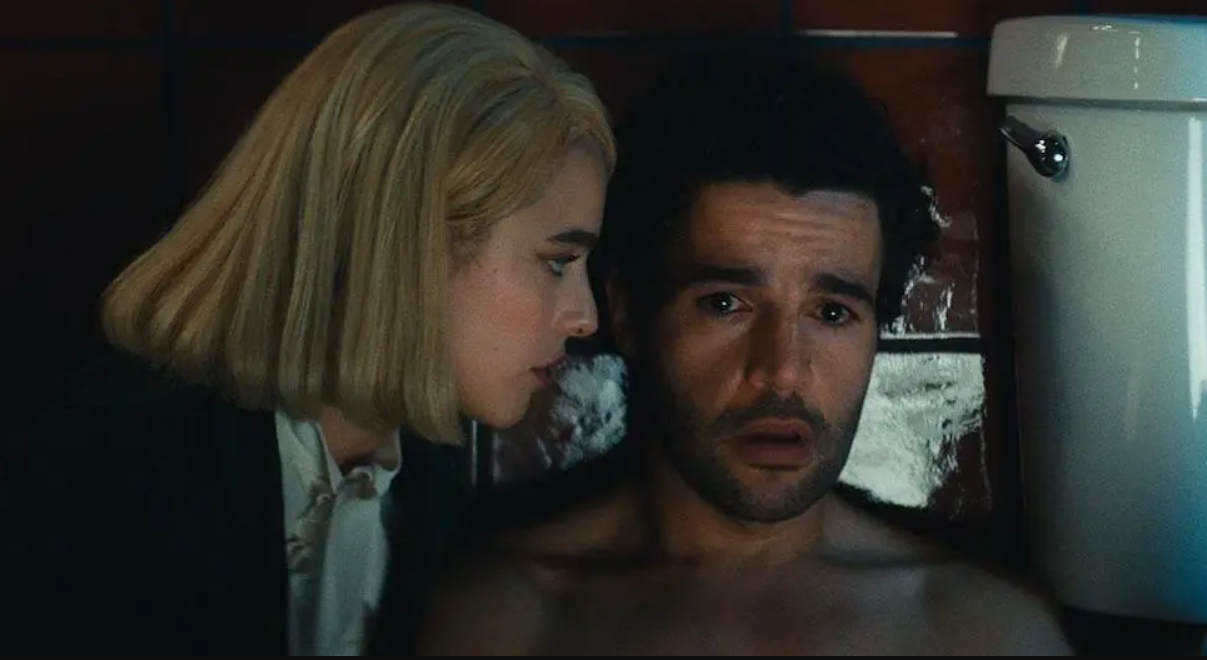
The movie opens with a young woman named Rebecca Martin (Margaret Qualley) arriving at a big and posh hotel room where a lad named Hal Porterfield (Christopher Abbott) is waiting for her. At first, Rebecca seems to be there for interviewing Hal for some business matter involveld with Hal’s very rich businessman father who recently passed away, and he looks willing to answer to any question from her, but we slowly start to sense something odd about the supposedly formal interactions between them.

If you already saw the trailer of the film, you surely know the real purpose of Rebecca’s visit. Rebecca is actually a professional dominatrix hired by Hal, and she is certainly ready to corner and then punish Hal as much as he desires, though he does not seem to know that well about how much he exactly wants to be punished for his kinky pleasure. He planned every detail of their foreplay in advance, but he seems rather confused and hesitant while Rebecca looks quite prepared for their little private fun and games.

What follows next is a series of psychological S&M plays, and we also get to know a bit more about Rebecca and Hal. Because he is going to be the CEO of his father’s big company, Hal decides to end his clandestine relationship with Rebecca after having one last fun with her, so he shows her more appreciation along with a considerable extra payment after his desire is fulfilled as usual, but Rebecca does not look so eager to end their relationship. Probably because getting accustomed a lot to dominating over him, she is not that willing to release him from her psychological control, and that naturally leads to another kinky (and twisty) play between her and Hal.

Surely knowing well how to push buttons on her client, Rebecca alternatively taunts and torments Hal in one way or another, and we come to wonder more about her true motives. At one point, she seems to be seriously blackmailing him with something which may irrevocably destroy his public image, but then she looks like simply messing with him for another fun and thrill between them. While often letting himself pushed or cornered by her in one way or another, Hal seems really exasperated and frustrated, and he even comes to make a threat on her life later in the story, but then Rebecca sharply reminds him of who the boss really is in their increasingly morbid circumstance.

Although mostly stuck inside its small main background along with its two main characters, the movie never feels stiff or bland under the competent direction of director Zachary Wigon, who previously made a feature film debut with “The Heart Machine” (2014). As cinematographer Ludovica Isidori’s camera dexterously moves around the two main characters at times, the editing by Kate Brokaw and Lance Edmands efficiently establishes the edgy tone of the movie along with the score by Ariel Max, and we come to pay more attention to every detail of the interactions between Rebecca and Hal as wondering what may happen next between them.
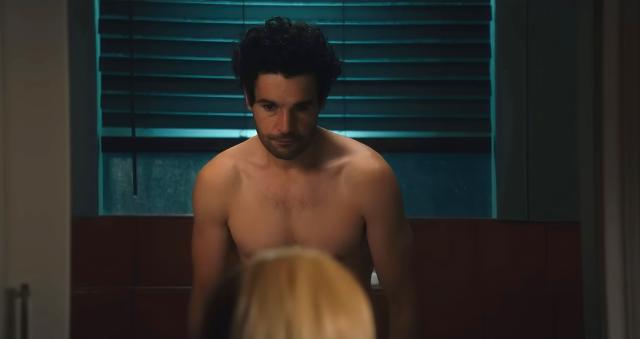
In the end, the movie works as a viciously amusing chamber comedy which will remind you of many other similar films ranging from “Who’s Afraid of Virginia Woolf?” (1966) to “Carnage” (2011). As Rebecca pushes her client more and more along the story, Hal comes to show what a pathetic guy he really is, and Rebecca also seems a bit honest about whatever she is actually feeling about her client, though you can be never sure about whether she is just dangling a carrot in front of him before wielding a whip as before.

The effectiveness of the film depends a lot on the talent and presence of its two lead performers, who surely show considerable commitment in pushing their characters to the extreme. Margaret Qualley, who is incidentally one of the daughters of Andie MacDowell, demonstrates again here that she is an interesting new actress to watch, and it is really fun and exciting to watch her going all the way for her character’s many deliciously naughty moments in the movie. On the opposite, Christopher Abbott, who recently appeared in Yorgos Lanthimos’ “Poor Things” (2023) with Qualley, ably supports his co-star’s showier acting, and I enjoyed how he conveys his character’s pitiful vulnerabilities as steadily maintaining some ambiguity. Clicking together well whenever things get pretty nasty between their characters, Abbott and Qualley constantly generate an ample amount of humor and tension, and they never make any misstep even when every hidden card of their characters is almost unfolded in front of us around the end of the film.

Overall, “Sanctuary” is a modest but entertaining genre piece driven well by its competent direction as well as its two skillful lead performances, and it is certainly recommendable if, like me, you have admired how Qualley and Abbott have advanced in their respective acting careers during last several years. So far, both of them have seldom disappointed me, and I sincerely hope that they will impress us more in each own way in the future.


Posted in Movies | Tagged , , , | Leave a comment

The Four Daughters (2023) ☆☆☆1/2(3.5/4): The reenactment of a family pain

Kaouther Ben Hania’s latest work “The Four Daughters”, which was recently nominated for Best Documentary Oscar (It was also selected as the Tunisian submission to Best International Film Oscar, by the way), presents one painful family story via a plain but striking mix of documentary and fiction. As making the three main real-life figures of the story participate in a series of reenactment scenes, the documentary gradually has them face and reflect more on their harrowing past, and the result is often quite powerful with the aching resonance between fact and fiction.

The central real-life figures of the documentary are a Tunisian woman named Olfa Hamrouni and her four daughters: Ghofrane, Rahma, Eya, and Tayssir. While Eya and Tayssir are going to play their younger selves in front of the camera, Olfa will be often substituted with Tunisian and Egyptian actress Hend Sabri whenever that is deemed necessary, and Ghofrane and Rhama, who are mostly absent in the documentary for a grim and horrific reason to be revealed later, will be played by two young professional performers instead.

After the introduction of Olfa and her four daughters, the documentary playfully presents some amusement generated between Olfa and her two daughters and the performers who are going to play Olfa and her other two daughters. Olfa is willing to show more of herself to Sabri, and Sabri is certainly ready to channel Olfa’s human qualities as much as possible. In case of Eya and Tayssir, they quickly get along well with Nour Karoui and Ichraq Matar, the two young actresses who are going to play their older sisters. In fact, you can clearly sense some emotional bond generated among them as these four young ladies work more fluidly along with each other in front of the camera.

While observing how Olfa and her two daughters collaborate with these professional performers under Ben Hania’s inobtrusive direction, the documentary sometimes simply listens to the personal stories told by Olfa and her two daughters. Even when she was young, Olfa was quite feisty and strong-willed to say the least, but she also eventually had to bend herself to tradition and patriarchy just like many other young women around her age. She got married to a man who did not love that much, but she went through her wedding night in her way, and you may get amused a bit by the following reenactment scene of her wedding night, where Olfa incidentally plays an older sister of hers.

As tolerating her mostly loveless married life during next several years, Olfa managed to give birth to no less than four daughters, who naturally became the sole reason for her to live one day after another. Eya and Tayssir frankly reminisce about how things were often hard and difficult for them and their older sisters mainly due to their father’s frequent abuse as well as their poor economic status, and there is a poignant moment when they do a make-believe play along with the fictional counterparts of their older sisters.

Around the time when Ghofrane and Rhama entered adolescence around the early 2011, Tunisia was shaken up by the beginning of the Arab Spring, and that certainly affected a lot not only them and their younger sisters but also their mother. After seeing the possibility for more change and freedom, Olfa eventually decided to leave her husband, and she subsequently got herself romantically involved with some guy who had just escaped from prison. It looked like she finally found some happiness for herself, but, alas, this dude turned out to be no better than her ex-husband to both her and her daughters.

We watch Eya and Tayssir acting along with an actor playing that scumbag, and the mood becomes so tense between them and him that he comes to quit in the middle of the shooting. As replaying this rather uncomfortable moment in my mind, I am not that sure about whether it was planned in advance or not, but I can tell you at least that you will not easily look away from the intense expression of complicated emotions from both Eya and Tayssir.

After breaking up with that crummy guy, Olfa went to Libya for earning more money for her family, and that was when the distance between her and her daughters began to grow. Especially in case of Rahma and Ghofrane, they became quite wild and rebellious, and they and her mother consequently clashed a lot with each other. Struggling to get things under control as much as she could, Olfa came to abuse her daughters more than once, and that certainly caused another emotional scar upon her daughters.

Because of their confused and vulnerable status, Rahma and Ghofrane subsequently let themselves delve into religious fanaticism mainly due to those loud-mouth fanatics in their neighborhood, and the following consequence was pretty dire to say the least. They ran away to Libya for joining the Islamic State, and the only consolation for Olfa was that she managed to prevent the other two daughters from falling into the same fate at least.

As Olfa and her remaining two daughters participate more in the reenactment scenes, they come to process more of their pain and sorrow, but their sad family story is unfortunately still being continued even at present. Rahma and Ghofrane are alive, but they have virtually been lost to their family, and Olfa and her remaining two daughters remain quite hurt by that hard fact of their life.

In conclusion, “The Four Daughters” is compelling for its unconventional presentation of a heartbreaking personal tale, and Ben Hania, who previously directed Oscar-nominated film “The Man Who Sold His Skin” (2020), did a commendable job of handling her main human subjects with enough care and respect. This is certainly one of the more interesting documentaries of last year, and I sincerely recommend you to check it out if you have a chance.

Posted in Movies | Tagged , , , , , | Leave a comment

Godzilla x Kong: The New Empire (2024) ☆☆1/2(2.5/4): Now they will fighter together…

When I was about to watch “Godzilla x Kong: The New Empire”, my physical condition was rather exhausted, and I sincerely hoped that I could be energized by whatever it would serve me during the next two hours. Unfortunately, the movie was not that good enough for galvanizing my weary mind, and I simply observed all those big monster fights and the accompanying mass destruction from the distance without much care or attention.

No, I did not expect at all anything which can be regarded as something, uh, artistic. After all, I finally overcame my remaining snobbishness as totally surrendering myself to the grand finale of “Godzilla vs. Kong” (2021), though I must confess that I do not remember much except lots of fights between Kong and Godzilla on the screen. Therefore, I was willing to embrace and enjoy another big serving of massive spectacles from the two main star monsters of the MonsterVerse, but, folks, I ended up checking the time more than once during my viewing.

The reason why I was not engaged or entertained enough is pretty simple; the movie takes a bit too much time before Godzilla and Kong finally join together for fighting against their common enemy. For more than the half of its running time, the movie merely slouches from one narrative point to another as trying to set the ground for their eventual big battle, and it also often trudges whenever it pays attention to its human characters, who are still the least interesting parts of the film. Once both Godzilla and Kong get together in action, the movie surely attempts to be as spectacular as possible, but, to my disappointment, the result feels rather hurried instead of being overwhelmingly exciting like “Godzilla vs. Kong”.

At least, the movie amused me to some degree with more preposterous stuffs on the way. While Godzilla occasionally makes a big news around the world just for reminding the world that who the boss is, Kong freely explores his vast underground world called “Hollow Earth”, and we get a little humorous moment when it happens to have a dental problem, which is later fixed by those dedicated employees of a big global organization called Monarch.

One of the key figures in Monarch is Dr. Ilene Andrews (Rebecca Hall), and she and her colleagues including Trapper (Dan Stevens) go down to Hollow Earth due to a mysterious signal coming from somewhere inside Hollow Earth. Incidentally, this signal is also received by the mind of Dr. Andrews’ young adopted daughter Jia (Kaylee Hottle), and Jia, who was once closely connected with Kong, is also willing to go down there along with others for finding what is really going on inside Hollow Earth.

On the other side, the movie follows Kong’s accidental journey into a certain uncharted region in Hollow Earth, where it encounters several big apes who look like the leftover extras from the recent Planet of the Apes movies. After defeating all of those aggressive opponents, Kong becomes determined to get to the bottom fo the situation, and then he gets guided by a smaller ape who sometimes feels like a cross between that house elf character in Harry Potter movies and Gollum in the Lord of the Rings movies.

Meanwhile, as the other star monster of the film, Godzilla gives us a series of destructive moments here and there in the world after also noticing the signal coming from Hollow Earth. At one point, it goes to a remote area in the Arctic region for getting more power for himself, and we surely get another monster fight scene as it goes all the way for the enormous power source inside some other monster.

Of course, all these narrative lines will converge together during the last act, but the movie still did not hold my attention enough even at that point. The eventual alliance between our two monster stars is quite contrived as hurrying them too quickly into the finale, and the following action sequence feels too scattershot at times as busily juggling many different story elements.

Furthermore, the subplot involved with the strained relationship between Dr. Andrews and Jia is redundant without much depth. I know well that human depth is the last thing I should expect from a Godzilla/Kong movie, but I could not help but notice how the human cast members of the movie often struggle with their thankless cardboard roles. While Rebecca Hall does not have much to do except being frequently required to deliver a lot of exposition to other characters as well as us, Dan Stevens and Brian Tyree Henry acquit themselves well in their deliberately broad acting, and young actress Kaylee Hottle holds herself fairly well even when she has to share the screen with Kong.

In conclusion, “Godzilla x Kong: The New Empire” did not bore me much, but it did not satisfy me enough for recommendation either. While Director/co-story writer Adam Wingard, who previously directed “Godzilla v. Kong”, and his crew members present a competent product to be consumed, the movie does not reach to the level of goofy grandeur of “Godzilla: King of the Monsters” (2019) or “Godzilla v. King”, and now I become more interested in checking out Japanese film “Godzilla: Minus One” (2023), which recently won a Best Special Visuals Oscar but has sadly not been released in South Korean theaters yet. After all, Godzilla is more fun to watch when it brutally roams in Japan, isn’t it?

Posted in Movies | Tagged , , | Leave a comment

Every Body (2023) ☆☆☆1/2(3.5/4): Their Body

Some good documentaries work as an empathic window to human experiences and conditions quite different from ours, and documentary film “Every Body”, which is currently available on Netflix in South Korea, is one of such exemplary examples in my humble opinion. Focusing on a sexual subject not so familiar to many of us, the documentary provides not only enlightenment but also empathy and understanding, and it surely widens my knowledge on sexual identity a bit more than before.

The documentary mainly revolves around three intersex figures: Sean Saifa Wall, Alicia Roth Weigel, and River Gallo. They all had each own personal struggle on sexual identity due to their intersex status, and their personal stories are often intercut with how intersex has been socially and medically misunderstood and mistreated for many years.

It can be said that the physical/psychological predicaments of these three people and many other intersex people our there were originated from the medical research on intersex by an American doctor named John Money, who was regarded as a pioneering expert in the field during his time. As studying various cases of intersex, Dr. Money concluded that intersex is a physical abnormality which had to be corrected by surgery or hormone/behavioral treatment, and his seriously misguided medical research, which is based on that conventional binary definition on sex, still exerts a considerable influence on his field even at this point.

Dr. Money’s most famous case is a guy whose story I incidentally came across via a book on human chromosomes in 2002. Although he was a biologically male, the patient was raised as a girl due to a very unfortunate castration incident which happened not long after birth, and Dr. Money often wrote about how his patient was perfectly fine as a girl despite his original sexual identity. That was certainly the main highlight of his medical career, and it certainly solidifies the common misconception among doctors on intersex.

However, this famous case of his later turned out to be quite distorted by Dr. Money himself. In contrast to what he wrote in several journal papers of his, his patient was not happy at all with his newly assigned gender identity even when he was just a little kid, and, what do you know, he actually became all the more comfortable with himself then before when he finally received another gender transition and then married a woman. He even willingly came forward for a TV interview for getting his real story known more in public, but, sadly, his life was subsequently ended due to his suicide in 2004.

Wall, Weigel, and Gallo also went through a lot of difficult moments due to each own sexual identity issues. As reflected by his initial physical condition, Wall was more drawn to maleness from the beginning, but it took some time of him to accept his sexuality identity and then begin a new life as a man. During her high school years, Weigel had to pretend to have a menstruation just like many of her schoolmates even though her body had testicles instead of womb or ovary. In case of Gallo, they was born without testicles, and they certainly felt confused a lot about their sexual identity despite being raised as a boy.

All of these people were put into sex-change medical treatments without their agreement just like many other intersex people out there. It is more accepted these days that intersex kids should be allowed to wait more for deciding on their adult sexual identity later, but many parents of intersex kids often tend to make their children have totally unnecessary sex-change medical treatments mainly out of fear or concern. Sure, most of them do not mean any harm onto their kids, but it is still wrong to force a gender identity upon their kids without any agreement, and the documentary certainly makes a strong point on that.

Nevertheless, intersex people have gradually come out in public as a part of the LGBTQIA group during last several decades. As a matter of a fact, they actually made a public organization in 1996, which subsequently became more prominent as more intersex people came out and then fought against those misconceptions and prejudices against intersex people.

And we see how Wall, Weigel, and Gallo are quite active about their life and civil rights as being totally comfortable with being themselves. Wall and Gallo express a lot of themselves more via artistic activities, and there is an interesting moment when Gallo plays an important female character in one certain Shakespeare play. Weigel becomes a notable representative of the intersex community, and she certainly tried really hard and then succeeded in stopping that blatantly discriminatory gender bathroom law in Texas.

In conclusion, “Every Body”, directed by Julie Cohen, is quite informative as well as compelling for its many touchingly human moments. It is certainly one of the better documentaries of last year, and, considering how it can be educative to many inquisitive young people, it is really a shame that the documentary is rated 18 here in South Korea just because of its main subject and a bit of full-frontal nudity. Yes, I am still clumsy in case of typing they/their/them in case of referring to non-binary persons, but I am willing to learn and open my eyes more at least, and I sincerely hope that there will be more movies and documentaries about intersex people out there.

Posted in Movies | Tagged , , , , | Leave a comment

Shirley (2024) ☆☆1/2(2.5/4): Meet Shirley Chisholm

To be frank with you, I had never heard about US Congresswoman Shirley Chisholm before I watched acclaimed TV miniseries “Mrs. America” a few years ago, which incidentally enlightened me on a lot of interesting American feminist real-life stories besides Chisholm’s. In the episode mainly focusing on Chisholm’s failed US presidential run in 1972, it has some of the most powerful moments in the miniseries, and Uzo Aduba, who deservedly won an Emmy for her performance, is simply devastating as Chisholm is pressured and cornered toward her eventual heartbreaking defeat.

That is why I had some expectation after coming across the trailer of Netflix biopic “Shirley”, which was released on last Friday. Unfortunately, the movie does not show much beyond what I came to learn via that memorable episode of “Mrs. America”, and the result is another by-the-number biopic just like recent Netflix film “Rustin” (2023).

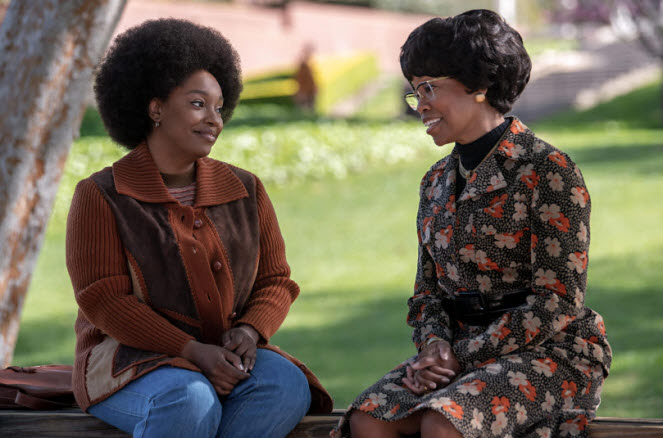
I must say there is not any fault in the lead performance by Regina King, a terrific actress who also produced the film with writer/director John Ridley. She embodies well her character’s unflappable determination and idealism, and she surely has several big scenes where her character shows her indomitable spirit and charisma, but Ridley’s screenplay does not delve that much into her character’s life and personality while often being busy with emphasizing how important Chisholm is in the American political history during the late 20th century.

And she is indeed an important figure, though she was regarded that highly when she entered the US Congress in 1969 as a first-time congresswoman representing her Brooklyn neighborhood of New York City. At that time, she was one of 12 women in the US Congress besides being the sole African American woman in the group, but she was daunted at all by her glaring minority status, and that is quite evident to us when she shows some pluck in front of a jeering racist Southern congressman.

In late 1971, many prominent figures int her party, which is incidentally the Democratic Party, begin to focus on who will eventually be the US presidential candidate competing against President Richard Nixon of the Republican Party, and Chisholm came to consider run for the Democratic Party’s presidential run because she sees some little possibility of actually becoming the nominee – and, perhaps, the president. After all, many people in the American society have been demanding for more change as their society was rocked by a series of sociopolitical happenings during the 1960s, and Chisholm is willing to be a new and fresh representative of changes to come.

Of course, Chisholm and her close associates including her devoted husband do not have much resource from the beginning compared to many other competitors in the party, but, to their surprise, their following modest campaign seems to work a bit better than expected. It actually looks like Chisholm will be able to stay in the competition till the party convention is held in Florida several months later, and Chisholm is certainly willing to go all the way as much as possible.

However, Chisholm and her campaign also face a lot of obstacles popping here and there on their bumpy road to the party convention. Because of her minority political status, many people inside and outside the party are not particularly serious about her campaign, and she is also frequently pressured from inside and outside her campaign. While she is often told that she has to quit for less competition inside the party, she also clashes a lot with her close advisers including her former mentor Wesley McDonald “Mac” Holder (Lance Reddick), and we also see how her married life often gets strained due to the growing distance between her and her husband, who subsequently divorced in 1977.

The movie later tries on some human complexity as Chisholm willingly interacts with a number of various figures ranging from George Wallace to Huey P. Newton, but the result somehow feels flat and uneven without much dramatic impact. In case of a subplot associated with Chisholm’s two family members, the screenplay seems to tries a bit of warts-and-all approach, but this subplot only ends up being rather superficial on the whole.

Anyway, King diligently carries her character and the movie to expected ending, and some of several notable supporting performers around her manage to leave some impression despite their underdeveloped parts. While Terrence Howard casually coasts around the screen as one of the key members of Chisholm’s campaign who would later be her second husband, Lucas Hedges provides some comic relief as an inexperience but smart lad ready to do as much as he can do for Chisholm’s campaign, and André Holland steals the show as usual during his brief appearance in the film. In case of Lance Reddick, who sadly passed away too soon in last year, he brings some intelligence and authority to his rather thankless supporting role, and that reminds me again of what a dependable character actor he was in numerous TV series and movies for many years.

Overall, “Shirley” is surely well-intentioned to say the least, but it fails to make something engaging enough to hold our attention. If it had been made, say, 10 or 15 years ago, I might have been more generous to it, but, folks, the standards of African American biopics have been going up a lot especially after “Selma” (2014), and I really think you should check out “Mrs. America” instead if you have not watched it yet.

Posted in Movies | Tagged , , , , | Leave a comment

Damsel (2024) ☆☆☆(3/4): A damsel against distress

Netflix film “Damsel” distinguishes itself in its familiar genre territory to some degree via its feisty heroine to remember. As reflected by the very title of the movie, she suddenly finds herself becoming your average damsel in distress, but she quickly becomes quite ready to do anything for her survival, and you will certainly come to root for her more as watching how she defiantly keeps fighting against her immense distress even without any prince coming to the rescue.

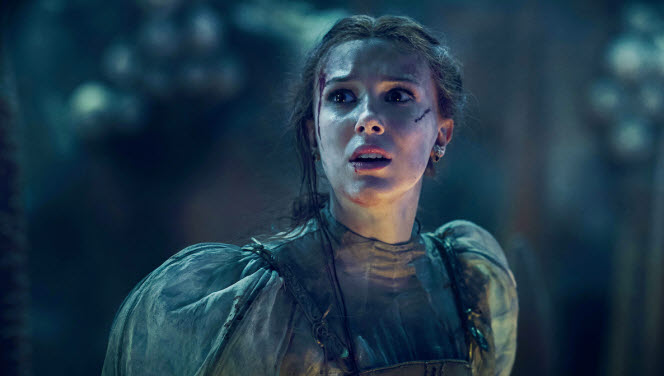
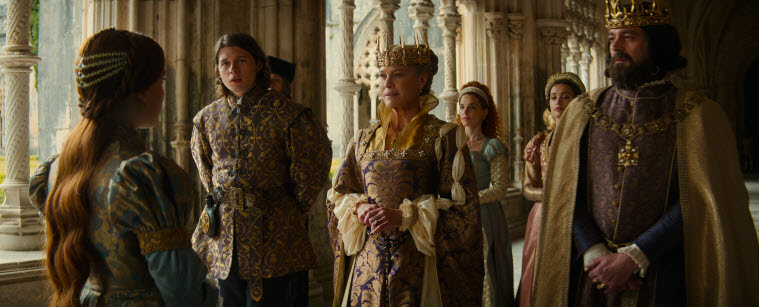
Early in the story, we get to know about how things have been hard and difficult for Elodie (Millie Bobby Brown), the elder daughter of a poor lord governing over some remote northern land. Because many people in this land have been struggling a lot due to the lack of food and resource, Elodie sincerely wants to help as much as possible, and then there comes an unexpected opportunity for her to help her father and the people of his land a lot. The queen regnant of a rich and powerful kingdom called Aurea sends a marriage proposal for her son, and Elodie agrees to travel to Aurea along with her family even though she is not so willing to marry a lad she has never met before.

Right upon their arrival in Aurea, Elodie and her family are quite impressed by the hospitality from the queen and her royal family and servants, and it seems that Elodie can be actually happy here with her future husband for the rest of her life, but then her stepmother comes to suspect and fear for the worst – especially after seeing how her husband becomes rather taciturn about whatever is arranged between him and the queen during their little private meeting. Although she and her stepdaughters are not that close to each other, she really becomes quite concerned about what may happen next to Elodie, but Elodie does not pay much attention to her stepmother’s words as everything seems pretty fine as far as she can see.

Of course, as already shown to us during the opening scene and then indirectly implied by the whispering chant in the score by David Fleming, there is a terrible fate waiting for her from the very beginning, and Elodie belatedly comes to realize that not long after her glorious wedding ceremony. She is immediately taken to the cave inside a nearby mountain, and then she is going to be another young girl to be sacrificed to a big dragon living there.

Once she clearly discerns what is going to happen to her after getting thrown into the pit connected to the dragon’s lair, Elodie is certainly scared a lot, but she does not lose her will and courage at all – even when she eventually encounters the dragon and its unforgiving fiery power. After managing to evade the dragon, she soon begins to search for any possibility for her escape and survival, and we accordingly get several grim moments including the one chillingly showing how many girls were sacrificed before her.

As many of you know, strong female movie characters are much more common these days, but Dan Mazeau’s screenplay does more than merely subverting its genre elements, and it does pay some attention to fleshing out its heroine before pushing her through a series of challenges to overcome. As steadily sticking to its heroine’s desperate attempts to survive, the movie surely depends a lot on the presence and charisma of its lead actress, and Millie Bobby Brown, a wonderful British actress who has been mainly known for her Emmy-nominated turn in Netflix drama series “Stranger Things”, is certainly the right lead performer who can bring an ample amount of plucky personality to our heroine. To be frank with you, I personally wish she made another Enola Holmes movie instead, but she ably demonstrates her undeniable star quality again, and, folks, that is more than enough in my inconsequential opinion.

Meanwhile, we get to know more about what has made the dragon so mean and vicious, and you may actually feel a bit sorry for the dragon even though it is still as menacing as that terrifying dragon in “Dragonslayer” (1981). Shohreh Aghdashloo, an exceptional Iranian and American actress whom I still remember for her poignant Oscar-supporting turn in “House of Sand and Fog” (2003), gives a really scary voice performance to unnerve you at every word, and her CGI character effectively functions as the daunting foe for our heroine.

The main weakness of the movie is how many of other main characters in the story are relatively flat and colorless in comparison, but that feels like a minor flaw at least during my viewing thanks to its several dependable main cast members. While she may look like doing a medieval version of her character in Netflix drama series “House of Cards”, Robin Wright plays her character with some sly gusto, and Ray Winston and Angela Bassett do more than required by their rather thankless supporting parts, and younger performer Brooke Carter is also well-cast as Elodie’s dear younger sister.

On the whole, “Damsel”, which is directed by Juan Carlos Fresnadillo, is your typical standard fantasy adventure movie which may not surprise you that much, but it is entertaining enough for recommendation mainly because of the game efforts from Brown and several other performers around her. Like “Spaceman”, another recent Netflix film I happened to watch on the same day, the movie actually does not bring anything particularly new to its genre, but it did its job as much as intended while bringing some nice modern touches, and I will not grumble for now because I had a fair share of entertainment from it at last night.

Posted in Movies | Tagged , , , | Leave a comment

Spaceman (2024) ☆☆1/2(2.5/4): Sandler and a Spider

I admire how Adam Sandler has developed his potential as a performer during last three decades. While his entire career has been riddled with a heap of disposable comedy films such as “The Waterboy” (1998) and “Jack and Jill” (2011), he also has often demonstrated the more serious sides of his acting talent in a number of notable films such as “Punch-Drunk Love” (2002) and “Uncut Gems” (2019), and I have been fascinated with how his screen persona has got gradually matured via these better movies.

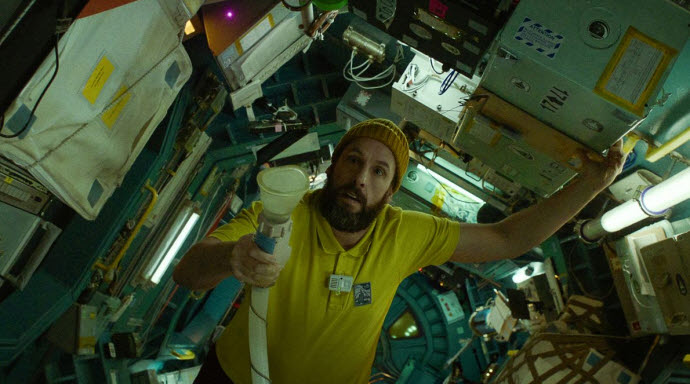
In case of Netflix film “Spaceman”, Sandler is willing to push himself further as dialing down himself much more than before, but his commendable efforts here in this movie are not unfortunately supported enough to my disappointment. As an isolated astronaut in the middle of the demanding space mission, Sandler is often effective in his subdued illustration of aching conflict and loneliness, but the movie often loses its focus and momentum for not being totally as committed as its lead actor, and it also fails to distinguish itself from “Ad Astra” (2019) and many other similar science fiction drama films out there.

At the beginning, the screenplay by Colby Day, which is based on Jaroslav Kalfař’s 2017 novel “Spaceman of Bohemia”, slowly establishes what Sandler’s astronaut hero, a Czech dude named Jakub Procházka, has been going through during last several months. A few years ago, a mysterious interstellar cloud suddenly appeared near the solar system to the surprise of everyone on the Earth, and we gather that a number of different nations embarked on each own space mission for exploring this inexplicable interstellar cloud. In the end, Czech’s spaceship somehow became the first one to reach to the interstellar cloud (South Korea happens to be the second one, by the way), and Jakub will soon get the honor alone by himself because he happens to be the only crew member of the Czech spaceship.

However, it is evident to us that Jakub has been struggling with the growing loneliness inside his mind. While he certainly tries to focus on his mission as usual, he comes to miss his wife Lenka (Carey Mulligan) more than before, so he becomes more dependent on his occasional interspace communication with his wife, but his wife turns out to get more tired of how he has often been absent in their married life. She has been pregnant during last several months, but her husband seems to be less interested in their baby, and she eventually decides that enough is enough.

When Lenka is about to tell her husband about her decision to end her marriage, everyone at the mission control becomes quite concerned for a good reason. Knowing well about Jakub’s emotional toil, Commissioner Tuma (Isabella Rossellini) decides to block the communication line between Lenka and Jakub for a while at least, but that only comes to exacerbates Jakub’s loneliness, and he becomes all the more stressed as the spaceship is having a number of small and big problems.

And then something really weird happens to Jakub. He comes across a big spider alien voiced by Paul Dano, and he is certainly thrown into panic while not so sure about whether this strange entity is actually real or not. No matter how much he tries, the spider, who is eventually named “Hanuš” by Jakub, does not go away at all, and Jakub has no choice but to accept his unexpected companion after discerning that Hanuš comes in for, uh, peace.

Because Hanuš happens to have a telepathic ability, it soon comes to look around the personal memories from Jakub’s life, and the movie naturally comes into the territory of “The Tree of Life” (2011) and “Ad Astra”. As cinematographer Jakob Ihre’s camera presents a number of different moments in Jakub’s life via deliberately distorted images, the movie becomes more introspective along its astronaut hero, and this introspective mood is accentuated further by the score by Max Richter, who incidentally also worked in “Ad Astra”.

However, Day’s screenplay also attempts to handle Renka’s growing personal conflict on the Earth, and that causes the main problem of the film. As alternating between Jakub’s main narrative and Renka’s subplot too frequently, the screenplay fails to develop both of these two main characters enough to hold our attention, and the movie consequently trudges from one expected narrative point to another without much dramatic weight. In the end, we do not care that much about whatever will happen between Jakub and Renka, and the same thing can be said about his strained relationship development with Hanuš, which is pretty predictable to the core even during the supposedly climactic part.

The movie also under-utilizes its several main cast members besides Sandler. While she is reliable as usual, Carey Mulligan does not have much to handle from the very beginning, and I must point out that she recently played a more interesting long-suffering spouse in another Netflix film “Maestro” (2023). Sounding as flat as HAL 9000 in “2001: A Space Odyssey”, Paul Dano manages to inject some personality into his alien character, and Isabella Rossellini and Lena Olin bring a little touch of class to their thankless supporting roles.

In conclusion, “Spaceman” is thankfully not a total bore as I feared, but it fails to bring anything fresh or distinctive to its genre territory. Director Johan Renck, who won an Emmy for HBO TV miniseries “Chernobyl”, and his crew and cast members do try a lot here, but the overall result is frequently middling on the whole, and I must confess that my mind kept going somewhere else during my viewing. At least, the movie shows that Sandler’s ongoing maturation as a compelling actor to watch, and I am sure that he will soon fly beyond it for whatever he will encounter in the future.

Posted in Movies | Tagged , , , , | Leave a comment

Evil Does Not Exist (2023) ☆☆☆(3/4): Ryusuke Hamaguchi’s interesting minor work

Ryusuke Hamgauchi’s latest film “Evil Does Not Exist”, which won the Grand Jury Prize when it was shown at the Venice International Film Festival in last year, is interesting to watch for several good reasons. Although it does not reach to the sublime level of achievement of his two previous works “Drive My Car” (2021) and “Wheel of Fortune and Fantasy” (2021), the movie is packed with his own distinctive touches to be savored at least. In my inconsequential opinion, that is more than enough for compensating for its noticeable flaws including the abruptly baffling finale.

At first, the movie takes some time to establish its main background and characters. After the rather unnerving main title scene accompanied with Eiko Ishibachi’s score, we are introduced to a guy named Takumi (Hitoshi Omika), and then the movie patiently observes one of his daily routines. We see him collecting some water at a little fountain in the middle of the nearby forest for a local restaurant run by one of his close neighbors in the village, and then he goes to a local kindergarten for picking up his little daughter, whom he has raised alone since his wife’s departure.
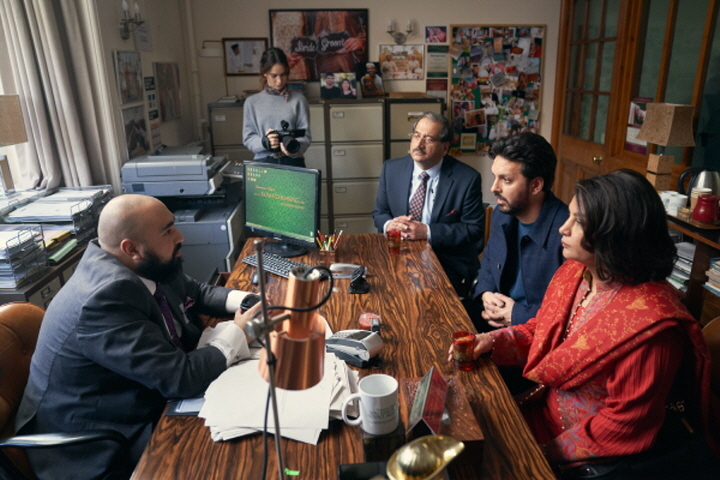
During the following evening, Takumi and several other neighbors including the village chief meet together at Takumi’s house for an important issue to discuss about. Some company is trying to build a big site for “glamping” (It is a fancy local compound word from “glamor” and “camping”, by the way) around the village, and it will soon hold a meeting between the villagers and the two representatives of the company. Not so surprisingly, Takumi and many of his neighbors do not welcome this change that much, and we instantly sense a big trouble even though they phlegmatically discuss on their impending issue.

And things do become quite problematic right from when the meeting is started on the next day. While those two representatives try their best for persuading the villagers, the villagers start to express their strong objection against the company plan one by one for a number of understandable reasons. For example, the septic facility of that glamping may pollute the main ground water source of the village, and most of the villagers, who are quite proud of their clean and crisp nature environment, are certainly concerned a lot about this serious possibility of environment pollution.

No matter how much the company representatives try, it only becomes more evident to us that they are way over their head right from the beginning without much preparation. Hamaguchi and his crew members deftly dial up the level of tension as the interactions between the company representatives and the villagers become more intense line by line. As cinematographer Yoshio Kitagawa’s camera calmly sticks to its static position, the editing by Hamaguchi and his co-editor Azusa Yamazaki is precise and efficient as vividly conveying what is being gradually accumulated beneath the screen, and this growing tension is dramatically punctuated by a sudden moment of action timely prevented by Takumi.

Around that narrative point, Hamaguchi’s screenplay shifts itself more toward the viewpoint of the company representatives, who come to show more human sides along the story. While being well aware of how greedy and opportunistic their boss is, they come to reflect a bit on themselves as trying to finish their job as before, and that leads to another terrific moment which will remind you again of why Hamaguchi is an almost peerless filmmaker in case of shooting a conversation scene inside vehicle.

During the following last act, the movie unfortunately stumbles more than once to my little dissatisfaction. I wish Hamaguchi’s screenplay fleshed out its main characters with more details and nuances, and I am also not so sure about whether the ending works as well as intended. It caught me off guard for being a bit too blunt and jarring compared to what has been somberly and thoughtfully built up to that point, and you may actually want Hamaguchi to roll his story and characters a little more instead of making a bitter ironic point against the very title of his movie.

Anyway, the movie is still fairly engaging thanks to a number of strong elements to hold our attention enough. Again, Hamaguchi drew good performances from his main cast members, and several main cast members including Hitoshi Omika are all convincing in their unadorned natural acting while imbuing their respective roles with enough sense of life and personality. In case of Ishibashi’s score, it is inarguably the most important factor in the overall mood of the film, and I was not so surprised to learn later that the movie was initially planned as a short film to accompany Ishibashi’s music.

In conclusion, “Evil Does Not Exist” does not impress me as much as I hoped, but it reminds me again of Hamaguchi’s undeniable filmmaking talent. Although I did not like “Asako I and II” (2018) much, I was quite impressed by how “Happy Hour” (2015) could amuse and engage me for more than 5 hours, and I certainly cherished many mesmerizing moments in “Drive My Car” and “Wheel of Fortune and Fantasy”. Yes, “Evil Does Not Exist” feels like a minor work in comparison, but it is worthwhile to watch especially if you have admired his works like I have, and I assure you that you will be rewarded to some degree.

Posted in Movies | Tagged , | 1 Comment

Assassination Nation (2018) ☆☆(2/4): Stylish but messy

“Assassination Nation” is a stylish but messy satire which throws lots of things on the screen but fails to be something coherent enough to engage or excite me. Sure, right from the start, I was ready to accept the warped reality inhabited by its main characters, but the movie ultimately feels quite superficial in terms of narrative and characterization while merely being pointlessly nasty and violent, and that made me more distant to the story and characters without much care or attention.

The story is unfolded in a town called Salem, which sounds so symbolic that you will get a pretty good idea on what the movie is about right from the opening scene. As a matter of fact, the movie cheerfully gives us an obnoxiously graphic notice for viewer discretion in advance, and you can actually decide whether you really want to continue your viewing (Full Disclosure: I seriously considered quitting even though I was watching the movie along with a friend of mine at last night).

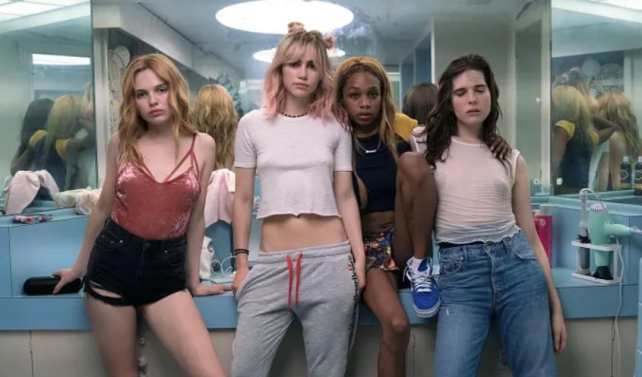
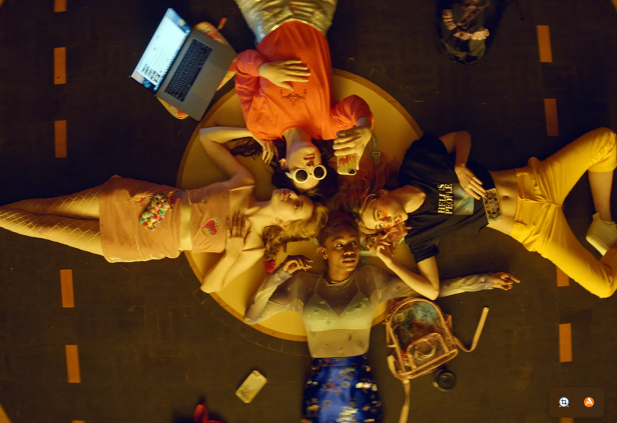
Anyway, the movie mainly revolves around four local high school girls: Lily (Odessa Young), Sarah (Suki Waterhouse), Bex (Hari Nef), and Em (Abra). While Lily seems to be a smart girl with good grades for going to some nice college someday, she is your average disaffected adolescent kid, and we often see her and these three friends of hers aimlessly spending time together like the young heroines of Sofia Coppola movies – or confidently strutting together in their high school like the main characters of “Mean Girls” (2004).

The mundane daily life of these girls and many other people in Salem is suddenly disrupted on one day due to some naughty anonymous hacker, who can freely hack into anyone’s smartphone somehow. First, this hacker dude hacks into the conservative mayor of the town, who is consequently humiliated a lot for the following exposure of the private contents of his smartphone. Not long after that, the principal of the local high school also gets his private contents of his smartphone exposed in public, and we become more uncomfortable because, unlike that hypocritical mayor, the principal does not deserve his following predicament at all.

Everyone in the town becomes more concerned about another hacking case to happen, but Lily does not look like being worried at all. In fact, she continues her very inappropriate online interaction with a certain adult guy in her neighborhood just because, well, she cannot help but drawn to the excitement of doing something naughty behind her back, even though she is warned later that the hacker may be focusing on her as the next target.

Meanwhile, the screenplay by director/writer Sam Levinson, who has been mainly known for his acclaimed HBO TV miniseries “Euphoria”. throws lots of blatantly thought-provoking ideas via Lily’s mouth. While she makes some good points on a number of important subjects including the misogyny on the Internet, the movie sadly stumbles a lot in its clumsy attempts on character development, and she eventually ends up feeling more like its main mouthpiece instead of a real human character with genuine life and personality.

In case of a number of supporting characters around her, they are also frequently limited by thin characterization. Ironically, Lily’s three friends are simply and mainly defined by their appearance on the surface, and I was particularly dissatisfied with a subplot involved with Bex, who is incidentally a transgender girl. In my trivial opinion, the movie could delve a bit more into Bex’s awkward relationship with a boy clearly conflicted about his attraction toward her, but it is so busy with juggling one thing after another that she remains to be a token supporting character even when things get pretty violent around her and her friends.

I forget to tell you that the situation in the town becomes much more intense and violent as the hacker goes for much more targets than before. As a consequence, the town is thrown into sheer chaos and violence while many people in the town are turned into the leftover extras from “The Purge” (2013), and Lily and her friends belatedly become more aware of how serious the circumstance around them really is.

The girls eventually become as feisty as those tough female characters of Quentin Tarantino’s movies, but the movie unfortunately does not provide much dramatic ground for making us root for them. Odessa Young, Suki Waterhouse, Hari Nef, and Abra surely look great as wearing the same red attire and then shooting a lot, but, alas, their good efforts sadly do not amount to much mainly because of their cardboard roles. In addition, the movie also criminally wastes the talent of several notable cast members including Anika Noni Rose, Bill Skarsgård, Joel McHale, Kathryn Erbe, Kelvin Harris Jr., and Colman Domingo, who at least leaves some nice impression even though the movie quickly throws his supporting character away early in the story.

Overall, “Assassination Nation”, which is incidentally Levinson’s second feature film, feels rather half-baked with all those thought-provoking ideas and themes in addition to suffering from the considerable tonal problem. Although his next film “Malcolm & Marie” (2021) was a bit better in comparison, Levinson still seems to be in the need of more progress as a filmmaker, and I can only hope that he will actually engage me enough with whatever he will direct next.

Posted in Movies | Leave a comment

What’s Love Got to Do with It? (2022) ☆☆1/2(2.5/4): So it goes like that

“What’s Love Got to Do with It”, which is incidentally not associated with the 1993 Tina Turner biopic, is as predictable as your typical romantic comedy. Right from when its two lead characters appear together at the beginning of the film, it is quite apparent to us that they will eventually open their eyes to their mutual feeling around the ending, and the movie just spices up the following process with some specific cultural flavor for our little entertainment. The overall result is thankfully not tedious at all, but this is still a run-of-the-mill stuff which will not surprise you a lot if you are a seasoned moviegoer like me.

The two lead characters of the movie are Zoe Stevenson (Lily James) and Kaz Khan (Shazad Latif). Zoe and Khan grew up together because their families happened to live right next to each other in a suburban neighborhood near London, and Zoe and her mother Cath (Emma Thompson) have been pretty much like close family members to Kaz and his Pakistani immigrant family. During the opening part, we see Zoe going to the wedding ceremony of Kaz’s older brother which is being held at Kaz’s family house, and her mother is already having lots of fun there as your average free spirit.

When Zoe comes across Kaz at their old favorite spot outside the house, Kaz tells her that he is going to try matchmaking for a practical reason. Because he does not believe much in romance, he decided to choose someone recommended to him via matchmaking instead, and it goes without saying that Kaz’s old-fashioned parents are delighted for his decision. After all, he is a good hospital doctor with a nice background, and he will be quite an excellent suitor for any young unmarried Pakistani girl out there.

In contrast to Kas, Zoe really believes in love, though she still has not had any serious romantic relationship yet. Often babysitting the two kids of a close female friend of hers, she envies her friend’s cozy family life, but there is not much luck for her, though her mother is quite eager to introduce her to anyone who looks like Mr. Right for her. As a matter of fact, her mother later attempts a sort of matchmaking between Zoe and a veterinarian who handles the latest problem of her mother’s pet dog.

Meanwhile, as watching Kaz going in the opposite direction, Zoe comes to have a little interesting idea about what she is going to do next as a promising documentary filmmaker. She will closely follow and record Kaz’s matchmaking process on her camera, and Kaz and his family do not have any problem with that because of their big trust on her.

At first, everything goes fairly well within a short time. Not long after consulting with a professional matchmaker, Naz is introduced to a young unmarried woman living in Lahore, Pakistan. After a series of online video conversations, he and she agree to marry in Lahore, and Zoe and her mother soon go there along with Kaz and his excited family.

Of course, things get a bit more complicated than before as Zoe comes to spend more time with Kaz as a part of her ongoing filmmaking process. It becomes more evident to us that they are attracted to each other more than they can admit, but Kaz is going to stick to his plan to the end, and Zoe certainly wants the good ending for her documentary.

In the meantime, the screenplay by co-producer Jemima Khan steadily coasts along its predictable narrative arc, and director Shekhar Kapur, an Indian filmmaker mainly known for “Elizabeth” (1998) and its 2007 sequel, throws some fun moments during the following wedding ceremony. Although her character feels a bit too broad at times, Emma Thompson is clearly having a ball here, and she has an uproarious moment when her character impulsively joins a bunch of dancing girls in the middle of the wedding ceremony.

It is not much of a spoiler to tell you that Zoe and Kaz finally come to recognize their longtime mutual feelings during the last act, but the movie keeps things rolling at least mainly thanks to the low-key chemistry between its two likable lead performers. While Lily James, who recently received an Emmy nomination for TV miniseries “Pam & Tommy”, brings a considerable amount of natural charm to her character, Shazad Latif functions well as her counterpart, and they effortlessly swing back and forth between comedy and drama. In case of several substantial supporting performers, Sajal Ali and Oliver Chris acquit themselves well despite their thankless roles, and Shabana Azmi, Jeff Mirza, Iman Boujelouah, and Pakiza Baig bring a bit of extra fun to the story as Kaz’s colorful family members.

In conclusion, “What’s Love Got to Do with It” does not bring anything new to its familiar genre territory. It is fairly enjoyable on the whole, but I cannot help but think of Nida Manzoor’s “Polite Society” (2023), another recent comedy film about Pakistani British people which also revolves around matchmaking and wedding ceremony. That movie has much more humor, spirit, and personality than this mild genre product in my humble opinion, and, to be frank with you, I want to revisit that little gem sooner or later. I will not stop you from watching “What’s Love Got to Do with It” if you have a spare time to kill, but, believe me, you will have more laughs if you watch “Polite Society” instead.

Posted in Movies | Tagged , , , , | Leave a comment