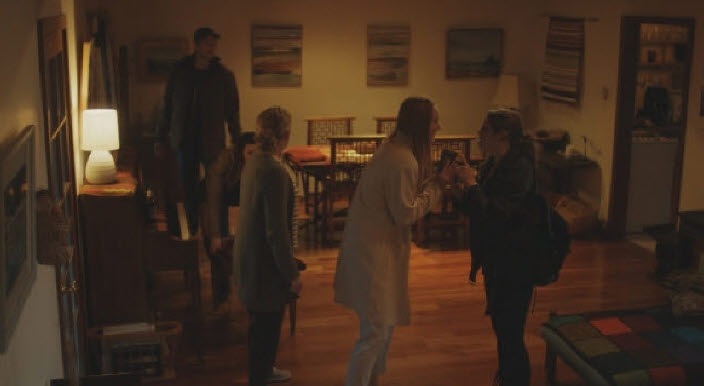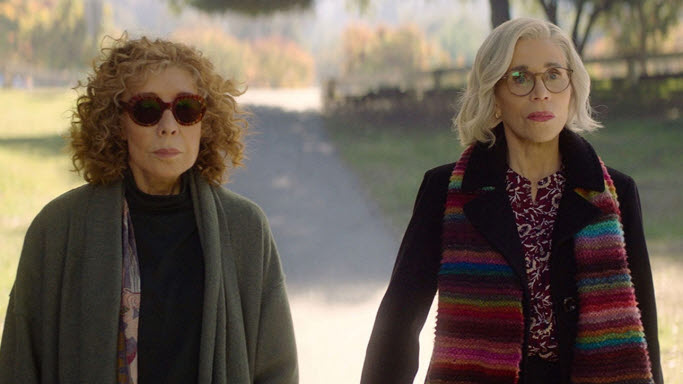
Moving On (2022) ☆☆1/2 (2.5/4): Fonda, Tomlin, and a bit more

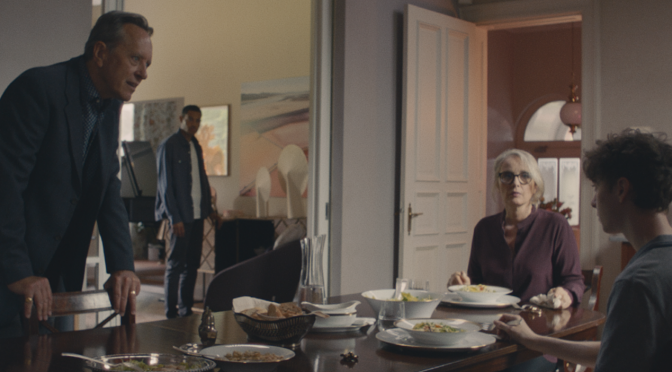
“Moving On”, which is currently available on Netflix in South Korea, is enjoyable whenever it is driven by the good chemistry between two legendary actresses at the center of the film. They are more than 80 at present, but these two great actresses have steadily and productively moved on during several recent years as before, and we are certainly lucky to see them still working, though the movie itself sometimes falters despite their fun and touching efforts on the screen.

Jane Fonda, who looks a bit dowdier than usual here in the film, plays Claire, an old woman who is about to go to visit LA for dealing with her old personal matter to settle. More than 50 years ago, she was raped by the husband of one of her close friends, and she told no one about that except a very few persons. Now her friend recently passed away, and she is going to confront and kill that scumbag at last while attending her friend’s upcoming funeral and wake in LA.

Of course, things do not go that well for Claire after she eventually arrives at the funeral. Right from when she encountered Howard (Malcolm McDowell) again, she flatly tells him that she is going to kill him sooner or later, but, not so surprisingly, she does not know whether she really wants that – and how she will actually do that. Besides, a lot of time has passed, and that man seems changed to some degree after getting quite older just like her, though his presence still makes her quite uncomfortable.

Claire’s docile awkwardness is contrasted with the late arrival of Evelyn (Lily Tomlin), another close friend of Claire who was quite close to both Claire and their deceased friend in the past. She sees right through how superficial the words from Howard feel when he attempts to say nice things about his married life during that following wake, and that is why she comes to reveal to everyone at the spot something quite personal between her and her deceased friend.

Meanwhile, Claire remains indecisive about whether she will really kill him or not – even when a certain tool for killing comes handy to her at one point. As she becomes more and more hesitant, she comes across her ex-husband Ralph (Richard Roundtree), who was also invited to the funeral just like Claire and Evelyn. They have not seen each other for many years since their rather painful divorce which incidentally happened not long after that rape incident, but, though they have moved on in each own way since that, Claire cannot help but feel another chance for romance, and the same thing can be said about Ralph. As a matter of fact, he even invites her to a little dinner at his residence just for old time’s sake.

As Evelyn and Claire try to handle Claire’s old personal issue together, the screenplay by director/writer/co-producer Paul Weitz, who has been more serious in his recent outputs compared to when he and his brother Chris made “American Pie” (1999) together many years ago, naturally swings back and forth between comedy and drama, and Fonda is effortless along with her co-star as they pull and push each other along the story. Lily Tomlin, who has built a remarkable career of her own just like Fonda during last six decades and recently worked with Fonda in Netflix TV series “Grace and Frankie”, deftly functions as a no-nonsense counterpoint to her co-star, and they also did a good job of conveying us to an old history between their characters even though we do not get to know that much about the past between Claire and Evelyn.
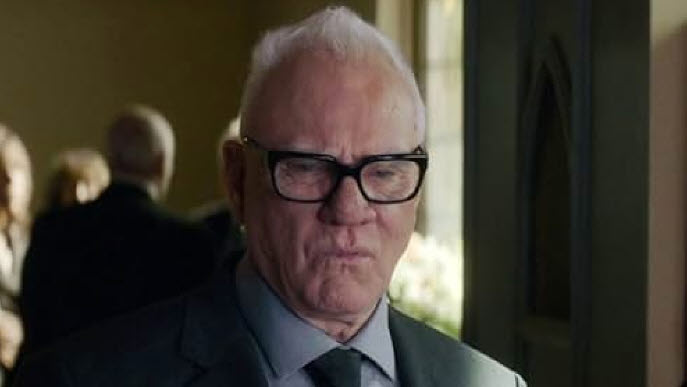
However, the movie unfortunately stumbles during its last act when Evelyn and Claire seem finally ready to confront Howard. While Claire surely comes to let out a bit more of her pain and frustration, the resulting dramatic moment between her and Howard somehow feels tame, and the following finale is quite contrived without much emotional impact on the whole. While Fonda and Tomlin do try to elevate their materials as much as possible, their efforts are ultimately limited by the rather flawed storytelling of the film, and that is quite a shame to say the least.

In addition, the movie brings two equally legendary actors for supporting Tomlin and Fonda, but they are not particularly utilized well as simply demanded to fill their respective spots. Although his role is more or less than a possible love interest, Richard Roundtree, who has been known for his charismatic lead performance in Gordon Parks’ “Shaft” (1971), and sadly passed way a few months ago, fills his functional character with enough life and presence, and you may enjoy a low-key romantic heat generated between him and Fonda later in the story. Malcolm McDowell, who has been and will always be remembered for his chillingly striking performance in Stanley Kubrick’s ever-disturbing masterwork “A Clockwork Orange” (1971), shows here that he can still exude the intense aura of vicious bad boy with his piercing blue eyes, and one of the major disappointments in the film is that it gives his character an ending which feels a bit too easy in my humble opinion.

In conclusion, “Moving On” is fairly watchable thanks to not only Fonda and Tomlin but also the solid supporting turns from Roundtree and McDowell, but it is still one or two steps from Weitz’ more satisfying recent works such as “Grandma” (2015), a little overlooked gem which incidentally has one of the best performances in Tomlin’s long and illustrative acting career. To be frank with you, I would rather recommend “Grandma” first, but I will not stop you from watching “Moving On” if you just want to see all those four great performers appearing in one movie.

Posted in Movies | Tagged , , | Leave a comment

Scoop (2024) ☆☆☆(3/4): How they got a scoop on Prince Andrew

Netflix film “Scoop”, which was released a few weeks ago, tries to give us a close look into the real-life story behind one of the most notorious TV interviews during last several years. Although I have no idea on how much that real-life story is actually fictionalized here, the result is a solid and entertaining drama about good professional journalism, which is surely something we need more than before these days.

As many of you know, everything began from a very questionable relationship between Prince Andrew of England (Rufus Sewell) and Jeffrey Epstein. According to Prince Andrew, he and Epstein were just close friends, but everyone started to suspect the worst when Epstein was arrested and then went to prison for his sex trafficking of young women around the late 2000s. When Prince Andrew and Epstein happened to be photographed together in the Central Park of New York City in 2010, there naturally came more suspicion upon Prince Andrew, and things got much worse for him later when Epstein was arrested again shortly before his sudden death in 2019.

The screenplay by director Peter Moffat and his co-writer Geoff Bussetil, which is based on the nonfiction book of the same name by Sam McAlister (Billie Piper), mainly focuses on the diligent efforts of the production team at the BBC Two news and current affairs program Newsnight during that period. As BBC is about to go through a big downsizing, everyone is quite daunted and depressed to say the least, the chief producer, Amanda Thirsk (Keeley Hawes), and her staff members try to keep going as usual nonetheless, and that is when McAlister, who has worked as a guest producer, suggests the exclusive interview of Prince Andrew for drawing more viewers out there. Although that seems not so possible because he may not answer to all those hard questions involved with his close association with Epstein, McAlister believes that she can make the interview happen, and she becomes more determined after Epstein’s second arrest.

In case of Prince Andrew, he believes that things will go back to normal for him sooner or later, but his personal assistant Esme Wren (Romola Garai) does not think so at all as a person relatively less isolated from the outside world compared to her royal boss. Knowing well how he will be far less popular than before, she certainly needs to swing the public opinion on him to some degree at least, so she eventually agrees to set an interview between Prince Andrew and Emily Maitlis (Gillian Anderson), a prominent journalist who is the current presenter of Newsnight.

What follows next is not so far from the first half of Ron Howard’s riveting interview drama film “Frost/Nixon” (2008). On one side, Wren and other assistants try to prepare their royal boss for the upcoming interview where Maitlis will not pull any punch at all on his longtime association with Epstein. On the other side, Thirsk and her staff members busily prepare for what might become the scoop of the year, and McAlister is definitely willing to participate more, though she is also concerned about not being there for her young son that often because of her busy work schedule.

Clearly siding with McAlister and her several female colleagues, the movie occasionally makes some sharp points associated with the #MeToo Movement. We see a bit of how many young women were exploited by Epstein and a number of rich and powerful associates of his including President Bill Clinton for many years, and we are also reminded that we should really have sided more with Monica Lewinsky considering how her inappropriate sexual relationship with Clinton was quite unequal from the very beginning.

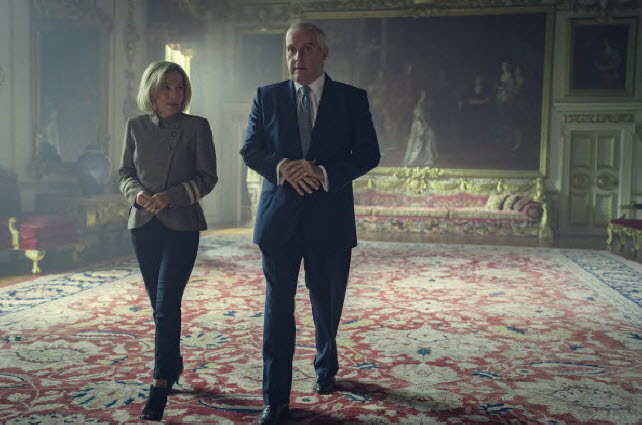
In the end, everything culminates to Maitlis’ one-hour interview with Prince Andrews at the Buckingham Palace, and the movie wisely does not try too much during this part, while adding some dry sense of wry humor. Shrewdly seeing that Prince Andrew himself is actually the biggest liability in this situation, McAlister advises Maitlis that she should simply make him talk more and more along the interview, and, this is surely not a spoiler for many of you, they actually get away with getting him exposed a lot more than expected in front of the camera, even though everything is constantly monitored by Wren and several her fellow staff members on the spot.

While they are the most prominent cast members in the bunch, Billie Piper and Gillian Anderson effortlessly slip themselves into the ensemble without being too showy, and Keeley Hawes and Romola Garai are also excellent in their substantial parts. In case of Rufus Sewell, whom I still fondly remember for appearing in Alex Proyas’ cult SF noir film “Dark City” (1998), he goes all the way for the pathetic obtuseness of a man who is clearly and hopelessly out of touch just like many of his royal family members, and you will definitely agree that Prince Andrew deserved all the public humiliation upon him.

In conclusion, “Scoop” is one of more enjoyable Netflix products during this year mainly thanks to its competent storytelling and several engaging performances. Although it does not reach to the level of several other recent acclaimed journalism drama films such as Tom McCarthy’s “Spotlight” (2015) or Maria Schrader’s “She Said” (2020), the movie does its reporting job fairly well, so I will not grumble for now.

Posted in Movies | Tagged , , , , | Leave a comment

The Lesson (2023) ☆☆(2/4): The writer, the wife, their son, and his tutor

“The Lesson”, which is currently available on Netflix in South Korea, reminds me again of how it is usually difficult to make a movie about writers. Its main characters often talk about writing and literature throughout the story, and some literature excerpts are freely quoted from time to time, but I somehow never got the sense of any interesting plot or narrative thickening during my viewing.

Daryl McCormack, a promising actor who recently gave us a wonderful breakthrough performance in “Good Luck to You, Leo Grande” (2022), plays Liam Sommer, a young man who is in the middle of an interview on his sensational first novel during the prologue scene of the film. When his interviewer asks him a bit about his source of inspiration, Liam naturally makes some enigmatic smile, and it goes without saying that the movie is soon going to delve into how he came to write his novel.

The main story of the film, which incidentally consists of three parts, begins with Liam suddenly getting employed as the new tutor of the younger son of J.M. Sinclair, a successful novelist who has been acclaimed for a number of serious novels written by him. As an aspiring young writer who has also been a big fan of Sinclair’s books, Liam is certainly excited about this unexpected golden opportunity, and he does not mind at all about spending several days inside Sinclair’s isolated country house under the non-disclosure agreement with Sinclair.

Not long after his arrival in Sinclair’s house, Liam meets Sinclair’s younger son Bertie, whom he is going to put through a series of dense lessons before Bertie has a demanding college entrance interview at the English literature department of Oxford University. At first, Bertie seems merely pressured about this, but he also does not look like really caring about whether he will study in Oxford or not, and his father is actually more excited about his son’s potential as a writer.

Eager to listen and learn from his favorite author, Liam also cannot help but notice more of the considerable emotional gap between Sinclair and his two family members. Bertie does not like being compared to his older brother who tragically died not so long ago, but his father keeps comparing him to his older brother nonetheless, and that certainly exasperates Bertie a lot. In case of Sinclair’s French art collector/broker wife Hélène (Julie Delpy), she is often elusively cold and phlegmatic, and it is apparent that there is not much love or affection between her and her husband.

It is not much of a spoiler to tell you that Liam soon finds himself getting more associated with his favorite writer than his student. Sinclair later turns out to be struggling a lot with finishing a new novel of his, and Liam is certainly willing to help his idol as much as possible in exchange for getting some helpful criticism on his current work in process.

Of course, it does not take much time for Liam to realize that there is something really sneaky about Sinclair. While he frequently talks about writing and literature, Sinclair does not seem to be that productive at all in his current writing process, and Liam also comes to suspect more about the recent death of Sinclair’s older son, who was incidentally quite a promising writer just like Bertie is at present.

What is eventually revealed along the story will not surprise you much, because the screenplay by Alex MacKeith virtually spelled that out in advance. In addition, it also fails to develop its few main characters into believable human characters to interest and then engage us. Liam is your average colorless hero who mostly observes everything from the distance, and he is only distinguished a bit by his exceptional photographic memory. Sinclair and his family members are more or less than stereotype caricatures, and you may be instead interested more in whether Liam’s eventually published novel has actually developed them more into three-dimensional characters. After all, literature is supposed to sublimate that superficial third-rate novel called reality, right?

As a result, we could not care that much about what is going on in the story while sometimes admiring how much McCormack and his fellow cast members in the film try to make their characters work as much as possible. Despite mostly stuck in his rather thankless role, McCormack acquits himself well on the whole, and Richard E. Grant, who has always been good at playing smarmy characters as shown from his recent Oscar-nominated supporting turn in “Can You Ever Forgive Me?” (2018), surely has some juicy moments as his character’s pompous façade gets crumbled later in the story. Although it is nice to see Julie Delpy trying something different from her usually likable appearance, the movie sadly does not provide much substance for her efforts, and she ultimately gets wasted just like Stephen McMillan, who unfortunately does not have much to do except usually looking morbid and sullen as required.

On the whole, “The Lesson”, directed by Alice Troughton, is not entirely without fun mainly thanks to its good cast members’ diligent efforts, but it will not tell or show you anything substantial about creative writing while leaving some empty impression on you in the end. If you actually expect to learn anything about creative writing from the movie, just go back to William Strunk Jr. and E. B. White’s guidebook “The Element of Style” or Stephen King’s equally valuable book “On Writing”. Believe me, you will have a much more productive time there.

Posted in Movies | Tagged , | Leave a comment

Música (2024) ☆☆1/2(2.5/4): Distracted but talented anyway

“Música”, which is currently available on Amazon Prime, gave me a rather mixed impression. The movie is often likable with a series of whimsically musical moments, but it is also quite distracting at times as trying too many things within its short running time (91 minutes). Although it has enough wit, mood, and spirit to support itself for a while, it could hone its story and characters more for some improvement in my inconsequential opinion, and I only admired the result from the distance instead of really getting engaged to the story and characters during my viewing.

Rudy Mancuso, who also directed the film besides serving as its co-writer/composer/co-executive producer, plays an apparently talented Brazilian American lad who seems autobiographical considering that 1) his name is also Rudy and 2) the movie looks like being based on a real-life story as humorously emphasized at its very beginning. The opening scene shows Rudy meeting his rich white girlfriend Haley (Francesca Reale) at a local diner for having a serious conversation about whether their relationship can be continued, but his mind cannot help but get distracted due to how many different sounds around them feel like the music to be processed by him, and Haley eventually decides that enough is enough.

While surely feeling hurt by this unexpected breakup with his girlfriend, Rudy’s mind is more occupied with what to do next for his life. While he is about to graduate from a local university as his dear immigrant mother Maria (Maria Mancuso, who is incidentally Mancuso’s real-life mother) has always wanted, he wants to do more of his own quirky puppet performance outside his New Jersey neighborhood after his graduation, though, so far, what he has routinely done at a nearby subway station is not that successful enough to draw the attention of others.

Anyway, after hearing about her son’s recent break-up, Maria is ready to recommend some suitable Brazilian girls who can be a nice wife for her son someday, and that leads to one silly scene where she blatantly attempts to set him up with some beautiful Brazilian lass in their neighborhood. To Rudy’s perplexed embarrassment, the girl is quite determined to move on the next step within a few minutes, and he has no choice but to tell her clearly that he is not into her at all from the start.

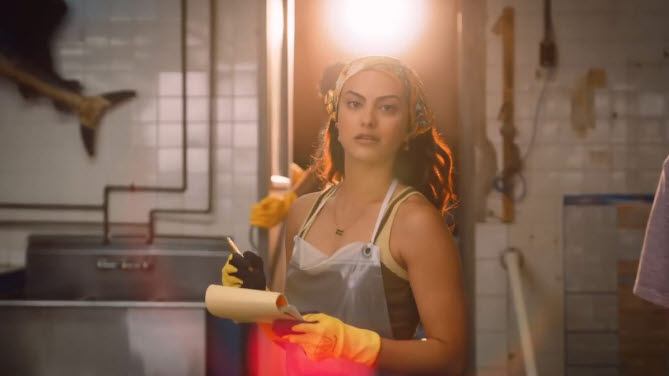
When he later comes to a local fish shop for doing a little errand for his mother, Ruby unexpectedly finds a chance for new romance. Although their first encounter is not exactly pleasant, Ruby becomes quite attracted to a young female employee working there, and it soon turns out that the feeling is mutual between him and Isabella (Camila Mendes). As they subsequently spend more time together, the movie provides several sweet moments to enjoy, and I particularly like when Ruby tries to show Isabella more of how his brain can instantly process many different sounds around him into a musical rhythm (This interesting neural condition of his brain is called Synesthesia, which is, according to the IMDB Trivia, “a perceptual phenomenon in which stimulation of one sensory or cognitive pathway leads to involuntary experiences in a second sensory or cognitive pathway.”).

Although their first official date turns out to be a bit disastrous due to one unexpected happening, Ruby and Isabella are still willing to move on the next step of their relationship. However, not so surprisingly, Haley comes to consider restarting her relationship with Ruby in the meantime, and his situation naturally becomes very complicated as he remains indecisive about which girl he has to choose.

Of course, what will eventually happen during the last act is quite evident to us to say the least, but the movie keeps things rolling as trying one impulsive musical moment after another. Even when he becomes all the more conflicted, Ruby’s mind still cannot help but process every sound into musical rhythm, and we frequently watch how people around him suddenly dance according to whatever is being processed inside his mind. Furthermore, he even begins to talk with his main puppet, and that certainly leads him to some soul-searching later in the story.

However, the screenplay by Mancuso and his co-writer/co-executive producer Dan Lagana often stumbles in its attempts to bring more substance to the story and characters. Most of the main characters in the film are rather broad stereotypes instead of feeling like real human characters to observe, and that is the main reason why one very awkward scene between Ruby and Haley’s rich white family is merely amusing despite some sharp points on the white prejudice against Latino immigrants. While the musical scenes in the film are well-executed on the whole, they are sometime distracting as interrupting the narrative flow of the movie, and you may come to wish that Mancuso put some more restraint on that as fleshing out the story and characters more.

As far as I can see from his solid lead performance, Mancuso looks like a promising new actor to watch. He is also supported well by several other main cast members including Camila Mendes, Francesca Reale, Maria Mancuso, and J.B. Smoove, and Smoove often steals the show as a local food truck owner who is also Rudy’s best friend.

In conclusion, “Música” is a fairly enjoyable product despite some glaring flaws in terms of storytelling and characterization. Although I cannot wholly recommend the movie, the overall result occasionally shows Mancuso’s considerable talent and presence at least, and it will be interesting to watch what this evidently talented actor will do next in the near future.

Posted in Movies | Tagged , , , | Leave a comment

Sewol: Years in the Wind (2023) ☆☆☆(3/4): The chronicle of their long plight

I still remember how shocking the sinking of MV Sewol incident was to me and many other South Koreans. When there came sudden news reports on the incident during the morning of April 16th, 2014, it did not seem that disastrous as we were told that everyone on the ship was saved at least, but then it soon turned out to be much more devastating than expected, and we were all the more outraged as how incompetent and heartless President Park Geu-hye and her government were in handling this terrible incident and the aftermath during next few years.

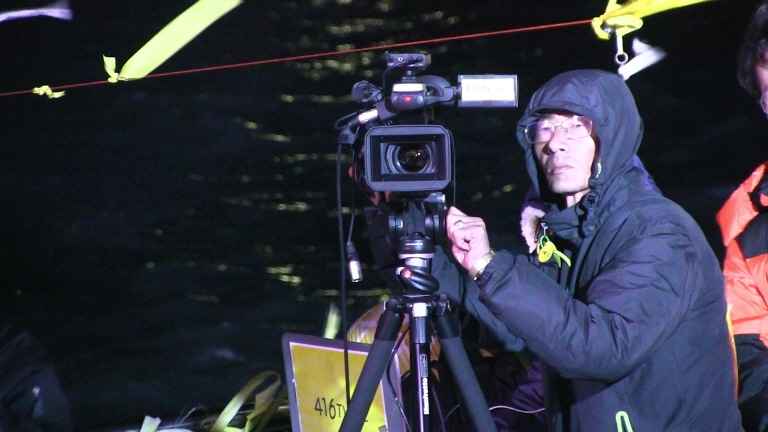
South Korean film “Sewol: Years in the Wind” simply and patiently followed the long plight of the surviving family members of those many young victims of the incident. At that time, a big group of boys and girls from one high school in a city called Ansan were on the ship, and most of them died mainly because they were simply told to stay inside the ship even when it was sinking. Needless to say, the parents of these dead students including co-director Kim Hwan Tae, who made the documentary along with Moon Jong-taek, were quite devastated to realize that their kids were not saved at all from the beginning, and they instantly demanded the government the open and thorough investigation on the incident, while trying to cope with their immense pain and grief.

However, the parents only found themselves getting more traumatized and frustrated due to what followed next to them. As President Park and her government did not do anything helpful for them at all, they decided to take care of their urgent matter for themselves, but then they were cruelly harassed and oppressed by the government and President Park’s right-wing party as well as those powerful media companies, who all stopped at nothing to insult and humiliate the parents. While her government willfully used the police and many other legal means for silencing the parents as much as possible, her party and several right-wing media companies constantly attempted to make the parents look like greedy people trying to benefit from the death of their children. Sadly, this tactic worked on many right-wing people to some degree even though there were also a considerable number of liberal and moderate supporters for the parents.

One of the most painful and infuriating moments in the documentary comes from a bunch of right-wing bullies and thugs deliberately eating lots of junk food right in front of the parents when the parents were attempting a public hunger strike. This surely reminded me again that there are lots of deplorable free-range rudes out there in the South Korean society who willingly give up being decent citizens and human beings because of hate and bigotry – just like those hateful MAGA people out there in US.

The parents still tried to stick together for drawing more public attention to their important cause, but their pain and frustration only got increased more day by day as they were pushed back further and further despite their desperate efforts. At one point, the school of their dead children eventually decided to clean up all of the kids’ classrooms which had functioned as memorial spots for a while, and this was surely another painfully unfair stab at their grieving heart.

At least, it later looked like there finally came a small light for the parents around late 2016 as the sheer incompetence of President Park and her government was fully revealed at last. Yes, they could have actually responded quickly to the incident, but President Park, who was revealed out to be a virtually mindless puppet of her equally hapless best friend as many of us had suspected for years, was totally at a loss about what to do next, and many government documents showed more of how much she and her government systemically oppressed the parents for covering up their gross incompetence.

In the end, the South Korean society was rocked by a series of massive public protests demanding the impeachment of President Park, and the parents were exalted when the congress eventually allowed the impeachment, but, again, they were let down by many of those prominent politicians including President Park’s successor President Moon Jae-in. While President Park was subsequently ousted early in the next year, she was not prosecuted at all for her incompetent response to the incident, and President Moon, whom I came to dislike and criticize more these days even though he was supposed to be a liberal compared to President Park, and his party only threw empty promises to the parents without caring much about the full investigation on the incident. As a matter of fact, he even pardoned President Park before eventually being succeeded by the current president of South Korea a few years ago.

And the parents were let down further as watching how the South Korean society and its people got more inclined to move on without looking back at the incident and their pain and suffering from that at all. They have wanted to make a memorial park in their city for their lost children and other victims, but many people were against that as wrongfully arguing that it will make their neighborhood look bad and disreputable, and President Moon and his government provided no help or support at all. The parents continued to protest as before, but they were reminded again and again of how apathic and callous the South Korean society and its people can be, and then there came the Seoul Halloween crowd crush incident on October 29th, 2022, another traumatic disaster clearly showing that their society and its people and government did not learn much from the sinking of MV Sewol incident.

Overall, “Sewol: Years in the Wind” is another earnest documentary about the surviving family members of the sinking of MV Sewol incident after “Life Goes On” (2021), which incidentally regards its main subject in a relatively wider view. As watching these good two documentaries one by one yesterday, I came to reflect more on the very serious systemic flaws of the South Korean society and government with more bitterness and sadness, and I certainly recommend both of them if you still care about the truth and justice for the surviving family members of the victims of the sinking of MV Sewol incident. Yes, they are trying very hard even at present for the closure still beyond their reach, and they do need all the support and compassion we can give right now.

Posted in Movies | Tagged , , , , | Leave a comment

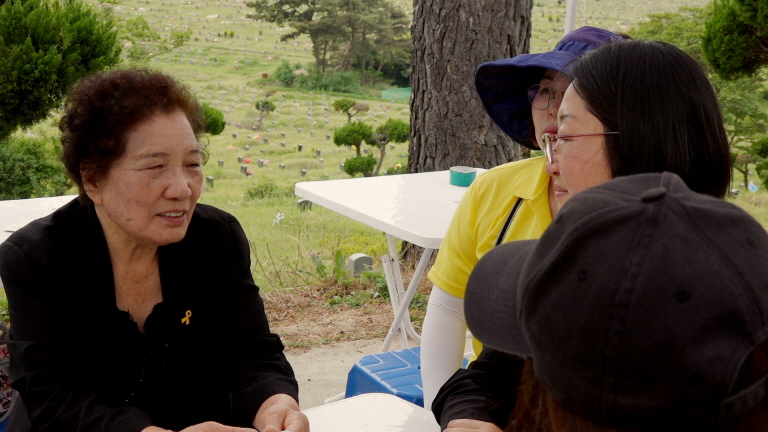
Life Goes On (2021) ☆☆☆(3/4): As they hold up

South Korean documentary “Life Goes On” is often sad and heartbreaking in its intimate presentation of several different persons who have tried to go on despite tragically losing their loved ones to some of the most traumatic accidents in the South Korean society during last three decades. While painfully accepting their irreversible personal losses, they also show some solidarity and compassion to each other as sharing their personal pain and frustration, and their individual stories remind me again of what has often been seriously disregarded and forgotten in the South Korean society for many years.

The documentary begins with Yoo Kyeong-geun, a plain family man who has been trying to demand more investigation on the sinking of MV Sewol incident on April 16th, 2014, which led to the death of more than 300 passengers including one of his daughters. At that time, his daughter happened to be going to Jeju Island along with many of her schoolmates, and, unfortunately, most of them died mainly due to the gross incompetence of President Park Guen-hye and her South Korean government.

What happened next to Yoo and many other grieving parents was quite unjust to say the least. No matter how much they protested for the truth and justice for their lost children, President Park and her government not only ignored them blatantly but also oppressed them a lot during next several years. For example, her despicable right-wing party and some powerful right-wing media companies willfully insulted and tarnished them by any means necessary, and, believe or not, there were also truly despicable thugs and bullies who gleefully ate junk food right in front of them when Yoo and his colleagues began a desperate hunger protest in public at one point.

In the end, President Park and her government were a lot more criticized as their sheer incompetence in responding to the incident was exposed more later, but Yoo and his colleagues remained dissatisfied as before. After President Park was consequently ousted, her successor, President Moon Jae-in, promised more investigation on the incident, but he and his party did not show much will or determination in keeping their promise, while many South Koreans became more inclined to forget and then move on without much thought or reflection.

This infuriating social apathy was evident when Yoo and his colleagues subsequently tried to install a big memorial for the victims of the incident in their city. While they had a fair share of supporters, there were also lots of people opposing against the memorial. These people impertinently argued that it would make their neighborhood look bad and disreputable, and, what do you now, some of them are the prominent members of President Park’s party.

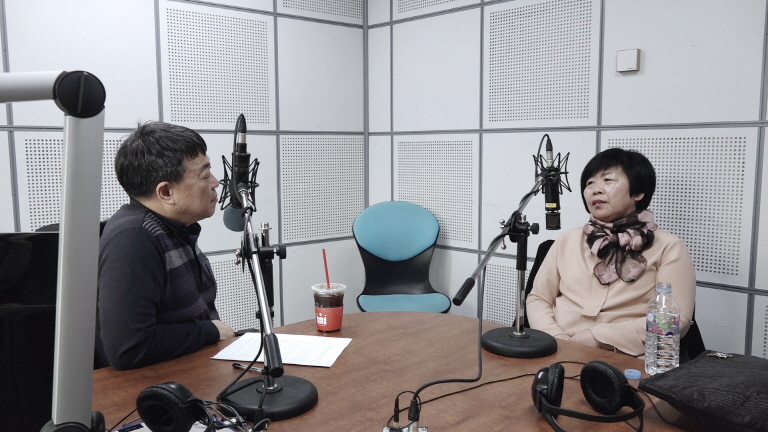
Meanwhile, Yoo began his independent podcast show, and that was how he came to meet and interact with many people who have suffered and endured a lot under the situations not so different from Yoo and his colleagues. In case of a guy named Go Seok, he lost his child to a big fire accident which killed more than 20 people including several young children on June 30th, 1999, and he has surely experienced his own grief and frustration despite his strenuous efforts on bringing more public awareness to child safety. In case of a middle-aged woman named Hwang Myeong-ae, her lost daughter was one of many victims of the Daegu subway fire incident on February 18th, 2003, and she still remembers how she and other surviving family members of the victims had to go there for collecting any remain of the victims for themselves.

As talking more with these two people and many others via his podcast show, Yoo came to see that he and his colleagues was not alone at all from the beginning. As a matter of fact, late Bae Eun-sim, who had been a prominent public figure since the death of her young democratization activist son in 1987, willingly and openly showed solidarity and compassion to Yoo and his colleagues because she understood well their ongoing plight. Right after her son got killed due to police brutality, Bae bravely stood forward in public along with the parents of many other dead young activists, and they all were harassed and oppressed a lot just because they demanded truth and justice to the government just like Yoo and his colleagues.

Sadly, the South Korean society and people do not seem to learn much even at this point. During last 10 years, the sinking of MV Sewol incident has been faded away from our public consciousness just like many other disastrous incidents caused by negligence and incompetence before that, and I and many other South Korean people had another social/personal trauma when the Seoul Halloween crowd crush incident happened on October 29th, 2022. Again, the South Korean government and its current leader were more occupied with saving their face and position instead of doing anything for us as well as the surviving family members of those unfortunate victims, who also came to experience their own grief and frustration just like Yoo and the other surviving family members of the victims of the sinking of MV Sewol incident.

On the whole, “Life Goes On”, which is directed by Jang Min-gyeong, is a modest but poignant documentary which handles its important main subjects with enough care and respect. Yes, things may not be changed that soon in the South Korean society, but, folks, there is always hope as long as people are still capable of compassion and solidarity, and I and many other South Koreans really should keep remind that to ourselves more than ever.

Posted in Movies | Tagged , , , , | Leave a comment

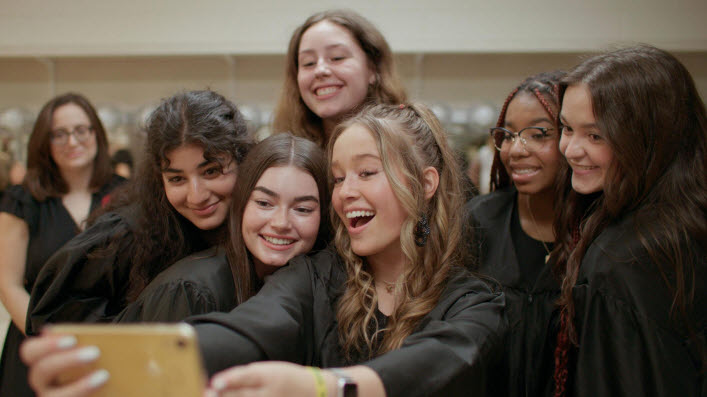
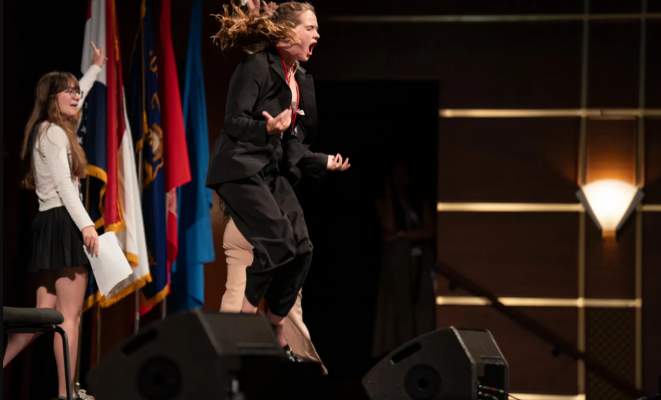
Girls State (2024) ☆☆☆1/2(3.5/4): Girls can do anything indeed

Documentary film “Girls State”, which is currently available on Apple TV+, observes a bunch of American female teenagers going through a well-known week-long leadership and citizenship program. While they sometime find themselves limited by gender bias and inequality, these young girls also often excel themselves in one way or another, and that surely reminds us again that girls can indeed do anything just like boys.

The documentary is intended as a companion piece to directors/producers Jesse Moss and Amanda McBaine’s previous documentary “Boys State” (2020), which is incidentally also available on Apple TV+ now. In nearly all of the states in US, the American Legion Boys State and the American Legion Auxiliary Girls State have been separately held in every summer, but there was some significant change in case of the Girls State held in Missouri for 2022 summer. This time, the Girls State was held along with the Boys State at the campus of the Lindenwood University in St. Louis during the same week, though the boys and the girls were still separated from each other nonetheless.

Anyway, those numerous participants of the Girls State were ready to do their best, and the documentary closely follows what some of them did and experienced during their one dynamic week. While they are all different from each other in terms of family background and political belief, all of them are eager to engage in a series of discussions and arguments with many other participants, and they certainly aspire to achieve each own goal in their little democratic experiment during next several days.

To many of the participants of the Girls State, the recent news on the impending decision of the US Supreme Court on the female rights on abortion naturally becomes a big issue to talk and discuss about. In case of Emily Worthmore, she seems to be your average conservative Christian girl at first, but, despite her strong conservative viewpoint, she keeps her mind open while showing much willingness to listen to different viewpoints, and she also agrees that female autonomy always comes first above all. Compared to those petty and deplorable American right-wing politicians out there, she surely looks a lot more reasonable and sensible to say the least, and you may hope that she will eventually become a good politician someday as she sincerely hopes.

In case of Nisha Murali, she surely feels like an outsider as the daughter of an immigrant family right from the first day, but she is not so daunted by this at all. Like Emily, Nisha is willing to express her political belief more in front of other girls as diligently reaching for her own goal, and the same thing can be said about Tochi Ihekona, who is another notable girl from immigrant family in the group and wants to take the position of the general attorney in the program.

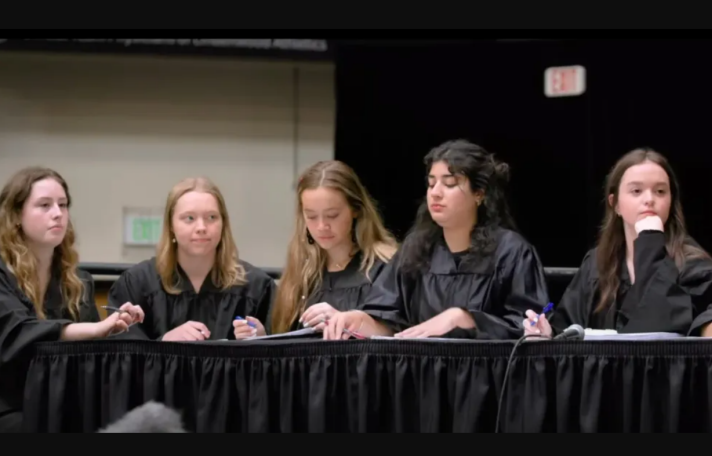
Nisha and several other participants later attempt to be appointed as the Supreme Court Judges, and we see how each of the girls tries to show more of their intelligence and passion during the following evaluation process, which is incidentally supervised by a few selected participants. When the eventual picks are announced, some of the candidates are understandably disappointed, but everyone congratulates on those chosen participants, nonetheless.

Meanwhile, Emily and several other girls embark on the upcoming Governor election, and we observe them respectively working on how they can appeal to more participants during next several days. In case of Cecilia Bartin, she draws a lot of attention from others via her forceful presence coupled with her own strong political opinions, and it is evident that she is going to be the one to beat for Emily and other prominent nominees.

As these and many other participants of the Girls State try to excel themselves as much as possible, the documentary makes some sharp point on the considerable gender gap between the Boys State and the Girls State. As pointed out later in the documentary, the Girls State has received less fund and support compared to its male counterpart, and many of its participants become more aware of this glaring inequality as often watching the Boys State from the distance. In fact, Emily subsequently tries to publish an article on this unfairness in the newspaper of the Girls State, but, to her frustration, her strong opinion on that is diluted to considerable degree by her supervising adult editor.

In addition, the documentary looks into the Boys State from time to time, and the difference between the Boys State and the Girls State is quite glaring to us at times. Both the girls and the boys are equally competitive, but those elected participants of the Boys States receive an aggressive mix of boos and cheers, while their counterparts of the Girls State are wholeheartedly applauded by everyone at the spot. In my humble opinion, that says a lot about why we really need much more female politicians and activists.

In conclusion, “Girls State” is a commendable documentary which surely deserves to be watched along with “Boys State”. While it bitterly reminds us again of the current social/political backlash on the female rights in the American society before its end credits, it powerfully shows us the considerable hope for more change via those smart girls to observe and admire, and it is certainly one of the better documentaries of this year.

Posted in Movies | Tagged , , , , , | Leave a comment

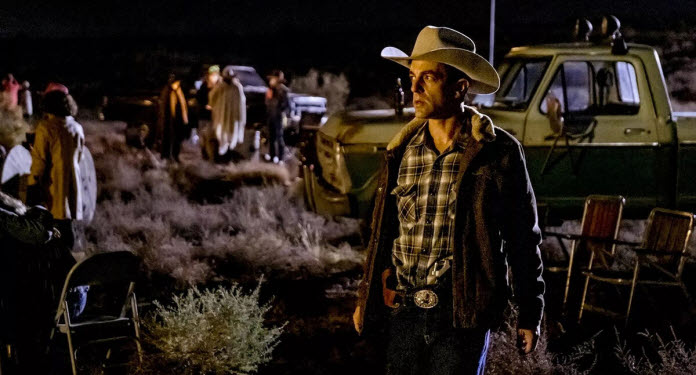
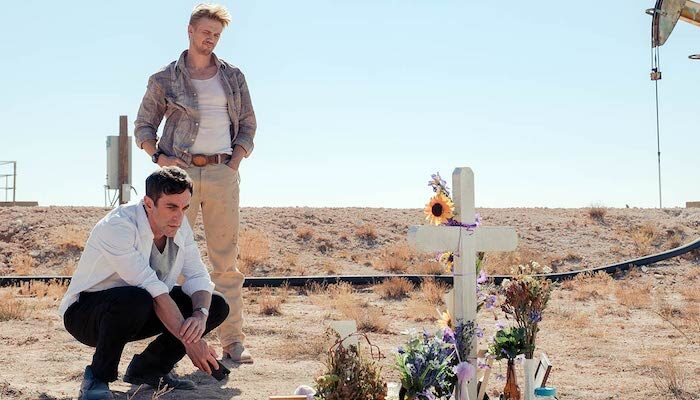
Vengeance (2022) ☆☆1/2(2.5/4): An offbeat comedy mystery drama set in Texas

“Vengeance” baffled me with some amusement and disappointment. Languidly driven by a little investigative reporting process on the mystery surrounding one seemingly plain incident, the movie attempts to make some barbed points on the current social/cultural gaps and divides in the American society, but, ironically, it also dabbles in numerous clichés and stereotypes you can expect from its quirky story promise. The overall result sometimes swings too much between drama and satire without enough balance for that, and I am still scratching my head on how to process its interesting but rather uneven presentation of various ideas and thoughts popping here and there.

B.J. Novak, who also directed and wrote the film, plays a New York City writer named Ben Manalowitz, and the early part of the film shows how superficially self-centered this dude is. While he has been fairly successful enough to support himself, Ben wants more success and attention nonetheless, and that is why he has tried to get draw some interest from a female friend of his who is incidentally an editor working in some big podcast company. However, she is not particularly interested in whatever suggested from him because, probably, she sees through his seemingly fancy but ultimately hollow words right from the start.

On one day, Ben receives an unexpected call which confounds him a lot for a good reason. The caller is the older brother of some young Texan woman with whom Ben slept a few times some time ago, and this guy tearfully notifies to Ben that, as already shown to us at the beginning of the film, his younger sister died recently. Ben is reluctant when he is asked to attend the upcoming funeral to held at that young woman’s hometown in Texas, but he eventually agrees to go there, mainly because her older brother is so persistent in his personal request that Ben cannot possibly say no.

After managing to endure a very awkward moment when he has to say something nice about that dead young woman, Ben is introduced to her surviving family members, who look and feel as clichéd as you can possibly imagine. For example, everyone in the family surely knows how to handle firearm, and they are also inexplicably quite obsessed with a certain local fast food restaurant, which seems to be the best place in their neighborhood although it does not have anything particularly special to eat.

Naturally, Ben is your average fish-out-of-water under this situation, and the movie dryly doles out some droll moments of cultural clashes you can expect from this setup. Yes, he surely comes to have another very awkward moment as an outsider when he attends a local rodeo game at one point. Yes, he also goes to a local bar where many people joyfully dance together on the floor, and he is rather amazed by that. As a matter of fact, it looks like he has never watched such a thing like that from TV or movies, though he says that he attended the SWSX Film Festival in Austin, Texas a few years ago.

Meanwhile, Ben comes to the possibility of an interesting narrative via that dead young woman’s brother, who is somehow convinced that she was actually murdered. Although there is no hard evidence, Ben is willing to investigate the incident more for getting more materials for his future podcast show, and his editor friend actually becomes interested enough to encourage and support him.

Of course, as he delves more into the incident, Ben is reminded again and again of how things can be weird or dangerous in Texas. Not only the local police but also several other law enforcement organizations are not particularly interested in resuming the investigation, and you may be amused by the sequence where Ben keeps facing the dead end in one way or another thanks to their very uncooperative attitude. In addition, it looks like he is not so welcomed by everyone in the area, and that naturally makes his podcast materials look more interesting than before.

However, Novak’s screenplay often loses its way more than once during its final act. While it seems to make a sly fun of Ben and many other stereotype characters in the story, it only scratches the surface without giving much depth to the story and characters. Around the finale, the movie does try to attempt to be more serious as our pathetic hero going through some soul-searching, but then it takes another expected plot turn as going through another odd moment along with him, and that can be a bit too jarring to you.

Anyway, Novak, who is no stranger to comedy considering his substantial supporting turn in American TV comedy series “The Office”, is effective in his character’s frequently self-absorbed status, and several main cast members including Boyd Holbrook, J. Smith-Cameron, and Issa Rae manage to bring some life and personality to their rather thin supporting parts. In case of Ashton Kutcher, he simply steals the show as the elusive but charismatic local music producer who was once associated with that dead young woman, and he will remind you again that he is capable of giving a very good performance if he gets a chance for that.

In conclusion, “Vengeance” is not entirely satisfying despite some enjoyable elements, but it shows at least that Novak, who made a feature film debut here, is a competent filmmaker with some potential. He stumbles a bit too much, here, but he may give us something more satisfying in the next time, and I will certainly keep my mind open for that.

Posted in Movies | Tagged , , | Leave a comment

Soft & Quiet (2022) ☆☆☆(3/4): Tense & Disquieting

“Soft & Quiet” is a small but striking genre piece you will not easily forget. As it pulls no punch at all in its increasingly tense and disturbing presentation of racism, you will probably wince more than once, but the movie will hold your attention to the end thanks to its skillful handling of mood, story, and character, and it will surely make you reflect more on its sensitive main subject after the gut-chilling finale.

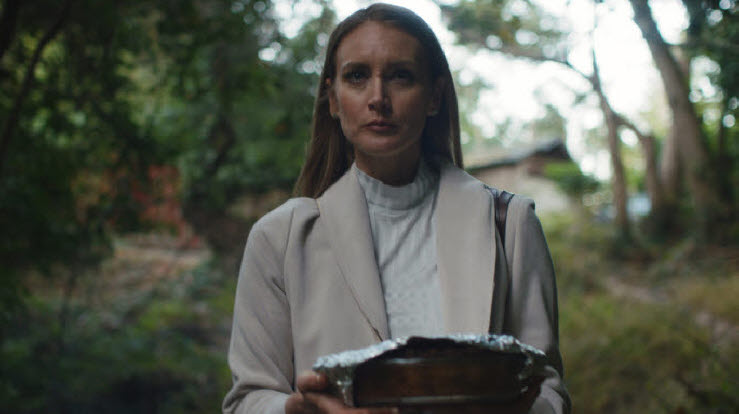
The movie opens with a white woman nervously doing a pregnancy test, and then we get to know a bit about her. She is a kindergarten teacher living in some suburban neighborhood, and we see her interacting a bit with one of her little students before going to some meeting, but then we gradually become uncomfortable about her – especially when she deliberately makes that innocent kid do a small act of racism to a colored janitor of her workplace.

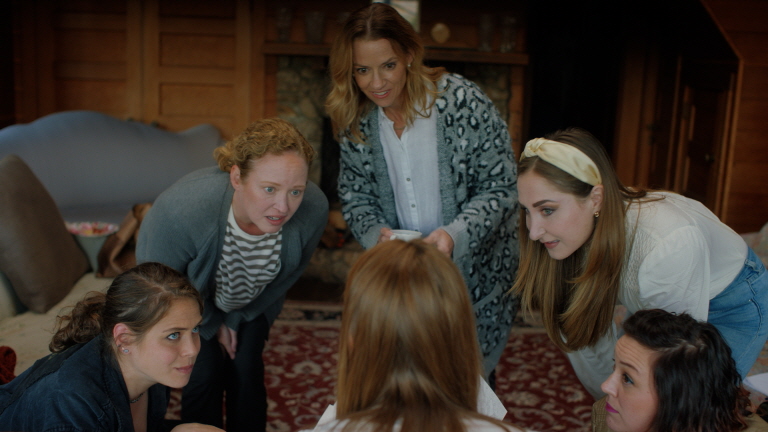
After she subsequently arrives at a meeting where some other white women are waiting for her, she comes to reveal her true color along with a little special pie of hers. They are actually your typical white racists just like those deplorable American people unleashed by the political rise of Donald J. Trump, and their following conversation and discussion feel like a sort of twisted endurance test for any sensible audience. While they look surely absurd in justifying their disgusting racist belief, it is really unnerving to watch them casually and cheerfully exchanging their toxic ideas and thoughts among them, and you may often feel like watching what is happening among a group of anonymous racists at the dark corners of the Internet at every hour.

This is definitely not a pleasant sight to watch at all, but the movie keeps things rolling for a while among these detestable ladies, who are fleshed out bit by bit as they talk more and more with each other. While we come to observe them from the distance with more disgust and uneasiness, they look and feel plausible as persons you may come across inside the American society, and that is why their banality of evil is quite frightening to us – particularly when they discuss more about how they will propagate their racist ideas more out there in “soft & quiet” ways. Their strategies may sound silly and pathetic, but just think about how all those absurd and outrageous racists lies from that orange-faced prick are still appealing to millions of his despicable followers even at this point.

In addition, director/writer/co-producer Beth de Araújo and her crew members including cinematographer Greta Zozula did an impressive job of bringing a considerable amount of realism and verisimilitude to the story and characters. They present the whole movie in one continuous shot, and, though this visual approach has been a lot more common since Alejandro G. Iñárritu’s Oscar-winning film “Birdman or (The Unexpected Virtue of Ignorance)” (2014), the result is still very impressive because they actually shot the movie in real time. Later in the story, the movie moves along with its main characters from one spot to another, but the camera steadily follows them without any interruption, and that makes the following second half of the movie all the more intense.

Now I have to be a little careful about describing the second half of the story, which becomes a lot darker than expected. There is an unpleasant but undeniably tense scene between its racist main characters and a couple of young colored women, one of whom is incidentally associated with what recently happened to the brother of the teacher character. Not so surprisingly, she and her fellow racists become all the more spiteful after this very disagreeable encounter, and then they eventually decide to be more active with their racist belief.

Around that narrative point, I could not help but reminded of that infamous home invasion scene of Stanley Kubrick’s “A Clockwork Orange” (1971), and the movie thankfully restrains itself a bit as they are driven further into cruelty and apathy by the vicious group mentality fueled by their racism. When they belatedly come to face the consequence of their actions, they are naturally thrown into more panic and fear, and then they find themselves going down further into the serious mess caused by them. Although we remain cold and distant to them as before, we are grabbed by the increasing level of tension around them, and you may be thankful for the very last shot, which is a bit contrived but necessary in literally bringing some air for us at least.

De Araújo, who made a feature film debut here after making several short films, also did a good job of pulling the credible performances from her small cast members. Stefanie Estes, Olivia Luccardi, Dana Millican, and Eleanore Pienta ably embody their characters’ deplorable aspects without too showy at all, and Luccardi is especially chilling when her character shows more willingness to go further than her fellow racist women. As the two crucial supporting characters in the story, Melissa Paulo and Cissy Ly are also effective, and Jon Beavers is also solid as the reluctant husband of Estes’ character.

On the whole, “Soft & Quiet”, which was incidentally distributed by the Blumhouse Productions in US (Jason Blum serves as one of its executive producers, by the way), is certainly not something you can casually watch on Sunday afternoon, but it skillfully leads us into the plain but ultimately chilling evil of racism. To be frank with you, I do not know whether I will be ever able to revisit it someday, but I am still impressed enough by the overall result, so I recommend it with some reservation.

Posted in Movies | Tagged , , | Leave a comment

Kung Fu Panda 4 (2024) ☆☆1/2(2.5/4): Enough is enough…

Animation film “Kung Fu Panda 4” is a passable product not bringing anything particularly new or surprising to its franchise, which was started with “Kung Fu Panda” (2008) and then continued in the two following sequels during next several years. I must confess that I do not remember anything much from any of them, but I do remember at least that I enjoyed all of the first three films in one way or another. Sadly, this new Kung Fu Panda film just mildly entertained me as being rather deficient in several aspects including story and character, and the result is another disappointing animation film of this year.

Again, our bumbling Panda hero Po (voiced by Jack Black) finds himself challenged inside as well as outside for more adventure and some spiritual growth on the way, so we are accordingly served with lots of physical comedy and some action as expected, but the film sometimes lacks humor and spirit compared to its predecessors. Sure, it is competent in technical aspects, but what we get here is pretty much same as what we got from those three previous films, and the film simply just stays on autopilot mode from the beginning to the end without trying anything fresh or interesting at all.

Most of all, the villain of this film is a big letdown compared to the villains of the previous films. Viola Davis, who seems to be more uninhibited in her stellar acting career especially after recently becoming another EGOT (Emmy, Grammy, Oscar, and Tony) winner, is certainly having a ball with her villain character here as she previously did in “The Hunger Games: The Ballad of Songbirds and Snakes” (2023), but her good voice performance still does not wholly compensate for her colorless character, and you will come to wish that the film utilized her distinctive talent more effectively.

Anyway, Po’s internal challenge comes when Master Shifu (voiced by Dustin Hoffman), an old red panda who has been Po’s master, notifies that Po must find someone to succeed him as a new Dragon Warrior. Because 1) he has had so fun and excitement as the current Dragon Warrior and 2) he is not so sure about whether he can actually decide who will succeed him, Po is naturally reluctant at first, and Master Shifu only tells his dear pupil that the time for change will come sooner or later no matter how much he resists.

Meanwhile, Po also comes to learn about the menace from Davis’ villain character, and, what do you know, he happens to encounter someone who may lead to his very dangerous opponent. That figure in question is a young corsac fox named Zhen (voiced by Awkwafina), and she gets imprisoned after being caught for stealing some artifacts in Po’s temple, but Po agrees to release her if she accompanies for helping him.

It goes without saying that Po and his rather unreliable companion do not click that well with each other during their bumpy journey to a big city dominated by Po’s latest opponent, and I do not even have to tell you that there is something sneaky about Zhen right from the very beginning. As a matter of fact, her and Po’s narrative arc so predictable to the core that we are not so surprised by her hidden agenda to be revealed later in the story – or how her resulting inner conflict is eventually resolved.

As many of you will agree, both Jack Black and Awkwafina are good comedians, but their voice performance often feels perfunctory in my inconsequential opinion. At least, Black seems a little more committed compared to his rather generic voice performance in “The Super Mario Bros. Movie” (2023), and Awkwafina also brings some sassy pluck to her character as she previously did in “Raya and the Last Dragon” (2021).

Interestingly, the subplot involved with the impromptu journey of Po’s two very different fathers often steals the show from the main plot. Although this part is virtually dragged by the main plot, it has more effective comic moments in fact, and James Hong and Bryan Cranston, who respectively reprise their familiar roles here, are effortlessly funny as a mismatched duo as compensating for the glaring absence of Po’s usual colleagues to some degree.

In case of several other notable voice cast members, some of them manage to inject some spirit and personality to their broad supporting parts despite being mostly under-utilized. While Ke Huy Quan, who has been more prolific thanks to his terrific Oscar-winning turn in “Everything Everywhere All at Once” (2022), shows more of his comic talent as an old associate of Zhen, Ian McShane and Dustin Hoffman do a bit more than required by their thankless roles, and the special mention goes to Lori Tan Chinn, who is hilarious as the cranky owner of a certain dangerous bar.

In conclusion, “Kung Fu Panda 4” is not a total bore at all, but it is one or two steps below its three predecessors, and you may seriously ask yourself whether another Kung Fu Panda movie is really necessary, though, considering the current box office success of “Kung Fu Panda 4” around the world, we will surely get that within a few years. As far as I observed while watching it at a local movie theater, young audiences surrounding me were entertained enough, but, to be frank with you, I really wanted to recommend them “Robot Dreams” (2023), a recent Oscar-nominated animation film which is currently being shown in South Korean theaters. That film is really something special to be enjoyed by not only young audiences but also all other audiences, you know.

Posted in Movies | Tagged , , , , | Leave a comment