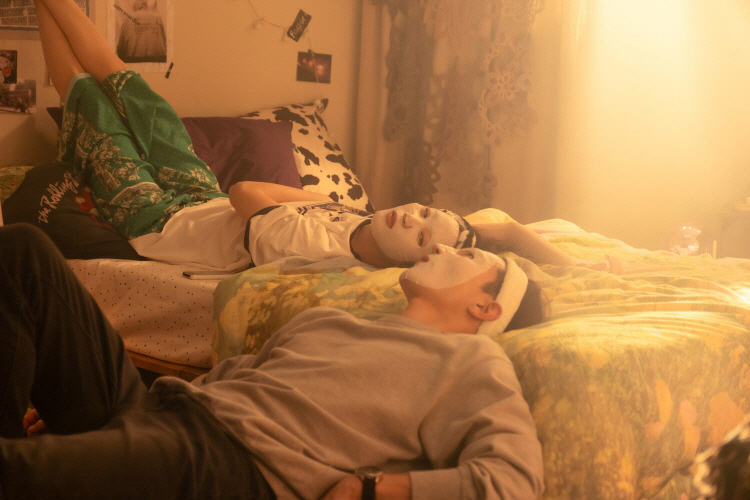
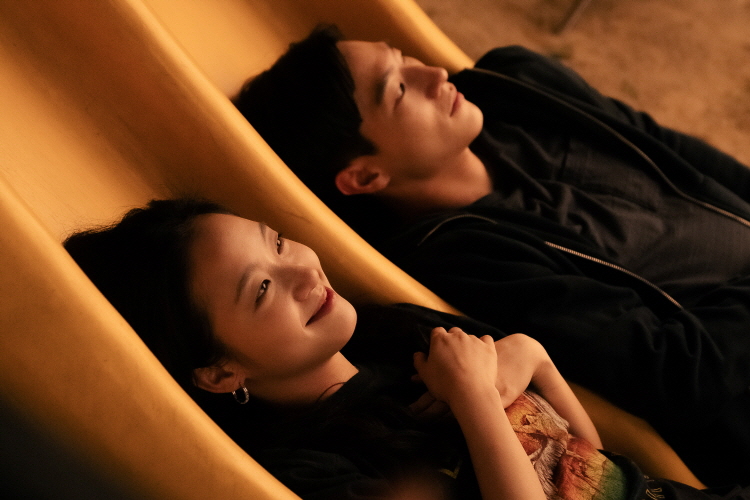
Suzhou River (2000) ☆☆☆(3/4): A gritty and bitter urban tale of romantic obsession

Chinese film “Suzhou River”, whose 4k restoration version was somehow released in South Korean theaters a few days ago, is a gritty and bitter urban tale of romantic obsession. Like many of other contemporary Chinese arthouse films, the movie requires some patience due to its slow narrative pacing, but this rather modest work is impressive for the raw juxtaposition between shabby realism and dreamy style, and I observe it with enough interest even when feeling impatient from time to time.

The story is mainly told via the viewpoint of a young aspiring filmmaker who is simply named “The Videographer” in the end credits while not being shown much on the screen throughout the running time, and the opening part of the movie serves us a series of random moments captured from here and there in a shabbier area around the Suzhou reiver of Shanghai, China. Although the city is going through a big social/economical change around 2000, this area often looks like being totally left behind from the ongoing national development, and the Videographer naturally adds some melancholy comments on these gloomy sights.

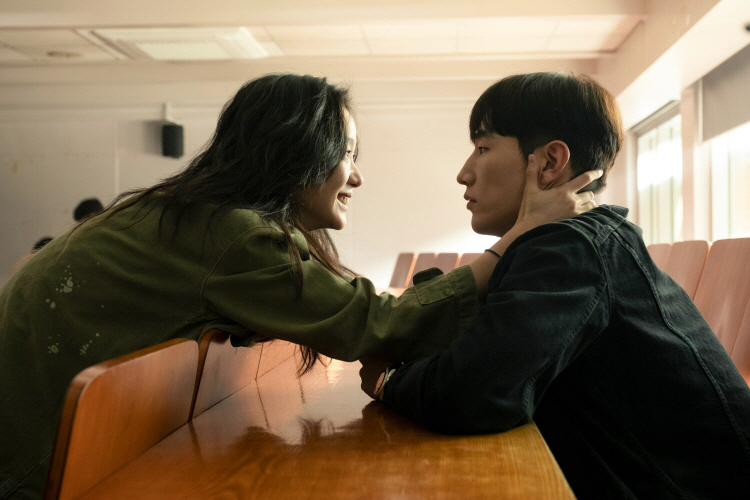
On one day, the Videographer is asked to shoot the mermaid show at a local bar, and that is how he meets Meimei (Zhou Xun), a pretty young woman who is going to wear a mermaid costume for that show. Right from their first encounter, the Videographer becomes quite attracted to Meimei, and Meimei willingly lets him a bit into her life as they get closer to each other for a while.

However, their relationship is actually not the center of the story. Meimei later asks the Videographer about whether he will look for her if she is ever vanished, and that is how she comes to tell the story about Mardar (Jia Hongsheng), a delivery man who got quite obsessed with one young beautiful girl he happened to be associated with. Even though it was quite possible that that young girl was already dead, this dude kept looking for her nonetheless, and then he found himself fixated on Meimei just because she looks a lot like that young girl.

Via a number of flashback scenes, we get to know more about Mardar’s relationship with that young girl, who was incidentally the daugther of some affluent local businessman. Whenever her father is having a little private time with any of his mistresses, Moudan, who is also played by Zhou Xun, has to be taken to her aunt’s apartment for convenience, and Mardar is the one who does that job for her father. At first, he does not care that much about Moudan, but he cannot help but get attracted to her as they spend more time together, and Moudan seems to enjoy getting his attention even though she remains rather elusive behind her plucky façade.

However, it later turns out that Mardar is involved in a little kidnapping scheme along with his two criminal associates. Everything seems to go well for their plan once Mardar keeps Moudan somewhere for a while, but, of course, things eventually go quite wrong for everyone including Mardar, who is consequently arrested and then sentenced to several years of incarceration.

When he is subsequently released from prison, Mardar searches for any clue to find Moudan, who has been presumed to be dead after she impulsively threw herself into the river at that time. When he comes across Meimei later, he is surprised by how much she resembles Moudan, and, what do you know, he soon goes after her just like James Stewart did to Kim Novak in Alfred Hitchcock’s “Vertigo” (1958).

Regardless of whether Meimei is actually Moudan, the movie toys with the growing ambiguity along the story as Meimei occasionally has some fun with Mardar’s intense attention. She sometimes asks him more about Moudan, but she never admits anything to him at all while keeping the distance between them as usual, and this strained relationship of theirs remains unresolved even after the Videographer enters the picture later.
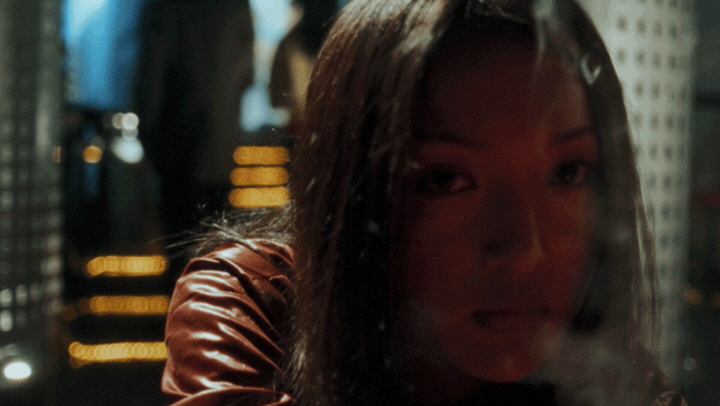
As both the videographer and Moudan struggle to deal with their tricky situation with Meimei, the movie frequently soaks itself into a dreamy atmosphere, which makes a striking visual contrast with its grim mundane background. Director/writer Lou Ye and his cinematographer Wang Yu willingly show the far less pleasant sides of the city on the screen, and, not so surprisingly, Ye was banned from filmmaking for two years when the movie was shown outside China without getting the permission from the Chinese government. The movie was eventually authorized later, but this was followed by more conflicts between him and the Chinese government during next several years, though he recently got his latest work premiered at the Cannes Film Festival early in this year.

Because of the constantly distant attitude of the movie, it is often hard for us to care that much about the story and characters, but Ye’s raw but stylish filmmaking holds our attention, and he also draws good performances from his two lead performers. While Jia Hongsheng holds the ground as required, Zhou Xun has several juicy moments as deftly handling her two different roles, and she is especially good when the line between her two characters is blurred a little later in the story.

In conclusion, “Suzhou River” is a dry but interesting exercise in style and mood, and I admired it even though I observed its good moments from the distance instead of fully engaged in them. In short, this is one of the notable works from the sixth generation of the Chinese Cinema during the early 2000s, and I think you should check it out if you want to know and learn more about the Chinese Cinema.

Posted in Movies | Tagged , | Leave a comment

Tokyo Story (1953) ☆☆☆☆(4/4): A great family drama

As revisiting Yasujirō Ozu’s “Tokyo Story”, whose 4K restoration version is being shown in South Korean theaters now, I was reminded again how it is sublimely gentle and bittersweet in the intimate depiction of the human sadness and melancholy observed from its family characters. While many of them just softly and quietly interact with each other throughout the film, the emotional undercurrents below the surface are more palpable to us as we look more into their feelings and thoughts, and that is the main reason why this movie is one of the most universal human dramas of all time.

The story premise is pretty simple to say the least. At the beginning, we are introduced to Shūkichi (Chishū Ryū) and Tomi (Chieko Higashiyama), an old couple living in some seaside village quite far from Tokyo. Except their second daughter who works as a local elementary school teacher, all of their children left their home for each own life some time ago, and Shūkichi and Tomi are now going to visit two of their children currently living with their respective families in Tokyo. Although it will take quite a long time to go to Tokyo by train, both of them are very excited about seeing their two children again, and we later see them welcomed at the house of their eldest son, who works as a doctor in a little suburban area around Tokyo.

However, we gradually come to discern that they are actually not welcomed that much by their children. While they are pretty much like old strangers to the two sons of their eldest son, their eldest son is frequently busy with taking care of local patients day by day, and we do not sense much affection between them and the wife of their eldest son, though they and she interact with each other as courteously as possible. Their eldest daughter, who has run a beauty parlor, is also always occupied with her own business, and we are not so surprised when she suggests to her older brother later that they should make their parents stay at a local spa outside the city for a while at least.

Ironically, the only person who really cares a lot about Shūkichi and Tomi besides their second daughter is Noriko (Setsuko Hara), the widow of their second son who died during the World War II. Although 8 years have passed since her young husband’s unfortunate death, Noriko remains devoted to her parents-in-law as before, and she is willing to spend some time with them when no one else in the family happens to be available for them.

As leisurely rolling the story and characters under that distinctive tranquil mood observed from many of Ozu’s films, the movie effortlessly moves back and forth between humor and pathos. While we are saddened by the growing melancholy surrounding Shūkichi and Tomi’s circumstance, we are also amused by a series of small comic moments observed among the main characters, which add more human qualities to them along the story. Yes, most of Shūkichi and Tomi’s children are pretty selfish at times just for being busy with each own daily matters, but they care about their parents to some degree, and we come to accept and understand their human flaws just like their parents.

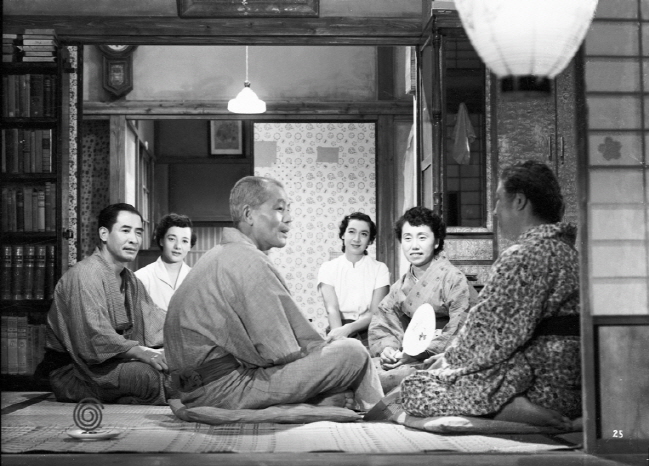
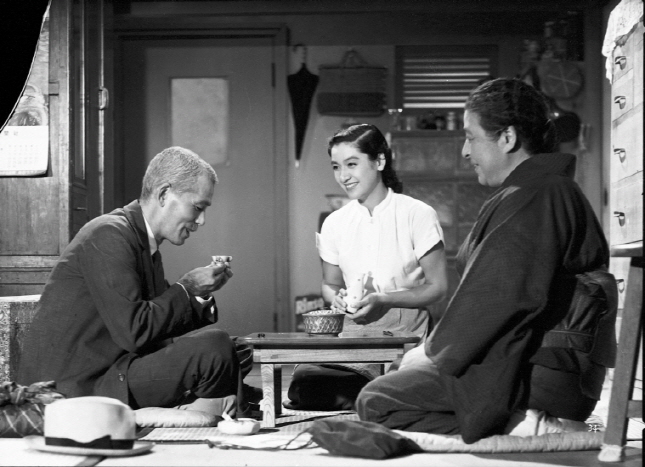
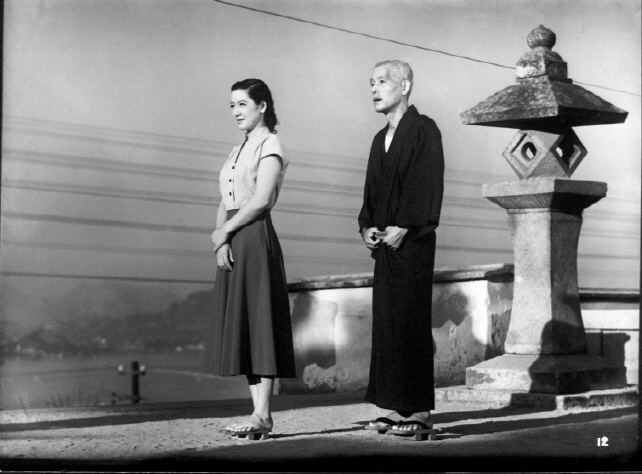
Ozu and his cinematographer Yūharu Atsuta usually observe the characters from the distance, but it is really remarkable how they subtly engage us without drawing much attention at all to their storytelling approach. Shot in black and white film of 1.33:1 ratio, the movie mostly feels static on the surface as the camera does not move that much during many of the conversation scenes, but then we come to pay more attention to whatever is being exchanged among the main characters mainly thanks to Ozu’s precise and thoughtful scene composition, which is often distinguished by how the characters and objects in the film are carefully arranged on the screen. Just look at how Shūkichi, Tomi, and a family member of theirs sit together during one certain brief moment in the middle of the film, and you will see what I mean.

In addition, the camera closely sticks to the level of the viewpoints of the main characters sitting together, which is crucial in those distinctive “Tatami shots” in Ozu’s works. The conversation scenes in the movie are sometimes accentuated by the camera directly looking right into a talking character, and, though this feels too plain and obvious at first, we gradually pay more attention to the understated nuances beneath the conversation scenes.

The performers in the film, many of whom were Ozu’s frequent collaborators, dutifully fill their respective role as adding more human elements to the story and characters. While Chishū Ryū and Chieko Higashiyama are often heartbreaking even though their characters do not signify much to us during their gradual realization on how they have become more distant to most of their children, Setsuko Hara always brings a warm sense of empathy and compassion to the story, and several other cast members in the movie including Haruko Sugimura, So Yamamura, Kuniko Miyake, and Kyōko Kagawa are also effective in their substantial supporting parts.

Overall, “Tokyo Story” is simply unforgettable for its haunting human qualities to be observed and appreciated. While this film and “Floating Weeds” (1959) are definitely the first ones to recommend, Ozu also made many other excellent films which deserve more attention in my humble opinion, and I assure you that you will not be disappointed all with any of these hidden gems. As a matter of fact, “Tokyo Twilight” (1957) is released along with “Tokyo Story” in South Korea, and I am already ready to watch this rather obscure film at last.

Posted in Movies | Tagged , , | 1 Comment

How to Make Millions Before Grandma Dies (2024) ☆☆☆1/2(3.5/4): Being with his grandma for money

Thai film “How to Make Millions Before Grandma Dies”, which was recently selected as the official submission of Thailand to Best International Film Oscar, is alternatively humorous and poignant in its gentle mix of human comedy and drama. While you can clearly see through where it is heading from the beginning, the story turns out to be more sincere and thoughtful along with a droll sense of humor to amuse us, and it surely earns all the emotions of its expectedly sentimental finale.

At first, we get to know about the rather distant relationship between an old lady named Mengju (Usha “Taew” Seamkhum) and many of her family members including her grandson M (Putthipong “Billkin” Assaratanakul). Although they gather together for a little family meeting at the beginning of the film, none of Mengju’s three children is not particularly close to their mother, and neither is M, your average young slacker who is simply bored while not much paying attention to his grandmother.

However, M later gets quite interested in being with his grandmother for a very selfish reason. One of young female cousins in his dead father’s family comes to receive a considerable amount of asset after taking care of her ailing grandfather for a while, so M decides to try something similar on his grandmother, who subsequently turns out to have a little time to live due to her terminal illness. Although she is much less affluent in comparison, her old residence happens to have some value as a piece of real estate, and he certainly wants to inherit that from her in exchange of taking care of her before her death. 

Of course, living with his grandmother turns out to be a bit more challenging than M expected. Even after she comes to learn of her terminal illness, Mengju is not daunted by this bad news at all while keeping going as usual, and M has no choice but to get accustomed to her daily routines including waking up and then preparing for her little porridge business early in the morning. In addition, he has also to hide more of his selfish intention as his mother and two uncles come to pay a lot more attention to Mengju than before for each own reason. 

Needless to say, our selfish hero slowly comes to care much more about his grandmother later in the story, but the screenplay by director Pat Boonnitipat and his co-writer Thodsapon Thiptinnakorn takes its time in building up the story and characters with more details to observe. While the Chinese heritage of the family characters in the story brings some specific cultural elements to the story, its supposedly broad main characters are illustrated with enough sense of life and personality, and it even shows a bit of compassion and understanding to one of Mengju’s two sons, a pathetic bum who has always brought nothing but money troubles to the family.

Above all, we get to know Mengju more bit by bit along with her grandson. As reflected by a brief but crucial scene between her and her estranged family member who heartlessly disregards her simple request, her life has been frequently ridden with one difficulty after another, but she does not lose her feisty spirit at all while also still capable of loving and caring about her family members around her. Although the movie is actually her debut film, Usha “Taew” Seamkhum’s gently soulful performance effortlessly swings back and forth between humor and pathos while ably embodying her character’s life history, and we come to like and care more about her character as Mengju is eventually approaching to the inevitable closing time later in the story.

 On the opposite, Putthipong “Billkin” Assaratanakul, who also made a debut here in this film, complements Seamkhum well, and he did a convincing job on his character’s gradual transformation along the story. While becoming much less selfish than he was at the beginning, M surprises even himself as sincerely wanting to be loved and appreciated by his grandmother, and he also comes to grow up a bit more as helping his grandmother reconnect with his mother, who has always loved Mengju despite having usually felt like being put behind her two brothers for many years.

 In the end, everything in the story culminates to the melodramatic finale as expected, but the movie wisely does not overplay at all while calmly but sensitively delivering the swelling emotions surrounding the finale. The result is certainly weepy enough to make many of you shed some tears, but it is genuinely touching nonetheless as we observe how the story comes to make a sort of full narrative circle with the very last scene.   

In conclusion, “How to Make Millions Before Grandma Dies”, whose original Thai title is just “Grandma’s Grandson”, is a familiar but undeniably moving family drama to be cherished for several good reasons including Boonnitipat’s skillful handling of story and characters and his two lead performers’ memorable performances. To be frank with you, the movie actually made me reflect more on how I have been quite distant to my aging grandmother since my childhood years, and, considering that she is over 90 at present, now I feel the need to show a bit more affection and respect to her than before, even though she was the least likable figure in her village or her family. I guess that says a lot about how good the movie is, right?

Posted in Movies | Tagged , , , , | 1 Comment

Rez Ball (2024) ☆☆☆(3/4): The story of a Navajo basketball team

Netflix film “Rez Ball”, which was released on Netflix a few weeks ago, is a typical basketball movie with some specific elements to observe and appreciate. Needless to say, this is basically your average underdog sports film which will remind you of many other seniors such as, yes, “Hoosiers” (1986), but it is equipped with an interesting story background which brings some local personality to its earnest narrative, and the result is a fairly solid genre product on the whole.

The story, which is mainly set in the Navajo Nation in New Mexico, US, begins with how a local high school basketball team and their coach try to begin another reason. Their star player, Nataanii Jackson (Kusem Goodwind), has just returned not long after losing his two family members due to a very unfortunate accident, but their coach, a former female basketball player named Heather Hobbs (Jessica Matten), is ready to try her best, and so do many of her team players including Jimmy Holiday (Kauchani Bratt).

However, of course, things do not look that promising right from their first game of the season. Although they win in the end, Hobbs are not so satisfied with how her team players played, and we also come to see that Jackson has not fully recovered from the grief and depression caused by the death of his two family members. This eventually leads to a devastating incident which struck hard many others around him, and many people come to have more doubt on whether the team can actually go on during the rest of the season.

Nevertheless, Hobbs does not give up at all as a good coach who cares a lot about her team players. Although it seems that her coaching career has no future despite her several job applications here and there in the country, she is not daunted by this at all, and she soon embarks on how to boost the ability of her team more than before. At one point in the film, she takes the team to a sheep ranch belonging to her grandmother, and her team players come to have some lesson on strategy and comradeship as they try to find and then lead a group of sheep back to the ranch.

As the team players become more focused under Hobbs’ guidance, they come to find their new center from Holiday, who comes to show more leadership around his colleagues despite his initial reluctance. While still struggling with what happened to his close friend, Holiday also has to deal with his alcoholic single mother as usual, and we see how Hobbs is more like a parent to him at times.

While going through one expected moment to another, the screenplay by director Sydney Freeland, who previously directed Netflix film “Deidra & Laney Rob a Train” (2017), and her co-writer Sterlin Harjo, which is based on the nonfiction sports novel “Canyon Dreams: A Basketball Season on the Navajo Nation” written by The New York Times journalist Michael Powell, sometimes pays attention to how things are usually gloomy for many people in the Navajo Nation. Young people like Holiday are certainly eager to get out of their area for a better life and future, but there are not many options for them from the beginning. Not so surprisingly, as mentioned in the film, the Navajo Nation has had a serious problem of depression, alcoholism, and suicide just like many other Native American reservation areas in US.

Holiday’s mother is one of such a sad, pathetic case. She was once a promising female basketball player when she played along with Hobbs a long time ago, but she has been going down and down with her alcoholism to her son’s frustration. In addition, she does not think her son will succeed as much as she could have during that time, and that surely puts more distance between them before she eventually comes to the point where most of alcoholics feel the need to turn around from their destructive lifestyle.

It goes without saying that the mood becomes more uplifting as Holiday and his team members excel themselves during a series of successful games. While pretty predictable at times, the basketball game scenes are as competent as they can be at least, and Kauchani Bratt and a bunch of other actors including Kusem Goodwind are convincing during these scenes in addition to bringing some extra spirit and personality to the story.

Without overshadowing Bratt and other actors at all, Jessica Matten steadily holds the ground for them, and I like how she earnestly handles her several locker room scenes. Hobbs does not make any rousing speech at all, but she shows common sense and dedication for her team players, and that is what any good coach is required to do. As Holiday’s struggling alcoholic mother, Julia Jones is rather under-utilized, but she manages to fill her role with enough sense of life, and she is poignant when her character finally makes some real connection with Holiday around the end of the story.

In conclusion, “Rez Ball” may not bring anything particularly new to its genre territory, but it is engaging enough to hold our attention thanks to its good direction and sincere storytelling, and you may want to learn more about its main subject after watching it. Yes, I saw through its playbook from the beginning, but it still plays the ball mostly well on the whole, so I will not grumble for now.

Posted in Movies | Tagged , , , , | Leave a comment

It’s What’s Inside (2024) ☆☆☆(3/4): A risky body-swapping game

Netflix film “It’s What’s Inside”, which was released on last Friday, is a cheerfully funny and confusing mix of comedy, horror, and thriller. I must confess that it was a bit too hard at times for me to follow whatever is happening among a bunch of main characters I did not care that much about, but I was entertained nonetheless by how the movie pushes its comically dark story premise to the end with enough style and mood.

The setup part of the story is pretty familiar to say the least. At first, we are introduced to Shelby (Brittany O’Grady) and her boyfriend Cyrus (James Morosini), and we subsequently see them going to a little evening part to be held at a big family house belonging one of their mutual friends of theirs, who invited them and their several friends for having some fun evening together before his upcoming wedding day on the next day. Due to the growing distance between them, Shelby and Cyrus are actually not so willing to go there, but they cannot say no just for keeping their appearance in front of others.

Not long after Shelby and Cyrus arrive at the house, there comes the last person to join the group. Although he has been quite estranged from others due to a serious incident which occurred during their college years, Forbes (David W. Thompson) got invited anyway, and, as a professional technician working in some IT company, he presents a very special device for their little game night. His friends are not so serious about that at first when he suggests doing a game via this special device, but, what do you know, they get their minds swapped among their respective bodies once he turns on that device for a test.

It goes without saying that everyone around Forbes is both surprised and disturbed by this very strange experience, but they eventually agree to do a game which is not so far from what most of you sometimes played with your friends for some evening fun. After getting their bodies swapped by Forbes again, they should guess the correct identity of whoever is actually inside their respective bodies, and this surely sounds like a lot of fun to them.

Of course, the mood gradually gets tense and unnerving as the main characters later come to find more of how much they can be free as hiding inside some other body. Although we cannot be entirely about who is who at times, the movie sometimes reveals the true identities behind those swapped bodies via a nice visual touch, and that certainly gives us some amusement especially when two certain swapped characters show more of their feelings to each other as enjoying being someone else.

During its second half, the movie eventually becomes a sort of cross between “Talk to Me” (2022) and “Bodies Bodies Bodies” (2022), and director/writer/editor Greg Jardin and his cinematographer Kevin Fletcher frequently emphasize the nightmarish circumstance of the main characters. While quite isolated from the outside, the house is decorated with various odd and weird stuffs thanks to the artist mother of the groom, and they look all the stranger with the striking utilization of light and shadow. For example, we instantly sense a trouble when a certain big sharp artwork is shown early in the film, and the movie exactly delivers what is expected at some point later in the film.

Because most of the main characters are quite superficial or unlikable, we often observe their plights from the distance without much care, but the movie has some nasty fun with how selfish and opportunistic its main characters can be. As coming to face more of the estrangement between them, Shelby and Cyrus have more doubts on their relationship, and, not so surprisingly, they come to focus more on their respective self-interest just like others around them. In case of their friends, they are no better than them at all, and some of the biggest laughs in the film come from one of them who is incidentally a popular (and very banal) online influencer.

Jardin’s screenplay stumbles a bit as arriving at the finale where everything in the story is hurriedly wrapped up along with a little unexpected plot turn, but it does not lose its sense of fun entirely. While you may feel a bit sorry for what eventually happen to some of its main characters, we all can agree that they richly deserve that for their folly and selfishness, and we surely get some another dark laugh from that.

The main cast members of the film certainly have a blast with playing several different roles along the story. While Britanny O’Grady and James Morosini have the most fun as we come to see more of their characters’ serious relationship problems, several other main cast members including Gavin Leatherwood, Nina Bloomgarden, Alycia Debnam-Carey, Reina Hardesty, and Devon Terrell are also well-cast in their respective roles, and David W. Thompson brings enough creepiness to the screen during the first act despite his rather thankless part.

On the whole, “It’s What’s Inside” could be improved more by more substance in terms of story and character, but its weak aspects are compensated enough by its wit and style at least, and it surely reminded again me that I should never, never, never play with something I do not understand at all. While this may not be the scariest stuff for the upcoming Halloween season, it is fairly dark and nasty enough in my humble opinion, and you may try it later along with your friends at any chilly autumn night.

Posted in Movies | Tagged , , , , | 1 Comment

Love in the Big City (2024) ☆☆☆(3/4): Two Roommates in the city

South Korean film “Love in the Big City” looks and feels typical at first. Yes, the unlikely friendship between a gay man and a heterosexual woman is not exactly an unconventional story material these days, but the movie has its heart in the right place in addition to being filled with enough personality and spirit, and we come to care about its two main characters more than expected.

After the prologue scene between its two main characters, the movie flashes backward to when they met each other for the first time during the freshman year of their college time. Right from their orientation week, Jae-hee (Kim Go-eun) draws the attention from many male students for her sassy and forthright attitude, but Heung-soo (Noh Sang-hyun) is just mildly amused mainly because of his homosexuality.

Nevertheless, as they study along with many other students in the French literature of their college, Heung-soo finds himself more fascinated with Jae-hee. She does not hide her irrepressible spirit and personality at all in front of others, and that certainly makes a big contrast with how Heung-soo has been strenuously hiding his homosexuality from others including his widow mother, who has been adamantly in denial since she witnessed her son kissing his first boyfriend.

When Jae-hee accidentally discovers that Heung-soo is gay on one day, Heung-soo naturally becomes so anxious that he even considers killing himself at one point, but, what do you know, Jae-hee willingly covers him up when he may get exposed to others in their class, and they become quite close to each other after finding many common things between them. For example, they often enjoy wild nights of dancing and drinking, and Heung-soo is willing to accompany Jae-hee whenever she needs someone safe enough to dance and drink with, and he also introduces her to a bit of his hidden lifestyle.

Of course, others around them begin to talk about whatever is going on around them, but Jae-hee and Heung-soo do not mind at all because Heung-soo can safely hide himself behind this false rumor. As they often spend time together in Jae-hee’s bigger residence, they get more accustomed to each other’s presence, and Heung-soo eventually comes to move into Jae-hee’s residence after one very unpleasant incident happens to her.

And we see more of how much different their viewpoints on love and relationship. While she gets disappointed and devastated more than once due to a series of crummy boyfriends, Jae-hee always finds more will and strength somehow for keeping going in her search of real love. Although he is often as lonely as she is, Heung-soo frequently hesitates to open himself more to his latest boyfriend, and he still cannot be honest about his homosexuality to others around him except Jae-hee. After getting severely beaten by several homophobic guys along with his boyfriend at one point, he becomes more afraid of being true and honest to himself, and that certainly affects his relationship with his boyfriend, who turns out to be a very nice guy who genuinely loves and cares about Heung-soo.

Anyway, Heung-soo and Jae-hee continue to support each other as much as they can, and the story bounces from one episodic moment to another along with them. While they get older along the passage of time, they often push and pull each other like a real couple, but they always depend a lot on each other during the worst moments of their lives, and the story becomes more poignant when Jae-hee finally comes to find someone who can not only love her but also accept who she is.

The screenplay by Kim Na-deul, which is based on a part of the acclaimed novel of the same name by Park Sang-young (The novel was also adapted into a TV miniseries, which will incidentally be released during this month), balances the story and characters well between humor and pathos. While never overlooking how things can be quite grim and difficult to its two main characters due to their status as outsiders, the movie also feels quite cheerful with a considerable amount of youthful energy, and we come to root for them more than before as occasionally amused by the comic moments between them.

The movie is also carried well by the two good lead performers at the center, who did much more than looking believable in their character’s gradual personal growth along the story. As Noh Sang-hyun, who previously appeared in “Seoul Searching” (2016), diligently holds the ground with his earnest acting, Kim Go-eun, a charming and wonderful actress who has steadily advanced since her breakthrough turn in “A Muse” (2012) complements her co-star well with her showier performance, and their solid chemistry on the screen often compensates for several weak points in the movie including a rather under-developed subplot between Heung-soo and his mother.

In conclusion, “Love in the Big City”, directed by Lee Eon-hee, may not bring anything particularly new to South Korean queer cinema, but it works well enough to engage and then touch us, and its wide theatrical release in South Korean theaters reminds me again of how things have been changed a bit compared to when I hesitated to be honest about my homosexuality around the 2000s. Yes, there is still lots of prejudice and hate against me and many other LGBTQ+ people out there in the South Korean society (My parents are still in denial even though I came out to my family in 2016), but the movie may lead to more mainstream queer films to come in the future, and I sincerely hope that they will soon come to me and other South Korean audiences.

Posted in Movies | Tagged , , , , | Leave a comment

Banel & Adama (2023) ☆☆☆(3/4): Being dried and suffocated

“Banel & Adama”, which was chosen as the official submission to Best International Film Oscar by Senegal in last year, is a sad story about a young rural woman getting dried and suffocated by the harsh reality of her isolated world. While she tries to be defiant as much as she can, it seems that she cannot stop the inevitability of her grim situation, and even her passionate love cannot help her much in the end.

At the beginning, everything looks fine for Banel (Khady Mane). She and her young husband Adama (Mamadou Diallo), who is incidentally the younger brother of her first husband who died not so long ago, are a lucky couple who has really loved each other, and they also have been planning to live outside their little rural village just because, well, they want more freedom and privacy. Whenever they have some free time, they go outside to dig up an abandoned house buried deep inside a mound of sand, and they do not care that much about whether it is really cursed as others in their village have said.

We also get to know a bit about the conflict between Adama and several town elders including his mother. Because he is the only surviving son of his father due to his older brother’s recent death, he has been expected to succeed his father as the new village chief, but Adama does not want that role at all even though he prepared for that role for some time, because he has felt rather burdened by this expectation.  

Meanwhile, the movie slowly lets us feel how things are getting gloomy for everyone in the village due to the ongoing drought. As they suffer more and more due to the serious lack of water and food, Adama and other men in the town naturally come to spend more time on how to maintain the village, and Banel is not so pleased about this change to say the least. Her dear husband becomes more like many other guys in the village as being frequently absent around her, and we observe how much she feels alone for refusing to conform to the patriarchy system of her village. Unlike the other young women in the village, she is determined not to become a mere wife and mother, and it is even suggested to us later in the film that she did something terrible for getting real love and freedom for her.

However, just like many others including her husband, she begins to wonder whether she and others in the village are cursed due to her and her husband’s little transgression. There are a series of brief but unnerving moments as her mind sometimes gets disturbed by some ominous vibe around her, and the circumstance becomes more despairing for her as her husband, who also experiences one very disturbing incident around that point, comes to bend himself under more pressure from his mother and others in the village. Although Adama still cares a lot about his wife, he and Banel become more distant to each other than before, and Banel consequently gets more frustrated than before as reminded again that she may eventually end up being stuck in a traditional role expected to be filled by her right from when she was born.  

Vividly conveying to us its heroine’s growing desperation and frustration along the story, the movie emphasizes more of how much the village is isolated in the middle of its vast remote area, and cinematographer Amin Berrada skillfully captures the stark beauty of the dried landscapes surrounding the village and its people. With any sign of rain to come, the village gradually feels static and lifeless as its residents become more restless and exhausted, and we are not so surprised as Banel looks more like being under some influence.

I wish the screenplay by director/writer Ramata-Toulaye Sy fleshes out the story and characters for more interest and understanding, but she did a solid job of immersing the audiences into a small, isolated background inhabited by its main characters, while never losing the focus on Banel and her increasingly deteriorating state of mind. Although you may get baffled by the rather ambiguous finale, this ending somehow makes sense considering what has been steadily built up to that point, and we all can agree that Banel comes to have some peace of mind regardless of what really happens to her in the end.

Sy also draws the good performances from her main cast members, most of whom are evidently non-professional performers as shown from their unadorned natural acting. As the center of the movie, Khady Mane is often heartbreaking as her character is driven more into despair and anxiety along the story, and she and her co-star Mamadou Diallo are convincing in the slow but inevitable implosion of their characters’ supposedly strong relationship. In case of the supporting performers, they simply seem to come and go around Mane and Diallo at first, but they look believable with a real sense of life nonetheless, and that is one of the main reasons why the movie kept holding my attention despite its decidedly slow and opaque storytelling.

In conclusion, “Banel & Adama” is a modest but interesting debut work from Sy, who previously made several short films before making a feature film debut here in this film. Although it will require some patience from you at the beginning, the movie is filled with the mood and details to be appreciated thanks to Sy’s competent direction, and it will be interesting to see what may come next from this promising African female filmmaker.

Posted in Movies | Tagged , , | Leave a comment

The Lives of Others (2006) ☆☆☆1/2(3.5/4): As he’s monitoring upon them

German film “The Lives of Others”, which was re-released in South Korean theaters in this week, takes us into a certain historical period which deserves to be described as “Orwellian”. For more than 40 years, the communist government of East Germany oppressed and monitored most of its citizens as thoroughly and ruthlessly as possible before it was collapsed along with the Berlin Wall in 1989, and the movie chillingly takes us into that grim period via its somber but undeniably powerful fictional story.

The center of the story, which is set in East Germany in the middle of the 1980s, is Gerd Wiesler (Ulrich Mühe), an officer of the East German national security agency. During the opening scene, he interrogates some recently arrested dude, and we observe how he systemically does his job without any hesitation. As a well-experienced interrogator, he surely knows how to break his target step and step, and he does extract a valuable confession from his target in the end.

Not long after he finishes a lecture for a bunch of young officers, Wiesler is approached by Anto Grubitz (Ulrich Tukur), an old friend/colleague of his who is incidentally one of the high-ranking officers in the agency. Grubitz simply wants Wiesler to check on a prominent playwright named Georg Dreyman (Sebastian Koch), and, as observing Dreyman and his actress girlfriend Christa-Maria Sieland (Martina Gedeck) at a local theater where their latest play is performed, Wiesler gets intrigued for sensing something about Dreyman. Although he has not had done anything illegal or subversive unlike some of his colleagues, Dreyman also looks too good to be true, and that is why Wiesler is determined to get to the bottom of his latest target.

What follows next is a frightening sequence how Wiesler and his men swiftly and meticulously work on Dreyman’s apartment while Dreyman and his girlfriend are absent. Within less than half an hour, a number of small microphones are installed here and there in the apartment, and we get more chilled when Wiesler sternly and effectively warns a close neighbor of Dreyman who happens to witness too much.

Once everything is set and ready, Wiesler patiently monitors Dreyman during next several days, and, to his little surprise, Dreyman turns out to be not so different from him in many aspects. While he does not like much of how the East German government has oppressed some of his colleagues, Dreyman is also a believer who has lots of faith in his government and its ideology just like Wiesler. As a matter of fact, the main purpose of Wiesler’s secret mission is finding anything to ruin Dreyman’s life and career for an influential government minister, who wants more than sexually exploiting Dreyman’s girlfriend behind his back.

In the meantime, we gradually sense that something is changing behind Wiesler’s seemingly unflappable appearance. As he listens upon Dreyman and his girlfriend much closer than before, he somehow becomes a lot more curious about their life, and, what do you know, he even finds himself reading a little poetry book he stole from Dreyman’s apartment.

The beauty of the screenplay by director/writer Florian Henckel von Donnersmarck is that it never spells out whatever is going on inside its dry and taciturn hero while clearly conveying to us his gradual inner transformation along the story. Regardless of whether Wisler has actually yearned for any kind of human connection for years (That seems evident when we look at a small, barren apartment where he lives alone), Dreyman’s human decency and rather innocent idealism clearly affects Wiesler’s heart, and he eventually becomes a hidden guardian angel for Dreyman and his girlfriend – especially after he comes to learn about the main reason of his secret mission.

Of course, the situation soon becomes trickier when Dreyman decided to do something quite courageous against the East Germany government. Having already made us immersed deep into the vivid and realistic presentation of the East German society during the 1980s, the movie adds more tension to the story from that narrative point, and we get all the more engaged as observing how its main characters are pushed to make a choice by their increasingly dangerous circumstance.

Everything eventually culminates to the melodramatic finale followed by no less than three epilogue scenes, but the movie firmly sticks to its calm, restrained attitude as before, and so does Ulrich Mühe, whose subtly masterful acting feels all the more poignant considering that he died not long after the movie came out then won a Best Foreign Language Film Oscar. While never signifying anything on the surface, Mühe gradually reveals a deeply lonely professional who comes to care about his target much more than he ever imagined, and he is also supported well by several good performers including Sebastian Koch, Martina Gedeck, and Ulrich Tukur, who provides some humor and sleaziness to the story as required by his despicably opportunistic character (He is particularly good when his character jokingly scares a certain junior officer for telling a rather irreverent joke about their leader).

On the whole, “The Lives of Others” still moves me a lot although it has been more than 15 years since I watched it early in 2007 and later chose it as one of the best films of that year. Yes, as some critics pointed out at that time, its epilogue part is a bit too long as neatly wrapping up everything in the story, but, boy, it still works enough to touch me as much as before, and I will just let you see it for yourself if you have not watched this wonderful movie yet.

Posted in Movies | Tagged , | Leave a comment

The Wild Robot (2024) ☆☆☆1/2(3.5/4): A robot in the wild

Animation feature film “The Wild Robot” may feel quite familiar in case of what it is about, but it will surprise you a lot for how it is about. Here is an animation film which is not just merely well-made and entertaining but actually quite thoughtful and poignant, and that is surely something we do not see at movie theater everyday.

The story premise of the film is deceptively simple and straightforward. A highly developed AI robot, ROZZUM unit 7134 (voiced by Lupita Nyong’o), happens to be washed onto a remote forest island during the opening scene, and the first act of the story mainly revolves around how it gradually gets itself adapted to this new environment. Although it is quite clumsy at first as attempting to communicate with those various animals living in the island, the robot soon gets to learn how to communicate with them, so the animal characters in the film can talk while we stick closer to the robot’s viewpoint.

As looking for any assignment during its rather rocky first days, the robot, which is eventually called “Roz” in short, comes upon the little egg of Canada goose after it inadvertently causes the death of one female Canada goose and her other offsprings. Roz becomes more flabbergasted when a runt eventually comes out of the shell, and it reluctantly takes the role of mother for this little runt as advised by a red fox named Fink (Voiced by Pedro Pascal), who becomes the robot’s best friend despite their rather unpleasant first encounter.

What follows next is how Roz comes to reprogram itself bit by bit for its accidental motherhood. Along with Fox, it tries its best for raising up that little runt, and that prompts it to find some loopholes in its command system for staying longer with that little runt, who is later named Brightbill (voiced by Kit Connor). During next months, Brightbill comes to grow up and up under its constant care, and then there comes a point where he must join many other Canada geese in their upcoming migration before the arrival of winter.

As simply letting the story and characters roll from one point to another, the screenplay by director/writer/co-producer Chris Sanders, which is based on the children’s book of the same name by Peter Brown, steadily builds up its emotional narrative with surprisingly moving moments to remember. Yes, Roz surely comes to have and feel more emotions as trying to raise her adoptive son, and this character development is a lot more engaging than expected as the story effortlessly balances itself between humor and gravitas. While Roz’s frequently unflappable attitude is the main source of amusement throughout the story, we come to sense more of her emotional development as she devotes herself to another assignment for her adoptive son, and the movie also thoughtfully handles the serious sides of the story with lots of honesty and sensitivity. For example, when Roz must be very honest to her adoptive son about what happened to his biological family, this crucial moment is presented with enough emotional complexity, and that is certainly appreciated a lot by both young and adult audiences.

Furthermore, the film is a sheer visual pleasure to be cherished for its rich background and character details. While it often looks quite realistic as you can expect from its digital animation, it also feels breathtakingly gorgeous with a number of distinctively stylish touches to be admired, and I particularly enjoyed many of background details in the film which sometimes evoke that lovely cell animation style of Hayao Miyazaki’s animation films.

During the part where Roz and Fink must teach and train Brightbill a lot for the upcoming migration, the film surely serve us several exhilarating flying sequences. This is no surprise at all considering that Sanders was the co-director of animation film “How to Train Your Dragon” (2010), but the result is still superlative on the whole, and it is further energized by Kris Bowers’ terrific score, which deserves to be Oscar-nominated like John Powell’s great score for “How to Train Your Dragon”.

Although its last act feels a bit jarring as going for more dramatic intensity, the film remains anchored well by the excellent voice performance by Lupita Nyong’o, which is inarguably the heart and soul of the story. While sounding as robotic as required all the time, Nyong’o subtly infuses emotional nuances to her character without making any misstep, and we come to like her character as much as that endearing robot hero of great Pixar animation film “Wall-E” (2008) or that hulking but ultimately lovable robot character in criminally overlooked animation film “The Iron Giant” (1999).

Around Nyong’o, the film assembles a bunch of colorful voice performers including Pedro Pascal, Kit Connor, Bill Nighy, Stephanie Hsu, Mark Hamill, Matt Berry, Ving Rhames, and Catherine O’Hara, and they also have each own moment to shine as bringing extra personality to the story and characters. A friend of mine recently told me that he got really tired of watching talking animals in animation films, and I understand that to some degree, but I can willingly tell him that “The Wild Robot” is an exception mainly because its robot character’s ability to communicate with animals not only is crucial but also feels organic in the context of the story.

Overall, “The Wild Robot” is a considerable achievement in many aspects while also reminding us that this year has been a rather exceptional year for animation robot characters. After we got “Robot Dreams” (2023) early in this year, and there recently came an unexpectedly solid surprise via “Transformers One” (2024), and now we have “The Wild Robot”. In my humble opinion, this is one of the best animation films of this year, and I wholeheartedly urge you to check it out at movie theater as soon as possible.

Posted in Movies | Tagged , , , , , , | 2 Comments

Joker: Folie à Deux (2024) ☆☆1/2(2.5/4): Joker in Love – and Repentance

Todd Phillips’ new film “Joker: Folie à Deux” is something bound to happen after all the controversies caused by his previous film “Joker” (2019). Like Martin Scorsese made a sort of apology in “The King of Comedy” (1982) after “Taxi Driver” (1976) or Brian De Palam did a similar thing in “Carlito’s Way” (1993) after “Scarface” (1983), Phillips willingly shows some repentance here even though the result is not wholly successful, and that is a sort of improvement compared to the hollow and virulent aspects of the previous film.

The story is set in around two years after the finale of “Joker”. Arthur Fleck (Joaquin Phoenix) is now incarcerated in a facility for the criminally insane due to killing several people as shown in the previous film, and not only Gotham city but also the whole American society are still struggling with the toxic consequences of his evil crimes. As the first day of his trial is approaching, the city is rocked by more unrest and disturbance, but Fleck does not care much about that while looking quite miserable and troubled as usual, though he seems less manic and violent compared to how he was in the previous film.

Although there is no possible way for Fleck to avoid the inevitable sentence for those serious criminal deeds he committed as “Joker”, his lawyer, Maryanne Stewart (Catherine Keener), has a little strategy for his upcoming trial. While making Fleck look more sympathetic, she is also planning to argue in front of the jury that he is too insane to be responsible for his crimes, and Fleck is willing to go along with that because, well, he somehow found some will to live during his incarceration period.

However, there comes an unexpected change to him on one day. Thanks to a little generosity from one of the guards, Fleck is allowed to participate in a music therapy program in the facility, and that is where he comes across a woman named Harleen “Lee” Quinzel (Lady Gaga). This lady, who is clearly a fan of Joker, actively approaches to Fleck more as showing more sympathy and interest to him, and, what do you know, Fleck finds himself falling in love with this apparently troubled woman. Although things are still grim and gloomy for him in the prison, he becomes a bit more brightened up as often singing and dancing during a series of delusional moments of his, and, of course, he naturally becomes more tempted to wield his notorious criminal persona in public again.

Again, Philips and his crew members make sure that the movie is drenched in stark despair and misery. While being less blatant and oppressive than before, the score by Hildur Guðnadóttir, a rising Icelandic female composer who won the Oscar for the previous film, still feels bitter and bleak as usual, and cinematographer Lawrence Sher, who was Oscar-nominated for the previous film, constantly fills the screen with barren gloominess as much as possible.

This glum atmosphere is often intercut with the occasional musical moments as Fleck gets more delusional along with Quinzel along the story. We often see them sing alone or together, and this trend is continued even as the trial is eventually started. Even though this is not exactly refreshing if you have ever seen Rob Marshall’s Oscar-winning musical film “Chicago” (2002) or Las von Trier’s “Dancer in the Dark” (2000), the musical sequences in the film are mostly slick and competent with some vicious amusement, and Lady Gaga and Joaquin Phoenix look committed enough to swing back and forth between the two contrasting modes of the film.

However, the most surprising thing in the film comes from when it attempts to confront and reflect on the consequences of its hero’s heinous actions. As several characters from the previous film appear as the witnesses for the prosecution (Guess who the prosecutor is?), the movie keeps emphasizing how petty and pathetic Fleck really is behind his grandiose criminal persona – how toxic and devastating his actions have been to not only several others around him but also the whole society. As his trial is being turned into a big media circus, more supporters of his gather around the courthouse, and you may be reminded of how millions of incel dudes out there got empowered and intoxicated with the previous film when it was released a few years ago.

In fact, the movie even makes an indirect self-criticism from time to time, and you may wonder whether Philips and his co-writer Scott Silver intend to give a big middle finger to those pathetically ardent fans of their previous film, though their result feels as thin and superficial as their previous film. Despite the good chemistry between Pheonix and Gaga, the romance between their characters does not always work as being riddled with clumsy plot contrivance, and Gaga is often under-utilized even though she ably fills her role with her strong presence as much as her co-star. The movie also criminally wastes several notable performers just like its predecessor, and Catherine Keener, Steve Coogan, and Brendan Gleeson do not have much thing to do except merely functioning as counterpoints to Phoenix. 

In conclusion, “Joker: Folie à Deux” succeeds in cleaning up the mess of its predecessor to some degree, but it still feels rather empty and shallow although you may appreciate its several strong assets including the commendable efforts from its two lead performers. I do understand that it wants to repent along with its hero, but, folks, isn’t that too late?

Posted in Movies | Tagged , , , , , | Leave a comment