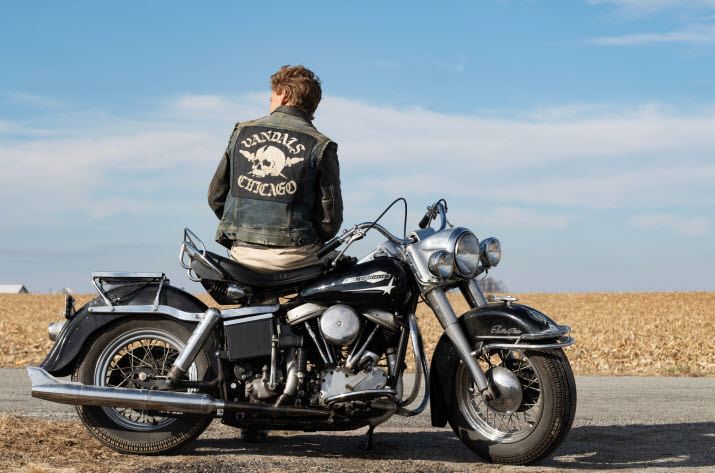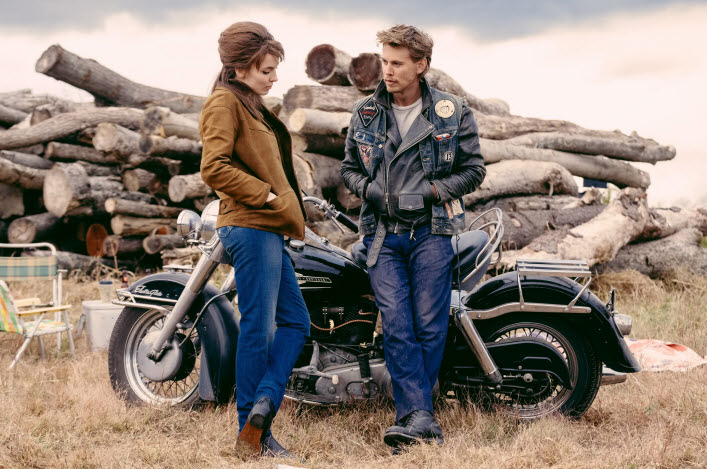
Jeff Nichols’ new film “The Bikeriders” could provide a fascinating anthropological presentation of one particular social group in the American society during the 1960-70s. While it attempts a fresh perspective via its sole substantial female character, many of its main characters are too thin and superficial to hold our attention, and we never feel like really getting to know any of them, while merely following the story of their rise and fall.
The story, which is inspired by the nonfiction book of the same name by Danny Lyon, is mainly driven by a series of interviews between Lyon (Mike Faist) and a woman named Kathy (Jodie Comer), who has a lot of things to tell as someone who was quite close to many members of a midwestern motorcycle club named “the Vandals”. As a matter of fact, she actually married one of them, and a flashback scene shows how she happened to draw the attention of Benny (Austin Butler) during one evening, when she simply dropped by their frequent site for doing a little favor for one of her friends.
After his silent but persistent courtship, Kathy eventually allows him into her life, and she is soon introduced to many different figures of the Vandals including Johnny (Tom Hardy), who has been their de facto leader for years without any challenge. While he was a plain family man who worked as a trucker at first, Johnny decided to live more wildly after watching Marlon Brando in “The Wild One” (1953) on one day, and, what do you know, he soon found himself hanging around with many other similar guys as forming their own motorcycle club.
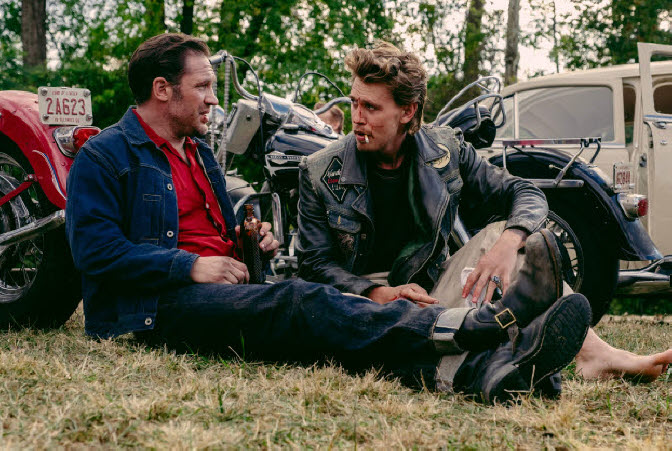
Of course, Johnny and his club members are not welcomed that much by many of local people, and they also find themselves clashing with the members of some other motorcycle clubs. At one point, we see Johnny and his gangs confronting several members of a separate motorcycle club, and you may be a bit amused by how silly and immature they look as clashing with each other over a rather trivial matter. They are more or less than boys who still need to grow up more, and you will not be so surprised when the mood becomes far less aggressive after a brief physical fight among them.
While Johnny tries to avoid any trouble as much as possible, Benny is your average natural troublemaker who always causes a new trouble as driven by his supposedly defiant spirit. In the opening scene, we see him sitting at a local bar alone, and then he soon confronts two big guys who do not approve much of his presence. Although he simply could leave, he adamantly refuses, and that leads to another big trouble, which incidentally results in a serious physical injury which might end his wild lifestyle once for all.
While certainly concerned a lot about Benny, Kathy is reminded again and again that there is nothing she can do about his wild lifestyle – even after she eventually marries him some time later. In fact, she also finds herself getting more associated more with the club just like the wives and girlfriends of its members, and it is really disappointing that Nichols’ screenplay does not delve much into this interesting aspect. There are several other female characters in the movie besides Kathy, but they all simply come and go without leaving much impression, and that is the main reason why its attempt on female perspective is inherently flawed from the beginning.
Meanwhile, things get changed a lot for Johnny and his club members as the American society enters the 1970s. Their club becomes a lot more expanded with many new members, but most of their new members, who are incidentally the Vietnam War veterans, are too volatile to be under their control, and Johnny comes to discern that he is losing the control over the club – especially when he is confronted by a young aggressive punk who may replace him someday.
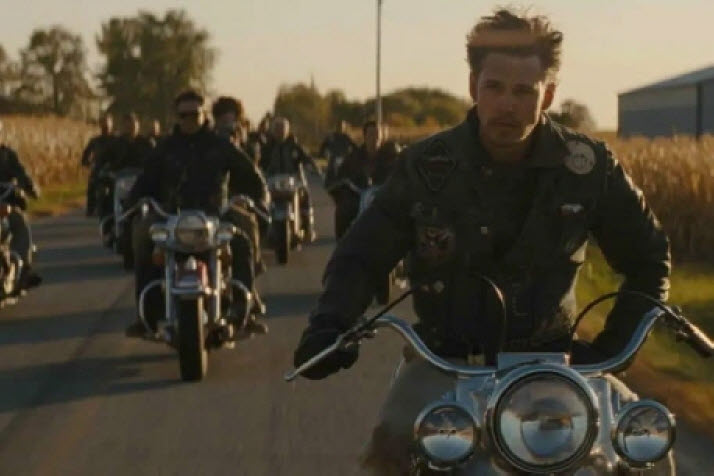
Around that point, we are supposed to care more about Johnny and his gangs, but they are merely pathetic figures without much interesting human qualities to observe. Both Tom Hardy and Austin Butler are undeniably talented performers, but they are unfortunately limited by one-dimensional characterization, and Butler often looks too detached to be really engaged in whatever is happening around his character. In case of Jody Comer, she feels a bit strained with her midwestern accent, and her scenes with Mike Faist are quite perfunctory without generating enough interest for us.
In case of a number of notable performers playing the fellow motorcycle riders of Johnny and Benny, they look fairly believable as the persons who have hung around with each other for a long time, but the movie simply looks around them instead of going deeper into their characters’ life and personality. While Michael Shannon, who previously collaborated with Nichols in several films including “Take Shelter” (2011), is criminally wasted to say the least, Toby Wallace, Boyd Holbrook, and Emory Cohen are merely required to fill their respective spots, and this is surely another disappointing aspect of the film.
On the whole, “The Bikeriders” is not entirely without interest mainly thanks to its competent technical aspects including the cinematography by Adam Stone, but it is quite dissatisfying compared to a series of stellar achievements by Nichols, who has never disappointed me since his stunning debut film “Shotgun Stories” (2007). Because I am your average nerdy guy who prefers to stay at my little apartment, I might have regarded its main characters with some detached disapproval during my viewing, but, folks, I would be really more interested if they were actually interesting human figures to observe from the start.