The Color of Pomegranates (1969) ☆☆☆(3/4): The life of an Armenian poet

In my humble opinion, a good movie can reach to your heart and mind, no matter how vague and elusive it is in what and how it is about. In case of Sergei Parajanov’s 1969 film “The Color of Pomegranates”, which was incidentally released in South Korean theaters in last week, you will likely be left with a lot of bafflement on what it is really about, especially if you do not know anything about its main subject in advance. To be frank with you, my mind became befuddled again when I watched it yesterday, but my heart was also reminded again that its rough but mesmerizing cinematic beauty is definitely something singular to behold.

Although he has been regarded as one of the greatest filmmakers in the 20th century, the works of Parajanov, who died in 1990, have been sort of an acquired taste to me. Before watching “The Color of Pomegranates”, I watched his another acclaimed work “Shadows of Forgotten Ancestors” (1965), but that film also baffled me a lot although it may be a bit more accessible in comparison. Right after watching it, I moved onto “The Color of Pomegranates”, but I was not wholly enthusiastic, unlike many other critics and filmmakers who cherished the film a lot as it slowly emerged from obscurity during last 46 years.

 The movie is supposed be about the life and career of a 17th century Armenian poet named Saya-Nova (1712 ~ 1795), but, folks, this is not a conventional biography film at all. Here in this film, Parajanov tries a very unorthodox artistic approach on his main subject without any apparent narrative line to hold our attention, and the movie mainly consists of a series of seemingly random individual scenes which are supposedly derived by the life and works of Saya-Nova.

You will surely get quite confused and confounded during its first 10 minutes as I did again, but you may also admire what Parajanov, who also edited the film along with M. Ponomarenko and Sergei Yutkevich, and his crew members including cinematographer Suren Shakhbazyan and composer Tigran Mansuryan are trying to achieve on the screen. Many of the key scenes in the film evoke the statically ordered composition of tableaux vivants for vividly conveying to us the artistry of the works of Sayat-Nova and their cultural/religious backgrounds, and I paid attention especially to how often Parajanov often adds some slight physical movements to the mise-en-scène of many of the key scenes in the movie. For example, he frequently adds an object moving back and forth like an pendulum in the background, and now I wonder whether this little artistic touch symbolizes the passage of time, though what my late mentor/friend Roger Ebert once said comes to my mind: “If you have to ask what it symbolizes, it didn’t.”

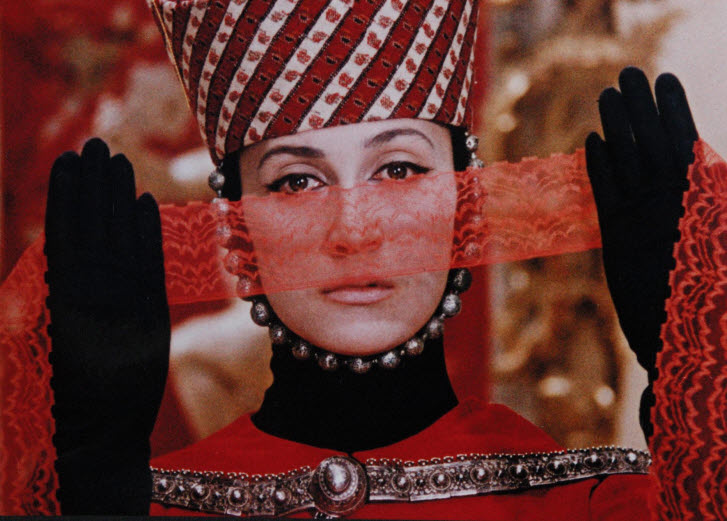
In case of those various images in the film, some of them will surely remain in your mind for a while for their striking visual quality. The opening scene is quite impressive as a number of various objects including a knife and, yes, three pomegranates are presented one by one on a piece of white sheet, and we later get the hunting image of the knife covered with the juicy fluid from the crushed pomegranates. In case of a part involved with a youthful romance in Sayat-Nova’s life, this part is unfolded inside a confined space which supposedly stands for a local palace, and Sofiko Chiaureli, who played various roles in the film including “Poet as a Youth”, provides several beguiling moments as a young beautiful woman who seems to be the object of desire for Saya-Nova.

Meanwhile, I came to notice more of several other interesting things in the film during my second viewing. The early part of the movie presents “Poet as a child”, played by Melkon Aleksanyan, and there is a brief but fascinatingly voyeuristic moment when this young boy has some sneaky peek on a local bathing place. Along with him, the movie lovingly looks at the full body of a man, and then there comes a shot showing a naked female torso whose one of the two breasts is covered by a shell. This somehow reminded me of that infamous line from Stanely Kubrick’s Roman period film “Spartacus” (1960): “My taste includes both snails and oysters”.

According to Wikipeida, Parajanov was actually a closeted bisexual who has some serious trouble with the Soviet government, which persecuted him a lot for his bisexuality and several other reasons such as his political involvement surrounding Ukrainian nationalism. Not long after “The Color of Pomegranates” was made, he got arrested and then sentenced to five years in a hard labor camp for homosexuality, and that was just one of many troubles he had with the Soviet government throughout his life and career.
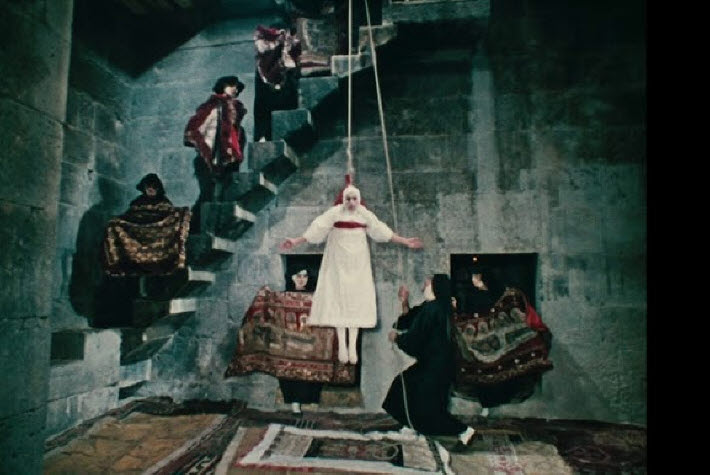
And the movie also went through a pretty hard and difficult time during the same period. Mainly due to its avant-garde style defying against the social realism style of many other contemporary Soviet films during that period, the movie was quickly rejected by the Soviet censors and officials, and the movie subsequently went through a considerable modification process just for making it a bit more accessible to the public. In fact, the very title of the movie was actually not the original one (The original title was simply “Sayat-Nova”).

Fortunately, the movie later went through the 2014 restoration by Martin Scorsese’s Film Foundation in conjunction with Cineteca di Bologna, and the result has been wholeheartedly embraced by many critics and movie fans around the world. In addition, it becomes all the more accessible now thanks to the release of the Criterion blu-ray edition in 2018 (Needless to say, Criterion did not disappoint us at all).    

On the whole, “The Color of Pomegranates” is quite an admirable arthouse film even though I still do not understand and like it that much even at this point. I only give it three stars now mainly because of this reason as well as its adamantly befuddling nature, but I am also willing to revisit and learn more from this remarkable artwork which has surely occupied a very important place in the cinema history. Anyway, I am glad that I watched it at a local movie theater along with several other equally baffled audiences yesterday, and I will remember this interesting movie experience at least for a while.

Posted in Movies | Tagged , | Leave a comment

Kontinental ’25 (2025) ☆☆☆(3/4): A bailiff who cares a lot

Romanian filmmaker Radu Jude’s “Kontinental ’25”, which is one of the two films from him during this year, amused me to some degree. While being relatively less edgy and provocative than his two previous film “Bad Luck Banging or Loony Porn” (2021) and “Do Not Expect Too Much from the End of the World” (2023), the movie is still as absurd and engaging as you can expect from Jude, who has risen as another interesting Romanian filmmaker to watch during last several years.

At first, the movie simply regards the daily life of an old homeless man living in Cluj, Romania. While almost penniless at present, he has lived in the basement of some old building to be demolished sooner or later, and, not so surprisingly, he is later visited by a female bailiff named Orsolya (Eszter Tompa) and several policemen, who are soon going to evict him out of the basement as ordered by the local court. Once he sees that resistance is futile, the old man asks for some time for gathering his private stuffs before eventually getting evicted, and Orsolya and the policemen have no problem with that at all.

However, a very unexpected thing occurs while they wait outside the building. When they return later, they are shocked to discover that the old man committed suicide in a rather grisly way, and Orsolya soon finds herself ridden with a lot of guilt in addition to being blamed for his death by numerous local social media users out there. Incidentally, many of these local social media users emphasize a lot on her specific ethnic background (She is a Romanian of Hungarian descent, by the way), and this certainly exasperates her more.

Needless to say, everyone around her says that she does not need to blame herself at all, but Orsolya continues to wonder more about whether she is responsible for the old man’s death, while nobody gives any definite answer for that. For instance, her husband is more occupied with their upcoming vacation in Greece, and, not so surprisingly, she later decides not to go to Greece along with him and their kids. One of her close friends tries to console and then advise her a bit during their little private meeting, but her friend only comes to show more of her own hypocrisy on many others in the city as disadvantaged as the old man. In case of her mother, the mood seems cordial between them at first, but they only end up arguing with each other over some petty matters, before Orsolya eventually leaves her mother’s apartment.

These and several other key scenes in the film are presented in considerably long and static extended shots, and this will not surprise you much if you are familiar with some of many notable Romanian films during last 20 years. For example, I still remember how long a certain extended scene in the second half of Corneliu Porumboiu’s exceptional comedy film “12:08 East of Bucharest” (2006) is – and how funny and compelling that scene is even though the camera simply observes the absurd situation of its three main characters from its static position without any interruption. In case of Jude’s “Do Not Expect Too Much from the End of the World”, it just presents its finale in static extended shot, but we gradually get its bitter and sardonic point while a lot of things happen in front of the static camera, and that is another big laugh from the film.

Compared to these two films, “Kontinental ’25”, which won the Silver Bear for Best Screenplay at the Berlin International Film Festival early in this year, feels less focused and more scattershot. I must confess that I sometimes scratched my head on what it is exactly about during my viewing, but I appreciate how deftly Radu handles those key scenes presented in extended shots. As the center of the film, Eszter Tompa is splendid as her character often swings back and forth across many different emotional modes, and several other main cast members including Gabriel Spahiu, Adonis Tanța, Oana Mardare, Șerban Pavlu, and Annamária Biluska function as an effective counterpart to Tompa during their respective scenes.

The funniest part in the movie comes from the encounter between Orsolya and her former student, who currently works as a delivery man. Although he does not like his current job much, this lad is pretty vivacious to say the least, and we are not so surprised when Orsolya later meets him not long after her husband and kids went away to Greece. When they talk with each other at a bar, he enthusiastically tells several morbidly amusing anecdotes involved with real-life Buddhist monks, and I assure you that you will have some good laughs even while wincing a bit for good reasons.   

Although you will be a bit disappointed with its rather fizzling ending, you may remain amused by a number of nice humorous touches throughout the film. In case of one particularly offbeat detail during its opening part, you will be caught off guard at first, but you will probably laugh a bit more when that appears again later in the film. The movie also makes some indirect points on the post-socialist economics of the Romanian society and the housing crisis associated with that, and this aspect becomes more evident when the camera simply observes several buildings in the city one by one before the end credits.

In conclusion “Kontinental ’25”, whose title is incidentally inspired by Roberto Rossellini’s 1951 film “Europe ‘51”, is less impressive than “Bad Luck Banging or Loony Porn” and “Do Not Expect Too Much from the End of the World”, but it is still interesting enough for recommendation in my trivial opinion. Again, I merely admire Jude’s filmmaking talent instead of being quite enthusiastic, but I am willing to keep following his career nonetheless, and that is all I can say for now.

Posted in Movies | Tagged , | 2 Comments

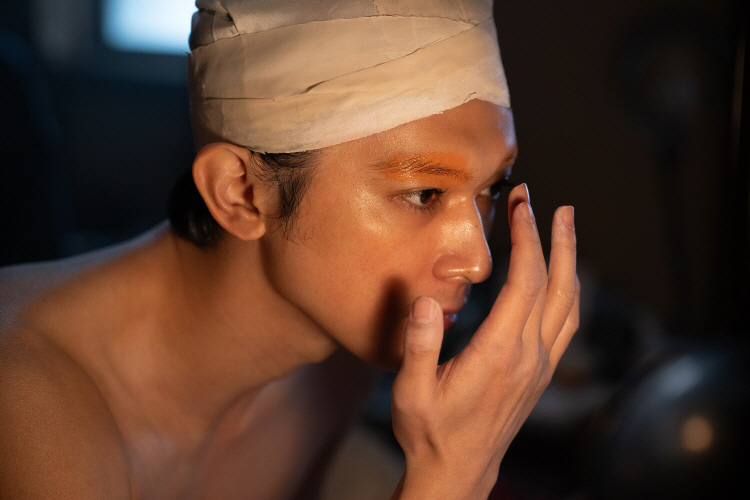
Kokuho (2025) ☆☆☆(3/4): Becoming a living national treasure

Japanese film “Kokuho”, which was selected as the Japanese entry to Best International Film Oscar at the 2026 Academy Awards, is an ambitious backstage drama to behold. Yes, this is another typical story about that hectic price of artistic achievement and success, but I admire its confident handling of mood and detail, even though I often found myself observing the story and characters from the distance during my viewing.

The main center of the story is a kabuki actor named Kikuo Tachibana (Ryo Yoshizawa), and the opening part of the movie, which is set in Nagasaki, 1964, shows us how young Kikuo, played by Sōya Kurokawa, came to draw the attention of Hanai Hanjiro (Ken Watanabe), a highly respectable kabuki actor from Osaka. When Hanjiro happens to drop by a New Year gathering held by Kikuo’s yakuza boss father, Kikuo presents a little kabuki performance of his in front of them and many others, and his “onnagata” performance (This is a kabuki term for male actors playing female characters, by the way) impresses Hanjiro a lot for his raw acting talent right from the beginning.

However, Kikuo’s father later gets killed due to an ambush from his opposing criminal organization, and Kikuo is eventually sent to Osaka for training and studying under Hanjiro. Once he is introduced to his teacher’s wife and their son Shunsuke (Keitatsu Koshiyama), Kikuo goes through a series of rigorous training sessions along with Shunsuke, and he and Shunsuke gradually become more like brothers despite the constant rivalry between them.

Several years later, both Kikuo and Shunsuke, who is now played by Ryusei Yokohama, are certainly ready to take the first step for their respective kabuki careers, and, of course, there soon comes a golden opportunity they cannot possibly refuse. Mainly thanks to Hanjiro’s considerable reputation and influence, they are asked to perform “The Maiden at Dojoji Temple” together, and, of course, they supremely dazzle and entertain their audiences together with sheer talent and confidence.

However, as enjoying their first career success, Kikuo and Shunsuke are also reminded of the considerable gap between them. While Shunsuke is surely expected to inherit the honorable title of his father someday, Kikuo does not have anyone particularly willing to support and admire his talent except his teacher and Shunsuke, and that makes him all the more serious and competitive than before. Not so surprisingly, he soon aims to get that honorable title of his teacher instead of Shunsuke, and this certainly leads to a growing conflict between him and several others around him including Shunsuke.

The screenplay by Satoko Okudera, which is based on the novel of the same name by Shuichi Yoshida, does not exceed our expectation much as hopping from one point to another along its sprawling narrative spanning no less than 50 years. Yes, there is a big moment of clash between Kikuo and Shunsuke not long after Hanjiro makes the final decision on who will inherit his honorable title. Yes, Kikuo and Shunsuke respectively go through a series of ups and downs after that point, and the movie surely generates some bitter irony from that. Yes, the movie certainly asks some important questions about the price of artistic achievement and success around the end of the story, and it expectedly delivers a dramatic answer with some ambivalent feelings.

The main flaw of the story lies on how the movie remains rather distant to its hero without delving a lot into whatever he feels or thinks behind his mostly detached façade. As far as I observe from the film, he is more or less than a blank canvass to whatever several other characters happen to suffer in one way or another because of him, and this makes us all the more distant to him without really getting to know or caring about him even at the end of the story.

I guess the movie simply wants to observe Kikuo’s relentless dedication to his art and ambition, and it surely does not disappoint us at all in case of its several kabuki performance scenes. I must confess that I do not know that much about kabuki, but I can tell you instead that the kabuki performances scenes in the film are simply superlative for their top-notch production qualities, and Ryo Yoshizawa and several main cast members look quite believable in every physical movement of theirs on the stage (Please do not ask me whether they actually had to depend on body doubles to some degree).

Behind his character’s aloof attitude, Yoshizawa did a good job of embodying his character’s ambition and commitment, and he is also supported by several good performers to notice. Ryusei Yokohama is particularly poignant during one key kabuki performance scene between him and Yoshizawa later in the film, and they are also flawlessly connected with Sōya Kurokawa and Keitatsu Koshiyama. Ken Watanabe, who is surely the most recognizable cast member to many of us, fills his archetype role with a palpable sense of honor and dignity, and Min Tanaka steals the show as an aging kabuki actor who has been appointed as a Living National Treasure (The title of movie means “National Treasure”, by the way). Another main flaw of the movie is its rather flat depiction of several substantial female characters in the story, but Mitsuki Takahata and Shinobu Terajima manage to fill their respective roles with enough presence at least.

On the whole, despite my reservation on a number of notable shortcomings, I enjoyed “National Treasure” enough for recommendation in addition admiring the skillful direction of director Lee Sang-il, a Zainichi (Korean Japanese) director who previously made several other major films including “Hula Girls” (2006). I personally prefer the cheerful spirit of “Hula Girls”, but “National Treasure” has its own strong aspects to appreciate, so I think you should give it a chance someday.

Posted in Movies | Tagged , , | 1 Comment

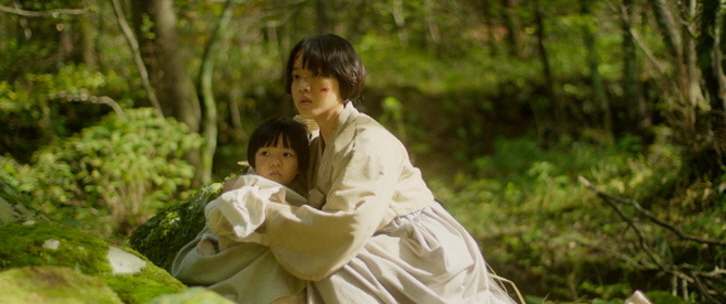
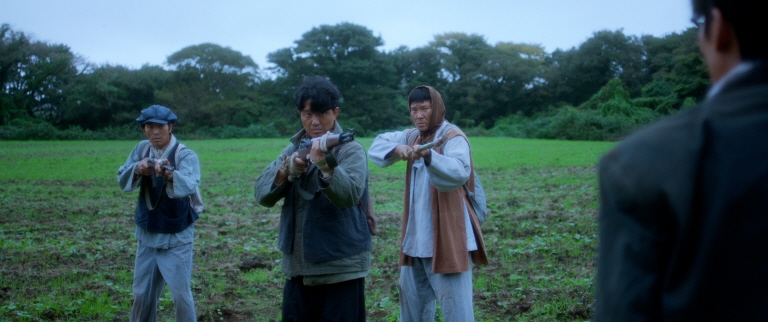
Hallan (2025) ☆☆☆(3/4): A young mother and her little daughter in the Jeju Uprising

South Korean film “Hallan” turns out to be a lot more haunting than I expected at first. Closely following the harrowing survival drama of a young mother and her little daughter in the middle of the Jeju Uprising (1948 ~ 1949), the movie humbly but powerfully conveys to us the enormous human horror and tragedy behind that incident, and you will come to reflect more on how that painful past never goes away even at this point.

After giving us some background information on the Jeju Uprising, the movie introduces us to Ah-jin (Kim Hyang-gi) and her daughter Hae-saeng (Kim Min-chae). Before the Jeju Uprising was started, they happily lived with Ah-jin’ schoolteacher husband in one small village in Jeju Island, but he came to join those left-wing insurrectionists in the mountain region of the island not long after the beginning of the uprising. As getting threatened more and more by many policemen and soldiers out there, most of the villagers eventually decide to hide away into the mountain area just like those left-wing insurrectionists, and Ah-jin also joins them, but she has her daughter stay with her mother-in-law even though that is the last thing her daughter wants.

At first, things look all right for Hae-saeng and the remaining villagers including her grandmother, but, of course, there eventually come a group of soldiers accompanied with several American military officers on one day. Although they have no definite proof against the villagers, Sergeant Park (Hwang Jung-nam) and his soldiers have no problem at all with labeling all of the villagers as the sympathizers to their enemies, and that leads to one of the most heartbreaking moments in the film.

Meanwhile, Ah-jin becomes more concerned about her daughter’s safety, even after a close friend of hers, who is incidentally a village shaman, tells her that Hae-saeng is still all right. In the end, she decides to go down to the village alone by herself, but, not so surprisingly, she soon comes upon a series of perils, and she also comes to learn that the left-wing insurrectionists can be pretty heartless for their cause just like their opponents.

The movie also pays some attention to the little struggle of Hae-sang, who managed to survive unlike many others in the village including her grandmother. Although she does not know at all where her mother and some other villagers are hiding now, she wanders around here and there in the mountain region without realizing anything about what is happening in the world surrounding her, and the movie gives us a number of achingly innocent moments as this little girl continues her aimless journey across the mountain area.

In addition, we get to know a bit about a few other main characters in the story. Ah-jin’s shaman friend provides some calmly mystic quality to the story, and there are a few interesting scenes showing her some soothsaying. In case of one of the soldiers under Sergeant Park, he becomes more conflicted about whether he and his comrades are really doing the right thing, and he surely functions as a little voice of conscience in the story. However, of course, he is reminded again of how helpless he is in front the bullying influence of Sergeant Park, who does not even hesitate to kill a couple of unfortunate soldiers just because they show a bit of care to those people they are supposed to eliminate at once.

Although the screenplay by director/writer Ha Myeong-mi, who previously made a feature debut with “Her Hobby” (2023), trudges a bit during its second half, the movie keeps us engaged under Ha’s competent direction, and the result is as impressive as O Meul’s “Jiseul” (2012), which is also about the human tragedy behind the Jeju Uprising. Its main characters are rather broad and simple in my humble opinion, but the drama generated among them is often emotionally striking, and we come to care more about Ah-jin and her daughter, though we are not so surprised by what will happen to them in the end. I will not go into detail here, but I can tell you instead that the movie thankfully does not resort to any kind of cheap sentimentalism or catharsis, and the very last scene of the film makes a very clear point on how Jeju Island and its people remain haunted by that darkly sad past which still needs to be revealed and then illuminated more.

Ha draws solid performances from the two lead performers at the center of the movie. While Kim Hyang-gi, who has appeared in a number of notable South Korean films including “Innocent Witness” (2019), gives her best performance here in this film, young performer Kim Min-chae’s effortless natural performance functions well as the other half of the story, and they are surely the soul and heart of the film. In case of several other main cast members, Kim Da-hwin and Kang Chae-young are suitable in their respective supporting roles, but Hwang Jung-nam is unfortunately demanded to chew every scene of his as the main villain of the story.

In conclusion, “Hallan”, whose title incidentally comes from the name of a wild local plant inhabiting in the mountain area of Jeju Island, may feel rather plain on the surface, but it will linger on your mind for a while mainly thanks to its earnest storytelling as well as several fine performances to remember. In short, this is another interesting movie to be added to the list of those numerous films and documentaries about the Jeju Uprising during last several years, and it will certainly make you want to learn more about the Jeju Uprising after it is over.

Posted in Movies | Tagged , , | 1 Comment

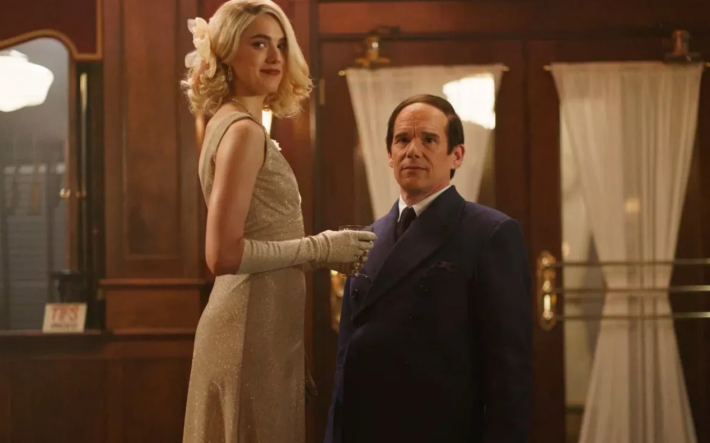
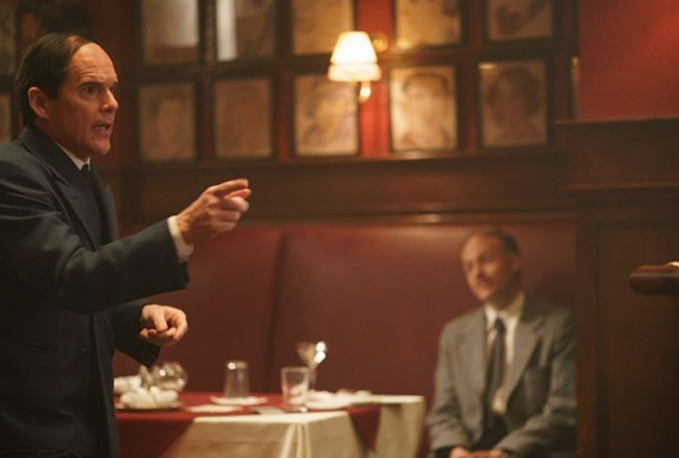
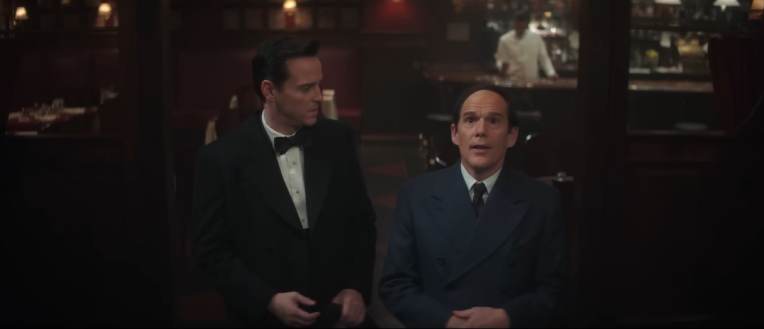
Blue Moon (2025) ☆☆☆1/2(3.5/4): He is surely blue…

“Blue Moon”, which is incidentally one of the Richard Linklater’s two movies released during this year, is a biographical drama film packed with a lot of insight and personality. Mainly focusing on one particularly complicated night of a famous American lyricist in the 1940s, the movie vividly illuminates the considerable passion and spirit inside this interesting figure, and the result is quite enjoyable to say the least.

The figure in question is Lorenz Hart, who collaborated with Richard Rodgers for more than 25 years before Rodgers moved onto Oscar Hammerstein II. Because of the enormous success of Rodgers and Hammerstein, Hart and Rodgers’ partnership may look relatively less important in comparison, but they did create a number of memorable songs to remember, and some of them including, yes, “Blue Moon” have survived the passage of time to be recognized and then embraced by many of us even at this point.

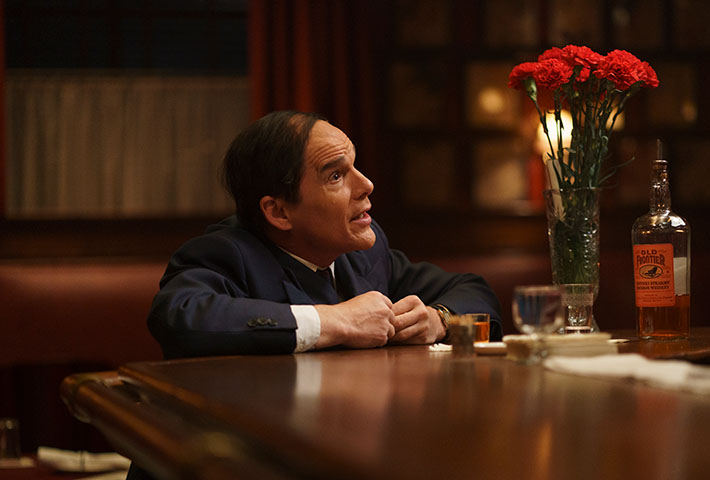
After the prologue scene showing its hero’s tragic death in November 1943, the story starts with the opening night of Rodgers and Hammerstein’s successful Broadway musical “Oklahoma!” on March 31st of the same year. While many of the audiences are quite entertained to say the least, Hart, played by Ethan Hawke, is not so amused in contrast. Although he came to the show with his mother, he leaves the theater even before the end of the performance, and then he goes to a nearby restaurant for drinking at its bar before Rodgers and Hammerstein and many others will come for the opening night celebration.  

As he talks with the bartender and a few others who happen to be there, it becomes apparent to us that Hart is really sour about the big success to be enjoyed by Rodgers and his new partner. He brutally criticizes a lot on how corny and sentimental “Oklahoma!” is many aspects, but he also bitterly recognizes that it will be wholeheartedly welcomed by audiences and critics exactly for that. As some of you know, this classic musical actually won the Pulitzer Prize at that time, and it surely would have won a bunch of Tony Awards if it had been made around, say, 10 years later.    

Anyway, Hart is looking forward to meeting a young female art college student Elizabeth Weiland (Margaret Qualley). While encouraging her artistic aspiration for a while, Hart has been quite infatuated with her youthful energy, and he is even willing to ignore his homosexuality just for getting closer to that. Nevertheless, he cannot help but become a sort of drama queen in front of the bartender and a few others around him, and they gladly go along with him because, well, he is quite a fun raconteur to observe despite getting more and more drunk. 

Needless to say, the screenplay by Robert Kaplow, who previously worked with Linklater in “Me and Orson Welles” (2010), needs a very talented actor who can ably handle those numerous wordy moments with a lot of wit and personality, and Hawke, who previously collaborated with Linklater in the Before Trilogy and “Boyhood” (2014), is simply superb as vividly embodying his colorful character from the beginning to the end. Although he is actually much taller than real Hart, Hawke looks convincingly short in addition to wearing a lot of makeup as required, and he also delves deep into his hero’s aching misery and loneliness. While he is not a very social person, Hart always needs someone to work or talk with, and you can clearly sense how much he feels hurt by his former partner’s decision to end their partnership.

When Rodgers and Hammerstein later arrive, they show some respect to Hart in each own way, though Rodgers, played by Andrew Scott, still wants to put some distance between him and Hart. He is willing to work with Hart on the revival of one of their old works, but he also points out how much he tolerated Hart’s many human flaws including his worsening alcoholism, and you can clearly sense that he has already decided that enough is enough even while appreciating Hart’s contribution to their success a lot. Scott, who deservedly won the Silver Bear for Best Supporting Performance when the movie was shown at the Berlin International Film Festival early in this year, did a good job of subtly conveying to us Rodgers’ complex feelings on Hart, and Simon Delaney has a little fun moment as Hammerstein when his character gladly introduces to Hart his little young protégé (This kid’s surname is never mentioned in the film, but some of you surely know that he is none other than Stephen Sondheim). . 

Like Scott and Delaney, several other main cast members function as the effective counterpoints to Hawke’s charismatic acting. As the bartender always ready to serve another drink to Hart, Bobby Cannavale often throws some humorous zaps as required, and Jonah Lee and Patrick Kennedy are also effective as the two other main figures hanging around Hart in the movie (You may appreciate a brief but amusing scene where Hart gives a nice story idea to Kennedy’s character, who is incidentally a real-life writer famous for several classic books for children). In case of Margaret Qualley, who has been more prominent as appearing in a series of acclaimed movies including Coralie Fargeat’s recent Oscar-winning film “The Substance” (2024), she exudes a lot of charm and spirit right from her very first scene in the film, and she and Hawke are quite effortless during a little private moment between their characters later in the story.

In conclusion, “Blue Moon” is another compelling work from Linklater, who has seldom disappointed me and others during last 30 years. Although it is mostly confined inside its limited main background, the movie never feels stuffy or stagy thanks to Linklater’s skillful direction, and it will actually make you check more on its main subject. That is what a good biography drama can do, isn’t it?

Posted in Movies | Tagged , , , | 1 Comment

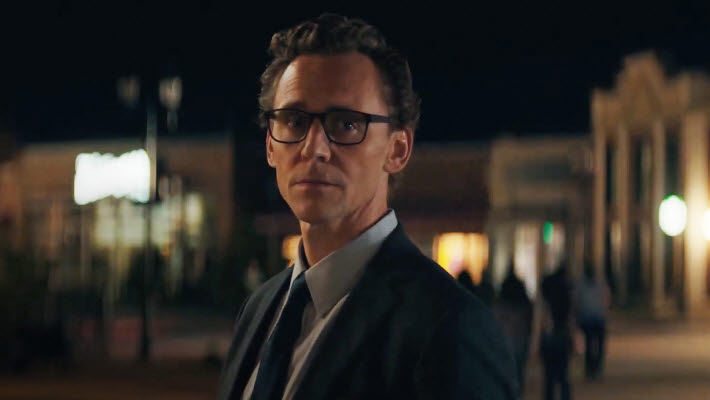
The Life of Chuck (2024) ☆☆☆(3/4): He contains multitudes…

Mike Flanagan’s latest film “The Life of Chuck”, which won the People’s Choice Award when it was shown at the Toronto International Film Festival in last year, interested me for what it is about and then touched me for how it is about. Based on the short story of the same name by Stephen King, the movie three different stories all connected with the life of its titular figure, and its main pleasure comes from how we gradually behold its big picture about the dark and bright sides of life bit by bit. 

The first act, which is actually “Act Three”, feels like one of those surreal episodes from American classic TV series “The Twilight Zone”. When one plain school teacher seems to be going through another ordinary day at his workplace as trying to teach his students a bit on a certain famous poem written by Walt Whitman, the human society suddenly begins to fall apart step by step via a series of inexplicable catastrophes, and he certainly feels quite perplexed just like many others around him, though he still tries to go on as usual.

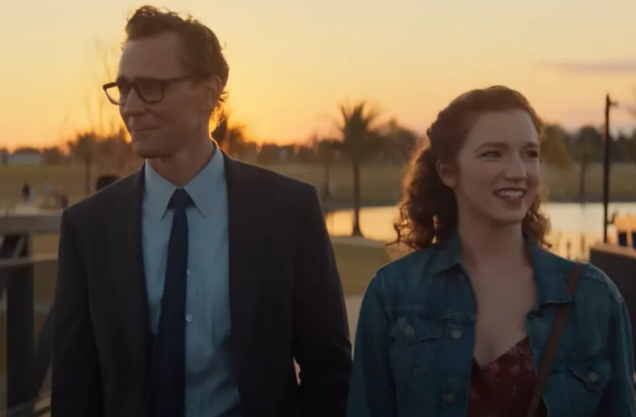
As his daily life gets collapsed in one way or another without any possibility for recovery, the teacher cannot help but notice a certain odd thing. When he saw an advertisement associated with a guy named Charles “Chuck” Krantz (Tom Hiddleston) for the first time, he does not take that seriously, but, what do you know, he keeps noticing several other advertisements associated with Krantz. It looks like this figure is someone very important in his neighborhood, but the teacher has no idea on who the hell is – and neither do several others encountered by him along the story.

Meanwhile, the teacher comes to consider meeting his ex-wife again before whatever may happen in the end. Although there was some bitterness between them before their divorce, they have been relatively friendly to each other after their divorce, and she and the teacher later come to have a long philosophical conversation on how transient the existence of the humanity actually is compared to the history of the universe.

Now this sounds rather boring to you, but Flanagan knows how to write and present a good conversation scene on the screen. Several long conversation scenes in the film never feel ponderous at all thanks to Flanagan’s solid writing, and, above all, they are fluidly unfolded on the screen without being too preachy. When the teacher talks to his ex-wife about what Carl Sagan said in that famous science TV program of his many years ago, the movie gets a bit too symbolic in my humble opinion, but this key moment is filled with genuine emotions thanks to Flanagan’s competent handling of mood and performance, and then it comes to function as the emotional ground for what will happen around the end of the first act.

After we eventually come to learn about who the hell Krantz is, the movie moves onto its middle act of the film, which is presented as “Act Two”. We meet Krantz again, and he goes through another ordinary working day of his without much spirit, but then he comes upon something which comes to stir up an old hidden memory somewhere inside his mind. Even though he has no idea on what that old memory of his exactly is, he soon finds himself showing an active response, and that leads to a very, very, very special moment for not only him and two total strangers but also a bunch of people around them.

You surely notice that my description is rather vague. I simply want you to watch this wonderful scene for yourself without knowing anything in advance, and I assure you that you will be reminded of how many of us sometimes come across a chance to sense how beautiful life can be even though it mostly sucks for us before we eventually arrive at our miserable final destination. Yes, joy and happiness cannot last that long, but isn’t it really nice to savor them at least for a while?  

Around its last act, which is presented as “Act One”, the movie does not seem to have much surprise for us as slowly heading to its eventual finale, but it becomes more poignant than expected. There is another wonderful scene which will surely resonate with the aforementioned scene in the middle act, and we are not disappointed at all when the movie finally adds a sublime finishing touch to what has been carefully building up to that point.

The main cast members did a commendable job of filling their archetype roles. While Tom Hiddleston’s earnest performance is connected well with the three different young actors playing his character’s younger versions, several other notable performers in the film including Chiwetel Ejiofor, Karen Gillan, Mark Hamill, Carl Lumbly, and Mia Sara are also effective in their respective roles. The dry narration by Nick Offerman is enjoyable with several wry moments of deadpan humor, and some of you may be delighted for the brief appearance by Heather Langenkamp, who was the heroine of Wes Craven’s classic horror film “A Nightmare on Elm Street” (1984).  

 In conclusion, “The Life of Chuck” is another entertaining feature film from Flanagan, who previously gave us a series of well-made genre products “Oculus” (2013), “Gerald’s Game” (2017), and “Doctor Sleep” (2019). He demonstrates here the more sensitive sides of his talent, and it will be interesting to see what this competent director will do next after this modest but likable drama movie. After watching it, I came to reflect more on how my life has been going, and I may look back at its highlights more as time goes by.

Posted in Movies | Tagged , | 1 Comment

Zootopia 2 (2025) ☆☆☆1/2(3.5/4): More animals, more worlds (and I like it more)

Disney animation feature film “Zootopia 2” has more animals and worlds to present, and I like it more. While it will still take some time for you to accept its rather shaky background premise, the film fills its animal fantasy world with an ample amount of humor and details to savor and appreciate, and you will soon enjoy another bumpy adventure of the contrasting duo at the center of the story.

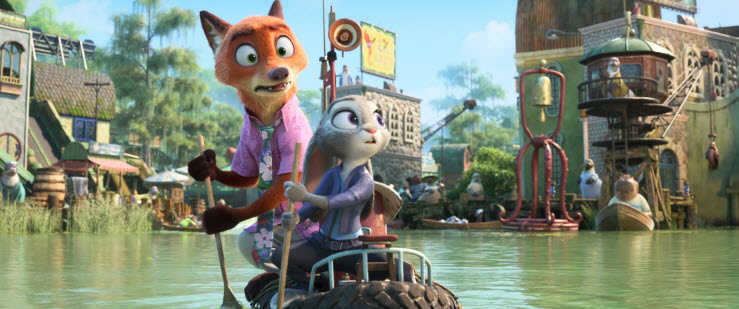
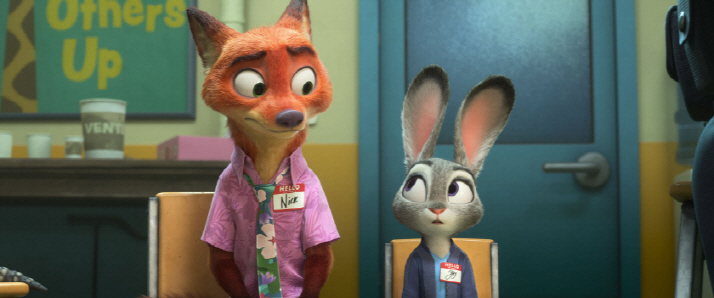
They are a rabbit cop named Judy Hopps (voiced by Jennifer Goodwin) and a red fox named Nick Wilde (voiced by Jason Batesman), and the opening part gives us a quick summary on how they saved their animal city and then began to work together in the police department of the city at the end of the previous film. Now they are eager to be assigned to another big case for proving themselves again, but their direct superior Chief Bogo (voiced by Idris Elba) is not so willing to allow that, so they come to cross the line a bit when their team is about to investigate a certain smuggling case. Not so surprisingly, their following reckless action causes a lot of headaches for their boss, and they are later instructed to attend a therapy course for problematic partnership.

Although they do not feel anything particularly wrong about their partnership at first, Judy and Nick soon find themselves conflicting with each other on something involved with that smuggling case. After noticing something fishy in the case, Judy is quite ready to delve more into that, and Nick, who is relatively more laid-back than his partner, is not particularly interested, but, what do you know, he soon gets involved in Judy’s unofficial investigation more, because, well, Judy is his partner after all. 

It is not much of a spoiler to tell you that our two cop characters will discover that their case is much more serious than they expected at first. I will not go into details here, but I can tell you instead that Nick and Judy later find themselves targeted by a certain powerful animal family associated with the foundation of Zootopia. Not so surprisingly, this family turns out to have something important to cover up as much and long as possible, and Judy and Nick must find a way to save and then vindicate themselves.    

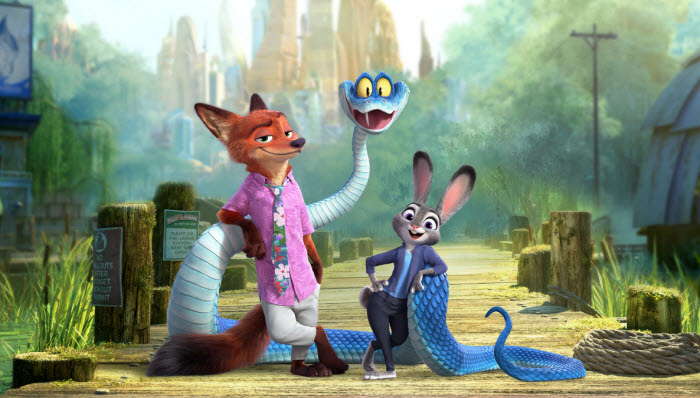
Luckily for them, Nick and Judy get two unlikely allies later in the story. One is Nibbles Maplestick (voiced by Fortune Feimster), a very eager beaver who is incidentally a podcast host and also can lead them to a certain hidden figure who may give some more information to help their ongoing investigation. The other one is Gary De’Snake (voiced by Ke Huy Quan), a pit viper who turns out to have a poignant personal motive behind his initially sneaky appearance.

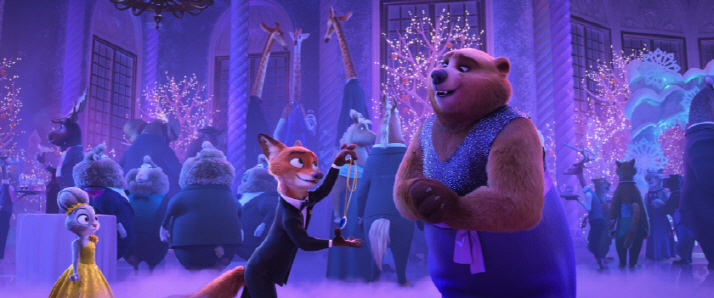
As Judy and Nick bounce from one narrative point to another, the film expands further what has been established well in its Oscar-winning predecessor, and the result is often quite delightful to say the least. While there are a number of familiar places and figures shown in the previous film, there are also several different new regions and characters to watch and enjoy for their colorful visual qualities, and the film steadily engages us as deftly mixing old and new things together along the story. As a Hollywood blockbuster animation film, it surely serves us with a lot of action, but it does not lose any sense of fun and wonder at all even during its well-made action scenes, and you will also frequently be amused by small and big humorous details to observe. My personal favorite is a brief but undeniably hilarious homage to a certain film by Stanley Kubrick, and I must tell you that I had a really good chuckle even though I knew about that in advance.  

While Jennifer Goodwin brings a lot of pluck and spirit to her character, Jason Batesman slyly demonstrates again that he is born to play a fox as much as, say, George Clooney in Wes Anderon’s Oscar-nominated animation film “Fantastic Mr. Fox” (2009), and the success of the film surely depends a lot on their undeniable comic chemistry. Besides effortlessly clicking well with each other as before, Batesman and Goodwin also ably balance their characters’ relationship drama between comedy and drama, and we come to care more about what is being at stake for Judy and Nick even while being tickled a lot by their comic conflicts along the story.        

The film is also filled with a lot of colorful supporting voice cast members to be noticed here and there. While Key Huy Quan and Fortune Feimster are the most prominent ones in the bunch, Andy Shamberg, Patrick Warburton, Quinta Brunson, and Danny Trejo are also effective in their respective supporting roles, and David Strathairn, who has always a reliable character actor during last 45 years since his modest film acting debut in 1980, shows here that he can chew his scenes if that is really required. In case of a number of notable voice cast members from the previous film, Idris Elba, Shakira, Nate Torrence, Bonnie Hunt, and Jenny Slate easily slip into their respective parts, and Maurice LaMarche, a veteran voice actor who has been known well for his considerable contribution to a heap of animation films and TV series, has a little juicy fun again with his aging crime boss character.

Overall, “Zootopia 2”, which is directed by Jared Bush and Byron Howard, is more entertaining than its predecessor. To be frank with you, I was not that enthusiastic at first mainly because I mildly enjoyed its predecessor and then wrote a casual 3-star review, but the film surprises me with more excitement and imagination, and now I can assure you that it is one of the best animation films of this year.

Posted in Movies | Tagged , , , | 1 Comment

Train Dreams (2025) ☆☆☆1/2(3.5/4): The life of a haunted man

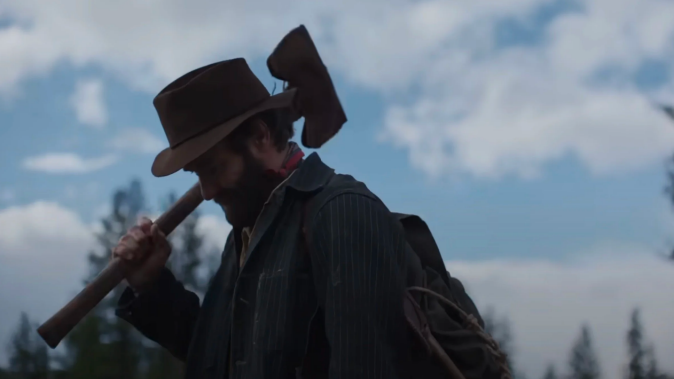
Netflix film “Train Dreams”, which unfortunately did not get a chance for theatrical release in South Korea before eventually being released on Netflix on last Friday, is a mesmerizing work of poetic atmosphere and details to be appreciated. Clearly influenced a lot by those meditative works of Terrence Malick such as “The Tree of Life” (2011), the movie engages and then touches us with its sublime visual qualities, and it is certainly something worthwhile to be experienced in my inconsequential opinion.

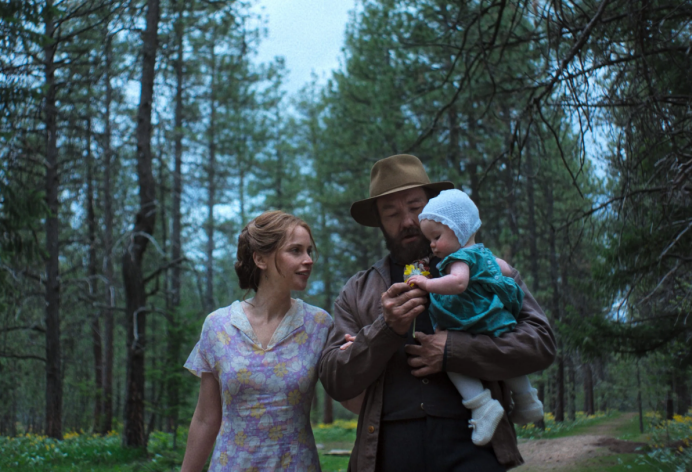
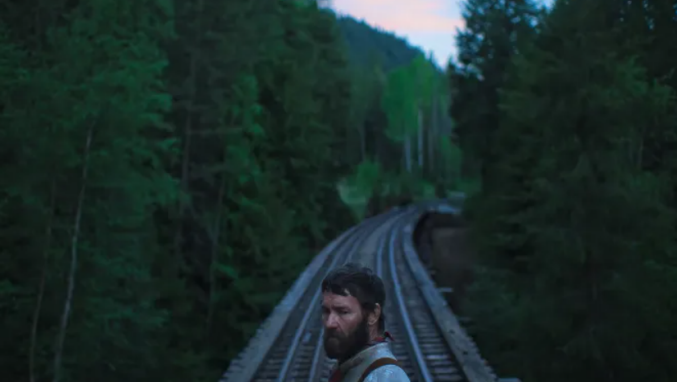
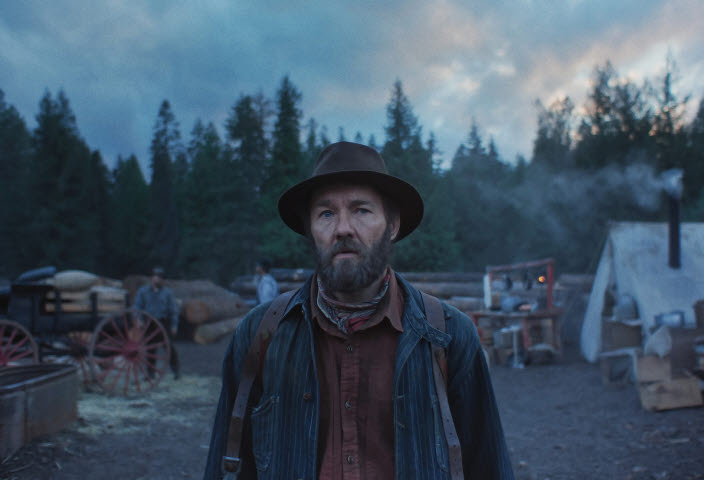
The movie mainly revolves around the life of a man named Robert Grainer (Joel Edgerton), who became an orphan not long after he was born around the 1880s and then was sent to a rural town in Idaho. He had to work for earning his living even when he was just a young boy, and the narration by Will Patton phlegmatically tells us how aimless his life has been for next several years before he happens to encounter a young woman named Gladys Olding (Felicity Jones). Although their first meeting was rather awkward at first, it does not take much time for both of them to get attracted to each other, and they become married in the end.

Of course, after they settle at a spot outside the town and build a little cabin for them and their little daughter, Grainer certainly has to work more and harder for supporting not only himself but also his dear family. At one point early in the story, he joins a bunch of guys working on the construction of a new railroad, and he comes to befriend some of them, but then he witnesses one Chinese worker killed by several white dudes for no apparent reason. Even though he actually tried to stop that, Grainer cannot help but feel guilty about that, and he subsequently finds himself often haunted by what seems to be the ghost of that dead Chinese worker.

Anyway, Grainer later works as a logger instead, but death seems to follow him steadily as he fears. While he and his co-workers are certainly well aware of the constant risks surrounding their work environment, there are always fatal accidents here and there. In case of one supposedly God-fearing dude, death comes upon him in quite an unexpected way, and there is a little morbid sense of humor from how the camera calmly observes this shocking incident from the distance.

At least, his wife and their little daughter have remained as the light of his life for Grainer. He always feels happy whenever he returns to his cabin where Gladys and their little daughter are waiting for him, and the movie often conveys his little joy and happiness with his family to us via a series of lyrical moments to remember. As cinematographer Adolpho Veloso vividly captures intimate human moments as well as natural beauty on his camera, we get more immersed into Grainer’s humble but happy life, and his inner peace is often accentuated by the simple but effective score by Bryce Dessner.

Not so surprisingly, as Patton’s narration announces to us in advance, Grainer’s happiness does not last that long. Just like the main characters of Malick’s great film “Days of Heaven” (1978), Grainer suddenly loses his little private heaven due to a happening totally beyond his control when he is about to pursue a more stable life along with his family. Quite devastated to say the least, he goes through a lot of emotional upheaval as he struggles to recover during next several years, and he naturally comes to have a lot of questions on his life and its meaning.

Firmly maintaining its tranquil attitude, the movie, which is based on the novella of the same name by Denis Johnson, seems to be simply rolling its hero along its somber narrative on the surface, but the adapted screenplay by director Clint Bentley and his co-writer Greg Kwedar comes to show much more sensitivity and thoughtfulness in the end. While a number of various characters just come and go around Grainer throughout the story, many of them leave some indelible human impression to reflect on, and there is a particularly haunting moment early in the film when Grainer comes to have a little talk with a much older worker. This old man turns out to be a bit more perceptive than he seems at first, and his scenes with Grainer resonate with when Grainer meets some other older dude later in the story.

Bentley, who previously directed “Jockey” (2021) and recently co-produced and co-wrote Kwedar’s Oscar-nominated film “Sing Sing” (2023), also drew stellar natural performances from his cast members. Joel Edgerton, who is no stranger to playing taciturn but sensitive tough guys as shown from Jeff Nichols’ Oscar-nominated film “Loving” (2016), effortlessly slips into his character right from the very first scene of his in the movie, and the result is another terrific performance to be added to his admirable movie acting career. Even though he does not signify much on the whole, Edgerton’s nuanced acting always speaks volumes to us on whatever his character feels or thinks, and that is one of the main reasons why the movie keeps us engaged to the end.

Around Edgerton, several other main cast members have each own moment to shine. While Felicity Jones brings some precious warmth to her several scenes with Edgerton, William H. Macy reminds us again of how he has always been dependable during last several decades, and Kerry Condon, who has been more notable thanks to her Oscar-nominated supporting turn in Martin McDonagh’s “The Banshees of Inisherin” (2022), is also wonderful during her brief but crucial appearance later in the film.

On the whole, “Train Dreams” is surely one of those arthouse movies which will require you some patience from the beginning, but it is quite a rewarding experience thanks to its superb mood, storytelling, and performance. Although it is a shame that I watched it at my home instead of movie theater, I can say at least that it is definitely one of the highlights of this year, and I think you should really check it out as soon as possible.

Posted in Movies | Tagged , | 1 Comment

Gattaca (1997) ☆☆☆1/2(3.5/4): In a genetically brave new world

Andrew Niccol’s 1997 film “Gattaca”, which happens to be re-released in selected theaters in South Korea a few days ago, still throws interesting questions for us. Even after more than 25 years after it came out, the movie remains to be a thought-provoking science fiction drama packed with fascinating ideas and details to observe, and it also touches us a lot as making some powerful points on how human spirit cannot be limited by technology.

During its opening part, the movie succinctly establishes a dystopian society where eugenical discrimination becomes quite common thanks to advanced genetic technologies. Many people come to prefer having their babies genetically modified for removing any inferior traits in advance, and many of those naturally conceived persons are socially discriminated in one way or another just because of being genetically inferior, while all those genetically modified individuals come to have much more chance and privilege in contrast.

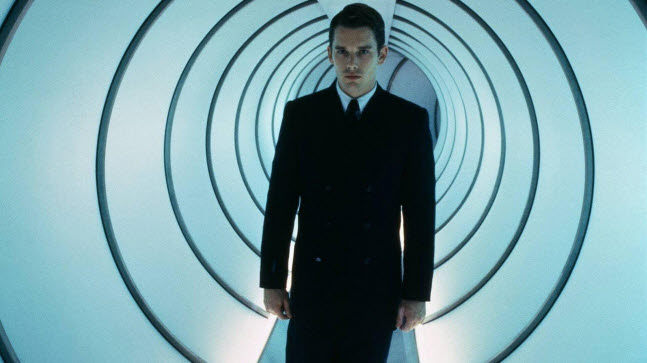
Vincent Freeman (Ethan Hawke) is one of those naturally conceived persons, and he has been well aware of how he is different even during his childhood years. Regretting the result of their good-willed choice on Vincent, his parents decided to have their second son Anton (Loren Dean) genetically modified in advance, and Vincent could not help but become more and more conscious of the genetic difference between him and his younger brother.  

Nevertheless, this did not prevent Vincent from dreaming of becoming an astronaut someday. Although that seemed impossible due to the social discrimination on his genetic condition, Vincent later came to have a bit of conviction when he happened to surpass his younger brother for the first time in their little swimming competition, and that eventually propelled him to try much more for his dream than before.

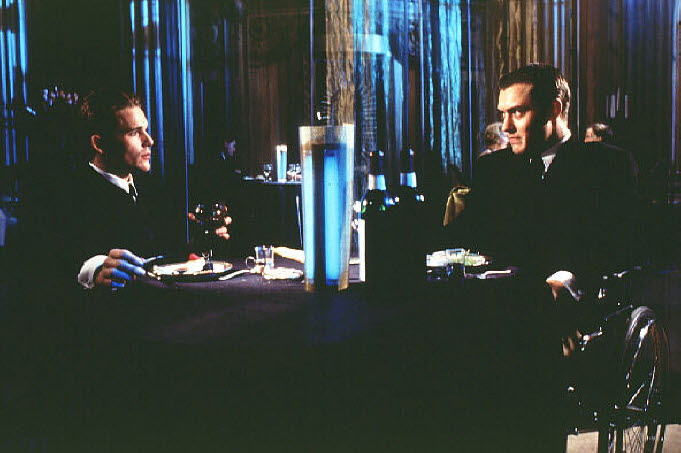
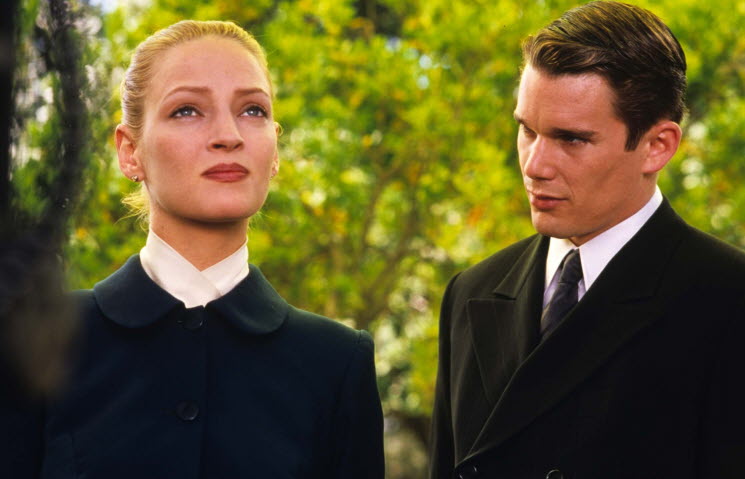
Several years after he left his family and then tried to find any possible way for getting employed in a spaceflight conglomerate named Gattaca Aerospace Corporation (As some of you know, its name consists of the four letters which respectively represent those four nucleobases of DNA: guanine (G), adenine (A), thymine (T), and cytosine(C)), Vincent comes across a good chance via an illegal broker, who introduces to him to a lad named Jerome Morrow (Jude Law). While he was once a promising professional swimmer with an almost flawlessly modified genetic background, Jerome is now wheelchair-bound due to his permanent spinal injury, and he is willing to rent his superior genetic identity to Vincent as living with Vincent for a while.
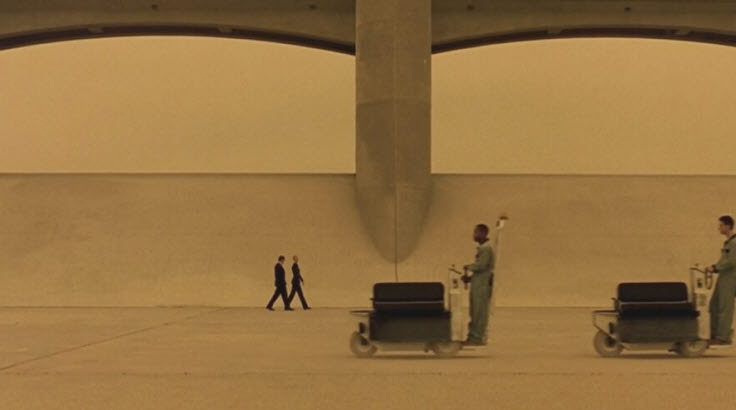
Thanks to what Jerome provides to him day by day, Vincent manages to get employed in Gattaca, and, thanks to his longtime preparations and efforts, it does not take much time for him to become one of the most promising figures in the company, though he must always be extremely careful about any possibility of getting exposed. As shown from the opening scene, he must clean and shave himself a lot early in the morning, and that is just a mere small part of his daily disguise in the company.      

And then things become very problematic for Vincent. One week before the beginning of another space mission which he may eventually join, one of the supervisors is violently murdered. Unfortunately, a tiny debris from his body is subsequently collected during the following police search, and he must be all the more careful in maintaining his genetic disguise – even when he comes to open his heart a bit to Irene Cassini (Uma Thurman), one of the fellow employees in his department who becomes quite attracted to him.

While closely following its hero’s increasingly desperate plight, the movie also takes some time in bringing more details to its distinctive futuristic world. The production design by Jan Roelf and Nancy Nye, which deservedly received an Oscar nomination, often impresses us with its slick and austere retro-futuristic style, and the resulting clinical mood surrounding the main characters is often accentuated by their similar attires and hairstyles. As watching Vincent and other Gattaca employees coming into the company one by one, my mind could not help but reminded of the lyrics from Malvina Reynolds’ 1962 song “Little Boxes”: “And they’re all made out of ticky tacky / And they all look just the same”. 

Within this dry and detached world, the movie finds some precious heart to engage us more. Around the last act, Vincent and Jerome come to stick together a lot more than expected, and Jerome’s own little drama along the story gives extra poignancy to the movie. In addition, Vincent’s passion and determination moves not only Irene but also a few others around him, and I particularly like a brief but crucial scene where Vincent receives some unexpected support from one of these figures. No matter how rigid a system is in classification and discrimination, humans always reach for any loophole and can actually succeed as driven by sheer belief and determination, and so now I wonder – is it possible that Vincent’s society has actually allowed and tolerated Vincent and many others strong-willed enough to cross the line, mainly for getting the brightest and strongest ones from their “genetically inferior” class?     

While his diligent performance steadily carries the movie to the end, Ethan Hawke, who has been one of the most interesting actors working in Hollywood for many years, is surrounded by a bunch of various performers to notice. Uma Thurman brings some little warmth to her several key scenes with Hawke, and she is especially good when her character makes an important choice later in the story without revealing anything. Alan Arkin, Ernest Borgnine, Gore Vidal, Loren Dean, Xander Berkeley, Elias Koteas, Blair Underwood, and Tony Shalhoub are well-cast in their respective supporting roles, and the special mention goes to Jude Law, who gives the best performance in the film as an arrogantly bitter man who comes to appreciate and care about the sincere aspiration of his accomplice.

On the whole, “Gattaca” is a superlative genre film whose ideas are quite relevant even at present. During last several decades, our society has had a lot of advance and development in biological science, and the world of “Gattaca” surely feels much closer to us than before. Will that brave new world eventually come to us? I have no idea for now, but I can only hope that human spirit will ultimately prevail as the movie hopes.

Posted in Movies | Tagged , , | Leave a comment

Wicked: For Good (2025) ☆☆1/2(2.5/4): A bit more serious now…

“Wicked: For Good” surely attempts to defy gravity more than its predecessor, but it does not fly that high in my humble opinion. There are several lovely musical moments fueled by the undeniable presence and talent of its two main cast members, but the movie did not engage me enough as predictably going along its yellow brick road, and that is a bit of shame.  

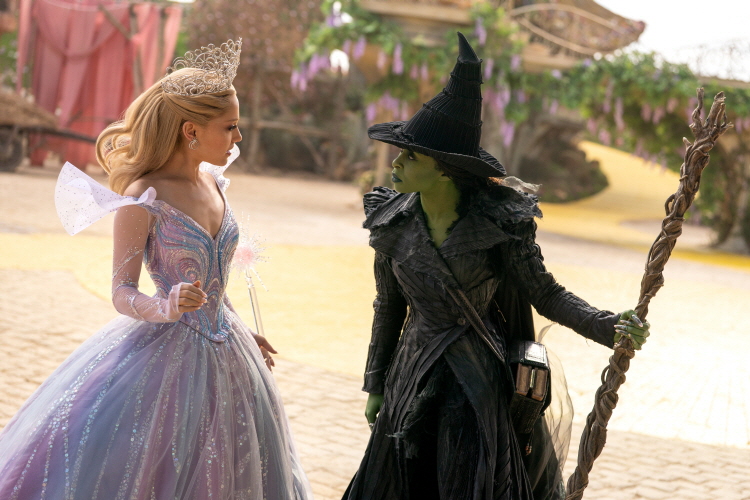
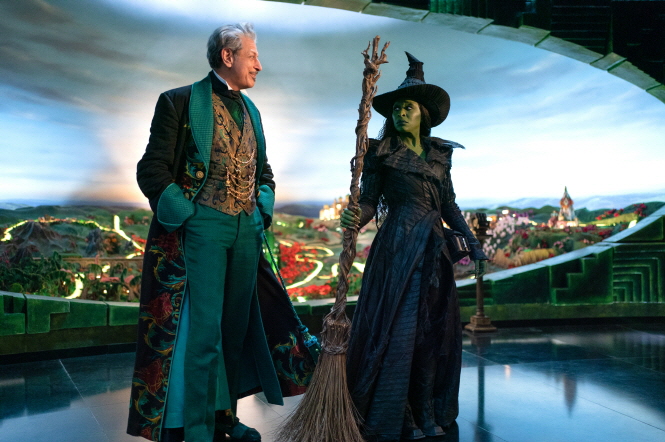
As many of you know well, the movie is the second half of the adaptation of famous Broadway musical “Wicked”, and its story begins at the point not so long after the grand finale of “Wicked” (2024). When she comes to learn that the Wonderful Wizard of Oz (Jeff Goldblum) is no more than a wily huckster, Elphaba Thropp (Cynthia Erivo), a young misfit lady born with green skin, is instantly labeled as the public enemy of Oz by him and his devious associate Madame Morrible (Michelle Yeoh). As she keeps defying against them with her magic power, she is widely known as, yes, the Wicked Witch of the West, and her false infamy only grows more and more around Oz despite her good-willed efforts.

As watching her best friend’s ongoing plight from the distance, Glinda Upland (Ariana Grande), who is now known as Glinda the Good as having the wizard and Madame Morrible behind her back, certainly feels hurt in her heart in addition to being quite conflicted about what she should do. While spreading a lot of good will and optimism around Oz as she has always wanted, she is well aware of how different her public image is from who she actually is, and that makes her all the determined to resolve the conflict between Elphaba and the wizard.

Not so surprisingly, things get messier despite the sincere attempts of these two young ladies on the opposite ends. There is a tragic subplot involved Elphaba’s disabled younger sister and a certain figure who will be one of the main characters in L. Frank Baum’s novel “The Wonderful Wizard of Oz”. There are also more intrigues involved with the wizard and Madame Morrible, and the consequences of their sneaky deeds will remind you of how our world has been negatively affected by fake news. 

Once it begins to overlap with “The Wonderful Wizard of Oz” and its 1939 movie adaptation, the story unfortunately stumbles more than once due to a lot of plot contrivance. While not showing a lot of that little girl from Kansas and her three accidental friends, the movie keeps focusing on the dynamic relationship drama between Elphaba and Glinda, but their drama is often limited by the pre-determined ending of their story, and we do not get much surprise on the whole. For instance, you will not be surprised a lot about the identity of Elphaba’s biological father if you are familiar with the law of character economy, and I must tell you that, though I did not know much about the Broadway musical version or Gregory Maguire’s 1995 novel “Wicked: The Life and Times of the Wicked Witch of the West”, I could easily guess the answer even before arriving at the end of “Wicked”.
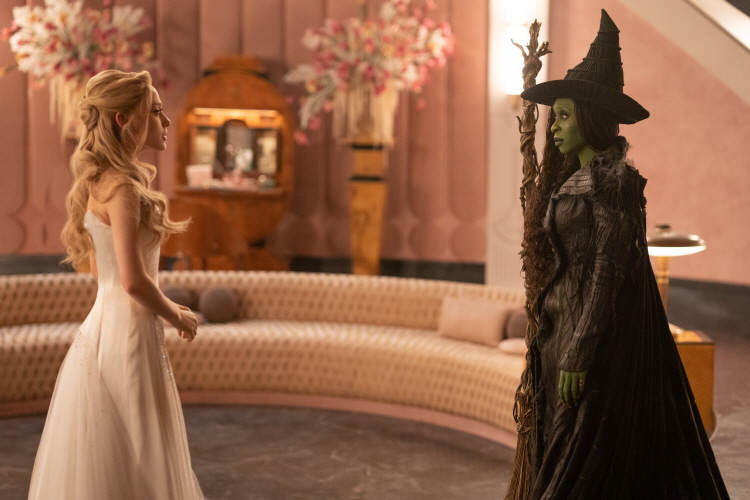
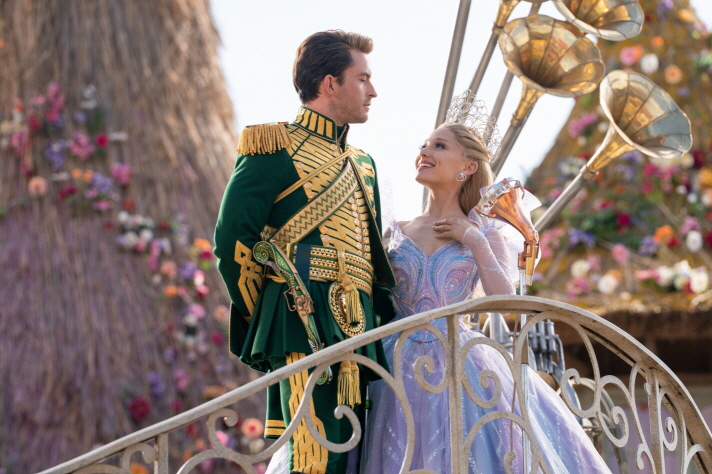
 Even though I became more dissatisfied with the movie during my viewing, I admire its top-notch technical qualities. The production design by Nathan Crowley and Lee Sandales, who previously won an Oscar together for “Wicked”, is filled with wonderfully colorful details to enjoy, and the same thing can be said about the costumes by Paul Tazewell, who also won an Oscar for “Wicked” and will definitely get Oscar-nominated along with Crowley and Sandales early in the next year.

The soundtrack of the film is fairly enjoyable, though I have to report to you that there is not anything to surpass “Defying Gravity” and some other catchy songs in “Wicked”. These less impressive songs are fortunately compensated by the effective score by Stephen Schwartz, who wrote the original songs in the Broadway musical version, and John Powell, and Powell, who had some old fun in “How to Train Your Dragon” (2025) in this year, did a splendid job of mixing old and new stuffs together in addition to ably providing extra excitement to several action scenes in the film.  

Schwartz also provides the two new songs for the movie, and they are skillfully performed by Cynthia Erivo and Ariana Grande, respectively. Although “No Place Like Home” is rather forgettable, Erivo handles this song with enough sensitivity, and then she has her own grand moment with “No Good Deed”. In case of “The Girl in the Bubble”. Grande brings some genuine poignancy, and she and Erivo always click well together even when they are not supported enough by the weakening narrative of their movie.

Compared to Grande and Erivo, the rest of the main cast members are mostly under-utilized. While Jeff Goldblum has a little nice musical moment in the middle of the film, Michelle Yeoh and Jonathan Bailey do not have much to do this time, and Colman Domingo is totally wasted as being simply demanded to provide a brief voice performance during only one scene.    

In conclusion, “Wicked: For Good” is one or two steps from the expectation built by its predecessor, but its target audiences will not probably mind this at all, while gladly appreciating the efforts of director Jon M. Chu, who also directed “Wicked”, and his cast and crew. I was not bored at least, but I was also not excited or energized after the movie was finally over, and that is all I can say for now.

Posted in Movies | Tagged , | Leave a comment